
What JEE Adds to Rotational Motion
Sections 1 to 12 built this chapter properly, and that build is genuinely complete for the Board syllabus. But JEE — Main, and far more so Advanced — asks a family of questions that the core never quite sets up. A ball is thrown down a lane with backspin; a bullet buries itself in a hanging rod; a block on a tilting plank has to choose between sliding and going over. None of these is harder physics. Each is the same physics asked from a slightly different place.
This section builds that machinery from scratch.
The nine things this section teaches
| # | Skill | Why it earns marks |
|---|---|---|
| 1 | about an arbitrary point | The examiner picks the point. Choose it well and the problem collapses |
| 2 | The spin plus orbital split | Turns any moving, spinning body into two easy pieces |
| 3 | Combined translation and rotation | The velocity of any point, not just the centre |
| 4 | The instantaneous axis of rotation | One point where the body is momentarily at rest, and the whole motion is a pure spin about it |
| 5 | Rolling with slipping and the moment it stops | Two linear graphs that meet; the crossing is the answer |
| 6 | A ball struck above its centre | One height makes the slipping phase vanish entirely |
| 7 | Particle-hits-rod collisions, hinged and free | The single most reliable Advanced set-up in the chapter |
| 8 | Toppling versus sliding | Two thresholds; the smaller one wins |
| 9 | by integration for cones, triangles and composites | Standard-table shapes are Section 8's job; these are not on it |
Running underneath all nine is one habit that separates candidates: decide which point you are taking moments about, write it down, and never move it. More marks are lost in this chapter to a silently shifted origin than to any algebra.
Conventions, fixed now
Every problem states its . Where the numbers come out clean with 10 m/s^2 this section uses 10; where the result is exact it stays symbolic. The two are never mixed inside one problem.
Notation. or for the position of the centre of mass. is the total mass, the velocity of the centre of mass, the moment of inertia, the radius of gyration, the angular momentum of a whole system and that of a single particle.
Shape factor. Throughout, is the number that identifies a rolling body: for a ring, for a spherical shell, for a disc or solid cylinder, for a solid sphere.
Key Point: Everything in this section follows from three statements you already have. for a particle. for a system. And for any point of a rigid body. There is no new law here — only new places to stand while you apply the old ones.
[Exam Tip] Before writing a single equation, ask three questions. About which point am I taking moments? Is there an external torque about that point? Is anything slipping? Answer those three and most of these problems are already half solved. Skip them and you will write four correct lines about the wrong origin.
Angular Momentum About Any Point You Like
Section 6 defined and Section 10 used for a fixed axis. Both are true. Neither tells you what to do when the examiner names a point that is nowhere near the axis, or when the body is translating and spinning at the same time.
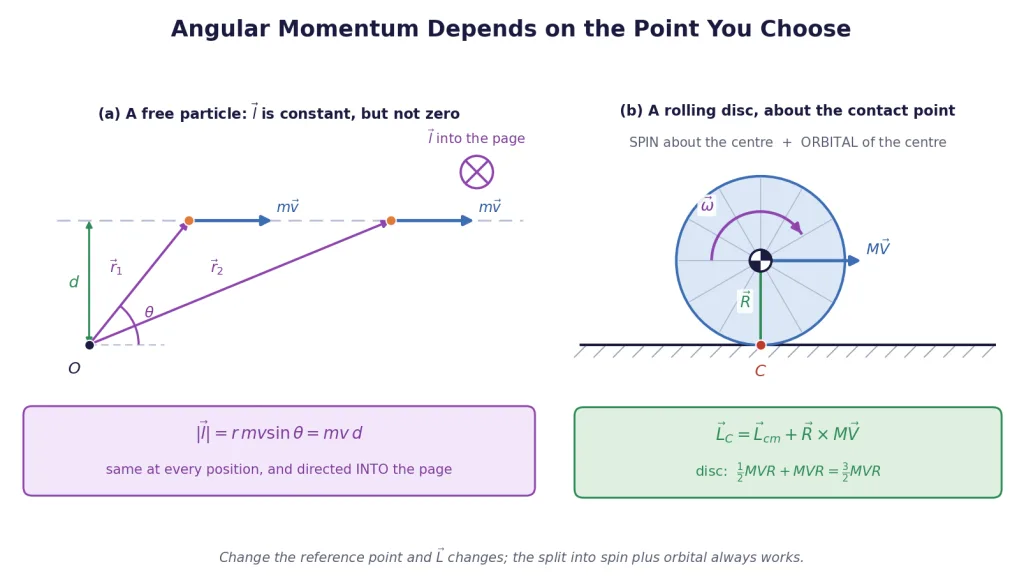
First, the thing most students get wrong
A single particle moving in a straight line at constant velocity has angular momentum about almost every point, and that angular momentum is constant.
where is the perpendicular distance from the chosen point to the line of motion. As the particle slides along, grows and shrinks in exactly the compensating way, so the product never changes. That is not a coincidence: the net force is zero, so the torque about every point is zero, so must be constant.
Key Point: Angular momentum is not a property of a body. It is a property of a body and a chosen point. Change the point and the number changes. The only point about which a straight-line particle has zero angular momentum is a point on its line of motion.
The decomposition, derived
Take a system of particles. Write each position and velocity relative to the centre of mass:
Then the angular momentum about the origin is
Expand into four sums. Two of them die instantly, because by the very definition of the centre of mass
What survives is one of the most useful equations in mechanics:
Read it as a sentence: the angular momentum of a body about any point is the angular momentum its centre of mass would have if the whole mass were concentrated there, plus the angular momentum of the body about its own centre of mass. The Earth going round the Sun has both: an orbital piece from the yearly journey, a spin piece from the daily rotation.
Two facts that follow at once
- is the same about every point. It is the spin, and the spin does not care where you stand. For a rigid body rotating with about an axis of symmetry, .
- The orbital piece is what changes when you move the reference point, and it is only , a single cross product of two vectors you already know.
Worked once, on a rolling disc
A disc of mass 4 kg and radius 0.25 m rolls without slipping at 3 m/s to the right. Then rad/s, clockwise, so both the spin and the orbital parts point into the page.
| Point taken as origin | Orbital | Spin | Total, in kg m/s |
|---|---|---|---|
| the contact point | in | in | into the page |
| the centre | in | into the page | |
| the topmost point | out | in | out of the page |
Three points on the same disc at the same instant; three different answers, one of them pointing the other way. Check the first line against the instantaneous-axis picture: . The two routes agree, as they must.
[Advanced] The topmost row is the one worth staring at. The orbital term is bigger than the spin term and points the opposite way, so the total flips sign. If a question asks for angular momentum "about the highest point of a rolling wheel" and you answer with , you have answered a different question.
When is parallel to ?
Only when the rotation axis is an axis of symmetry, or more generally a principal axis, of the body. A spinning top precessing about the vertical has and pointing in genuinely different directions, which is exactly why it precesses. For every problem in this section the axis is a symmetry axis, so holds — but know that the restriction exists.
Combined Translation and Rotation, and the Instantaneous Axis
A rigid body moving in a plane is doing two things at once, and there are two equally correct ways to describe it. Learning to switch between them on demand is worth several marks a paper.
Picture 1: every point, from one formula
Translate the whole body with the centre of mass, then spin it about the centre of mass. That is all. The vector runs from the centre of mass to the point , and is perpendicular to it with magnitude .
For a body moving to the right with into the page and a distance above the centre, this gives ; a distance below the centre gives . Nothing more complicated is happening.
Picture 2: the instantaneous axis of rotation
Look for the point where those two contributions cancel exactly. Setting gives a point at perpendicular distance from the centre, on the side where the spin runs against the translation. At that instant the whole body is turning as if pinned there, with the same . That point is the instantaneous axis of rotation (IAR).
This is not a trick, it is a theorem: any planar rigid motion with is, at each instant, a pure rotation about some line.
| Situation | Where the IAR sits | Speed of the contact point |
|---|---|---|
| rolling without slipping, | exactly at the contact point, | zero |
| slipping forward, | below the ground, | forward |
| spinning too fast, | inside the body, | backward |
| pure translation, | infinitely far away | equal to |
| spinning on the spot, | at the centre |
Key Point: The kinetic energy of a body in planar motion is using the moment of inertia about the instantaneous axis. This is always true, slipping or not, and it is often the fastest route to an energy equation. What is not generally true is about a moving instantaneous axis — for torque equations, stick to the centre of mass or to a genuinely fixed point.
The ladder, and why it is the same problem
A rod of length slides with its lower end on the floor and its upper end against a wall. can only move horizontally, only vertically. Draw a perpendicular to each velocity: the two perpendiculars meet at the fourth corner of the rectangle, and that corner is the instantaneous axis. Instantly you get so if the rod makes an angle with the floor, and , and therefore . No differentiation of a constraint equation, no algebra. One rectangle.
[Exam Tip] The recipe for locating an IAR from a diagram: draw a perpendicular to the velocity at each of two points; where they cross is the axis. If the two perpendiculars are parallel, the body is translating and there is no finite axis. This handles rolling cylinders, sliding ladders, gear trains and linkages with the same three pencil strokes.
A worked reading
A disc of radius 0.4 m has m/s to the right while spinning clockwise at only 10 rad/s. Since m/s is less than 6 m/s, the disc is skidding forward.
- Contact point: m/s forward. It is sliding, so kinetic friction acts.
- Topmost point: m/s forward.
- The IAR sits m below the centre, that is 0.2 m below the ground — a perfectly respectable place for a geometrical point to be.
- The point at the front of the disc, level with the centre, has forward and downward: speed m/s, directed below the horizontal.
Rolling With Slipping, and the Height That Skips It
Section 11 handled rolling without slipping, where the contact point is at rest and friction is static. Now let the contact point actually slide. This is the single most productive set-up in the whole chapter for JEE.
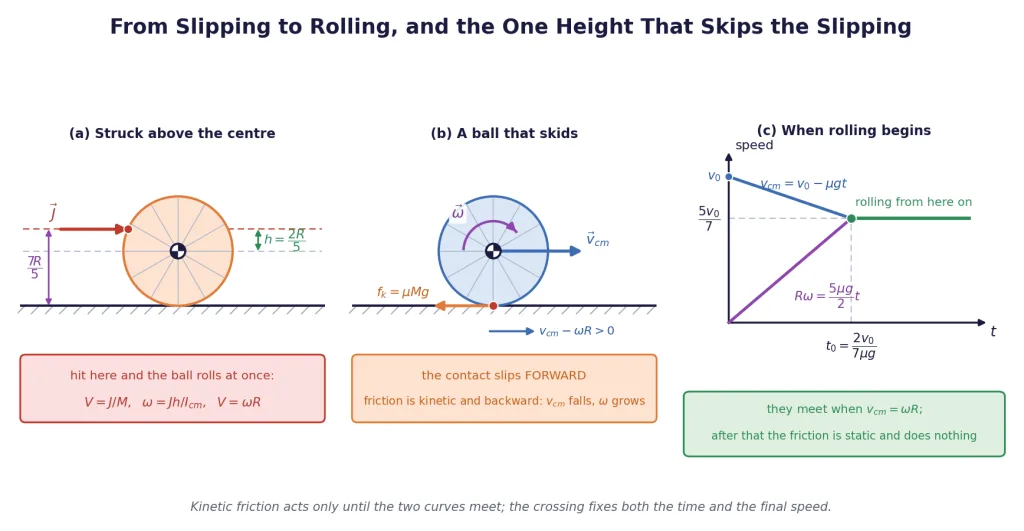
The set-up
A body of mass , radius , shape factor , is put on a horizontal surface with some starting and some starting that do not satisfy . The contact point slides, so kinetic friction acts, opposing the sliding of the contact point.
Two archetypes cover almost every question:
- The bowling ball. Thrown forward with and no spin. The contact slides forward, friction acts backward: it slows the centre and simultaneously torques the ball up to speed. falls, rises.
- The backspin ball. Spun up to and set down with no forward speed. The contact slides backward, friction acts forward: it accelerates the centre and slows the spin. rises, falls.
Either way the two quantities march towards each other, and the instant they are equal, sliding stops. Static friction takes over, no further force is needed on level ground, and the body rolls forever after.
The two equations, and their meeting point
Take the bowling ball. With friction backward,
Setting gives the moment rolling begins:
There is a shortcut that handles both archetypes at once and never needs the time at all. Angular momentum about a fixed line drawn along the ground under the contact is conserved throughout the sliding phase — friction acts along that line, and gravity and the normal force have no moment about it. Therefore
Feed the archetypes in and out drop the famous results:
| Start | Solid sphere, | General |
|---|---|---|
| , no spin | , after | |
| spin , no | , after |
Key Point: Notice what does not depend on: and do not appear. Roughen the floor and the ball reaches rolling sooner and over a shorter distance, but at exactly the same final speed. controls when, never what.
The energy that disappears
The contact really slides, so real heat is generated:
For a solid sphere thrown with and no spin, the loss works out to exactly of the initial kinetic energy — about 29%. For the same sphere spun up and set down, the loss is , over 70%. Both are worth remembering as a sanity check.
[Exam Tip] Never write during a rolling phase and never write during a slipping phase. Slipping means kinetic friction at its full value; rolling means static friction at whatever value the constraint demands. Deciding which regime you are in is the first line of the solution, not an afterthought.
The height that makes slipping vanish
Now strike the ball horizontally with a sharp impulse at a height above the centre — a cue striking a billiard ball. The impulse gives
Demand that the ball rolls immediately, with no sliding phase at all, so :
For a solid sphere , so
Both numbers describe the same point; read the question to see which one it wants. This height is the reason a good cue action strikes the ball a little above its middle.
| Body | above the centre | Height above the surface |
|---|---|---|
| Ring or hoop | (the very top) | |
| Spherical shell | ||
| Disc or solid cylinder | ||
| Solid sphere |
[Advanced] Strike below that height and the ball slips forward at first, so friction acts backward and it ends up slower than the cue gave it. Strike above it and the ball over-spins, friction acts forward, and the ball ends up faster than the impulse alone would suggest. Struck right at the top, , a solid sphere finally rolls at of its initial centre speed. In general, striking at height leaves a final rolling speed
A Particle Hits a Rod: The Asymmetry That Decides Everything
This is the most reliable Advanced set-up in the chapter, and the whole thing turns on one question: is the rod held by anything?
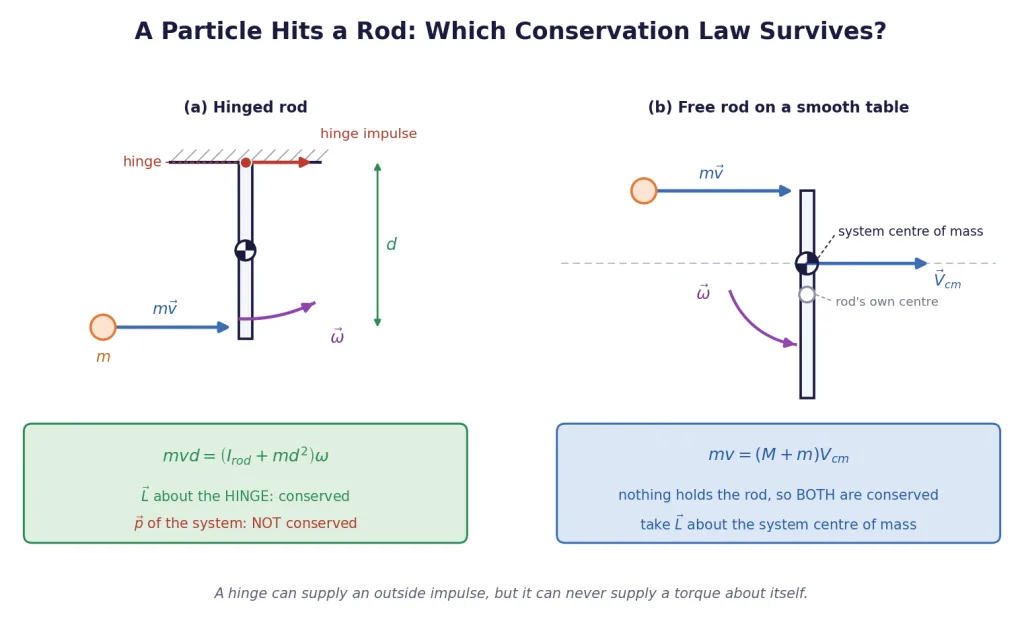
Case A: the rod is hinged
A rod is pivoted at a fixed hinge. A particle of mass moving at strikes it a perpendicular distance from the hinge and sticks.
During the collision the hinge is not a passive bystander. It exerts a large impulsive reaction on the rod, and that reaction is an external force on the particle-plus-rod system. So:
Key Point: In a hinged collision, linear momentum is NOT conserved, because the hinge delivers an outside impulse. Angular momentum about the hinge IS conserved, because that impulsive hinge force acts at the hinge and therefore has zero moment arm about it. Take moments about the hinge, and only about the hinge.
Make that asymmetry the teaching point of the whole topic. Students lose this mark not by mis-computing , but by writing out of habit from Chapter 5.
The size of the cheat. Take a rod of mass 3 kg and length 1 m hinged at its upper end, struck at the lower end by a 1 kg particle at 6 m/s which sticks.
Momentum before: kg m/s. After, the rod's centre moves at m/s and the particle at m/s, so the total is kg m/s. The system ended up with more momentum than it started with, and the extra 1.5 N s came from the hinge. That is not a paradox; it is the hinge doing its job.
The centre of percussion: where the hinge feels nothing
There is one striking point at which the hinge delivers no impulse at all. For a uniform rod hinged at one end, an impulsive blow at sets the rod turning with exactly the centre-of-mass velocity that the blow alone would produce, so the hinge has nothing to correct. That is the centre of percussion — the "sweet spot" of a bat or racquet, and the reason a mistimed shot stings your hands.
Case B: the rod is free
Now put the rod on a frictionless table with nothing holding it. No external horizontal force acts at all, so both conservation laws hold:
The trap here is a different one. After the particle sticks, the centre of mass of the combined system is not the rod's midpoint — it has moved toward the struck end. Angular momentum must be taken about that point, and the moment of inertia must be computed about that point.
The standard sequence:
- Locate the new system centre of mass.
- from linear momentum.
- about the new centre of mass, using the parallel-axis theorem for both pieces.
- , where is the perpendicular distance from the new centre of mass to the particle's line of motion.
- Any point's velocity afterwards: .
Do this for a 2 kg, 1 m rod struck at one end by 0.5 kg of putty at 4 m/s and you get m/s and rad/s — and the far end of the rod moves at 1.0 m/s backward, opposite to the incoming putty. Half the kinetic energy is lost, as it must be when things stick.
Case C: the ballistic pendulum, rotational form
Chapter 5 had a bullet embedding in a hanging block. Replace the block with a hanging rod and the whole problem becomes rotational. It is always three phases, and mixing them up is the classic error:
| Phase | What holds | What does NOT hold |
|---|---|---|
| 1. The collision (instantaneous) | angular momentum about the hinge | kinetic energy; gravity is irrelevant here |
| 2. The swing up | mechanical energy | angular momentum; gravity now exerts a torque |
| 3. At the top | , all energy is potential | — |
Between phase 1 and phase 2 you hand over exactly one number: the angular speed immediately after impact.
[Exam Tip] Never apply energy conservation through the collision, and never apply angular momentum conservation through the swing. Almost every wrong answer in this topic comes from using one law across a boundary where it does not hold. Write the two phases on separate lines of your page, with a horizontal rule between them if it helps.
Toppling or Sliding, and the Rod That Falls About a Hinge
Two standard rigid-body set-ups, both of which reduce to a single line once you see what is being asked.
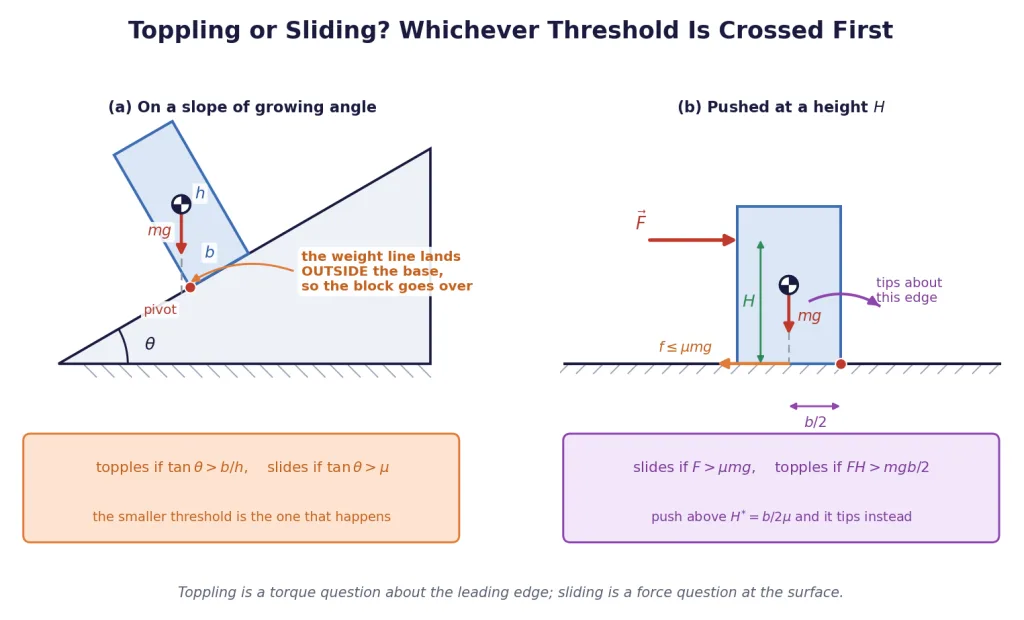
Toppling versus sliding
A block of width and height sits on a surface with coefficient of friction . There are two completely different ways for it to stop being at rest, and they have two completely different criteria.
Sliding is a force question at the surface: it starts when the driving force exceeds .
Toppling is a torque question about the leading bottom edge: it starts when the weight's line of action leaves the base, so that the weight no longer provides a restoring moment about that edge.
| Set-up | Slides when | Topples when |
|---|---|---|
| On a slope of angle | ||
| Pushed horizontally at height |
Key Point: Compute both thresholds and take the smaller one. That is the whole method. A tall narrow block ( small) topples first; a squat block on a slippery floor slides first. Nothing else needs deciding.
For the horizontal push there is a tidy consequence. Sliding needs ; toppling needs . Set them equal and you find the critical height Push above and the block goes over; push below it and the block slides. Push a wardrobe near the floor, not near the top — this is why.
[Advanced] Two refinements the examiner enjoys. First, once the block is on the verge of toppling the normal force has migrated all the way to the leading edge, which is why you take moments about that edge and not about the centre. Second, a block on a slope that is about to topple and about to slide at the same angle satisfies exactly — a neat one-line answer to "for what do the two happen together?"
The rod falling about a hinged end
A uniform rod of length and mass is hinged at one end and released from the horizontal. Find its angular speed as it swings through the vertical.
The hinge force acts at a point that never moves, so it does no work. Energy conservation is legitimate. The centre of mass falls a height :
and therefore the free end arrives at
Why the free end beats a falling stone
Here is the fact that makes this a favourite. A particle dropped through a height arrives at . The rod's end has fallen the same but arrives at , which is times faster. Where did the extra speed come from?
Not from anywhere illegal. The rod is not a collection of independent falling particles — it is rigid, and its internal forces redistribute the energy. The centre of mass falls and ends up moving at , which is slower than a free particle dropped through would be. The inner half of the rod is being held back; the outer half is being dragged forward faster than gravity alone could manage. The books balance exactly: total energy in equals total energy out.
Key Point: Along the rod there is one point, at a distance from the hinge, whose downward acceleration at the moment of release is exactly . Everything closer to the hinge accelerates more slowly than free fall; everything beyond it accelerates faster. Put a coin on a hinged plank beyond the two-thirds mark, release the plank from horizontal, and the plank arrives first and the coin is left behind in mid-air.
The rest of the falling-rod data
At the moment of release, with the rod horizontal:
Since the centre of mass accelerates downward at only , the hinge must be pushing up with
For a 2 kg rod with m/s^2 that is a 5 N upward reaction. Note what this is not: it is not , and it is not zero.
[Exam Tip] In any hinged-rod problem, use energy to get at a chosen position and to get at that position. They answer different questions and neither substitutes for the other. Then, if the hinge reaction is asked for, apply to the whole rod with having both a tangential part and a centripetal part .
Moment of Inertia by Integration, for the Shapes Not on the Table
Section 8 built the standard table and both axis theorems. Those cover rings, discs, rods, cylinders, spheres and shells. The Advanced paper routinely asks for a shape that is on nobody's table, and expects you to integrate.
The method, in four lines
- Choose an element whose every point is at the same distance from the axis. Get this right and the integral is easy; get it wrong and it is impossible.
- Express through the density: for a wire, for a lamina, for a solid.
- Write in terms of the integration variable.
- Integrate over the whole body.
The one genuine skill is step 1. For an axis of revolution, use a thin ring or a thin disc. For a lamina rotating about an in-plane axis, use a strip parallel to that axis.
The solid cone about its own axis
Take a cone of mass , base radius , height , standing on its base, with the axis vertical. Slice it into horizontal discs. At a height above the base the radius has shrunk linearly to
A disc of thickness has mass and contributes , so
The total mass is , and dividing kills every constant except one:
Sanity check: sits below the disc's , exactly as it should, because the cone's mass is pulled inward toward the axis as you climb it.
The triangular lamina about its base
A uniform triangular plate of mass , base and height , rotating about an axis along its base. Use a strip parallel to the base at height . Its width shrinks linearly:
Every point of the strip is at the same distance from the axis, so
Note that has vanished — widen the triangle and both and the integral scale together. The answer depends only on the height, measured perpendicular to the axis.
The square plate about a diagonal, without any integration at all
A square plate of side and mass . About an axis in its plane through the centre, parallel to a side, . About the perpendicular axis through the centre, the perpendicular-axis theorem gives .
Now rotate your two in-plane axes to lie along the diagonals. By symmetry the two diagonals give the same answer , and the perpendicular-axis theorem still gives . So as well.
Key Point: For a square plate — indeed for any lamina with three-fold or higher symmetry — every in-plane axis through the centre has the same moment of inertia. A diagonal is no different from a side-parallel axis. That single sentence answers a whole family of questions with no work at all.
Composites: add and subtract
For a body assembled from standard pieces, moments of inertia about a common axis simply add. For a body with a hole, treat the hole as negative mass: computing each about the same axis, using the parallel-axis theorem to move each piece there.
A reference table for the harder shapes
| Body | Axis | |
|---|---|---|
| Solid cone, base radius | its own axis | |
| Triangular lamina, height | along the base | |
| Square lamina, side | ANY in-plane axis through the centre | |
| Rectangular lamina, sides and | perpendicular, through the centre | |
| Solid cylinder, length , radius | perpendicular, through the centre | |
| Annulus, radii and | central, perpendicular | |
| Solid sphere | tangent to the surface | |
| Disc | tangent, in its own plane |
[Exam Tip] Before integrating anything, ask whether the shape is really new. A great many "hard" moment-of-inertia questions are a standard shape plus the parallel-axis theorem, or a standard shape minus a hole, or a lamina plus the perpendicular-axis theorem. Integration is the fallback, not the first move.
Solved Examples
Twelve problems at Advanced level. Try each one on paper before reading the solution — the value of this section is in the set-up, not the arithmetic.
Example 1: The same particle, three different origins
A particle of mass 2 kg moves with a constant velocity of 5 m/s in the direction along the line m. Find the magnitude and direction of its angular momentum about (a) the origin , (b) the point , (c) the point . (d) Show that each answer is the same at every instant, and say why.
Solution:
Use the perpendicular-distance form. For a particle moving along a straight line, where is the perpendicular distance from the chosen point to the line of motion, not to the particle.
(a) About . The line is m and is on , so m: Direction: with pointing up and to the right and pointing right, is into the page ().
(b) About . The point lies on the line of motion, so and
(c) About . Now m:
(d) Why nothing changes with time. Check it directly at two positions. At m, and , so . At m, again. The reason is one line: the net force is zero, so the torque about every fixed point is zero, so everywhere.
Final Answer: (a) 30 kg m/s into the page; (b) zero; (c) 50 kg m/s into the page; (d) constant, because zero force means zero torque about every point.
Takeaway: A body moving in a straight line still has angular momentum, and how much depends entirely on where you stand. The only point that gives zero is one on the line of motion. Every question that begins "a particle moves in a straight line, find its angular momentum about…" is this problem.
Example 2: A rolling disc, seen from three places
A uniform disc of mass 4 kg and radius 0.25 m rolls without slipping on level ground at 3 m/s to the right. Find its angular momentum about (a) its own centre, (b) the point of contact, (c) the topmost point of the disc.
Solution:
Set up. Rolling gives rad/s, clockwise, so the spin vector points into the page.
(a) About the centre. The orbital term is zero because the position vector of the centre relative to itself is zero.
(b) About the contact point. The centre is a distance above the contact and is moving to the right, so also points into the page: Cross-check with the instantaneous axis: and . The two routes agree.
(c) About the topmost point. Now the centre lies a distance below the reference point, so the orbital cross product reverses:
Final Answer: (a) 1.5 into the page; (b) 4.5 into the page; (c) 1.5 out of the page, all in kg m/s.
Takeaway: Same disc, same instant, three answers — and one of them points the opposite way. Write down your reference point before you write anything else. The orbital term is the only piece that changes, and it is a single cross product.
Example 3: A disc that is skidding, not rolling
A disc of radius 0.4 m moves with m/s to the right while spinning clockwise at rad/s. Find (a) whether it is rolling, (b) the velocity of the contact point and of the topmost point, (c) the position of the instantaneous axis of rotation, (d) the speed of the point on the front rim, level with the centre.
Solution:
(a) Test the rolling condition. They are not equal, so the disc is not rolling. Since , it is skidding forward, like a car braking hard, and kinetic friction acts backward.
(b) Any point, from one formula. With into the page and a point a height above the centre, .
- Contact point (): m/s forward. It really is sliding.
- Topmost point (): m/s forward.
(c) The instantaneous axis. It is the point where the two contributions cancel: The centre is only 0.4 m above the ground, so the instantaneous axis lies 0.2 m below ground level. That is perfectly legal — it is a geometric point, not a physical pivot.
(d) The front rim point. Here points horizontally forward, so points straight down with magnitude m/s, while the translation contributes 6 m/s forward: directed at below the horizontal.
Final Answer: (a) skidding forward; (b) contact 2 m/s forward, top 10 m/s forward; (c) 0.6 m below the centre, i.e. 0.2 m below the ground; (d) 7.21 m/s, below the horizontal.
Takeaway: Always test before assuming anything. If it fails, the contact point is moving, friction is kinetic, and the instantaneous axis is somewhere other than the contact point — possibly underground.
Solved Examples (continued)
Example 4: The bowling ball that has to catch up with itself
A solid sphere is thrown along a horizontal floor with m/s and no spin at all. The coefficient of kinetic friction is 0.2. Take m/s^2. Find (a) the time at which pure rolling begins, (b) the speed then, (c) the distance the centre travels in that time, (d) how far the contact point actually slides, and (e) the fraction of the kinetic energy lost.
Solution:
(a) Two linear graphs, one crossing. Kinetic friction acts backward at the contact: Rolling starts when :
(b) The speed then. Note that cancelled out of this: a rougher floor would give a shorter time and a shorter distance, but the same 5 m/s.
(c) Distance of the centre.
(d) How far the contact slid. The rim laid down only m of arc while the centre advanced 6.0 m, so
(e) Energy. Per kilogram of ball, Independent check: heat J per kg. The two agree exactly.
Final Answer: (a) 1.0 s; (b) 5.0 m/s; (c) 6.0 m; (d) 3.5 m of slip; (e) , about 28.6%, lost.
Takeaway: A solid sphere thrown without spin always settles at and always loses of its energy, whatever the floor is made of. Friction decides how long it takes, never the final speed.
Example 5: A ball that is only spinning
A solid sphere of radius 0.2 m is spun up to 35 rad/s about a horizontal axis and then gently placed on a floor with , with no forward velocity. Take m/s^2. Find the time to reach pure rolling, the final speed, and the fraction of the energy lost.
Solution:
Which way does friction point? The contact point of the ball is moving backward relative to the floor (the spin drags it back), so kinetic friction acts forward. It pushes the ball along and slows its spin at the same time.
The two equations.
Set .
The final motion. Check with the general result m/s.
Energy, per kilogram.
Final Answer: 0.8 s; 2.0 m/s; and , about 71.4%, of the energy lost.
Takeaway: The spun-up ball converts spin into translation and throws away five sevenths of its energy doing it — far worse than the bowling ball's two sevenths. That is why a ball dropped with backspin scuffs, smokes and barely moves.
Example 6: Where to strike a cue ball
A cue ball is a solid sphere of mass 0.17 kg and radius 3.0 cm. A cue delivers a horizontal impulse of 0.34 N s. Find (a) the speed of the centre immediately afterwards, (b) the height above the centre at which the cue must strike for the ball to roll immediately, and that height measured from the table, (c) the final rolling speed if the ball is instead struck exactly at its centre, and (d) the final rolling speed if it is struck at the very top.
Solution:
(a) The impulse-momentum theorem. This is the same whatever the height, because the impulse is the same.
(b) Immediate rolling. The angular impulse about the centre is , so Demanding : Measured from the cloth, that is
(c) Struck at the centre, . No spin is given, so this is exactly the bowling-ball case:
(d) Struck at the top, . Now the ball is over-spun; the contact slides backward, friction acts forward, and the ball speeds up. Using the general result, which is , a 43% gain over the speed the cue actually delivered.
Final Answer: (a) 2.0 m/s; (b) 1.2 cm above the centre, 4.2 cm above the table; (c) 1.43 m/s; (d) 2.86 m/s.
Takeaway: is the height at which the impulse hands the body exactly the spin the rolling condition wants. Below it the body loses speed to friction; above it the body gains speed from friction. For a solid sphere the magic height is above the surface.
Solved Examples (continued)
Example 7: The hinge that quietly adds momentum
A uniform rod of mass 3 kg and length 1 m hangs vertically from a frictionless hinge at its upper end. A 1 kg lump of putty moving horizontally at 6 m/s strikes the lower end and sticks. Find (a) the angular speed immediately after impact, (b) the linear momentum of the system before and after, (c) the impulse delivered by the hinge, (d) the kinetic energy lost, and (e) the maximum angle through which the rod swings. Take m/s^2.
Solution:
(a) Angular momentum about the hinge. The hinge's impulsive reaction acts at the hinge, so it has no moment about it. Gravity is finite and acts for a negligible time. So about the hinge is conserved:
(b) Linear momentum, before and after. After impact the rod's centre moves at m/s and the putty at m/s:
(c) The hinge impulse. The change in the system's momentum can only have come from outside: This is the whole point of the problem: linear momentum was not conserved, and by a full 25%.
(d) Energy. Exactly half is lost, as heat and deformation in the sticking.
(e) The swing. Now switch laws: after the collision, energy is conserved. For a rise of angle from the vertical, the rod's centre rises and the putty rises :
Final Answer: (a) 3.0 rad/s; (b) 6.0 before, 7.5 after; (c) 1.5 N s from the hinge; (d) 9 J lost; (e) .
Takeaway: Angular momentum about the hinge: conserved. Linear momentum: not. The hinge is an external agent, and the 1.5 N s it supplied is measurable. Then hand exactly one number — — from the collision phase to the energy phase, and never mix the two.
Example 8: A bullet, a hanging rod and a swing
A uniform rod of mass 1 kg and length 1 m hangs from a hinge at its top. A 50 g bullet travelling horizontally at 40 m/s embeds itself in the lower end. Take m/s^2. Find (a) the angular speed just after impact, (b) the percentage of the bullet's kinetic energy lost in the collision, and (c) the angle through which the rod swings.
Solution:
(a) Phase 1, the collision. Angular momentum about the hinge:
(b) Energy lost in the collision. A bullet burying itself in wood is about as inelastic as collisions get.
(c) Phase 2, the swing. Energy is conserved from here on. Rising through angle from the vertical: The rod stops just short of the horizontal.
Final Answer: (a) 5.22 rad/s; (b) 87.0% of the bullet's energy lost; (c) .
Takeaway: This is the ballistic pendulum with the block replaced by a rod, and it is worked in exactly two phases. Angular momentum through the collision, energy through the swing. Note that the moment of inertia has to include the embedded bullet — dropping the term is the standard slip.
Example 9: Putty hits a rod that nothing is holding
A uniform rod of mass 2 kg and length 1 m lies at rest on a frictionless horizontal table. A 0.5 kg lump of putty slides across the table at 4 m/s, perpendicular to the rod, strikes one end and sticks. Find (a) the velocity of the centre of mass afterwards, (b) the angular speed, (c) the velocity of the far end of the rod just afterwards, and (d) the kinetic energy lost.
Solution:
Locate the new centre of mass first. Measure from the rod's midpoint toward the struck end. The rod's own centre is at 0, the putty lands at 0.5 m: The system now spins about a point 0.10 m from the rod's midpoint, not about the midpoint.
(a) Linear momentum is conserved — nothing holds the rod:
(b) Angular momentum about the new centre of mass. The perpendicular distance from that point to the putty's line of motion is m:
(c) The far end. It sits m from the centre of mass, on the opposite side from the putty: The far end moves at 1.0 m/s backward — opposite to the putty that hit the rod.
(d) Energy. Half the energy is gone.
Final Answer: (a) 0.80 m/s; (b) 3.0 rad/s; (c) 1.0 m/s backward; (d) 2.0 J lost, exactly half.
Takeaway: With no hinge, both conservation laws work — but the spin is about the system's centre of mass, which the collision has just moved. Take moments about the rod's old midpoint and you will get the wrong , and the sign error on the far end that follows from it.
Solved Examples (continued)
Example 10: Will it slide, or will it go over?
(a) A rectangular block 0.30 m wide and 0.90 m tall rests on a plank with . The plank is slowly tilted. Does the block slide first or topple first, and at what angle? (b) A 20 kg cabinet is 0.40 m deep and 1.2 m tall, standing on a floor with . A horizontal push is applied at a height . Take m/s^2. Find the force needed to slide it, the force needed to tip it when pushed at the very top, and the height at which the two become equal.
Solution:
(a) Two thresholds, computed separately.
Compare. , so as the plank is raised the toppling condition is met first: It never gets the chance to slide.
(b) Sliding force.
Toppling force at height . Take moments about the leading bottom edge. The push has moment ; the weight resists with moment : Pushed at the top, m: That is far less than the 100 N needed to slide it, so pushing at the top tips the cabinet over at 33.3 N.
The critical height. Set the two equal: which is also m. Push below 0.40 m and the cabinet slides; push above it and the cabinet goes over.
Final Answer: (a) topples first, at ; (b) 100 N to slide, 33.3 N to tip from the top, and the changeover height is 0.40 m.
Takeaway: Work out both thresholds and take the smaller. Sliding is a force condition at the surface; toppling is a torque condition about the leading edge. They are independent, and the geometry decides which one arrives first.
Example 11: The rod that outruns a falling stone
A uniform rod of mass 2 kg and length 1.2 m is hinged at one end and held horizontal, then released. Take m/s^2. Find (a) the angular acceleration at the moment of release, (b) the force the hinge exerts at that moment, (c) the angular speed when the rod is vertical, (d) the speed of the free end then, and (e) compare that speed with and explain the result.
Solution:
(a) At release, about the hinge. The weight acts at the centre, from the hinge:
(b) The hinge force. The centre of mass accelerates downward at which is less than . Newton's second law for the whole rod, taking down as positive: Not N, and not zero.
(c) At the vertical, use energy. The hinge does no work, so
(d) The free end.
(e) The comparison. A stone dropped through the same 1.2 m arrives at The rod's end is faster, by a factor . Nothing is broken: the rod is rigid, so its inner parts, which fall through less height, are forced to hand energy outward to the tip. Check the books: the centre of mass moves at m/s, and J, exactly equal to J.
Final Answer: (a) 12.5 rad/s; (b) 5.0 N upward; (c) 5.0 rad/s; (d) 6.0 m/s; (e) 22% faster than a free fall through the same height, because the rod is rigid.
Takeaway: Use for accelerations at an instant and energy for speeds after a finite swing; they are not interchangeable. And remember the free end at beats the stone at — the point two-thirds along the rod is the one that keeps pace with gravity exactly.
Example 12: Three moments of inertia the table will not give you
Find, from first principles, (a) the moment of inertia of a solid cone of mass 6 kg and base radius 0.5 m about its own axis, (b) that of a uniform triangular plate of mass 3 kg and height 0.6 m about an axis along its base, and (c) that of a square plate of mass 4 kg and side 0.3 m about one of its diagonals.
Solution:
(a) The cone: slice into discs. At height above the base the radius is . A slice of thickness is a disc of mass contributing : With , dividing gives
(b) The triangle: slice parallel to the axis. With base and height , the strip at distance from the base has width and surface density : The base length never appeared — only the height perpendicular to the axis matters.
(c) The square plate: no integration needed. About an in-plane axis through the centre parallel to a side, . The perpendicular-axis theorem then gives the central perpendicular axis: Now use the same theorem with the two diagonals as the in-plane pair. By symmetry both give the same , so and which is exactly the side-parallel value.
Final Answer: (a) 0.45 kg m; (b) 0.18 kg m; (c) 0.03 kg m.
Takeaway: Pick an element every point of which is the same distance from the axis — discs for an axis of revolution, strips parallel to an in-plane axis — and the integral becomes routine. And before integrating, always check whether symmetry plus the perpendicular-axis theorem gets you there for free, as it does for every in-plane axis of a square.