
Equilibrium Means Two Things at Once, Not One
Section 6 left you with two laws that govern a rigid body:
The first says forces change how the body moves through space. The second says torques change how it spins. A body can be perfectly happy on one count and in trouble on the other — a spanner floating in space, pushed by two equal and opposite forces at its two ends, goes nowhere but spins faster and faster.
So "in equilibrium" has to mean both momenta are steady.
Key Point — mechanical equilibrium: A rigid body is in mechanical equilibrium if its total linear momentum and its total angular momentum are both constant in time. Equivalently: Both must hold. Either one alone is not enough.
From here on "force" and "torque" always mean the external ones. Internal forces cancel in pairs — you proved that in Section 3 for forces and in Section 6 for torques — so they can never disturb equilibrium.
Equilibrium does not mean "at rest"
This trips up almost everybody the first time.
does not say the velocity is zero; it says the velocity is not changing. A parachutist drifting down at a steady 5 m/s is in translational equilibrium. A flywheel spinning at a constant 300 rpm with no net torque on it is in rotational equilibrium.
| Situation | In equilibrium? | ||
|---|---|---|---|
| book lying on a table | 0 | 0 | yes — static equilibrium |
| parachutist at terminal velocity | 0 | 0 | yes, though it is moving |
| flywheel coasting at constant | 0 | 0 | yes, though it is spinning |
| ball at the top of its flight | down | — | no, momentarily at rest but accelerating |
Key Point: Static equilibrium is the special case in which the body is in mechanical equilibrium and at rest. Every ladder, bar and bracket problem in this section is a static-equilibrium problem. "Momentarily at rest" is not equilibrium at all.
How many equations do you actually get?
Both conditions are vector equations, so each is three scalar equations:
That is six independent conditions in three dimensions.
Almost every problem you will meet has all the forces in one plane — say the -plane. Then is automatically zero, every torque points along , and the six collapse to three:
Key Point — the coplanar case (the one you will use): For forces all lying in a plane, mechanical equilibrium needs exactly three scalar conditions: Two from resolving forces along any two perpendicular directions in the plane, one from taking moments about any axis perpendicular to the plane.
[JEE Tip] Three equations means you can solve for at most three unknowns. Count your unknowns before you start: 3 unknowns is standard, 4 means you have missed a piece of information (or the problem is statically indeterminate and beyond this course).
And for a single particle?
A particle has no size, so it cannot rotate and there is nothing for a torque to do. Only condition (1) survives: for a particle in equilibrium the vector sum of the forces must vanish, and since they all act at one point they are necessarily concurrent. That is the Class 11 statics you already know. Everything new in this section comes from condition (2).
About Which Point Should You Take Moments?
Here is the question every student asks the first time, and it is the right question.
Torque is defined about a point. Section 6 showed that the same force has different torques about different points — move the origin and changes. So "" seems dangerously incomplete. Zero about what?
The answer is one of the neatest results in mechanics.
The theorem that rescues everything
Take a body acted on by forces at points measured from an origin . Now shift to a new origin displaced from by . The new position vectors are , so the total torque about is
Look at what that says. The change in total torque depends only on the net force.
Key Point — the shift theorem: If the net external force on a body is zero, the total torque is the same about every point in space. It does not matter where you put your origin.
Two consequences, and you will use both constantly.
Consequence 1 — one point is enough. Suppose you have already checked . Then if you find about any one convenient point, it is automatically zero about every point, and the body really is in equilibrium. You never have to test a second point.
Consequence 2 — choose the point that does the most work for you.
Key Point — the pivot-choosing rule: Take moments about the point through which the largest number of unknown forces pass. Those forces have zero moment arm about that point, so they vanish from the equation, and what is left often has a single unknown in it.
That single trick is the difference between a three-line ladder solution and half a page of simultaneous equations. In the ladder problem you take moments about the foot, because the normal force and the friction at the foot both act there and both disappear. In the knife-edge problem you take moments about one knife edge, because that reaction disappears and the other one falls out immediately.
The warning that comes with it
If , none of this applies. Then the torque genuinely does depend on the point, and a phrase like "the torque on the rod is 8 N m" means nothing until you say about what.
[Board Important] "Show that if the translational equilibrium condition holds, the rotational equilibrium condition is independent of the choice of origin" is a standard derivation. It is exactly the three lines above — write them out, they are worth full marks.
Partial Equilibrium, and the Couple
Because there are two conditions, there are two ways to be half in equilibrium. Both cases are physically real and both get examined.
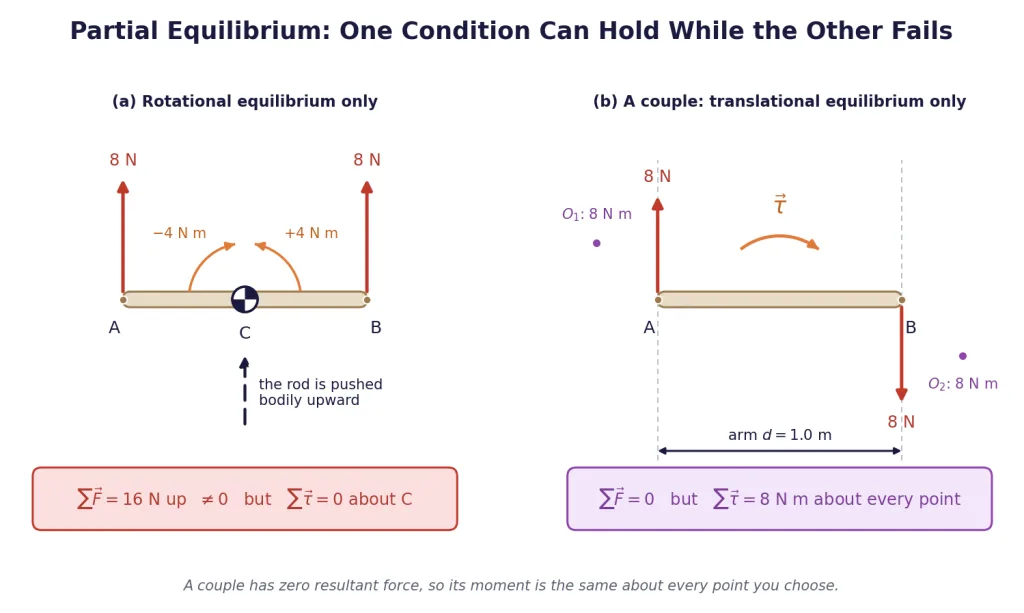
Case 1: rotational equilibrium without translational
Take a light rod of length 1.0 m and push up with 8 N at each end.
- Net force: N upward. Not zero.
- Moments about the centre : the force at gives N m, the force at gives N m, total zero.
The rod does not turn — it just gets shoved bodily upward. Rotational equilibrium, yes; translational equilibrium, no.
Notice something: about the end , the total moment is N m, not zero. That is the shift theorem biting. Because the net force is not zero here, the total torque is different about different points, and "" is only true about the particular point .
Case 2: translational equilibrium without rotational — the couple
Now reverse the force at : 8 N up at , 8 N down at .
- Net force: . Zero.
- Moment about : both forces turn the rod the same way, giving N m.
The rod does not go anywhere, but it spins up. And this time — since the net force is zero — that 8 N m is the moment about every point you care to pick: about , about , about a point in the next room.
Key Point — couple: A couple is a pair of equal and opposite forces whose lines of action are different (not collinear). A couple has zero resultant force but a non-zero moment, so it produces rotation without translation. Its moment is where is the perpendicular distance between the two lines of action, and this value is the same about every point.
Why the moment of a couple is origin-independent
Let the forces be at and at . About any origin ,
The origin has vanished. Only the vector joining the two points of application survives, and that is fixed in the body. Taking magnitudes, , with the perpendicular separation of the lines of action.
Couples you have used today
| Everyday act | The two forces | Perpendicular distance |
|---|---|---|
| unscrewing a bottle cap | fingers pushing opposite ways on the rim | across the cap |
| turning a steering wheel with both hands | equal tangential pushes at opposite ends | the wheel's diameter |
| turning a tap or a door knob | the same, on a smaller radius | the knob's diameter |
| a compass needle settling north | the Earth's field pulls the north pole north, the south pole south | the length of the needle |
| winding a clock key | thumb and finger on opposite sides | across the key |
Key Point: A couple cannot be balanced by a single force. A single force would have to be zero to keep the resultant zero, and then it could not cancel the moment. Only another couple of equal and opposite moment can balance a couple.
[NEET Important] Two forces that are equal, opposite and collinear are not a couple — they cancel completely, force and moment both. The whole point of a couple is that the lines of action are apart.
The Lever and the Principle of Moments
An ideal lever is a light rigid rod free to turn about a fixed point called the fulcrum. A see-saw is one. So is a crowbar, a pair of scissors, an oar and a wheelbarrow.
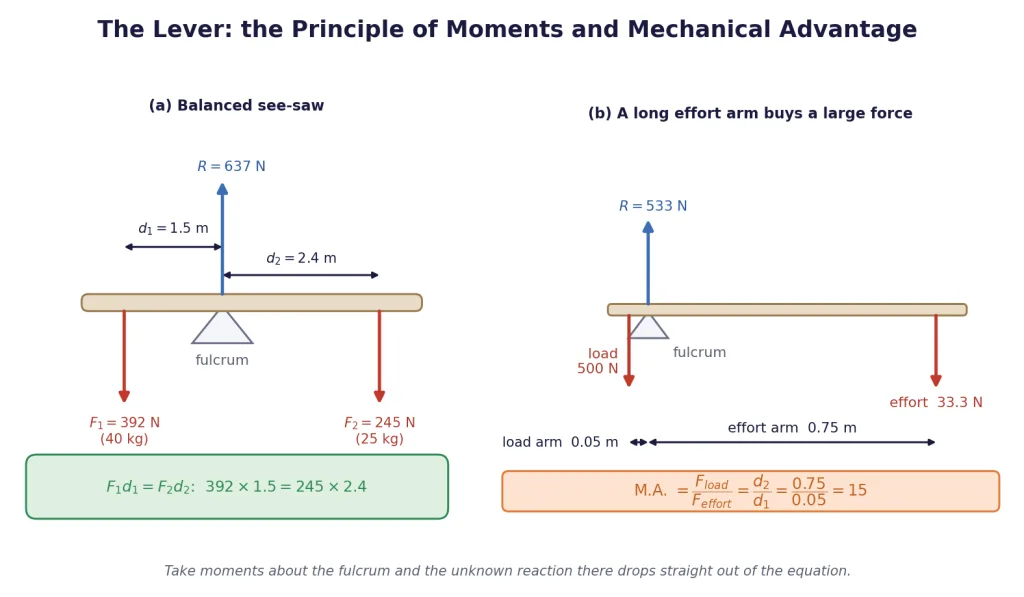
Two forces and act downward on the lever at distances and on opposite sides of the fulcrum, and the support pushes up with a reaction at the fulcrum. Apply the two conditions.
Translational equilibrium (taking up as positive):
Rotational equilibrium, taking moments about the fulcrum — where acts, so has zero moment arm and disappears:
Key Point — the principle of moments: For a lever in equilibrium, in words, load arm load = effort arm effort. Anticlockwise moments are conventionally positive and clockwise negative; the principle just says the two sets balance.
The vocabulary is worth fixing once:
- is the load — the weight you want to move. Its distance from the fulcrum is the load arm.
- is the effort — what you supply. Its distance is the effort arm.
Mechanical advantage
Key Point: The mechanical advantage of a lever is It is a pure number, with no units. A long effort arm and a short load arm give : a small effort lifts a large load.
A crowbar with its fulcrum 0.05 m from the load and your hands 0.75 m away has — a 33 N push lifts a 500 N block.
Nothing is free, of course. Your hand at the far end has to move 15 times as far as the load rises, so the work you do is the same. The lever trades distance for force; energy is not created.
The levers around you
| Lever | Fulcrum | Effort | Load | |
|---|---|---|---|---|
| see-saw | central pivot | one child | the other child | about 1 |
| crowbar | the block it rests on | your hands, far end | the weight, near end | large |
| wheelbarrow | the wheel | your hands at the handles | the load in the tray | greater than 1 |
| nutcracker | the hinge | your grip | the nut | greater than 1 |
| a pair of tongs | the closed end | your grip | the object held | less than 1 |
| your forearm | the elbow joint | biceps, very close to the elbow | the weight in your hand | much less than 1 |
The last two look like failures, but buys you something else: speed and range. Your biceps contracts a couple of centimetres and your hand sweeps half a metre. That is a good trade for an arm.
Two refinements
The forces need not be perpendicular to the lever. If a force acts at an angle, use its perpendicular distance from the fulcrum to the line of action as the arm, exactly as in Section 6:
The reaction at the fulcrum is invisible in the moment equation but not in the force equation. Students happily find the balance point and then forget that the pivot is carrying . Examiners like asking for exactly that number.
[Board Important] "State and prove the principle of moments for a lever" is a routine three-mark question: draw the lever, write , take moments about the fulcrum, get , define mechanical advantage.
Centre of Gravity, and Why It Is Not the Centre of Mass
Section 2 built the centre of mass — a point fixed by the distribution of mass alone, defined by . Gravity was never mentioned in that definition and did not need to be.
This section needs a different idea. A real body is pulled by gravity at every particle: , thousands of tiny parallel forces. When you draw a free-body diagram you replace all of them with one arrow . Where exactly should that arrow be drawn so that the replacement is honest?
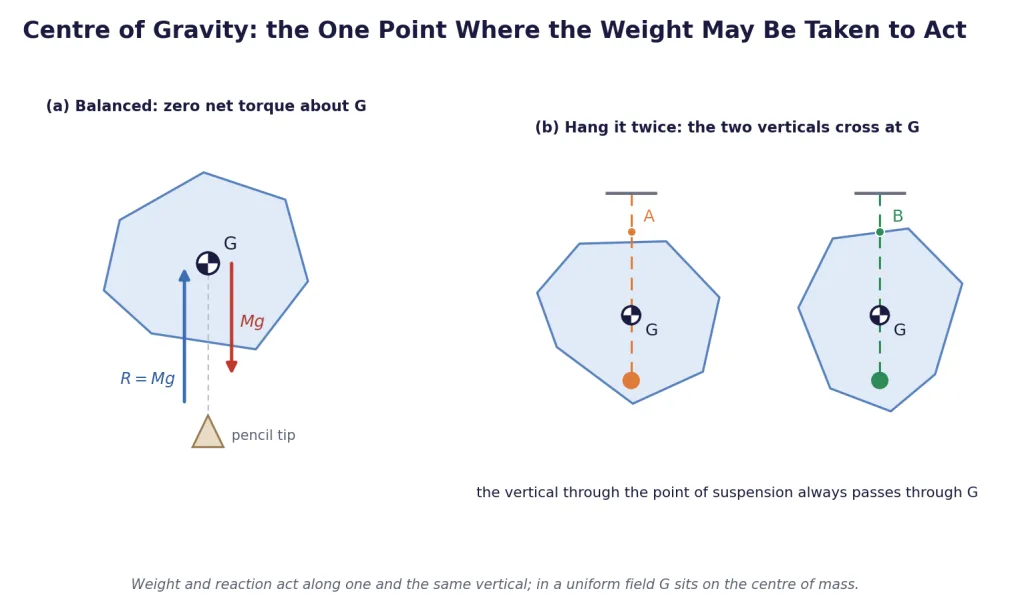
Key Point — centre of gravity: The centre of gravity (CG) of a body is the point about which the total gravitational torque on the body is zero: where every is measured from the CG. Draw the single force at the CG and the body behaves exactly as it does under the real distributed pull.
When does it coincide with the centre of mass?
Suppose the body is small enough that is the same vector at every particle in it. Then comes out of the sum:
Since and the sum must vanish for every orientation of the body, we need
and that is precisely the condition, from Section 2, that the origin of these position vectors is the centre of mass.
Key Point: In a uniform gravitational field the centre of gravity coincides with the centre of mass. In a field that varies over the body, they do not coincide. They are different concepts that happen to agree in the situation you usually meet:
- centre of mass — geometry and mass distribution only, no gravity anywhere in the definition, exists even in deep space;
- centre of gravity — where the resultant weight acts, meaningless without a gravitational field.
How far apart can they get?
For anything you can carry, the answer is: immeasurably little. falls by only about 0.003% over a person's height.
But make the body big enough and the gap is real. Stand a uniform vertical rod 1000 km tall on the Earth's surface. Its centre of mass is exactly at the midpoint, 500 km up, by symmetry. Its centre of gravity, weighted by the true inverse-square field which is weaker at the top, sits about 24 km below that. For a tall building, a mountain or an orbiting station, the distinction is a working engineering correction, not a philosophical one.
[NEET Important] The one-line answer to "when do the centre of mass and centre of gravity coincide?" is: in a uniform gravitational field (equivalently, when the body is small enough that does not vary across it). Saying "always" is wrong.
Finding the CG by experiment
Method 1 — balancing. Rest an irregular piece of cardboard on a pencil tip and slide it until it stays horizontal. At balance the tip supplies an upward through the point of support, and the gravitational torque about that point is zero. The balance point is the centre of gravity.
Method 2 — the plumb line. Hang the body freely from a point . Only two forces act: the weight at the CG and the support force at . For zero net torque these two must be collinear, so the CG must lie on the vertical line through . Mark that line. Hang the body again from a different point and mark the new vertical. The CG is where the two lines cross. A third suspension is a nice check that you did it right.
Method 2 is the practical one, because it works for a body of any shape and gives you the point even if it lies outside the material — as it does for a ring, a horseshoe or a boomerang.
[JEE Tip] In every reaction problem below, the weight arrow is drawn at the centre of gravity, which for a uniform bar or ladder is its geometric midpoint. If the problem says the rod is non-uniform, you cannot put it at the middle — its position becomes an unknown, and usually the thing you are asked to find.
A Working Recipe for Reaction Problems
Everything so far becomes a procedure. Follow it in this order and these problems stop being puzzles.
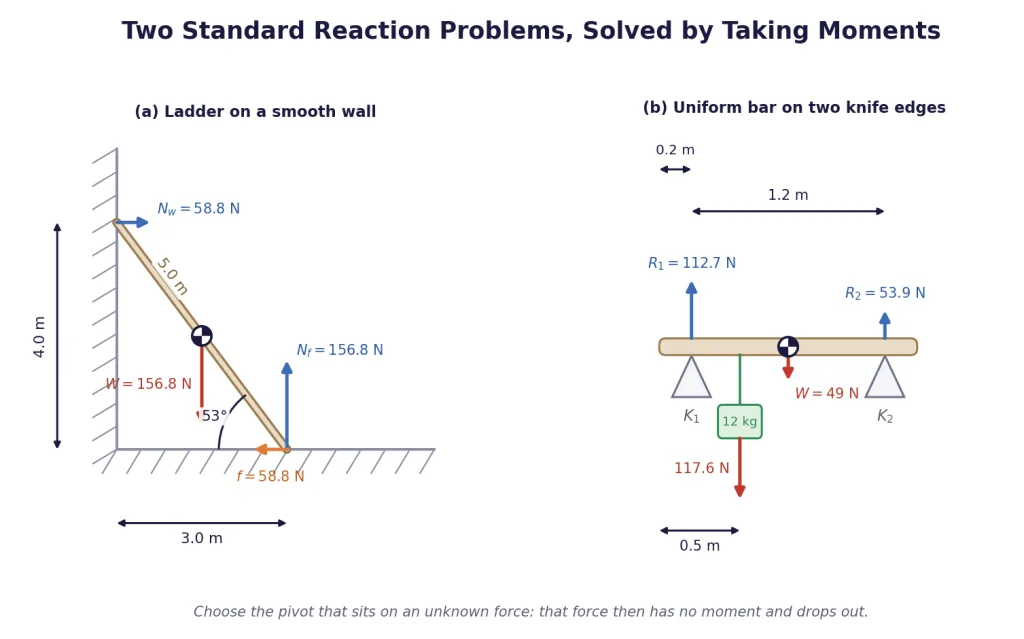
The six steps
- Draw the body alone and mark every force acting on it. Nothing else in the diagram.
- Put the weight at the centre of gravity — the midpoint for a uniform bar or ladder.
- Choose axes and resolve. Horizontal and vertical is almost always right.
- Write and .
- Pick the pivot through which the most unknowns pass, and write about it. Fix a sign convention first: anticlockwise positive, clockwise negative.
- Solve, then check by taking moments about a different point. If the answer is right the residual is zero; if you slipped a sign it will not be.
What each kind of support can do to you
This table is the part students most often get wrong, and it is pure bookkeeping.
| Contact | Force it can exert | Unknowns |
|---|---|---|
| smooth (frictionless) wall or floor | normal only, perpendicular to the surface | 1 |
| rough floor | normal plus friction along the surface | 2 |
| knife edge or sharp support | a single force; vertical if no horizontal forces act | 1 (usually) |
| hinge or pin joint | a force of unknown direction — resolve into and | 2 |
| light string or cable | tension along the string, pulling away from the body | 1 |
| roller or a body on a smooth peg | normal to the surface of contact | 1 |
Key Point: Coplanar forces give you three equations. If your unknowns come to three or fewer, the problem is solvable (statically determinate). A ladder against a smooth wall has exactly three: , , . A ladder against a rough wall has four and cannot be solved with statics alone — which is why the wall is always described as smooth in these questions.
The traps, listed so you can stop falling into them
- Forgetting the body's own weight. A bar "of mass 5 kg" contributes 49 N at its midpoint. Free marks lost every year.
- Putting the weight of a non-uniform rod at its centre. You cannot; its centre of gravity is somewhere else.
- Taking moments about a point and then including a force that acts at that point. Its moment is zero; writing anything else is a sign error waiting to happen.
- Using the length of the ladder where the horizontal distance is wanted. The moment arm of a vertical force is a horizontal distance.
- Mixing and in one problem. Pick one and stay with it. Everything in this section uses m/s.
- Assuming friction is at its maximum. holds only at the point of slipping. Otherwise friction is whatever equilibrium demands, and is an inequality you check afterwards.
[JEE Tip] When a question asks for "the reaction at the floor" it wants the resultant of the normal and the friction, both magnitude and direction — not just the normal component. Read the wording carefully.
Solved Examples
m/s throughout this section — 10 is never used, so no problem here mixes the two.
Example 1: One rod, two ways to push it
A light rod of length 1.0 m has forces of 8 N applied at each end, perpendicular to the rod. Find the net force and the net moment (i) about the midpoint and (ii) about the end , when (a) both forces point upward, and (b) the force at is reversed.
Solution:
Put at m, at the origin and at m. Anticlockwise moments are positive.
(a) Both forces up. Net force:
Moments about . The force at acts 0.5 m to the left of and pushes up, turning the rod clockwise; the force at acts 0.5 m to the right and turns it anticlockwise:
Moments about . Now the force at has zero arm and only contributes: Zero about but 8 N m about — and that is perfectly consistent, because the net force here is not zero, so the shift theorem allows the total moment to change from point to point.
(b) Force at reversed. Net force:
Moments about . Both forces now turn the rod the same way:
Moments about and about . Identical, as they must be: this pair is a couple, the net force is zero, and its moment is the same about every point in the plane.
Final Answer: (a) 16 N up, zero moment about , 8 N m about . (b) zero net force, 8 N m clockwise about , about , about — about anywhere.
Takeaway: Check both conditions, never one. Case (a) is in rotational equilibrium and still accelerates; case (b) has zero net force and still spins up. Only when both vanish is the body in equilibrium.
Example 2: The couple on a steering wheel
A driver grips a steering wheel of diameter 0.30 m and pushes with 12 N tangentially at the top and 12 N tangentially at the bottom, in opposite directions. Find the moment of this couple about (i) the centre of the wheel and (ii) a point 7 m to the right and 4 m below the centre.
Solution:
Recognise the couple. The two forces are equal, opposite and act along different lines, 0.30 m apart. The resultant force is zero, so this is a couple and the moment should not depend on the point at all.
About the centre. Each force acts at a radius of 0.15 m and each turns the wheel the same way:
Directly from the definition. where m is the perpendicular distance between the two lines of action — here the full diameter, not the radius.
About the far-off point. Take the bottom of the wheel as the origin, so the forces are at and at , and the reference point is . Using with position vectors measured from that point:
Read the arithmetic. Two enormous individual moments, 48 N m and 51.6 N m, differing by exactly 3.6 N m. Move the point further away and both grow without limit while their difference never budges.
Final Answer: 3.6 N m about both points, and about every other point too.
Takeaway: For a couple, with the separation of the lines of action, and you may take moments wherever it is convenient. [JEE Tip] The commonest slip is using the radius of the wheel instead of the diameter — that halves the answer.
Example 3: Zero net force is not equilibrium
Three coplanar forces act on a rigid body: N at the origin, N at the point m, and N at the point m. Is the body in equilibrium?
Solution:
Test condition (1). The body is in translational equilibrium. Its centre of mass will not accelerate.
Test condition (2), about the origin. Use for each force: Not zero. The body is not in equilibrium — it will start to spin clockwise.
Would another origin help? Try the point , measuring each position vector from there: The same. It has to be: the net force is zero, so by the shift theorem no choice of point can change the answer.
Final Answer: Not in equilibrium. Translational equilibrium holds, but there is a net moment of 6 N m clockwise about every point — the three forces are equivalent to a pure couple.
Takeaway: You cannot hunt for a lucky origin. Once , the moment is what it is. Three forces that add to zero reduce either to nothing (if their lines of action are concurrent) or to a couple — never to anything else.
Example 4: Balancing a see-saw
A see-saw consists of a light plank pivoted at its centre. A child of mass 40 kg sits 1.5 m from the pivot. Where must a child of mass 25 kg sit on the other side to balance it, and what force does the pivot support carry?
Solution:
Moments about the pivot. The reaction at the pivot acts through the pivot, so it has zero moment there and drops out. With the unknown distance:
cancels — a small mercy that makes lever problems fast:
Now the force condition, where does not cancel.
Final Answer: The 25 kg child sits 2.4 m from the pivot; the support carries 637 N.
Takeaway: The lighter you are, the further out you sit — distances go inversely as the masses. And notice how the two conditions divide the labour: the moment equation gives the position, the force equation gives the reaction. [NEET Important] The pivot reaction is the sum of the two weights, not the difference.
Example 5: A crowbar and what it buys you
A crowbar is used to lift a block. The fulcrum is 0.05 m from the point where the bar touches the block, and you push down at a point 0.75 m from the fulcrum on the other side. The block presses down on the short arm with 500 N. Find the effort needed, the mechanical advantage, and the force on the fulcrum.
Solution:
Moments about the fulcrum — the fulcrum reaction has no arm there and disappears:
Solve for the effort.
Mechanical advantage.
The fulcrum reaction. Both applied forces push down on the bar, so the fulcrum must push up with their sum:
Where the gain comes from. The arms are in the ratio 15 : 1, so to raise the block by 1 cm your hands must travel 15 cm. Work done by you: J. Work done on the block: J. Identical.
Final Answer: effort 33.3 N, mechanical advantage 15, fulcrum reaction 533.3 N.
Takeaway: A lever multiplies force, never energy. Whatever factor you gain in force you lose in distance, exactly. [Board Important] The fulcrum quietly carries more than the load itself — a favourite one-mark follow-up.
Example 6: A loaded bar on two knife edges
A uniform bar 1.6 m long and of mass 5 kg rests on two knife edges placed 0.2 m from each end. A 12 kg load hangs from the bar at a point 0.5 m from the left end. Find the reaction at each knife edge.
Solution:
Set up the geometry with the left end at . The knife edges and are at m and m. The bar is uniform, so its weight acts at its midpoint, m. The load hangs at m.
Take moments about , which kills :
Vertical force balance gives the other reaction:
Check by moving the pivot to : Agreement, so the arithmetic is sound.
Final Answer: N at the left knife edge, N at the right one.
Takeaway: The support nearer the load carries more of it. The load sits at 0.5 m, well to the left, so takes roughly twice as much as . [JEE Tip] Always verify with the second pivot — it costs one line and catches every arm-length error.
Example 7: A non-uniform bar gives up its centre of gravity
A bar 2.0 m long rests horizontally on two supports, one at each end. The supports are found to carry 120 N and 80 N. Find the weight of the bar, its mass, and the position of its centre of gravity.
Solution:
Vertical equilibrium gives the weight at once:
The bar is not uniform, so its centre of gravity is at some unknown distance from the left end — that is exactly what we are being asked for. Take moments about the left support, killing the 120 N reaction:
Solve.
Sanity check. The left support carries more, so the centre of gravity must lie nearer the left end. It does: 0.8 m from the left, 1.2 m from the right, and N m about the centre of gravity, as required.
Final Answer: N, kg, and the centre of gravity lies 0.8 m from the left end.
Takeaway: Two weighings locate a centre of gravity. This is precisely how a vehicle's weight distribution is measured — drive each axle on to a weighbridge and the two readings fix where the centre of gravity sits along the wheelbase.
Example 8: Weighing a metre scale with two coins
Two identical coins, each of mass 5 g, are stacked at the 12.0 cm mark of a uniform metre scale. The scale is then found to balance on a knife edge placed at the 45.0 cm mark. Find the mass of the metre scale.
Solution:
Locate the forces. The scale is uniform, so its whole weight acts at the 50.0 cm mark. The coins, of total mass 10 g, press down at the 12.0 cm mark. The knife edge is at 45.0 cm and its reaction has no moment there.
Moments about the 45 cm mark. Work in grams and centimetres — cancels and so does every unit conversion:
Solve.
Check the sense. The coins sit 33 cm from the pivot, the scale's centre only 5 cm on the other side. To balance a small load on a long arm you need a big load on a short arm, and 66 g is comfortably bigger than 10 g. Good.
Final Answer: The metre scale has a mass of 66 g.
Takeaway: In a pure moment equation, and the choice of mass unit both cancel. Convert nothing. [NEET Important] Distances are measured from the pivot, not from the zero of the scale — mixing the two is the standard wrong answer here.
Example 9: A ladder against a smooth wall
A ladder 5.0 m long and of mass 16 kg leans against a smooth vertical wall, with its foot resting on rough ground 3.0 m from the wall. Find the reaction of the wall, and the magnitude and direction of the reaction of the floor.
Solution:
Geometry first. The ladder, the wall and the ground make a right triangle: The ladder's centre of gravity is at its midpoint, which is a horizontal distance of 1.5 m from the foot and a height of 2.0 m.
The forces. The wall is smooth, so it can only push horizontally: . The ground supplies a normal upward and friction horizontally, pointing towards the wall to stop the foot sliding out. The weight is
Force equations.
Moments about the foot — where two of the three unknowns act, so both vanish: and therefore N as well.
The floor's reaction is the resultant of and .
Final Answer: wall reaction 58.8 N horizontal; floor reaction 167.5 N at to the horizontal (normal component 156.8 N, friction 58.8 N).
Takeaway: The moment arm of a vertical force is a horizontal distance. The weight acts 1.5 m horizontally from the foot, not 2.5 m along the ladder. [JEE Tip] "Reaction of the floor" means the resultant, not the normal alone.
Example 10: How much friction does the painter need?
Take the same ladder — 5.0 m, 16 kg, foot 3.0 m from a smooth wall — and let a painter of mass 64 kg stand on it 3.0 m from the foot, measured along the ladder. Find the normal force from the floor, the wall reaction, the friction required, and the smallest coefficient of friction that will keep the ladder from slipping.
Solution:
Convert "along the ladder" into a horizontal distance. The ladder rises 4 m over a base of 3 m, so its horizontal run is of its length:
Weights.
Vertical equilibrium.
Moments about the foot.
Horizontal equilibrium fixes the friction the ground must supply:
The condition for no slipping. Friction can only deliver up to , so we need
Final Answer: N, N, and the coefficient of friction must be at least 0.435.
Takeaway: Friction here is not — it is whatever equilibrium demands, and is only the ceiling. Note how much worse the painter makes things: alone, the ladder needed ; with him aboard it needs 0.435, and it climbs further the higher he goes.
Example 11: The bearings of a loaded shaft
A uniform horizontal shaft of mass 10 kg is supported by bearings 1.2 m apart. A flywheel of mass 30 kg is keyed on to the shaft 0.4 m from the left bearing. Find the load carried by each bearing.
Solution:
Forces on the shaft. Its own weight acts at its midpoint, 0.6 m from the left bearing:
Moments about the left bearing, which removes :
Vertical equilibrium.
Check. The flywheel sits nearer the left bearing, so the left bearing should carry more. It does — 245 N against 147 N — and the two add back to the total 392 N.
Final Answer: left bearing 245 N, right bearing 147 N.
Takeaway: Exactly the same three equations run every "two supports and a load" problem — a bar on knife edges, a shaft in bearings, a beam on pillars, a car on its axles. Learn the pattern once.
Example 12: A hinged beam held by a cable
A uniform beam of mass 12 kg and length 2.0 m is hinged to a wall at one end and held horizontal by a cable attached to its far end. The cable makes an angle of with the beam. Find the tension in the cable and the force exerted by the hinge.
Solution:
Three forces act on the beam: its weight 117.6 N down at the midpoint, the tension along the cable at the far end, and the hinge force, whose direction is unknown, so we resolve it into and .
Moments about the hinge — the hinge force acts there and disappears. Only the component of perpendicular to the beam has a moment, and that is :
Horizontal equilibrium. The cable pulls the beam towards the wall with , so the hinge must push out:
Vertical equilibrium. The cable holds up N, only half the weight, so the hinge carries the rest:
Combine.
Final Answer: N; the hinge pushes with 117.6 N at above the horizontal (components 101.8 N horizontal, 58.8 N vertical).
Takeaway: A hinge force is almost never vertical — resolve it into two components and let the equations tell you. That the hinge force here comes out equal to the tension is not a coincidence: when just three forces hold a body in equilibrium their lines of action must be concurrent, and here that symmetry forces the two to match.