
Force Is Not Enough: the Moment of a Force
You know what changes the translational state of a body: a force. So what changes its rotational state?
The honest way to find out is to look at a door.
A door is a rigid body hinged on a fixed vertical line. Push it and ask what actually makes it swing:
- Push at the hinge line and it does not turn at all, however hard you push.
- Push along the door, straight towards the hinge, and again nothing turns.
- Push at the outer edge, at right angles to the door, and it swings easily.
- Push at the same outer edge but at a slant, and it swings, but less readily.
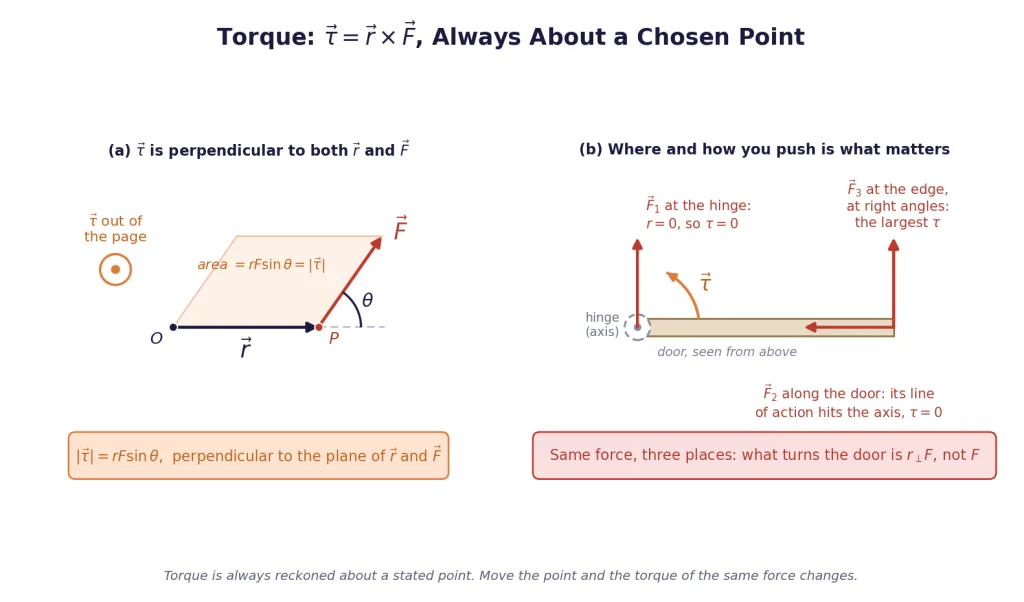
So the force alone settles nothing. Where you apply it and which way it points matter just as much. The quantity that combines all three — how big, where, and which way — is called the moment of force, or the torque.
The definition
Key Point — torque: If a force acts on a particle whose position vector with respect to a chosen origin is , the moment of the force about , or the torque, is It is a vector, perpendicular to the plane containing and , with its sense given by the right-hand rule. The symbol is the Greek letter tau.
Everything about it follows from the cross product you set up in Section 4 — anticommutativity, the determinant form, the right-hand rule. Nothing new is needed here; we are simply feeding physics into machinery that already works.
Units and dimensions, and a warning
The SI unit is the newton metre (N m).
Key Point: Torque has the same dimensions as work and energy, but it is a completely different physical quantity. Work is a scalar, formed from a dot product; torque is a vector, formed from a cross product. Never write the unit of torque as a joule. Write N m.
[Board Important] "Torque and work have the same dimensions — are they the same quantity?" is a standard two-mark question. The answer is the sentence above: same dimensions, different nature, one scalar and one vector, and the units are deliberately written differently to keep them apart.
Reading the door again, now with symbols
| Where you push | Angle between and | ||
|---|---|---|---|
| at the hinge | undefined | 0 | |
| along the door, towards the hinge | along the door | 0 | |
| at the edge, at right angles | full width | , the largest possible | |
| at the edge, at a slant | full width | , less |
Key Point — when the torque vanishes: if the force is zero, or if , or if or — that is, whenever the line of action of the force passes through the chosen point. Remember it as: a force aimed at the pivot cannot turn anything about it.
Three Readings of the Same Number
The magnitude of the torque,
can be grouped in three ways, and each grouping tells a different story about the same situation. In an exam you should be able to slide between them without thinking.
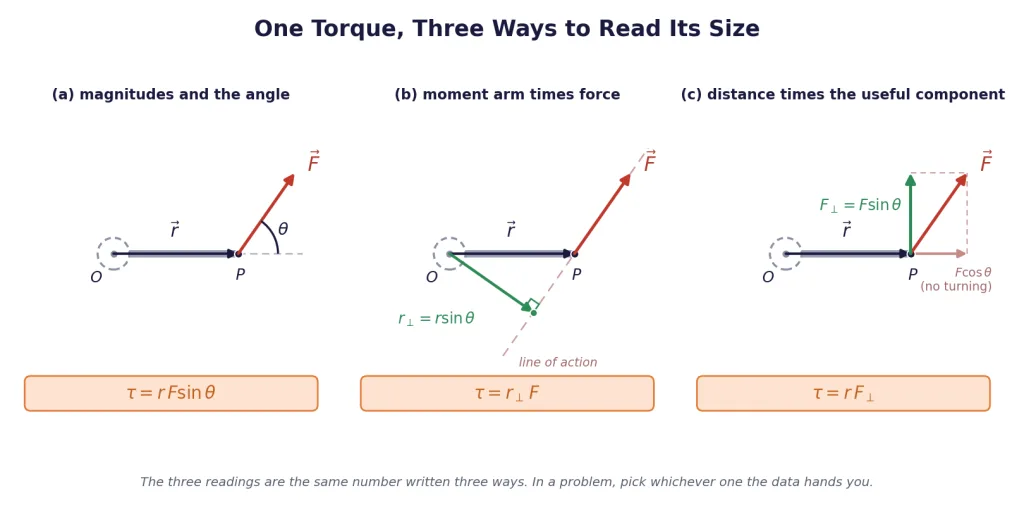
Reading 1:
Take the full distance, the full force, and pay a penalty for the misalignment. Use this when the question hands you a distance, a force and an angle.
Reading 2: , the moment arm
Regroup as . Now is the perpendicular distance from the point to the line of action of the force — extend the force's line both ways and drop a perpendicular on to it from . That distance is the moment arm (or lever arm).
This is the reading engineers and lever problems use, and it makes the vanishing case obvious: if the line of action passes through , the moment arm is zero, so the torque is zero.
Reading 3: , the useful component
Regroup the other way as . Split at the point of application into a piece along and a piece across it:
- , along — this piece pulls or pushes towards or away from and produces no turning at all;
- , at right angles to — this piece is the whole of the turning effect.
Key Point — the three readings: One number, three routes. Pick the route the data hands you.
[JEE Tip] When several forces act at different points and different angles, Reading 2 is nearly always fastest: draw each line of action, read off each moment arm by geometry, multiply, and add with signs. You never have to resolve a single force.
The sign, for coplanar problems
Almost every problem you meet has all the forces in one plane. Then all the torques point along the one perpendicular axis, and you can treat them as signed numbers:
- torque tending to turn the body anticlockwise in your diagram: positive;
- torque tending to turn it clockwise: negative.
Add them algebraically. That is legitimate only because they are all parallel vectors, which is exactly what makes coplanar problems easy.
What reversing things does
Because is linear in each factor:
| Change | Effect on |
|---|---|
| reverse | reverses |
| reverse (move to the diametrically opposite point) | reverses |
| reverse both | is unchanged |
| double , halve | unchanged |
[NEET Important] That last row is the whole idea of a spanner, a lever and a steering wheel: to get the same turning effect with less force, increase the moment arm.
Torque Is Always Reckoned About a Point — and the Point Matters
A force has a magnitude and a direction and that is the end of it. A torque is not fully specified until you say what it is about. This is the single most-missed idea in the topic.
The same force, two different torques
Let a force N act at the point with position vector m.
About the origin :
About the point at m, the position vector of relative to is , so
Same force, same point of application — different size and opposite sense. Neither answer is wrong; they answer different questions.
The shifting rule
Suppose you know the torque about and want it about a new point whose position vector is . The new position vector of the particle is , so
Key Point — moving the reference point: The torque of a single force changes when you move the point, unless happens to be parallel to — that is, unless you move the point along the line of action.
Check it on the numbers above: , , and . It works.
Notice also that there is always one whole line of points about which a given force has zero torque — namely its own line of action. Here that is the vertical line through m.
[JEE Tip] In any problem involving torque, the first line of your solution should name the point: "torques about the hinge", "torques about the centre of mass". An unlabelled torque is not an answer.
Torque about an axis, rather than a point
Sometimes what you want is not the whole vector but its effect about a particular line — the hinge line of a door, the shaft of a wheel. That is the component of along that line:
where is a unit vector along the axis and the torques are taken about any point on the axis. Only this component can change the body's rotation about that axis; the perpendicular components are taken up by the bearings that hold the axis in place.
For rotation about a fixed -axis this reduces to the familiar , and Sections 8 to 10 build the fixed-axis dynamics on top of it.
Key Point: A force with a large torque about a point may have zero torque about a chosen axis through that point — if its torque vector happens to be perpendicular to the axis. This is why pushing sideways on a door frame does not open the door.
Angular Momentum of a Particle:
Torque is the rotational partner of force. What, then, is the rotational partner of momentum?
Build it the same way. Torque was the moment of a force: position vector crossed into force. So define the moment of momentum, and give it a name of its own.
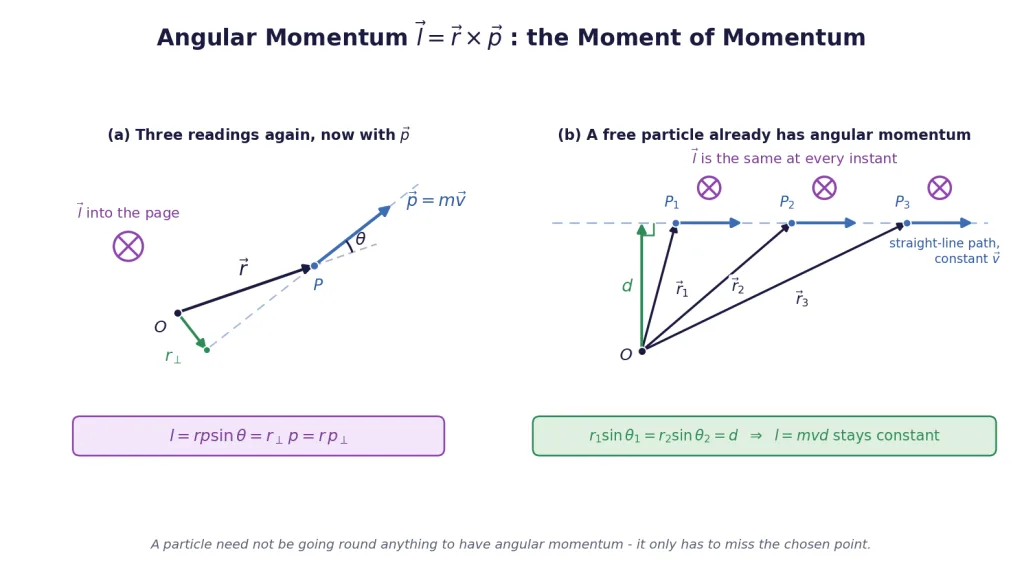
Key Point — angular momentum of a particle: For a particle of mass with linear momentum at position relative to a chosen origin , It is a vector perpendicular to the plane of and . Its SI unit is kg m/s, equivalently J s, and its dimensional formula is .
We write , lower case, for a single particle, and reserve capital for a whole system. Like torque, angular momentum is defined about a point and changes if you move that point.
The same three readings
Everything said about the magnitude of transfers word for word, with replaced by :
- is the perpendicular distance from to the line along which the particle is moving;
- is the component of momentum at right angles to .
Key Point — when vanishes: if the particle is at rest (), or sits at the origin (), or is moving directly towards or away from the origin ( or ), so that the line of its motion passes through .
A particle going in a straight line has angular momentum
This surprises everybody, so meet it now. A particle moving at constant velocity along a straight line, with no forces on it at all, has a perfectly good, perfectly constant angular momentum about any point that is not on that line.
The reason is in the second reading. As the particle moves, grows and shrinks, but the product is just the perpendicular distance from to the line of motion — and that never changes. So
and the direction of , perpendicular to the fixed plane containing and the line, does not change either.
Key Point: Angular momentum does not require going round in a circle. It requires only that the particle's line of motion misses the point you are measuring about.
That result is not a curiosity — it is a consistency check on the whole framework. A free particle has no force on it, therefore no torque about , therefore its angular momentum about had better be constant. It is. The next block turns that "therefore" into an equation.
The Rotational Newton's Second Law:
Force and momentum are tied together by . Torque and angular momentum are tied together in exactly the same way, and the proof takes four lines.
The derivation
Start from the definition and differentiate with respect to time, using the product rule (which holds for cross products, provided you keep the order of the factors):
Look at the first term. is the velocity , and , so
because the cross product of any vector with itself vanishes. The first term is gone.
In the second term, Newton's second law gives , so
Putting the two together:
Key Point — the rotational analogue of Newton's second law: The rate of change of a particle's angular momentum about a point equals the torque about that same point. Both must be taken about the same origin — mixing origins makes the statement false.
Set it beside its partner and the correspondence is exact:
| Translation | Rotation |
|---|---|
| no net force constant | no net torque constant |
How to read the equation
The torque does not "cause rotation" in some vague sense. It does something sharper: it tells which way to change, and how fast.
- parallel to : the angular momentum grows in length, direction unchanged.
- antiparallel to : it shrinks — braking.
- perpendicular to : the length of does not change at all, but its direction swings. This is precisely what makes a spinning top precess instead of falling over, and a bicycle wheel held by one end of its axle turn slowly about that string rather than dropping.
The last case is worth pausing on, because it is the answer to a question that has probably bothered you since Section 1. Differentiate :
so the magnitude of changes only through the component of along . A perpendicular torque redirects, it does not speed up.
[JEE Tip] Whenever a problem says "the angular momentum is constant in magnitude but changing in direction", it is telling you . That is often the fastest way in.
From One Particle to a Whole Body:
A rigid body is a system of particles, so add up.
That is the total angular momentum of the system about the chosen origin. Differentiating term by term and using the single-particle result on each,
Now the crucial step. The force on particle is partly external (gravity, a push, a string from outside) and partly internal (the forces the other particles of the system exert on it). Split the total torque to match:
Why the internal torques cancel
Take any two particles and . By Newton's third law the forces they exert on each other are equal and opposite: . Their combined torque about the origin is
Here comes the extra assumption. Newton's third law by itself only says the two forces are equal and opposite. We now assume something slightly stronger, and true of every force in this chapter:
Key Point — the central-force assumption: The internal forces between two particles act along the line joining them. Such forces are called central.
If lies along the line joining the particles, then it is parallel to , which is exactly the vector along that line. The cross product of parallel vectors is zero, so the pair contributes nothing. Every internal pair cancels the same way, so and
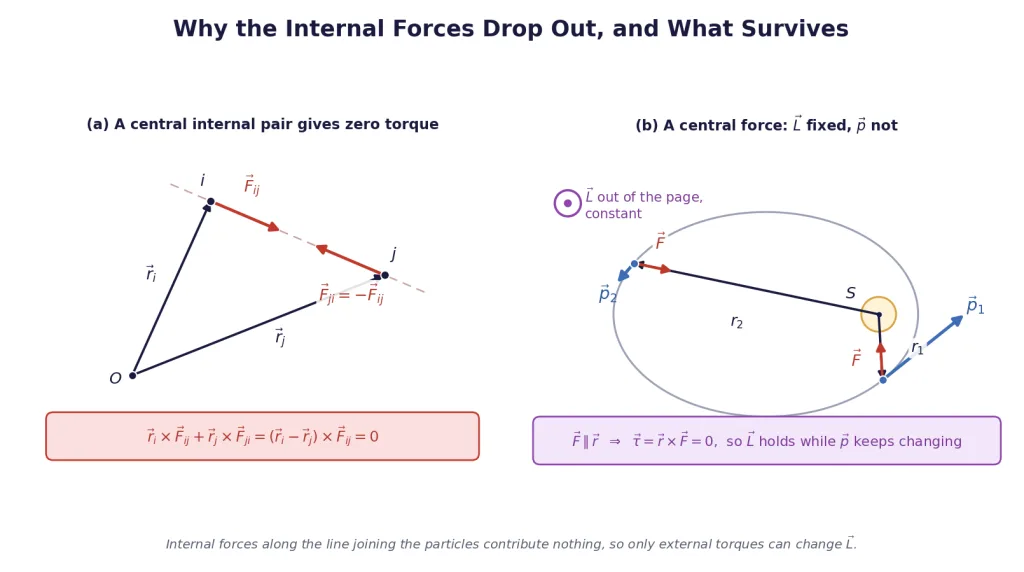
Key Point — the equation of rotational motion for a system: The rate of change of the total angular momentum of a system about a point equals the total external torque about that same point. Internal forces cannot change , however violent they are.
This is the exact rotational twin of from Section 3, and it holds for any system of particles — a rigid body, a cloud of gas, an exploding shell — not just for bodies that hold their shape.
Conservation of angular momentum
Set the external torque to zero and the law falls out.
Key Point — conservation of angular momentum: If the total external torque on a system is zero, then Because this is a vector equation, it is really three separate statements: and each component is conserved separately.
That last point is more useful than it looks. If the external torque has zero component along one particular axis — even though it is not zero overall — then the angular momentum about that axis is still conserved. Many problems turn on exactly this partial conservation.
constant while is not
The two conservation laws are independent, and it is worth seeing a case where one holds and the other does not.
Consider a planet or comet orbiting a star. The gravitational pull is always directed straight at the star, so about the star
Therefore about the star is constant — fixed in magnitude and fixed in direction, which is why the orbit stays in one plane for ever. Meanwhile the linear momentum is changing continuously: the force is not zero, so swings round and its magnitude rises and falls as the comet comes in and goes out. At the two ends of the orbit, where and are perpendicular,
so the comet races through its close approach and crawls at its far point. That is Kepler's law of equal areas, and it is nothing but conservation of angular momentum.
| System | conserved? | conserved? |
|---|---|---|
| comet orbiting a star (about the star) | no, gravity is an external force | yes, the force is central so the torque is zero |
| two skaters pushing off each other on ice | yes, no external horizontal force | yes, no external torque either |
| a ball falling freely (about a point on its own line of fall) | no, weight acts | yes, the line of action passes through the point |
| a ball falling freely (about a point to one side) | no | no, the weight has a moment arm |
[JEE Tip] Read the last two rows together. Whether is conserved depends on which point you chose. Always name the point before you claim conservation.
Section 10 takes this law and specialises it to rotation about a fixed axis, where it becomes the rule that makes a spinning skater speed up the instant she pulls her arms in. Section 7 takes the case and and calls it equilibrium.
Solved Examples
Every cross product below has been recomputed with a vector library and checked twice over — that the answer is perpendicular to both inputs, and that its length really is . Where a rate of change is claimed, it was obtained by differentiating the actual trajectory numerically. m/s is used in Example 7 and nowhere else in this section.
Example 1: Torque in component form
A force N acts on a particle whose position vector is m. Find the torque of this force about the origin, and its magnitude.
Solution:
Set up the determinant.
Expand along the top row.
Magnitude.
Two free checks. The answer must be perpendicular to both inputs: Both zero, so the arithmetic is sound.
Final Answer: N m, of magnitude about 15.7 N m.
Takeaway: Always run the two dot products. They cost ten seconds and catch nearly every sign slip in a determinant. [Board Important] Write the unit as N m, never as a joule.
Example 2: One spanner, three readings
A spanner 0.25 m long turns a nut at . A force of 60 N is applied at the far end of the spanner, at to the spanner's length. Find the torque about the nut three different ways, and check that they agree.
Solution:
Reading 1 — magnitudes and the angle.
Reading 2 — the moment arm. Extend the line along which the force acts and drop a perpendicular on to it from :
Reading 3 — the useful component. Split the 60 N at the point of application:
What would be better. Pulling at instead would give N m — double, for the same effort.
Final Answer: 7.5 N m by all three routes; pulling at right angles would double it to 15 N m.
Takeaway: Most of a slanted force is wasted. At only half of the 60 N does any turning; the other 52 N simply tries to pull the spanner off the nut. That is why you are told to pull a spanner square.
Example 3: The same force, two different points
A force N acts at the point whose position vector is m. Find the torque of this force (a) about the origin , (b) about the point at m, and (c) find every point about which this force has zero torque.
Solution:
(a) About . The position vector of from is : Anticlockwise as seen from the side.
(b) About . Now the position vector of is measured from : Smaller, and clockwise — the opposite sense.
Check with the shifting rule. With , Agreement.
(c) Zero torque. The torque vanishes about any point on the line of action of the force — the vertical line m. About a point on that line the moment arm is zero.
Final Answer: (a) N m; (b) N m; (c) every point on the line m.
Takeaway: "The torque of this force" is not a complete phrase. Until you name the point, the question has no answer — and moving the point can even flip the sense. [JEE Tip] Write "about " or "about the hinge" in the first line of every torque solution.
Example 4: Net torque on a hinged rod
A light rod lies along the -axis, hinged at the origin. Three forces act on it, all in the -plane: 10 N in the direction at m; 15 N in the direction at m; and 8 N in the direction at m. Find the net torque about the hinge, and say which way the rod starts to turn.
Solution:
Fix the sign convention. Anticlockwise (along ) is positive.
The 10 N force. Moment arm 1 m, force downward, so it turns the rod clockwise:
The 15 N force. Moment arm 3 m, force upward, anticlockwise:
The 8 N force. It acts along the rod, so its line of action runs straight through the hinge. Moment arm zero:
Add.
Final Answer: 35 N m anticlockwise; the rod begins to turn anticlockwise about the hinge.
Takeaway: A force along the rod does nothing to turn it, no matter how large — it is taken entirely by the hinge. This is exactly the door pushed towards its hinges. [NEET Important] Set the sign convention down in writing before you add anything.
Example 5: Angular momentum of a particle, in components
A particle of mass 2 kg is at m, moving with velocity m/s. Find its angular momentum about the origin, and verify the answer using the perpendicular distance.
Solution:
Momentum first.
The cross product. Both vectors lie in the -plane, so only the term survives:
Verify with . The perpendicular distance from the origin to the line along which the particle moves is and then kg m/s. Consistent.
Final Answer: kg m/s, out of the page; the line of motion misses the origin by 2.2 m.
Takeaway: For any planar problem, only the component of survives, and it is just . Memorise that one line — it turns most two-dimensional angular momentum questions into a single subtraction.
Example 6: A free particle keeps its angular momentum
A particle of mass 0.5 kg moves in a straight line at a constant 4 m/s along the line m, in the direction. Show that its angular momentum about the origin is the same at , m and m, and explain why that had to happen.
Solution:
The momentum is the same everywhere: kg m/s.
Compute at each place. Here and , so kg m/s.
At :
At :
At :
The -coordinate never enters, so the value cannot change.
The geometric reason. Use . The perpendicular distance from the origin to the line of motion is m, whatever the particle's position along that line. So constant. As the particle moves away, grows and shrinks in exactly compensating proportion.
The dynamical reason, which is the real one. No force acts on the particle, so the torque about the origin is zero, so . Angular momentum must be conserved; the geometry above is just that law seen from the side.
Final Answer: kg m/s at every point, that is 6 kg m/s into the page; it is constant because there is no torque about the origin.
Takeaway: A particle does not have to orbit anything to have angular momentum. It only has to miss the point you are measuring about. [JEE Tip] If a question asks for the angular momentum of a particle moving in a straight line, find the perpendicular distance from the point to the line and multiply by . Do not attempt any geometry beyond that.
Example 7: A projectile, and a direct test of
A 1 kg ball is thrown from the origin with velocity m/s. Taking m/s, find its angular momentum about the launch point at s, find the torque of gravity about the same point at that instant, and verify that one is the rate of change of the other.
Solution:
Write the motion.
At s. (The ball is at the top of its flight, moving horizontally.)
Angular momentum, using :
Torque of gravity about the launch point. The weight is N acting at :
Now verify the law. In general and the torque at time is . They match at every instant, and at s both equal .
Final Answer: kg m/s and N m at s; and throughout the flight.
Takeaway: Notice that grows all through the flight even though the ball starts with zero angular momentum — gravity keeps supplying torque. [JEE Tip] In projectile questions the torque of gravity about the launch point is simply , so the angular momentum is easiest to get by integrating that, not by re-doing the cross product each time.
Example 8: Circular motion, seen from two different points
A particle of mass 0.2 kg moves in a horizontal circle of radius 0.5 m at a steady speed of 3 m/s. Find its angular momentum (a) about the centre of the circle and (b) about a point lying in the same plane, 2 m from the centre. In which case is constant?
Solution:
(a) About the centre. Here and are always perpendicular, so : Its direction is along the axis of the circle, and it never changes. So about the centre, is constant in magnitude and direction.
Why that is consistent. The force keeping the particle on the circle points at the centre. About the centre its moment arm is zero, so and must be constant.
(b) About . Put the centre at the origin and at . When the particle is at angle its position relative to is and its velocity is . Then
Read it. This swings between and kg m/s. It is not constant, and it even changes sign. About the centre-directed force does have a moment arm, so there is a torque, and obediently changes.
Final Answer: (a) 0.30 kg m/s, constant; (b) kg m/s, varying between and and therefore not conserved.
Takeaway: Conservation of angular momentum is a statement about a chosen point, not about the motion. The very same particle in the very same circle has a conserved about one point and a wildly varying about another.
Example 9: Zero momentum, non-zero angular momentum
Two particles, each of mass 1 kg, are at m and m. The first moves with velocity m/s and the second with m/s. Find the total linear momentum and the total angular momentum about the origin. Then find the total angular momentum about the point m.
Solution:
Total linear momentum. The system as a whole is going nowhere: its centre of mass is at rest.
Angular momentum about the origin, particle by particle, using : Both contributions have the same sign, because the two particles are turning the same way round the origin.
About m. Shift both position vectors: particle 1 is now at and particle 2 at . The same answer.
Why the shift made no difference. Moving the origin by changes by , and here .
Final Answer: but kg m/s; and because , that value of is the same about every point.
Takeaway: Zero total momentum does not mean zero total angular momentum. A system can be spinning furiously while going nowhere — which is exactly what a flywheel does. [JEE Tip] When the total momentum of a system is zero, its angular momentum is origin-independent. That is a genuine shortcut, and it is why the centre-of-mass frame is so convenient.
Example 10: A comet, where holds and does not
A comet moving round a star is m from it at closest approach, travelling at m/s. At its farthest point it is m away. Find its speed there. What happens to its linear momentum along the way?
Solution:
Identify the conserved quantity. Gravity always pulls the comet straight towards the star, so is parallel to and With no external torque about the star, about the star is constant.
Use the simple form at the two ends. At closest approach and at the farthest point the velocity is perpendicular to the radius, so and at both:
Solve.
What linear momentum does. Its magnitude halves, from to , and its direction turns through between the two ends. Linear momentum is not conserved at all — gravity is a large external force. Angular momentum is conserved because that force has no moment about the star.
Final Answer: m/s at the far point; halves and swings right round, while does not change by a hair.
Takeaway: A central force conserves angular momentum and destroys the conservation of linear momentum. Doubling the distance halves the speed — the comet sprints past the star and crawls at the far end. This is Kepler's second law in one line. [NEET Important] The condition is that the force points at the chosen point, not that the force is small.
Example 11: Why internal forces never appear
Two particles of a system sit at m and m. They attract each other along the line joining them with a force of 5 N. Show explicitly that this internal pair contributes nothing to the total torque about the origin.
Solution:
Find the line joining them. so the unit vector from towards is .
Write the two forces. Particle is pulled towards :
Torque on particle about the origin.
Torque on particle .
Add.
The general reason, in one line. because lies along , and parallel vectors have zero cross product. Nothing about the choice of origin entered, so the cancellation holds about every point.
Final Answer: the two torques are N m and N m; they sum to zero, about the origin and about any other point.
Takeaway: This is why works. Notice what the proof actually needs: not merely that the forces are equal and opposite, but that they act along the line joining the particles. Newton's third law alone would not be enough.
Example 12: A torque that turns without changing its size
A 3 kg particle is at m with velocity m/s, and a force N acts on it. Find and about the origin, and describe how is changing at this instant.
Solution:
Angular momentum. kg m/s, so
Torque. (using ).
Compare their directions. They are perpendicular.
Read the physics. Since , the magnitude of is momentarily unchanging: it stays at 30 kg m/s. But itself is changing at the rate , so its direction is swinging — the vector is tipping from towards at units per second.
Final Answer: kg m/s and N m; the two are perpendicular, so is constant while the direction of turns.
Takeaway: A torque perpendicular to the angular momentum steers it instead of speeding it up — precisely the mechanism behind a precessing top and a gyroscope. [JEE Tip] Any time you are told is constant but is not, you are being told .