
The One Point That Behaves Like the Whole Body
Section 1 ended with a promise: the general motion of a rigid body splits into translation of one special point plus rotation about that point. This section finds the point.
Think of it this way. Throw a spanner spinning across a room and photograph it every hundredth of a second. Almost every part of it traces a wild, looping curve. But there is exactly one point in the spanner that traces a clean, boring parabola — the same parabola a thrown pebble would follow. That point is the centre of mass, and this section is about locating it.
Start with two particles
Put two particles on a line — call it the -axis — with masses and at positions and .
Key Point — centre of mass of two particles: The centre of mass is the point at It is the mass-weighted mean of and : an ordinary average in which each position is counted as many times as the mass sitting there.
Read the formula, don't just memorise it
Equal masses. Put : Exactly midway, as common sense demands.
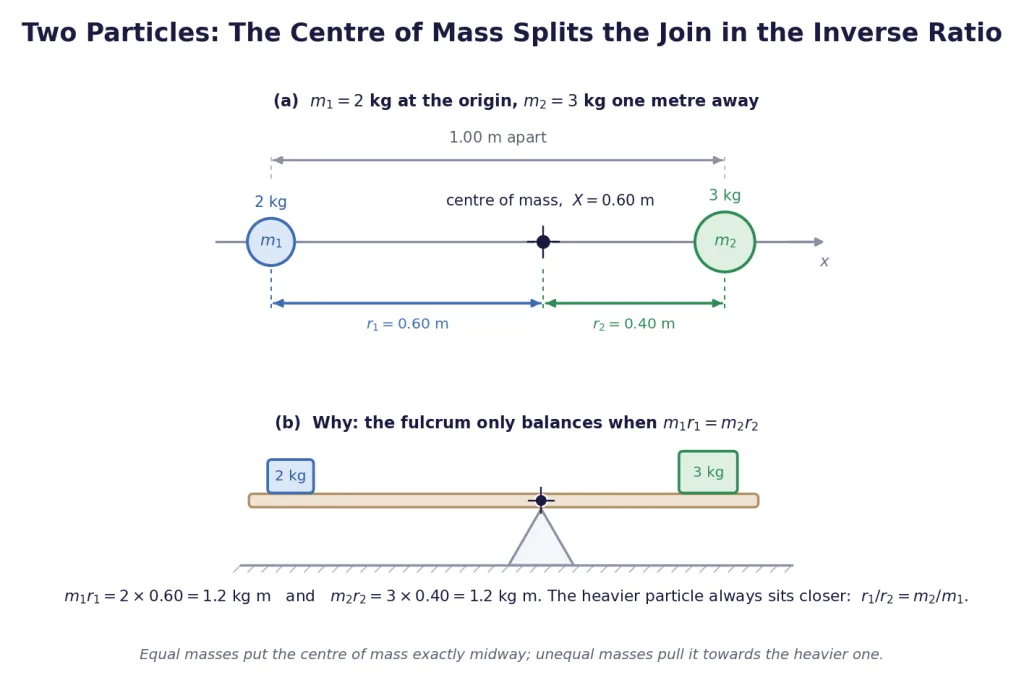
Unequal masses. Now the heavier particle wins, and by a precise amount. Take the numbers in the figure: 2 kg at the origin, 3 kg one metre away. Then
So the centre of mass is 0.60 m from the 2 kg particle and 0.40 m from the 3 kg one. Notice what happened:
The inverse-ratio result
That was not a coincidence. Take the general two-particle case, measure and , and substitute:
Divide one by the other and everything cancels except the masses:
Key Point — the inverse ratio: For two particles, the centre of mass lies on the line joining them and divides it in the inverse ratio of the masses: The centre of mass always lies closer to the heavier particle, and always between the two.
Panel (b) of the figure gives the physical picture: put the two masses on a light plank and the plank balances only when the pivot sits at the centre of mass, because is precisely the balance condition. (Section 7 makes that connection exact under the name centre of gravity.)
[NEET Important] For two particles the answer is almost always faster from than from the full formula. "The separation is ; where is the centre of mass?" has the instant answer measured from .
A caution about the inverse ratio
This clean result is only for two particles. With three or more you must go back to the weighted sum — there is no simple "divides in the inverse ratio" statement for a triangle of masses, and assuming there is will cost you the question.
Many Particles, and the Vector Form
Two particles were a warm-up. Now the general case.
Along a line
For particles of masses at positions along the -axis, where is the total mass of the system. The symbol just says "add these up over all particles".
In space
Particles rarely oblige by lying on a line. If the -th particle sits at , then the centre of mass is at with
Three separate scalar sums, one for each axis. They never mix — an -coordinate can only ever affect .
The one-line version
Write for the position vector of the -th particle, and for the centre of mass. Then all three equations collapse into one:
Key Point — centre of mass of a system of particles: The sum on the right is a vector sum. Its unit is the metre; the centre of mass is a position, not a mass.
The centre of mass is written , and equally often or — the same quantity in every case. Do not let a change of letter throw you in an exam.
The single most useful consequence
Multiply the definition through by :
Now do something clever: choose the origin of coordinates at the centre of mass itself. Then , and the equation becomes
Key Point: If the origin is taken at the centre of mass, then where is the position of the -th particle measured from the centre of mass. In words: the mass-weighted position vectors of a system add to zero about its own centre of mass.
This looks like a triviality and is not. It is the statement that the centre of mass is the "balance point" of the mass distribution, and it is the identity that makes Section 3's results come out so cleanly. Keep it.
Two properties worth stating now
1. The centre of mass does not depend on your choice of origin. Shift the origin and every changes by the same constant vector ; then which is the same physical point, just relabelled. Choose the origin to make the arithmetic easy — at a corner, at one of the masses, at a centre of symmetry — and say what you chose.
2. A rigid body's centre of mass is fixed in the body. Since the particles of a rigid body never move relative to one another, the centre of mass sits at a definite point of the body and travels with it. For a fluid or a flexing system it can wander about inside.
Where this is heading
Nothing in this section is about how the centre of mass moves; that is Section 3's job, and it is where the payoff is (, and the momentum of a system). Here we are only learning to locate it.
Continuous Bodies: From Sums to Integrals
A metre rule is a system of particles too — it is just that it has around of them, and you are not going to write down that sum.
So we do what physics always does with very large numbers of very small things: we chop the body into small elements of mass , put the -th element at , and write
Then we let the elements get smaller and more numerous. In that limit , and the sums become integrals.
Key Point — centre of mass of a continuous body: or, in one vector line, Taking the origin at the centre of mass itself gives the continuous version of the balance identity: , that is, .
The only hard part is
An integral over is useless until is written in terms of a length, an area or a volume. That is what density is for:
| Body | Density symbol | Its meaning | Element |
|---|---|---|---|
| Wire, rod, thin ring | mass per unit length | ||
| Lamina, sheet, disc | mass per unit area | ||
| Solid body | mass per unit volume |
For a uniform body , , are constants and come straight out of the integral. For a non-uniform one they are functions of position and must stay inside.
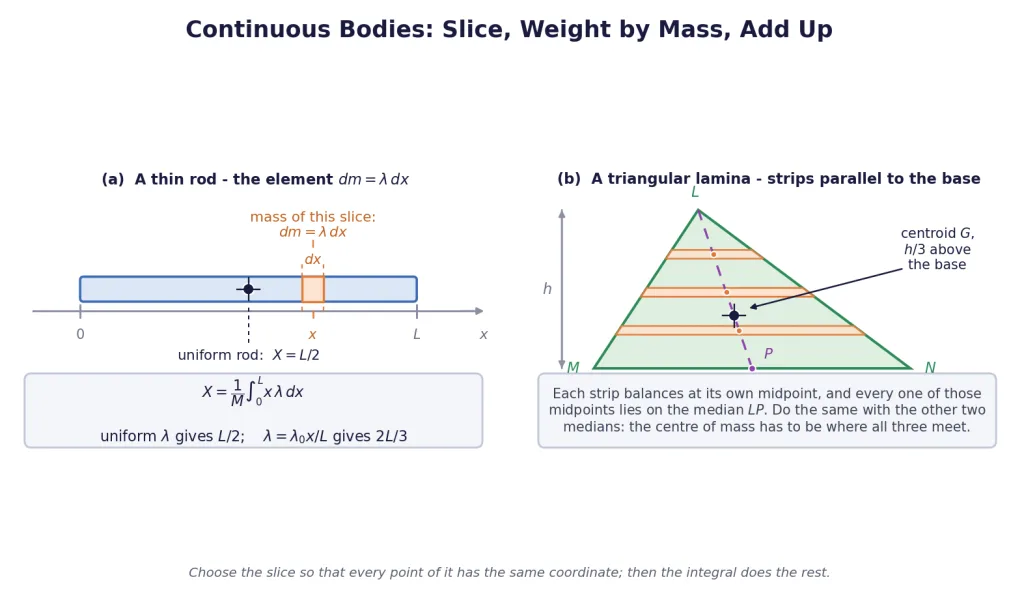
How to choose the element — the rule that saves you
Key Point: Choose the mass element so that every point of it has the same value of the coordinate you are integrating. Then you can treat the whole element as sitting at that one coordinate.
For a rod integrating along its length, the element is a thin slice perpendicular to the rod. For a triangular lamina finding , the element is a strip parallel to the base (every point of it has the same ). For a disc, an annular ring or a strip, depending on which coordinate you want. Choose badly and the integral becomes a double integral you did not need.
Worked: the uniform thin rod
Take a rod of length and mass lying along the -axis from to . It is uniform, so is constant and .
The midpoint, as you would have guessed. because the rod is thin and lies on the axis.
Worked: a rod whose density increases along its length
Now let the rod be non-uniform, with — massless at one end, densest at the other. Nothing changes in the method; simply stays inside both integrals.
Total mass:
First moment:
Divide:
Two-thirds of the way along, pulled towards the heavy end. Check the sense of the answer: the mass piles up near , so . It does. That sanity check catches most sign and algebra slips.
[JEE Tip] Non-uniform rods with , , or are standard JEE Main fare. The recipe never changes: compute first, then , then divide. Never assume the midpoint.
Worked: the triangular lamina
A uniform triangular lamina of base and height . Slice it into strips parallel to the base at height . By similar triangles, the strip at height has width , so with surface density , which is (area), as it must be. Then
Key Point: The centre of mass of a uniform triangular lamina lies on the centroid — at the intersection of the three medians, a distance above any side taken as base.
There is a slicker argument, and the figure shows it. Every strip parallel to balances at its own midpoint, and all those midpoints lie on the median . So the centre of mass lies on . Repeat the argument slicing parallel to the other two sides and it must lie on those medians too. The only point on all three medians is the centroid.
Symmetry: the Shortcut, and Why the Answer Can Be Nowhere Near the Body
You will almost never actually do the integral in an exam, because for the standard shapes symmetry hands you the answer.
The symmetry argument
Take a uniform thin rod and put the origin at its geometric centre. For every element at position , reflection symmetry guarantees an identical element at . Their contributions to are and : they cancel in pairs. Every pair cancels, so the whole integral is zero — and is exactly the condition that the origin is the centre of mass.
The same argument runs for any body with a centre of symmetry. If for every element at there is an identical element at , then all three integrals vanish together.
Key Point — the symmetry shortcut: For a body of uniform density possessing a centre of symmetry, the centre of mass coincides with the geometric centre. No integration required.
That covers rings, discs, spheres (solid and hollow), rods (thin or thick, of circular or rectangular cross-section), cubes, rectangular laminas, and uniform cylinders.
If a body has only one line of symmetry rather than a centre, the argument still buys you something: the centre of mass must lie on that line. You then need one integral instead of two or three.
The centre of mass need not be in the material
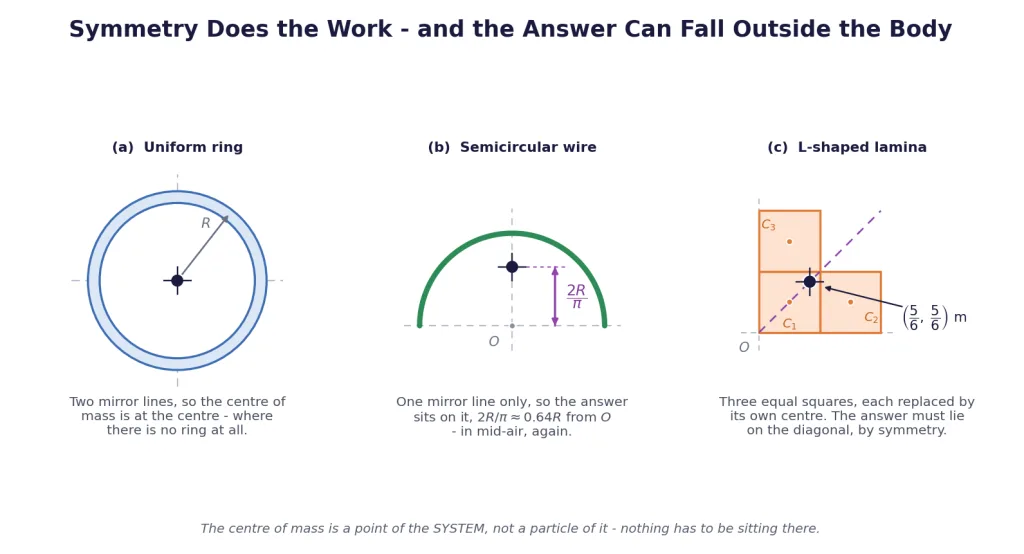
Look at panel (a). A uniform ring has two mirror lines, so its centre of mass is at the centre — where there is no ring at all. Nothing is sitting at the centre of mass. It is a point of the system, not a particle of it.
Panel (b) is a semicircular wire. It has one mirror line, so the answer sits on that line, at from the centre — again in mid-air, since the wire itself is everywhere at distance .
The same happens for a horseshoe, a boomerang, a bangle, an empty cup, a hollow sphere, a doughnut, a V-shaped bracket. A perfectly ordinary state of affairs, and a favourite one-mark question.
The standard table — print it in your memory
Distances are measured from the centre of the flat face (or the centre of the circle) along the axis of symmetry.
| Uniform body | Centre of mass |
|---|---|
| Thin rod, length | midpoint, from either end |
| Rectangular or square lamina | intersection of the diagonals |
| Circular ring or hoop, radius | the centre (no material there) |
| Circular disc, radius | the centre |
| Solid sphere or hollow spherical shell | the centre |
| Solid cylinder, length | midpoint of its axis |
| Triangular lamina, height | centroid, above the base |
| Semicircular wire, radius | from |
| Semicircular lamina (half disc), radius | from |
| Hemispherical shell, radius | from |
| Solid hemisphere, radius | from |
| Hollow cone (no base), height | above the base |
| Solid cone, height | above the base |
[NEET Important] The four that get asked over and over are the semicircular wire (), the half disc (), the solid hemisphere () and the solid cone (). Notice the pattern in the last two pairs: the solid version always sits closer to the flat face than the hollow one, because a solid body has more of its mass bunched near the base.
A caution. Symmetry only works if the body is uniform. A ring made of copper on one side and aluminium on the other has the same shape and a completely different centre of mass. Read the word "uniform" in the question before you reach for symmetry.
Composite Bodies and Cavities: Chop It Up, or Subtract
Most real questions are not a single clean shape. They are two shapes joined, or one shape with a bite taken out. Both cases use the same idea: replace each simple piece by a point particle at its own centre of mass, then apply the discrete formula.
Key Point — the composite rule: If a body is made of parts of masses whose individual centres of mass are at , then This is exact, not an approximation. The centre of mass of a system of bodies is found exactly as for a system of particles.
Worked: the L-shaped lamina
Panel (c) of the previous figure shows a uniform L-shaped lamina of mass 3 kg, made of three squares each 1 m on a side. Because the lamina is uniform, each square carries 1 kg.
By symmetry each square's own centre of mass is at its geometric centre, so with the axes as drawn the three point masses are
| Piece | Mass | Its centre of mass |
|---|---|---|
| 1 kg | ||
| 1 kg | ||
| 1 kg |
So the answer is m, about .
You could have guessed that it lies on the diagonal. Reflect the L-shape in the line and it maps onto itself, so that line is a mirror line and the centre of mass has to sit on it. That does not give the answer, but it checks it — and it is worth a mark for the reasoning.
And if the squares had different masses? Then the mirror symmetry is gone, but the method is untouched: use the same three positions with the actual masses in the weighted sum.
Cavities: the negative-mass trick
Now the other case. A uniform disc of radius has a circular hole of radius punched out of it, the hole's centre being at a distance from the centre of the disc.
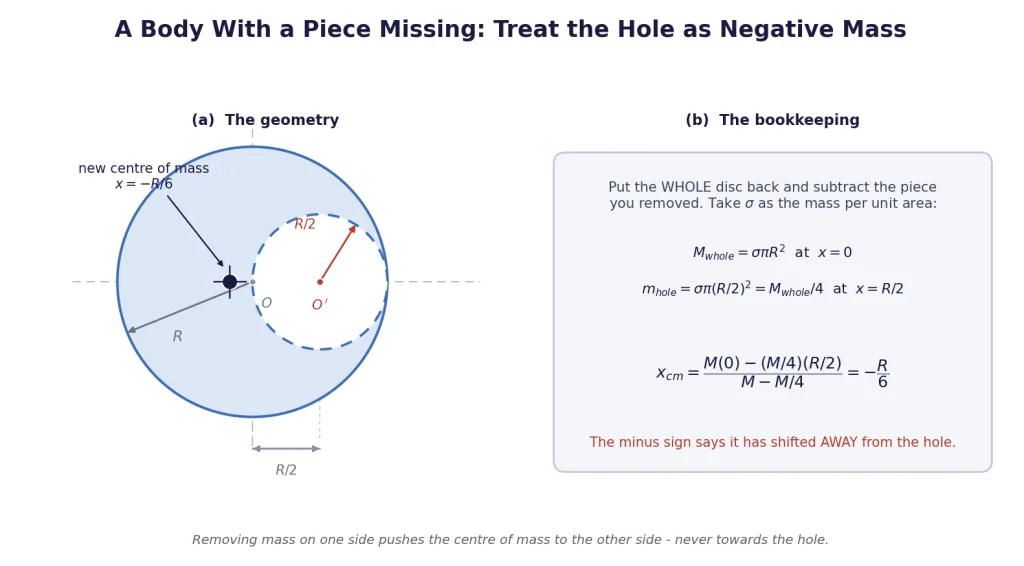
Integrating over the awkward crescent that is left would be unpleasant. Instead:
Key Point — the negative-mass method: Restore the removed piece, so that you have a whole body again, and then subtract it by treating the removed piece as having negative mass: Both the numerator and the denominator lose the removed part. Everything else is the ordinary composite rule.
Do it. Let be the mass per unit area. Put the origin at the centre of the full disc, with the hole's centre on the positive -axis.
- The whole disc: , its centre of mass at .
- The removed disc: radius , so with its centre of mass at .
- Subtract:
- , because the whole arrangement is symmetric about the -axis.
Read the minus sign. The centre of mass has moved to the side away from the hole, by . That is the physical sense-check: removing mass from the right pushes the balance point left. If your answer comes out on the hole's side, you have dropped a sign.
[JEE Tip] Three things make or break a cavity problem. (i) Compute the removed mass from its area or volume ratio, not by guessing — a hole of half the radius removes a quarter of a disc's mass but an eighth of a sphere's. (ii) Put the origin at the centre of the full body and the cavity on an axis; that kills one coordinate outright. (iii) Check the sign at the end.
The mass ratio table for cavities
| Removed piece | Fraction of the original mass removed |
|---|---|
| Disc of radius from a disc of radius | |
| Disc of radius from a disc of radius | |
| Sphere of radius from a sphere of radius | |
| Square of side from a square of side | |
| Cube of side from a cube of side |
For a lamina the fraction goes as the square of the length ratio; for a solid, as the cube.
What the Centre of Mass Is, and What It Is Not
A short block of housekeeping, because the misunderstandings here are expensive.
It is a point, not a particle
Nothing has to be sitting at the centre of mass. A ring's centre of mass is in the hole; a hollow sphere's is in the empty middle; a V-shaped bracket's is in the air between its arms. "Is there mass at the centre of mass?" — usually, but not necessarily, and it does not matter.
It is not the centre of the body
For a uniform body the two coincide, and that is why symmetry works. For a non-uniform one they do not. Three equal masses at the corners of a triangle put the centre of mass at the centroid; make them unequal and it moves off the centroid immediately. A cricket bat's centre of mass is nowhere near its geometric centre.
It is not (in general) the centre of gravity
These two are different ideas that happen to coincide in every problem you will meet at this level:
- the centre of mass depends only on how the mass is arranged;
- the centre of gravity is the point where the total weight may be taken to act.
They coincide whenever is uniform over the body — which for anything smaller than a mountain it is. Section 7 makes this precise and shows where the two would separate.
Its position in the body does not depend on the coordinate system
Slide the origin, rotate the axes, and the numbers , , change — but they always describe the same physical spot in the body. So choose the most convenient origin and say so.
Its motion is Section 3's business
This section only locates the centre of mass. What makes it worth locating is what happens next: the centre of mass of any system, however wildly its parts are moving, obeys as though the whole mass sat there and every external force acted there. That result — and the linear momentum that comes with it, and the exploding shell whose fragments scatter while the centre of mass sails serenely along the original parabola — is developed in Section 3.
The method, in order
- Look for symmetry first. Uniform and symmetric? The answer is the geometric centre; stop. One mirror line? The answer is on it, so one coordinate is already known.
- Discrete particles? Use , one axis at a time. Two particles only: use instead.
- A continuous body? Pick the element so that all of it shares one coordinate, write using , or , find first, then , then divide.
- A composite? Replace each simple part by a point mass at its own centre of mass and use the discrete formula.
- A cavity? Put the piece back and subtract it as a negative mass. Get the removed mass from the area or volume ratio.
- Always sanity-check. Is the answer inside the region the mass occupies? Is it on the side you expect — nearer the heavy end, away from the hole? Does it lie on the mirror line?
The classic mistakes
| Mistake | What to do instead |
|---|---|
| Using for three or more particles | Go back to the weighted sum |
| Assuming a non-uniform rod balances at its midpoint | Integrate; the midpoint is only for uniform rods |
| Taking the removed mass to be half when the radius is halved | For a lamina it is a quarter; for a solid, an eighth |
| Getting the centre of mass on the same side as the cavity | Recheck the sign; it always moves away from the hole |
| Mixing units in one sum (grams with kilograms, cm with m) | Convert everything first; the units cancel in the ratio, but only if they match |
| Forgetting that the answer may lie outside the material | Perfectly normal for rings, arcs and L or V shapes |
[Board Important] "Does the centre of mass of a body necessarily lie inside the body?" — answer no, and give the ring or the horseshoe as the example. It is asked almost every year in some form.
Solved Examples
No problem in this set needs .
Example 1: Two particles, and the inverse-ratio check
Particles of mass 2 kg and 3 kg lie on a straight line, 1.00 m apart. Locate the centre of mass, and verify that it divides the join in the inverse ratio of the masses.
Solution:
Choose the origin at the 2 kg particle, with the -axis along the join. Then and m.
Apply the definition:
Distances from each particle:
Check the inverse ratio: Equivalently and : equal, as required.
Check the origin does not matter. Put the origin at the 3 kg particle instead, so and . Then m, which is 0.40 m from the 3 kg particle on the side of the 2 kg one — the same physical point.
Final Answer: 0.60 m from the 2 kg particle, or equivalently 0.40 m from the 3 kg particle.
Takeaway: Step 5 is worth doing once in your life and then trusting forever: the centre of mass is a physical point and does not care where you put your origin. Choose the origin that makes the arithmetic shortest — usually at one of the masses.
Example 2: A diatomic molecule
In a carbon monoxide molecule the two nuclei are about Å apart ( Å m). An oxygen atom is about times as massive as a carbon atom, and essentially all of an atom's mass sits in its nucleus. Locate the centre of mass of the molecule.
Solution:
Set it up. Put the carbon nucleus at the origin and the oxygen nucleus at Å. Work in atomic mass units: u, u, total 28 u. The units of mass cancel in the formula, so there is no need to convert to kilograms.
Weighted sum:
From the other end: Å from the oxygen nucleus.
Sense-check with the inverse ratio. The centre of mass should be closer to the heavier oxygen, and by the factor . Indeed
Final Answer: about Å from the carbon nucleus, on the line joining the two nuclei — that is, Å from the oxygen nucleus.
Takeaway: Ratios of masses are all that matter, so any consistent mass unit will do — atomic mass units, grams, "times as massive as". Converting to kilograms here would waste a minute and risk an error. [NEET Important] Molecule problems are pure two-particle problems in disguise; go straight to .
Example 3: Three unequal masses at the corners of a triangle
Masses of 1 kg, 2 kg and 3 kg sit at the vertices of an equilateral triangle of side 1.00 m. Find the centre of mass. Is it at the centroid of the triangle?
Solution:
Choose coordinates. Put the 1 kg mass at the origin , the 2 kg mass at , and the 3 kg mass at the apex . For an equilateral triangle of side 1.00 m the apex is at
Total mass: kg.
The -coordinate:
The -coordinate: (Exactly .)
Compare with the centroid. The centroid of the triangle is the plain average of the vertices: Not the same point.
Why not? The centroid is what you get when the three masses are equal; then the weights cancel and the weighted mean becomes an ordinary mean. Here the 3 kg mass at the apex drags the centre of mass upwards and the 2 kg mass drags it to the right — exactly what the numbers show.
Final Answer: m; it is not the centroid, because the masses are unequal.
Takeaway: The centroid is the centre of mass only for equal masses (or for a uniform lamina). [JEE Tip] Whenever a question puts different masses at the corners of a symmetric figure, it is testing exactly this point — do not shortcut to the geometric centre.
Example 4: Four masses at the corners of a square
Masses 1 kg, 2 kg, 3 kg and 4 kg are placed at the corners , , , of a square of side 2.0 m, taken in order. Find the centre of mass.
Solution:
Coordinates. Put at the origin and the square in the first quadrant:
Total mass: kg.
-coordinate:
-coordinate:
Sense-check. The heavy side is the top ( kg above, kg below), so should be above the middle value 1.0 m. It is: 1.4 m. Left and right carry kg and kg — equal, so should sit exactly in the middle at 1.0 m. It does.
Final Answer: m from corner .
Takeaway: Do the two coordinates as two completely separate one-dimensional problems. And use the "which side is heavier?" check on each one — in this problem it pins down before you calculate anything.
Example 5: A rod whose density is not uniform
A rod of length lies along the -axis from to . Its linear mass density varies as , where is a constant. Find its centre of mass.
Solution:
Element: a slice of width at position , of mass .
Total mass first:
First moment:
Divide:
Sense-check. The density at is and at it is — twice as heavy at the far end — so the centre of mass must be beyond the midpoint but not by much. against : exactly the modest shift we expected.
Final Answer: , measured from the light end.
Takeaway: Compute by integration too — do not assume . Half the marks lost on non-uniform rod problems come from using the wrong total mass in the denominator. [JEE Tip] For the answer is always : check it — gives , gives .
Example 6: Deriving the centroid of a triangular lamina
Show by integration that the centre of mass of a uniform triangular lamina of base and height lies at a height above the base.
Solution:
Choose the element. Slice into strips parallel to the base, so that every point of a strip has the same . Take the strip at height , of thickness .
Its width. By similar triangles, the horizontal cut at height is shorter than the base in the ratio , so its width is .
Its mass. With surface density ,
Total mass (a good check): which is , that is, density times area. Correct.
First moment:
Divide:
The symmetry argument, as a cross-check. Each strip balances at its own midpoint, and the midpoints of all strips parallel to one side lie on the median from the opposite vertex. So the centre of mass lies on that median. Slice the other two ways and it lies on the other two medians as well. The only such point is the centroid — which is indeed above every side.
Final Answer: above the base, at the centroid.
Takeaway: The answer is from any side you choose as base, since the centroid divides each median in the ratio from the vertex. [Board Important] Both routes — the integral and the median argument — are acceptable derivations; the median argument is quicker and harder to get wrong.
Example 7: A semicircular wire
Find the centre of mass of a uniform semicircular wire of radius and mass .
Solution:
Use symmetry to kill one coordinate. Put the centre of the circle at the origin with the wire occupying the upper half. The -axis is a mirror line, so . Only needs work.
The element. Take the small piece of wire subtending an angle at the centre, at angle from the -axis. Its length is , and with ,
Its -coordinate: every point of that little piece is essentially at .
Integrate over the semicircle, from to :
Sense-check. , so , comfortably less than . It must be, since every bit of the wire is at distance from the centre but most of it is not directly overhead. And note where the answer is: at up the -axis, in mid-air — the wire itself is nowhere near there.
Final Answer: on the axis of symmetry, at a distance from the centre.
Takeaway: Note the two savings: symmetry removed one coordinate for free, and choosing (rather than ) as the variable made the element trivially simple. [NEET Important] for the wire and for the half disc are worth memorising outright; questions rarely leave time to derive them.
Example 8: A semicircular lamina
Find the centre of mass of a uniform half disc of radius and mass .
Solution:
Symmetry again. With the flat edge along the -axis and the material in the upper half plane, .
The element — choose it well. Slice the half disc into thin semicircular strips of radius and thickness . Each such strip is itself a semicircular wire, and Example 7 already told us that its own centre of mass is at . That saves a whole integration.
Mass of the strip. Its area is (length , thickness ), so with ,
Integrate:
Sense-check. , so — less than the of the wire, and it should be: the lamina has material spread all the way down to the flat edge, while the wire has all its mass out at the rim.
Final Answer: on the axis of symmetry, at from the centre of the flat edge.
Takeaway: Step 2 is the trick worth stealing — build a harder body out of a shape whose centre of mass you already know. The same move gives a solid hemisphere from hemispherical shells, and a solid cone from discs.
Example 9: The L-shaped lamina
A uniform L-shaped lamina of total mass 3 kg is made of three squares, each 1 m by 1 m. With the origin at the inner corner of the L, the squares occupy the regions , and . Locate the centre of mass.
Solution:
Split into pieces whose answers you know. Three equal squares, and the lamina is uniform, so each square has mass kg. Each square's own centre of mass is at its geometric centre.
Tabulate:
Square Mass 1 kg 1 kg 1 kg Weighted sums:
Check it with symmetry. Reflecting the L in the line maps it exactly onto itself, so that line is a mirror line and the centre of mass must lie on it. Our answer has . Consistent.
Is the point inside the material? Yes — lies inside the corner square. For a slightly different L it need not; there is no rule that says it must.
Final Answer: m, that is, about m from the inner corner.
Takeaway: Cut a composite into the fewest pieces whose centres of mass you already know, and never integrate what you can split. And always look for a mirror line first: here it gives you half the answer before any arithmetic.
Example 10: A disc with a hole punched out of it
From a uniform circular disc of radius cm, a circular piece of radius 6 cm is removed. The centre of the removed piece is 6 cm from the centre of the disc. Locate the centre of mass of what is left.
Solution:
Set up. Origin at the centre of the full disc; -axis along , where is the centre of the hole, at cm. By symmetry about this axis, .
Masses from areas. Let be the mass per unit area. So — a quarter, because the radius halved and area goes as radius squared.
Remaining mass: .
Subtract the hole as a negative mass:
In symbols. With a hole of radius centred at , and cm. Agreed.
Read the sign. Negative means it has moved away from the hole, to the side of the disc that still has all its material.
Final Answer: 2.0 cm from the centre of the disc, on the side opposite the hole.
Takeaway: Two habits will carry you through every cavity problem. Get the removed mass from the area (or volume) ratio, never from the radius ratio, and check the direction at the end — the centre of mass always retreats from a hole. [JEE Tip] The general result for this exact configuration is worth remembering; it appears constantly.
Example 11: A square plate with a square hole
A uniform square plate of side 4.0 m has its corner quarter — a square of side 2.0 m — cut away. Taking the origin at a corner of the plate that survives, with the plate occupying and the removed square occupying , find the centre of mass of the remainder.
Solution:
Masses from areas, with the mass per unit area: The cut removes of the plate.
Remaining mass: .
Subtract:
By symmetry, is the same. The whole arrangement — plate and hole together — is unchanged by reflection in the line , so
Sense-check. Before the cut the centre of mass was at . Removing material from the far corner should pull it back towards the origin, and it has: .
Final Answer: m, about m from that corner.
Takeaway: The negative-mass method does not care what shape the hole is — square, circular, triangular, all the same. [JEE Tip] Look for a mirror line before you compute the second coordinate; here it halved the work.
Example 12: Placing a third mass to put the centre of mass where you want it
(a) Particles of mass 1 kg and 2 kg lie at and m. Where must a 3 kg particle be placed so that the centre of mass of the three is at the origin?
(b) In two dimensions, a 1 kg particle sits at m and a 2 kg particle at m. Where must a 3 kg particle be placed so that the centre of mass of the system is at the origin?
Solution:
The condition. "Centre of mass at the origin" means — the balance identity from earlier in this section. That is much easier to work with than the fraction.
(a) One dimension.
Check (a):
(b) Two dimensions — do the two components separately.
Check (b):
Final Answer: (a) at m; (b) at m, about m.
Takeaway: When the target is the origin, use rather than the full formula — no denominator to carry, no fractions. [JEE Tip] If the question instead asks for the centre of mass to be at some point , shift your origin to first and the same trick works.