
The Result That Makes the Centre of Mass Worth Finding
Section 2 taught you to locate the centre of mass. It deliberately stopped there, and it owed you a reason for caring. Here it is.
Think of it this way. A cricket bat tossed across the room tumbles end over end; a firework shell bursts into forty glowing fragments; a swimmer thrashes on a diving board. In every one of these the individual particles move in ways nobody could write down. And yet one point in each of them moves along a path you could have predicted before it started — a clean parabola, in fact, in all three cases. That point is the centre of mass, and this section proves why.
Differentiate the definition. Twice.
Start from the definition of Section 2, cleared of its denominator:
The masses do not change with time, so differentiating with respect to is easy — every becomes a velocity:
Here is the velocity of the centre of mass. Differentiate once more:
and is the acceleration of the centre of mass. So far this is pure calculus; no physics has been used.
Now bring in Newton
By Newton's second law applied to the -th particle, , where is the total force on that particle. Therefore
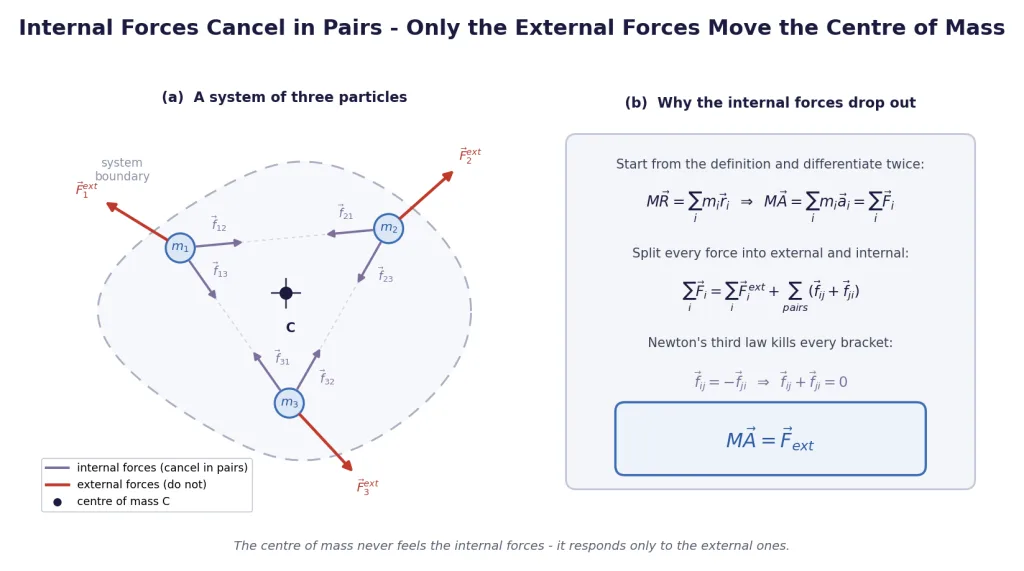
Now split each into two parts:
- external forces — exerted by things outside the system (gravity, a push from a hand, friction from the floor, a rope tied to a wall);
- internal forces — exerted by one particle of the system on another (the chemical bonds in the bat, the explosive gases pushing on the shell fragments, the muscles of the swimmer).
Write for the force that particle exerts on particle . Then
The internal forces vanish, and they vanish exactly
Newton's third law says : whatever particle 2 does to particle 1, particle 1 does back to particle 2, equal and opposite. So every bracket in that second sum is zero. Not small — zero. The internal forces cancel in pairs and contribute precisely nothing.
Key Point — the equation of motion of the centre of mass: The centre of mass of a system of particles moves as if all the mass of the system were concentrated there and every external force acted at that point. Internal forces, however violent, cannot move it.
Read it slowly, because it says a lot
You need no knowledge of the internal forces at all. To predict the path of the centre of mass you need only the external forces. The explosion inside the shell, the tension in the swimmer's tendons, the collisions between gas molecules — all of it is irrelevant.
It works for absolutely any system. A rigid body, a bag of sand, a cloud of gas, a family of planets, two carts joined by a spring. Nothing in the derivation assumed the particles keep fixed distances.
It is the justification for everything you did in earlier chapters. When you called a car "a particle of mass 1000 kg" and applied , you were secretly using this result. You were tracking the car's centre of mass, and the internal forces you ignored genuinely did not matter.
[Board Important] "Show that the internal forces of a system do not affect the motion of its centre of mass." That is a full derivation question: the two differentiations, the split into external and internal, and Newton's third law killing the internal sum. Write all three steps.
Linear Momentum of a System, and Newton's Second Law Rewritten
For a single particle you already know and . Extending both to a system takes almost no work — and the payoff is large.
Total momentum of a system
The total linear momentum of a system is simply the vector sum of the individual momenta:
But that right-hand side is exactly what came out of the first differentiation in the last block. So:
Key Point — the momentum of a system: The total linear momentum of a system equals the total mass times the velocity of the centre of mass. A hundred particles buzzing about in a hundred directions have exactly the momentum of a single body of mass moving at .
This is worth pausing on. It means you never have to add a hundred momentum vectors: find and multiply by . It also means that a system whose centre of mass is at rest has zero total momentum, no matter how fast its parts are moving.
Newton's second law for a system
Differentiate once, with constant:
and comparing with from the previous block,
Key Point: This is Newton's second law extended from one particle to any system whatever. The rate of change of the total momentum equals the net external force.
Three forms of the same statement
These three are the same equation wearing different clothes. Learn to move between them instantly:
| Form | Says |
|---|---|
| how the centre of mass accelerates | |
| how total momentum and the centre of mass are linked | |
| how total momentum changes |
[JEE Tip] In a problem, choose the form that matches what you are given. Given forces and asked for motion, use . Given "before" and "after" states, use and the conservation statement of the next block. Trying to force one route when the other is natural is where the time goes.
A worked reading: the exploding shell, before it explodes
A shell of mass flies through the air. The only external force on it is gravity, . So
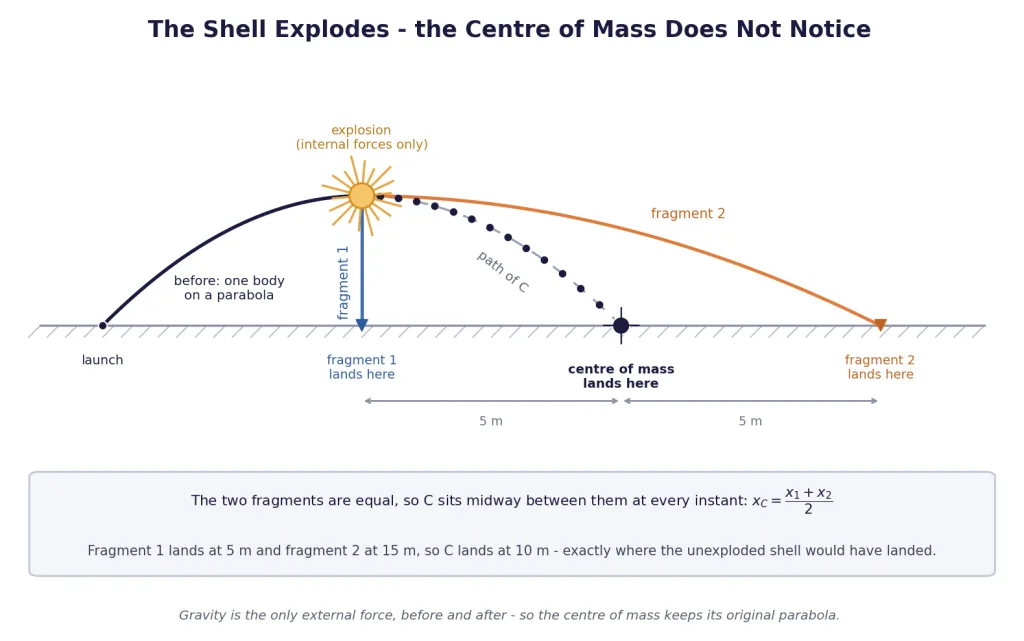
The centre of mass falls with acceleration — which is why the shell traces a parabola. Now let it explode. The explosive forces are internal, so they change no term in . The external force is still (the total mass has not changed; the fragments are all still there). Therefore is still , and the centre of mass carries on down the very same parabola. That is the picture the next block is built around.
Conservation of Linear Momentum for a System
Everything so far has been machinery. Here is the law it exists to produce.
The statement
Put in :
Key Point — conservation of linear momentum: When the net external force on a system is zero, Equivalently, since : the velocity of the centre of mass stays constant. The centre of mass either stays at rest or moves uniformly in a straight line, like a free particle — no matter what the individual particles get up to.
It is three laws, not one
is a vector, so constant is really
three separate scalar statements. And they are independent:
Key Point: If only the -component of the net external force is zero, then only is conserved. The other components are not.
[JEE Tip] This is the single most useful refinement in the whole topic. A firecracker exploding in mid-air has gravity acting on it, so is not conserved — but gravity is vertical, so is. Half the exploding-projectile questions in JEE Main turn on exactly this. Always ask the question one axis at a time.
When is the net external force zero?
In practice, one of these:
| Situation | Why (or nearly) |
|---|---|
| A body explodes or breaks up | Explosive forces are internal; take the horizontal direction, where gravity does not act |
| Two bodies collide | Collision forces are internal and enormous, so external forces are negligible during the brief contact |
| Recoil of a gun, rocket exhaust | Firing forces are internal to the gun-and-bullet system |
| Radioactive decay | Nuclear forces are internal; external forces on a nucleus are negligible |
| Objects on a frictionless horizontal surface | Weight and normal force cancel; nothing else acts horizontally |
| Two people pulling a rope on ice | Rope tension is internal; friction is absent |
Recoil, and the two-body break-up
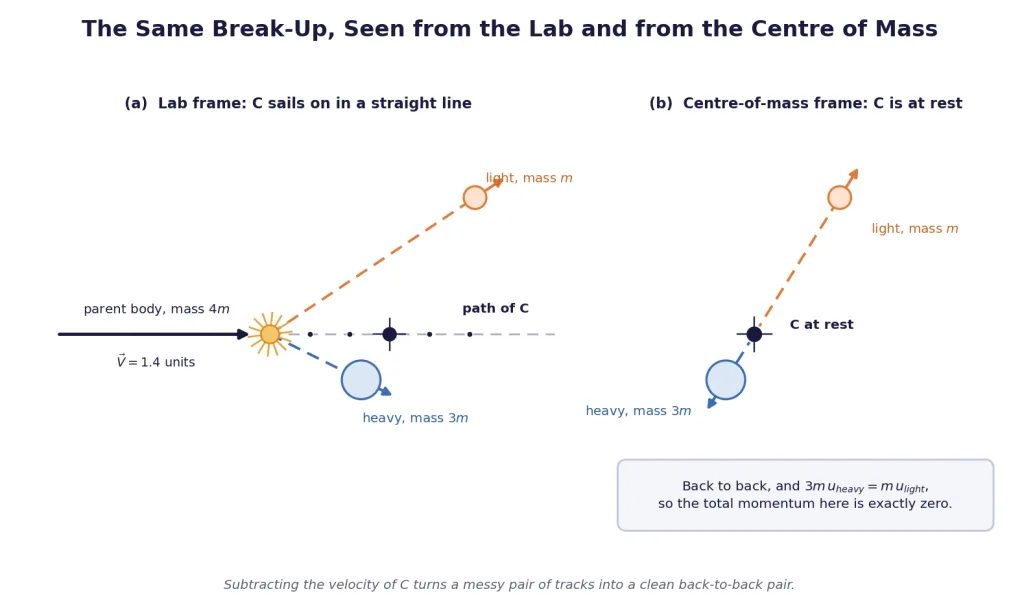
Take the commonest case of all: a body at rest breaks into two pieces, of masses and . Before: . After: must still be , so
Read off three consequences, all of them examinable:
- The two pieces fly apart along the same line, in opposite directions — "back to back".
- Their speeds are in the inverse ratio of their masses: . The lighter piece is the faster one.
- Their kinetic energies are also in the inverse ratio of the masses. Since and both carry the same magnitude of momentum , The lighter piece walks off with most of the energy. A rifle bullet takes essentially all of it; the rifle keeps a couple of joules.
[NEET Important] Memorise the pair: same momentum magnitude, energy in the inverse ratio of the masses. "A bomb at rest splits into pieces of mass ratio 1 : 3 — find the ratio of their kinetic energies" is answered in five seconds as 3 : 1.
Radioactive decay is the same problem
A radium nucleus at rest disintegrates into a radon nucleus and an alpha particle. The forces driving the decay are internal; nothing external matters. So the radon and the alpha fly apart back to back, with speeds in the ratio inverted, and the light alpha particle carries away over 98% of the released energy. If the radium nucleus was moving to begin with, the two products still move so that their centre of mass keeps sailing along the original straight line — which is exactly panel (a) of the figure above.
Momentum is conserved; kinetic energy usually is not
Be careful here, because it is a favourite trap. In an explosion, chemical energy is released, so the kinetic energy afterwards is greater than before. In a completely inelastic collision, kinetic energy is lost to heat and deformation. Momentum, meanwhile, is untouched in both cases.
Key Point: is conserved whenever , whatever happens internally. Kinetic energy is a separate question and is conserved only in elastic processes.
The Exploding Projectile, and Other Places It Pays Off
This is the showpiece of the whole section, and the one the exam sets most often.
The set-up
A shell is fired and follows the usual parabola. Somewhere in mid-flight it explodes into fragments that go scattering off in all directions. What happens to the centre of mass?
Nothing at all happens to it. The forces of the explosion are internal, so they do not appear in . The external force is still gravity acting on the same total mass, so still. The centre of mass continues along the original parabola as though there had been no explosion, and it lands where the unexploded shell would have landed.
Two rules for solving these
Key Point — the exploding-projectile recipe:
- Find where the unexploded shell would have gone. That is the path of the centre of mass, before, during and after the burst.
- Then place the fragments so that their centre of mass sits on that path at every instant. For two fragments of masses and ,
Note the subtlety in step 2: this locates the fragments at the same instant. If they land at different times you must be careful — but in the standard exam problem the fragments are launched from the highest point, where the vertical velocity is zero, so both fragments (and the imaginary unexploded shell) take exactly the same time to fall, and you can compare landing points directly.
[JEE Tip] If one fragment is given as "falling vertically downward", it means that fragment's horizontal velocity is zero immediately after the burst. Then all the horizontal momentum goes to the other fragment, and for two equal halves the second one moves at twice the original horizontal speed.
Internal motion cannot shift the centre of mass
Turn the same idea sideways and you get a second family of problems.
Suppose the net external force on a system is zero and the system starts at rest. Then forever, and so the centre of mass cannot move at all. Integrating over time gives the displacement form:
Key Point — the displacement rule: For a system with starting from rest, The mass-weighted displacements must add to zero. Whatever one part gains on one side, the rest must give back on the other.
Two people on frictionless ice
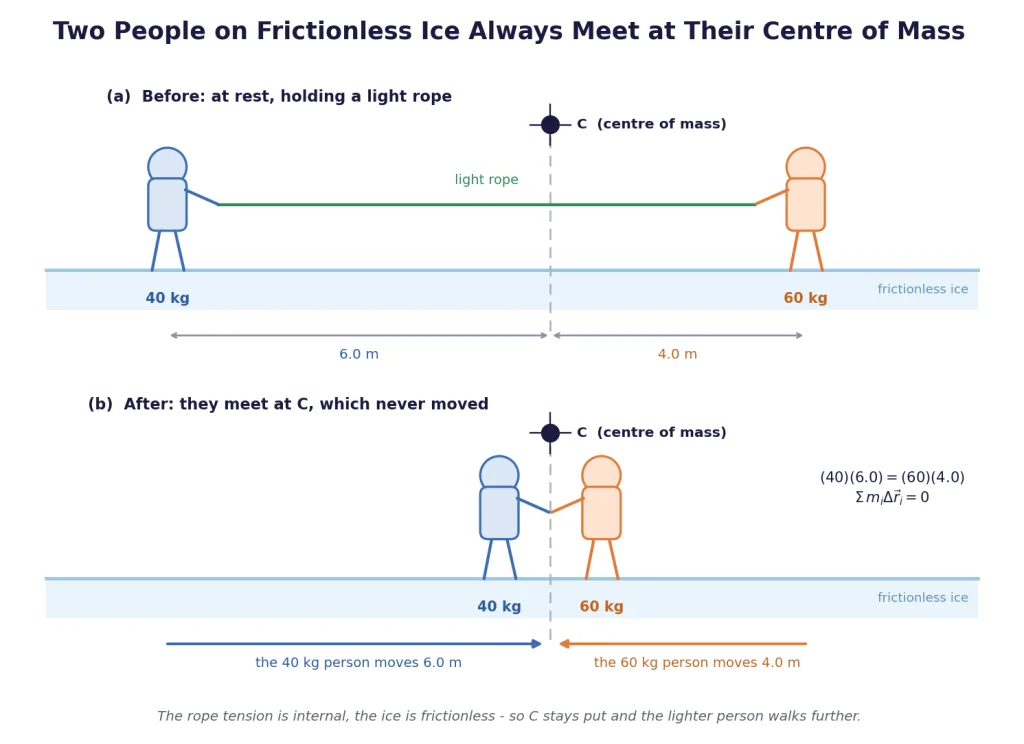
Two people of masses 40 kg and 60 kg stand 10 m apart on frictionless ice, holding the ends of a light rope. They pull. Where do they meet?
The rope tension is internal. The ice is frictionless, so nothing external acts horizontally. They start at rest, so their centre of mass never moves — and since they end up at the same place, that place must be the centre of mass: from the 40 kg person. So the 40 kg person walks 6.0 m and the 60 kg person only 4.0 m. Check with the displacement rule: , and with the signs included the sum is zero.
The lighter person always travels further, and the ratio of the distances is the inverse ratio of the masses. Their speeds at every instant are in that same inverse ratio, so they arrive together.
The same idea, three more times
| Problem | What is internal | The answer in one line |
|---|---|---|
| Man walks from one end of a floating boat to the other | Friction between his feet and the deck | Boat slides back so that |
| Child runs about on a trolley moving on a smooth floor | Friction between shoes and trolley | The speed of the centre of mass is completely unchanged |
| Two blocks fly apart when a compressed spring is released | The spring force | , and the centre of mass stays put |
[Board Important] "A child sits at one end of a trolley moving uniformly with speed on a smooth floor. The child gets up and runs about. What is the speed of the centre of mass of the trolley-and-child system?" The answer is , unchanged, and the reason is that the child's muscles exert only internal forces while the floor is smooth. One line of reasoning, full marks.
The Centre-of-Mass Frame
Every problem in this section gets easier if you look at it from the right place. That place is the centre of mass.
Definition
The centre-of-mass frame (also called the C-frame, or the zero-momentum frame) is the reference frame that moves along with the centre of mass. To convert into it, subtract from every velocity:
The primes mean "as measured in the centre-of-mass frame".
Its defining property
Add up the momenta in the new frame:
Key Point: In the centre-of-mass frame the total momentum of the system is always exactly zero: and the centre of mass itself is at rest at the origin. That is what makes the frame worth using.
This is the moving version of the identity Section 2 gave you: when positions are measured from the centre of mass. Differentiate that and you get exactly the statement above.
Why it helps
Two-body problems become one-body problems. For two particles with zero total momentum, at every instant. Learn one velocity and you know the other. A messy pair of curved tracks in the lab becomes a clean back-to-back pair.
Break-ups look trivial. A particle that decays at rest in this frame sends its two products off exactly back to back. A binary star system becomes two circles about a common stationary centre. In the lab you then just add back to everything.
Collisions simplify. In the centre-of-mass frame a head-on collision has both particles approaching, colliding, and (if elastic) leaving with their speeds unchanged and directions reversed. You will use this heavily when you meet collisions in detail.
The kinetic energy splits in two
Here is the other reason the frame matters. Write and grind out the total kinetic energy. The cross term contains , which is zero, so it disappears and you are left with
Key Point — the kinetic energy of a system splits cleanly: The first term is the translational kinetic energy of the system as a whole; the second is the internal kinetic energy, which is what an explosion adds and what a perfectly inelastic collision destroys.
This split will come back with real force in Section 11, where a rolling body's energy separates into plus a rotational term.
[JEE Tip] For two particles the internal term has a tidy closed form: , where is the reduced mass and is their relative speed. So the energy that a collision can destroy is at most — the part is locked in by momentum conservation and cannot be lost.
Separating the two motions is the big idea of the chapter
Look at what has happened over these two sections. The motion of any system splits into
- the motion of the centre of mass, governed entirely by the external forces through , and
- the motion about the centre of mass, governed by whatever is happening inside.
For a binary star, the first is a straight line and the second is a pair of circles. For a spinning tossed spanner, the first is a parabola and the second is a rotation. Chapter after chapter, that is the decomposition physics keeps returning to — and from Section 4 onwards we build the tools to describe the second half of it.
Method, Traps and a Checklist
The method, in order
- Draw a box around your system and ask what crosses the boundary. Forces from inside the box are internal and can be ignored for the motion of the centre of mass. Forces from outside are external and are all that matter.
- Check each axis separately. "Is the net external force zero?" is really three questions. Very often the horizontal answer is yes and the vertical answer is no.
- If along an axis, write down constant on that axis — total momentum before equals total momentum after, with signs.
- If the system started at rest, go straight to for displacement questions, or for velocity ones.
- If forces are given rather than a before-and-after pair, use to get the acceleration of the centre of mass directly.
- Sanity-check the direction. The lighter piece must be faster; the centre of mass must lie between the fragments; a body that started at rest must have its pieces going opposite ways.
The traps that cost marks
| Trap | The fix |
|---|---|
| "The explosion changes the path of the centre of mass" | It cannot. Explosive forces are internal |
| Conserving total for a projectile that bursts in mid-air | Only the horizontal component is conserved — gravity acts vertically |
| Forgetting that momentum is a vector | Add components, not magnitudes. Opposite directions need opposite signs |
| Assuming kinetic energy is conserved in an explosion or a collision | It is not. Only momentum is |
| Taking the heavier fragment to carry more energy | The lighter one does, in the inverse ratio of the masses |
| Using the mass before the break-up in the "after" equation | Use each fragment's own mass; only the total is unchanged |
| Comparing fragment positions at different times | The centre-of-mass condition holds instant by instant |
| Thinking a system with zero total momentum has all its parts at rest | It only means the centre of mass is at rest |
What is worth memorising
Key Point — the five lines of this section:
Where this goes next
Section 4 changes subject completely and builds a piece of vector algebra — the cross product — from scratch. It looks like a detour, and it is not: from Section 5 onwards every rotational quantity in this chapter is defined as a cross product, and Section 6 will do for rotation exactly what this section did for translation, producing by the same argument about internal effects cancelling in pairs. If you understood why the internal forces dropped out here, you have already understood half of Section 6.
Solved Examples
Every problem here that needs uses m/s².
Example 1: The child who runs about on a moving trolley
A trolley of mass 200 kg moves uniformly at 3.0 m/s on a smooth horizontal floor. A child of mass 40 kg sits still on it.
(a) The child now gets up and runs about on the trolley in any manner whatsoever. What is the speed of the centre of mass of the trolley-and-child system?
(b) At one moment the child is running forward at 5.0 m/s relative to the ground. How fast is the trolley moving then?
Solution:
Identify the external forces. Gravity acts downward and the floor pushes up; these cancel. The floor is smooth, so there is no horizontal external force. Every force between the child's shoes and the trolley is internal.
(a) Apply the law. With horizontally, is constant, so is constant: It does not matter what the child does — run, jump, sit down again.
(b) Write the momentum statement. Total mass is kg, so This must still equal the sum of the two individual momenta:
Solve:
Sense-check. The child sped up from 3.0 to 5.0 m/s, so the trolley must have slowed from 3.0 to 2.6 m/s. Recompute the centre of mass: m/s. Unchanged, as required.
Final Answer: (a) 3.0 m/s, exactly as before. (b) 2.6 m/s.
Takeaway: Internal forces cannot change . Part (a) needs no arithmetic at all — just the recognition that the floor is smooth. [Board Important] This is one of the most frequently asked one-mark questions in the chapter; the answer is always "unchanged, because the forces involved are internal".
Example 2: Velocity and momentum of a two-particle system
A 2 kg particle has velocity m/s and a 3 kg particle has velocity m/s. Find the velocity of the centre of mass and the total momentum of the system.
Solution:
Total mass: kg.
Sum the momenta, component by component. in kg m/s.
Velocity of the centre of mass:
Total momentum — two ways, and they must agree. Directly, kg m/s. Or through the centre of mass, kg m/s. Agreed.
Magnitude:
Final Answer: m/s and kg m/s, of magnitude about 16.3 kg m/s.
Takeaway: turns "add up all the momenta" into "find one velocity and multiply". Never add the magnitudes — would give , which is wrong. Components first, always.
Example 3: The shell that bursts at the top of its flight
A shell is fired from the ground with velocity components m/s horizontally and m/s vertically. At the highest point of its path it explodes into two equal fragments. One of them falls vertically to the ground. Where does the other one land? Take m/s².
Solution:
Describe the flight before the burst.
Where does the centre of mass land? The explosion is internal, so the centre of mass keeps the original parabola and lands at 240 m from the launch point.
Fragment 1. "Falls vertically" means it has no horizontal velocity after the burst, so it drops straight down from the point 120 m along, landing at m. (It falls the same 80 m in the same 4.0 s, since at the top the vertical velocity was zero for everything.)
Fragment 2, from the centre of mass. The two halves are equal, so the centre of mass is midway between them:
Cross-check with momentum. Just before the burst the shell of mass moved horizontally at 30 m/s, so . After: fragment 1 has zero horizontal momentum, so Fragment 2 then travels horizontally for the same 4.0 s of fall: m. The two routes agree.
Final Answer: The second fragment lands 360 m from the launch point (240 m beyond the first fragment).
Takeaway: Two independent routes — the centre of mass, and horizontal momentum — and you should be able to run either. [JEE Tip] When one equal half "falls vertically", the other always leaves at twice the original horizontal speed, and the landing points are symmetric about the undisturbed range: , , .
Example 4: An unequal break-up in mid-air
A shell of mass 5 kg is moving horizontally at 30 m/s at the top of its trajectory when it explodes into a 2 kg piece and a 3 kg piece. Immediately after the burst the 2 kg piece is seen moving vertically upward at 30 m/s. Find the velocity of the 3 kg piece immediately after the burst. Take m/s².
Solution:
Why momentum applies. The explosion lasts a tiny time. The explosive forces are internal and enormous; the impulse of gravity over that instant is negligible. So both components of momentum are conserved across the burst itself.
Momentum before, with horizontal and vertically upward:
Momentum after:
Equate and solve:
Interpret. Speed m/s, directed at below the horizontal, and forward.
Sense-check. The 2 kg piece was thrown upward, so the 3 kg piece must be thrown downward — the vertical momenta must cancel, and . They do. And the 3 kg piece must carry all the forward momentum plus a bit more, since the light piece took none: . Correct.
Final Answer: m/s — about 53.9 m/s at 21.8° below the horizontal.
Takeaway: Do the two components separately; there is no shortcut that mixes them. [JEE Tip] After solving, always check each component's bookkeeping on its own line. The vertical check takes two seconds and catches an arithmetic slip immediately.
Example 5: Two people pulling a rope on frictionless ice
Two people of masses 40 kg and 60 kg stand at rest 10 m apart on a frictionless frozen lake, holding the two ends of a light rope. They pull on the rope and eventually meet.
(a) How far does each of them travel? (b) What is the ratio of their speeds at any moment?
Solution:
Set up. Put the origin at the 40 kg person, with the other at m.
Where is the centre of mass?
Why that is the answer. The rope tension is internal; the ice is frictionless, so there is no horizontal external force; and they start at rest. Therefore the centre of mass never moves. Since they end up together, they must end up at the centre of mass.
(a) Distances travelled: Check with the displacement rule: and , equal and opposite, so .
(b) Speeds. At every instant , so The lighter person moves 1.5 times as fast — which is exactly why they cover 6.0 m while the other covers 4.0 m in the same time.
Final Answer: (a) the 40 kg person travels 6.0 m, the 60 kg person 4.0 m; (b) their speeds are always in the ratio 3 : 2.
Takeaway: They meet at the centre of mass, always — and it makes no difference whether they haul hand over hand, pull once hard, or take turns. [NEET Important] The answer depends only on the masses and the initial separation, never on how they pull.
Example 6: The man who walks along a boat
A man of mass 60 kg stands at one end of a 120 kg boat of length 3.0 m, floating at rest on still water. He walks to the other end. Assuming the water offers no resistance, how far does the boat move, and how far does the man move relative to the water?
Solution:
The system is man plus boat. Water resistance is neglected, so there is no horizontal external force, and everything starts at rest. Therefore the centre of mass stays exactly where it is.
Let the boat slide back a distance (opposite to the man's walk) as measured from the bank. The man's displacement relative to the boat is the boat's length, 3.0 m; so his displacement relative to the water is forward.
Apply , taking forward as positive:
So: the boat moves 1.0 m backwards, and the man moves m forwards relative to the water.
Check. forward and backward. They cancel, so the centre of mass has not budged. Also note — the inverse ratio of the masses, as always.
Final Answer: The boat moves 1.0 m in the direction opposite to the man's walk; the man moves 2.0 m relative to the water.
Takeaway: The one place people go wrong is step 2: the given 3.0 m is the man's displacement relative to the BOAT, not relative to the water. Write the ground-frame displacement as (relative displacement) minus (boat's displacement) and the rest is arithmetic. [JEE Tip] The general result is ; here m.
Example 7: Recoil of a rifle, and where the energy goes
A rifle of mass 4.0 kg fires a bullet of mass 20 g with a muzzle speed of 400 m/s. Find (a) the recoil speed of the rifle and (b) the kinetic energies of bullet and rifle, and comment on the comparison.
Solution:
The system is rifle plus bullet. The explosive forces are internal, and during the tiny firing time no significant external horizontal force acts. Total momentum before firing is zero.
(a) Conserve momentum. With the bullet's direction positive and kg, The minus sign is the recoil: the rifle moves backwards at 2.0 m/s.
(b) Kinetic energies:
The comparison. The bullet carries 200 times the energy of the rifle. That is no coincidence: Equal momenta, energies in the inverse ratio of the masses.
And notice what is not conserved. Before firing the kinetic energy was zero; afterwards it is 1608 J. That energy came from the propellant, so kinetic energy is emphatically not conserved — only momentum is.
Final Answer: (a) 2.0 m/s backwards. (b) 1600 J for the bullet against 8.0 J for the rifle — a factor of 200, equal to the mass ratio.
Takeaway: Same momentum, wildly different energies. This is why the rifle bruises your shoulder instead of killing you. [NEET Important] For any break-up from rest, — quote it, do not re-derive it.
Example 8: Radioactive decay of a radium nucleus
A radium nucleus at rest decays into a radon nucleus (mass number 222) and an alpha particle (mass number 4). The alpha particle is emitted with a speed of m/s.
(a) Find the recoil speed of the radon nucleus. (b) What fraction of the released energy does the alpha particle carry?
Solution:
Nothing external acts, and the nucleus starts at rest, so the total momentum stays zero. The two products must therefore fly apart back to back.
(a) Momentum balance, using mass numbers as the masses (their common unit cancels):
Sense-check. The radon is 55.5 times heavier, so it must be 55.5 times slower: . Correct.
(b) Energies. Both particles carry the same magnitude of momentum , so with ,
Convert to a fraction:
Final Answer: (a) about m/s, in the direction opposite to the alpha particle. (b) about 98.2% of the released energy.
Takeaway: A decay at rest is just a two-body break-up in different clothes. Mass numbers are fine as masses because only their ratio matters. [NEET Important] "Which product carries more energy?" — always the lighter one, and by the mass ratio.
Example 9: A body at rest that shatters into three pieces
A body of mass 6 kg lying at rest on a frictionless horizontal table explodes into three pieces of 2 kg each. One flies off at 4.0 m/s along the direction and a second at 3.0 m/s along the direction. Find the velocity of the third piece.
Solution:
Momentum before is zero, and no external horizontal force acts, so the total momentum after must also be zero:
Substitute:
Solve:
Magnitude and direction: pointing into the third quadrant, at below the axis — that is, exactly opposite to the resultant of the first two.
Check. for , and for . Total momentum is zero. Correct.
Final Answer: m/s, a speed of 5.0 m/s directed opposite to the vector sum of the other two momenta.
Takeaway: With three or more fragments the rule is unchanged: the momentum vectors must close up into a zero resultant. Draw them tip to tail and they form a closed polygon. [JEE Tip] When the first two are perpendicular, the third has magnitude — here a 3-4-5 triangle, which is why 5.0 m/s came out so cleanly.
Example 10: Acceleration of the centre of mass of an Atwood machine
Two masses of 3 kg and 1 kg hang from the two ends of a light inextensible string passing over a light frictionless pulley. Find the acceleration of the centre of mass of the two masses. Take m/s².
Solution:
Accelerations of the blocks. For the standard machine, The 3 kg block accelerates down at 5.0 m/s²; the 1 kg block accelerates up at 5.0 m/s².
Combine them into the centre of mass, taking downward as positive:
A second, independent route — external forces only. The system is the two blocks. The external forces are the two weights, N down, and the two string tensions pulling up on the blocks. With the net external force is N downward, so The two routes agree.
The closed form. In general ; here m/s². Note that it is the square of the mass fraction.
Final Answer: 2.5 m/s², directed downward (towards the heavier mass).
Takeaway: The centre of mass accelerates even though the system as a whole "goes nowhere" — because the pulley supplies an external upward force smaller than the total weight. [JEE Tip] Check the two limits of the closed form: equal masses give (nothing moves), and gives (free fall). A formula that survives both limits is probably right.
Example 11: Two blocks and a compressed spring
Two blocks of 2 kg and 3 kg rest on a frictionless horizontal table with a compressed spring squeezed between them, held by a thread. The thread is burnt. The 2 kg block moves off at 6.0 m/s.
(a) Find the speed of the 3 kg block. (b) Find the energy that was stored in the spring. (c) Where is the centre of mass while all this happens?
Solution:
(a) Momentum. The spring force is internal and the table is frictionless, so total momentum stays zero: in the opposite direction.
(b) Energy. All the stored energy goes into kinetic energy (the blocks leave the spring behind):
Check the energy split. , the inverse mass ratio, exactly as the theory demands.
(c) The centre of mass. It started at rest and no external horizontal force acts, so it stays exactly where it was — permanently. The blocks separate symmetrically about it, the lighter one always 1.5 times further away.
Final Answer: (a) 4.0 m/s; (b) 60 J; (c) at rest, unmoved, at its original position.
Takeaway: Momentum gives you the speeds; energy is then a separate calculation. Never assume the two blocks share the energy equally — they share the momentum equally in magnitude, which is a different thing entirely.
Example 12: Splitting the kinetic energy about the centre of mass
A 2 kg particle moves at m/s and a 3 kg particle at m/s along the same straight line. Find (a) the velocity of the centre of mass, (b) the total kinetic energy, and (c) how that energy divides between the motion of the centre of mass and the motion about it.
Solution:
(a) Velocity of the centre of mass:
(b) Total kinetic energy in the lab frame:
(c) The bulk part.
The internal part — go into the centre-of-mass frame. Subtract from each velocity: Momentum check: , exactly as the frame demands.
They add up: J, the total from step 2.
A third route to the same 29.4 J. With the reduced mass kg and relative speed m/s,
Final Answer: (a) m/s; (b) 31 J; (c) 1.6 J belongs to the motion of the centre of mass and 29.4 J to the internal motion.
Takeaway: Only the internal 29.4 J is available to be lost in a collision — the 1.6 J is locked in by momentum conservation and cannot go anywhere. [JEE Tip] For a perfectly inelastic collision between these two, the energy lost is exactly J, and both end up moving at 0.8 m/s. Memorise that shortcut.