You already know one. In the previous chapter, on work, energy and power, the scalar product turned two vectors into a number:
a⋅b=abcosθ
and work, W=F⋅d, was the first physical quantity built out of it.
This section builds the other one. The vector product — also called the cross product, because of the × sign — takes two vectors and produces a third vector, at right angles to both.
Why bother?
Because rotation needs it. Whether a force makes a door swing depends not only on how hard you push but on where you push and in which direction — and the answer has to carry a sense of rotation, clockwise or anticlockwise, which a plain number cannot express. From Section 5 onwards, every rotational quantity in this chapter is defined as a cross product. This section builds the tool; the physics comes later. Treat it as pure vector algebra and learn it cold.
The definition
Key Point — the vector product: The vector product of a and b is the vector c=a×b defined by:
Magnitude:∣c∣=absinθ, where a and b are the magnitudes and θ is the angle between the two vectors.
Direction:c is perpendicular to the plane containing a and b.
Sense: fixed by the right-hand rule, below.
That still leaves two possible directions — straight up out of the plane, or straight down into it. Rule 3 picks one of them.
The right-hand rule, two ways to say it
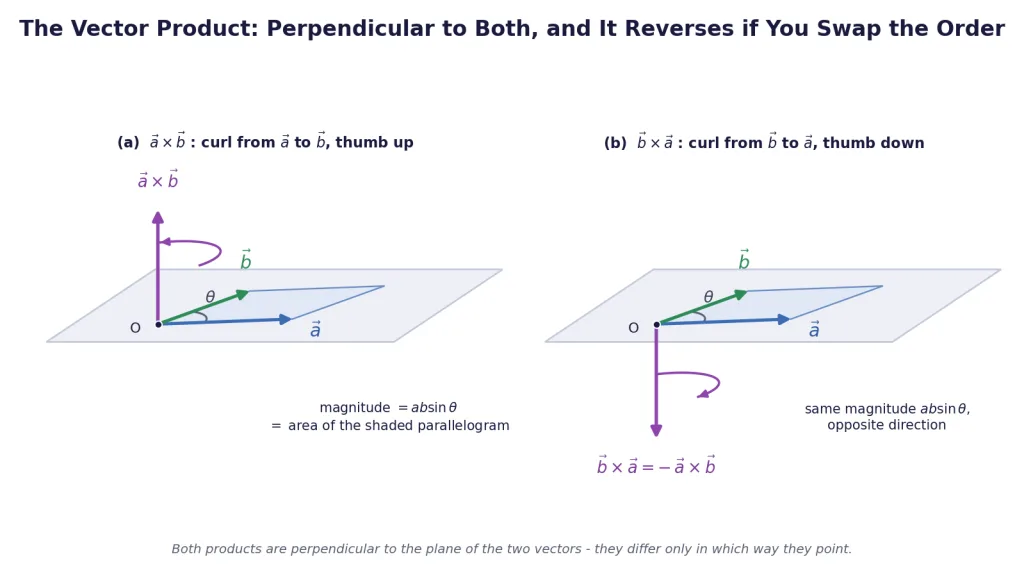
The right-hand screw rule. Place a right-handed screw perpendicular to the plane of a and b and turn its head in the sense that carries a round to b. The direction in which the screw advances is the direction of a×b.
The curled-fingers rule (easier in an exam). Open your right palm and curl the fingers so that they sweep from a towards b. Your outstretched thumb now points along a×b.
Key Point — a warning about the angle: There are always two angles between two vectors, θ and 360°−θ. Always take the smaller one, so that 0°≤θ≤180° — and therefore sinθ≥0 and the magnitude is never negative. Sweep through that smaller angle when applying either rule too.
Reading the magnitude
The factor sinθ is the whole story:
Angle between a and b
sinθ
∣a×b∣
0° (parallel)
0
0 — vanishes
30°
0.5
2ab
90° (perpendicular)
1
ab — the largest it can ever be
150°
0.5
2ab
180° (antiparallel)
0
0 — vanishes again
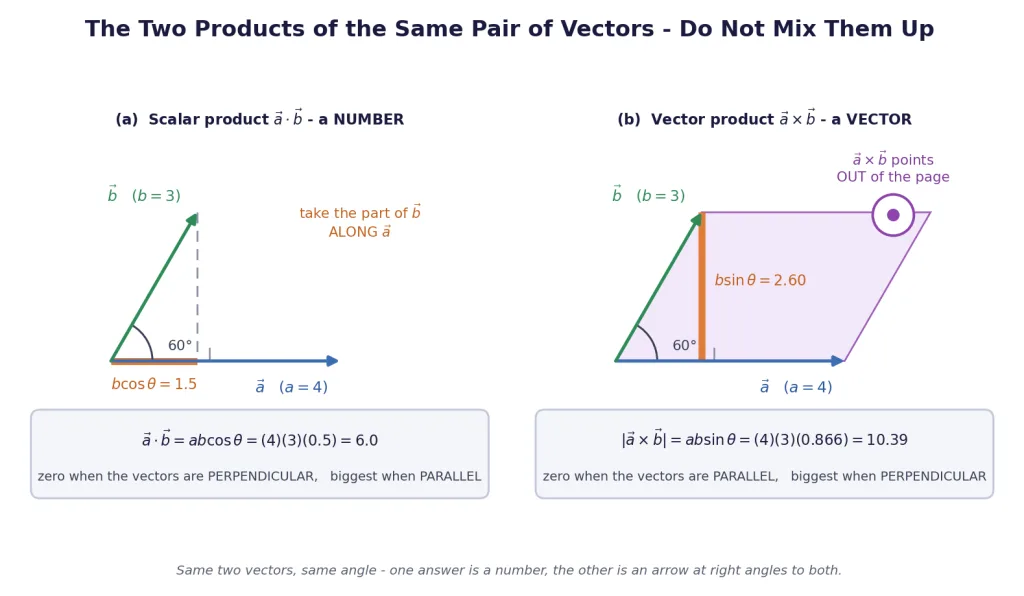
So the cross product measures how non-parallel two vectors are. It is largest when they are at right angles and disappears when they line up — the exact opposite of the scalar product's behaviour, which is why the two are so easy to confuse and so important to keep apart.
[NEET Important] Two one-mark facts that get asked directly: a×b=0 for parallel or antiparallel vectors, and ∣a×b∣ is maximum, equal to ab, when they are perpendicular.
The Properties, and the One That Trips Everybody Up
It is not commutative — order matters
Look at panel (b) of the figure above. To form b×a you curl your fingers from b to a — the opposite way round — so your thumb points the opposite way. The magnitude is the same absinθ and the line is the same perpendicular, but the arrow is reversed.
Key Point — anticommutativity:a×b=−b×a
Compare with the scalar product, where a⋅b=b⋅a and the order is irrelevant. Swapping the order of a cross product flips its sign.
[JEE Tip] This is the number one source of lost marks in the whole topic — a torque or an angular momentum that comes out exactly right in size and exactly wrong in direction. Whenever you write a cross product, write the two vectors in the order the definition demands and do not "tidy them up".
The cross product of a vector with itself is zero
Put b=a. The angle between a vector and itself is 0°, so
∣a×a∣=aasin0°=0
Key Point:a×a=0
Here 0 is the null vector — a vector of zero magnitude and no particular direction, not the number zero. More generally a×b=0 whenever a and b are parallel or antiparallel, and that is a useful test: if a cross product vanishes and neither vector is zero, the two must be along the same line.
It is distributive over addition
Just like the scalar product,
a×(b+c)=a×b+a×c
and similarly (a+b)×c=a×c+b×c. But keep every factor in its original position when you expand — because of anticommutativity you may not slide a vector from the right of the × to the left.
A scalar may be moved about freely, though:
(λa)×b=λ(a×b)=a×(λb)
It is not associative
(a×b)×c=a×(b×c)in general
A single counter-example settles it. Take a=b=i^ and c=j^. Then (i^×i^)×j^=0×j^=0, while i^×(i^×j^)=i^×k^=−j^. Different answers. So the brackets in a triple cross product are not optional.
A worked consequence you should be able to produce
Expand (a+b)×(a−b) using distributivity, keeping the order of every factor:
=a×a−a×b+b×a−b×b
The first and last terms vanish, and b×a=−a×b, so
(a+b)×(a−b)=−2(a×b)=2(b×a)
Notice that the ordinary algebra answer, a2−b2, is nowhere in sight. Cross products do not obey the algebra of numbers.
One more property, for completeness
Look at a system in a mirror. Every coordinate reverses, x→−x, y→−y, z→−z, so every ordinary vector reverses: a→−a and b→−b. What happens to the product?
a×b→(−a)×(−b)=a×b
It does not reverse. A cross product behaves differently from an ordinary vector under reflection — which is why quantities like angular velocity and torque are sometimes called axial vectors. You will not be asked to calculate anything with this, but it is a favourite conceptual question.
Unit Vectors, the Cyclic Pattern, and the Determinant
Definitions are all very well, but in a problem you are handed components, not angles. Here is how to compute.
Start with the unit vectors
i^, j^ and k^ are mutually perpendicular unit vectors along the x, y and z axes, arranged in the standard right-handed way.
Each with itself: the angle is 0°, so
i^×i^=j^×j^=k^×k^=0
Each with the next: take i^×j^. Its magnitude is (1)(1)sin90°=1, so the result is a unit vector. It must be perpendicular to both i^ and j^, so it lies along the z-axis. Curl your right hand from i^ to j^ and the thumb points along +z. So i^×j^=k^, and by the same argument for the other pairs:
Key Point — the unit-vector products:i^×j^=k^,j^×k^=i^,k^×i^=j^j^×i^=−k^,k^×j^=−i^,i^×k^=−j^i^×i^=j^×j^=k^×k^=0
The cyclic wheel — do not memorise twelve results
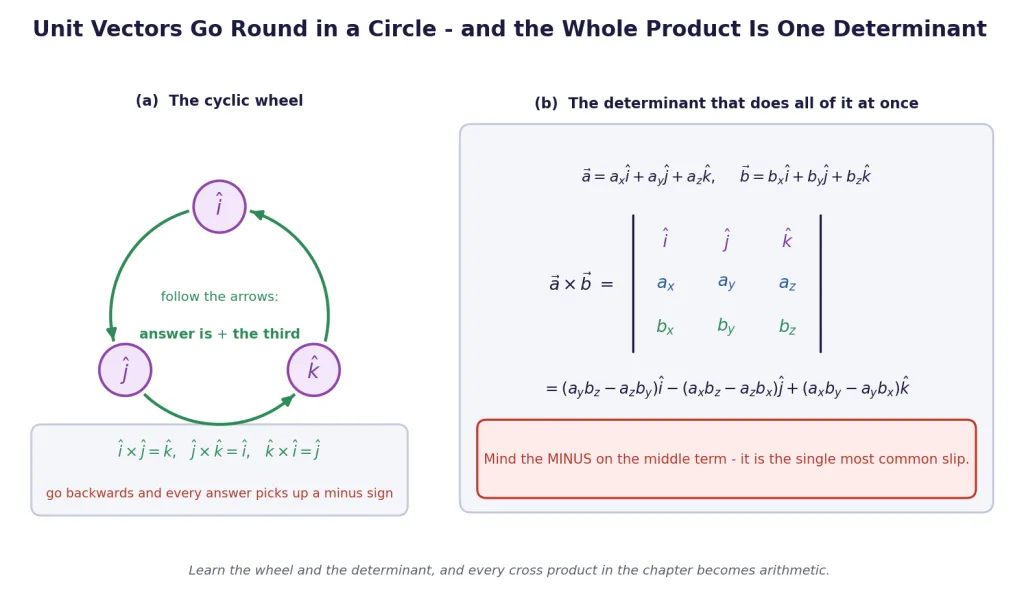
Write i^, j^, k^ round a circle in that order, as in panel (a) of the figure. Then:
Go round the circle in the arrow direction (i→j→k→i) and the product of two neighbours is plus the third.
Go against the arrows and the answer picks up a minus sign.
That single picture holds all six results, and you can redraw it on the corner of your answer sheet in three seconds.
The component form
Now put it to work. Write a=axi^+ayj^+azk^ and b=bxi^+byj^+bzk^, multiply out using distributivity, and use the table above on each of the nine terms. Six survive, and they collect into
Key Point — the component form:a×b=(aybz−azby)i^+(azbx−axbz)j^+(axby−aybx)k^
The determinant — the form you should actually use
Nobody remembers those three brackets correctly under pressure. Write them as a determinant instead:
Key Point:a×b=i^axbxj^aybyk^azbz
Top row: the unit vectors. Middle row: the components of the first vector. Bottom row: the components of the second. Expand along the top row:
=i^(aybz−azby)−j^(axbz−azbx)+k^(axby−aybx)
[JEE Tip] Two habits will save you every time. (i) Mind the minus sign on the j^ term — it is by far the commonest slip in the chapter. (ii) Check your answer by dotting it with both inputs. If c=a×b is right then c⋅a=0 and c⋅b=0, exactly. Two quick multiplications, and they catch essentially every arithmetic error.
The order of the rows is the order of the product
Swap the middle and bottom rows of a determinant and its value changes sign. That is precisely a×b=−b×a, appearing again in a different disguise. Put the first-named vector in the middle row.
A useful identity to keep
Since ∣a×b∣=absinθ and a⋅b=abcosθ, squaring and adding gives
∣a×b∣2+(a⋅b)2=a2b2
and dividing one by the other gives a neat way to find an angle without any inverse cosine:
tanθ=a⋅b∣a×b∣
This is often the fastest route to θ, and unlike cosθ alone it tells you at once whether the angle is acute or obtuse — the sign of a⋅b gives it away.
What It Measures: an Area, and Then a Volume
The cross product is not an arbitrary definition. Its magnitude is a piece of geometry you can see.
The parallelogram
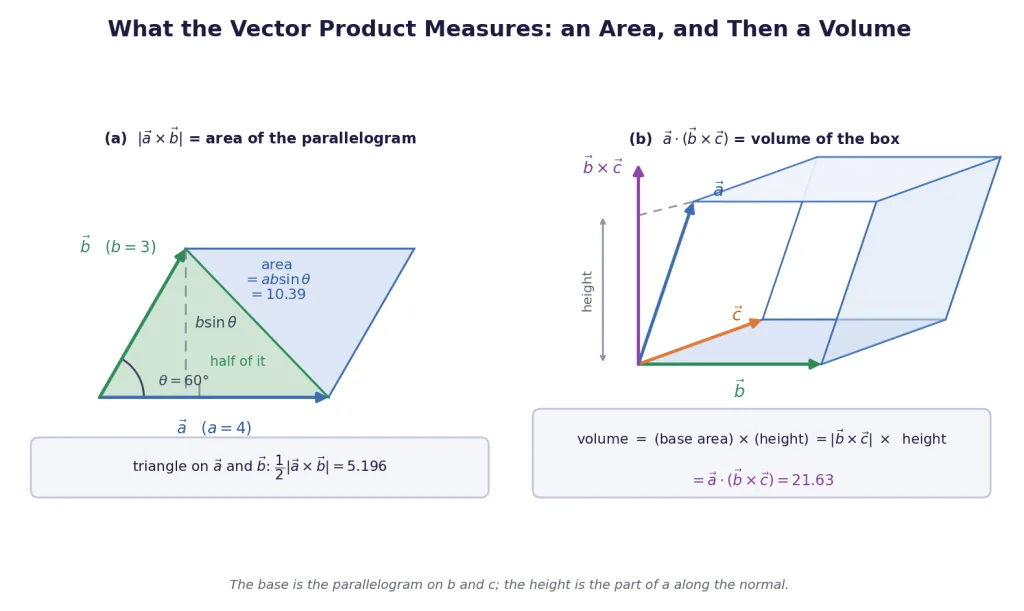
Draw a and b from a common point and complete the parallelogram. Take a as the base, of length a. The perpendicular height is the part of b at right angles to a, which is bsinθ. So
area=base×height=a(bsinθ)=∣a×b∣
Key Point — area of a parallelogram: The parallelogram with adjacent sides a and b has area
A=∣a×b∣
and the triangle on the same two sides is half of it:
A△=21∣a×b∣
For a triangle given by three pointsP, Q, R, first build two edge vectors from the same corner, PQ and PR, then take half the magnitude of their cross product. Which corner you start from makes no difference to the answer.
If instead you are given the two diagonalsd1 and d2 of a parallelogram, its area is 21∣d1×d2∣ — a small result worth carrying, since diagonals are sometimes what the question hands you.
The scalar triple product
Now take three vectors and build a parallelepiped — a slanted box — on them, as in panel (b).
Choose b and c as the base. Its area is ∣b×c∣, and b×c points along the normal to that base. The height of the box is the part of a along that normal, which is ∣a∣cosϕ where ϕ is the angle between a and b×c. Multiply:
volume=∣b×c∣∣a∣cosϕ=a⋅(b×c)
Key Point — the scalar triple product:V=a⋅(b×c)
is the volume of the parallelepiped with a, b, c as its three concurrent edges. It is a number, not a vector — a cross product followed by a dot product. In components it is simply the determinant
a⋅(b×c)=axbxcxaybycyazbzcz
Two properties of the triple product
It is cyclic. Rotating the three vectors round does not change it:
a⋅(b×c)=b⋅(c×a)=c⋅(a×b)
Of course — all three describe the same box. Swapping any two, however, flips the sign, because you have swapped two rows of the determinant.
It vanishes for coplanar vectors. If all three lie in one plane the box is flat and has no volume:
Key Point — the coplanarity test: Three non-zero vectors a, b, c are coplanar if and only if
a⋅(b×c)=0
[JEE Tip] "Show that these three vectors are coplanar" and "find the volume of the parallelepiped" are the same calculation with a different last sentence. Build the 3×3 determinant, evaluate it, and either report its modulus as the volume or note that it is zero.
A unit vector perpendicular to two given vectors
One more standard use. Since a×b is perpendicular to both a and b, dividing it by its own magnitude gives a unit vector perpendicular to both:
n^=∣a×b∣a×b
There are exactly two such unit vectors, n^ and −n^; the formula picks the one given by the right-hand rule. Say which one you have chosen.
Scalar Product Against Vector Product, Side by Side
The two products look similar on the page and behave in almost opposite ways. Getting them straight is worth more marks than any single formula in this section.
Scalar (dot) product a⋅b
Vector (cross) product a×b
Result is
a number (a scalar)
a vector
Magnitude
abcosθ
absinθ
Direction
none
perpendicular to both, by the right-hand rule
Order
a⋅b=b⋅a
a×b=−b×a
Vectors parallel
maximum, ab
zero
Vectors perpendicular
zero
maximum, ab
A vector with itself
a⋅a=a2
a×a=0
Unit vectors
i^⋅i^=1, i^⋅j^=0
i^×i^=0, i^×j^=k^
Can be negative?
yes, when θ>90°
its magnitude never is; the direction reverses instead
Components
axbx+ayby+azbz
the 3×3 determinant
Geometry
projection of one on the other
area of the parallelogram on the two
Key Point — the one-line test: the dot product asks how much of b lies ALONG a; the cross product asks how much of b lies ACROSS a. Everything in the table follows from that.
The method, in order
Decide which product the question wants. A number out? Dot. A direction out? Cross.
Given magnitudes and an angle? Go straight to absinθ, and take the angle between the two vectors — nose to tail is not the same as tail to tail, so redraw them from a common point first.
Given components? Write the 3×3 determinant, first-named vector in the middle row, and expand along the top row remembering the minus on j^.
Always verify with two dot products.(a×b)⋅a and (a×b)⋅b must both come out exactly zero.
Need a unit normal? Divide by the magnitude.
Need an area? It is ∣a×b∣ for the parallelogram, half of that for the triangle. Need a volume or a coplanarity test? Build the scalar triple product.
The traps
Trap
The fix
Writing a×b=b×a
It is −b×a. Order is everything
Dropping the minus sign on the j^ term of the determinant
Expand as +i^(…)−j^(…)+k^(…), every time
Using cosθ in a cross product
Cross uses sinθ; dot uses cosθ
Reporting a×a=a2
That is the dot product. The cross product of a vector with itself is the null vector
Treating (a×b)×c as a×(b×c)
The cross product is not associative. Keep the brackets
Forgetting the factor 21 for a triangle
The cross product gives the parallelogram; halve it
Writing the answer to a⋅(b×c) as a vector
It is a number. A cross followed by a dot always is
Taking the reflex angle between the vectors
Use the smaller angle, 0° to 180°, so sinθ≥0
Where this is used
Nothing in this section was physics — it was all algebra and geometry, and it is worth being able to do in your sleep. From here:
Section 5 defines the velocity of any point of a rotating body as v=ω×r;
Section 6 defines torque as τ=r×F and the angular momentum of a particle as l=r×p.
Every one of them is a cross product of exactly the kind you have just been evaluating. Get the determinant and the right-hand rule fluent now, and those sections become physics rather than arithmetic.
Solved Examples
Example 1: Straight from the definition
Two vectors have magnitudes a=6 and b=4, and the angle between them is 30°. Find ∣a×b∣ and a⋅b, and say which way a×b points if a lies along +x and b lies in the xy-plane above it.
Solution:
Magnitude of the cross product:∣a×b∣=absinθ=(6)(4)sin30°=(24)(0.5)=12
The scalar product, for contrast:a⋅b=abcosθ=(6)(4)cos30°=(24)(0.866)=20.78
Same two vectors, same angle, and two completely different answers — one a vector of length 12, the other the plain number 20.78.
Direction. Both vectors lie in the xy-plane, so the product is along the z-axis. Curl the right hand from a (along +x) towards b (up and to the right): the thumb points out of the page, along +z.
Soa×b=12k^, and b×a=−12k^.
Final Answer:∣a×b∣=12, directed along +k^; a⋅b=20.78.
Takeaway: At 30° the cross product is small and the dot product is large; at 60° it would be the other way about. sin for cross, cos for dot — write that on the top of your rough sheet and never mix them.
Example 2: The determinant, and how to check it
Find a×b for a=3i^−4j^+5k^ and b=−2i^+j^−3k^. Then verify your answer.
Solution:
Set up the determinant, first vector in the middle row:
a×b=i^3−2j^−41k^5−3
Expand along the top row, minding the minus on j^:i^-term=(−4)(−3)−(5)(1)=12−5=7j^-term=−[(3)(−3)−(5)(−2)]=−[−9+10]=−1k^-term=(3)(1)−(−4)(−2)=3−8=−5
Check 2 — the magnitude.∣a×b∣=49+1+25=75=8.660. Independently, a=50=7.071, b=14=3.742, and a⋅b=−6−4−15=−25, so cosθ=26.458−25=−0.9449 and θ=160.9°. Then absinθ=(26.458)(0.3273)=8.660. The same number. ✓
And the reverse:b×a=−7i^+j^+5k^, the exact negative.
Final Answer:a×b=7i^−j^−5k^.
Takeaway: Step 4 costs ten seconds and catches almost every mistake you can make in step 2. Make the two dot-product checks a reflex.[JEE Tip] Note that θ came out obtuse — that is what the negative scalar product was telling you, and it is information the cross product's magnitude alone cannot give.
Example 3: A unit vector perpendicular to two given vectors
Find a unit vector perpendicular to both a=2i^+3j^−k^ and b=i^−j^+2k^.
Solution:
The cross product is automatically perpendicular to both, so start there:
a×b=i^21j^3−1k^−12
Check both dot products:(5)(2)+(−5)(3)+(−5)(−1)=10−15+5=0 and (5)(1)+(−5)(−1)+(−5)(2)=5+5−10=0. ✓
Its magnitude:∣a×b∣=25+25+25=53≈8.660
Divide:n^=535i^−5j^−5k^=3i^−j^−k^
Confirm it is a unit vector: 31+1+1=1. ✓
Final Answer:n^=31(i^−j^−k^), or its negative.
Takeaway:There are always two answers, n^ and −n^, and both are correct unless the question fixes a sense. State which one you have given. [Board Important] Divide by the magnitude of the cross product, not by ab — a very common slip.
Example 4: Finding the angle without an inverse cosine
Find the angle between a=2i^+2j^+k^ and b=3i^−4k^.
Solution:
Magnitudes:a=4+4+1=3 and b=9+0+16=5. Convenient numbers.
Scalar product:a⋅b=(2)(3)+(2)(0)+(1)(−4)=6+0−4=2
Vector product:a×b=i^23j^20k^1−4=i^[(2)(−4)−(1)(0)]−j^[(2)(−4)−(1)(3)]+k^[(2)(0)−(2)(3)]=−8i^+11j^−6k^
with ∣a×b∣=64+121+36=221=14.87.
Use the tangent form:tanθ=a⋅b∣a×b∣=214.87=7.433⟹θ=82.3°
Cross-check with the cosine route:cosθ=(3)(5)2=0.1333, giving θ=82.3°. The same.
And the identity:∣a×b∣2+(a⋅b)2=221+4=225=(3)2(5)2=a2b2. ✓
Final Answer:θ≈82.3°.
Takeaway: The tangent route needs no square roots of awkward numbers and fixes the quadrant automatically: a positive dot product means acute, a negative one means obtuse. [JEE Tip] The identity in step 6 is the fastest possible check on a pair of products — if it fails, one of the two is wrong.
Example 5: Area of a parallelogram
Find the area of the parallelogram whose adjacent sides are a=3i^+j^+4k^ and b=i^−j^+k^.
Solution:
Area is the magnitude of the cross product:a×b=i^31j^1−1k^41
Check:(5)(3)+(1)(1)+(−4)(4)=15+1−16=0 and (5)(1)+(1)(−1)+(−4)(1)=5−1−4=0. ✓
Area:A=∣a×b∣=25+1+16=42≈6.48 square units
Final Answer:42≈6.48 square units.
Takeaway: The area is a number; do not leave a vector as your final answer. And note that no angle was ever needed — the determinant carries the sinθ inside it. [Board Important] If the question gives the two diagonals instead of the sides, the area is 21∣d1×d2∣.
Example 6: Area of a triangle from three vertices
Find the area of the triangle with vertices P(1,1,1), Q(2,3,5) and R(−1,0,2).
Solution:
Build two edge vectors from the same corner. From P:
PQ=(2−1)i^+(3−1)j^+(5−1)k^=i^+2j^+4k^PR=(−1−1)i^+(0−1)j^+(2−1)k^=−2i^−j^+k^
Takeaway:Subtract to get edge vectors before you cross anything — crossing the position vectors of the three points is meaningless here. And do not forget the 21; leaving it out is the single commonest error in this type. Starting from Q or R instead of P gives the same area.
Example 7: Volume of a parallelepiped
Find the volume of the parallelepiped whose three concurrent edges are a=2i^−3j^+4k^, b=i^+2j^−k^ and c=3i^−j^+2k^.
Solution:
Find b×c first — the base of the box:
b×c=i^13j^2−1k^−12i^:(2)(2)−(−1)(−1)=4−1=3j^:−[(1)(2)−(−1)(3)]=−[2+3]=−5k^:(1)(−1)−(2)(3)=−1−6=−7b×c=3i^−5j^−7k^
Dot it with a:a⋅(b×c)=(2)(3)+(−3)(−5)+(4)(−7)=6+15−28=−7
Volume is the modulus:V=∣−7∣=7 cubic units
What the minus sign means. It says the three vectors, in that order, form a left-handed set — a lies on the opposite side of the base from b×c. A volume cannot be negative, so take the modulus.
Check by the cyclic property:b⋅(c×a) must give the same −7, and it does. Swapping any two of the three, for instance a⋅(c×b), gives +7 — the same box, the opposite handedness.
Final Answer: 7 cubic units.
Takeaway: The scalar triple product is a number. Do the cross first, then the dot — (a⋅b)×c is not even meaningful, since you cannot cross a number with a vector. [JEE Tip] In practice just evaluate the 3×3 determinant of the nine components directly; it is the same thing and it is faster.
Example 8: Testing three vectors for coplanarity
Are a=i^+2j^−k^, b=2i^−j^+3k^ and c=3i^+j^+2k^ coplanar?
Dot with a:a⋅(b×c)=(1)(−5)+(2)(5)+(−1)(5)=−5+10−5=0
Conclusion: the triple product vanishes, so the three vectors are coplanar.
A confirmation. If they are coplanar, one must be a combination of the other two. Try c=αa+βb: the i^ and j^ equations give α+2β=3 and 2α−β=1, so α=1 and β=1. Check the k^ equation: −1+3=2. ✓ Indeed c=a+b.
Final Answer: Yes — the scalar triple product is zero, so the three vectors are coplanar.
Takeaway:Zero volume means coplanar, and step 5 shows what that really means: one vector is a combination of the other two. [JEE Tip] When the question asks you to find a value of λ that makes three vectors coplanar, set the determinant to zero and solve for λ — same test, run backwards.
Example 9: Making two vectors parallel
For what value of λ are a=2i^+λj^+k^ and b=4i^−2j^+2k^ parallel?
Solution:
The condition. Two non-zero vectors are parallel or antiparallel exactly when sinθ=0, that is, when a×b=0.
Compute the cross product with λ carried along:i^:(λ)(2)−(1)(−2)=2λ+2j^:−[(2)(2)−(1)(4)]=−[4−4]=0k^:(2)(−2)−(λ)(4)=−4−4λ
Set every component to zero. The j^ component is already zero. From the i^ component, 2λ+2=0, so λ=−1; from the k^ component, −4−4λ=0, so λ=−1 as well. Consistent, which is what tells you a solution exists at all.
Verify: with λ=−1, a=2i^−j^+k^ and b=4i^−2j^+2k^=2a. One is exactly twice the other, so they are certainly parallel.
Final Answer:λ=−1.
Takeaway: For parallel vectors, use a×b=0 — or, equivalently, the proportionality of components, 42=−2λ=21. [NEET Important] The mirror-image question, "for what λ are they perpendicular?", uses a⋅b=0 instead. Read which one is being asked.
Example 10: An identity you should be able to prove
Prove that (a+b)×(a−b)=2(b×a), and verify it for a=i^+2j^+3k^ and b=2i^−j^+k^.
Solution:
Expand by distributivity, keeping every factor on its original side of the ×:
(a+b)×(a−b)=a×a−a×b+b×a−b×b
Kill the self-products:a×a=0 and b×b=0.
Use anticommutativity on the second term: −a×b=+b×a. So
=b×a+b×a=2(b×a)=−2(a×b)
Now the numbers.a×b=i^12j^2−1k^31=i^(2+3)−j^(1−6)+k^(−1−4)=5i^+5j^−5k^
Direct evaluation of the left side. With a+b=3i^+j^+4k^ and a−b=−i^+3j^+2k^,
i^3−1j^13k^42=i^(2−12)−j^(6+4)+k^(9+1)=−10i^−10j^+10k^
Final Answer:(a+b)×(a−b)=2(b×a)=−2(a×b), here equal to −10i^−10j^+10k^.
Takeaway: The ordinary-algebra answer a2−b2 is wrong here, and the reason is anticommutativity: the two middle terms reinforce instead of cancelling. [JEE Tip] Any expansion of a cross product is safe as long as you never move a vector across the × sign.
Example 11: The Lagrange identity as a checking tool
For a=3i^−4j^+5k^ and b=−2i^+j^−3k^, verify that ∣a×b∣2+(a⋅b)2=a2b2.
Solution:
The two products were found in Example 2: a×b=7i^−j^−5k^ and a⋅b=−25.
Why it must work.∣a×b∣2+(a⋅b)2=a2b2sin2θ+a2b2cos2θ=a2b2(sin2θ+cos2θ)=a2b2. It is Pythagoras in disguise.
Final Answer: Both sides equal 700, so the identity holds.
Takeaway: This is the best single check on a pair of products, because it uses both of them at once — a slip in either one breaks the equality. [JEE Tip] It also lets you find one product from the other: given a⋅b and the two magnitudes, ∣a×b∣=a2b2−(a⋅b)2 with no angle needed.
Example 12: The same product two different ways
Evaluate (2i^−3j^+k^)×(i^+4j^) (a) by expanding term by term with the unit-vector products, and (b) by the determinant. Confirm the two agree.
Solution:
(a) Expand. There are six non-zero products; write them out:
(2i^)×(i^)=2(i^×i^)=0(2i^)×(4j^)=8(i^×j^)=8k^(−3j^)×(i^)=−3(j^×i^)=−3(−k^)=3k^(−3j^)×(4j^)=−12(j^×j^)=0(k^)×(i^)=j^(k^)×(4j^)=4(k^×j^)=4(−i^)=−4i^
Add them up:−4i^+j^+(8+3)k^=−4i^+j^+11k^
(b) The determinant, with the z-component of the second vector written in as 0:
i^21j^−34k^10=i^[(−3)(0)−(1)(4)]−j^[(2)(0)−(1)(1)]+k^[(2)(4)−(−3)(1)]=−4i^−j^(−1)+11k^=−4i^+j^+11k^
The two agree. And the checks: (−4)(2)+(1)(−3)+(11)(1)=−8−3+11=0, and (−4)(1)+(1)(4)+(11)(0)=−4+4=0. ✓
Final Answer:−4i^+j^+11k^.
Takeaway: The two routes are the same calculation; the determinant is just bookkeeping for the expansion. Use the determinant in exams — it is faster and it does not let you forget a term. [Board Important] When a vector has a missing component, write it in explicitly as 0 before building the determinant; a two-row-of-two-entries determinant is where sign errors breed.
Ready to test your knowledge?
Take a quick interactive quiz on this topic —
free, works without login.