
Internal Energy: the Energy That Is Already There
Section 1 listed internal energy among the state variables and then quietly moved on. Time to pay that debt, because is the quantity the whole rest of the chapter is about.
What it is
Every bulk system is made of an enormous number of molecules, and every one of them is carrying energy. There are exactly two kinds.
- Kinetic energy of random motion. In a gas the molecules fly about, and that flying is not only translation from place to place: a molecule with more than one atom also rotates, and its atoms vibrate against the bonds holding them together. All three count.
- Potential energy of the forces between molecules. Molecules attract and repel one another, and any pair of interacting particles stores potential energy in that interaction. In a solid or a liquid this is a large contribution. In a dilute gas the molecules are so far apart that it is nearly negligible, which is why an ideal gas is defined with it set to zero.
Key Point — internal energy:
The internal energy of a system is the total energy of its molecules, measured in the frame in which the centre of mass of the system is at rest: It is a state function — its value depends only on the present equilibrium state of the system and not at all on how that state was reached.
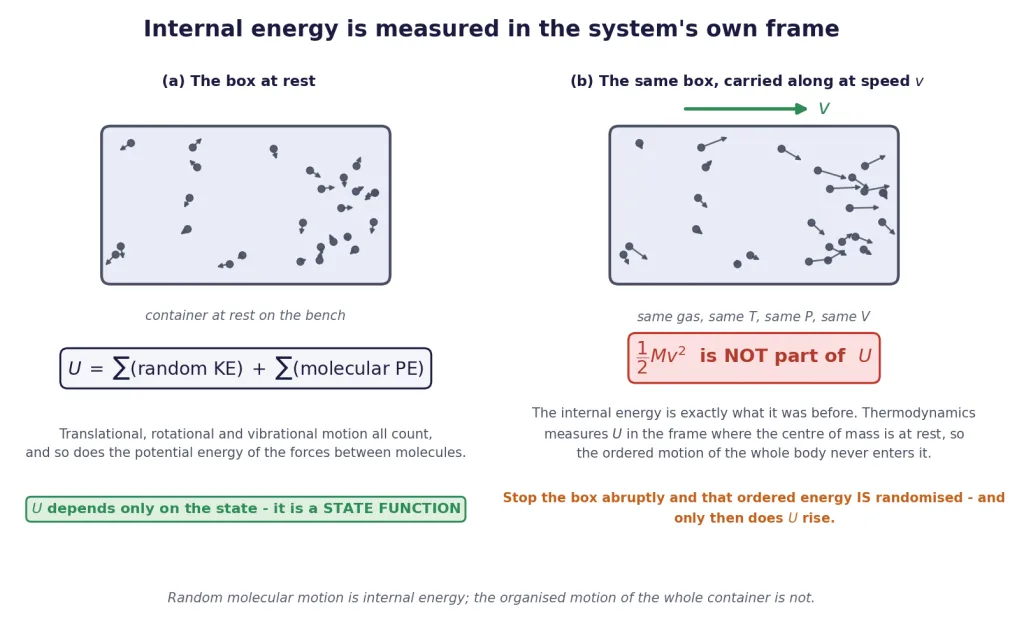
Why the beaker's own motion does not count
Here is the piece of the definition that gets tested, and the one students most often get wrong.
Take a beaker holding one kilogram of water at 300 K. Sitting on the bench, it has some internal energy . Now pick it up and walk across the room with it at 10 m/s. The beaker plus water, mass about 1 kg, now has a kinetic energy of of ordered, bulk motion.
None of that 50 J is internal energy. The water is at exactly the same temperature, the same pressure and the same density as before, and has not changed by a single joule.
There are three ways to see why, and it is worth having all three.
- From the definition. is defined in the frame where the centre of mass is at rest. Walk beside the beaker and the ordered motion vanishes; only the random jiggling is left, and that is what counts.
- From the physics. Internal energy is disordered energy — the molecules are going in all directions at once. The carried beaker adds one extra velocity to every molecule, all in the same direction. That is organised, and it belongs to mechanics.
- From what you can measure. Every thermodynamic instrument you own — thermometer, pressure gauge, ruler — reads exactly the same on the moving beaker as on the still one. A quantity that no thermodynamic measurement can detect is not a thermodynamic quantity.
And yet the 50 J is perfectly real. Slam the beaker to a halt against a wall and it has to go somewhere. It goes into the random motion of the molecules of the water and the wall — and then rises, by exactly 50 J. Ordered energy became disordered energy. Section 8 will show that this direction of conversion is desperately easy and the reverse is desperately hard, and that fact turns out to be the second law of thermodynamics.
Key Point: Bulk kinetic energy and bulk potential energy of a system as a whole are never part of . They are mechanics. They enter thermodynamics only at the moment they are randomised.
Why is a state function, and why that matters
Nothing in the definition of refers to history. Fix the state of a gas — fix its , its , its and how much of it there is — and you have fixed how its molecules are moving and how far apart they are. Nothing else is left to choose. So is fixed too.
That gives the property that decides more exam questions than any formula in this chapter:
Key Point: For any process taking a system from state 1 to state 2, and this depends only on the two end states. Gentle heating, violent compression, a wild detour through a thousand intermediate states — every route between the same two states gives the same .
In particular, around a closed cycle the system returns to its starting state, so exactly. That single sentence is the foundation of every heat engine in Sections 9 to 11.
[JEE Tip] In thermodynamics only changes in ever appear, never itself. That is a relief, because the absolute internal energy of a real body is a horrible thing to compute and includes chemical and nuclear binding energy you will never need. Choose any zero you like; it cancels out of every equation in this chapter.
Heat and Work: the Only Two Doors
Internal energy is a property that a system has. The next question is how it changes.
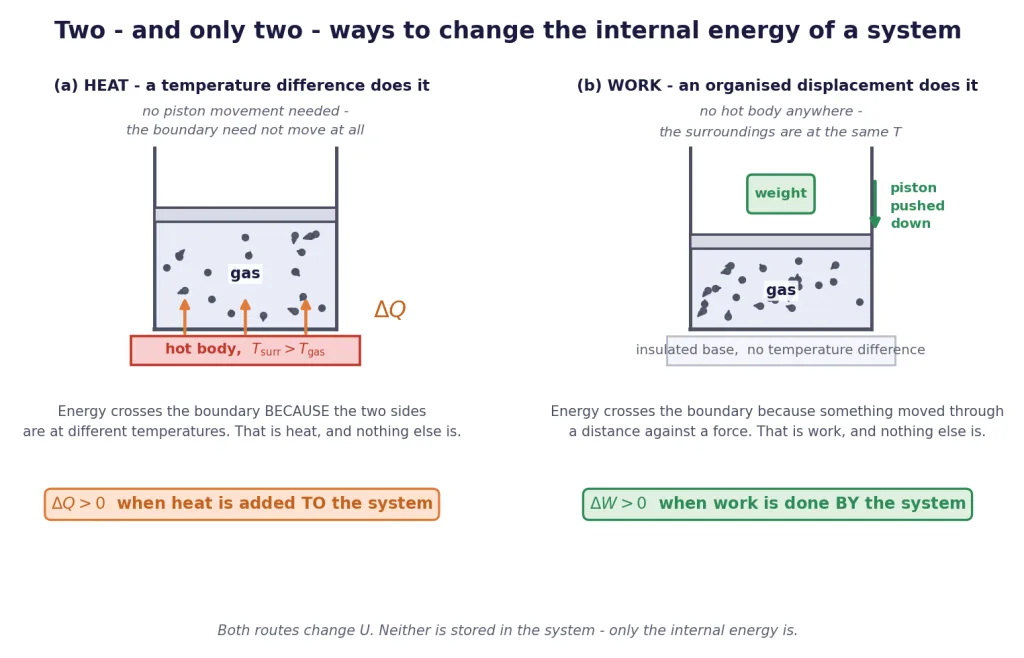
Take a fixed mass of gas in a cylinder with a piston. There are exactly two things you can do to raise its internal energy, and they look completely different.
One: put the cylinder on something hot. Energy flows in because the outside is at a higher temperature than the gas. Nothing has to move. The piston can be bolted down and it still works.
Two: push the piston in. Now nothing is hot; the surroundings can be at exactly the same temperature as the gas throughout. Energy flows in because something moved through a distance against a force.
Key Point — the two modes of energy transfer:
- Heat is energy that crosses the boundary of a system because of a temperature difference between the system and its surroundings.
- Work is energy that crosses the boundary by an organised, macroscopic displacement — a piston moving, a paddle turning, a wire stretching — with no temperature difference required.
Both are energy in transit. Neither is a property of the system.
The test that separates them is not "did something move?" — it is what drove the transfer. A temperature difference means heat. A displacement against a force means work. That is the whole distinction, and it is sharper than it looks.
A system never "contains" heat
This is the hardest habit in the chapter to break, because ordinary language is against you. We say a room "has a lot of heat in it", or that hot tea "contains heat". In thermodynamics both statements are meaningless, and the reason is worth understanding rather than memorising.
Key Point — heat and work are PATH functions:
and are not state variables. They describe what happened during a process, not what a system is. It is meaningless to ask how much heat or how much work a system contains; the only meaningful question is how much crossed its boundary during a particular process — and the answer depends on the route taken.These statements are fine: "800 J of heat was supplied to the system." "The gas did 300 J of work on its surroundings."
This statement is nonsense: "The gas contains 800 J of heat."
This statement is fine: "The gas has an internal energy of 5000 J."
The bank account that makes it click
Your bank balance is a state function: a single number, today, and it does not remember whether the money arrived by transfer or by cash.
Deposits by transfer and deposits by cash are the analogues of heat and work. Both change the balance. But it makes no sense to ask "how much of my balance is transfer?" Once the money is in, it is just money. The distinction existed only while it was crossing.
Heat and work are like that. Once energy is inside the system, it is just internal energy. There is no way, even in principle, to look at a hot gas and say which joules arrived as heat and which as work — which is exactly why "the heat contained in the gas" cannot mean anything.
And the amount depends on the route
Section 1 used two climbers reaching the same summit by different paths. Their altitude is the same, because altitude is a state function. Their distance walked is not, because it depends on the route.
is the altitude. and are the distance walked.
Take a gas from a state to a state by two different processes and you will find:
| Quantity | Route 1 | Route 2 | Same? |
|---|---|---|---|
| J | J | yes — always | |
| J | no | ||
| J | no |
Both routes end at the same state with the same internal energy. One did it by heating with the piston clamped; the other did it by stirring inside a perfectly insulated vessel. Same destination, different journeys, different and , identical . Section 3 makes this asymmetry the centre of the first law; here it is enough to see that it is real.
[Board Important] "Distinguish between heat and internal energy" is a standing two-marker. The full-mark answer says that internal energy is a state variable of the system while heat is energy in transit across the boundary, driven by a temperature difference, and is a path function — and then adds that a body therefore cannot be said to contain heat. Three clauses, two marks.
The Sign Convention and Notation for the Whole Chapter
Everything up to here has been about how much energy crossed. Now we fix which way is positive, and this is the single most important block in the section — every later section, every worked example and every exam answer in this chapter depends on it.
There is nothing deep here. It is a choice, like choosing which way is positive along an axis. But it must be made once and then never drifted from, because a sign error in thermodynamics does not produce a slightly wrong answer; it produces a confidently wrong one.
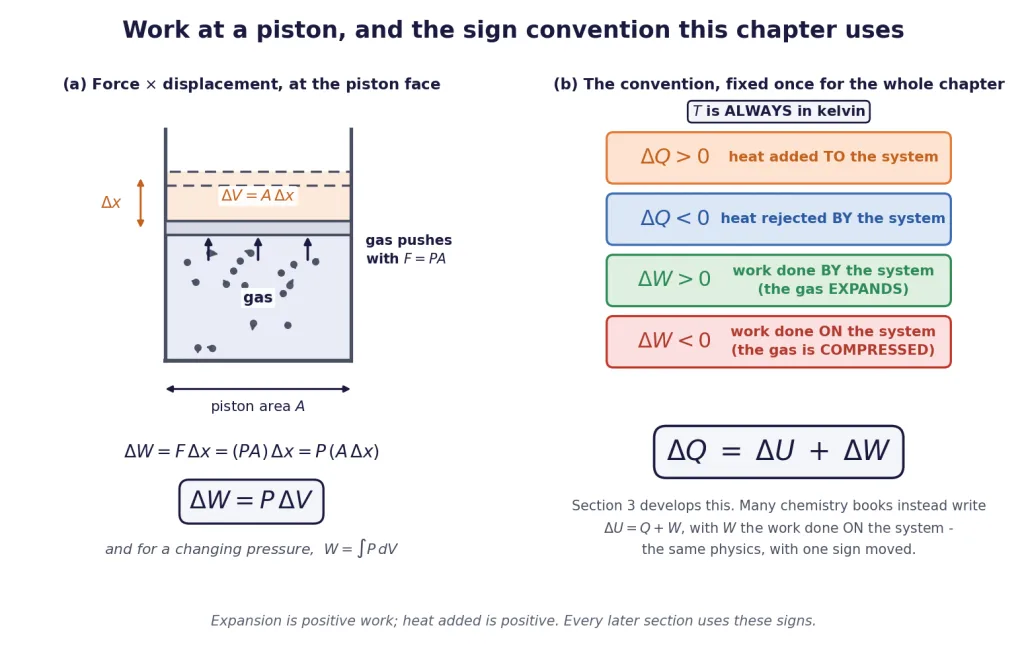
Key Point — THIS CHAPTER'S SIGN CONVENTION:
- is positive when heat is added TO the system, and negative when heat leaves it.
- is positive when work is done BY the system (the gas expands), and negative when work is done ON the system (the gas is compressed).
With those two choices, energy conservation takes the form which Section 3 develops as the first law of thermodynamics.
Read the equation in words and the convention explains itself: heat put into a system goes partly into raising its internal energy and partly into the work it does pushing on the outside world. Everything on the right is something the system did with the energy you gave it. That is why work done by the system is the positive one — this convention was invented by engineers who wanted their engines' useful output to come out positive.
Fixing the signs in your head
| Situation | Because | ||
|---|---|---|---|
| Gas is heated | — | heat enters the system | |
| Gas is cooled, heat rejected | — | heat leaves the system | |
| Gas expands | — | the system pushes the piston out; the system does the work | |
| Gas is compressed | — | the surroundings push the piston in; work is done on the system | |
| Rigid container, volume fixed | — | nothing moves, so no work is done either way | |
| Perfectly insulated (adiabatic) | — | no heat can cross |
Key Point: In this chapter, never write "work done = 500 J". Write "500 J of work is done by the gas, so J", or "500 J of work is done on the gas, so J". A number without a direction is not an answer, and every worked example in this chapter states, for each of , and , both the sign and what it means physically.
The Other Convention
Chemistry uses a different but equally valid choice: means the work done ON the system, so that the first law reads
This is not different physics. It is the same equation with one sign moved. Put into our form and it turns into theirs immediately. Both describe the same gas doing the same thing; they simply disagree about which direction to call positive for work.
Throughout, the form used is , with the work done BY the system. If a question hands you a formula in the other convention, translate the question before you start.
The rest of the notation, fixed now
The chapter is full of symbols that look alike. Here is the complete list.
| Symbol | Means | Notes |
|---|---|---|
| absolute temperature, in kelvin — always | write or for Celsius; | |
| temperature of the source — the hot reservoir | ||
| temperature of the sink — the cold reservoir | ||
| heat absorbed from the source | positive by our convention | |
| heat rejected to the sink | quoted as a magnitude, with the direction stated in words | |
| number of moles | ||
| universal gas constant, J/(mol K) | never means resistance here | |
| , | molar specific heats, J/(mol K) | at constant volume, at constant pressure |
| , | specific heats per kilogram, J/(kg K) | lower case means per kilogram |
| , always greater than 1 | Section 4 gives its values | |
| efficiency of a heat engine, a fraction | may be quoted as a percentage; never exceeds 1 | |
| coefficient of performance of a refrigerator | not an efficiency — it routinely exceeds 1 | |
| internal energy | a state function | |
| , | heat and work | path functions |
Three of these are worth saying out loud now, because they cause more lost marks than anything else in the chapter.
is kelvin. Every ratio, every gas-law step, every efficiency formula. If a temperature is being multiplied or divided, it is absolute.
is hot and is cold, and the subscripts never swap. Likewise is what comes in from the source and is what goes out to the sink. Set this down now and Sections 9 to 11 become much easier.
is never called an efficiency. A refrigerator with moves four joules of heat out of the cold space for every joule of work you pay for. Calling that "400% efficient" is meaningless — it is not converting anything into anything, it is moving heat, and it is allowed to move a lot. Section 10 makes this precise.
Joule's Paddle Wheel, and What It Settled
The idea that heat and work are two ways of delivering the same thing is now so ordinary that it is hard to see how radical it was. For most of the eighteenth century heat was believed to be a weightless fluid — caloric — that seeped from hot bodies into cold ones, conserved in total, like water finding its level between two tanks.
Two experiments killed that idea.
Rumford, boring cannon (1798). Drilling out a brass cannon barrel produced heat without limit — enough to boil water — for as long as the horses kept turning the drill. In the caloric picture the heat was supposed to be squeezed out of the metal's pores, so a blunt drill, which scoops out less, ought to produce less. It produced just as much. What the heat tracked was the work done, and nothing else. A fluid that can be generated without limit is not a fluid.
Joule, with a paddle wheel (1840s). Rumford showed the caloric picture failed. Joule measured what replaced it.
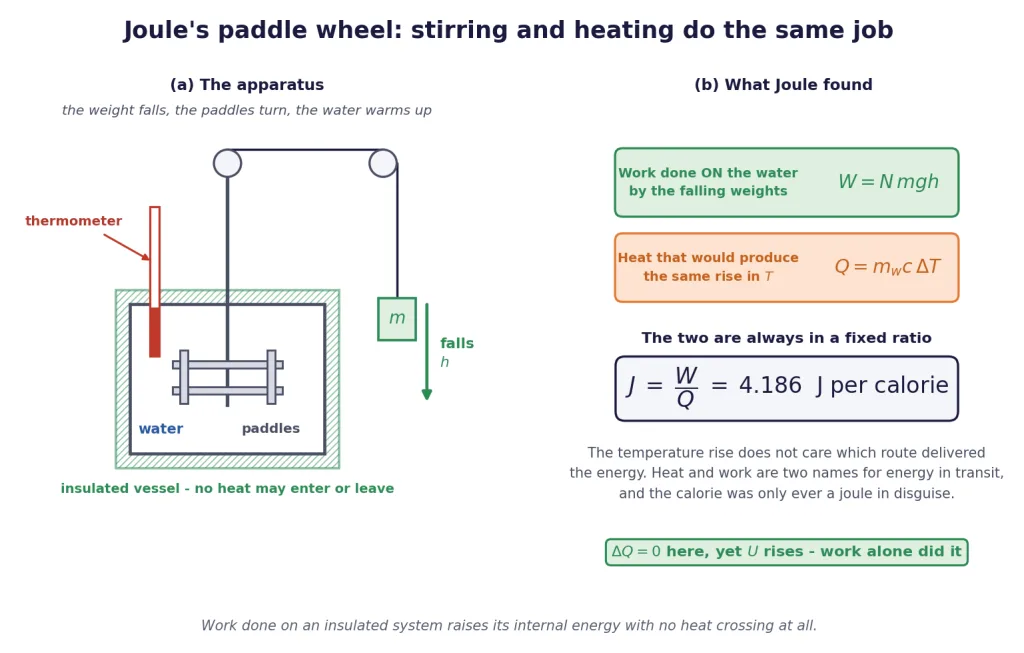
The experiment
A vessel of water, very carefully insulated, with a set of paddles inside on a vertical shaft. The shaft is turned by a cord over pulleys carrying known weights. The weights fall a measured height, the paddles churn the water, and a sensitive thermometer records the temperature rise.
Two numbers come out of one run:
- The work done on the water is purely mechanical, and you know it exactly: for falls of a mass through a height . (The weights are arranged to descend slowly, so essentially none of the energy is left as their kinetic energy.)
- The temperature rise of a known mass of water tells you how much heat would have produced the same effect: .
What he found
The ratio of the two was always the same number, however the experiment was arranged. Stirring water, forcing water through fine tubes, compressing a gas, rubbing iron plates together under mercury — every route gave the same answer:
This is the mechanical equivalent of heat. Its significance is not the number, which is just a conversion factor between two units that happened to be invented separately; it is what the constancy means.
Key Point — what Joule's experiment establishes:
- Heat is a form of energy, not a substance. It can be created from work without limit, so it cannot be conserved on its own.
- Work and heat are interchangeable ways of raising internal energy. The water cannot tell which one you used — only shows up in the thermometer.
- The calorie was never a separate unit. 1 cal J, and modern work simply uses the joule for everything. The phrase "mechanical equivalent of heat" is now a historical label for a unit conversion.
Read the signs off this experiment
It is the cleanest possible illustration of the convention just fixed, so do it explicitly. Take the water as the system.
- The vessel is insulated, so no heat crosses the boundary at all: .
- Work is done on the system by the paddles, so by our convention is negative: .
- Energy conservation then gives , and the internal energy rises — which is exactly what the thermometer shows.
Zero heat crossed the boundary, and the water still got hotter. If you ever catch yourself thinking "the temperature went up, so heat must have been added", this experiment is the answer. It did not. Work was.
Key Point — adiabatic work defines :
Because here, the whole of the work done on an insulated system shows up as a change in internal energy. That is more than a convenience: it is how can be measured without ever having to define heat first, which is why this experiment is the historical foundation of the first law.
[NEET Important] Two one-line facts from this block get asked directly: 1 cal J, and Joule's experiment showed that work and heat are equivalent ways of changing internal energy. The apparatus — falling weights, paddle wheel, insulated calorimeter, thermometer — is worth being able to sketch.
Where Comes From
Work in mechanics is force times displacement. Work in thermodynamics is the same thing, dressed for a gas. Here is the derivation, and it takes four lines.
The set-up
A gas is held in a cylinder closed by a frictionless piston of cross-sectional area . The gas is at pressure . Let the piston move outward by a small distance .
Step 1 — the force the gas exerts on the piston. Pressure is force per unit area, so This force acts on the piston face, and it points outward, along the direction the piston is about to move.
Step 2 — force times displacement. The force and the displacement are in the same direction, so
Step 3 — recognise the volume. The area swept by the piston times the distance it moved is precisely the increase in the volume of the gas:
Step 4 — put it together.
Key Point — work done by a gas: and, when the pressure changes as the gas expands, in the limit of small steps Here is the pressure of the gas at the piston face, and this identification requires the process to be slow enough for the gas to have a definite pressure throughout — the quasi-static condition that Section 5 makes precise.
The signs come out automatically
This is the elegant part. You do not have to remember the sign rule separately; the formula produces it.
- Expansion: , so , so . The gas does work on the surroundings. Positive, exactly as the convention says.
- Compression: , so , so . Work is done on the gas. Negative, exactly as the convention says.
- Rigid container: , so . No work at all, no matter how hot the gas gets or how furiously it is heated.
That last one is worth pausing on. A gas in a sealed rigid vessel can be heated to any temperature you like and it does zero work, because nothing moved. Work needs a displacement. Pressure alone is not enough.
Two things this formula does not say
It is not "". It is times the change in volume. Writing is one of the two commonest algebra errors in this chapter.
is not necessarily constant. is exact only for a step small enough that does not change during it — or for a whole process in which the pressure genuinely is held constant. When varies, you must integrate: slice the change into thin steps, use in each, and add. For a pressure falling in a straight line from to , the sum works out to the mean pressure times the total volume change, but that shortcut is special to a straight-line path, and it is not a general rule. Section 5 turns into a picture, and Sections 6 and 7 evaluate it for each standard process.
The units check out
Pressure times volume is an energy. That is worth knowing on its own: whenever you see , or , or anywhere in this chapter, it has the dimensions of energy.
[JEE Tip] For a gas at constant pressure, combine with and the volumes disappear: This is much faster than computing two volumes and subtracting, and it works with in kelvin or in Celsius, because only a temperature difference appears. That is the one place in this chapter where Celsius is safe.
The Section on One Card, and the Traps
The card
Key Point — everything above, compressed:
- = random molecular kinetic energy + molecular potential energy, in the frame where the centre of mass is at rest. A state function.
- The bulk kinetic energy of a moving system is never part of — until it is randomised.
- depends only on the end states; around a cycle .
- Heat crosses because of a temperature difference. Work crosses because of an organised displacement. They are the only two channels.
- and are path functions. A body never contains heat.
- Sign convention: heat added TO the system; work done BY the system. Then .
- , and when varies. Expansion positive, compression negative, rigid vessel zero.
- At constant pressure, .
- Joule: cal J, and stirring an insulated system raises with .
The traps, in the order they are set
Trap 1 — dropping the sign of in a compression. If the gas is compressed, is negative. Writing " J" for a compression and then using it in an energy balance produces an answer wrong by twice the work. This is the single most expensive error in the chapter.
Trap 2 — writing "work done = 500 J" with no direction. Always say by or on. If you cannot, you do not yet know the sign.
Trap 3 — importing the chemistry convention halfway through. If you are using , then is work done by the system throughout. Mixing the two forms in one solution guarantees a sign error.
Trap 4 — saying a hot body "contains heat". It contains internal energy. Heat is what crossed the boundary while it was being warmed, and it stopped existing as heat the moment it arrived.
Trap 5 — counting the bulk motion of a system in . A moving beaker, a falling block, a flying bullet: their ordered kinetic energy is mechanics, not internal energy.
Trap 6 — using when is not constant. It is a formula for constant pressure or for an infinitesimal step. Otherwise, integrate. And it is , never .
Trap 7 — assuming a temperature rise means heat was added. Joule's paddle wheel raises the temperature with . So does compressing a gas in an insulated cylinder, and so does a bicycle pump getting warm.
Trap 8 — forgetting that can be negative even when heat is added. Ice melting into water at 0°C absorbs a great deal of heat and shrinks, so is strongly positive while is (slightly) negative. Water is unusual in this, and it makes a good exam question.
What belongs to the sections either side
- Section 1 owns systems, state variables and the zeroth law. The definition of a state variable used above was established there.
- Section 3 takes , which is written above only to justify the sign convention, and develops it properly as the first law: what it forbids, the state-versus-path asymmetry, and the cyclic consequence.
- Section 4 defines and using the result derived here.
- Section 5 turns into the area under a curve on a pressure-volume diagram, which is where the path dependence of becomes visible rather than merely stated. That picture is deliberately not drawn here.
- Sections 6 and 7 evaluate for the isothermal, adiabatic, isobaric, isochoric and cyclic processes.
Solved Examples
Constants used throughout, unless a problem states otherwise: J/(mol K), 1 atm Pa, m/s, J/(kg K), J/(kg K), latent heat of vaporisation of water J/kg, latent heat of fusion of ice J/kg, 1 cal J.
Example 1: A gas expands at constant pressure
A gas held at a constant pressure of Pa expands from 1.0 L to 3.0 L while 900 J of heat is supplied to it. Find , and , each with its sign, and say what each sign means.
Solution:
Convert to SI first. L m and L m, so Positive, because the gas got bigger.
The work, from with constant: Positive, so the work is done BY the gas on its surroundings — it pushed the piston out.
The heat is given directly. Heat was supplied to the gas, so by our convention Positive, so energy entered the system as heat.
The internal energy. Of the 900 J that went in, 400 J was spent pushing the piston out. The remainder stays in the gas: Positive, so the internal energy of the gas rose — and since rises with temperature, the gas ended up hotter than it started. (Section 3 formalises this bookkeeping as the first law; here it is just conservation of energy.)
Check the story hangs together. Heat in, some spent on work, the rest banked: . Nothing missing.
Final Answer: J (done by the gas), J (added to the gas), J (internal energy rises).
Takeaway: State all three signs and say what each means. "Work = 400 J" is not an answer in this chapter; " J, done by the gas" is.
Example 2: The same gas, compressed and cooled
A gas is compressed at a constant pressure of Pa from 5.0 L to 2.0 L, and during the compression 700 J of heat is removed from it. Find , and with their signs.
Solution:
The volume change is negative, and that is the whole point of this problem:
The work: Negative, so 450 J of work was done ON the gas by whatever pushed the piston in. Notice that the formula produced the sign by itself — you did not have to remember a rule, only to keep signed.
The heat. Heat was removed, so it left the system: Negative, so heat flowed out of the gas into its surroundings.
The internal energy: Negative, so the internal energy fell and the gas ended up colder.
Does that make sense? 450 J was pushed into the gas mechanically, but 700 J was drained out of it as heat. More left than arrived, so the gas lost 250 J overall. Yes.
Final Answer: J (work done on the gas), J (heat rejected by the gas), J (the gas cools).
Takeaway: Two minus signs in one line is where marks die. Write out in full rather than doing it in your head. Compression means , every single time.
Example 3: Boiling one gram of water
One gram of water at 100°C and atmospheric pressure is completely converted into steam at the same temperature. In the liquid phase it occupies 1.0 cm; as vapour it occupies 1671 cm. Take the latent heat of vaporisation as J/kg and 1 atm Pa. Find , and , and comment on where the energy went.
Solution:
Kelvin check. The temperature is constant at 100°C, that is 373.15 K. It plays no part in the arithmetic here, but the phase change happens at that temperature and it is positive and absolute, as it must be.
The heat supplied, from the latent heat, with g kg: Positive — heat had to be put in to boil the water.
The work done as the water expands. The vaporisation happens against the constant pressure of the atmosphere, so applies directly: Positive — the steam pushed the atmosphere back to make room for itself.
The internal energy change: Positive, and large.
Read the split. Of the 2256 J supplied, only was spent pushing the atmosphere out of the way. The other 92.5% went into internal energy — into tearing the water molecules apart from one another against their mutual attraction. That is what latent heat mostly is: not motion, but the potential energy of separation.
Final Answer: J (supplied), J (done by the expanding steam), J, that is about 2087 J (stored, mostly as molecular potential energy).
Takeaway: A phase change at constant temperature still changes enormously. Temperature tracks molecular kinetic energy; the latent heat mostly goes into potential energy, which is why the thermometer does not move while the water boils.
Example 4: Joule's paddle wheel, with numbers
In a paddle-wheel experiment, two masses of 5.0 kg each are attached to a cord and allowed to descend 2.0 m, turning paddles inside 0.50 kg of water in a perfectly insulated vessel. The masses are raised and released 20 times. Take m/s and J/(kg K). Find , and for the water, and the rise in its temperature.
Solution:
The work done ON the water is the total loss of gravitational potential energy of the falling masses (they descend slowly enough that they arrive with negligible kinetic energy):
Now put in the signs. Our convention measures as work done by the system, and here the work is done on it, so Negative — the surroundings did work on the water.
The heat. The vessel is perfectly insulated: No heat crossed the boundary at all.
The internal energy: Positive — every joule of work went into internal energy, because there was nowhere else for it to go.
The temperature rise:
The point of the experiment, in one sentence. The water got 1.87 degrees hotter with zero heat supplied. If you have ever assumed that a temperature rise proves heat was added, this is the counterexample.
Final Answer: , J (work done on the water), J, and the water warms by 1.87 K.
Takeaway: A rise in temperature does not imply that heat was added. Work on an insulated system does the job just as well, and the system cannot tell the difference.
Example 5: Getting the mechanical equivalent of heat out of one run
In a stirring experiment on 1.00 kg of water, it is found that 4186 J of mechanical work raises the temperature by exactly 1.00 K. The same rise is known to require 1000 calories of heat. Find the mechanical equivalent of heat, and state , and for the stirring run.
Solution:
The two routes, side by side. By stirring: J produces K. By heating: cal produces the same K in the same water.
Both routes end in the same final state, so both delivered the same change in internal energy. The ratio of the two measurements is therefore a pure unit conversion:
The signs for the stirring run, taking the water as the system:
- — the vessel is insulated, so no heat crossed.
- J — work was done on the system, so it is negative.
- J — the internal energy rose by the full amount of work done.
- What the constancy of means. Joule found the same 4.186 whether he stirred water, forced it through fine tubes, compressed a gas or rubbed iron plates together. A conversion factor that does not depend on the mechanism is telling you that heat and work are the same physical quantity in different clothes — energy in transit.
Final Answer: J/cal; for the run, , J, J.
Takeaway: "Mechanical equivalent of heat" is a historical name for a unit conversion. Work in joules throughout and the whole idea disappears, which is exactly what modern practice does.
Example 6: A copper block hits the ground
A copper block of mass 0.50 kg is dropped from a height of 20 m onto a hard floor and comes to rest without bouncing. Assume all of its kinetic energy at impact stays in the block. Take J/(kg K) and m/s. Find the rise in temperature, and state , and for the block.
Solution:
Before the impact. The block has J of energy, but it is ordered kinetic energy of the block as a whole. It is not internal energy, and while the block is falling its temperature is unchanged.
At the impact all of that ordered motion is destroyed, and it is converted into the disordered motion of the copper atoms. Taking the block as the system:
- — the impact is over in milliseconds, far too fast for any appreciable heat to leak into the floor.
- J — the floor did 98 J of work on the block in stopping it, so the sign is negative.
- — the internal energy rose by 98 J.
The temperature rise:
A neat detail worth spotting. The mass cancels: Every copper block dropped from 20 m warms by the same 0.51 K, whether it is a coin or a cannonball. The answer never needed the mass at all.
Final Answer: , J, J, and the block warms by 0.51 K.
Takeaway: Bulk kinetic energy becomes internal energy only when it is randomised. In flight it is mechanics; after the impact it is thermodynamics.
Example 7: The beaker you carry across the room
A beaker holds 1.0 kg of water at 300 K. It is carried at a steady 10 m/s. (a) By how much does the internal energy of the water change while it is moving? (b) The beaker is then brought abruptly to rest and all of its kinetic energy ends up in the water. Find the new temperature. Take J/(kg K).
Solution:
(a) While it is moving, the water has a bulk kinetic energy of but this is ordered motion of the whole body, so The water is at the same temperature, pressure and density as before. Every thermodynamic instrument would read exactly the same. The 50 J is real energy, but it is mechanical energy, not internal energy.
(b) Stopping it. Now the ordered motion is destroyed and randomised into the water:
- (fast, and nothing hot is involved),
- J (work done on the water in bringing it to rest),
- J.
The temperature rise:
Feel the size of that. Carrying a litre of water at 10 m/s — running speed — and slamming it to a halt warms it by about one hundredth of a degree. Water is extraordinarily hard to heat, and ordinary mechanical energies are tiny compared with thermal ones. That imbalance is worth remembering: it is why a car's brakes get red hot while the car itself barely slows the air around it.
Final Answer: (a) while moving; (b) J on stopping, and the water warms to 300.012 K.
Takeaway: This is the definition of internal energy in one experiment. Moving the beaker changes its energy but not its internal energy; stopping it changes its internal energy without any heat crossing the boundary.
Example 8: Work when the pressure will not stay still
A gas expands from 2.0 L to 6.0 L while its pressure falls linearly from Pa to Pa. During the process 1100 J of heat is supplied. Find , and with their signs, and show what answer the careless shortcut would give.
Solution:
Why cannot be used as it stands. That formula needs a single value of , and here the pressure is a different number at every instant. You must go back to and evaluate it for this particular path.
Slice and add. Because the pressure falls in a straight line with volume, the sum of over all the thin slices is the mean pressure times the total volume change: Positive — the gas expanded, so it did work on its surroundings.
The careless shortcut, and what it costs. Using the initial pressure throughout: That is 50% too big, because the gas only had that pressure at the very first instant. Using the final pressure instead gives 400 J, 50% too small. The correct answer is between them precisely because the pressure passed through every value in between.
The heat and the internal energy: Positive — the gas is left hotter than it started, despite having expanded.
Final Answer: J (done by the gas), J, J.
Takeaway: The mean-pressure shortcut is legitimate only for a straight-line path. For any other shape you must actually do — which Section 5 turns into a much friendlier picture.
Example 9: Heating two moles at constant pressure
Two moles of an ideal gas are heated at a constant pressure of 1 atm from 300 K to 400 K. Its internal energy is measured to rise by 4157 J. Take J/(mol K) and 1 atm Pa. Find the work done and the heat supplied, and compute the work by two independent routes.
Solution:
Kelvin check. Both temperatures are given as absolute: 300 K and 400 K, both positive. Good.
Route one — through the volumes. From :
Route two — the shortcut. At constant pressure, directly: Same answer, in one line instead of three. Positive, so the gas expanded and did work on its surroundings.
The heat supplied. The gas needed energy for two things — to raise its internal energy and to do the pushing: Positive, so heat was added to the gas.
Notice the split. Of the 5820 J supplied, about 29% was spent on expansion and 71% on raising the internal energy. Had the container been rigid, the whole 4157 J would have done the job. That extra cost of heating at constant pressure is exactly what Section 4 turns into the relation .
Final Answer: J (done by the gas), J (supplied), J.
Takeaway: at constant pressure saves you two volume calculations. And because only appears, it is the one formula in this chapter where Celsius and kelvin give the same number.
Example 10: A sign drill in four parts
For each of the following, state , and with signs. (i) A gas expands, doing 250 J of work on its surroundings, while 600 J of heat is supplied. (ii) A gas is compressed with 400 J of work done on it while 400 J of heat is removed. (iii) A gas in a rigid sealed vessel is supplied with 500 J of heat. (iv) An insulated gas expands, doing 300 J of work.
Solution:
Set the convention out before doing anything. means heat in; means work by the system; and energy conservation gives .
Work each one:
| Case | What it means | |||
|---|---|---|---|---|
| (i) expand, heated | J | J | J | some heat did work, the rest warmed the gas |
| (ii) compress, cooled | J | J | work in exactly matched heat out; temperature unchanged | |
| (iii) rigid, heated | J | J | nothing moved, so all the heat became internal energy | |
| (iv) insulated expansion | J | J | the gas paid for the work out of its own energy, so it cools |
Case (iv) deserves a second look, because it is the one that surprises people. No heat came in, yet the gas did 300 J of work. The energy had to come from somewhere, and the only place available was the gas's own internal energy. So the gas cooled. That is why a gas cylinder gets cold when you let it out fast, and why a spray can chills in your hand.
Case (ii) is the other useful one. Both quantities are negative and equal, so they cancel exactly and : the gas ends at the same temperature it started, having been squeezed and cooled in balance.
Final Answer: as tabulated: (i) , , J; (ii) , , ; (iii) , , J; (iv) , , J.
Takeaway: Write the convention at the top of your answer, then fill in three signed numbers. Doing it in that order makes sign errors almost impossible; doing it in the other order makes them almost certain.
Example 11: Melting ice, where the work is negative
0.10 kg of ice at 0°C is melted into water at 0°C under atmospheric pressure. Ice has a density of 917 kg/m and water 1000 kg/m. Take the latent heat of fusion as J/kg and 1 atm Pa. Find , and with their signs.
Solution:
The heat needed: Positive — heat must be supplied to melt ice.
The volumes, before and after. This is the unusual bit: water is denser than ice, so the sample shrinks as it melts.
The work, with that negative carried through: Negative — the atmosphere did about 0.92 J of work ON the sample as it contracted.
The internal energy: Positive, and essentially the whole of .
What the numbers are telling you. The work term is smaller than the heat term by a factor of about 36 000, so for a melting solid it is entirely negligible in practice. But its sign is not a curiosity — it is the physical fact that ice floats, and it is why a bottle of water bursts in a freezer and a frozen pond stays liquid underneath.
Final Answer: J (supplied), J (done on the sample by the atmosphere), J.
Takeaway: Heat added and work done are independent in sign. Here heat pours in while the work is negative, because is negative — and , not intuition, is what sets the sign of .
Example 12: Two routes to exactly the same place
A system is taken from a state to a state twice. Route 1: it is heated in a rigid sealed container until 600 J of heat has entered, doing no work. Route 2: starting again from , it is stirred inside a perfectly insulated rigid vessel until 600 J of work has been done on it. Find , and for each route and explain what the comparison proves.
Solution:
- Route 1 — pure heating in a rigid vessel.
- J, heat added to the system.
- , because the container is rigid and nothing moved.
- J.
- Route 2 — pure stirring, insulated.
- , because the vessel is perfectly insulated.
- J, because 600 J of work was done on the system.
- J.
- Line the two up:
| Route 1 | Route 2 | Same? | |
|---|---|---|---|
| J | no | ||
| J | no | ||
| J | J | YES |
What this proves. The two routes have nothing in common in their heat and work, and yet they arrive at exactly the same final state with exactly the same internal energy. is a property of the two end states; and are properties of the journey. That is what "state function" and "path function" mean, stated as a measurement rather than a definition.
And the killer consequence. Hand someone the final system and ask them how much heat it contains. They cannot answer, because the question has no answer: Route 2 involved no heat at all. The system does not contain heat. It contains internal energy.
Final Answer: Route 1: J, , J. Route 2: , J, J. The internal energy changes are identical; the heats and works are not.
Takeaway: If two routes to the same state can give different and but must give the same , then and cannot be properties of the system. Section 3 builds the first law on exactly this asymmetry.