
The Two Processes That Carry the Mathematics
Section 5 gave you the picture: a quasi-static process is a curve on the - diagram, and the work done by the gas is the area under it. But "a curve" is not enough to compute with. To get a number you need to know which curve, and that is decided by what you hold fixed while the gas changes.
Hold the temperature fixed and you get an isothermal process. Let no heat cross the boundary and you get an adiabatic one. Those two are the subject of this section, and between them they account for most of the algebra in the chapter. The other two, isobaric and isochoric, are simpler and are Section 7's business.
Before anything else, the rule that every sign in this chapter obeys.
Key Point — the sign convention used throughout this chapter:
- is positive when heat is added TO the system, negative when heat leaves it.
- is positive when work is done BY the system (an expansion), negative when work is done on it (a compression).
- The first law is then
Chemistry writes the first law as , with the work done on the system — the same physics with one sign moved.
Isothermal: hold the temperature still
Key Point — isothermal process:
An isothermal process is one in which the temperature of the system stays constant throughout, so and .For an ideal gas, with fixed gives which is Boyle's law. So an isothermal process for an ideal gas is a Boyle's-law process.
Now the step that makes the whole thing collapse. For an ideal gas the internal energy depends on temperature and on nothing else — not on pressure, not on volume. That is a result you can take from the kinetic theory: is just the total random kinetic energy of the molecules, and that is fixed by alone.
So if does not change, does not change:
Feed that into the first law:
Key Point: In an isothermal process on an ideal gas, Every joule of heat that enters leaves again as work. The gas is a pure pass-through — it banks nothing. And if the gas is compressed instead, every joule of work done on it is dumped straight out as heat.
The work: do the integral
needs as a function of along this path, and the gas law hands it over: , with , and all constant.
Three equivalent faces of the same formula, all worth knowing:
The middle one comes from , so — note the flip, pressures the other way up from volumes. The third is for when your calculator only gives you .
Here is the number of moles (also written ) and J/(mol K).
Reading the signs off the formula
- Expansion, : the log is positive, so — the gas does work — and , so heat flows in.
- Compression, : the log is negative, so — work is done on the gas — and , so heat is released.
Never write "the work done is 3458 J" and stop. Write "the gas does 3458 J of work on its surroundings", or "3458 J of work is done on the gas". The number without the direction is only half an answer.
The isotherm is a rectangular hyperbola
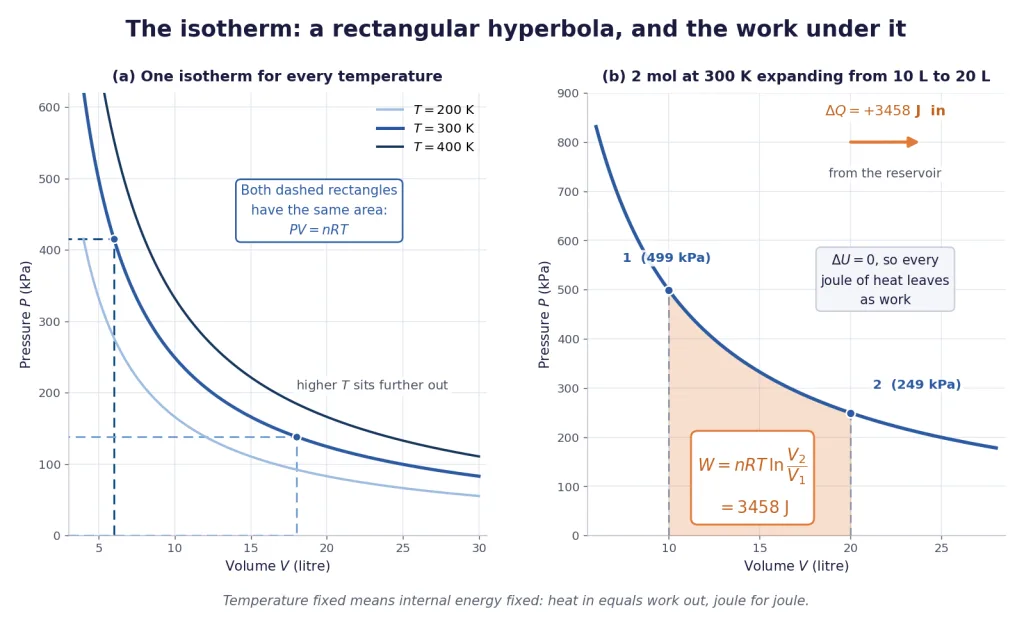
is , and that curve is a rectangular hyperbola with the two axes as its asymptotes. Some things to notice on the figure above:
- There is one isotherm for every temperature, and they never cross. A higher temperature means a bigger constant , so its curve sits further from the origin.
- Pick any point on an isotherm and drop a rectangle to the axes. Its area is , the same for every point on that curve. That is the visual meaning of Boyle's law.
- The curve is steep on the left and flat on the right, because — a result we will need again in a moment.
[Board Important] A three-mark question that comes round often: "Draw the - diagram for an isothermal expansion and write an expression for the work done." Full marks want the hyperbola drawn falling from left to right, the area under it between and shaded, stated, and the remark that so .
What It Actually Takes to Hold a Temperature Still
A formula is easy. Getting a real gas to expand at genuinely constant temperature is not, and the exam asks about it because the answer explains what "quasi-static" really costs.
When a gas expands it does work, and that work comes out of its energy account. Unless something replaces that energy at exactly the rate it is spent, the gas cools. So an isothermal expansion needs three things at once.
Key Point — the three requirements for an isothermal process:
- Conducting walls. The container must be a good conductor — thin metal, not glass or plastic — so heat can pass through it freely. Insulating walls would give you the opposite process entirely.
- A heat reservoir. The container sits in a body so large that it can supply or absorb the heat without its own temperature shifting measurably — a big water bath, the atmosphere, the sea. That is what a reservoir means.
- Slowness, above everything else. The process must be carried out so slowly that heat has time to flow in and keep pace with the work being done. This is the hard one.
Why slowness is the real condition
Suppose you yank the piston out quickly. The gas expands, does work, and cools — because heat conduction through the wall is a slow business and it simply cannot deliver energy fast enough. By the time the reservoir has caught up, the expansion is over. What you performed was much closer to an adiabatic expansion than an isothermal one.
Now imagine doing the same expansion over an hour, in a thousand tiny steps, pausing after each. After every step the gas is a hair cooler than the bath, heat trickles in, and the temperature is restored before the next step begins. The gas is never more than infinitesimally out of equilibrium — the definition of quasi-static — and the whole path is a genuine isotherm.
Key Point: A perfectly isothermal process would take infinite time. It is a limiting ideal, approached by any process slow enough that the temperature difference between system and surroundings is always negligible. In the laboratory "slow" typically means slow compared with the time heat takes to cross the wall.
[JEE Tip] Examiners like to pair the two conditions and see if you can tell them apart. Remember it as: isothermal needs conducting walls and slowness; adiabatic needs insulating walls or speed. A fast process in a conducting container is still adiabatic, because heat has no time to move. A slow process in an insulated container is still adiabatic, because heat has no route. You need both a route and time for heat to matter.
Isothermal compression, and what comes out
Push the piston in slowly instead. Now , so is negative and
which is our convention's way of saying work is done on the gas. Since is still zero, as well: heat leaves the gas and goes into the reservoir, joule for joule with the work put in.
This is exactly what a bicycle pump would do if you pumped slowly enough — and exactly what it does not do when you pump hard, which is why the barrel gets hot. Section 6's other half explains that.
One warning about
in an isothermal process is a statement about an ideal gas. It rests on depending on alone. For a real gas at high pressure there is potential energy stored in the intermolecular forces, that energy depends on the spacing of the molecules, and so shifts a little even at fixed temperature. Every problem in this chapter treats the gas as ideal, so stands — but know why it stands.
Also note what is not claimed: does not mean "no energy changed hands". A great deal of energy crossed the boundary — in as heat, out as work. It is the stock of internal energy that is unchanged, not the traffic.
Adiabatic: Seal the Boundary and See What Happens
Key Point — adiabatic process:
An adiabatic process is one in which no heat enters or leaves the system: The first law then gives
Read that boxed line slowly, because it is the whole physics of the section. With no heat available, the only account the gas can draw on is its own internal energy. If it does work on the world, its internal energy must fall by exactly that amount. And for an ideal gas, internal energy falling means temperature falling.
Key Point — the consequence you must never forget:
- Adiabatic expansion: , so — the gas cools.
- Adiabatic compression: , so — the gas heats up.
No heat went anywhere. The temperature changed because work changed the internal energy.
Two ways to get one
You can achieve by blocking the route or by removing the time:
- Insulate. Surround the gas with a poor conductor — thermacole, a vacuum jacket, a pile of sand on the piston. Heat has nowhere to go.
- Be quick. Do it so fast that heat conduction, which is slow, has no chance to move anything. A tyre bursting, a pump stroke, a sound wave passing through air: all effectively adiabatic, in ordinary containers, purely because they are over in a fraction of a second.
The second route is why adiabatic processes are so common in real life and isothermal ones so rare. Real machinery is fast.
Deriving constant
Take an infinitesimal quasi-static adiabatic step. Three facts go in:
- First law with : .
- Internal energy of an ideal gas: , with the molar specific heat at constant volume, in J/(mol K).
- Work: .
Step 1. Put them together:
Step 2. Differentiate the gas law :
Step 3. Eliminate . From step 1, , so
Step 4. Multiply through by and gather the terms:
Step 5. Mayer's relation says , so :
Step 6. Divide by and write :
Step 7. Integrate:
Key Point — the adiabatic relations, all three of them: Substituting gives the temperature-volume form: and substituting gives the temperature-pressure form:
Which one you reach for depends on which pair of quantities the question gives you. Volumes and pressures: use the first. Volumes and temperatures: the second. Pressures and temperatures: the third. Getting fluent at picking the right one is most of the skill.
The values of you will need
is always greater than 1, because always. Section 4 derives where these numbers come from; here they are as the working reference this section needs, since no adiabatic problem can be started without one.
| Gas type | Examples | |||
|---|---|---|---|---|
| Monatomic | He, Ne, Ar | |||
| Diatomic | H, O, N, air | |||
| Polyatomic | CO, CH, NH |
Specific heats are in J/(mol K) with J/(mol K). Air is diatomic, so for every atmosphere problem in this chapter.
A relation worth memorising, because it turns up in every second adiabatic problem:
The Work Done in an Adiabatic Change
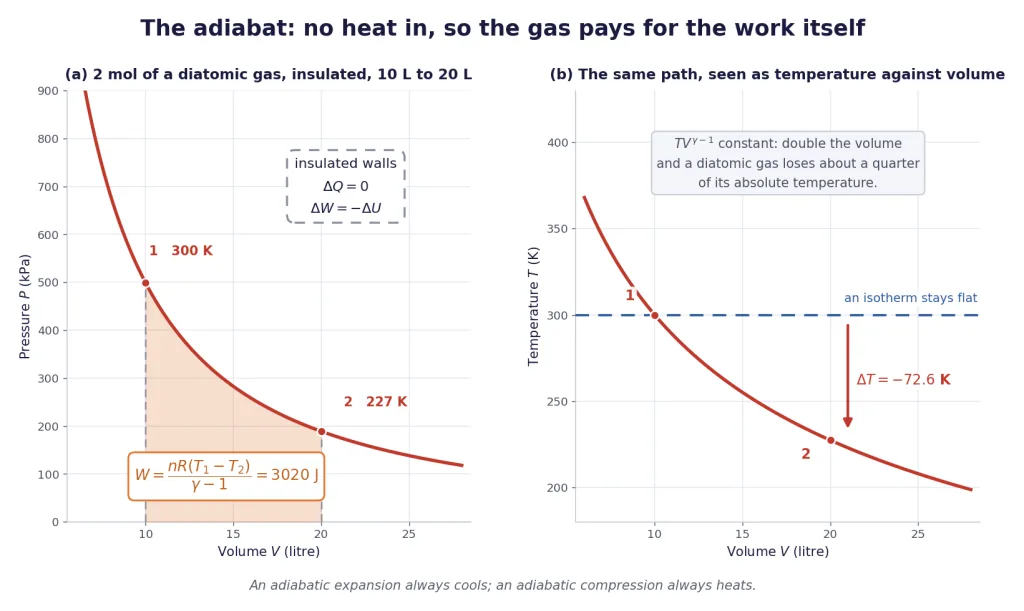
There is no reservoir to bill, so the work has to come out of the gas. Two routes to the formula, and they had better agree.
Route one: integrate, as always
Along the path , so , and
Now use the constant in its two disguises: when it multiplies the term, and when it multiplies the term. Then , and likewise for state 1:
Key Point — adiabatic work: The second form follows from at each end. Both are the work done by the gas.
Route two: no integration at all
means . And since ,
the same answer. That agreement is not a coincidence — it is the first law and the definition of being consistent with each other, and it is a good check to run in your head.
What the signs are telling you
Look at and remember , so the denominator is always positive.
- (the gas cooled) gives : the gas did work. An adiabatic expansion cools the gas, and that cooling is the payment.
- (the gas got hotter) gives : work was done on the gas. An adiabatic compression heats the gas, and that heating is where the work went.
Key Point: In an adiabatic process the temperature change is the energy bookkeeping. There is no third party. Write and read the sign off the temperature.
[NEET Important] A one-liner worth having ready: "A gas expands adiabatically. What happens to its temperature and why?" Answer: it falls, because the gas does work at the expense of its internal energy and there is no heat coming in to replace it. Do not say "because it expanded" — an isothermal expansion also expands and its temperature does not budge.
A useful cross-check on any adiabatic answer
Whatever numbers a problem gives you, these three must all hold at once, and checking two of them catches almost every slip:
| Quantity | Adiabatic value | Sign for expansion | Sign for compression |
|---|---|---|---|
| , by definition | |||
| positive | negative | ||
| negative | positive |
And, always, must come out to zero on the left. If your three numbers do not satisfy it, one of them is wrong — go back before you write the answer down.
Why the Adiabat Is Steeper — and by Exactly How Much
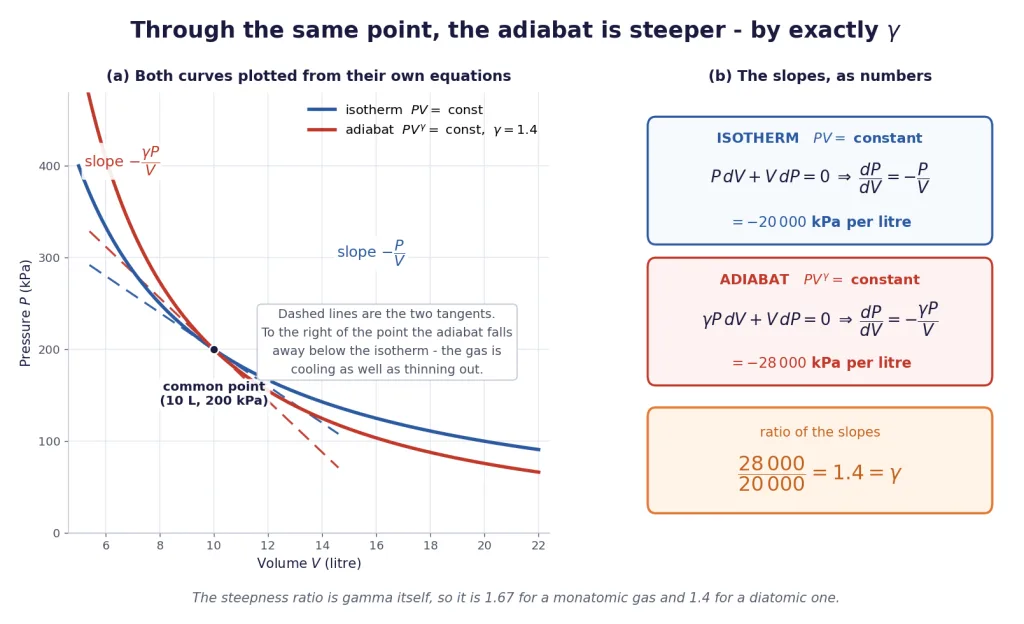
Draw an isotherm and an adiabat through the same point on a - diagram. They start together and immediately part company, with the adiabat always the steeper of the two. This is the single most-asked graphical fact in the chapter, and it takes four lines to prove.
The isotherm's slope
. Differentiate both sides with respect to , using the product rule:
The adiabat's slope
. Same treatment: Divide through by :
Divide one by the other
At a common point the two curves share the same and the same , so everything cancels except one symbol:
Key Point — the steepness result: Since for every gas, the adiabat through any point is steeper than the isotherm through that point, by exactly the factor — a factor of 1.67 for a monatomic gas, 1.4 for a diatomic one, about 1.33 for a polyatomic one.
Why it must be so, without any calculus
Expand a gas isothermally and the pressure drops for one reason only: the same molecules are spread through a bigger volume, so they strike the walls less often.
Expand it adiabatically and the pressure drops for two reasons: the molecules are spread out and they have slowed down, because the gas cooled. Two effects instead of one, so the pressure falls faster, so the curve is steeper. Run it backwards for a compression: the adiabat climbs faster because squeezing also heats.
That argument is worth more marks than the derivation in a conceptual question, and it is impossible to forget once you have seen it.
Three things that follow
1. Adiabatic expansion does less work than isothermal expansion between the same two volumes. The adiabat dives below the isotherm from the shared starting point, so it encloses less area with the volume axis. Physically: the isothermal gas is being fed heat the whole way and the adiabatic one is running on its savings.
2. Adiabatic compression takes more work. Same reasoning, reflected. Going left from the shared point the adiabat climbs above the isotherm, so there is more area to pay for.
3. An adiabat can cut a given isotherm only once, and two adiabats never cross each other. If they did, you could build a closed loop out of two adiabatic legs, which would let you convert heat to work with nothing to show for it — the sort of thing Section 8's second law exists to forbid.
[JEE Tip] In a multi-curve graph question, identify the adiabat as the steeper curve at the crossing and say why: " and ." Examiners give the mark for the reason, not the label.
Where This Shows Up, and the Two Processes Side by Side
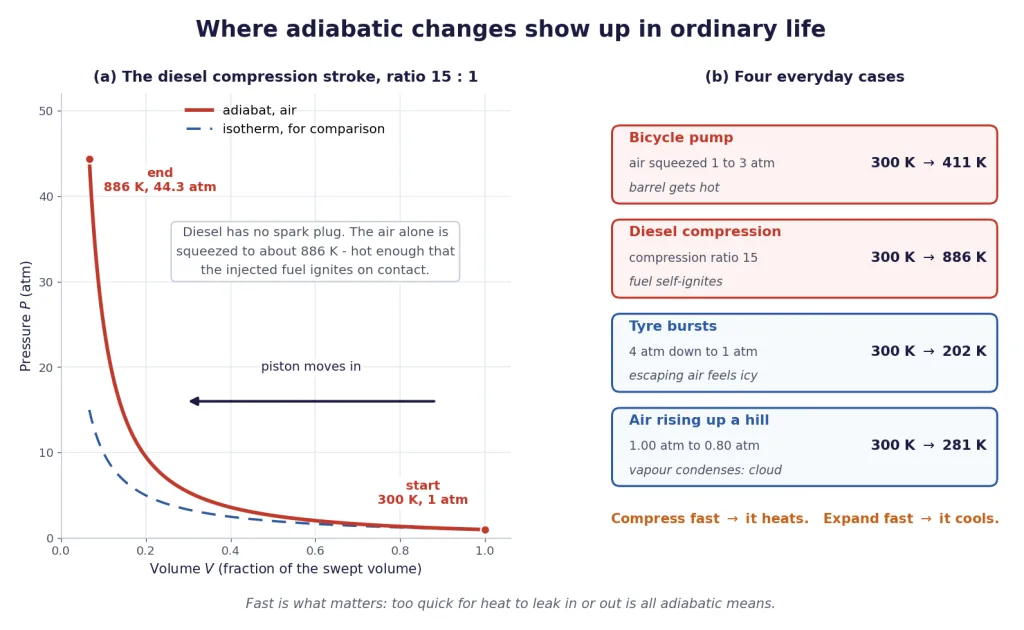
Adiabatic changes are everywhere, precisely because they need no special apparatus — only speed.
The diesel engine's compression stroke
A petrol engine uses a spark. A diesel does not: it draws in air alone and squeezes it into a fifteenth of its volume in a few milliseconds. Far too fast for heat to escape, so it is adiabatic, and with takes air from about 300 K to about 886 K, over 600°C. Fuel injected into air that hot ignites on contact. The compression itself is the ignition system. That is why diesels run at high compression ratios and petrol engines cannot.
A bicycle pump gets hot
Pump a tyre briskly and the barrel becomes noticeably warm within a few strokes. Two things are happening, and only one of them is friction. The dominant effect is adiabatic compression: you are doing work on the trapped air far faster than heat can leak out through the metal, so the air's internal energy — and its temperature — climbs. Compressing air from 1 atm to 3 atm in one quick stroke takes it from 300 K to about 411 K.
A bursting tyre feels cold
Now run it backwards. When a tyre bursts, air at several atmospheres expands into the atmosphere in a fraction of a second. Adiabatic expansion, so the escaping air cools sharply — dropping from 300 K to about 202 K for a 4-to-1 pressure release. Water vapour in the air condenses, which is why you sometimes see a brief white puff at a valve when a cylinder is opened fast. The same effect chills the nozzle of an aerosol can.
Clouds
A parcel of moist air pushed up a hillside or up the front of a weather system finds itself at lower pressure. It expands, and because air is a very poor conductor and the parcel is enormous, the expansion is adiabatic. So it cools — roughly 10 K for every kilometre it rises while it stays unsaturated. Cool it enough and the water vapour it carries reaches its dew point and condenses into droplets. That is a cloud: the visible bottom of a cloud is the height at which a rising parcel finished cooling to saturation.
The two processes, side by side
This table is the one to have in your head walking into an exam.
| Isothermal | Adiabatic | |
|---|---|---|
| Held fixed | temperature | heat exchanged, |
| Equation of the path | constant | constant |
| Other forms | and constant | |
| Shape on a - plot | rectangular hyperbola | steeper hyperbola-like curve |
| Slope | , steeper by | |
| , all of it | ||
| Work by the gas | ||
| Temperature on expanding | unchanged | falls |
| What it needs | conducting walls, a reservoir, slowness | insulation, or speed |
| Specific heat of the gas | infinite ( with heat flowing) | zero ( with changing) |
That last row surprises people, so here it is in words. Specific heat is . In an isothermal process heat flows while , so is infinite. In an adiabatic process the temperature changes while , so is zero. Both are perfectly legitimate, and both are favourite one-mark questions. They are also the clearest possible demonstration that a gas does not have "a" specific heat — it has one for every process you can put it through.
[NEET Important] The two commonest errors in this section, in order of frequency. First, using for an adiabatic process — it is that vanishes there, not ; the two are almost opposites. Second, putting Celsius into constant. is always absolute temperature in kelvin. Convert first, every time, or the ratio is meaningless.
Solved Examples
Constants used throughout, unless a problem says otherwise: J/(mol K), 1 atm Pa, K, and for a monatomic gas, for a diatomic gas (including air), for a polyatomic one.
Example 1: An isothermal expansion, from the ground up
2 moles of an ideal gas at 300 K expand isothermally from 10 litre to 20 litre. Find (a) the initial and final pressures, (b) the work done, (c) the heat exchanged, and (d) the change in internal energy. State the sign and meaning of each.
Solution:
SI first, and check the temperature. m, m, K, already absolute and positive.
(a) Pressures, from the gas law: Volume doubled, pressure halved — Boyle's law, as an isotherm must obey.
(b) The work: Positive, so this is work done by the gas on its surroundings.
(d) Internal energy first, because it is the easy one. Temperature is unchanged and the gas is ideal, so
(c) Heat, from the first law: Positive, so heat flowed into the gas from the reservoir. The gas banked none of it: everything that came in as heat went straight out as work.
Final Answer: (a) Pa and Pa; (b) J, done by the gas; (c) J, absorbed; (d) .
Takeaway: In an isothermal process the answer to "how much heat?" and the answer to "how much work?" are the same number. Compute one and you have both — but still write down all three quantities with their signs.
Example 2: An isothermal compression, and where the heat goes
0.5 mole of an ideal gas at 300 K is compressed isothermally from 8.0 litre to 2.0 litre. Find , and , and say what each sign means physically.
Solution:
The volume ratio is less than one, which is the whole story of the signs:
Work: Negative. In this chapter's convention that means work was done on the gas — 1728.8 J of it, by whatever pushed the piston.
Internal energy: unchanged, gas ideal, so .
Heat: Negative, so heat left the gas and went into the reservoir.
The physical picture. You put 1728.8 J in through the piston. The gas could not store it, because storing energy would mean warming up and the reservoir will not permit that. So it handed the same 1728.8 J out through the walls as heat. A perfect pass-through, running the other way.
Final Answer: J (work done on the gas), J (heat rejected), .
Takeaway: A compression is not a different formula, only a different sign. Put the volumes in the right order, let the logarithm go negative, and read off what the sign is telling you.
Example 3: Given pressures instead of volumes
1 mole of an ideal gas at 400 K expands isothermally until its pressure falls from 5.0 atm to 1.0 atm. Find the initial and final volumes and the work done. Take 1 atm Pa.
Solution:
Volumes from the gas law. Pa, Pa.
Use the pressure form, which saves the volume step entirely. Since on an isotherm, — pressures the other way up:
Check against the volumes: , the same number. Good.
Signs. J (by the gas), , so J (absorbed).
Final Answer: L, L, J done by the gas, with the same amount absorbed as heat.
Takeaway: Use when the data is pressures — and get the ratio the right way up. Writing gives you the correct magnitude with the wrong sign, which the examiner will notice.
Example 4: An adiabatic compression with clean numbers
1 mole of a monatomic ideal gas at 300 K occupies 8.0 litre. It is compressed adiabatically to 1.0 litre. Find (a) the final temperature, (b) the initial and final pressures, (c) the work done, and (d) the change in internal energy. Take .
Solution:
Identify and . Monatomic, so and .
(a) Temperature, from constant: because . The gas is four times hotter and no heat went in at all.
(b) Pressures: Check with : , and . It holds.
(c) Work: Negative, so 11.2 kJ of work was done on the gas.
(d) Internal energy. , so Positive — every joule you pushed in is now sitting in the gas as internal energy, which is exactly why the temperature quadrupled.
Audit. . Consistent.
Final Answer: (a) 1200 K; (b) Pa and Pa; (c) kJ, done on the gas; (d) kJ.
Takeaway: Choose the exponent to match the data you have: for a pressure-volume step, for a temperature-volume step. Mixing them up is the commonest single mistake in adiabatic problems.
Example 5: An adiabatic expansion of a diatomic gas
2 moles of a diatomic ideal gas at 300 K in a well-insulated cylinder of volume 10 litre expand adiabatically until the volume has doubled. Find the final temperature, the work done and . Then find how much work the same expansion would have done isothermally, and explain the difference.
Solution:
Diatomic, so and .
Final temperature: A drop of 72.6 K, with the cylinder sealed the whole time.
Work: Positive: the gas did about 3.02 kJ of work.
Internal energy: , so J. Negative — the gas is poorer than it started, and its temperature says so.
The same expansion, isothermally:
Why the isothermal route does more work. Both start at the same point and end at the same volume. On the isotherm the gas is being fed heat all the way, so its pressure stays higher throughout; on the adiabat it cools as it goes, so its pressure sags faster. Higher pressure over the same volume swept means more area under the curve, and 3457.7 J against 3019.7 J is that area difference — the adiabat does 87% as much.
Final Answer: K, J by the gas, J. Isothermally the same expansion would give J.
Takeaway: Between the same two volumes, an isothermal expansion always beats an adiabatic one for work output. The isotherm sits above the adiabat, and area under the curve is work.
Example 6: The diesel compression stroke
Air (treat it as diatomic, ) is drawn into a diesel cylinder at 300 K and 1.0 atm and compressed adiabatically to one-fifteenth of its volume. Find the temperature and pressure at the end of the stroke, and comment.
Solution:
The compression ratio is .
Temperature: In Celsius that is C.
Pressure: which is 44.3 atm.
Cross-check with the third form. should equal . It does, so the two relations agree.
Comment. Diesel fuel ignites at around 500 K. The air alone, squeezed hard and fast, is at 886 K — comfortably above it. That is why a diesel engine has no spark plug: the compression is the ignition. It also explains why a diesel must be built far more robustly than a petrol engine, since it is containing 44 atm rather than about 10.
Final Answer: K (613°C) and Pa, about 44.3 atm.
Takeaway: For a compression ratio , use and directly. Both exponents are positive and the ratio is written big-over-small, so both quantities go up. That sanity check catches an inverted ratio instantly.
Example 7: The bicycle pump
Air at 300 K and 1.0 atm trapped in a bicycle pump is compressed rapidly to 3.0 atm. Find the final temperature and the temperature rise. Why does the barrel feel hot?
Solution:
Why adiabatic. The stroke lasts a fraction of a second. Heat conduction through the metal barrel is far slower than that, so essentially no heat leaves during the compression: .
We have pressures and temperatures, so use constant in its practical form:
The rise: K, or about 111 degrees.
The signs. ; work is done on the gas so ; therefore and the temperature climbs. That is the whole mechanism.
Why the barrel feels hot. The hot air then conducts its heat into the metal, which is a good conductor, and the barrel warms. Friction between the piston washer and the barrel adds a little, but the adiabatic heating of the air is the main term — which you can test by pumping slowly, when the barrel warms far less because the process is closer to isothermal.
Final Answer: K, a rise of about 111 K.
Takeaway: When a problem gives pressures and asks for temperatures, go straight to . Deriving it from volumes each time wastes minutes you do not have.
Example 8: The bursting tyre
Air inside a tyre at 4.0 atm and 300 K escapes suddenly to the atmosphere at 1.0 atm. Estimate the temperature of the escaping air, and explain the white puff sometimes seen.
Solution:
Adiabatic again, and for the same reason — it is over in a fraction of a second, far too fast for heat to flow in from the surroundings.
Pressure-temperature form:
In Celsius: C. A drop of 98 K.
Signs. ; the gas expands so ; therefore and the temperature falls hard.
The white puff. Air always carries water vapour. Chill it to 202 K and that vapour is far past its dew point, so it condenses into a mist of droplets — briefly visible as a white cloud at the valve. The real drop is smaller than 98 K, because the escaping jet mixes with room air almost at once, but the mechanism is exactly this one.
Final Answer: About 202 K, roughly C, a drop of some 98 K.
Takeaway: The same formula runs both ways. A pressure ratio bigger than one heats the gas, a ratio smaller than one cools it, and the exponent never changes.
Example 9: The same expansion by two different routes
1 mole of a monatomic ideal gas at 300 K expands from 10 litre to 20 litre, (a) isothermally, and (b) adiabatically. Compute the work in each case and the final temperature in each case, and comment on the difference.
Solution:
(a) Isothermal. and
(b) Adiabatic, with , so :
Compare. Same start, same finish volume, and The isothermal route does 25% more work.
Where the difference sits. On the isotherm, 1728.8 J of heat came in and 1728.8 J of work went out, with the internal energy untouched. On the adiabat, nothing came in and 1384.4 J of work went out — every joule of it subtracted from the gas's own internal energy, which is why the gas ends up 111 K colder. Two different paths between the same volumes, two different amounts of work: that is what it means to say is a path function.
Final Answer: Isothermal: J, K. Adiabatic: J, K.
Takeaway: The end volumes do not determine the work — the path does. , by contrast, depends only on the end temperatures, which is exactly the state-versus-path distinction the whole chapter turns on.
Example 10: An adiabat given only and
A gas at Pa occupying 5.0 litre expands adiabatically to 20 litre. Take . Find the final pressure and the work done, without being told the number of moles or the temperature.
Solution:
Final pressure, from :
Work, using the form that needs no moles:
Signs. Positive, so the gas did about 2.13 kJ of work. , so J and the gas cooled. In fact , so it lost 43% of its absolute temperature.
Final Answer: Pa and J done by the gas.
Takeaway: When moles and temperature are missing, use . It is the same formula as with written for , and it needs nothing you have not been given.
Example 11: Comparing the two slopes at a point
An isotherm and an adiabat for a diatomic gas both pass through the point where Pa and litre. Find the slope of each curve there and their ratio.
Solution:
Isotherm. Differentiating constant gives :
Adiabat. Differentiating constant gives , and :
Ratio:
Read it. Both slopes are negative, because both curves fall to the right. The adiabat's is larger in magnitude, so it is the steeper curve — by a factor of exactly , as it must be at any shared point. Had the gas been monatomic the factor would have been 1.67 instead.
Final Answer: Pa/m for the isotherm, Pa/m for the adiabat, ratio 1.4.
Takeaway: The ratio of the slopes at a common point is and nothing else — no volumes, no pressures, no moles survive the division. That is why the result is quotable as a fact.
Example 12: The cloud on the hill
A parcel of moist air at 300 K and 1.00 atm is carried up a hillside until its pressure has fallen to 0.80 atm. Air is diatomic. Find its temperature, and say why a cloud may form.
Solution:
Why adiabatic. Air is a very poor conductor, and the parcel is huge — heat exchange with the air around it is negligible over the few minutes the ascent takes. So .
Temperature:
The drop: K, or 281.5 K C.
Why a cloud. Cooler air holds less water vapour. As the parcel cools past its dew point the vapour it is carrying can no longer stay vapour, and it condenses onto dust particles as a mist of tiny droplets. That mist is a cloud. The flat base you see on a fair-weather cloud is the height at which rising parcels reach their dew point — which is why so many clouds share the same base height on the same day.
Signs, once more. , the parcel expanded so , therefore and the temperature fell. No heat was lost to anything; the air simply spent its own energy pushing the surrounding atmosphere aside.
Final Answer: About 281.5 K, or 8.3°C — a fall of roughly 18.5 K.
Takeaway: Adiabatic cooling on ascent is the reason weather exists. Nothing removed heat from that parcel; it cooled because it did work against the thinning atmosphere around it.