
Drawing a Line Round the Thing You Care About
Every problem in this chapter starts with one decision, and if you get it wrong nothing afterwards can be rescued: what exactly is the system?
Rub your palms together on a cold morning and they get warm. Which is the system — your left palm? Both palms? The palms plus the air between them? All three are legitimate choices, and each gives a different answer to "how much energy crossed the boundary". Thermodynamics is not vague about this. You draw an imaginary closed surface, you declare everything inside it to be the system, and from that moment on you are strictly bookkeeping what crosses that surface.
Key Point — the three words that set up every problem:
- The system is the part of the universe you have chosen to study — the gas in a cylinder, the water in a beaker, the working substance of an engine.
- The surroundings are everything else that can exchange energy or matter with it.
- The boundary (or wall) is the surface separating them. It may be real (the cylinder wall) or imaginary (a surface drawn in the middle of a river), rigid or movable, and it is the boundary's properties that decide what the system can do.
The three kinds of system
Classify a system by asking two questions about its boundary: can matter cross? and can energy cross? There are only three useful answers.
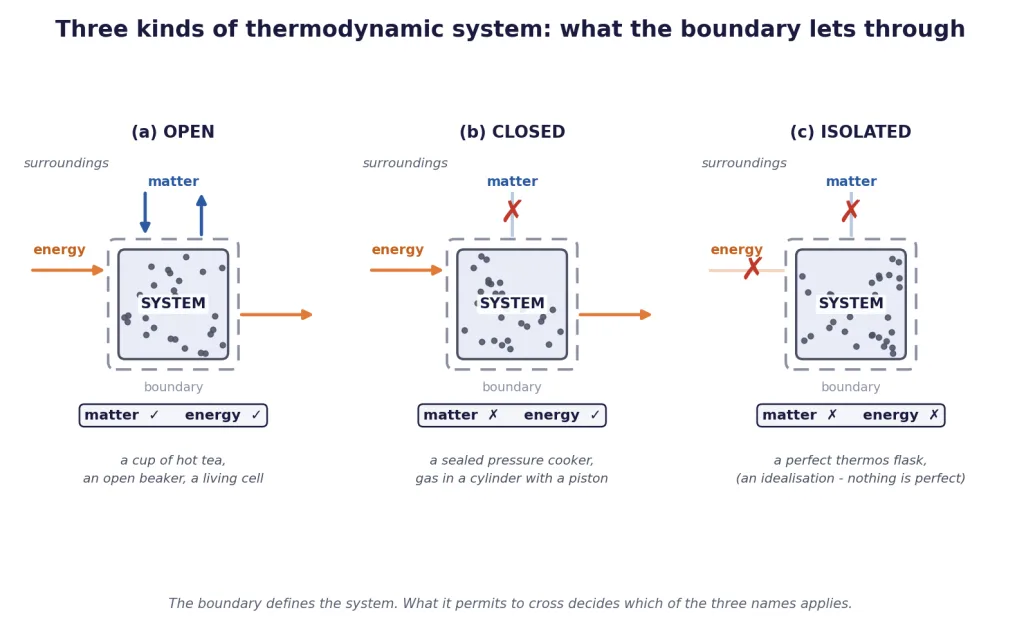
| System | Matter crosses? | Energy crosses? | Everyday examples |
|---|---|---|---|
| Open | yes | yes | a cup of hot tea, an open beaker of boiling water, a living cell, a jet engine |
| Closed | no | yes | a sealed pressure cooker, gas in a cylinder with a piston, a sealed refrigerant loop |
| Isolated | no | no | an ideal thermos flask, a perfectly insulated rigid box, the universe as a whole |
Three things worth noticing straight away.
- Closed does not mean sealed off from the world. A closed system swaps energy with its surroundings freely — as heat, as work, or as both. It only refuses to swap matter. The gas-in-a-cylinder is the working example for the whole chapter, and it is closed.
- A movable piston does not make a system open. The piston lets the gas do work; it does not let molecules escape. The system is still closed.
- A genuinely isolated system does not exist. Every real flask leaks a little heat eventually. It is an idealisation, and a very useful one, because in an isolated system the total energy simply cannot change.
[Board Important] "Give one example each of an open, a closed and an isolated system" is a standard two-marker. Answer with an open beaker of water / a sealed pressure cooker / a thermos flask (ideally insulated) and add the one-line reason in each case. The reason is what earns the mark.
The two kinds of wall
Because the boundary decides everything, thermodynamics gives its two extremes names, and you will meet both constantly.
Key Point — adiabatic and diathermic walls:
- An adiabatic wall is a perfect insulator. No heat can cross it. Two systems separated by an adiabatic wall can sit at wildly different temperatures for ever and neither will change. Thermacole, a vacuum jacket and glass wool are practical approximations.
- A diathermic wall is a perfect conductor. Heat crosses it freely. Two systems separated by a diathermic wall will change until their temperatures match, after which nothing more happens. A thin copper sheet is a practical approximation.
"Adiabatic" is going to be one of the most heavily used words in this chapter — it means no heat exchanged, and nothing more than that.
Equilibrium: the state a system settles into
In mechanics, equilibrium means the net force and torque are zero. In thermodynamics it means something different and richer.
Key Point — thermodynamic equilibrium:
A system is in thermodynamic equilibrium when the macroscopic quantities describing it do not change with time, and it is in equilibrium internally as well as with its surroundings. That requires three things at once:
- thermal equilibrium — one temperature throughout, no net heat flow;
- mechanical equilibrium — one pressure throughout, no unbalanced force, nothing accelerating;
- chemical equilibrium — no net reaction and no net diffusion of any component.
A gas sealed in a rigid insulated box, sitting still, with a definite pressure, volume, temperature and mass that stay put — that is an equilibrium state. Two situations that emphatically are not:
- A gas rushing into an empty space. During the rush the gas is dense at one end and thin at the other. Ask "what is its pressure?" and there is no single answer, because different parts have different pressures. There is no one number to write down.
- A petrol-air mixture a millisecond after the spark. Temperature and pressure vary violently from point to point. Again there is nothing to write down.
Both settle into equilibrium eventually, and only then can you describe them with a handful of numbers. That restriction is not a weakness of the subject; it is the price of its extraordinary generality, and the next block explains why the bargain is worth it.
Why Thermodynamics Refuses to Look at Molecules
Here is a fact that ought to be startling. A litre of air at room temperature contains about molecules. To describe it the way mechanics describes a cricket ball, you would need three position coordinates and three velocity components for every one of them — roughly numbers, updated continuously. Writing that list down at one number per second would take longer than the age of the universe by a factor of about .
And yet you can describe that same litre of air completely, for every purpose in this chapter, with four numbers: its pressure, its volume, its temperature and its mass.
Key Point — thermodynamics is a macroscopic science:
Thermodynamics describes a system by a small number of bulk properties that you can measure directly — pressure with a gauge, volume with a ruler, temperature with a thermometer — and never asks what any individual molecule is doing.That is not a simplification made out of laziness. It is the source of the subject's power: its laws were written down before anyone was sure molecules existed, and nothing that has been discovered about molecules since has changed a single one of them.
What that buys you
Because thermodynamics never commits to a molecular model, its conclusions apply to anything. The first law governs a steam engine, a stretched rubber band, a chemical reaction, a magnetised iron bar, a star and a black hole. The second law limits the efficiency of a petrol engine and of a mitochondrion with equal authority. A theory built on a picture of billiard-ball molecules could not have done that.
The trade is honest and worth stating: thermodynamics tells you what is possible and what is forbidden, but it never tells you why. It says a gas at a given temperature has a definite internal energy; it does not say the energy is the molecules' random motion. That "why" is the job of kinetic theory, the chapter that follows this one, and the two subjects fit together like a lock and a key.
The mechanical state and the thermal state are different things
Fire a bullet from a rifle. What changes about the bullet, in the language of mechanics, is its kinetic energy — it is moving fast. Its temperature is barely altered.
Now let the bullet bury itself in a block of wood. It stops. All that organised kinetic energy has gone somewhere, and where it has gone is into the disordered motion of the molecules of the bullet and the wood: both get hot.
Key Point: Thermodynamics is not concerned with the motion of a system as a whole. It is concerned with the internal, disordered, macroscopic state of the body. The bullet in flight and the bullet at rest on a table can be at exactly the same temperature; what distinguishes them belongs to mechanics, not to this chapter.
That distinction is going to matter enormously in Section 2, where we define internal energy and have to be very careful about which energy counts.
The state variables
Key Point — a state variable (or state function):
A state variable is a macroscopic quantity whose value depends only on the present equilibrium state of the system, and not at all on the route by which the system arrived there.The ones you will use in this chapter are — pressure, volume, absolute temperature, amount of substance, and internal energy. Entropy joins the list in Section 8.
The phrase "not on the route" is the whole point, and it is worth being concrete. Take a gas from a state at 300 K to a state at 400 K. Heat it gently. Or compress it violently. Or heat it to 800 K and let it cool back to 400 K. If the final pressure and volume are the same in all three cases, then every state variable is the same — same , same , same , same — and no measurement made on the final gas could possibly tell you which route it took.
Height above sea level behaves the same way. Two climbers standing on the same summit are at the same altitude, whether one walked the gentle path and the other went up the north face. Altitude is a state function. Distance walked is not. Hold on to that image: Section 2 will show that heat and work are the "distance walked" of thermodynamics.
[JEE Tip] A question that says "a system is taken from state to state along two different paths" is nearly always testing exactly this. Whatever else changes, , , and are identical for both paths, because each is the change in a state variable. Spot that in the first ten seconds and half the work is done.
Extensive and Intensive: the Halving Test
Look at the list of state variables again — , , , , — and ask a question that sounds trivial but is not: if I had twice as much of this stuff, which of these numbers would double?
Volume would. Mass would. Internal energy would, because there would be twice as many molecules each carrying their share of it. But pressure would not — two litres of air at one atmosphere is still at one atmosphere. Nor would temperature: pour two identical cups of tea at 60°C into one pot and you get a bigger pot of tea at 60°C, not at 120°C.
That splits every thermodynamic quantity into two families, and the split is one of the most useful sanity checks you will ever learn.
Key Point — the halving test:
Take a system in equilibrium and imagine cutting it into two equal halves.
- A variable whose value gets halved in each part is extensive — it scales with the amount of matter.
- A variable whose value is unchanged in each part is intensive — it does not.
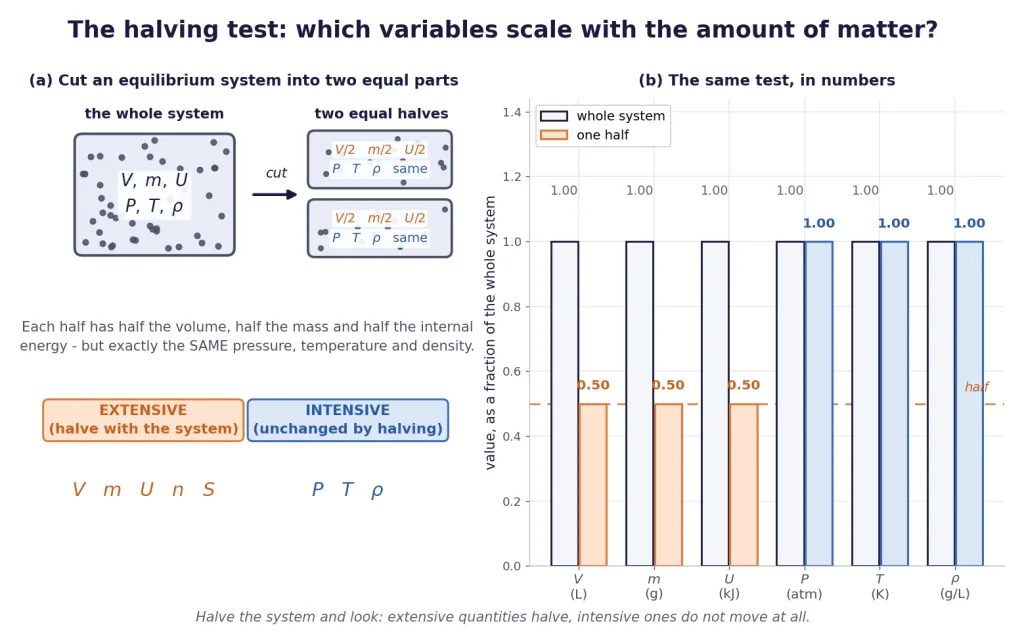
| Extensive (halve with the system) | Intensive (unchanged by halving) |
|---|---|
| volume | pressure |
| mass | absolute temperature |
| number of moles | density |
| internal energy | molar volume |
| heat capacity | specific heat capacity |
| entropy (Section 8) | molar internal energy |
Two rules that fall straight out
Rule 1 — extensive divided by extensive is intensive. Density is : halve the system and both top and bottom halve, so the ratio does not budge. The same argument makes molar volume, molar internal energy and specific heat capacity all intensive. This is exactly why we quote specific and molar quantities in the first place — they are properties of the material, not of the lump you happen to have.
Rule 2 — intensive times extensive is extensive. Pressure is intensive and a volume change is extensive, so the product is extensive. That will matter the moment you meet it in Section 2.
Using it as a check on an equation
This is where the classification earns its place in an exam, and almost nobody uses it.
Every term in a correct thermodynamic equation must be of the same kind. You cannot set an extensive quantity equal to an intensive one, any more than you can set metres equal to seconds. So a wrongly remembered formula can often be killed in five seconds without touching a single number.
Suppose you write down the ideal gas law from a hazy memory as Halve the system. The left-hand side is pressure, which is intensive, so it does not change. The right-hand side contains , which is extensive, so it halves. An equation cannot have one side change while the other stays put. It is wrong, and you knew that before you looked up anything.
Now do the same to the correct form: Left side: intensive extensive extensive, so it halves. Right side: extensive and intensive extensive, so it halves too. Both sides halve together. Consistent.
Key Point: Extensive and intensive is a free error-detector. Any thermodynamic equation you write should have every term on both sides scaling the same way when you double the amount of substance. It will not catch a wrong numerical factor, but it will catch a misremembered structure, which is the more expensive mistake.
[NEET Important] The single most-asked version is a straight recall: "Which of the following is an intensive variable?" with a list containing volume, mass, temperature and internal energy. The answer is temperature. Run the halving test in your head and you never have to memorise the list.
Equations of State: Three Variables, Two of Them Free
You now have a set of state variables. The next question is whether they are independent of one another — whether you can dial each one to any value you like.
You cannot, and finding out exactly how they are chained together is a large part of experimental physics.
Take a fixed amount of gas. Trap it in a cylinder, set its volume to 2 litres and its temperature to 300 K, and then try to make its pressure whatever you fancy. You cannot. Nature has already decided what the pressure will be. The three quantities are tied together by a relation, and that relation has a name.
Key Point — the equation of state:
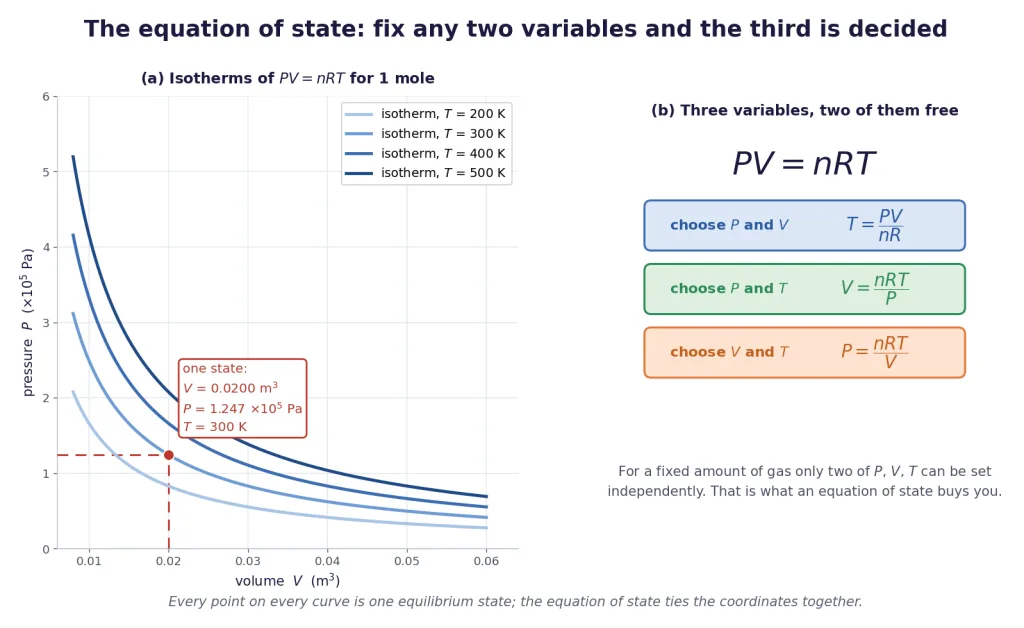
An equation of state is a relation among the state variables of a system that holds in every equilibrium state. It expresses the fact that the state variables are not independent.For an ideal gas it is where is the number of moles (also written ) and J/(mol K) is the universal gas constant. here is the absolute temperature in kelvin — always, without exception.
What the equation actually does for you
It reduces the count of things you have to know. For a fixed amount of gas, three variables appear — , and — but only two of them can be chosen independently. Fix any two and the third is determined:
That is why a gas can be drawn as a curve on a flat sheet of paper. Two independent variables means two axes, and one equilibrium state is one point. A curve of constant temperature drawn on a pressure-volume plot is called an isotherm, and it is a genuine rectangular hyperbola, , not an artist's impression. Section 5 turns that picture into a working tool.
Kelvin, and why this is the chapter's most expensive habit
Write and you mean kelvin. If you need Celsius, write or , and convert before the temperature goes anywhere near a formula: For most problems 273 is close enough, and we will say so when we use it.
The reason is easy to see and easy to forget. Kelvin and Celsius have the same size of degree but different zeros. A difference of temperature is therefore the same number in both — a rise of 20 degrees Celsius is a rise of 20 kelvin, and that is why the conduction formulas of the previous chapter did not care. But the ideal gas law does not contain a difference. It contains itself, and it multiplies it. Doubling the temperature of a gas from 27°C to 54°C does not double its pressure at constant volume, because in kelvin those are 300.15 K and 327.15 K — a rise of just 9%.
Key Point: Any time a temperature is multiplied, divided, or put into a ratio, it must be in kelvin. That covers , every gas-law step, and every efficiency formula later in this chapter. The only place Celsius is safe is inside a plain difference.
The ideal gas law is a model, not a law of nature
Two honest caveats, both of which get asked.
It is a limiting law. A real gas obeys well when it is dilute and hot — when the molecules are far apart and moving fast, so that the space they themselves occupy is negligible and the attractions between them barely matter. Squeeze a gas hard or cool it towards liquefaction and it departs from the law noticeably. Real gases need more elaborate equations of state with correction terms for molecular volume and intermolecular attraction.
Every system has one, not just gases. A stretched wire has an equation of state connecting tension, length and temperature. A soap film has one connecting surface tension and area. A magnetic material has one connecting magnetisation, field and temperature. Gases simply have the tidiest one, which is why they run this chapter.
[JEE Tip] For a fixed mass of gas the constant cancels between two states, giving the form you will actually use: Both temperatures in kelvin. Both pressures in the same unit, whatever it is — pascal, atmosphere or bar — because the units cancel. Same for volume. That cancellation saves a lot of conversion, and forgetting that it does not apply to temperature is the classic slip.
Thermal Equilibrium and the Zeroth Law
We have used the word "temperature" freely for two blocks. It is time to earn it.
What thermal equilibrium is
Put a beaker of hot water in contact with a beaker of cold water through a thin metal sheet — a diathermic wall. Something happens: measurable quantities of both change, and go on changing, until suddenly they stop. From then on nothing more happens, however long you wait.
Key Point — thermal equilibrium:
Two systems are in thermal equilibrium when, placed in thermal contact through a diathermic wall, no net flow of heat occurs between them and none of their macroscopic variables changes any further.Note what this definition does not mention: temperature. That is deliberate — we are about to construct temperature from this idea, so we are not allowed to assume it first.
If instead the two beakers are separated by an adiabatic wall, they can be at any conditions whatever and nothing will happen, because heat cannot cross. Adiabatic separation tells you nothing. Only a diathermic contact is a test.
The experiment behind the zeroth law
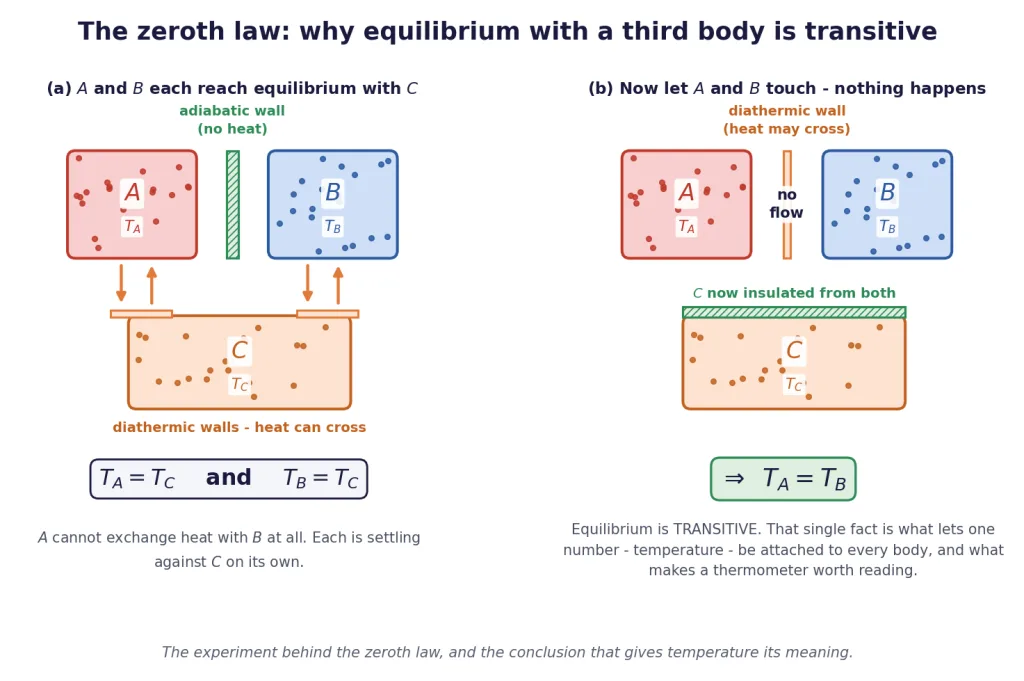
Take three systems, , and . Separate from by an adiabatic wall, so they cannot possibly influence each other, and put both in diathermic contact with . Wait. Both and settle into equilibrium with .
Now change the walls over. Make the wall between and diathermic, and insulate away from both with an adiabatic wall. and are now in thermal contact for the first time. What happens?
Nothing. Not a flicker. Their pressures and volumes stay exactly where they were.
Key Point — the zeroth law of thermodynamics:
If two systems are each in thermal equilibrium with a third system, they are in thermal equilibrium with each other.In symbols: if and , then , where means "is in thermal equilibrium with".
Why on earth is that a law?
This is the question examiners love, and the reason the law exists, so give it a moment. The statement looks like an insult to your intelligence. Surely it is obvious?
It is not, and here is the proof that it is not: the same statement is false for almost every other relation you can think of.
- Amit knows Bhavna. Bhavna knows Chetan. It does not follow that Amit knows Chetan.
- Team beats ; team beats . It does not follow that and are equally matched.
- Two magnets can each attract a piece of iron and yet repel each other violently.
A relation for which " and implies " is called transitive, and transitivity is a special property, not a free one. That thermal equilibrium happens to have it is an experimental fact about the universe, and it could have come out otherwise. Because it is a fact about nature that cannot be derived from the other laws, it is a law.
What the law buys: temperature, and a working thermometer
Now the payoff, in two steps.
Step one — temperature exists. If and are in equilibrium, there must be some physical property they share. If they were not in equilibrium, the property would differ. Transitivity guarantees that this property can be labelled by a single number attached to each body separately, such that two bodies are in equilibrium exactly when their numbers match. That number is what we call temperature. Without the zeroth law, there is no guarantee that such a labelling is even possible.
Step two — a thermometer means something. A thermometer is just system : a small body with an easily read property (the length of a mercury column, the resistance of a wire, the pressure of a fixed volume of gas). Here is the argument you use every time you take a temperature, laid bare:
- Put the thermometer in contact with body ; wait for equilibrium; read 42.
- Put the same thermometer in contact with body ; wait for equilibrium; read 42.
- Conclude that and would be in equilibrium with each other — that they are "at the same temperature" — even though and were never brought together.
Step 3 is pure zeroth law, and there is nothing else that could justify it. Every clinical thermometer, every furnace pyrometer and every weather station in the world runs on it. That is why the apparently trivial statement is promoted to a law of thermodynamics.
The name
The first and second laws were named and numbered in the nineteenth century. Only later did physicists realise that the statement above was being quietly assumed by both of them and had never been written down. Because it logically comes before the first law, and because "first" and "second" were already taken, it was numbered zero.
Key Point — what the zeroth law does NOT say:
It does not say what temperature is, and it does not tell you how to put numbers on it. It only guarantees that a consistent labelling exists. Choosing the numbers — the kelvin scale, the triple point of water at 273.16 K — is a separate step called thermometry, and it is why the ideal gas thermometer, which reads at constant volume, is such a natural instrument.
[Board Important] State the zeroth law in one sentence, then add the consequence in a second: "it establishes temperature as a valid state variable and makes measurement by a thermometer possible." The consequence is where the second mark lives. Answers that only quote the statement routinely lose half.
The Section on One Card, and the Traps
The card
Key Point — everything above, compressed:
- System / surroundings / boundary. Decide the system first, then bookkeep what crosses.
- Open (matter + energy cross), closed (energy only), isolated (neither).
- Adiabatic wall: no heat crosses. Diathermic wall: heat crosses freely.
- Thermodynamic equilibrium = thermal + mechanical + chemical, all steady in time.
- Thermodynamics is macroscopic: a few measurable bulk variables, no molecules.
- State variables , , , , depend only on the present state, never on the path.
- Extensive halves with the system (, , , ); intensive does not (, , ).
- Equation of state: , with in kelvin, J/(mol K). Two variables free, the third decided.
- Zeroth law: equilibrium with a third body is transitive, so temperature exists and a thermometer works.
The traps, in the order they are set
Trap 1 — putting Celsius into . The single most expensive habit in the chapter. is kelvin, always. Convert first, then compute, and if the answer looks absurd this is the first thing to check.
Trap 2 — calling a piston-and-cylinder an open system. Energy leaves through the moving piston; matter does not. It is closed. Openness is about matter.
Trap 3 — confusing "isolated" with "insulated". An insulated box with a movable piston is not isolated, because work can still cross the boundary. Isolated means nothing crosses — neither heat nor work nor matter.
Trap 4 — thinking equilibrium means "nothing is moving". Molecules never stop. Equilibrium means the macroscopic variables have stopped changing.
Trap 5 — assuming a system always has a pressure and a temperature. A gas in the middle of a violent expansion has neither, because different parts of it have different values. State variables describe equilibrium states only, which is why the next few sections work so hard to arrange processes slow enough for them to apply.
Trap 6 — mixing up specific and molar quantities. Both are intensive, but one is per kilogram and one is per mole. Section 4 makes this distinction load-bearing, so start being careful now.
Trap 7 — reciting the zeroth law without its consequence. The statement alone is not the full answer. The consequence — temperature is well defined and thermometers work — is the reason it exists.
What belongs to the sections either side
- Section 2 defines internal energy properly, introduces heat and work as the two ways of changing it, and fixes the sign convention that the whole chapter runs on. Note that was listed as a state variable here without being explained — that explanation is Section 2's job.
- Section 3 states the first law, . Nothing above needed it, and that is deliberate: everything in this section is true before energy conservation is even mentioned.
- Section 5 takes the isotherm sketched here and turns the pressure-volume diagram into the chapter's main working tool, including what "quasi-static" has to mean for a process to be drawable at all.
Solved Examples
Constants used throughout, unless a problem states otherwise: J/(mol K), K, 1 atm Pa. Molar mass of oxygen 32 g/mol.
Example 1: Sorting nine everyday things into three boxes
Classify each as an open, a closed or an isolated system, and give the reason: (a) a cup of hot coffee on a table, (b) a sealed pressure cooker on a flame, (c) an ideal thermos flask of soup, (d) a car engine cylinder during the compression stroke, (e) a human being, (f) the Earth, (g) a sealed but uninsulated glass bottle of water, (h) a rigid perfectly insulated box of gas, (i) the entire universe.
Solution:
Ask two questions of every boundary, in this order. Can matter cross? If yes, it is open and you are done. If no, ask can energy cross? If yes it is closed; if no it is isolated.
Work through them:
| Case | Matter? | Energy? | Verdict |
|---|---|---|---|
| (a) cup of coffee | yes — steam leaves | yes | open |
| (b) sealed pressure cooker | no — it is sealed | yes — the flame heats it | closed |
| (c) ideal thermos of soup | no | no (ideally) | isolated |
| (d) engine cylinder, valves shut | no | yes — the piston does work | closed |
| (e) a human being | yes — food, air, waste | yes | open |
| (f) the Earth | almost none | yes — sunlight in, infrared out | closed (very nearly) |
| (g) sealed glass bottle of water | no | yes — glass conducts | closed |
| (h) rigid insulated box of gas | no | no — rigid blocks work, insulated blocks heat | isolated |
| (i) the universe | nothing outside it | nothing outside it | isolated |
- The two that separate a good answer from a lazy one. Case (d): a moving piston does not let molecules out, so the cylinder stays closed even though it is doing work furiously. Case (h): note that it takes both conditions — rigid and insulated. Insulated alone is not enough, because a movable wall would let work cross.
Final Answer: open — (a), (e); closed — (b), (d), (f), (g); isolated — (c), (h), (i).
Takeaway: "Open" is a statement about matter, never about energy. A closed system can be violently exchanging heat and work with the world and is still closed. Only an isolated system exchanges nothing at all.
Example 2: How much oxygen is in the cylinder?
A rigid steel cylinder of internal volume 0.020 m contains oxygen at a pressure of Pa and a temperature of 300 K. Find (a) the number of moles of oxygen and (b) its mass. Take J/(mol K) and the molar mass of oxygen as 32 g/mol.
Solution:
Check the temperature first. It is given as 300 K — already absolute, already positive. Nothing to convert. Getting into the habit of looking at this line first will save you marks all chapter.
(a) Apply the equation of state, rearranged for :
(b) Convert moles to mass:
Sanity check on the size. At standard conditions a mole of gas occupies about 22.4 L, so 12 moles would need 270 L. We have squeezed them into 20 L — a factor of about 13 — and the pressure is correspondingly about 15 times atmospheric. Consistent.
Final Answer: (a) 12.03 moles; (b) 385 g of oxygen.
Takeaway: Write the temperature line before you write anything else. In this chapter, "is my in kelvin?" should be as automatic as checking units, because unlike a unit slip it produces an answer that looks perfectly reasonable.
Example 3: Cut the cylinder in half
The cylinder of Example 2 has its contents divided by an imaginary partition into two equal halves. Its internal energy is measured to be 75.0 kJ. For each half, state the values of , , , , and , and identify which of these are extensive and which intensive.
Solution:
- Apply the halving test to each variable in turn. Extensive quantities halve; intensive ones do not move.
| Quantity | Whole system | One half | Kind |
|---|---|---|---|
| volume | 0.020 m | 0.010 m | extensive |
| moles | 12.03 | 6.01 | extensive |
| mass | 385 g | 193 g | extensive |
| internal energy | 75.0 kJ | 37.5 kJ | extensive |
| pressure | Pa | Pa | intensive |
| temperature | 300 K | 300 K | intensive |
Confirm the half is a legitimate state. It must satisfy the equation of state in its own right: Both and halved, so their ratio was unchanged and the pressure came out the same. That is exactly the behaviour that makes intensive.
A ratio of two extensives is intensive. The density is Identical, as it must be.
Final Answer: each half has m, moles, g, kJ (all extensive, all halved) at the same Pa and K (both intensive, both unchanged).
Takeaway: The partition can be purely imaginary and the test still works. Nothing physical has to be done to the gas — you are asking a question about the definition of each variable, not performing an experiment.
Example 4: The thermometer that never touched either beaker
A mercury thermometer is placed in beaker of water, left to settle, and reads 42°C. It is dried, placed in beaker of cooking oil, left to settle, and again reads 42°C. The two beakers have never been in contact with each other. If they were now placed in thermal contact through a thin copper sheet, would heat flow? Justify your answer, and state the temperatures in kelvin.
Solution:
Name the three systems. is the water, is the oil, and is the thermometer. Note that and have never met.
What the two readings actually establish. The thermometer settling and staying put means it stopped exchanging heat, so
Apply the zeroth law. Two systems each in thermal equilibrium with a third are in thermal equilibrium with each other. Therefore and are in thermal equilibrium, and if joined by a diathermic wall no net heat will flow and neither will change.
Convert to kelvin:
Notice what has been done here. A conclusion was drawn about two bodies that were never brought together, from measurements made on a third. That is the entire practical content of the zeroth law, and it is what every thermometer reading in the world silently relies on.
Final Answer: No net heat flows — and are in thermal equilibrium by the zeroth law, both at 315.15 K.
Takeaway: A thermometer is system . When you compare two temperature readings you are not comparing the bodies directly; you are invoking the zeroth law. Say so in a Board answer and the mark is automatic.
Example 5: Which of these does halving change?
A 2.0 kg block of water at 4°C occupies exactly 2.0 L. It is poured equally into two identical cups. For the water in one cup, find the mass, the volume and the density, and say what has happened to the temperature.
Solution:
Mass and volume are extensive, so each halves:
Density is a ratio of two extensive quantities, so it is intensive. Check it: Unchanged, as promised.
Temperature is intensive. Both cups are at 4°C, which is K. Splitting water does not cool it. The common student instinct that "less water means less hot" confuses temperature (intensive) with internal energy (extensive) — the cup does indeed hold half the internal energy, but at the same temperature.
Final Answer: each cup: kg, L, kg/m unchanged, C K unchanged.
Takeaway: Halving a system halves its energy but not its temperature. Keeping those two apart is the whole reason the extensive/intensive language exists.
Example 6: A compression, and the mistake that ruins it
A fixed mass of an ideal gas is at 27°C, Pa and 3.0 L. It is compressed to 1.5 L, and its pressure is found to be Pa. Find the final temperature, in kelvin and in Celsius. Then show what answer you would have obtained by leaving the temperature in Celsius, and why it is nonsense.
Solution:
Convert the temperature first. Positive, absolute, safe to multiply.
The amount of gas is fixed, so is the same in both states and cancels: Volumes may stay in litres and pressures in pascal, because each appears on both sides and the units cancel. Temperature is the one quantity that must be converted, because a temperature ratio is meaningless in Celsius.
Solve for :
Back to Celsius for the reader:
Now the blunder. Using 27 in place of 300.15: and you would write "33.75°C". Look at how plausible that is — a modest warming after a compression, nothing alarming about it. That is exactly what makes this the most dangerous error in the chapter: it does not produce an absurd number, it produces a believable wrong one. The true rise is about 75 degrees, not 7.
Final Answer: K, that is C. The Celsius shortcut gives 33.75°C, wrong by roughly 68 degrees.
Takeaway: A temperature only ever appears in a gas law as an absolute value, never as a difference. So kelvin is compulsory, and the wrong answer will look reasonable. Convert before you multiply.
Example 7: Is an insulated cylinder an isolated system?
A gas is held in a cylinder whose walls are perfectly insulating. The cylinder is fitted with a frictionless piston, and a heavy weight rests on the piston. (a) Is the gas an isolated system? (b) What if the piston is now clamped so that it cannot move? (c) What if instead the insulation is removed but the piston stays clamped?
Solution:
Test the boundary against all three currencies: matter, heat, work.
(a) Insulated walls, free piston. Matter cannot cross (the cylinder is sealed). Heat cannot cross (the walls are adiabatic). But if the weight is reduced the gas expands and pushes the piston up — work crosses the boundary. Energy is therefore still able to leave or enter. Not isolated. It is a closed, adiabatic system.
(b) Insulated walls, clamped piston. Matter: no. Heat: no. Work: no, because with the volume fixed the gas cannot push anything through a distance. Nothing at all can cross. Isolated. Its internal energy is now locked at whatever value it has.
(c) Conducting walls, clamped piston. Matter: no. Work: no. But heat can now cross freely. Not isolated — it is a closed system, and specifically one held at constant volume.
Read the pattern. Isolation needs the boundary to block every channel. Rigid kills the work channel, adiabatic kills the heat channel, and sealed kills the matter channel. Remove any one and isolation is gone.
Final Answer: (a) not isolated (work can cross); (b) isolated; (c) not isolated (heat can cross).
Takeaway: "Insulated" blocks heat. "Rigid" blocks work. "Isolated" needs both, plus sealed. Examiners set this trap constantly by insulating a cylinder and leaving the piston free.
Example 8: Reading a temperature off a pressure gauge
A rigid vessel of volume 5.0 L contains 0.50 mole of an ideal gas. A gauge on the vessel reads an absolute pressure of Pa. Find the temperature of the gas, in kelvin and in Celsius.
Solution:
Convert the volume to SI: L m. Everything else is already SI.
Two variables are given, so the third is decided. That is exactly what an equation of state is for:
Check the sign, always. K is positive, as any absolute temperature must be. A negative answer here would mean an arithmetic slip, not a very cold gas.
In Celsius: A cool room. Entirely believable, which is a mild confirmation that nothing has gone wrong.
Final Answer: K, that is C.
Takeaway: This is what "two variables free, the third decided" means in practice. You never need to measure all three; measure any two and the equation of state hands you the last one.
Example 9: When a gas has no pressure at all
A cylinder is divided into two halves by a thin partition. One half holds gas at a high pressure; the other has been pumped out to a vacuum. The partition is suddenly punctured. Explain why, during the rush of gas from one side to the other, the system cannot be described by state variables at all, and say when the description becomes valid again.
Solution:
State variables describe equilibrium states only. The definition demands a single value throughout the system that does not change with time.
What is actually happening during the rush. The gas nearest the hole streams into the empty half at high speed while the gas at the far wall has hardly begun to move. At one instant, one region is dense and another is nearly empty. Ask "what is the pressure of the gas?" and there is no single answer — different parts of the same gas are at different pressures. The same is true of temperature.
Therefore the system has no and no during the process. Not "an unknown pressure" — no pressure at all, in the thermodynamic sense. You cannot mark this state as a point on a diagram, because a point needs coordinates and it has none.
When does it become describable again? After the gas has spread out, stopped swirling, and settled. Then pressure and temperature are once more uniform, one number applies everywhere, and the final state is a perfectly ordinary equilibrium state with well-defined , and .
So the initial and final states are describable, and the middle is not. That is a genuinely awkward situation, and it is the reason Section 5 introduces the quasi-static idealisation — a process run so slowly that the system is in equilibrium at every instant and can be drawn as a curve.
Final Answer: during the rush the gas has no uniform pressure or temperature, so no state variables apply; the description becomes valid again once the gas has settled into a new equilibrium.
Takeaway: A fast process has a beginning and an end but no describable middle. Every formula in this chapter that draws a path assumes the process was slow enough to have one.
Example 10: A constant-volume gas thermometer
A constant-volume gas thermometer holds a fixed amount of gas in a rigid bulb. At the triple point of water, which is defined to be 273.16 K, the gas pressure is Pa. The bulb is then placed in a hot liquid bath and the pressure settles at Pa. Find the temperature of the bath. What property of the world makes this instrument trustworthy at all?
Solution:
What is held fixed. The volume is fixed (rigid bulb) and the amount of gas is fixed (sealed). So in everything except and is a constant, giving
Solve for the bath temperature. Both temperatures must be absolute — and they are, because we started from a kelvin fixed point:
In Celsius, for a feel: C. Just above the boiling point of water at ordinary pressure — a plausible hot bath.
Why the instrument is trustworthy. Two separate reasons, and both are worth naming:
- The equation of state guarantees that at fixed and the pressure is a clean, single-valued function of temperature, so one pressure reading means one temperature and nothing else.
- The zeroth law guarantees that once the bulb has stopped changing, it shares a temperature with the bath, and that the same reading taken in a different bath means the two baths would be in equilibrium with each other. Without transitivity, a reading of 375.6 K in two different places would tell you nothing about how those places compare.
- A remark on why this design is used for standards. Different liquids expand by slightly different amounts, so two mercury and alcohol thermometers can disagree in the middle of their range. Dilute gases, however, all approach the same behaviour as the pressure is reduced, which is why the gas thermometer, and not the mercury one, defines the absolute scale.
Final Answer: the bath is at 375.6 K, that is 102.4°C.
Takeaway: A thermometer needs both a law and an equation. The equation of state converts a reading into a number; the zeroth law is what lets you compare two readings taken at different times and places.
Example 11: Which quantities survive a change of size?
A container holds 4.0 moles of a gas whose internal energy is 30.0 kJ. (a) Find the internal energy per mole. (b) The gas is divided into two equal parts; find , and the internal energy per mole for one part. (c) Which of these three quantities is intensive?
Solution:
(a) Molar internal energy is internal energy divided by the number of moles:
(b) Halve the system. Both and are extensive, so both halve: and the molar value is
(c) Read off the answer. halved and halved, so both are extensive. The ratio did not move at all, so it is intensive — precisely because it is one extensive quantity divided by another.
Why this matters beyond the arithmetic. 7.5 kJ/mol is a property of the gas, at that temperature, and it would be the same number for a thimbleful or for a tanker. That is what makes molar and specific quantities worth tabulating: they describe the substance, not the sample. Section 4 uses exactly this idea to define the molar specific heats and .
Final Answer: (a) 7.5 kJ/mol; (b) mol, kJ, still 7.5 kJ/mol; (c) the molar internal energy is intensive.
Takeaway: Dividing any extensive quantity by the amount of substance turns it intensive. That single move is where every "specific" and "molar" quantity in physics comes from.
Example 12: Killing a wrong formula in five seconds
A student, trying to recall the ideal gas law under exam pressure, writes . Without looking anything up, and without substituting a single number, show that this cannot be right. Then apply the same test to and to .
Solution:
The tool: every term in a correct equation must scale the same way. Imagine halving the system and ask what each side does. If one side halves and the other does not, the equation is dead.
Test .
- Left side: is intensive, so halving the system leaves it unchanged.
- Right side: is extensive, so it halves; and are constants or intensive, so they do not. The right side therefore halves.
- One side changed and the other did not. The equation is wrong. No numbers were needed.
- Test .
- Left side: intensive extensive extensive, so it halves.
- Right side: extensive intensive extensive, so it halves.
- Both sides halve together. Consistent — the test is passed. (Passing does not prove the equation, but failing certainly disproves it.)
- Test .
- Left side: density is intensive, unchanged.
- Right side: extensive divided by extensive, so the halving cancels top and bottom and the ratio is unchanged.
- Consistent.
- The honest limit of the method. The test checks structure, not numbers. It would happily pass , because both sides still scale identically. What it catches is a variable in the wrong place — a missing , an that should not be there, a molar quantity written where a total was meant — and that is the more damaging class of error, because a misplaced variable makes every subsequent line wrong.
Final Answer: fails the scaling test (intensive left, extensive right) and is wrong; and both pass.
Takeaway: Before you use a formula you half-remember, halve the system in your head. It costs five seconds, needs no data, and eliminates the most expensive kind of mistake there is.