
Isobaric: Hold the Pressure Still
Section 6 took the two hard processes. This one takes the two easy ones — and then the loop that ties all four together, which is where the exam marks actually live.
First, the rule everything obeys, restated so that nothing in this section is ambiguous.
Key Point — the sign convention used throughout this chapter:
is positive when heat is added TO the system. is positive when work is done BY the system. The first law isKey Point — isobaric process:
An isobaric process is one carried out at constant pressure. On a - diagram the path is a horizontal straight line.For an ideal gas at fixed , the gas law gives which is Charles's law.
Isobaric processes are far and away the commonest in ordinary life, and for a dull reason: anything open to the atmosphere is at constant pressure. Water boiling in an open pan, a chapati puffing up, a gas expanding under a piston that is free to slide, a hot-air balloon warming — the atmosphere presses down with the same 1 atm throughout, so the pressure simply cannot change.
The work: the one case you can do in your head
comes straight out of the integral, because it is a constant:
Key Point — isobaric work: The last form comes from subtracting from . Use whichever pair of quantities the problem gives you.
The area under a horizontal line is a rectangle, so this is the one process where you can read the work straight off the graph without integrating anything. Expansion gives ; compression gives .
The heat, and where it splits
Both and change here, so unlike the two processes in Section 6 nothing vanishes. All three quantities are alive:
with and the molar specific heats in J/(mol K). Check that these are consistent with the first law:
using Mayer's relation . That is what is for: at constant pressure the gas has to pay for the expansion as well as the warming, so it needs more heat per degree than it would at constant volume.
How much of the heat comes out as work?
Divide the work by the heat:
Key Point: In any isobaric process, the fraction of the supplied heat that emerges as work is , and the rest stays as internal energy. That is for a monatomic gas and for a diatomic one — regardless of how much heat you supply, or of , or of .
[Board Important] "A gas is heated at constant pressure. Where does the heat go?" The full answer is: partly into internal energy, raising the temperature, and partly into work done pushing back whatever is holding the pressure constant. The split is fixed by alone. Saying only "it raises the temperature" loses the mark.
Isochoric: Lock the Volume and Nothing Can Be Done
Key Point — isochoric process:
An isochoric (or isovolumetric) process is one carried out at constant volume. On a - diagram the path is a vertical straight line.For an ideal gas at fixed , which is Gay-Lussac's law.
No work at all — and that is exact, not approximate
The limits of the integral are the same number, so the integral is zero no matter how wildly varies along the way. Graphically: the strip under a vertical line has zero width, so it has zero area.
Key Point — the isochoric result: Every joule of heat supplied goes into internal energy, and every joule removed comes out of it. This is the only process in the chapter where heat and internal energy change are the same number.
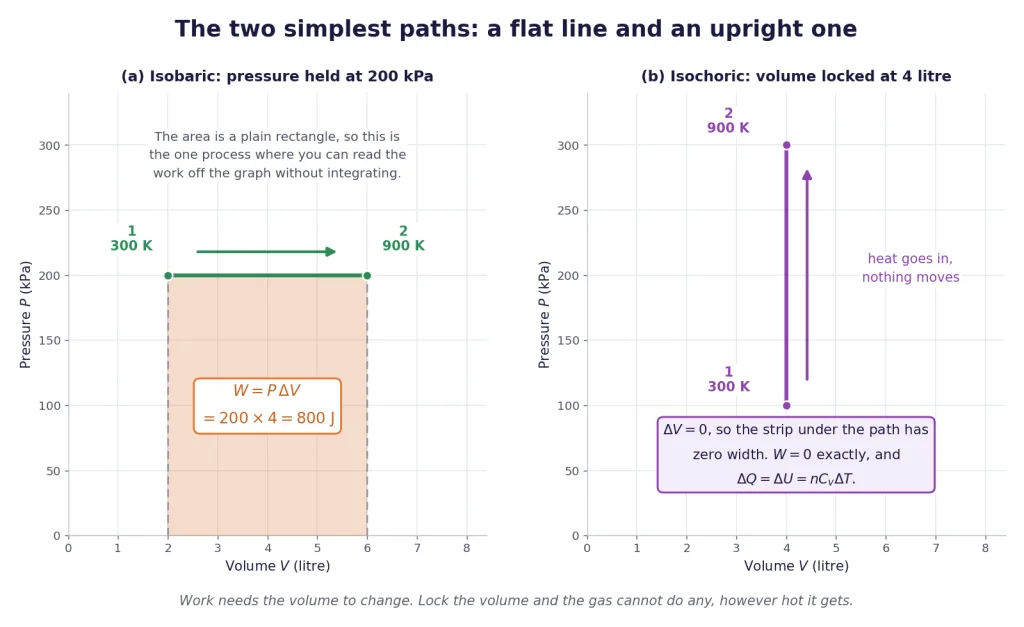
[JEE Tip] The trap here is the pressure. Students see the pressure rising and think work must be happening — after all, the gas is pushing harder. It is, but pushing is not working. Work needs displacement. The walls do not move, so the gas exerts an enormous force through zero distance, which is zero work, exactly as it was in mechanics. Write " because " and move on.
Where you meet it
- A pressure cooker before the weight lifts. The lid is sealed and the volume of the vessel is fixed, so as the burner supplies heat the pressure and temperature climb together along a vertical line. Once the pressure reaches the value the weight can hold, steam escapes and the process turns isobaric instead — but everything up to that moment is isochoric.
- A gas in a rigid sealed vessel: a steel cylinder, a sealed glass bulb, a car tyre treated as rigid. All the heat goes into temperature.
- A bomb calorimeter, which is a thick steel vessel used precisely because its volume cannot change, so the heat released by a reaction inside it equals with no work term to worry about.
An isochoric leg is your friend in a cycle
Because , an isochoric leg contributes nothing to the work column of a cycle. It is the free row in the ledger: write a zero and spend your time on the legs that matter. Sections further on will use this constantly.
[NEET Important] Do not confuse the two names. Isobaric has "bar" in it, as in the unit of pressure — pressure fixed, horizontal line. Isochoric comes from the Greek for space or volume — volume fixed, vertical line. If you can attach "bar to pressure" you will never mix them up in a graph question again.
The Four Processes on One Page
This is the table to know cold. Everything in the rest of the chapter is built on it, and a large fraction of the marks in this chapter come from applying one of its rows correctly.
| Isothermal | Adiabatic | Isobaric | Isochoric | |
|---|---|---|---|---|
| Held constant | temperature | heat, | pressure | volume |
| Gas law becomes | const | const | const | const |
| Named law | Boyle | none | Charles | Gay-Lussac |
| Path on a - plot | rectangular hyperbola | steeper hyperbola-like curve | horizontal line | vertical line |
| Slope | infinite | |||
| Work | ||||
| Heat | ||||
| Change | ||||
| Molar specific heat | infinite | |||
| Everyday example | slow expansion in a water bath | tyre burst, pump stroke | boiling in an open pan | pressure cooker sealed |
How to use it in an exam
Three questions, asked in this order, get you to the right row every time.
- What is being held constant? The problem always says, sometimes in disguise: "in a rigid vessel" means isochoric, "open to the atmosphere" or "a freely sliding piston" means isobaric, "insulated" or "suddenly" means adiabatic, "in a large water bath" or "slowly at constant temperature" means isothermal.
- Which of , , is zero? In three of the four rows, exactly one of them is. That is the whole point of naming these processes.
- Get the other two from the first law, . Never compute all three independently and hope they agree — compute two and let the first law give the third, then sanity-check the signs.
The ordering of the work
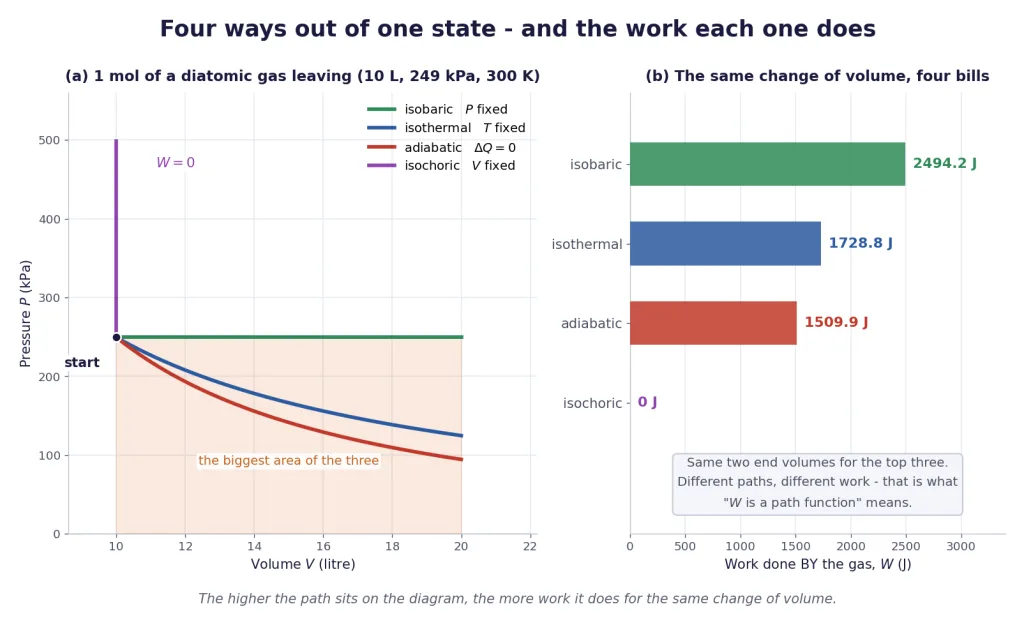
Take one mole of a diatomic gas at 300 K in 10 litre and let it reach 20 litre four different ways. The figure above plots all four paths from their own equations, and the work comes out as:
| Route | Work by the gas | Heat absorbed | Final | |
|---|---|---|---|---|
| Isobaric | J | J | J | 600 K |
| Isothermal | J | J | 300 K | |
| Adiabatic | J | J | 227.4 K | |
| Isochoric | J | J | 600 K |
Key Point: For the same change of volume, isobaric does the most work, then isothermal, then adiabatic, and isochoric does none. The reason is entirely visual: the higher a path sits on the - diagram, the more area it encloses with the volume axis. The isobar stays at its starting pressure the whole way; the isotherm sags; the adiabat sags faster still because the gas is cooling too.
The isochoric row is there for contrast — it cannot reach 20 litre at all, so it is shown heated at fixed volume to the same final temperature as the isobaric route. Same temperature rise, same , but the isobaric route needed 8729.7 J of heat against 6235.5 J, and the extra 2494.2 J is precisely the work it did. That difference is in action, multiplied by .
[JEE Tip] When four processes share a starting point in a graph question, identify them by slope alone: flat is isobaric, vertical is isochoric, and of the two curves the steeper is the adiabat. You never need to compute anything to label them.
Cyclic Processes: Back Where You Started
Key Point — cyclic process:
A cyclic process is one in which the system, after passing through any sequence of changes, returns to its initial state. On a - diagram it is a closed loop.
Now use the single most powerful idea in the chapter. Internal energy is a state function: its value depends only on the state the system is in, not on how the system got there. Return to the starting state and you return to the starting internal energy.
That is not an approximation and it does not depend on the gas, the shape of the loop, or how many legs it has. Feed it into the first law:
Key Point — the two results that define a cycle: Over one complete cycle, the net heat absorbed equals the net work done. The system stores nothing; it is a converter, turning a net inflow of heat into a net outflow of work, or the other way round.
Note the word net. Individual legs will absorb heat and other legs will reject it; individual legs will do work and others will have work done on them. It is only the sums that obey this.
The net work is the area enclosed by the loop
Section 5 established that work is the area under a path. Now walk a closed loop. On the upper part of the loop, going right, the gas expands at high pressure and does a large positive amount of work. On the lower part, coming back left, it is compressed at lower pressure, so the negative work is smaller in size. The two areas do not cancel, and what is left over is exactly the area between them.
Key Point — the area rule and its sign:
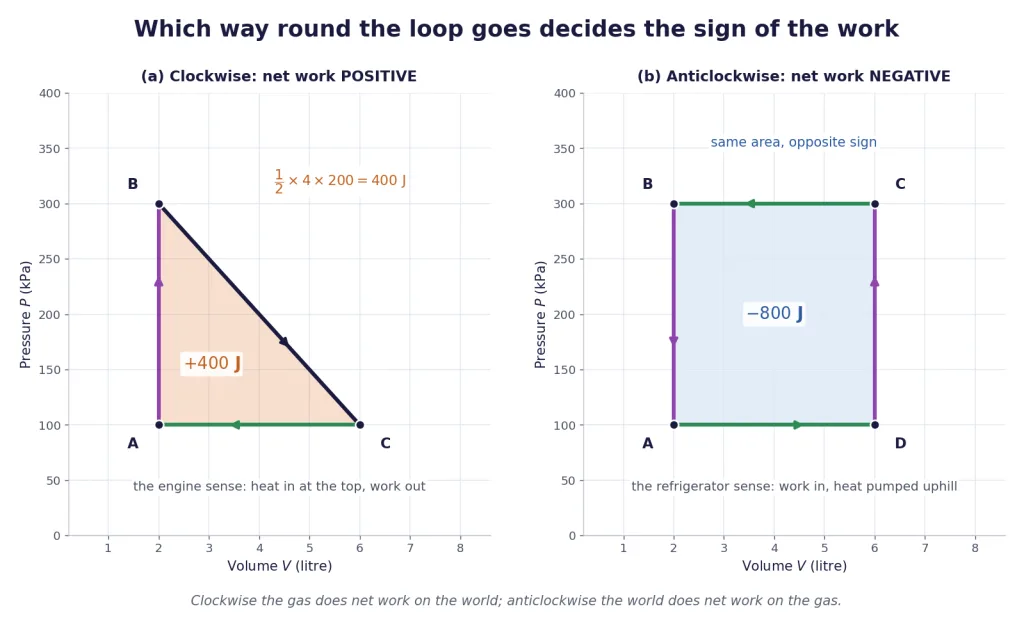
- Clockwise loop: is positive. The gas does net work on its surroundings, having absorbed net heat. This is the sense in which every heat engine runs.
- Anticlockwise loop: is negative. Net work is done on the gas, and it rejects net heat. This is the sense in which every refrigerator runs.
Same loop, same area, opposite sign — the direction of travel is the whole difference.
Why an engine must run in a cycle at all
A gas expanding in a cylinder does work, but only until the piston reaches the end of its travel. To do work again the piston has to come back, and bringing it back costs work. The only way to get useful work out repeatedly is to bring the gas back to its starting state along a cheaper path than the one it went out on — a path that lies lower on the - diagram. The gap between the two paths is the loop, and its area is the profit per cycle. Sections 9 and 11 build real engines on exactly this idea; here you only need the geometry.
[NEET Important] Two facts get asked directly and are worth one line each. In a cyclic process, always — no matter what the gas is or what the legs are. And the net work is the enclosed area, positive for clockwise. A surprising number of marks turn on nothing more than those two sentences.
Working a Cycle Leg by Leg
This is a method, and once you have it the hardest questions in the chapter become bookkeeping. Do not try to see the answer whole. Make a table with three columns, fill it one leg at a time, and let the column sums check your work.
The method
- Draw the loop and label every corner with its and . Note the sense — clockwise or anticlockwise.
- Name each leg: horizontal is isobaric, vertical is isochoric, and any curve should have been identified by the question.
- For each leg, fill in the two entries you can get directly, then use for the third:
- isochoric: , and ;
- isobaric: , and ;
- isothermal: , and ;
- adiabatic: , and .
- Add the columns. Then check, without exception:
- . If it does not, a temperature or a sign is wrong.
- . If it does not, an entry is wrong.
- equals the enclosed area you can read off the graph.
Three checks on the same table. It is very hard to get a wrong answer past all three.
A shortcut that saves the mole count
You often are not told . You do not need it. Since and ,
Key Point: for any leg of any process. No moles, no temperatures, just the corner coordinates and . For a cycle the sums of at the start and end are identical, which is why falls out automatically.
A worked cycle
Take a monatomic gas (, so ) round the rectangle with the corners
Up the left side, right along the top, down the right side, left along the bottom: that is clockwise.
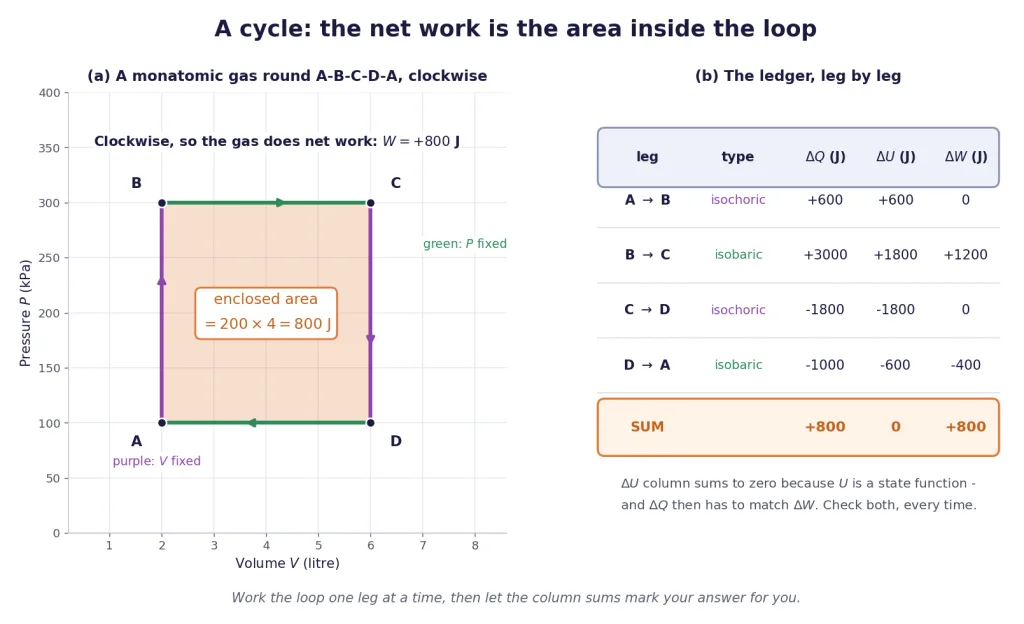
Work in SI: 2 L m, 100 kPa Pa. Then J, J, J, J.
| Leg | Type | |||
|---|---|---|---|---|
| isochoric | J | J | ||
| isobaric | J | J | J | |
| isochoric | J | J | ||
| isobaric | J | J | J | |
| SUM | J | J |
Now run the three checks.
- . Passes.
- J . Passes.
- Enclosed area J, and the loop is clockwise so the sign is positive. Passes.
Three independent routes to J. That is what a well-kept ledger buys you.
Read it back as physics
The gas absorbed heat on legs and , a total of 3600 J, and rejected 2800 J on and . The difference, 800 J, came out as net work. Nothing was stored: the gas is in exactly the state it began in. That sentence is the first law applied to a cycle, and it is the sentence a heat engine is built around.
Habits That Turn Cycle Questions Into Arithmetic
Read temperatures straight off the corners
You are rarely given temperatures in a cycle problem, and you rarely need them — but when a question asks "at which point is the gas hottest?" the answer takes two seconds. Since and is fixed round the loop,
Key Point: is proportional to the product . Multiply the coordinates at each corner and rank them. The corner with the largest is the hottest state; equal products mean equal temperatures, which means those two points lie on the same isotherm.
In the rectangle above, J and J, so and are at the same temperature even though they look nothing alike on the diagram. That is a favourite one-mark question.
The missing-leg trick
A very common question gives you or for some legs and the net work, then asks for the one that is missing. You do not need to reconstruct the physics of that leg at all. Just use the column sums as equations:
Two equations, and whichever single entry is unknown drops out. For instance, on the triangular cycle in the solved examples the legs and carry J and J, the net work is J, and therefore the remaining leg must have J. No integration, no gas law, no .
The five mistakes that cost the most marks
- Using for an adiabatic process. It is that vanishes there. belongs to the isothermal process and to any complete cycle.
- Thinking a vertical leg does work because the pressure changes. and , so exactly. Force without displacement is not work.
- Getting the sense of the loop wrong. Trace the arrows with a finger. Clockwise means the gas does net work and ; anticlockwise means work is done on it.
- Leaving volumes in litres or pressures in kPa. An area on a - diagram is in joules only if the axes are in pascal and cubic metres. A useful conversion to hold: 1 kPa multiplied by 1 litre is exactly 1 joule, which makes many textbook rectangles come out in whole numbers.
- Reporting a bare number. "The work is 800 J" is half an answer. Write "the gas does 800 J of net work on its surroundings", or "800 J of work is done on the gas". Every worked solution in this section states the sign of , and and what each one means.
A last sanity check before you write the answer down
For any single process or any complete cycle, these three numbers must satisfy with their signs. Put them in a row and add. If the residual is not zero, one of them is wrong, and finding out which takes less time than defending a wrong answer.
[Board Important] A five-mark question that comes up regularly: "A gas is taken round the cycle shown. Calculate the work done in each part and the net work, and state whether heat is absorbed or rejected overall." Answer it with a three-column table, one row per leg, the sums underneath, and one closing sentence: since the loop is clockwise, the net work is positive, so the gas absorbs net heat and converts it to work.
Solved Examples
Constants used throughout, unless a problem says otherwise: J/(mol K), 1 atm Pa, K. Monatomic gas: , , . Diatomic gas including air: , , . Specific heats in J/(mol K).
Example 1: An isobaric expansion in full
2 moles of a diatomic ideal gas at 2.0 atm are heated from 300 K to 400 K at constant pressure. Find the initial and final volumes, , and , and the fraction of the heat that emerged as work.
Solution:
SI and a kelvin check. Pa. Both temperatures are already absolute and positive.
Volumes: Charles's law check: . Good.
Work: Positive — the gas expanded and did work on whatever was holding the pressure constant. The same number from J.
Internal energy, with J/(mol K): Positive — the gas got hotter.
Heat, with J/(mol K): Positive — heat was supplied to the gas.
Audit: . Closes exactly.
The fraction:
Final Answer: L, L; J done by the gas, J, J absorbed. 28.6% of the heat came out as work.
Takeaway: is usually faster than , because it skips the volumes entirely. And the work fraction is fixed by the gas alone — nothing about the size of the sample can change it.
Example 2: An isobaric expansion with the heat given
A gas at a constant pressure of Pa expands from 2.0 litre to 5.0 litre while absorbing 800 J of heat. Find the work done and the change in internal energy.
Solution:
Work first, since and are both given: Positive: the gas expanded, so it did 450 J of work.
Heat is given with its sign. "Absorbing 800 J" means J.
Internal energy, from the first law: Positive, so the gas also got hotter.
Read it back. Of the 800 J supplied, 450 J went out again as work pushing the surroundings back and 350 J stayed behind as internal energy. Notice the split is , which is not for any real gas — so this gas is not being described consistently as ideal with a standard , and the question is simply testing the first law. When a problem hands you directly, use it; do not overwrite it with .
Final Answer: J done by the gas, J.
Takeaway: Convert litres to cubic metres before multiplying by a pressure in pascal. Leaving as 3 gives 450 000 J, which is a thousand times too big and the single commonest arithmetic slip in this topic.
Example 3: Isochoric heating in a rigid vessel
3 moles of a monatomic ideal gas are sealed in a rigid vessel of volume 10 litre at 300 K and heated to 500 K. Find , and , and the initial and final pressures.
Solution:
The volume cannot change, so regardless of how the pressure behaves.
Internal energy, with J/(mol K):
Heat, from the first law: Every joule supplied went into internal energy. Note that this is and not — using here is the classic error and would give 12 471 J.
Pressures: Gay-Lussac check: . Good.
Final Answer: ; J; Pa and Pa.
Takeaway: Constant volume means ; constant pressure means . The whole reason the gas needs two specific heats is that in one case it has work to pay for and in the other it does not.
Example 4: A rigid vessel whose pressure doubles
2 moles of a diatomic gas occupy a rigid sealed vessel of 20 litre at 300 K. The gas is heated until its pressure has doubled. Find the initial pressure, the final temperature and the heat supplied.
Solution:
Initial pressure: which is 2.46 atm.
Final temperature. At constant volume is constant, so doubling doubles the absolute temperature: Doubling in kelvin, never in Celsius — 27°C doubled is not 54°C.
Heat. , so with J/(mol K): Positive, so heat was supplied; and J as well.
Final Answer: Pa; K; kJ, with .
Takeaway: Any ratio of temperatures must be taken in kelvin. Doubling the pressure of a gas at 300 K takes it to 600 K, which is 327°C — a fact that matters when the vessel is a pressure cooker.
Example 5: One volume change, four different routes
1 mole of a diatomic ideal gas starts at 300 K in 10 litre. Find the work done, the heat absorbed and if it (a) expands isobarically to 20 L, (b) expands isothermally to 20 L, (c) expands adiabatically to 20 L, and (d) is heated at constant volume to the same final temperature as in (a).
Solution:
Starting pressure:
(a) Isobaric to 20 L. At constant , doubling doubles , so K.
(b) Isothermal to 20 L. K and .
(c) Adiabatic to 20 L, :
(d) Isochoric to 600 K. The volume never changes, so
Compare (a) and (d). Both end at 600 K, so both have exactly the same J — internal energy is a state function and does not care how you got there. But (a) needed 8729.7 J of heat and (d) needed only 6235.5 J. The difference of 2494.2 J is precisely the work (a) had to do, and it equals . That is , seen as an energy bill.
Final Answer: (a) J, J, J; (b) J, ; (c) J, , J; (d) , J.
Takeaway: depends only on the end states; and depend on the path. Routes (a) and (d) prove the first half of that sentence and routes (a), (b) and (c) prove the second.
Example 6: A rectangular cycle, worked as a ledger
A monatomic gas is taken clockwise round the cycle . Find , and for each leg and for the cycle, and confirm the net work against the enclosed area.
Solution:
SI and corner products. m, m. Then J, J, J, J. With , , and on every leg.
, isochoric. . J. J, absorbed.
, isobaric expansion. J. J. J, absorbed.
, isochoric. . J. J, rejected.
, isobaric compression. J, work done on the gas. J. J, rejected.
The column sums.
The area check. The loop is a rectangle of height Pa and width m, so its area is J. The path goes up, right, down, left — clockwise — so the net work is positive. J, agreeing.
Read it back. Heat absorbed over the cycle: J. Heat rejected: J. Net heat in: 800 J, all of it converted to work, with the gas ending exactly where it started.
Final Answer: Net J (done by the gas), net J (absorbed), for the cycle.
Takeaway: The three checks — , , and area equals net work — are independent of each other. Passing all three is as close to certainty as you get in an exam.
Example 7: The same cycle run backwards
The gas of Example 6 is taken round the same rectangle in the opposite sense, . Find the net work and the net heat, and say what kind of device runs this way.
Solution:
Every leg reverses, so every entry changes sign. , and for a reversed leg are the negatives of their forward values, because the two end states have simply swapped.
The ledger:
| Leg | Type | |||
|---|---|---|---|---|
| isobaric expansion | J | J | J | |
| isochoric | J | J | ||
| isobaric compression | J | J | J | |
| isochoric | J | J | ||
| SUM | J | J |
The checks. ; J ; the enclosed area is still 800 J, but the loop now runs right along the bottom, up, left along the top and down — anticlockwise — so the sign is negative.
What it means. J means 800 J of work was done on the gas over the cycle, and J means the gas rejected 800 J net. Something outside had to supply that work. An anticlockwise loop is the sense in which a refrigerator or a heat pump runs — you pay work in, and heat is moved against its natural direction. Section 10 develops that properly.
Final Answer: Net J (done on the gas), net J (rejected), .
Takeaway: Reversing a cycle reverses every sign and changes nothing else. The area is a property of the shape; the direction of travel supplies the sign.
Example 8: A triangular cycle
A monatomic gas is taken round , with a straight line on the - diagram. Find the net work, and identify any two states at the same temperature.
Solution:
Corner products. J, J, J. Since , and are at the same temperature — they lie on one isotherm, even though the straight line joining them is not that isotherm.
, isochoric. , J, J.
, a straight line. The area under a straight segment is a trapezium, so the work is the average pressure times the change in volume: , so J.
, isobaric compression. J. J. J.
Sums. . J. J .
Area check. The triangle has base m and height Pa, so its area is J. Up the left side, down to the right, back along the bottom: clockwise, so positive. J.
Final Answer: Net J done by the gas, equal to the net heat absorbed; and are at the same temperature.
Takeaway: For a straight line on a - diagram, work is the average pressure times . You never need to integrate a straight segment, and the trapezium rule is exact for it.
Example 9: A cycle with a genuine isothermal leg
1 mole of a monatomic ideal gas at 400 K occupies 10 litre at state . It expands isothermally to 20 litre at , is then compressed isobarically back to 10 litre at , and finally heated at constant volume back to . Find the pressures, the temperature at , and the net work.
Solution:
Pressures at and .
, isothermal expansion at 400 K.
, isobaric compression at back to 10 L. The temperature at :
, isochoric heating from 200 K back to 400 K.
Sums.
Sense of the loop. From the gas moves right along a falling isotherm, then left along a lower horizontal line, then straight up. That is clockwise, so the net work should be positive — and it is.
Final Answer: Pa, Pa, K, and the net work is J done by the gas, equal to the net heat absorbed.
Takeaway: A curved leg does not change the method, only one entry in the table. Compute that leg's work with its own formula and carry on; the column checks work exactly as before.
Example 10: Finding a missing leg from the sums alone
A gas is taken round a three-leg cycle . On it absorbs 600 J and does no work. On it rejects 1000 J and 400 J of work is done on it. The net work done by the gas over the cycle is 400 J. Find , and for the leg .
Solution:
Write down what is given, with signs.
Work for the missing leg, from the work column:
Internal energy for the missing leg, from : So and are at the same temperature.
Heat for the missing leg, from the first law:
Cross-check with the heat column. For a cycle J, so J. Agrees.
Final Answer: J absorbed, J done by the gas, .
Takeaway: You never need to know what the missing leg physically is. and are two equations, and they will hand you any single unknown entry in the table.
Example 11: Boiling water, the classic isobaric problem
1.0 g of water at 100°C is converted completely to steam at 100°C at a constant pressure of 1.0 atm. The volume changes from 1.0 cm to 1671 cm. Take the latent heat of vaporisation as J/kg. Find , and .
Solution:
Kelvin check. The temperature is K throughout, absolute and positive. Note that the temperature does not change even though heat is pouring in — the heat is going into a phase change.
Heat supplied: Positive, since heat was absorbed.
Work done. The pressure is constant, so Positive: the expanding steam pushed the atmosphere back.
Internal energy: Positive, and this is the part that actually went into pulling the water molecules apart against their mutual attraction.
The split. Only of the latent heat went into pushing the atmosphere aside. The other 92.5% is stored in the steam as potential energy of separated molecules — which is why steam scalds so badly: condensing on your skin, it gives all of it back.
Final Answer: J, J done by the steam, J.
Takeaway: Latent heat is not all internal energy. A small slice of it always pays for the expansion, and this problem is the standard way of asking whether you know the difference.
Example 12: A sealed cooker heating up
A rigid sealed vessel of volume 2.0 litre contains air (diatomic) at 1.0 atm and 300 K. It is heated to 400 K. Find the number of moles, the final pressure, the work done and the heat supplied.
Solution:
Moles, from the gas law:
Final pressure. The volume is fixed, so is constant:
Work:
Heat, with J/(mol K): Positive, so heat was supplied, and all of it stayed as internal energy.
A cross-check that avoids the moles altogether. J. Same answer.
Final Answer: mol, Pa (1.33 atm), , and J.
Takeaway: is the fastest check you own — it needs only the two corner coordinates and , and it will catch a slip in the mole count immediately.