
Thirty Questions. Thirty Minutes. Go.
Section 15 taught you the fast way through this chapter — the statements the paper asks for almost word for word, the recognition table of every formula with a hook attached, the four-process comparison table, single-step numericals, - graph reading, the three templates, the biology-adjacent angle, the two special formats and the elimination habits. This section finds out whether any of it survives contact with a clock.
There is no new physics below. There are 30 questions built the way this paper builds them, and one rule that matters more than the rest: you are being tested on pace, not on cleverness. If a question here takes you five lines of algebra, you have misread it.
How to attempt this set
Key Point: Blank sheet, pen, timer. Attempt all 30 questions in one unbroken sitting, and do not read a single explanation until your last answer is written. A drill you pause to check is a reading exercise, and reading exercises do not build speed.
| The setup | What it is |
|---|---|
| Number of questions | 30, single correct option |
| Marking scheme | correct, incorrect, unattempted |
| Maximum score | marks |
| Minimum possible score | marks |
| Suggested time limit | 30 minutes (45 Physics questions in about 45 minutes, so roughly a minute each) |
| Allowed | a rough sheet and your memory |
| Not allowed | calculator, formula sheet, or a glance back at Section 15 |
The constants sheet
Every question that needs a number uses these and no others.
| Quantity | Value |
|---|---|
| universal gas constant, | J/(mol K) |
| absolute zero | C, so |
| atm | Pa |
| cal | J |
| monatomic gas | , J/(mol K), |
| diatomic gas | , J/(mol K), |
| polyatomic gas | |
| , , | , , |
Three housekeeping notes on those.
The sign convention is this chapter's, unchanged. is positive when heat is added TO the system, is positive when work is done BY the system, and the first law is . Many chemistry books write with meaning work done on the system; that is the same physics with one sign moved, and it is not used anywhere below.
Every temperature entering a ratio, a Carnot formula or a gas-law step must be converted to kelvin, and every answer below states the conversion. Where only a difference appears, Celsius and kelvin give the same number and no conversion is wanted. Knowing which of the two situations you are in is the single most valuable habit in this chapter.
The symbols hold to the chapter's convention throughout. is absolute and is Celsius; is the source (hot) and the sink (cold), with absorbed from the source and rejected to the sink; is the number of moles; and are molar specific heats in J/(mol K) and ; is efficiency and is the coefficient of performance, which is never called an efficiency.
[Important] The 30-minute limit is the entire exercise. Most students can get 27 of these right given an hour — and an hour is exactly what the real paper will not give you. Finishing in 30 minutes with 24 correct puts you in far better shape than taking 55 minutes to get 27. Keep the timer where you can see it, and the moment a question passes 60 seconds, mark your best surviving option and move on.
Here is the arithmetic that makes that instruction safe. A blind guess among four options is worth , essentially nothing. But once you have eliminated two options, a guess between the survivors is worth marks on average. Eliminate first, then commit. Leave blank only what you could not narrow down at all.
What this set covers
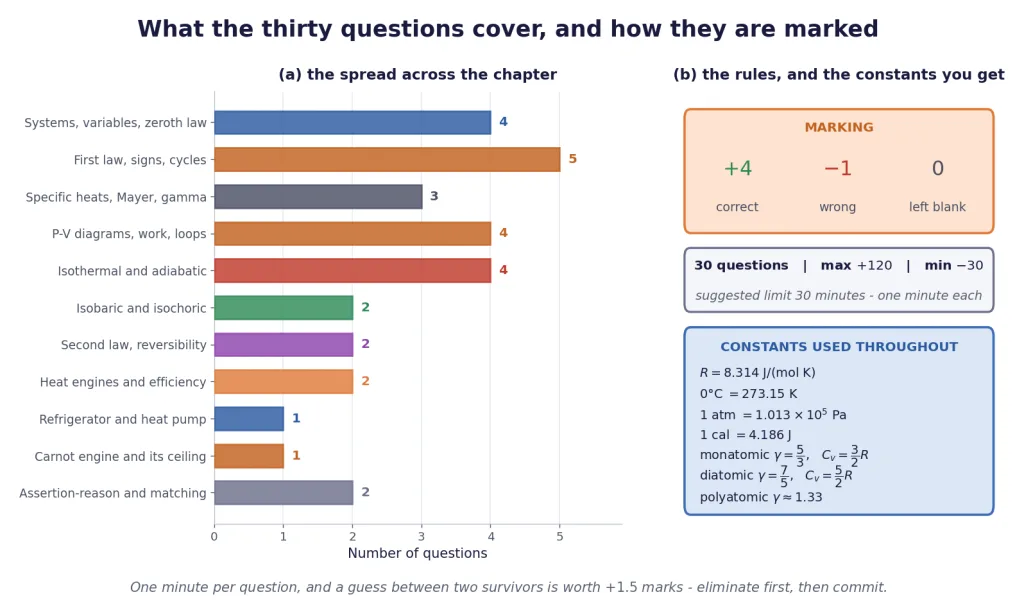
| Topic | Questions | How many |
|---|---|---|
| Systems, state variables and the zeroth law | Q1 to Q4 | 4 |
| The first law, signs and cyclic processes | Q5 to Q9 | 5 |
| Molar specific heats, Mayer's relation and | Q10 to Q12 | 3 |
| - diagrams, work as area, loops | Q13 to Q16 | 4 |
| Isothermal and adiabatic processes | Q17 to Q20 | 4 |
| Isobaric and isochoric processes | Q21 to Q22 | 2 |
| The second law and reversibility | Q23 to Q24 | 2 |
| Heat engines and efficiency | Q25 to Q26 | 2 |
| Refrigerators and heat pumps | Q27 | 1 |
| The Carnot ceiling | Q28 | 1 |
| Assertion-reason and column matching | Q29 to Q30 | 2 |
That weighting is deliberate and it mirrors the real paper. The first law and the four processes between them supply nearly half the set, because between them they supply nearly half of what this chapter is asked about. Two questions are about a human body, because this paper never lets that opportunity pass.
Mark It Honestly, Then Read Your Own Answer Sheet
Score with the real scheme: for every correct answer, for every wrong one, for every blank. No half marks for "I nearly had that one". The number you end up with is the number that means something.
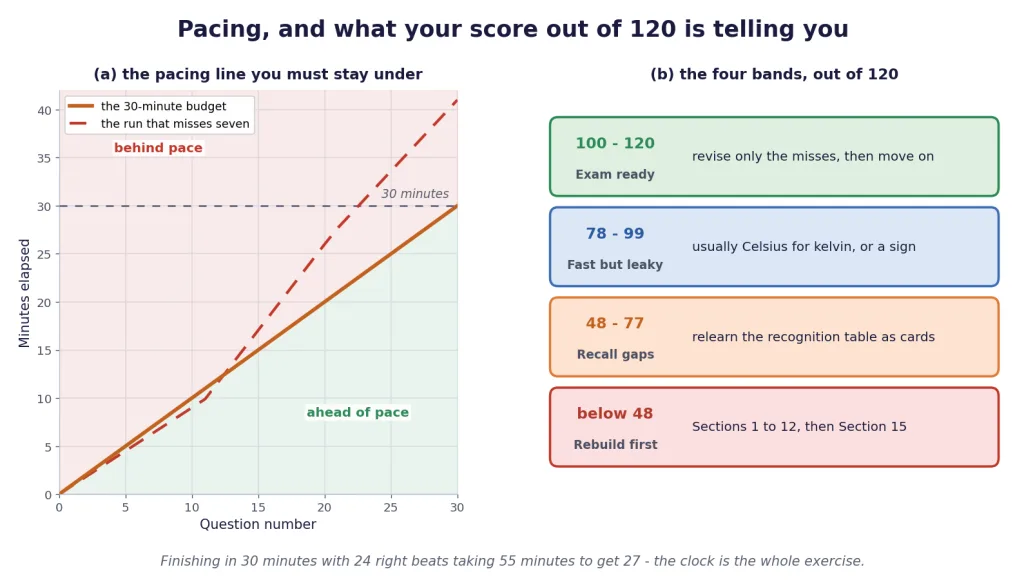
The bands
| Your score (out of 120) | Verdict | What to do next |
|---|---|---|
| 100 to 120 | Exam ready. Over 80% on a full-length set, inside the time. | This chapter is now free marks for you. Revisit only the items you missed, then move to the next chapter. |
| 78 to 99 | Fast but leaky. You know the material; something leaks on the way to the answer sheet. | Almost always a Celsius value used where kelvin was required, or a sign flipped on a compression or a rejection — not a gap in knowledge. Redo every wrong question without the explanation first, and count how many you fix alone. |
| 48 to 77 | Recall gaps. The speed is not the problem; the lookup is. | Go back to Section 15's recognition table and the four-process table, and learn them as flashcards. Then re-attempt this set cold. |
| Below 48 | Rebuild first. | Work Sections 1 to 11 properly, then Section 12's worked problems, then Section 15. Re-attempting this set today would teach you nothing except the answer key. |
Sort your mistakes into three piles
Do this before you read a single explanation. It is the most useful ten minutes in this section.
- Did not know it. A formula you could not recall, whether or is the one that vanishes in an adiabatic process, whether for a diatomic gas is or , which of Kelvin-Planck and Clausius forbids the perfect refrigerator. Cheapest to fix — it is a memory job, and it takes an evening.
- Knew it, computed it wrong. You put a Celsius value into , left a volume in litres, used where the vessel was rigid, or flipped the sign on a compression. Slow down for four seconds on the final line.
- Knew it, answered a different question. You gave the work done on the gas when it asked for the work done by it; the heat rejected when it asked for the heat absorbed; the refrigerator's when it asked for the heat pump's. The distractors here are built specifically to reward this mistake.
Key Point: Two students both score 88. The first has four pile-1 mistakes and a syllabus gap that revision closes in a day. The second has nine pile-3 mistakes and a reading habit that will follow them into the exam hall. Pile 3 is the expensive one — count it before you explain it away.
The fifteen facts this set keeps testing
- , with heat into the system positive and work done by the system positive.
- is a state function; and are path functions. is the same on every path; and are not.
- Over a complete cycle , so , and the net work is the enclosed area — positive clockwise, negative anticlockwise.
- The first law forbids the perpetual motion machine of the first kind, and nothing else. Heat flowing cold to hot is the second law's business.
- for an ideal gas on EVERY path, not just at constant volume.
- , and is , and about for monatomic, diatomic and polyatomic gases.
- Isothermal: , . Adiabatic: , constant, .
- does NOT mean , and does not mean .
- Isobaric: , . Isochoric: , .
- An adiabat is steeper than an isotherm through the same point, by exactly .
- Kelvin-Planck forbids the perfect engine; Clausius forbids the perfect refrigerator, and the word "sole" is essential in both.
- , always less than 1, and with equality only for a reversible engine.
- may exceed 1, and . Neither is an efficiency.
- Carnot: and , both in kelvin, both depending on the two temperatures alone.
- A living organism is an open system, which is why it can hold its entropy low while the total entropy still rises.
[Important] If you got fewer than 24 right, count how many of your errors were a sign or a Celsius value that should have been kelvin. In this chapter those two between them usually account for more lost marks than everything else put together, and both are the cheapest mistakes in this chapter to fix: write the two signs on the page before the formula, and write the letter K next to every temperature the moment it enters a ratio.