
Same Chapter, Half the Clock
Sections 1 to 11 took this chapter apart slowly, Section 12 worked forty-odd problems through it, and Sections 13 and 14 pushed it as far as it goes. If you worked through those, you already know more thermodynamics than this section will ever ask of you.
So why a separate corner? Because the skill being tested is different.
Physics is 45 questions, and inside a 180-minute paper shared with Chemistry and Biology those 45 deserve roughly 45 minutes. One minute each. Thermodynamics reliably supplies two to four of them, and every one has to be finished in well under a minute, correctly, so that the time is banked for the questions that genuinely need it.
What is NOT asked from this chapter
This list matters as much as anything else here, because it tells you what to stop worrying about.
Key Point: Thermodynamics at this level never leaves the core syllabus. No work along an arbitrary curved path that has to be integrated. No polytropic processes constant, and no . No mixtures of gases with an effective . No two-chamber problems with a movable piston or a conducting partition. No spring-loaded piston, no mercury-thread gas column, no engines coupled in series. Everything on the paper is a statement you recall, one standard formula you substitute into, a set-up you have drilled, a graph you read, or one of the two special formats.
Every item on that list belongs to Section 13. If you find yourself writing with a that is not constant and not a hyperbola, you have wandered into the wrong section's version of the question.
The five types, and what each should cost you
| Type | What it looks like | Your budget | The right instinct |
|---|---|---|---|
| 1. Direct recall | "State the Clausius statement." "Is heat a state function?" "Why can exceed 1?" | 15-20 s | You either know it or you do not. Never derive a definition. |
| 2. One-step plug-in | , , , | 25-35 s | Spot the process, pick the card, substitute once. |
| 3. Standard template | The cycle tabulated leg by leg, the engine ledger, the Carnot triple | 30-45 s | Recognise the set-up. You should already know the shape of the answer. |
| 4. Graph reading | A - diagram: which process, which sign, how much area | 20-30 s | Read the axes, name the path, take the area. |
| 5. Assertion-Reason / Column matching | Two special formats, both drilled below | 35-45 s | Judge each statement alone, then judge the link. |
[Important] A diagnostic worth internalising: if a thermodynamics question needs a fifth line of working, you have misread it. You are handed two of , , and asked for the third, or two temperatures and asked for an efficiency. If your page is filling up, stop and reread the stem.
The two mistakes that cost more marks than everything else combined
Neither is a formula. One is a sign and one is a unit.
Key Point — the sign convention:
- is positive when heat is added TO the system, negative when heat leaves it.
- is positive when work is done BY the system (expansion), negative when work is done ON it (compression).
With those two choices the first law reads Chemistry writes the first law as , with the work done ON the system — the same physics with one sign moved.
Key Point — the kelvin rule:
Wherever a temperature appears as a ratio — in a Carnot efficiency, in a coefficient of performance, in a gas-law step, constant on an adiabat — it must be in kelvin, .
Wherever only a difference appears — , for an isobaric leg, — kelvin and Celsius give the same number, because a Celsius degree and a kelvin are the same size.
Here is what ignoring the kelvin rule costs. An engine works between a source at 227°C and a sink at 27°C, and you are asked for its maximum efficiency.
- Right: K, K, so , about 40%.
- Wrong: , about 88%.
That 88% is printed as an option. Write the letter K next to every temperature you substitute into a ratio, and you have banked four marks before you have thought about anything else.
The / arithmetic
Four marks for a correct answer, minus one for a wrong one, zero for a blank. On a doubtful item the real question is not "can I get this?" but "can I get this in 40 seconds?" A blind guess among four options is worth , essentially nothing. Once you have eliminated two options, a guess between the survivors is worth marks on average. Eliminate first, then commit.
The constants and symbols this section fixes, now
Every question in this section and the next uses these values and no others. A question that supplies its own number always wins.
| Quantity | Value |
|---|---|
| universal gas constant, | J/(mol K) |
| absolute zero | C, so |
| atm | Pa |
| cal | J |
| monatomic gas | , J/(mol K), |
| diatomic gas | , J/(mol K), |
| polyatomic gas | |
| , , | , , |
Working values for this section. Every solution below states the constants it uses inside the solution.
Key Point — the symbol convention:
is always an absolute temperature in kelvin; or is Celsius. is the source (hot) and is the sink (cold), and likewise is the heat absorbed from the source and the heat rejected to the sink — also written and , but the subscripts here never swap. is the number of moles, also written . and are molar specific heats in J/(mol K), while lowercase and are per kilogram, and . is efficiency, a fraction that never reaches 1; is the coefficient of performance, which routinely exceeds 1 and is never called an efficiency. is a state function; and are path functions.
What this section does, and what it does not repeat
We will not rebuild systems and state variables (Section 1), rederive or the sign convention from scratch (Section 2), reargue the first law (Section 3), rederive Mayer's relation (Section 4), rebuild the - diagram from (Section 5), rederive the isothermal and adiabatic work formulas (Section 6), rebuild the cyclic ledger (Section 7), reargue the two second-law statements (Section 8), rederive engine efficiency (Section 9), rebuild the refrigerator and the heat pump (Section 10) or reprove Carnot's theorem (Section 11). What you get instead is the same material reorganised for recognition speed:
- The sentences that come back almost verbatim.
- Every formula in the chapter as a recognition table, with a hook for each.
- The four-process comparison table, drilled until it is automatic. This is the highest-yield page in the chapter.
- - graph reading, and the three ready-made templates.
- The biology-adjacent physics this paper reaches for every year.
- The two special formats, and the speed habits.
One housekeeping note. The coefficient of performance, heat pumps, work as the area under a - curve, and the numerical values of all sit outside the rationalised syllabus body text — yet Boards, JEE and this paper ask about every one of them every year, so every one appears in the tables below and in the practice set that follows.
The Sentences That Come Back Almost Verbatim
This block is pure recall ammunition. Read it as flashcards, not as prose. Every item here has appeared as a complete question by itself.
The zeroth law, word for word
Key Point: If two systems A and B are each separately in thermal equilibrium with a third system C, then A and B are in thermal equilibrium with each other.
The point of it is not that it is surprising. It is that it is what makes temperature a meaningful quantity at all, and what lets system C be a thermometer. Without it, "these two things are at the same temperature" would not be a statement you could check with an instrument.
The distractor to reject on sight is anything claiming that A and B must have equal internal energies or equal heat capacities. A bathtub and a teacup at the same temperature have wildly different internal energies.
Why is a state function and and are not
This decides more questions in this chapter than any formula, so learn the exact sentence.
Key Point:
- Internal energy is a state function. It has a definite value in every equilibrium state, so between two given states is the same for every path connecting them. For an ideal gas it depends on temperature alone: , on every path, including adiabatic ones.
- Heat and work are path functions. They are not properties of a state at all; they are quantities that cross the boundary during a process, and how much crosses depends on the route. Two paths between the same two states give the same and different and .
- Therefore it is meaningless to ask how much heat, or how much work, a system contains. A system possesses internal energy. Heat and work are transfers, not stores.
Three consequences, all set directly. Over a complete cycle exactly, so . A state function has an exact differential, written ; heat and work do not, which is why and are written with deltas rather than as and in careful books. And the sentence "a hot gas contains a lot of heat" is wrong at the word contains — it has a large internal energy.
The first law, and what it forbids
Key Point: The heat supplied to a system is used partly to increase its internal energy and partly to do work on the surroundings: It is nothing but the conservation of energy, written for a system that can exchange both heat and work, with the state/path distinction built in.
What it forbids: a perpetual motion machine of the first kind — a device that would deliver work in a cycle with no energy supplied. Over a cycle , so , and work out demands heat in.
What it does NOT forbid: heat flowing from a cold body to a hot one, a gas gathering itself into one corner, or an engine converting all its heat into work. Every one of those conserves energy perfectly. Ruling them out is the second law's job, and confusing the two laws is a standard trap.
The second law, both statements word for word
Learn these two sentences exactly. They are asked as quotations.
Key Point — Kelvin-Planck statement: No process is possible whose sole result is the absorption of heat from a reservoir and the complete conversion of the heat into work.
Key Point — Clausius statement: No process is possible whose sole result is the transfer of heat from a colder object to a hotter object.
Three things about them that are asked directly.
The word "sole" is doing all the work in both. Remove it and both statements become false. An ideal gas expanding isothermally converts heat into work with 100% efficiency — but it is not the sole result, because the gas ends up bigger, in a different state. A refrigerator moves heat from cold to hot every second of the day — but not as the sole result, because work was supplied and heat was dumped outside.
The two statements are equivalent. A device violating one can be coupled to an ordinary machine to build a device violating the other. So they are not two laws; they are one law seen from two directions.
Kelvin-Planck forbids the perfect engine; Clausius forbids the perfect refrigerator. Both of those hypothetical devices are called perpetual motion machines of the second kind: they conserve energy, so the first law is content, and the second law kills them.
Why no engine can reach 100% efficiency
Key Point: For any engine running in a cycle, , so and requires : an engine that takes heat from one reservoir and turns all of it into work, with nothing rejected. That is exactly the device the Kelvin-Planck statement forbids. So is not an engineering shortcoming, it is a law of nature.
And even before that limit, is capped by the temperatures alone: , with equality only for a reversible (Carnot) engine. Reaching would need a sink at K, which is unattainable.
The distractor here is "because of friction and heat losses". Those are real, and they explain why a real engine falls short of — but they do not explain why the ceiling exists. Two separate reasons, and the paper likes to see whether you can keep them apart.
Why a coefficient of performance can exceed 1
Key Point: For a refrigerator, the useful output is the heat removed from the cold space, and what you pay for is the work : Nothing is being converted here, so nothing is being asked to exceed 100% of anything. The machine is moving heat, and one joule of work can move several joules of heat. is routinely 3 to 6 in a domestic fridge, which is why it is deliberately not called an efficiency.
It cannot be infinite, though: needs , which would be heat moving from cold to hot with no work at all, and that is what the Clausius statement forbids.
A heat pump is mechanically the same machine, but you now value the heat delivered to the warm room: so it always exceeds 1 by construction. That is why a heat pump can deliver three or four joules of warmth per joule of electricity, and an electric heater can never deliver more than one.
Why an adiabat is steeper than an isotherm
Key Point: Differentiate each along its own path.
- Isotherm, constant:
- Adiabat, constant:
At the same point the slopes differ by exactly the factor , and always. So the adiabat is steeper, by the factor .
The physical sentence to say in the exam: in an isothermal expansion the pressure falls only because the volume grows; in an adiabatic expansion the gas also cools, so the pressure falls for two reasons at once and falls faster.
The always-true / never-true table
Speed comes from knowing which sentences are safe.
| Statement | Verdict |
|---|---|
| A hot gas contains a large amount of heat | Never — it has a large internal energy |
| is the same for every path between two given states | Always |
| and are the same for every path between two given states | Never — they are path functions |
| Over a complete cycle and | Always |
| holds only for a constant-volume process | Never — it holds on every path, for an ideal gas |
| in an isochoric process | Always |
| in an isothermal process, for an ideal gas | Always |
| in an adiabatic process | Always |
| implies | Never — an adiabatic gas changes temperature |
| implies | Never — an isothermal gas exchanges heat freely |
| An adiabat is steeper than an isotherm through the same point | Always — by the factor |
| A gas cools when it expands adiabatically | Always |
| Celsius may be used in | Always — only a difference appears |
| Celsius may be used in | Never — kelvin only |
| The efficiency of a heat engine can equal 1 | Never |
| The coefficient of performance of a refrigerator can exceed 1 | Always possible, and usual |
| A refrigerator violates the Clausius statement | Never — work is supplied, so it is not the sole result |
| Carnot efficiency depends on the working substance | Never — on the two temperatures alone |
| A clockwise loop on a - diagram is an engine | Always |
| Work done by the gas is the area under the - curve | Always, for a quasi-static process |
| Free expansion into a vacuum has and | Always, for an ideal gas |
| Free expansion is reversible because nothing was dissipated | Never — it is violently irreversible |
[Important] The four most reused distractors in this chapter are " means the temperature cannot change", "a refrigerator breaks the second law", "the Celsius temperature may be used in " and "heat is a property of a body". Each turns up somewhere almost every year, and each is worth four marks in under fifteen seconds.
The Recognition Table, With a Hook for Each
Sections 1 to 11 derived all of these. Your job here is different: see the situation, name the formula, substitute. No derivation, ever.
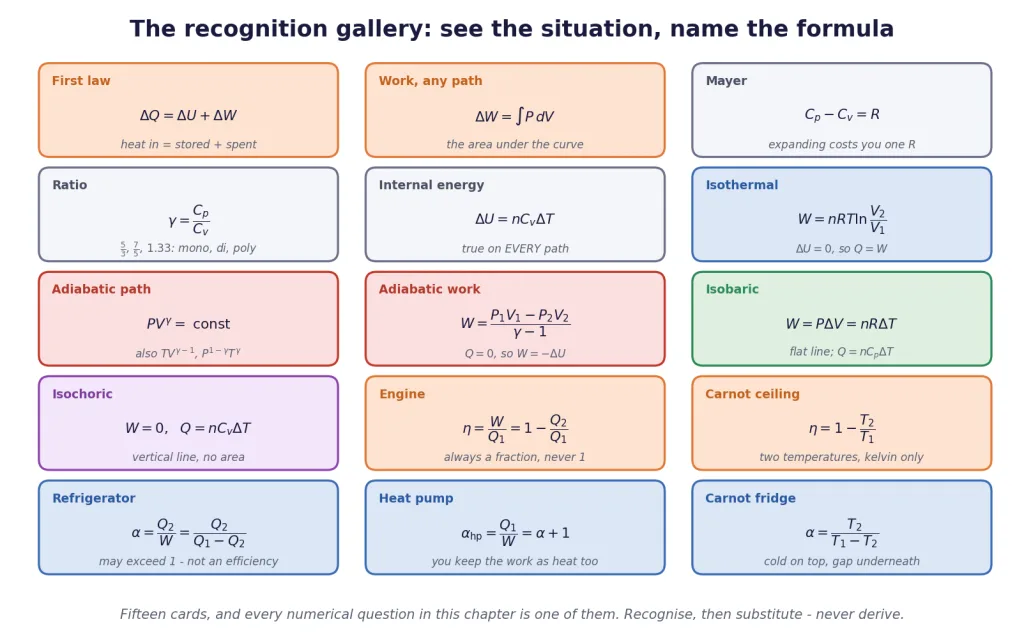
The eighteen you must know cold
| # | Situation | Formula | Memory hook |
|---|---|---|---|
| 1 | any process at all | heat in = stored + spent | |
| 2 | work on any quasi-static path | = area under the curve | the picture IS the formula |
| 3 | work at constant pressure | flat line, rectangle of area | |
| 4 | internal energy of an ideal gas | true on every path | |
| 5 | molar specific heats | expanding costs you one | |
| 6 | the ratio | , , for mono, di, poly | |
| 7 | heat at constant volume | no work, so all of it is stored | |
| 8 | heat at constant pressure | stored plus the push | |
| 9 | isothermal work | , so | |
| 10 | adiabatic path | const | and , |
| 11 | adiabatic work | , so | |
| 12 | cyclic process | , so = area enclosed | back where you started |
| 13 | engine, energy balance | what came in, less what went out | |
| 14 | engine efficiency | always a fraction, never 1 | |
| 15 | Carnot ceiling | two temperatures, kelvin only | |
| 16 | refrigerator | may exceed 1, not an efficiency | |
| 17 | heat pump | you keep the work as heat too | |
| 18 | Carnot refrigerator | cold on top, the gap underneath |
Numbers 3, 6, 16, 17 and 18, together with the "area under the curve" reading of number 2, sit outside the rationalised syllabus body text, yet all of them are asked, so all of them belong on this card.
The relations between the specific heats, in one place
You will be handed one of these and asked for another. There is no derivation to do; it is four lines of algebra you should have memorised as results.
| Given | ||
|---|---|---|
| and | ||
| monatomic, | ||
| diatomic, | ||
| polyatomic, |
All values in J/(mol K), with J/(mol K).
Notice the coincidence that traps people: of a monatomic gas and of a diatomic gas are the same number, J/(mol K). If a question hands you and asks what the gas is, the answer is "not determined until you are told which specific heat it is".
The ratio shortcuts, which are faster than substituting
Most questions in this chapter compare two situations rather than asking for one absolute number. Learn the proportionalities and you rarely touch a calculator.
Worked in one line each.
- An ideal gas doubles its volume isothermally, then doubles it again. Each doubling does the same work, because the work depends on and appears twice.
- A monatomic gas is compressed adiabatically to one-eighth its volume. . Four times, instantly, with no logarithms.
- A Carnot engine has K, K, so . Raise the source to 900 K: . Lower the sink to 150 K instead: . Cooling the sink by 150 K helps more than heating the source by 300 K — and yet in practice you can always heat the source and almost never cool the sink, because the sink is the atmosphere.
- A reversible machine has when run as a refrigerator. Run forwards as an engine between the same two reservoirs it has , since , and are the same three numbers either way. One figure gives the other, for a reversible machine.
[Exam Tip] Three units get asked directly and all three are free marks. and are in J/(mol K) and so is — which is why is dimensionally sane. and have no unit at all, being ratios of energies. And has the dimensions of energy, which is worth checking whenever you are unsure whether a - area came out in joules: pascals times cubic metres is joules, kilopascals times litres is also joules, and that second one saves you two conversions per question.
The Four-Process Table, Drilled Until It Is Automatic
If you learn one page of this chapter, learn this one. Almost every numerical question the paper sets is a request to identify which of four processes you are looking at and then read one row off this table.
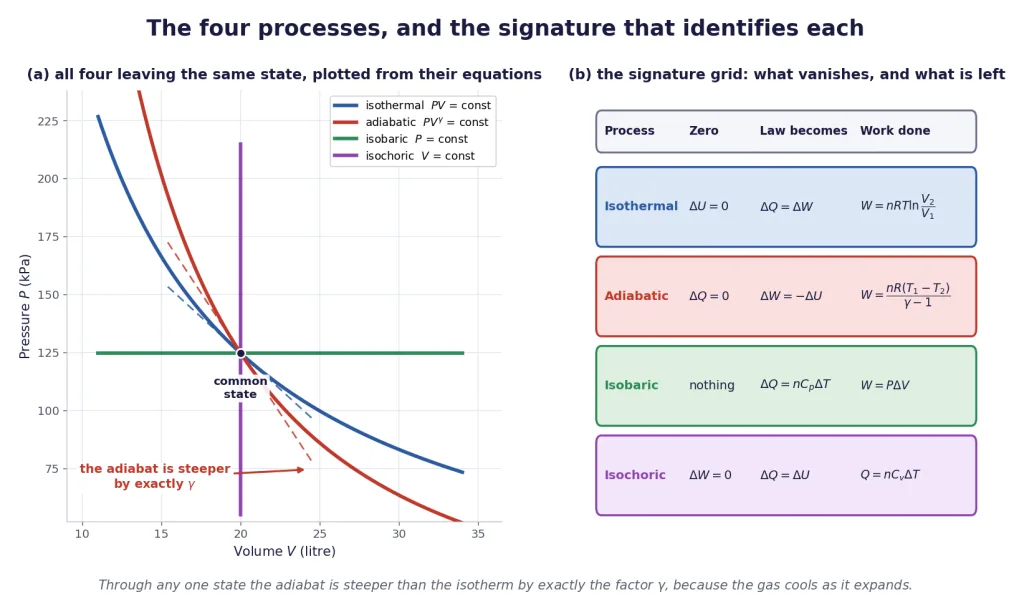
The table
| Isothermal | Adiabatic | Isobaric | Isochoric | |
|---|---|---|---|---|
| Held fixed | no heat exchanged | |||
| Path on a - diagram | hyperbola const | steeper curve, const | horizontal line | vertical line |
| Governing relation | ||||
| Molar specific heat | infinite | |||
| First law becomes | nothing drops out |
The two "molar specific heat" entries look strange until you read them off the definition : an isothermal process absorbs heat with no temperature change at all, so is infinite; an adiabatic process changes temperature with no heat at all, so is zero.
The four sentences that recover the whole table
You do not have to memorise thirty-odd cells. You have to memorise which one quantity vanishes, and then let the first law do the rest.
Key Point:
- Isothermal: (ideal gas, depends on alone), so the first law gives — every joule in comes out as work.
- Adiabatic: (no heat crosses), so — the gas does work only by spending its own internal energy, and therefore cools as it expands and heats as it is compressed.
- Isochoric: (nothing moves), so — every joule in is stored.
- Isobaric: nothing vanishes, which is exactly why it is the only one needing two formulas, and .
The recognition drill: name the process from the wording
The stem almost never uses the word "isochoric". It describes a container. Train yourself on the description.
| What the stem says | The process |
|---|---|
| "in a rigid sealed vessel", "in a closed metal cylinder of fixed volume" | isochoric |
| "under a freely movable piston", "open to the atmosphere", "in an open pan" | isobaric |
| "very slowly, in a conducting container in contact with a large reservoir" | isothermal |
| "suddenly", "rapidly", "in a perfectly insulated cylinder", "the tyre bursts" | adiabatic |
| "returns to its initial state", "goes round the loop" | cyclic, so |
[Important] "Suddenly" means adiabatic, not isothermal. The reasoning is that heat needs time to cross a boundary, so a fast process has no time to exchange any. "Slowly, in a conducting vessel" means isothermal, for the opposite reason. A stem that says "compressed suddenly" and an option that says "the temperature is unchanged" are placed together on purpose.
The comparison questions this table answers instantly
Same gas, same starting state, same final volume — which process does more work?
Draw both paths from the common point. The adiabat lies below the isotherm on expansion, so the area under it is smaller:
Same gas, same temperature rise — which process needs more heat? because at constant pressure the gas also has to do the work of pushing back the atmosphere. The extra is exactly , which is Mayer's relation in disguise.
A gas is compressed. In which process does its temperature rise the most? Adiabatic — because there is nowhere for the work to go except into internal energy.
In which process is the temperature unchanged? Isothermal, by definition, and only isothermal. A free expansion of an ideal gas also ends at the same temperature, but that is a different (and irreversible) matter.
The cyclic-process ledger
A cycle is not a fifth process. It is a sequence of the four, and the discipline that makes it easy is a three-column table.
Key Point — how to work any cycle in 45 seconds:
- Draw the ledger: one row per leg, columns , , .
- Fill in the easy cell on each leg first — on an isochoric leg, on an adiabatic leg, on an isothermal leg.
- Get the second cell from a formula, and the third from .
- Check the sums. must be exactly zero round the loop, and must equal . If either fails, you have a sign error, and it is almost always on a compression leg.
- The net work is also the area enclosed: positive for a clockwise loop (an engine), negative for an anticlockwise one (a refrigerator).
That last line is worth four marks by itself. Clockwise means the gas does net work on the world; anticlockwise means the world does net work on the gas.
Reading a Graph, and the Three Templates
- graph reading, which this paper sets every year
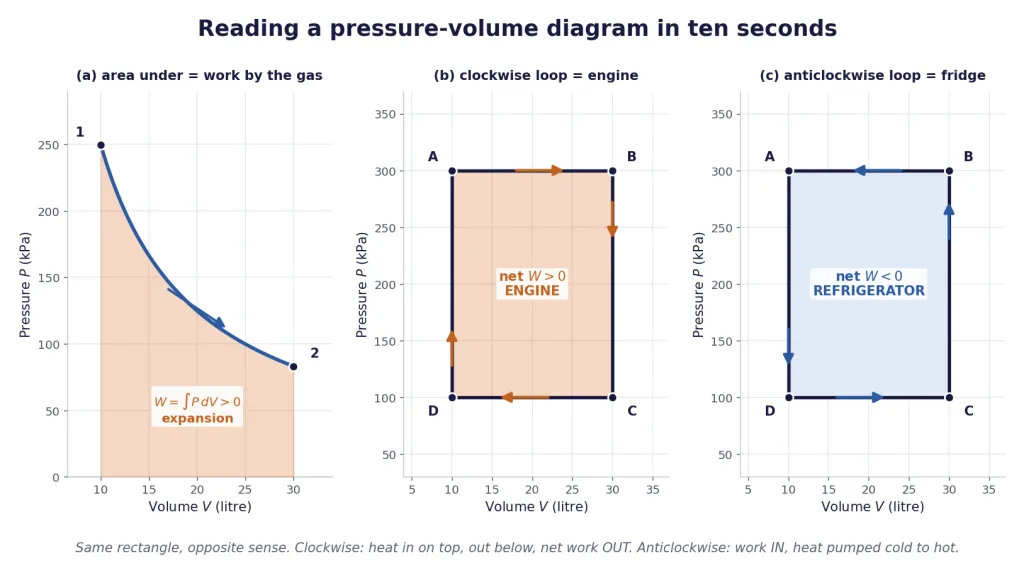
Six readings cover every graph question this chapter can produce.
| What you see | What it means |
|---|---|
| a horizontal segment | isobaric; , a rectangle of area |
| a vertical segment | isochoric; no area, so |
| a hyperbola | isothermal; , so |
| a steeper curve through the same point | adiabatic; , so |
| the area under any segment | the work done by the gas: positive rightwards, negative leftwards |
| the area enclosed by a loop | the net work: clockwise, anticlockwise, and so it equals the net heat |
Three habits that make this fast.
1. Read the direction of travel before anything else. Rightward means expansion means . Leftward means compression means . Everything else follows.
2. Check the units on the axes. A graph in kilopascals against litres gives work directly in joules, because . That single fact removes two conversions from every graph question, and forgetting it is where the factors of in the wrong options come from.
3. Use to see where the temperature is going. On a - diagram, moving to a point with a larger product means a higher temperature, so . Points on the same hyperbola are at the same temperature. That one idea answers every "what happens to the internal energy" question without any arithmetic.
Key Point: Two different paths between the same two points enclose different areas, so they involve different work and different heat — but they end at the same state, so they have the same . That single sentence is the whole content of "work is a path function and internal energy is not", and it is examined every year.
Template 1 — the cyclic process
You are shown: a closed loop, usually a rectangle or a triangle, on a - diagram. You are asked: the net work, the net heat, or the efficiency.
The drill.
- round the loop, so the net heat equals the net work. Write that down first.
- The net work is the enclosed area. For a rectangle it is ; for a triangle it is base height.
- Sign from the sense of travel: clockwise positive, anticlockwise negative.
Worked. A gas is taken round .
The loop runs right to along the top and back left along the bottom, so it is clockwise, and J: the gas does 400 J of net work on the surroundings, and absorbs a net 400 J of heat. Ten seconds, and no leg-by-leg work at all.
Template 2 — the engine ledger
You are shown: , , or — any two of them. You are asked: the rest.
The drill: one triangle of relations.
Worked. An engine absorbs 1000 J per cycle from a source at 600 K and rejects 750 J to a sink at 300 K.
Then always check the ceiling. , and , so the engine is legal. If a problem's numbers ever give above , the machine is impossible and "such an engine cannot exist" is the answer being fished for.
Template 3 — the Carnot triple
You are shown: two temperatures, in Celsius as often as not. You are asked: an efficiency, a heat, a work, or a missing temperature.
The drill, four lines.
- Convert both temperatures to kelvin and write the letter K. .
- .
- For a Carnot engine only, — heats in the same ratio as absolute temperatures.
- Run it backwards for the fridge: , and .
Worked. A Carnot engine runs between 177°C and 27°C and absorbs 1200 J per cycle.
Check with the temperature ratio: and . They agree, as they must for a Carnot engine.
[Exam Tip] In this last problem, working in Celsius would have given , about 85%. That number is on the option list. So is , which is negative, for the students who put the two temperatures the wrong way up. is the hot one and it goes on the bottom of the fraction.
Thermodynamics Wearing a Lab Coat
Of every chapter in Class 11 Physics, this one reaches furthest into biology after thermal properties — and a paper that spends two thirds of its length on living things is not going to let that pass. A human being is a chemical engine running at about 100 W, and every sentence of this chapter applies to it. Expect at least one of the thermodynamics questions you are given to be about a body.
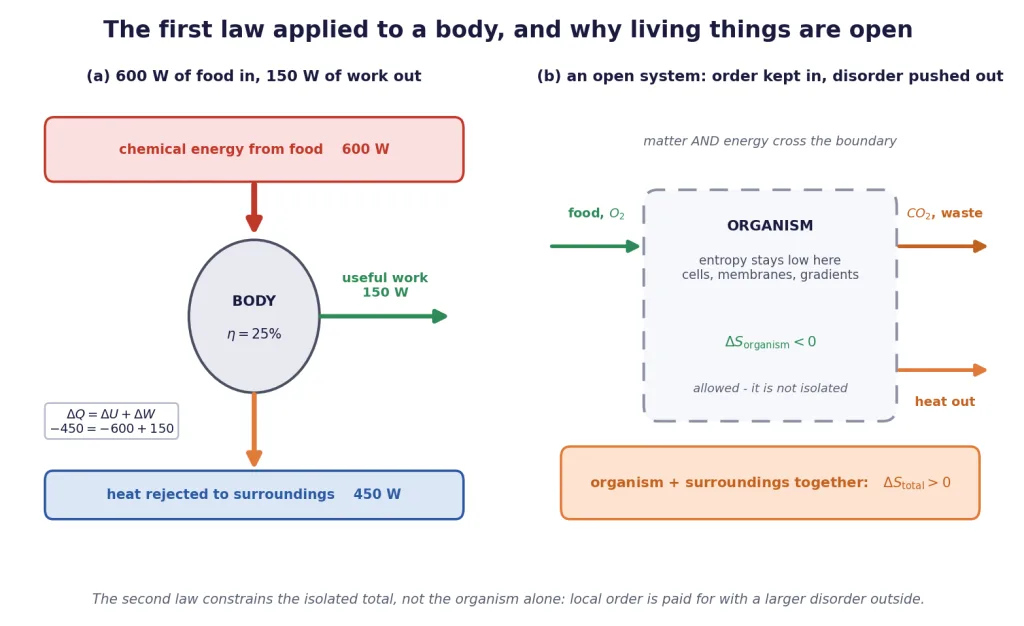
Metabolism is the first law, and nothing more
Food carries chemical energy. Some of it becomes external work; the rest leaves as heat. Written with this chapter's signs, for the body taken as the system over some interval:
- when you do external work — lift a load, climb a stair, pedal a bicycle.
- almost always, because the body is warmer than the room and heat is continually leaving.
- when you are burning stored energy faster than you are eating, which is exactly what "using up reserves" means in physics.
Worked, at rates. A cyclist releases chemical energy at 600 W and delivers 150 W of mechanical power to the pedals.
Over one hour, with s in an hour:
and J is exactly , the chemical energy released. The first law closes to the joule. Note the two negative signs and what each means: heat left, and the body's own store fell.
Key Point: For a body, negative means reserves being consumed, negative means heat being shed, and positive means external work being done. A question that says "a person does J of work and loses J of heat" wants with both signs put in — and it is asking whether you can read the words "loses" and "does" as signs.
The body as a heat engine, and why 25% is respectable
Skeletal muscle converts chemical energy into mechanical work at 20 to 25%, the rest appearing as heat. Set that beside the machines:
| Machine | Typical efficiency |
|---|---|
| human muscle | 20 to 25% |
| petrol engine | 25 to 30% |
| diesel engine | 35 to 40% |
| large steam turbine plant | 35 to 45% |
| electric motor | 85 to 95% |
A person is about as efficient as the engine in a car, which is a genuinely surprising fact and a fair exam question.
But there is a subtlety here worth understanding, because it is a favourite of the assertion-reason format.
Key Point: The body is not a heat engine in the thermodynamic sense. A heat engine takes heat from a hot reservoir and rejects it to a cold one, and its ceiling is . If a body were doing that, with a core at 310 K and skin at 306 K, its ceiling would be It achieves 25%, twenty times that. The resolution is that muscle converts chemical energy directly into work, without ever passing it through heat, so the Carnot ceiling simply does not apply to it. The second law is not violated; a different limit governs a chemical converter.
Note that the ceiling calculation itself obeys every rule of this chapter: both temperatures in kelvin, source on the bottom, and the answer smaller than 1.
The basal metabolic rate is a heat-rejection problem
At rest a typical adult releases about 100 W — the basal metabolic rate, roughly one filament lamp's worth. Since a resting person does essentially no external work, , and the first law says every one of those joules must leave as heat:
If the body could not shed it, the temperature would climb. Take a 60 kg body with an average specific heat capacity of about 3500 J/(kg K):
About four hours to a fatal 44°C. The entire apparatus of skin, sweat and circulation exists to reject 100 W continuously, and five or six times that when you work hard. Where that heat goes — radiation, convection, evaporation and conduction — belongs to the chapter on thermal properties; what belongs here is the balance itself.
Why a person warms a sealed room
Put a person in a small, sealed, rigid room and the room is very nearly an isolated system with a 100 W heater inside it. The air's volume cannot change, so this is an isochoric process for the air: , and every joule goes into internal energy.
Take a room 5 m by 4 m by 3 m, so 60 m of air. Air has a density of about kg/m, giving a mass of 72 kg, and at constant volume its specific heat capacity is J/(kg K).
Seven kelvin an hour, from one person. Four people give 28 K an hour, which is why a packed unventilated room becomes unbearable so quickly, and why an examination hall needs real ventilation rather than a fan.
[Important] Use , not , when the container is rigid and sealed. Using J/(kg K) instead would give K and is the wrong answer the question is built around. Rigid means isochoric means ; free to expand means isobaric means .
Living systems are open, and the second law is fine with them
This is the single most reliable assertion-reason theme in the chapter, so learn the argument exactly.
The objection sounds serious. A seed becomes a tree; a cell divides into two ordered cells; a body maintains a set of steep chemical gradients for eighty years. Order is being created and maintained. Does that not violate the second law, which says disorder must increase?
Key Point: No, because the second law's statement about increasing disorder applies to an ISOLATED system, and a living organism is an OPEN system.
An organism continuously takes in low-entropy material and energy — food, oxygen, sunlight — and exports high-entropy material and energy — carbon dioxide, water, waste, and above all heat. The entropy of the organism can fall, and does: because at the same time Local order is bought with a larger disorder outside. An organism is not a violation of the second law; it is a demonstration of it, because maintaining that order requires a continuous throughput of energy, and the moment the throughput stops the order decays.
Three exam-ready one-liners that follow.
- A living organism is an open system — matter and energy cross its boundary. A closed system exchanges only energy; an isolated one exchanges neither.
- Death is what an isolated organism looks like. Cut off the throughput and the gradients run down: that is entropy increase in the biological case.
- A refrigerator makes exactly the same point about the same law. It lowers the entropy of its cold chamber, but only while consuming work and dumping more entropy into the kitchen. The organism and the refrigerator are the same argument in different clothes.
The whole biology-adjacent list, one line each
| Observation | The physics |
|---|---|
| Eating more than you burn | for the body: internal energy is being stored |
| Losing weight on a hard trek | : reserves converted to and |
| A person radiating about 100 W at rest | basal metabolic rate; with , all of it must leave as heat |
| Muscle at 20 to 25% | a chemical converter, comparable with a petrol engine |
| Why the Carnot ceiling does not apply to muscle | it converts chemical energy directly, never passing it through heat |
| A crowded sealed room heating up | isochoric heating of the air: , so |
| A seed growing into a tree | an open system exporting more entropy than it creates order |
| Why life needs a continuous energy supply | maintaining low entropy costs work, continuously |
| A refrigerator and an organism | both lower a local entropy while raising the total |
The Two Special Formats, and the Speed Habits
Assertion-Reason: the four codes
You are given an Assertion (A) and a Reason (R), and asked to choose:
| Code | Meaning |
|---|---|
| (a) | Both A and R are true, and R is the correct explanation of A |
| (b) | Both A and R are true, but R is not the correct explanation of A |
| (c) | A is true but R is false |
| (d) | A is false but R is true |
Read the option list before you start — the order of these four is not fixed between papers, and choosing "option (a)" from memory when the paper has shuffled them is a self-inflicted wound.
Key Point: Three separate judgements, in this order, and never let one influence the next:
- Cover R. Is A true, on its own?
- Cover A. Is R true, on its own?
- Only if both are true: does R actually explain A, or is it merely another true fact about the same topic?
Step 3 is where the marks are, and it is the step people rush. Ask yourself: if R were false, would A stop being true? If yes, R explains A. If A would survive without R, the answer is (b).
Worked, four times.
Item 1. A: The efficiency of a heat engine is always less than 1. R: Some heat is always rejected to the sink. A alone: true. R alone: true. Does R explain A? Yes — , and is precisely the statement . Both true, R explains A.
Item 2. A: The efficiency of a heat engine is always less than 1. R: Friction and heat leakage always waste some of the energy. A alone: true. R alone: true of a real engine. But does R explain A? No. Even a perfect, frictionless, reversible engine has ; the limit comes from the second law, not from losses. R is a true statement about why a real engine falls short of its ceiling, which is a different question. Both true, R does not explain A. Items 1 and 2 have the same assertion and completely different answers, and that is exactly how this format is built.
Item 3. A: A refrigerator transfers heat from a colder body to a hotter one without violating the second law. R: Work is supplied to the refrigerator, so the transfer is not the sole result of the process. A alone: true. R alone: true, and the word "sole" is the whole point of the Clausius statement. Both true, R explains A.
Item 4. A: A living organism maintains a highly ordered state, so it violates the second law. R: A living organism is an open system that exports entropy to its surroundings. A alone: false — no violation occurs. R alone: true, and it is the reason there is no violation. A is false but R is true. Watch how the assertion has been written to sound plausible; the word "violates" is what makes it false.
Column matching: anchor, do not solve
You are given four items in Column I, four in Column II, and four codes. Never work out all four pairings. Find the one or two that are unmistakable, and use them to kill codes.
Key Point: Anchor on whatever is structurally unique in Column II — the only one containing a logarithm, the only one with a in it, the only one that is exactly zero, the only one with two temperatures. Two anchors almost always leave exactly one surviving code.
Worked. Column I: (A) isothermal process (B) adiabatic process (C) isochoric process (D) cyclic process. Column II: (i) (ii) (iii) and (iv) over the whole path.
Anchor 1: (ii) is the only entry with in it, and "no heat exchanged" is the definition of adiabatic, so B-ii. Anchor 2: (i) is the only entry that is exactly zero work, and only a fixed volume can do that, so C-i. Two anchors, and any code disagreeing with either is dead. The last two fall out with no work: isothermal is the process version, A-iii, and cyclic is the round-trip version, D-iv.
[Exam Tip] In this chapter, one anchor is nearly always free: can only be isochoric, and can only be adiabatic. Find whichever of those two appears in Column II and you have your first pairing before you have read the rest of the question.
The speed habits that finish a thermodynamics question in under 45 seconds
Six habits, in the order you should apply them.
1. Read the last line of the stem first. It tells you which formula you need and, half the time, which trap is being set. The words "by the gas", "on the gas", "rejected", "supplied", "net", "per cycle" and "maximum possible" all change the answer.
2. Name the process before you write anything. Rigid vessel, free piston, suddenly, slowly and in contact with a reservoir, round a loop — one word in the stem fixes the whole row of the table.
3. Write the signs before the numbers. Decide, for each of , and , whether it is positive, negative or zero, and then substitute. A number with the wrong sign is not a near miss in this chapter; it lands exactly on a distractor.
4. Write the letter K. Every temperature entering a ratio, a Carnot formula or a gas-law step gets converted and labelled before anything else. Every temperature appearing only as a difference stays in Celsius and you save the conversion.
5. Prefer the ratio to the substitution. Comparing two situations? Cancel everything common. , , — these are ten-second answers where the full substitution takes ninety.
6. Sanity-check the size before you look at the options. is a fraction below 1 and usually below . for a domestic fridge is between 2 and 6. is between 1 and . for one mole and 100 K is about 831 J. in kPa times litres is joules. If your answer is a decade away from those, you have dropped a conversion.
[Important] And the elimination habit that is worth the most: look at what each wrong option encodes. In this chapter the distractors are almost never a few per cent out. They are the Celsius-for-kelvin answer, the sign flipped answer (work on instead of work by), the reciprocal answer ( instead of , or instead of ), the -for- answer, or a factor of from litres left unconverted. Identify which trap each option encodes and you can often eliminate two of them without computing anything at all.
Solved Examples
Twelve problems at exam level and exam pace. Give yourself 45 seconds on each before reading the solution. Throughout, J/(mol K), , for a monatomic gas and for a diatomic one; other constants are stated where they are used. Every solution states the sign of each of , and and what it means physically.
Example 1: Twenty one-liners, straight from the statements
Answer each in a single sentence, with no calculation.
(a) State the zeroth law, and say what it is for. (b) Why is it meaningless to ask how much heat a system contains? (c) What is the first law, in words? (d) What does the first law forbid? (e) Give the Kelvin-Planck statement word for word. (f) Give the Clausius statement word for word. (g) What is the word "sole" doing in both? (h) Why can no heat engine have ? (i) Why can a coefficient of performance exceed 1? (j) Why can it not be infinite? (k) Why is an adiabat steeper than an isotherm, and by what factor? (l) For which process is the molar specific heat zero, and for which is it infinite? (m) Is restricted to constant-volume processes? (n) Does imply ? (o) What is the work done in an isochoric process? (p) What is over a complete cycle, and what follows? (q) On what does the Carnot efficiency depend? (r) What is a perpetual motion machine of the second kind? (s) Is a free expansion into a vacuum reversible? (t) Is a living organism an open, a closed or an isolated system?
Solution:
(a) If two systems are each separately in thermal equilibrium with a third, they are in thermal equilibrium with each other. It is what makes temperature a measurable property and a thermometer meaningful.
(b) Because heat is a transfer, not a store. It exists only while crossing a boundary because of a temperature difference. What a system possesses is internal energy.
(c) The heat supplied to a system goes partly into raising its internal energy and partly into the work it does on its surroundings: .
(d) A perpetual motion machine of the first kind — a device delivering work in a cycle with no energy supplied.
(e) No process is possible whose sole result is the absorption of heat from a reservoir and the complete conversion of the heat into work.
(f) No process is possible whose sole result is the transfer of heat from a colder object to a hotter object.
(g) Everything. Without it both statements are false: an isothermal expansion converts heat entirely into work, and every refrigerator moves heat from cold to hot — but neither does so as the sole result.
(h) needs , an engine that rejects nothing, which is exactly what Kelvin-Planck forbids. Separately, , and would need a sink at absolute zero.
(i) Because is not a conversion ratio. The machine moves heat rather than converting it, and one joule of work can move several joules.
(j) needs : heat moving from cold to hot with no work at all, which Clausius forbids.
(k) Because in an adiabatic expansion the gas also cools, so the pressure falls for two reasons rather than one. The slopes are and , so the adiabat is steeper by exactly .
(l) Zero for adiabatic (temperature changes with no heat at all) and infinite for isothermal (heat flows with no temperature change at all).
(m) No. For an ideal gas depends on alone, so holds on every path — isothermal, adiabatic, isobaric, anything. It is merely derived most easily at constant volume.
(n) No. That is the single commonest confusion in this chapter. An adiabatic process has and a large temperature change; an isothermal process has and a large heat exchange.
(o) Zero. Nothing moves, so no work is done either way, and the first law collapses to .
(p) exactly, because the system returns to its initial state and is a state function. Therefore for the cycle.
(q) On the two absolute temperatures and nothing else — not the working substance, not the design, not the size: .
(r) A device that would take heat from a single reservoir and convert it entirely into work in a cycle. It conserves energy, so the first law permits it; the second law forbids it.
(s) No. , and for an ideal gas, so it looks harmless — but the gas passes through no equilibrium states at all, and it never re-gathers itself, so the process is violently irreversible.
(t) Open — both matter and energy cross its boundary, which is exactly why it can maintain internal order without breaking the second law.
Takeaway: Every one of these twenty has been a complete question by itself. None is worth more than fifteen seconds, and none should be derived.
Example 2: The first law in four one-line applications
For each, find the missing quantity, state the sign of all three of , and , and say what each sign means.
(a) A gas absorbs 300 J of heat and does 120 J of work on its surroundings. (b) An insulated gas is compressed, 250 J of work being done on it. (c) A gas in a rigid sealed vessel absorbs 400 J of heat. (d) Over one complete cycle a gas absorbs 900 J and rejects 650 J.
Solution:
(a) Heat added, so J. Work done by the gas, so J. Signs: , heat entered; , the gas expanded and pushed the surroundings; , the gas ended hotter. Check: .
(b) Insulated means adiabatic, so . Work done on the gas, so J. Signs: , no heat crossed; , the surroundings did the work; , the gas got hotter even though no heat was supplied. That last sentence is the whole point of adiabatic compression, and it is why a bicycle pump warms up. Check: .
(c) Rigid means isochoric, so . J. Signs: ; , nothing moved; , all of it stored. Check: .
(d) Over a cycle the system returns to its initial state, so exactly. Signs: net heat in positive, net work out positive, zero. This is a heat engine, delivering 250 J per cycle with , about 28%. Check: .
Takeaway: In every one of the four, one quantity was zero because of the words in the stem — insulated, rigid, cyclic. Find the zero first, then the first law hands you the rest in one line.
Example 3: One mole, four processes, one table
One mole of a monatomic ideal gas starts at 300 K. Take J/(mol K), and J/(mol K), , .
(a) It expands isothermally to twice its volume. (b) It expands adiabatically to twice its volume. (c) It expands isobarically to twice its volume. (d) It is heated isochorically to 600 K.
Find , and in each case.
Solution:
(a) Isothermal. because is fixed and depends only on . Signs: heat in, work out, internal energy unchanged. Every joule supplied leaves as work.
(b) Adiabatic. . Use constant with : Signs: ; , the gas expanded; , it paid for that work out of its own internal energy and cooled from 300 K to 189 K.
Notice at once that : the adiabatic expansion does less work than the isothermal one between the same volumes, exactly as the two curves on the diagram promise.
(c) Isobaric. Doubling the volume at fixed pressure doubles the absolute temperature, so K and K. Check the first law: , against from — agreement to the rounding of each term. Signs: all three positive. Heat in, gas expands, gas gets hotter.
(d) Isochoric. because the volume is fixed. Signs: , , . All of the heat is stored.
| Process | (J) | (J) | (J) | The signature |
|---|---|---|---|---|
| Isothermal, doubled | ||||
| Adiabatic, doubled | ||||
| Isobaric, doubled | nothing vanishes | |||
| Isochoric, 300 to 600 K |
Every row satisfies to the last digit.
Takeaway: Four processes, four zeros, four rows. Compare the isobaric and isochoric rows: the same 300 K rise costs J one way and J the other, and the difference J is exactly — Mayer's relation, appearing as an arithmetic fact.
Solved Examples (continued)
Example 4: A rectangular cycle, read in twenty seconds
An ideal gas is taken round the closed loop .
(a) Name each of the four legs. (b) Find the work on each leg, with signs. (c) Find the net work, and check it against the enclosed area. (d) Find the net heat, and say whether this is an engine or a refrigerator.
Solution:
Units first. Pressures are in kilopascals and volumes in litres, so a product of the two is already in joules: J. No conversions needed anywhere below.
(a) is horizontal, so isobaric expansion. is vertical, so isochoric cooling. is horizontal, so isobaric compression. is vertical, so isochoric heating.
(b) Work is the area under each segment, with the sign fixed by the direction.
(c) Add them: Against the enclosed area: The two agree, as they must. The loop runs rightwards along the top and leftwards along the bottom, so it is clockwise and the net work is positive.
(d) Over a cycle exactly, so Net heat in and net work out: this is a heat engine, delivering 400 J per cycle.
Takeaway: For any rectangular loop, the net work is and the sign is the sense of travel. You never need the leg-by-leg work unless the question asks for a single leg — but doing it once, as above, is how you convince yourself the shortcut is exact.
Example 5: An engine ledger, and the ceiling check nobody does
A heat engine absorbs 1000 J per cycle from a source at 600 K and rejects 750 J to a sink at 300 K.
(a) Find the work per cycle and the efficiency. (b) Find the maximum efficiency possible between these two reservoirs. (c) Is the engine legal? By how much does it fall short? (d) The engine runs at 20 cycles per second. What is its power output?
Solution:
(a) Over a cycle , so all the energy is accounted for by the two heats: Signs for the working substance over one cycle: J, J, . The first law closes: .
(b) Both temperatures are already absolute, and K is the source:
(c) , so the engine is perfectly legal — it simply achieves half the ceiling, which is typical of a real machine. Had the stem claimed , the correct answer would have been "impossible", not "efficient".
(d) Power is work per cycle times cycles per second: and the rate of heat intake is kW, of which kW is rejected.
Takeaway: Three relations and one check. , , and then always compare with before you answer. If the temperatures are in the stem at all, the question wants you to make that comparison.
Example 6: The Carnot triple, and the trap waiting in the option list
A Carnot engine operates between 177°C and 27°C and absorbs 1200 J per cycle from its source.
(a) Find its efficiency. (b) Find the work done and the heat rejected per cycle. (c) Verify the result against . (d) What would working in Celsius have given, and why is that answer impossible on inspection?
Solution:
(a) Convert first, and show the conversion, using : Both are absolute and positive, and as a source must be.
(b) Signs over one cycle: J, J, . First law closes .
(c) For a Carnot engine, and only for a Carnot engine, the heats stand in the ratio of the absolute temperatures: Equal to four figures, as they must be.
(d) Celsius would have given That is on the option list every time. Two reasons to reject it in three seconds. First, the Celsius scale has an arbitrary zero, so a ratio of Celsius temperatures has no physical meaning at all — the same two reservoirs expressed in Fahrenheit would give a different "efficiency", which is absurd. Second, sanity: no real engine runs at 85%, and a source only 150 K above its sink certainly does not.
There is a third distractor worth naming. , a negative efficiency, is what you get from putting the temperatures the wrong way up. is the hot one and it sits on the bottom.
Takeaway: Convert, label with K, put the sink on top, and check the ratio. Four lines, and the trap is disarmed before you reach it.
Solved Examples (continued)
Example 7: A refrigerator and a heat pump in one breath
A refrigerator removes 900 J of heat from its cold chamber in each cycle while 300 J of work is supplied to it. The chamber is at 260 K and the kitchen at 300 K.
(a) Find its coefficient of performance. (b) Find the heat rejected to the kitchen per cycle. (c) The same machine is used as a heat pump. What is its coefficient of performance now? (d) Is the machine legal? What is the best possible between these temperatures?
Solution:
(a) The useful output is the heat removed from the cold space, and what you pay for is the work: Greater than 1, and that is entirely normal. is not an efficiency — nothing is being converted, heat is being moved.
(b) Over a cycle for the working substance, so everything that goes in must come out: Signs for the working substance: it absorbs J at the cold end and rejects J at the hot end, so J; the work is done on it, so J; and . First law: .
(c) A heat pump is the same machine valued for what it delivers to the warm space: The relation is exact and follows in one line from . A heat pump therefore always beats an electric heater, which can never deliver more than the 1 joule of heat per joule of electricity it consumes.
(d) The Carnot limit for a refrigerator, both temperatures already absolute: Since , the machine is legal, achieving a little under half the ideal. For a refrigerator the ceiling is on , not on any efficiency, and sits comfortably below . One caution while you are here: the relation , which converts one figure into the other, describes one and the same reversible machine run both ways. This refrigerator is irreversible, so it cannot simply be turned round and read off as an engine.
Takeaway: , , , ceiling . Four lines, and note which heat sits on top in each: for the fridge because you care about the cold space, for the pump because you care about the room.
Example 8: Metabolism as an energy balance
A cyclist releases chemical energy from food at a steady 600 W and delivers 150 W of mechanical power to the pedals.
(a) What is the efficiency of this conversion? (b) At what rate must the body reject heat? (c) Over one hour, find , and for the body, with signs, and check the first law. (d) How much food energy is that in kilocalories, with cal J?
Solution:
(a) Useful work out over energy in:
(b) The body is not storing energy at a steady rate while cycling steadily, so everything that is not work must leave as heat:
(c) Take the body as the system, over s.
Work. External work is done by the body, so it is positive:
Heat. Heat leaves the body, so it is negative:
Internal energy, from the first law:
Check: gives . And independently, J is exactly : the fall in internal energy equals the chemical energy released, as it must.
What the signs mean. : the body did work on the world. : heat flowed out, because the body is warmer than the air. : the body's own store of energy fell — which, in ordinary language, is what "burning 500 kilocalories" means.
(d) About 520 dietary Calories in an hour of hard cycling, which is the right order for a real athlete.
Takeaway: The first law applied to a body is exactly the first law applied to a gas. Read "does work" as , "loses heat" as , and let do the rest. The commonest error is putting in as positive because the word "energy" sounded like a supply.
Example 9: Is the body a heat engine?
Human muscle converts chemical energy to mechanical work at about 25%. Body core temperature is C and skin temperature about C.
(a) If the body were a heat engine working between core and skin, what would its maximum efficiency be? (b) Compare with the 25% actually achieved, and resolve the apparent contradiction. (c) How does 25% compare with real engines? (d) Does anything here violate the second law?
Solution:
(a) Convert first, and label with K: Both temperatures absolute and positive, source on the bottom, answer well below 1 .
(b) The body achieves 25%, about twenty times that ceiling. Since Carnot's theorem is not negotiable, the only possible conclusion is that the assumption in part (a) is wrong: the body is not a heat engine.
Muscle does not take heat from a hot reservoir and reject it to a cold one. It converts the chemical energy stored in ATP directly into mechanical work at the level of individual protein molecules, and the heat is a by-product of that conversion, not the intermediate step. The Carnot ceiling constrains machines that go through the sequence heat in, work out, heat rejected. A chemical converter never enters that sequence, so the ceiling does not bind it.
(c) Very respectably:
| Machine | Typical efficiency |
|---|---|
| human muscle | 20 to 25% |
| petrol engine | 25 to 30% |
| diesel engine | 35 to 40% |
| electric motor | 85 to 95% |
A person is about as efficient at converting stored energy into work as the engine of a car — and unlike the car, does it at C.
(d) Nothing. The second law forbids specific things: a cyclic device converting heat wholly into work, and heat moving from cold to hot as the sole result. A chemical converter running at 25% does neither. What would violate the second law is a machine that took the body's waste heat at C and turned a useful fraction of it back into work — and that is precisely what the figure tells you is hopeless.
Takeaway: Carnot's ceiling applies to heat engines. Ask, before you apply it, whether the device actually takes heat from a hot reservoir. The body does not, which is why 25% and a 1.3% ceiling can coexist without either being wrong.
Solved Examples (continued)
Example 10: Why a person warms a sealed room
A sealed, rigid, well-insulated room measures 5 m by 4 m by 3 m. Air has a density of kg/m and, at constant volume, a specific heat capacity J/(kg K). One person inside releases heat at a steady 100 W.
(a) What kind of thermodynamic process is the air undergoing, and what is ? (b) By how much does the air temperature rise in one hour? (c) What would four people do in the same hour? (d) Why would using J/(kg K) be wrong here, and what answer would it have given?
Solution:
(a) The room is rigid, so the air's volume cannot change: this is an isochoric process. Therefore Every joule that enters the air is stored as internal energy. That single sentence is the whole physics of the question.
(b) Mass of air: Heat delivered in s: Signs: , heat into the air; , nothing moved; , the air is hotter. First law: .
Note that appears only as a difference here, so 7.0 K and C are the same number and no kelvin conversion was needed. That is the other half of the kelvin rule.
(c) Heat scales with the number of people, and scales with heat: Twenty-eight kelvin in an hour — which is why a packed unventilated room becomes intolerable so fast, and why the real answer is ventilation rather than a fan.
(d) is the specific heat capacity when the gas is free to expand and push back the surroundings, doing work as it is heated. Here the room is sealed and rigid, so no such work is done and none of the heat is spent on it. Using would give an underestimate by 29%, and it is on the option list. Rigid means isochoric means ; free piston or open to the atmosphere means isobaric means .
Takeaway: Identify the process from the container, and the specific heat follows. A real room leaks, so the true rise is smaller — but the physics the question is testing is .
Example 11: Four assertion-reason items, judged in three steps each
For each, decide whether A and R are true, and whether R explains A.
(a) A: A gas cools when it expands adiabatically. R: In an adiabatic expansion the gas does work at the expense of its own internal energy. (b) A: The efficiency of a Carnot engine can be increased more effectively by lowering the sink temperature than by raising the source temperature by the same amount. R: The efficiency of a Carnot engine depends on the working substance used. (c) A: A living organism maintains a low internal entropy without violating the second law. R: A living organism is an open system that exports more entropy to its surroundings than the order it creates internally. (d) A: can be used for an isobaric process. R: For an ideal gas the internal energy depends only on the temperature.
Solution:
(a) A alone: true — an adiabatically expanding gas always cools. R alone: true — , so , and positive work means negative . Does R explain A? Completely: falling means falling for an ideal gas. Verdict: both true, R is the correct explanation.
(b) A alone: true. With K and K, . Raise the source by 100 K: . Lower the sink by 100 K instead: . Lowering the sink wins. R alone: false — Carnot efficiency depends on the two temperatures and on nothing else, certainly not the working substance. Verdict: A is true but R is false. This item exists to check whether a true-sounding assertion tempts you into accepting a false reason.
(c) A alone: true. R alone: true. Does R explain A? Yes, exactly — the second law's demand that entropy increase applies to an isolated system, and an organism is not one. Verdict: both true, R is the correct explanation. This is the single most predictable assertion-reason item in the chapter.
(d) A alone: true — holds on every path for an ideal gas, isobaric included. R alone: true, and it is precisely why. Verdict: both true, R is the correct explanation. The trap here is the belief that may be used only at constant volume; that is a statement about how the formula is derived, not about where it is valid.
Takeaway: Judge A alone, judge R alone, then judge the link. Item (b) shows why the third step matters: a true assertion sitting beside a false reason is a whole category of question, and the reason "Carnot efficiency depends on the working substance" is false every time it appears.
Example 12: Column matching, anchored not solved
Match Column I with Column II.
Column I: (A) Isothermal process (B) Adiabatic process (C) Isobaric process (D) Cyclic process
Column II: (i) (ii) and (iii) and (iv) and the net work equals the enclosed area
Solution:
Do not evaluate all four. Find the anchors.
Anchor 1 — the free one. (iii) is the only entry containing , and no heat exchanged is the definition of adiabatic. B-iii. That pairing alone kills every code that says otherwise.
Anchor 2 — the next most distinctive. (i) is the only entry containing , and belongs to constant pressure. C-i.
The remaining two, in five seconds. (ii) and (iv) both contain , which is why they were placed together — but (iv) mentions an enclosed area, and only a closed loop encloses anything. So D-iv, and by elimination A-ii.
The trap in this set is that (ii) and (iv) both say , and a student who anchors on that alone has two candidates for each of A and D and no way to choose. Anchor on what is unique, not on what is shared.
Takeaway: In this chapter your free anchor is almost always one of two lines: can only be isochoric, and can only be adiabatic. Find whichever appears, pair it, and let the codes do the rest of the work for you.