
How to Use This Problem Bank
Eleven sections of theory, and now the part that actually earns marks. What follows is 45 worked problems, arranged easy first and hard last, covering the whole chapter — from "which formula is this?" up to the multi-step cycles that decide ranks.
Work them with a pen and paper. Cover the solution, try it, then compare — including the check at the end of each one, because the check is where the marks usually leak away.
The Sign Convention
Key Point — THIS CHAPTER'S SIGN CONVENTION:
- is positive when heat is added TO the system, negative when heat leaves it.
- is positive when work is done BY the system (expansion), negative when work is done ON it (compression).
- is the change in internal energy, a state function.
The first law is then
Your chemistry course, and many physics books, write with meaning the work done ON the system. That is the same physics with one sign moved, and this section mentions it here and then never again. Every solution below uses exclusively, and every solution states the sign of each of the three quantities and says what that sign means physically. A bare number is not an answer in this chapter.
The four questions to ask before you write anything
- Is the temperature in kelvin? Every ratio , every gas-law step, every efficiency and every adiabatic relation needs absolute temperature. Only a bare difference is the same number in Celsius and kelvin. This is the commonest wrong answer in the chapter.
- Which process is it? Constant , constant , constant or constant ? Name it before you reach for a formula — three of the four kill a whole term of the first law outright.
- Is the gas expanding or being compressed? That fixes the sign of before any arithmetic. Volume up means .
- Is this one process, or a closed loop? Round a loop exactly, so and the net work is the enclosed area. Spotting a loop turns a hard question into a table.
Key Point — every formula this section uses, in one place:
A note on symbols, once
is always an absolute temperature in kelvin; or is Celsius, and . is the source (hot) and is the sink (cold) — also written and — and is the heat drawn from the source while is the heat rejected to the sink, both quoted as magnitudes with the direction stated in words. is the number of moles, also written . and are molar specific heats in J/(mol K); lowercase and are per kilogram, in J/(kg K). is efficiency and is the coefficient of performance, which is never called an efficiency because it routinely exceeds 1.
The constants used below
Every solution also restates the constants it uses inside itself, so you never have to scroll back.
| Quantity | Value used |
|---|---|
| Gas constant | 8.314 J/(mol K) |
| 1 atmosphere | Pa |
| Absolute zero offset | C K |
| 1 calorie | 4.186 J |
| , monatomic (He, Ne, Ar) | |
| , diatomic (H, N, O, air) | |
| , polyatomic (CO, NH) | |
| monatomic / diatomic / polyatomic | 12.47 / 20.79 / 24.94 J/(mol K) |
| monatomic / diatomic / polyatomic | 20.79 / 29.10 / 33.26 J/(mol K) |
| Specific heat capacity of water | 4186 J/(kg K) |
The values of , and the fact that work is the area under a - curve, sit outside the rationalised syllabus body text, yet nothing here can be solved without them — Boards, JEE Main and NEET all ask about them every year, so they are used freely throughout.
[Board Important] Every solution writes the formula on its own line before any number goes into it, and every temperature that enters a ratio is written with the letter K next to it. Do both in the exam. A correct formula with an arithmetic slip still earns most of the marks; a Celsius value inside loses them all.
Solved Examples
Part 1: Systems, State Variables and the Zeroth Law
Four warm-ups. No first law yet — just the vocabulary, used precisely. Everything in this part is worth exactly the marks that a careless reader throws away.
Key Point: An open system exchanges both matter and energy with its surroundings; a closed system exchanges energy only; an isolated system exchanges neither. The classification depends on the boundary you choose, not on the object — which is why the same kitchen pot can be all three in the space of ten minutes.
Example 1: A pressure cooker at three moments
A pressure cooker sits on a flame. Classify the gas-plus-water inside as open, closed or isolated at each of these moments: (a) the lid is off and the water is boiling; (b) the lid is sealed, the weight is down, and the flame is on; (c) the sealed cooker is taken off the flame and wrapped in a thick blanket of expanded polystyrene.
Solution:
Fix the system and the boundary first. Take the system to be everything inside the cooker: the water and the steam above it. The boundary is the inner surface of the pot plus, when there is one, the lid.
(a) Lid off, boiling. Steam is leaving through the open top, so matter crosses the boundary. Heat is arriving from the flame, so energy crosses too. Both cross: this is an open system. Notice that the mass of the system is falling, which is exactly why an open system cannot be described by a fixed in .
(b) Lid sealed, weight down, flame on. Nothing can get past the sealed lid while the weight stays seated, so no matter crosses. But the metal base conducts heat in from the flame, so energy still crosses. Matter no, energy yes: a closed system. This is the case almost every thermodynamics problem means when it says "a gas in a cylinder".
(c) Off the flame, wrapped in insulation. No matter crosses, and now the insulation blocks heat as well. Nothing crosses: an isolated system — to the extent that the insulation is perfect, which it never quite is.
The catch worth noticing. The cooker in (c) is not doing any work either, so its internal energy is now fixed. That is what "isolated" buys you: a constant , which is the strongest constraint in the whole subject.
Final Answer: (a) open, (b) closed, (c) isolated.
Takeaway: A system is open, closed or isolated because of its boundary, not because of what it is made of. Draw the boundary explicitly before you classify anything, and re-draw it whenever the physical setup changes.
Example 2: Turning extensive quantities into intensive ones
A rigid cylinder holds 2.00 moles of helium (molar mass 4.00 g/mol) in a volume of m at 300 K. Find its mass, pressure, density, molar volume, internal energy and internal energy per kilogram. Then cut the whole thing in half with an imaginary partition and say which of these six numbers changes.
Solution:
The constants. J/(mol K); for a monatomic gas J/(mol K). The temperature is already absolute: 300 K.
Mass and pressure.
Internal energy. For an ideal gas , and for helium J/(mol K):
The three ratios.
Now halve it. Slice the cylinder down the middle. Each half contains 1.00 mole in m, of mass g, with internal energy J. So , , and all halve — these are the extensive quantities. But are all unchanged, and so are and . These are the intensive quantities.
The pattern behind it. Every one of the unchanged quantities is a ratio of two extensive quantities. Divide an extensive quantity by another extensive quantity and the size of the system cancels out. That is the entire recipe for manufacturing an intensive variable, and it is why density, molar volume and specific internal energy exist at all.
Final Answer: g, Pa, kg/m, m/mol, J, J/kg. Halving the system halves , , and and leaves , , , and alone.
Takeaway: Halve the system in your head — whatever halves is extensive, whatever survives is intensive. It is a five-second test and it never fails.
Example 3: Three flasks and one thermometer
Three sealed flasks , and stand on a bench. A thermometer is dipped into and settles at 310.2 K. is then placed in thermal contact with and, after a long wait, no heat flows between them. is separately placed in contact with , and again no net heat flows. What can you say about and ? And what would happen if and were brought into contact with each other, with the thermometer never having touched either?
Solution:
Write down what "no net heat flows" means. Two bodies in contact with no net heat flow between them are in thermal equilibrium. So and are in thermal equilibrium, and and are in thermal equilibrium.
Apply the zeroth law. The zeroth law of thermodynamics states: if is in thermal equilibrium with , and is in thermal equilibrium with , then and are in thermal equilibrium with each other. So bringing and together will produce no net heat flow, even though they have never met.
Now the temperature. The thermometer read 310.2 K in . The thermometer, being in equilibrium with , is at the temperature of . Since and are each in equilibrium with , all four objects share one number: which is C, a healthy body temperature.
Why this deserves to be called a law. It sounds like arithmetic — "if and then " — but it is a claim about nature, not about algebra. It says that thermal equilibrium is a transitive relation, and nothing forced that to be true. Because it is true, a single number can be attached to a body and called its temperature, and a thermometer calibrated once will work on anything. Without transitivity, a thermometer would be useless: it would tell you about the thermometer's relationship with one particular body and nothing more.
The practical reading. The whole of clinical thermometry rests on this. Nobody compares your forehead directly with a reference block of metal in a laboratory in Paris. The thermometer is the third body , and the zeroth law is the only reason its reading means anything.
Final Answer: and are in thermal equilibrium with each other and both are at 310.2 K, or C. Placing them in contact produces no net heat flow.
Takeaway: The zeroth law is what makes a thermometer possible. It is not a triviality about equals signs; it is the empirical fact that thermal equilibrium is transitive, and the entire concept of temperature is built on it.
Example 4: Fixing a state with two numbers and reading off the third
A closed cylinder holds mol of nitrogen (a diatomic gas) at a pressure of Pa and a temperature of 350 K. Find the volume and the internal energy. Then decide which of these five quantities are state variables: pressure, volume, temperature, internal energy, and the heat that was supplied to get the gas here.
Solution:
The constants. J/(mol K); for a diatomic gas J/(mol K). The temperature 350 K is already absolute, so it can go straight into the gas law.
Volume from the equation of state.
Internal energy. For an ideal gas depends on temperature alone:
Notice what just happened. You were handed two numbers, and , and the equation of state produced the third. For a fixed amount of ideal gas, only two of , and are independent — the equation of state uses up the third degree of freedom. That is what makes a - diagram sufficient: fix a point on it and the temperature is already decided.
Which are state variables? , , and all are: each has a definite value in the state described, no matter how the gas got there. The heat supplied is not. Ask "how much heat is in this cylinder?" and the question is meaningless. Heat is energy in transit across a boundary; it exists only during a process, and the amount depends on which route was taken. The same is true of work. That asymmetry — a state function, and path functions — decides more exam questions than any formula in the chapter.
Final Answer: L and J. Pressure, volume, temperature and internal energy are state variables; the heat supplied is not.
Takeaway: Two numbers fix the state of a fixed mass of ideal gas; the third comes free from . And if a quantity only makes sense while something is happening, it is a path function, not a state variable.
Part 2: The First Law in Every Combination
Seven problems on and nothing else. Every one of them is solved by writing the law down, putting in the two quantities you know with their signs, and reading off the third. The arithmetic is trivial; the signs are everything.
Key Point: Rearranged three ways, the first law is , and . Learn the last one and derive the other two on the spot — that way you can never lose a minus sign by misremembering.
Example 5: Heat in, work out
A gas in a cylinder absorbs 850 J of heat from a flame and, in the same process, pushes the piston out, doing 320 J of work on the surroundings. Find the change in its internal energy and say what happens to its temperature.
Solution:
Assign the signs before anything else. Heat is absorbed by the system, so J. The gas expands and does work on the surroundings, so J.
Apply the first law.
State every sign and what it means.
- J: positive, so 850 J of heat entered the gas.
- J: positive, so the gas did 320 J of work on its surroundings — it expanded.
- J: positive, so the internal energy rose. For an ideal gas depends only on temperature, so the gas got hotter.
- The bookkeeping in words. Of the 850 J supplied, 320 J was immediately spent pushing the piston out against the outside world, and the remaining 530 J stayed behind as extra random molecular energy. Nothing was created and nothing was lost.
Final Answer: J; the internal energy rises and the gas warms up.
Takeaway: Heat supplied splits into internal energy plus work done. Write , mark the signs on the two knowns, and the third falls out with no thinking at all.
Example 6: Compressed and cooled at the same time
A gas is compressed by a piston, 450 J of work being done on the gas, while 600 J of heat is simultaneously removed from it by a cooling coil. Find and state what happens to the temperature.
Solution:
Signs first, and this is where the marks are. Heat is removed, so J. Work is done ON the gas, and our convention takes work done by the system as positive, so J.
Apply the law.
State every sign and what it means.
- J: negative, so 600 J of heat left the gas.
- J: negative, so 450 J of work was done on the gas by the piston. The gas was compressed.
- J: negative, so the internal energy fell by 150 J and the gas cooled.
Why the answer is smaller than either input. The two effects fight each other. Compressing the gas adds 450 J to it; the coolant removes 600 J. The coolant wins by 150 J, so the net result is a modest fall in internal energy. Had the compression been 700 J instead, would have come out at J and the gas would have got hotter even while being cooled.
The trap. Writing J is the standard error, and it comes from putting the magnitude of the compression work in with a minus sign already attached and then subtracting it again. Fix the sign once, at the top, and then obey the formula literally.
Final Answer: J; the gas cools slightly.
Takeaway: Double negatives are the chapter's favourite trap. is ; write the substitution out in full rather than doing it in your head.
Example 7: A heater against a working system
An electric heater delivers energy to a system at a steady rate of 180 W. At the same time the system performs external work at a rate of 125 J per second. At what rate is its internal energy changing, and by how much does the internal energy change in 4.0 minutes?
Solution:
Recognise the form. The first law works just as well per second as it does per process. Divide every term by the time interval: All three are now powers, measured in watts.
Signs. Energy is supplied to the system, so W. The system does work on the surroundings, so W.
Rate of change of internal energy.
Over 4.0 minutes. First convert: minutes s.
State every sign and what it means. kJ over the interval (heat in), kJ (work out, done by the system), kJ (internal energy rising, so the system is warming). Check: . The law closes exactly.
Final Answer: the internal energy rises at 55 W, and by kJ in 4.0 minutes.
Takeaway: The first law in rate form is the same law with every term divided by time. Watts in, watts out, watts stored — and the units tell you instantly whether you have divided by the time or forgotten to.
Example 8: An adiabatic route and a heated route between the same two states
A gas is taken from equilibrium state to equilibrium state along a perfectly insulated path, and J of work is found to be done on the gas. The gas is then returned to and taken to again along a completely different, non-insulated path, during which it absorbs a net calories of heat. How much work is done by the gas on this second route? (Take 1 calorie J.)
Solution:
Do the insulated route first, because it hands you for free. "Perfectly insulated" means . Work is done on the gas, so J.
Here is the whole idea of the problem. is a state function. The change from to therefore has the same value J on every path between those two states, insulated or not, fast or slow, in one step or in fifty.
Convert the heat on the second route into joules. Never mix calories and joules in the same equation: Positive, because the gas absorbs it.
Now the first law on the second route.
State every sign and what it means.
- Route 1: (insulated), J (work done on the gas), J (internal energy rises).
- Route 2: J (heat absorbed), J (work done by the gas — it expands on this route), J, identical to route 1.
- Read the contrast. On one path the gas is squeezed and does negative work; on the other it expands and does positive work. and are wildly different on the two routes — they are path functions. Only their difference is fixed.
Final Answer: J of work is done by the gas on the second route.
Takeaway: Find on whichever path is easiest, then carry it to the path you were actually asked about. An adiabatic leg, where , is nearly always the easy one.
Example 9: Heat, work or a paddle wheel — three ways to add the same energy
A fixed mass of gas is to be taken from state to state , for which J, by three different routes.
- Route 1: the gas is heated, absorbing 700 J, while it is allowed to expand.
- Route 2: the gas is compressed, 150 J of work being done on it, while heat is also supplied.
- Route 3: the cylinder is perfectly insulated and a paddle wheel inside it is turned by a falling weight.
Find on routes 1 and 3 and on route 2, and comment on route 3.
Solution:
The one fact common to all three. is a state function, so J on every route. That is the anchor.
Route 1. J (absorbed). Positive, so the gas does 300 J of work on the surroundings — it expands, as stated.
Route 2. Work is done on the gas, so J. Positive, so 250 J of heat still has to be supplied. Less heat is needed than on route 1, because the compression is already delivering 150 J of the required 400 J.
Route 3. Perfect insulation means . Negative, so 400 J of work is done on the gas — by the paddle wheel, which is driven by the falling weight. No heat crosses the boundary at all; the entire internal energy rise is delivered mechanically.
Why route 3 is special, and worth a sentence in the exam. The paddle wheel does not push a piston; it stirs. The gas passes through states with no well-defined pressure or temperature while the stirring is going on, so route 3 cannot be drawn as a curve on a - diagram at all. It is adiabatic but emphatically not quasi-static, and it is irreversible — no amount of waiting will make the gas spontaneously turn the paddle backwards and lift the weight. That does not stop the first law from applying: the first law never asks whether a process is reversible.
The three ledgers side by side.
| Route | (J) | (J) | (J) |
|---|---|---|---|
| 1: heated, expands | |||
| 2: heated, compressed | |||
| 3: insulated, stirred |
Every row obeys . The middle column never moves; the outer two roam freely.
Final Answer: route 1, J done by the gas; route 2, J absorbed; route 3, J, i.e. 400 J done on the gas by the paddle.
Takeaway: The same can be bought with pure heat, pure work, or any mixture. That is precisely what "state function" means, and it is the single most examinable sentence in this chapter.
Example 10: From joules to a temperature rise
Two moles of a diatomic ideal gas absorb 1500 J of heat and do 900 J of work on their surroundings. By how much does the temperature rise? (Take J/(mol K).)
Solution:
Signs. J (absorbed); J (done by the gas, so it expanded).
First law for the internal energy. Positive, so the gas warms.
Convert internal energy into temperature. For an ideal gas, whatever the process, and for a diatomic gas J/(mol K).
Solve.
A point that catches people out. was derived for a constant-volume process, but it holds for every process on an ideal gas, because depends only on . Here the gas certainly did not stay at constant volume — it expanded and did 900 J of work — and the formula is still correct. What is not correct here is ; the heat depends on the path, so that would give the wrong answer.
And the units. A rise of K is a rise of Celsius degrees. A temperature difference has the same number on both scales; only a reading differs.
Final Answer: the temperature rises by K.
Takeaway: works for every process on an ideal gas; works only at constant volume. Confusing the two is worth a lot of lost marks.
Example 11: A closed loop audited with nothing but the first law
A gas is taken round a closed cycle. On some legs it absorbs a total of 2400 J of heat; on the others it rejects a total of 1650 J. Find the net work done per cycle and the change in internal energy per cycle. If the same cycle is retraced in the opposite sense, what changes? Compute the efficiency in the first case and the coefficient of performance in the second.
Solution:
The defining property of a cycle. The gas returns to exactly its starting state, so every state variable returns to its starting value. In particular This is true for every cycle, of every shape, in every substance.
Net heat, with signs. Positive overall, so more heat entered than left.
Net work. With the first law collapses to : Positive, so the gas does 750 J of net work on its surroundings each cycle. On a - diagram this is the enclosed area, and the loop is traced clockwise.
Efficiency as an engine. The heat drawn from the hot side is J and the work delivered is J: Check with the other form: . The two agree, as they must.
Now run the loop backwards. Every heat and every work reverses sign. The gas now absorbs 1650 J at the cold side, rejects 2400 J at the hot side, and requires J — that is, 750 J of work must be done on it each cycle. The loop is traced anticlockwise. This is a refrigerator.
Read the two numbers side by side, because students constantly confuse them. As an engine the device converts 31.2% of its heat intake into work. Run backwards it moves 2.20 J of heat out of the cold space for every joule of work paid in. The second number is bigger than 1 and that is not a paradox: is not an efficiency, because nothing is being converted. Heat is being moved, and moving is cheap.
Final Answer: and J per cycle, with . Reversed, 750 J of work must be supplied per cycle and .
Takeaway: Round any loop, , so exactly. Clockwise means an engine and positive net work; anticlockwise means a refrigerator and work paid in.
Part 3: Work as the Area Under a Pressure-Volume Curve
Five problems on the single most visual idea in the chapter: since , the work done by the gas is the area under its path on a - diagram. Get the geometry right and half of thermodynamics becomes mensuration.
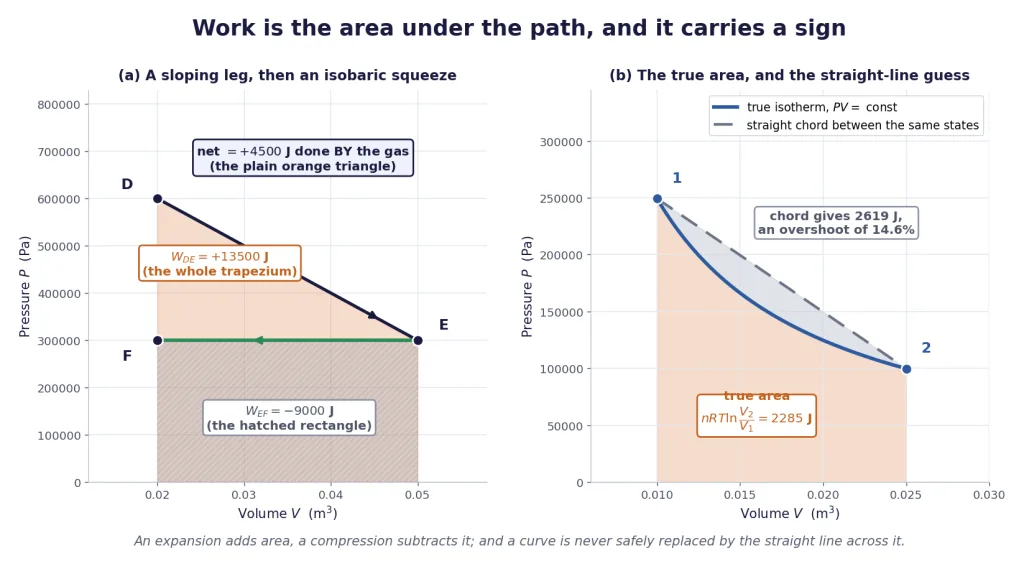
Key Point: Area is measured down to the volume axis, not to the origin, and it carries a sign. Moving right (expansion) counts the area as positive; moving left (compression) counts it as negative. A closed loop therefore encloses the net work: positive clockwise, negative anticlockwise.
Example 12: A sloping leg, then an isobaric squeeze
A gas is taken from state at m, Pa to state at m, Pa along a straight line on the - diagram. From its volume is then reduced back to m at constant pressure, arriving at state . Find the work done by the gas on each leg and in total.
Solution:
Leg : a trapezium. The path is a straight line, so the area under it is a trapezium of parallel sides and and width : Positive, because the volume increased: the gas expanded and did work on the surroundings.
Leg : a rectangle, traversed leftwards. Pressure is constant at Pa: Negative, because the volume decreased: 9000 J of work was done on the gas by whatever pushed the piston in.
Total.
Check the answer geometrically. The two areas overlap over the whole width; what survives is the triangle above the line Pa and below : The two routes to the answer agree exactly, which is the check worth doing.
State the signs and what they mean. J (work done by the gas), J (work done on the gas), net J done by the gas. Note that and have the same volume but different pressures, so this is not a closed cycle — do not be tempted to call J an "enclosed area" of a loop.
Final Answer: J, J, total J done by the gas.
Takeaway: Do each leg separately, sign it by the direction of travel, and add. Two-leg problems fall apart the moment you try to do them in a single formula.
Example 13: Kilopascals times litres are joules
A gas is taken along a straight line on a - diagram whose axes are marked in kilopascals and litres, from L, 200 kPa to L, 500 kPa. Find the work done by the gas.
Solution:
Check the unit product before converting anything. So an area read straight off axes in kilopascals and litres is already in joules. This is worth memorising: it turns most graph-reading questions into mental arithmetic.
Area of the trapezium.
Confirm it in SI, to prove the shortcut. Identical, as promised.
Sign. J: positive, because the volume rose from 2.0 L to 8.0 L. The gas expanded and did 2100 J of work on its surroundings. Both the pressure and the volume increased, which means heat must have been supplied generously — is certainly positive too, since and hence rose.
Final Answer: J done by the gas.
Takeaway: kPa L J. Read the area off the graph in the units printed on the axes and you have the answer in joules without a single power of ten.
Example 14: The area is real, but the work is negative
A gas is compressed along a straight line on a - diagram from m, Pa to m, Pa. Find the work done by the gas, and the work done on the gas.
Solution:
Same trapezium formula, but watch the order of the volumes. Keep the subscripts in the order the process actually happens: start is state 1, end is state 2.
Read the sign properly. kJ: negative, so the gas does kJ of work on its surroundings, which is the same statement as 10 kJ of work is done ON the gas. The area on the diagram is of course a positive kJ as a geometrical area; the sign comes from the direction of travel, not from the geometry.
What that implies about the rest of the ledger. Both the pressure and the volume changed, and J while J. Since , the gas ended hotter, so . With and kJ, the first law gives , which could be either sign depending on the number of moles — but if is smaller than 10 kJ, heat must have been removed even though the gas got hotter. Compression can heat a gas while it is being cooled; there is no contradiction.
The habitual error. Writing "work done kJ" and stopping. Ten kilojoules by or on? In this chapter that is not a stylistic quibble; it flips the sign of the answer to the next part of the question.
Final Answer: kJ, i.e. 10 kJ of work is done on the gas.
Takeaway: The direction of travel sets the sign; the geometry only sets the size. Rightwards is positive, leftwards is negative, always.
Example 15: How far wrong is a straight line drawn under a hyperbola?
One mole of an ideal gas at 300 K expands isothermally from m to m. Find the work done. Then find what you would have got by drawing a straight chord between the two end states instead of the true curve, and say how big the error is. (Take J/(mol K).)
Solution:
The two end pressures, from . The temperature 300 K is already absolute.
The true area under the isotherm. Because varies along the path, the area is an integral, not a trapezium:
The straight-chord estimate. Pretend the path were a straight line between the same two states:
The error. The chord overestimates by nearly fifteen per cent, and it always overestimates, because a hyperbola is convex — it sags below the chord drawn across it.
Signs and their meaning. J (positive: the gas expands and does work on the surroundings). Isothermal on an ideal gas means , hence , hence positive, so exactly that much heat had to be drawn in from the reservoir to keep the temperature steady. Every joule that came in as heat left as work.
Final Answer: the true work is J; the straight-chord estimate of J is 14.6% too high.
Takeaway: A curved path is never safely replaced by the straight line across it. If the pressure is not constant and not linear in , the area needs an integral, and for an isotherm that integral is a logarithm.
Example 16: Two staircases between the same two corners
An ideal gas is taken from state at m, Pa to state at m, Pa by two different two-leg routes:
- Path I: expand at the constant pressure Pa to m, then drop the pressure at constant volume to Pa.
- Path II: drop the pressure at constant volume to Pa first, then expand at that constant pressure to m.
Find the work done on each path, the difference, and comment.
Solution:
Path I. The isobaric leg does all the work; the isochoric leg does none, because .
Path II. Now the pressure drops first, so the expansion happens against the low pressure.
The difference. And look what that equals: the area of the rectangle enclosed if you go out along path I and back along path II, They match exactly, which is the check.
What is the same and what is different. Both paths start at and end at , so is identical on the two — is a state function. But differs by 6000 J, so by the first law must differ by 6000 J too. Path I needs 6000 J more heat than path II.
Signs, stated. J and J, both positive because both paths expand overall. On path I the gas is at high pressure while it expands and so pushes harder for the same displacement; that is the whole reason it does more work.
The moral, in one line. Work is a path function. If a question gives you two routes between the same two states, it is almost certainly testing this, and the answer is almost always " same, and different".
Final Answer: J, J; the difference of 6000 J is the enclosed rectangle, and is the same on both paths.
Takeaway: Expand while the pressure is high and you get more work out. That single sentence is the design principle behind every heat engine ever built.
Part 4: Molar Specific Heats and Mayer's Relation
Five problems on why a gas needs two specific heats and what connects them. The whole part rests on three lines: for any process, at constant pressure, and .
Key Point — the four relations you will use constantly: With J/(mol K), these give and for a monatomic gas (), and for a diatomic gas (), and and for a polyatomic one (), all in J/(mol K).
Use the exact fractions. Feeding the rounded decimal into gives instead of — a 1% drift that is enough to make you pick the wrong option.
Example 17: Warming nitrogen under a free piston, ledger and all
How much heat must be supplied to kg of nitrogen at room temperature to raise its temperature by 50 K at constant pressure? Split the answer into the part that becomes internal energy and the part that becomes work. (Molar mass of N is 28 g/mol; J/(mol K).)
Solution:
Moles first.
Identify the gas type. Nitrogen is diatomic, so at room temperature Note , exactly as Mayer's relation requires.
The heat, at constant pressure.
Where it goes. The internal energy change uses regardless of the process: and the work at constant pressure is
Check the first law closes.
State every sign. J: heat entered the gas. J: the internal energy rose, so the gas is hotter. J: the gas expanded and pushed the piston out, doing work on the atmosphere. Of every 100 J supplied, about 71 J stayed as internal energy and 29 J was spent on the piston — and confirms the 28.6%.
A note on . The rise is "50 K", which is the same as a rise of 50 Celsius degrees. Only a temperature difference appears here, so no conversion is needed. Had the problem asked for a ratio of temperatures, kelvin would have been compulsory.
Final Answer: J, of which J becomes internal energy and J is work done by the gas.
Takeaway: At constant pressure, the fraction of the heat that becomes work is — about 29% for a diatomic gas and 40% for a monatomic one. It never depends on how much gas there is.
Example 18: Carbon dioxide, per mole and per kilogram
Carbon dioxide is polyatomic, with and molar mass 44 g/mol. Find its molar specific heats and , and its specific heats per kilogram and . Verify Mayer's relation in both sets of units.
Solution:
Molar values from alone. Combine with : Use the exact value , so that :
Check Mayer's relation. and numerically , which is to this rounding.
Convert to per-kilogram values. A molar quantity divided by the molar mass in kilograms per mole gives the per-kilogram quantity:
Mayer's relation in per-kilogram form. Divide through by : and indeed J/(kg K). The difference is no longer in these units — it is , and it is different for every gas. That is exactly why the molar form is the one worth memorising.
Why the notation matters. Capital means per mole, lowercase means per kilogram. Mixing them is a guaranteed factor-of- error, and for carbon dioxide is 44, so the error is not subtle.
A warning about the decimal. If you put into you get , not . The rounding in is only 0.25%, but it sits in a denominator that is itself small, so it blows up to 1% in the answer. Whenever appears underneath, use the fraction, never the decimal.
Final Answer: and J/(mol K); and J/(kg K). , while J/(kg K).
Takeaway: Mayer's relation is per mole and per kilogram. Check which one the question is using by looking at the units before you write a single number.
Example 19: The price of letting the piston move
A fixed amount of gas is to be warmed through the same twice: once in a rigid sealed vessel, once under a free-moving piston at constant pressure. By what percentage does the constant-pressure heating cost more, for a monatomic, a diatomic and a polyatomic gas? Explain the pattern.
Solution:
Write the two heats.
Form the extra fraction. using and . The answer depends only on , not on and not on .
Put the three values in.
| Gas type | (J/(mol K)) | (J/(mol K)) | Extra heat needed, | |
|---|---|---|---|---|
| Monatomic (He, Ar) | ||||
| Diatomic (N, O, air) | ||||
| Polyatomic (CO) |
Each is written as an exact fraction on purpose. The polyatomic row in particular is , not : the rounded decimal would give here and a of , both slightly wrong.
Where the extra heat goes. It is not lost. In every case the extra heat is exactly , which is exactly the work the gas does pushing the piston out. The rigid vessel gets that work for free because nothing moves.
Why a monatomic gas suffers most. The extra cost is always the same absolute amount, . But a monatomic gas has the smallest — its molecules can only store energy as translation, with no rotation to soak any up — so that fixed extra is the largest fraction of a small base. A polyatomic molecule has many more internal ways to store energy, so the same is a smaller slice of a much bigger cake.
The sign ledger, for the isobaric case. (heat in), (internal energy up), (positive, work done by the gas as it expands). For the rigid vessel, and exactly.
Final Answer: the extra cost is , i.e. 66.7% for a monatomic gas, 40.0% for a diatomic gas and 33.3% for a polyatomic gas.
Takeaway: The gap between and is always exactly , but as a percentage it is biggest for the gas with the fewest ways to store energy. That is , and it is why is largest for monatomic gases.
Example 20: Identifying a gas from two per-kilogram numbers
A laboratory measurement on an unknown gas gives J/(kg K) and J/(kg K). Find its molar mass, its ratio , and identify the gas.
Solution:
Use Mayer's relation in per-kilogram form. Dividing by the molar mass gives , so
The ratio of specific heats. is a ratio, so it does not care whether the specific heats are per mole or per kilogram — the cancels:
Cross-check with the molar values. and , which is the diatomic value.
Identify. A molar mass of 32 g/mol and : this is oxygen, O, and it is diatomic. The two pieces of evidence are independent — the mass comes from the difference of the specific heats, the structure from their ratio — and they agree, which is what gives the identification its confidence.
The check that saves you. If the arithmetic had produced g/mol together with , something would be wrong: helium has but is monatomic with . Whenever the mass and the ratio disagree about the kind of molecule, suspect an arithmetic slip.
Final Answer: g/mol and ; the gas is oxygen, a diatomic gas.
Takeaway: The difference of the specific heats gives you the mass; their ratio gives you the structure. One measurement, two independent answers, and each checks the other.
Example 21: The same 5 kJ, two different temperature rises
Five kilojoules of heat is supplied to 3.0 moles of a diatomic ideal gas, once in a rigid container and once under a free piston at constant pressure. Find the temperature rise in each case, and for the constant-pressure case split the heat into internal energy and work. (Take J/(mol K).)
Solution:
The specific heats. Diatomic, so and J/(mol K).
Rigid container: constant volume. No work is possible, so all 5000 J becomes internal energy:
Free piston: constant pressure. Now some of the heat leaks away as work:
The ratio is not a coincidence. The same heat always produces a temperature rise times bigger in a rigid vessel than under a piston, for any ideal gas.
Split the isobaric case.
Signs, stated. Both cases: J, heat entering. Rigid vessel: (nothing moves) and J. Free piston: J (gas expands, work done by it) and J. In both the gas gets hotter, but the rigid vessel gets hotter faster because none of the energy is being spent on the outside world.
Final Answer: K at constant volume and K at constant pressure, a ratio of exactly . Of the 5000 J at constant pressure, J becomes internal energy and J becomes work.
Takeaway: Same heat, rigid vessel, bigger temperature rise — by exactly the factor . If your two answers do not sit in that ratio, one of the specific heats is wrong.
Part 5: Isothermal Processes
Four problems on the process where the temperature never moves. For an ideal gas that means , so the first law collapses to and every joule of heat that comes in leaves again as work.
Key Point: For an isothermal process on an ideal gas, Note that the volume ratio goes final over initial while the pressure ratio goes initial over final — because at fixed the two are reciprocals. Getting that upside down flips the sign of the answer.
Example 22: Every joule in, every joule out
Two and a half moles of an ideal gas at 320 K expand isothermally and quasi-statically from litres to litres. Find the initial and final pressures, the work done, the heat absorbed and the change in internal energy. ( J/(mol K).)
Solution:
Check the temperature is absolute. It is given as 320 K, which is C. Good — it can go straight into .
The two pressures. Convert litres to cubic metres first: L m and L m. The pressure has fallen by exactly the factor , as Boyle's law demands at fixed temperature.
The work.
The other two entries follow immediately. Isothermal on an ideal gas means the temperature is unchanged, so
State every sign and what it means.
- J: positive, the gas expanded and did that much work on its surroundings.
- : the internal energy did not change at all, because the temperature did not.
- J: positive, exactly that much heat had to flow in from the reservoir. Without it the gas would have cooled as it expanded.
- What the equipment must look like. To hold the temperature fixed the cylinder must have conducting walls, must sit in a large heat reservoir, and the expansion must be extremely slow so that heat has time to trickle in and keep pace. A fast isothermal expansion is a contradiction in terms.
Final Answer: Pa, Pa, J, .
Takeaway: In an isothermal process on an ideal gas the heat and the work are the same number. Compute one and you have both — and is zero without any calculation at all.
Example 23: Squeezing air to five atmospheres without letting it warm
mol of air is compressed isothermally at 350 K from 1.0 atmosphere to 5.0 atmospheres. Find the work done and the heat exchanged, and say which way each flows. (Take 1 atm Pa and J/(mol K).)
Solution:
Use the pressure form of the isothermal work. At fixed , , so and
Substitute, keeping the ratio the right way up.
The pressures never had to be converted. Only their ratio appears, so atmospheres cancel. That said, the volumes are worth knowing:
Heat and internal energy. Isothermal, so and
State every sign and what it means.
- J: negative, so J of work was done on the gas by the compressor.
- : the temperature is held at 350 K throughout, so the internal energy is unchanged.
- J: negative, so J of heat had to be removed from the gas. Every joule the compressor put in had to be dumped to the surroundings, or the gas would have got hot.
- Why real compressors have cooling fins. This is the physical content of the answer. An isothermal compression is only isothermal if you take the heat away, and the amount you must take away is exactly the work you put in. Left uncooled, the same compression would be adiabatic instead, and the air would come out much hotter — a case worked in the next part.
Final Answer: J (work done on the gas) and J (heat rejected by the gas); .
Takeaway: Use when you are given pressures and when you are given volumes — never mix them up, because the two ratios are reciprocals and the sign of the whole answer depends on it.
Example 24: Sixteen grams of oxygen, expanded threefold
Sixteen grams of oxygen at C expands isothermally until its volume is three times the original. Find the work done by the gas and the heat absorbed. (Molar mass of O is 32 g/mol; J/(mol K).)
Solution:
Moles.
Convert the temperature — this is compulsory. The work formula contains as a multiplying factor, not as a difference, so it must be absolute: Using in place of would make the answer eleven times too small, which is the single commonest error in the chapter.
The work.
Heat and internal energy. Isothermal on an ideal gas, so and J.
State every sign. J: positive, the gas expands and does work on its surroundings. J: positive, that much heat flows in from the reservoir. : the oxygen leaves at exactly the temperature it started at, K, even though it has done over a kilojoule of work.
Notice what was not needed. Neither the initial volume nor the initial pressure was given, and neither was required — only the ratio . Isothermal work depends on , and a ratio, and nothing else.
Final Answer: J; .
Takeaway: Isothermal work needs only , the absolute temperature, and a ratio. If a question gives you a volume ratio and a Celsius temperature, the conversion to kelvin is the only real step.
Example 25: Why a hotter isotherm encloses more area
One mole of an ideal gas expands isothermally from litres to litres, once at 300 K and once at 600 K. Compare the work done in the two cases, and explain the result both algebraically and from the shape of the graph.
Solution:
The two works. Both temperatures are already absolute.
The ratio. Exactly double, because is doubled and everything else in the formula is identical.
Algebraically, why. In the logarithm depends only on the volume ratio, which is 3 in both cases. So , strictly and exactly.
Graphically, why. The isotherm through a given volume sits at , so doubling doubles the pressure at every volume. The 600 K isotherm is the 300 K isotherm stretched vertically by a factor of two, and the area under a curve that has been stretched vertically by two is exactly twice as big. The two hyperbolas never cross — a higher isotherm lies entirely above a lower one, which is why isotherms can be used to label temperature on a - diagram.
The ledgers. At 300 K: , J, J. At 600 K: , J, J. In both cases positive work by the gas and positive heat into the gas, and the hotter run needs exactly twice the heat because it delivers exactly twice the work.
The engineering reading. This is the first hint of why heat engines want a hot source. The same volume swing extracts twice as much work at twice the absolute temperature, for free. Section 11's Carnot efficiency is the fully developed version of the same idea.
Final Answer: J at 300 K and J at 600 K — exactly double, because isothermal work is proportional to the absolute temperature.
Takeaway: Double the absolute temperature and you double the isothermal work for the same volume ratio. It is one of the few places in physics where the proportionality is exact and needs no approximation.
Part 6: Adiabatic Processes
Six problems on the process where no heat crosses the boundary at all. With the first law becomes : the gas does work entirely at the expense of its own internal energy, so it cools as it expands and heats as it is compressed.
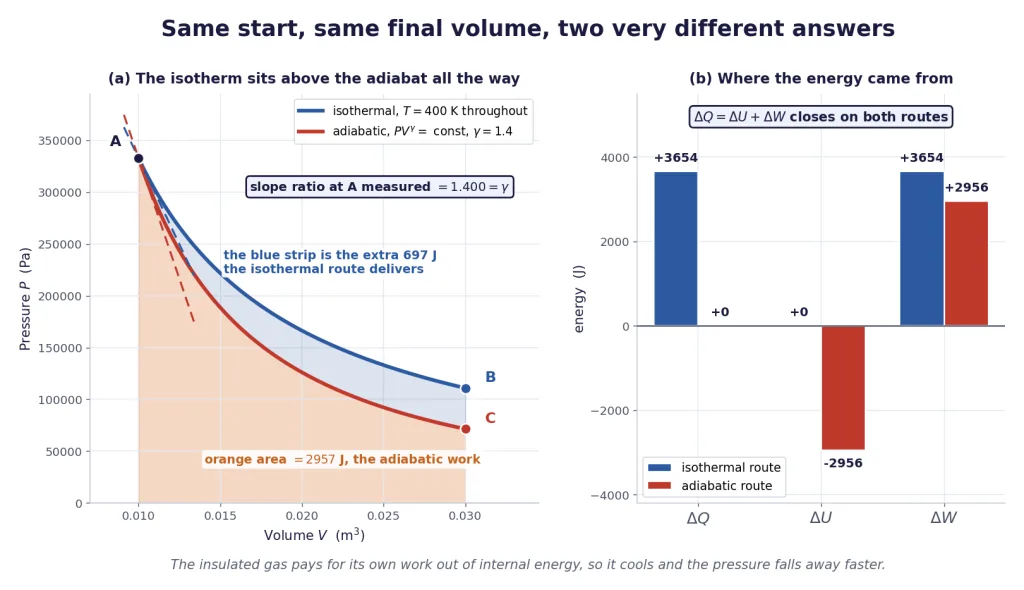
Key Point — the three adiabatic relations, all equivalent: and the work that follows, Pick the form whose variables the question actually gives you. Every temperature in them is absolute.
Example 26: Hydrogen under a pile of sand, squeezed to half
A cylinder fitted with a movable piston contains 3.0 moles of hydrogen at C and 1.0 atmosphere. The walls of the cylinder are heat-insulating, and the piston is insulated too by a deep pile of sand resting on it. The gas is compressed to half its original volume. By what factor does the pressure rise? Find the final temperature and the work done. (Hydrogen is diatomic, ; 1 atm Pa; J/(mol K).)
Solution:
Recognise the process. Insulated walls and an insulated piston mean no heat can cross the boundary: . This is an adiabatic compression. The sand is the standard trick for making it quasi-static as well — grains are added one at a time.
Convert the temperature. K. It appears in a ratio, so it must be absolute.
The pressure factor, from const. So the pressure rises by a factor of , giving Note that it rises by more than the factor of 2 that Boyle's law would give at constant temperature — the extra comes from the gas heating itself up as it is squeezed.
The final temperature, from const. which is C. The gas has warmed by more than 87 degrees with no heat added at all.
The volumes and the work.
State every sign and what it means.
- : no heat crossed the boundary, by construction.
- J: negative, so J of work was done on the gas by the piston and the sand.
- J: positive, so all of that work went straight into the internal energy, which is why the gas heated up.
- Cross-check independently. J/(mol K), so (the 2 J discrepancy is rounding in ).
Final Answer: the pressure rises by a factor of to Pa; K; J and J with .
Takeaway: In an adiabatic compression the pressure rises by , not by . The exponent is the whole difference between an adiabat and an isotherm, and forgetting it is worth a whole question.
Example 27: Compressing argon fivefold in an insulated cylinder
mol of argon, initially at 300 K in a volume of m, is compressed adiabatically and quasi-statically to one-fifth of its volume. Find the final temperature, the pressure ratio and the work done. (Argon is monatomic, ; J/(mol K).)
Solution:
Temperature check. 300 K is already absolute — equivalent to C. Good.
Final temperature, from const with . which is C. Compressing a gas fivefold with no heat escape nearly triples its absolute temperature.
Pressure ratio, from const. Sanity check the two results against each other with the gas law: gives ✓.
The initial pressure and the work.
State every sign. (insulated). J: negative, so J of work is done on the argon. J: positive, and it is exactly the work done on the gas, since no heat could escape. Verify with :
Why argon heats more than hydrogen would. For the same compression ratio the exponent is for a monatomic gas but only for a diatomic one. A monatomic molecule has nowhere to hide energy except in its translation, so all the work done on it shows up as temperature.
Final Answer: K, the pressure rises by a factor of , and J with J.
Takeaway: The bigger the , the more violently an adiabatic compression heats the gas. That is why the working substance in a diesel cylinder matters, and why has to be looked up before the first line of algebra.
Example 28: Why a compressor outlet gets scorching
Air is drawn into a compressor at 1.00 atmosphere and 300 K and compressed adiabatically to 8.00 atmospheres. Find the outlet temperature. (Air is effectively diatomic, .)
Solution:
Choose the relation whose variables you were given. The question gives pressures, not volumes, so use the pressure-temperature form
The exponent.
Substitute. The temperature is already absolute at 300 K. which is C.
Check the exponent has not been inverted. The gas is being compressed, so the temperature must rise; ✓. If your answer had come out below 300 K you would have used or flipped the pressure ratio.
The energy ledger, in words. by assumption. is negative — the compressor does work on the air. is therefore positive and equal in magnitude to that work, and since rises the temperature rises. Per mole, so about kJ of work must be done on every mole compressed.
Why this matters in practice. C is hot enough to break down lubricating oil and to be a burn hazard, which is why industrial compressors have intercoolers between stages. Cooling between stages moves the process back towards isothermal, and an isothermal compression, as Example 23 showed, costs less work for the same pressure ratio.
Final Answer: K, or about C.
Takeaway: Given pressures, use and check the direction of the temperature change before you write the answer down. Compression heats, expansion cools — always.
Example 29: An adiabatic expansion worked from the temperatures alone
Two moles of a diatomic ideal gas expand adiabatically and quasi-statically from 500 K to 350 K. Find the work done by the gas, the change in internal energy, and by what factor the volume and the pressure change. (, J/(mol K).)
Solution:
Both temperatures are absolute ( K C and K C), so they can go straight into the ratios.
The work, from the temperature form.
The internal energy, independently. J/(mol K): These two are equal and opposite, exactly as demands, and that agreement is the check.
The volume ratio, from const.
The pressure ratio, from const. Check against the gas law: ✓.
State every sign. : no heat crossed. J: positive, the gas expanded and did that work on its surroundings. J: negative, and the fall is exactly the work done, because the gas had nowhere else to get the energy from. That is why it cooled by 150 K.
Final Answer: J, J, ; the volume rises by a factor and the pressure falls to of its original value.
Takeaway: When an adiabatic problem gives you both temperatures, use and skip the volumes entirely. Then use as a free check.
Example 30: Which expansion delivers more work, and why
One mole of an ideal diatomic gas at 400 K occupying m is expanded to m, once isothermally and once adiabatically. Find the work done in each case, the final temperature in the adiabatic case, and compare. (, J/(mol K).)
Solution:
The common starting pressure.
The isothermal route. with and therefore J drawn in from the reservoir.
The adiabatic route: find the final temperature first. The gas cools by more than 140 K simply by expanding.
The adiabatic work. with and J.
Compare. The isothermal expansion delivers about 24% more work — a surplus of J — for exactly the same volume swing.
Why, in one sentence. On the isothermal path the reservoir keeps topping the gas up, so its pressure stays high all the way and it pushes hard on the piston the whole time. On the adiabatic path the gas has to pay for its own work out of its internal energy, so it cools, its pressure collapses faster, and it pushes progressively more feebly. The adiabat therefore lies below the isotherm everywhere to the right of the common point, and encloses less area.
The slope statement, made precise. Differentiating the two curves at the common starting point gives so the adiabat is steeper by exactly the factor , here 1.40. Both slopes are negative, so "steeper" means more negative.
The two ledgers.
| Route | (J) | (J) | (J) | Final |
|---|---|---|---|---|
| Isothermal | 400 K | |||
| Adiabatic | K |
Both rows satisfy .
Final Answer: J and J; the adiabatic expansion ends at K and delivers 24% less work.
Takeaway: From the same start to the same final volume, an isothermal expansion always beats an adiabatic one, and the adiabat is steeper by exactly . Sketch both from the same point and the whole comparison becomes obvious.
Example 31: The cylinder that gives away its own gamma
An unknown gas expands adiabatically and quasi-statically from to . Find , identify the type of gas, find the work done, and find the ratio of the final to the initial absolute temperature.
Solution:
Extract from the two points. Along an adiabat , so
Identify. is the monatomic value — helium, neon, argon or one of the other noble gases. A diatomic gas would have given and a polyatomic one about .
The two products, which are the pieces the work formula needs.
The work.
The temperature ratio. Since with fixed, : The absolute temperature falls to a quarter of its starting value. Check it against const: ✓.
State every sign. (adiabatic). J: positive, the gas expanded and did that work on the surroundings. J: negative, the internal energy fell by exactly the work done, which is why the temperature dropped so dramatically. Confirm: J ✓.
Why the number of moles was never needed. Every step used products rather than separately. Whenever a question gives you and at both ends, work in and cancels itself out of the problem.
Final Answer: , so the gas is monatomic; J and J; the absolute temperature falls to one quarter.
Takeaway: Two points on an adiabat determine , and names the type of gas. Take logarithms of both ratios and divide — no moles, no temperatures, no gas constant required.
Part 7: Isobaric, Isochoric, Cyclic Processes and Free Expansion
Five problems on the remaining process types and the loops built from them. Isochoric kills the work term; isobaric makes it trivial; a cycle kills altogether. Free expansion, remarkably, kills all three.
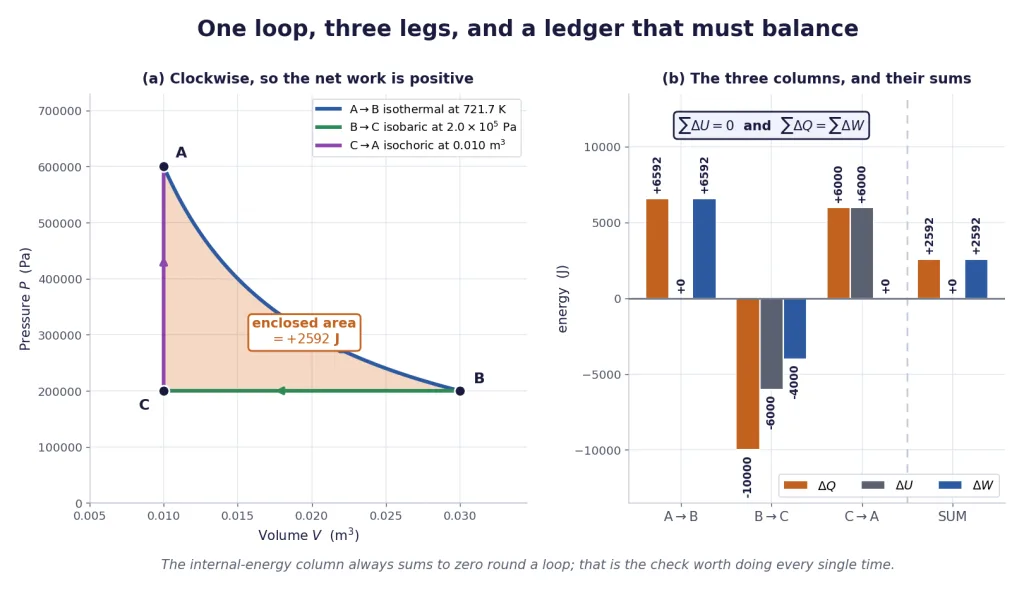
Key Point — the four processes on one line each:
Process Held fixed Path on - Isothermal hyperbola equals Adiabatic steeper hyperbola Isobaric horizontal line Isochoric vertical line equals
Example 32: Nothing moves, so every joule stays inside
A rigid sealed steel bottle of internal volume litres holds mol of helium, initially at 290 K. It is placed on a hotplate and warmed to 480 K. Find the initial and final pressures, the work done, the heat supplied and the change in internal energy. (Helium is monatomic, J/(mol K); J/(mol K).)
Solution:
Name the process. The bottle is rigid and sealed, so throughout. This is an isochoric process. Both temperatures are already absolute ( K C and K C).
The work is zero, and that is a physical statement, not a formality. Nothing moved, so nothing was pushed, so no work was done by or on the gas — no matter how large the pressure grew.
The heat and the internal energy therefore coincide.
The pressures. Convert the volume: L m.
Check the pressure ratio against the temperature ratio. At constant volume — in kelvin. Using instead would have been catastrophically wrong, and this is exactly where students lose the mark.
State every sign. (rigid vessel). J: positive, heat flowed in from the hotplate. J: positive, and equal to the heat, because there was no other route for the energy to take. Every joule supplied stayed inside as random molecular energy.
Final Answer: Pa, Pa, , and J.
Takeaway: Rigid vessel means means . Spot the word "rigid" or "sealed steel" and one whole term of the first law disappears before you start.
Example 33: A weighted piston rising, joule by joule
moles of a diatomic ideal gas is held at a constant pressure of Pa by a freely moving weighted piston. It is heated from 300 K to 420 K. Find the initial and final volumes, the work done, the change in internal energy and the heat supplied. ( J/(mol K).)
Solution:
Name the process. A freely moving piston with a fixed weight on it holds the pressure constant: this is isobaric. For a diatomic gas and J/(mol K).
The two volumes. Both temperatures are absolute already. so m, about 6.0 litres.
The work, two equivalent ways. The second form is faster and never needs the volumes at all.
The internal energy and the heat.
Check the first law closes.
State every sign. J: heat into the gas. J: internal energy up, gas hotter. J: positive, the gas expanded and lifted the weighted piston, doing work against gravity and the atmosphere. The fraction spent on work is , the standard for a diatomic gas.
Final Answer: L, L, J, J, J.
Takeaway: At constant pressure use and skip the volumes. It is the same answer as with two fewer opportunities to drop a power of ten.
Example 34: One isotherm, one isobar, one isochor — the whole ledger
One mole of a monatomic ideal gas is taken round the following closed cycle:
- : isothermal expansion from to ;
- : isobaric compression at Pa back to m;
- : isochoric heating at m back to the start.
Tabulate , and for each leg, check the column sums, and find the efficiency if the loop is run as an engine. ( J/(mol K); J/(mol K).)
Solution:
Temperatures at the three corners, from . confirms that really can be isothermal — both states have the same product , which is the test.
Leg , isothermal at K. (Note the neat shortcut: J, so no separate multiplication is needed.)
Leg , isobaric at Pa.
Leg , isochoric at m.
The ledger.
| Leg | Process | (J) | (J) | (J) |
|---|---|---|---|---|
| isothermal expansion | ||||
| isobaric compression | ||||
| isochoric heating | ||||
| Sum |
- Run the two compulsory checks.
- ✓. It must be zero, because is a state function and the gas came home.
- J ✓, which follows immediately from the first.
If either check fails, a leg is wrong, and it is far quicker to find the error here than to keep going.
The net work, and the sense of the loop. J is positive, so the gas does net work on its surroundings and the loop is traced clockwise. That number is also the area enclosed by the loop on the - diagram.
Efficiency as an engine. Heat is absorbed on and , and rejected on : Check with the other form: ✓.
The sanity check that must never be skipped. The hottest point in the cycle is K and the coldest is K, so no engine running between these extremes can beat Our is comfortably below it, so the answer is physically legal. An efficiency above the ceiling would mean an arithmetic error, not a discovery.
Final Answer: the ledger above; J with , and .
Takeaway: Tabulate the cycle leg by leg and check that the column sums to zero before you quote anything. That one check catches almost every mistake a cycle problem can generate.
Example 35: The stopcock experiment — gas rushing into a vacuum
Two rigid cylinders and of equal capacity are joined by a stopcock. contains one mole of an ideal gas at C and 1.0 atmosphere; is completely evacuated. The whole assembly is thermally insulated. The stopcock is opened suddenly. Find (a) the final pressure, (b) the change in internal energy, (c) the change in temperature, and (d) say whether the intermediate states can be drawn on a - diagram.
Solution:
The work is zero — and the reason matters. The gas expands into a vacuum. There is no piston, no atmosphere, nothing at all on the far side to push against. Since and the external pressure is zero, This is not the isochoric argument. The gas's own volume certainly changes; what is absent is anything for it to do work on.
The heat is zero. The assembly is thermally insulated, so .
Hence the internal energy is unchanged.
And therefore the temperature is unchanged. For an ideal gas depends on temperature alone, so forces The gas ends at exactly the temperature it started at. (A real gas, with attractive intermolecular forces, would cool slightly — that is the Joule-Thomson effect, and it is the one place where the ideal-gas idealisation shows.)
The final pressure. The volume available has doubled and the temperature is unchanged, so by , For the record, m L, the familiar molar volume at standard temperature and pressure, and the gas ends up in L.
(d) The intermediate states. During the rush, the gas is turbulent and nowhere near equilibrium: different parts of it are at different pressures and different temperatures, so there is no single and no single to plot. The intermediate states therefore do not lie on the surface , and the process cannot be drawn as a curve on a - diagram. Only the initial and final points can be marked; the route between them is undrawable.
State every sign, and the one that surprises people. , , — all three vanish, and yet something obviously and irreversibly happened. The gas will never spontaneously gather itself back into cylinder . Free expansion is the cleanest example in the syllabus of a process that the first law permits completely and the second law forbids in reverse. Its entropy increases even though its energy does not change.
Final Answer: (a) Pa, i.e. half an atmosphere; (b) ; (c) , the gas stays at K; (d) no — the intermediate states are not equilibrium states and cannot be plotted.
Takeaway: Free expansion: because there is nothing to push, because it is insulated, so and the temperature does not move. And it is still violently irreversible, which is the whole point of the example.
Example 36: A nitrogen cylinder left in the sun
A rigid -litre cylinder of nitrogen stands at C with an absolute pressure of Pa. It is left in the sun and its temperature rises to C. Find the number of moles, the new pressure, and the heat absorbed. (Nitrogen is diatomic, J/(mol K); J/(mol K).)
Solution:
Convert both temperatures, because they enter a ratio.
Moles, from the initial state. Volume L m.
New pressure, at constant volume. a rise of about Pa, or 10.0%.
The trap, shown explicitly. Using Celsius would have given and a predicted pressure of Pa — more than double, and wrong by a factor of nearly two. A thirty-degree rise near room temperature is a ten per cent rise in absolute temperature, not a hundred per cent one.
The heat absorbed. Rigid cylinder, so and
State every sign. : the steel wall never moved. kJ: positive, heat flowed in from the sunlight and the warm air. kJ: positive, all of it stored as internal energy, which is what shows up as the higher pressure on the gauge.
Why this is a real safety calculation. Compressed-gas cylinders carry a stamped maximum working pressure, and the ten per cent headroom eaten by a warm afternoon is exactly why they are stored in the shade. The physics is nothing more than at constant volume, done in kelvin.
Final Answer: mol, Pa (a rise of 10.0%), and kJ with .
Takeaway: A modest Celsius rise is a tiny fractional rise in kelvin. Convert first, then take the ratio — in that order, every single time.
Part 8: Where Thermodynamics Meets Calorimetry
Three problems that reach back into the previous chapter. The first law is the same law that governs a geyser, a bucket of mixed liquids and a car tyre — and these are exactly the questions Boards like to set, because they look like everyday life and test the physics honestly.
Key Point: For a liquid or a solid at ordinary pressures the volume barely changes, so and the first law reduces to . That is why calorimetry never mentions work — the work term is genuinely negligible, not forgotten.
Example 37: Sizing the gas bill for a geyser
A gas geyser heats water flowing at litres per minute from C to C. The burner's fuel has a heat of combustion of J per gram. Assuming all the heat released reaches the water, find the heating power and the rate at which fuel is consumed. (Specific heat capacity of water is 4186 J/(kg K); density of water 1000 kg/m.)
Solution:
Turn the flow rate into a mass rate. One litre of water has a mass of kg, so
The temperature rise. Only a difference appears here, so Celsius and kelvin give the same number: (For the record, C K and C K, and their difference is 50 K.) No conversion is needed for a difference — but if the problem had asked for a ratio, it would have been compulsory.
Heat required per minute.
As a power. which is a realistic rating for a domestic instant gas geyser.
Fuel consumption. or about kg per hour of continuous running.
Signs, and what has been assumed. From the water's point of view J per minute (heat into the water) and , so J per minute — the water's internal energy rises and it comes out hot. The assumption that all the combustion heat reaches the water is generous; a real geyser sends a good fraction up the flue, so the true fuel consumption is higher. Quote the assumption in the exam and you keep the mark.
Final Answer: the geyser must deliver about kW, consuming fuel at grams per minute.
Takeaway: Work in "per minute" throughout and only divide by 60 at the very end if a power is wanted. Mixing per-second and per-minute quantities halfway through is how these problems go wrong.
Example 38: The mixture that refuses to settle at the mean
kg of water at C is mixed with kg of an oil at C in a well-insulated vessel. The specific heat capacity of the oil is 2000 J/(kg K) and that of water is 4186 J/(kg K). Find the final temperature and explain why it is not the average of C and C.
Solution:
The governing statement. The vessel is insulated, so no heat leaves the system, and no work is done. Energy conservation therefore reads
Set it up with signs, letting be the common final Celsius temperature.
Solve.
Check the ledger. They cancel exactly, as they must. Negative for the water means heat left it; positive for the oil means heat entered it.
Why not C? The naive average C would be right only if the two bodies had equal heat capacities. Here the relevant quantities are the products : the water has J/K, the oil has J/K. The oil's heat capacity is larger, so the final temperature is dragged towards the oil's starting temperature, and lands below the midpoint at C.
The general rule, worth stating. The final temperature is the heat-capacity-weighted average: Two bodies settle at the plain mean only in the special case . Notice also that only temperature differences appear here, so Celsius is perfectly legal throughout — this is one of the few places in the chapter where kelvin is not required.
The related everyday fact. This is why a coolant in a chemical or nuclear plant is chosen to have a high specific heat capacity: for a given mass and a given quantity of heat absorbed, a large means a small , so the coolant carries away more heat without itself getting dangerously hot. Water, with J/(kg K), is the cheapest good coolant there is.
Final Answer: the mixture settles at C, below the arithmetic mean of C, because the oil has the larger heat capacity .
Takeaway: Two bodies in contact settle at the heat-capacity-weighted mean, not the plain mean. The plain mean is a special case, not a rule.
Example 39: Three everyday questions the first law answers
Explain, using the ideas of this chapter: (a) why the air pressure in a car tyre rises during a long drive; (b) why a harbour town has a more temperate climate than a desert town at the same latitude; and (c) for the tyre, estimate the new gauge pressure if a tyre inflated to a gauge pressure of Pa at C warms to C. (Take 1 atm Pa.)
Solution:
(a) The tyre. Two effects combine, and both raise the temperature of the enclosed air. First, the tyre wall flexes continuously as it rolls, and rubber is not perfectly elastic, so some of that flexing energy is dissipated as heat. Second, there is friction between the tread and the road. Both deliver energy to the air inside, and the tyre's volume is very nearly fixed, so The temperature rises, and at almost constant volume in kelvin, so the pressure rises with it. This is exactly why tyre pressures are specified "cold".
(c) Put numbers on it. Gauge pressure is the excess over atmospheric, so the absolute pressure is what obeys the gas law: Convert both temperatures, because they enter a ratio: Back to gauge: a rise of about Pa, roughly 9.7% of the original gauge reading. Two traps live in this calculation: forgetting to convert gauge to absolute, and forgetting to convert Celsius to kelvin. Either one alone gives a badly wrong answer.
(b) The harbour town. The sea has an enormous mass of water with a very high specific heat capacity, 4186 J/(kg K), roughly four to five times that of dry sand or rock. A given amount of solar heating therefore produces a much smaller temperature change in the sea than in desert ground: Large and large together make small. On top of that, water near a coast evaporates, and evaporation carries away latent heat, capping the daytime rise; and the sea mixes by convection, spreading absorbed heat through a deep layer instead of concentrating it in a thin surface skin. The desert has none of these: low , no evaporation, no mixing, so it roasts by day and freezes by night. The sea acts as a giant thermal buffer, and the harbour town lives inside it.
The single idea underneath all three. In every case the volume is essentially fixed, so and the first law reduces to . Whether that heat produces a big or a small temperature change is then decided entirely by the heat capacity of whatever is absorbing it.
Final Answer: (a) flexing and friction heat the enclosed air at nearly constant volume, and in kelvin; (b) the sea's large mass and high specific heat, helped by evaporation and mixing, buffer the temperature swings; (c) the gauge pressure rises from Pa to about Pa.
Takeaway: Gauge plus atmospheric equals absolute, and only absolute pressure obeys the gas law. Convert the pressure and the temperature before you take any ratio.
Part 9: Engines, Refrigerators, Heat Pumps and the Carnot Ceiling
Six finishers. Every one of them needs at least two ideas joined together, and every one of them ends with the check that decides whether the answer is even legal: no engine may beat , and no refrigerator may beat .
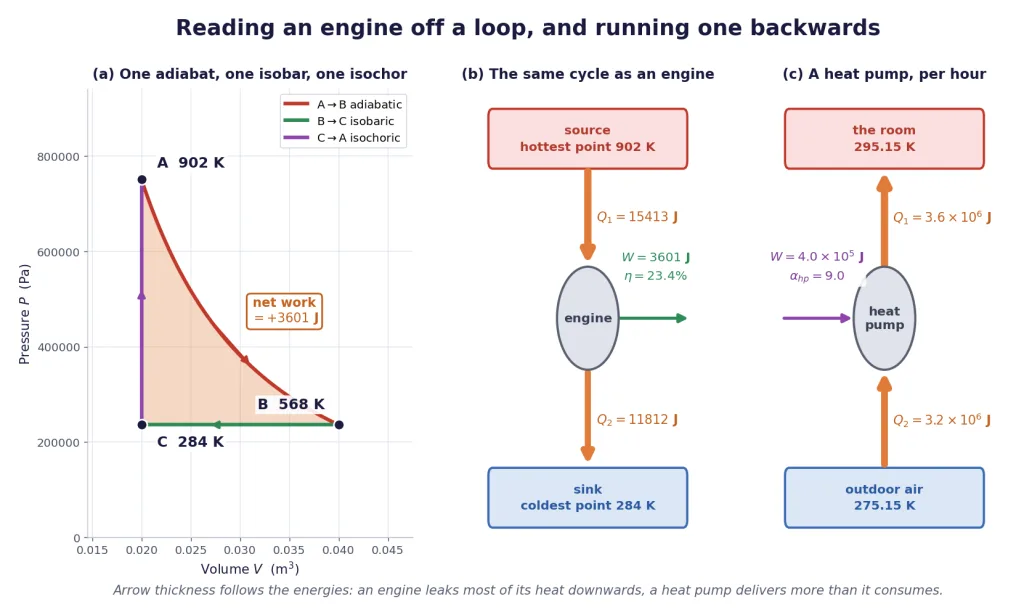
Key Point: is the source (hot) and is the sink (cold), always. is drawn from the source and rejected to the sink, and over a cycle exactly, because . Then
Example 40: An engine cycle read straight off the diagram
Two moles of a monatomic ideal gas are taken round the cycle:
- : adiabatic expansion from to a volume of m;
- : isobaric compression back to m;
- : isochoric heating back to the start.
Find the pressure at , the three corner temperatures, the leg-by-leg ledger, the net work and the efficiency, and check the result against the Carnot ceiling. (, J/(mol K), J/(mol K).)
Solution:
Pressure at , from const.
The three corner temperatures, from with J/K.
Leg , adiabatic. , and
Leg , isobaric compression.
Leg , isochoric heating.
The ledger.
| Leg | Process | (J) | (J) | (J) |
|---|---|---|---|---|
| adiabatic expansion | ||||
| isobaric compression | ||||
| isochoric heating | ||||
| Sum |
The compulsory checks. ✓, and J ✓.
Efficiency. Heat is taken in only on , and rejected only on :
Against the ceiling. The hottest and coldest temperatures anywhere in the cycle are K and K, both absolute, so Our is well under it — legal. If a cycle ever computes to an efficiency above this ceiling, the arithmetic is wrong; it is never a discovery.
Signs, summarised. The gas does net positive work of J per cycle on its surroundings, the loop runs clockwise, and the net work equals the area enclosed. It is an engine.
Final Answer: Pa; the ledger above; J and , comfortably below the Carnot ceiling.
Takeaway: is the sum of the heats on the legs where heat goes IN, not the biggest number in the table. Sort the legs by the sign of first, then compute the efficiency.
Example 41: Two refrigerators, one electricity bill
Two refrigerators must each remove J of heat from their cold chambers per day. Model has a coefficient of performance of ; model has . Find the electrical work each consumes per day, the heat each dumps into the kitchen, and what the better model saves over a year at Rs 8 per kilowatt-hour.
Solution:
The defining relation. For a refrigerator, where is the heat removed from the cold space and is the work supplied.
Work per day.
Heat dumped into the kitchen. Over a cycle , so everything that goes in must come out: Both dump more heat into the kitchen than they remove from the food — which is exactly why a refrigerator warms the room it stands in.
The saving. Convert to kilowatt-hours, remembering kWh J:
State every sign, from the refrigerator's point of view. Over one cycle . , which is negative — the working substance rejects more heat than it absorbs. , also negative, meaning work is done on the working substance by the compressor. For model , J per day and J per day.
As heat pumps. The same two machines, valued for what they deliver to the warm side instead, would have Check directly: ✓.
The point about that must be said out loud. Both coefficients exceed 1, and neither is an efficiency. Nothing is being converted from one form into another — heat is being moved, and moving it costs much less than creating it. Calling "450% efficient" is meaningless.
Final Answer: J/day and J/day; they dump and J/day respectively; the better model saves about kWh, or Rs 176, a year.
Takeaway: and are the only two equations a refrigerator problem ever needs. Everything else is arithmetic and unit conversion.
Example 42: A heat pump measured against its own Carnot ceiling
A heat pump keeps a room at C while the outside air is at C. Each hour it delivers J of heat to the room while consuming J of electrical energy. Find its coefficient of performance as a heat pump and as a refrigerator, the heat drawn from the outside air, the maximum coefficient of performance allowed by the second law, and compare with a plain electric heater.
Solution:
Convert both temperatures — they will enter a ratio.
The heat-pump coefficient of performance is the heat delivered divided by the work paid for:
The heat drawn from outside, by energy conservation over a cycle: so the same machine viewed as a refrigerator has and indeed exactly, as it must, since .
The second-law ceiling. The best possible machine between these two reservoirs is a reversed Carnot engine, for which , giving Our machine achieves out of a possible , that is 61% of its own ceiling — good but not miraculous, and crucially not a violation. Had the quoted numbers given , the claim would have been impossible.
Against an electric heater. A resistive heater converts electrical energy to heat one for one, so delivering J to the room would need J of electricity — nine times as much as the heat pump uses. The heat pump is not creating energy out of nothing; it is moving J of energy that was already sitting in the cold outside air, and paying only for the pumping.
State every sign, from the working substance's point of view. Over a cycle . J per hour: negative, work is done on the working substance by the compressor. J per hour: negative, the substance rejects more heat than it absorbs, which is exactly the point of the machine.
Why the ceiling gets worse in a cold winter. collapses as the outside gets colder. Drop the outdoor air to C, or K, and the ceiling falls from to . That is the real engineering limit on heat pumps in cold climates — not that they stop working, but that they get progressively less spectacular.
Final Answer: and , drawing J per hour from outside; the Carnot ceilings are and , so the machine reaches 61% of the maximum; an electric heater would use nine times the electricity.
Takeaway: A heat pump beats a heater because it moves heat instead of making it, and always. Check every quoted coefficient against before you believe it.
Example 43: Getting to sixty per cent — what the reservoirs must be
An engineer wants a Carnot engine of efficiency 60%. (a) If the sink is the local river at C, what must the source temperature be? (b) If instead the source is fixed at 600 K by the available boiler, what would the sink have to be? (c) Starting from a source at 600 K and a sink at 300 K, compare raising the source by 100 K with lowering the sink by 100 K.
Solution:
The formula, and the kelvin rule. Both temperatures are absolute, always. This formula is meaningless in Celsius.
(a) Sink fixed. K. A demanding but achievable boiler temperature — real supercritical power plants run near this.
(b) Source fixed at 600 K. This is the impractical option. Maintaining a sink at C would need a refrigerator, and running that refrigerator would consume more work than the extra efficiency delivers. The sink of a real engine is the environment, and you do not get to choose it.
(c) The 100 K comparison, from a base of 600 K and 300 K. The base efficiency is Raise the source to 700 K: Lower the sink to 200 K:
Why lowering the sink wins mathematically. Differentiate: Per kelvin, the sink is twice as effective here. And yet in practice engineers raise the source, because the sink is a river, the sea or the atmosphere and cannot be lowered for free, while a hotter boiler is merely an engineering problem. Both halves of that sentence are needed for full marks.
Final Answer: (a) K, or C; (b) K, or C, which is impractical; (c) lowering the sink by 100 K gains points against points for raising the source, but only the source can actually be changed.
Takeaway: Rearranging is easy; the marks are in knowing which temperature you are allowed to move. The sink is the environment and it is not yours to choose.
Example 44: Three claims, one ceiling
Three inventors bring claims. Engine works between 500 K and 300 K and is claimed to be 45% efficient. Engine works between 800 K and 320 K and is claimed to be 55% efficient. Engine works between 400 K and 300 K and is claimed to be exactly 25% efficient. Assess each.
Solution:
The test. Carnot's theorem says that no engine working between two given temperatures can be more efficient than a reversible engine between the same two, and every reversible engine between them has the same efficiency . So compute the ceiling and compare. All temperatures are already absolute.
Engine . The claim of 45% exceeds the ceiling. Impossible. Coupling this engine to a reversed Carnot engine between the same reservoirs would produce a net transfer of heat from cold to hot with no other change, violating the Clausius statement, and equivalently a net conversion of heat into work with no other change, violating the Kelvin-Planck statement.
Engine . The claim of 55% is below the ceiling. Possible — it is a good real engine, running at of the theoretical limit, which would be exceptional in practice but breaks no law.
Engine . The claim of exactly 25% equals the ceiling. This is legal only if the engine is perfectly reversible — every process quasi-static, no friction, no turbulence, no finite temperature difference anywhere in the heat transfer. Since no real machine is, the honest verdict is: theoretically permitted, practically unattainable.
Summary table.
| Engine | (K) | (K) | Carnot ceiling | Claim | Verdict |
|---|---|---|---|---|---|
| 500 | 300 | impossible | |||
| 800 | 320 | possible | |||
| 400 | 300 | only if perfectly reversible |
- The two habits worth carrying out of this. First, always convert to kelvin before taking the ratio — a Celsius version of engine would have given and passed a claim that is actually impossible. Second, the ceiling depends on nothing but the two temperatures: not the working substance, not the design, not the size of the machine. An inventor who says "but my engine uses a special fluid" has already lost the argument.
Final Answer: is impossible; is possible; is possible only in the ideal reversible limit and therefore not achievable in practice.
Takeaway: Compute first and compare second. Any claim above that line is refuted by the second law without a single detail of the machine being examined.
Example 45: The post-mortem on a real engine
A diesel engine burns fuel at an effective combustion temperature of 1800 K and exhausts at 600 K, and its measured thermal efficiency is 40%. Find the Carnot ceiling, split the shortfall into the part the second law demands and the part the engineers are responsible for, and account for every joule of 1000 J of fuel heat.
Solution:
The ceiling. Both temperatures are absolute.
The two shortfalls, and they are quite different in kind. The engine reaches of its own theoretical ceiling.
Account for 1000 J of fuel heat.
| Destination | Energy (J) | Why |
|---|---|---|
| Useful work at the crankshaft | the measured 40% | |
| Lost to irreversibility in this engine | friction, turbulence, fast combustion, heat leakage | |
| Necessarily rejected to the exhaust | demanded by the second law, whatever the design | |
| Total | first law: nothing is missing |
Why the third row can never be removed. Eliminating it would mean and , an engine whose sole result is the complete conversion of heat into work. That is precisely what the Kelvin-Planck statement forbids. A perfect engine is not merely difficult to build; it is inconsistent with the second law. And the ceiling would only reach 1 if the sink were at absolute zero, which is itself unattainable.
Why the second row can be attacked. These are irreversibilities: friction between piston and cylinder, turbulence in the intake and exhaust, combustion that happens far too fast to be quasi-static, and heat leaking through the cylinder walls into the coolant instead of into the piston. Each is an engineering problem — better lubricants, better port design, better insulation, higher compression — and each yields, slowly, to money and effort. Turbocharging, direct injection and thermal barrier coatings are all attacks on this row.
The honest reading of a real engine's specification. When a manufacturer quotes 40%, the right question is not "why not 100%?" — that question was answered in 1851 — but "how close to 66.7% can this design be pushed?" The answer is currently around 45% for the best large marine diesels, and every point is hard won.
Signs, per cycle. over a cycle. J per 1000 J of fuel heat, and J: positive, work done by the working substance on the piston. J absorbed, J rejected, and J ✓.
Final Answer: the Carnot ceiling is ; of every 1000 J of fuel heat, 400 J becomes work, 267 J is lost to avoidable irreversibility and 333 J must be rejected no matter what. The engine achieves 60% of its own ceiling.
Takeaway: A real engine falls short for two independent reasons — the second law's ceiling, which is permanent, and its own irreversibilities, which are not. Any answer that names only one of them is half an answer.