
The First Law Is a Bookkeeper, Not a Policeman
Seven sections in, the first law has been the whole story. Energy is conserved; ; put heat in and it goes partly into internal energy and partly into work. Nothing has been allowed to break that rule.
Now look at what the rule permits.
- Your coffee sits on the table and cools. Nothing forbids the reverse: the room gives up a millionth of a degree, the coffee climbs back to 70°C, and the books balance to the last joule. It has never happened.
- Open a perfume bottle and the scent spreads through the room. Nothing forbids every molecule wandering back into the bottle. It has never happened.
- A cricket ball rolls across the floor and stops, its kinetic energy ending up as internal energy in the ball and the floor. Nothing in the first law forbids the floor cooling slightly and the ball rolling off again by itself. It has never happened.
- Put a hot spoon in cold water and the spoon cools while the water warms. Nothing forbids heat running the other way, making the hot spoon hotter and the cold water colder, with the total energy unchanged. It has never happened.
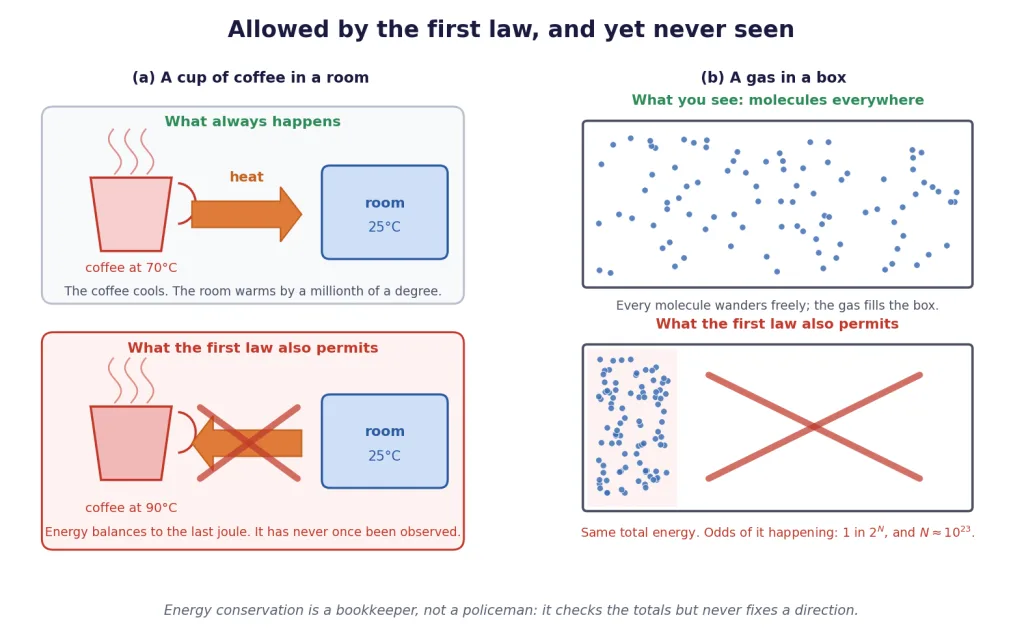
Every one of those reversed processes conserves energy exactly. The first law has nothing whatever to say against them. And yet not one of them has ever been observed, anywhere, by anyone.
Key Point: The first law is an accountant. It checks that the totals match. It does not care which way the money moved.
Something else in nature picks a direction for these processes, and that something is the second law of thermodynamics.
What the second law is for
The second law is not a refinement of the first. It is an independent law, discovered separately, and it does a completely different job: it says which of the energy-conserving processes actually happen.
In this chapter it will earn its keep in two very specific ways:
| The second law says | Which means |
|---|---|
| the efficiency of a heat engine can never be 1 | you can never turn a tankful of petrol wholly into motion |
| the coefficient of performance of a refrigerator can never be infinite | cooling always costs work, and Section 10 says how much |
Both of those are results, not definitions. They fall out of two short sentences, one written down by Kelvin and Planck and one by Clausius, and the next two blocks give them in full.
One Warning
Students often summarise the second law as "energy always spreads out" or "things get messier". Those are useful pictures and they are not wrong, but they are not the law, and they will not earn a mark. The examinable second law is the two statements, word for word. Learn them exactly. The pictures come afterwards, in the last block of this section.
The Kelvin-Planck Statement: No Perfect Engine
Here it is, in full, and it is worth learning by heart.
Key Point — the Kelvin-Planck statement of the second law:
No process is possible whose sole result is the absorption of heat from a reservoir and the complete conversion of that heat into work.
Read it slowly. It does not say heat cannot become work — of course it can, that is what every engine on earth does. It says heat cannot become work and nothing else.
What it forbids: the perfect engine
Imagine a machine that sits beside the sea, draws heat out of the water, turns all of it into work, and gives nothing back. The ocean cools by a thousandth of a degree and a ship crosses the Atlantic. Energy is perfectly conserved. No law of mechanics is broken. Such a device is called a perfect heat engine, or a perpetual motion machine of the second kind, and the Kelvin-Planck statement says flatly that it cannot be built.
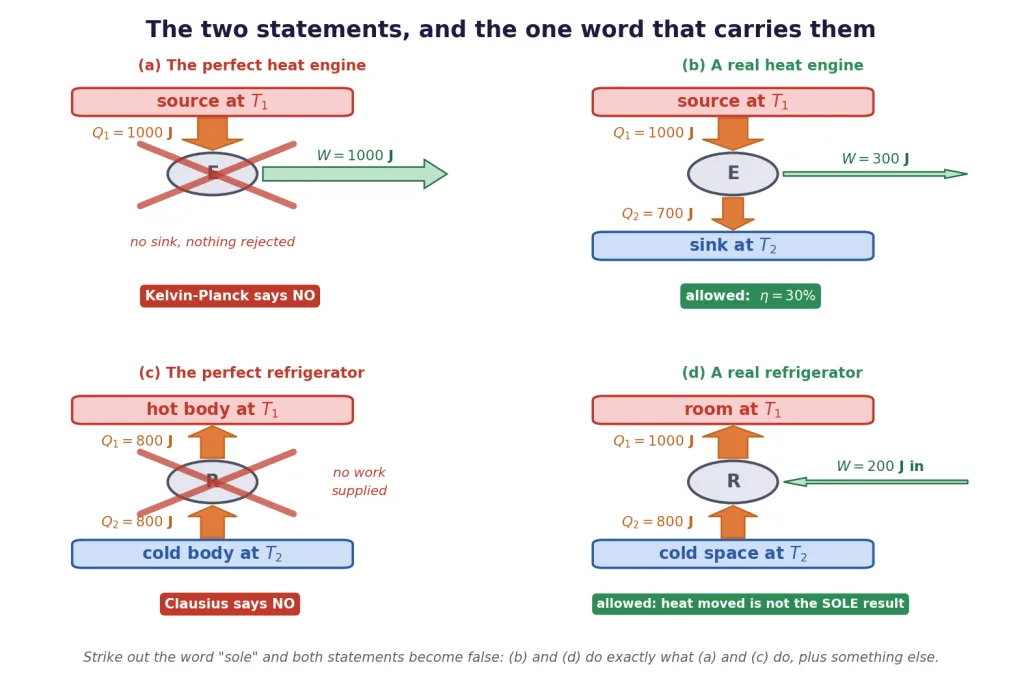
Notice what a perfect engine is not. It is not a machine that creates energy out of nothing — that would break the first law, and is called a perpetual motion machine of the first kind. A perfect engine obeys the first law impeccably. It fails on a completely different count.
Key Point: Two machines, two different laws.
- PMM of the first kind — produces work from nothing. Forbidden by the first law.
- PMM of the second kind — produces work from heat drawn from a single reservoir, with no waste. Obeys the first law; forbidden by the second.
An exam question that asks "which law does this device violate?" is almost always asking you to tell these two apart. Check energy conservation first. If the totals balance, the objection is the second law.
The word "sole" is doing all the work
Here is the sentence everybody misreads, and the single most valuable paragraph in this section.
Take an ideal gas at 300 K and let it expand isothermally and quasi-statically. Its temperature never changes, so , so the first law gives
Every joule of heat that came in left as work. A hundred per cent conversion of heat into work — and it does not violate Kelvin-Planck at all.
Why not? Because that was not the sole result. Something else changed: the gas ended up expanded. Its volume is larger, its pressure lower; the system is not in the state it started in. To use the same gas again you must first compress it, and compressing it costs work.
Key Point: Kelvin-Planck does not forbid converting heat into work. It forbids converting heat into work with no other change left behind.
The way to leave no other change is to make the working substance return to its starting state — that is, to run in a cycle. So the statement really says: no engine running in a cycle can take heat from one reservoir and turn all of it into work. Some heat must be rejected, to a colder body, every single cycle.
What follows immediately
Since a cyclic engine must reject some heat to a sink, the work it gets out of is at most , and its efficiency is strictly less than 1 for every engine that has ever been built or ever will be. Section 9 develops that properly. What matters here is that is not an engineering limitation to be designed away. It is a law of nature.
[Board Important] "State the Kelvin-Planck statement of the second law of thermodynamics" is a standard two-mark question. Write the sentence exactly, keep the word sole, and add one line: it forbids a perfect heat engine, an engine with efficiency 1.
The Clausius Statement: No Perfect Refrigerator
The second statement looks completely unrelated. It is not.
Key Point — the Clausius statement of the second law:
No process is possible whose sole result is the transfer of heat from a colder object to a hotter object.
Again, read it slowly. It does not say heat cannot go from cold to hot. Every refrigerator in every kitchen in India moves heat from a cold space into a warmer room, all day, every day. It says heat cannot go from cold to hot and nothing else.
What it forbids: the perfect refrigerator
A perfect refrigerator would take heat out of a cold body, deliver exactly to a hot body, and require no work at all — a cooling machine you never plug in. Energy conservation is untouched: the same joules that left the cold body arrive at the hot one. Clausius says it cannot be built.
Why your fridge does not violate it
This is the question examiners love, and the answer is one word.
Your refrigerator takes heat out of the cold space, but it also has work done on it by the compressor, and it rejects to the room through the coils at the back. Heat did go from cold to hot — but that was not the sole result. Electrical energy was consumed and turned into internal energy of the room. The universe is left different in a second way, and the statement is satisfied.
Key Point: Strike out the word "sole" and both statements become false, because real engines and real refrigerators do exactly what the statements describe, plus something else. The word "sole" is not decoration. It is the entire content of both sentences.
Here is the same idea as a table, and it is worth copying into your notes.
| Device | Does it move heat cold to hot, or make work from heat? | What else changes? | Verdict |
|---|---|---|---|
| Perfect engine | turns wholly into | nothing | forbidden by Kelvin-Planck |
| Real engine | turns part of into | is dumped in the sink | allowed |
| Perfect refrigerator | moves from cold to hot | nothing | forbidden by Clausius |
| Real refrigerator | moves from cold to hot | work is consumed | allowed |
What follows immediately
Since work must always be supplied, the coefficient of performance can never be infinite — you can never get cooling for free. Note carefully that is not an efficiency and is routinely bigger than 1; Section 10 makes that precise. All the second law says here is that can never be zero.
[NEET Important] The commonest single-line question on this topic is: "Does a refrigerator violate the second law?" The full-mark answer is: no — heat is transferred from cold to hot, but external work is supplied, so that transfer is not the sole result. Say "sole" and you are done.
Why the Two Statements Are One Statement
One sentence is about engines. The other is about refrigerators. They sound like different laws. They are not: each one implies the other, so if you could break one you could break both. That is what "completely equivalent" means, and here is the argument in the direction that is easiest to see.
Break Clausius, and Kelvin-Planck falls with it
Suppose somebody hands you a Clausius violator: a device C that quietly carries 600 J from a cold reservoir at up to a hot reservoir at , using no work at all.
Now do something innocent. Beside it, run a perfectly ordinary, perfectly legal heat engine E between the same two reservoirs — say one that takes 1000 J from the hot reservoir, delivers 400 J of work and rejects 600 J to the cold one. Its efficiency is 40%. The two reservoir temperatures are ours to choose, so choose them generously — K and K, say, where Section 11 will show the ceiling is 50%. Then E at 40% sits comfortably below that ceiling, which makes it an ordinary irreversible engine, the everyday kind. There is nothing suspicious about E at all.
Choose the sizes so that E rejects exactly the 600 J that C carries back up. Now stand back and look at the pair as a single machine.
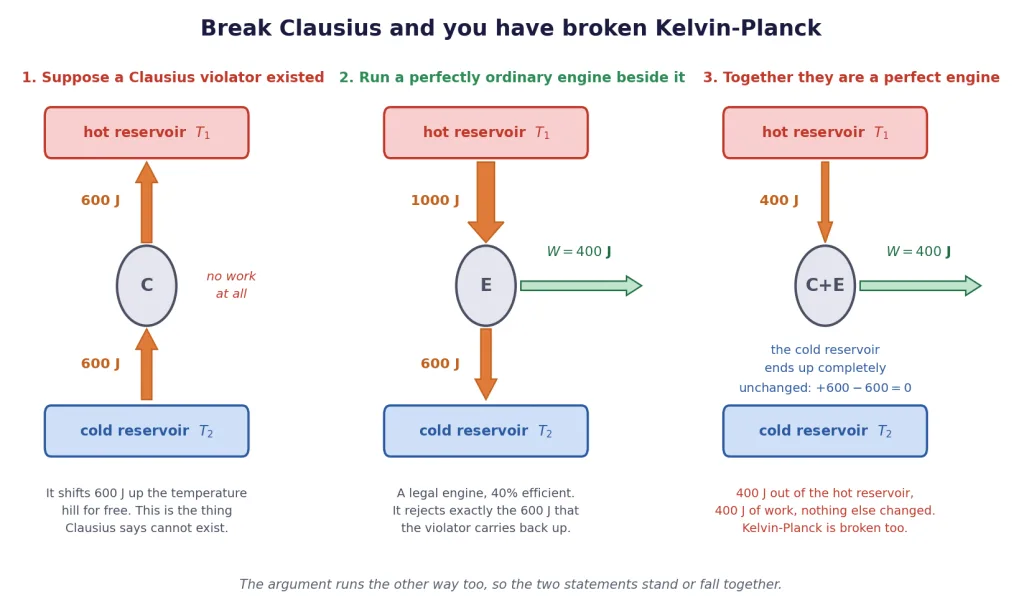
Add the two ledgers:
| Reservoir | Device C | Engine E | Combined |
|---|---|---|---|
| hot, at | gains 600 J | loses 1000 J | loses 400 J |
| cold, at | loses 600 J | gains 600 J | unchanged |
| work out | none | 400 J | 400 J |
The cold reservoir ends every cycle exactly as it began. Nothing else in the universe has changed. So the combined machine has done just one thing: taken 400 J out of a single reservoir and turned all of it into work. That is a perfect heat engine, and Kelvin-Planck forbids it.
So a Clausius violator lets you build a Kelvin-Planck violator. If Kelvin-Planck is true, Clausius must be true.
And the argument runs the other way
Start instead with a Kelvin-Planck violator: a device that takes 400 J from the hot reservoir and turns all of it into 400 J of work, leaving nothing else changed. Feed that work into an ordinary refrigerator running between the same two reservoirs. The refrigerator uses the 400 J to lift, say, 600 J out of the cold reservoir and deliver 1000 J to the hot one.
Combined: the hot reservoir gives up 400 J and receives 1000 J, so it gains 600 J; the cold reservoir loses 600 J; and no work has been supplied from outside, because the work the refrigerator needed came from the violator. Net result: 600 J moved from cold to hot with no other change. That is a Clausius violator.
Key Point: Break either statement and you can build a machine that breaks the other. So the two statements stand or fall together — they are two faces of one law, and it is a matter of taste which you call "the" second law.
[JEE Tip] This coupling trick — run a suspect device alongside a legitimate one, add the energy ledgers, and look at what the pair achieves — is the single most reusable argument in thermodynamics. Section 11 uses exactly the same move to prove Carnot's theorem. Learn the method here, where the arithmetic is easy, and the harder proof will cost you nothing.
Reversible Processes: the Ideal Nobody Reaches
The second law is really a statement about direction, so the next question almost asks itself: which processes, if any, can run backwards?
Key Point — a reversible process:
A process taking a system from state to state is reversible if it can be run backwards so that both the system and its surroundings return to their original states, with no other change anywhere else in the universe.If reversing it leaves anything different — a warmer floor, a flatter battery, a mark on the table — the process was irreversible.
The "and the surroundings" clause is the whole difficulty. It is easy to get a system back to where it started: compress the gas you just expanded. The hard part is getting the room back too.
Two conditions, and both are needed
Key Point: A process is reversible only if
- it is quasi-static — carried out so slowly that the system is in equilibrium with its surroundings at every stage, with no finite pressure or temperature difference anywhere; and
- it is free of all dissipative effects — no friction, no viscosity, no electrical resistance, no turbulence.
Fail either one and the process is irreversible. Both, always.
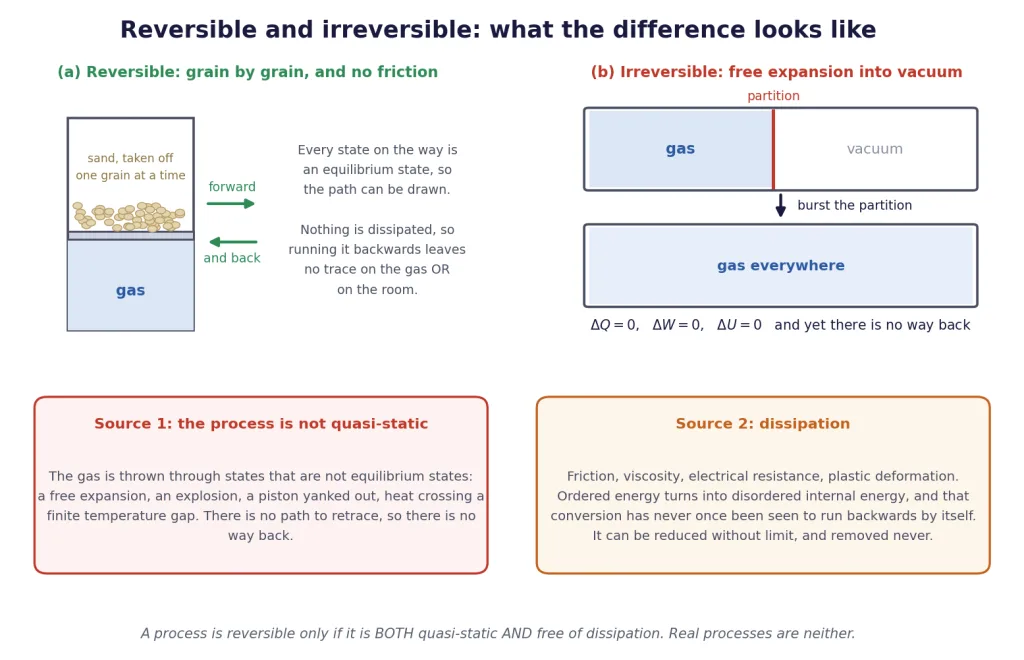
Why quasi-static is needed. A process that is not quasi-static throws the system through states that are not equilibrium states — states with no single well-defined pressure or temperature. Section 5 made the point that such a process cannot even be drawn on a - diagram. A path you cannot draw forwards is a path you cannot retrace backwards.
Why "no dissipation" is needed, separately. Now imagine a piston that moves infinitely slowly, so the gas is in equilibrium at every instant, but the piston rubs against the cylinder. Push it in and out and back to where it started: the gas is fine, but the cylinder wall is warmer, and that warmth came from your muscles. The system returned; the surroundings did not. Quasi-static is not enough on its own.
The picture to keep
The standard image of a reversible expansion is a cylinder of gas held down by a heap of fine sand, one grain at a time. Take off one grain: the pressure drops by a hair, the gas expands by a hair, and the system is never more than a hair from equilibrium. Put the grain back and the gas goes back. Do it grain by grain and the gas can be walked out and walked home along exactly the same sequence of equilibrium states, with the surroundings none the wiser — provided the piston is frictionless.
That is an idealisation and it is honest to say so. No real process is reversible. But some come close: a very slow, well-lubricated compression; a gas expanding against a piston with a temperature difference of a thousandth of a degree; a pendulum in a good vacuum. Reversibility is a limit you approach, like a frictionless plane in mechanics.
Why this idea matters so much here
Because of one result you will prove in Section 11: a reversible engine is the most efficient engine there can be between two given temperatures. Every scrap of irreversibility — every bit of friction, every finite temperature gap, every turbulent eddy — costs efficiency. That is why a chapter about engines has to spend a page on what "reversible" means before it can say anything about how good an engine can get.
[JEE Tip] A favourite trap: "A quasi-static process is always reversible." False. Quasi-static is necessary, not sufficient; a slow process with friction is quasi-static and irreversible. The true statement is the other way round: a reversible process is always quasi-static.
Irreversibility, the Arrow of Time, and a First Look at Entropy
Reversibility is the exception you never quite meet. Irreversibility is everything else.
Key Point — the two sources of irreversibility:
- The process is not quasi-static. The system is driven through non-equilibrium states — a free expansion, an explosion, a piston released suddenly, heat crossing a finite temperature difference.
- Dissipative effects are present. Friction, viscosity, electrical resistance, plastic deformation, turbulence — all of which turn ordered energy into internal energy, and never the other way.
Dissipation can be reduced without limit and eliminated never, so almost every process in nature is irreversible.
The standard examples, and what makes each one irreversible
| Process | Which source? | Why it will not run backwards |
|---|---|---|
| Free expansion of a gas into vacuum | not quasi-static | the gas rushes through states with no defined pressure; getting it back into half the vessel needs work |
| Cooking gas leaking and filling the kitchen | not quasi-static | the molecules will not gather themselves back into the cylinder |
| Petrol and air burning at a spark | not quasi-static | the products will not spontaneously reassemble into petrol and oxygen |
| Stirring a liquid and watching it warm | dissipative (viscosity) | the liquid will not cool and start the paddle turning again |
| A block sliding to a stop | dissipative (friction) | the floor will not cool and push the block off again |
| Heat flowing from a hot spoon to cold water | not quasi-static (finite ) | reversing it would move heat cold to hot with nothing else changed |
| A current heating a resistor | dissipative (resistance) | the resistor will not cool and drive a current backwards |
Look down the last column. Every entry is really the same sentence: the reverse would be a Kelvin-Planck or a Clausius violation. Irreversibility is not a separate fact about the world. It is the second law, seen in everyday clothes.
The arrow of time
Here is something genuinely strange, and worth a minute of your attention.
Every law you have met so far in physics works equally well forwards and backwards. Film a planet orbiting the Sun, or two billiard balls colliding elastically, and run the film in reverse: what you see still obeys Newton's laws exactly. Nothing in mechanics distinguishes past from future.
Now film a cup of tea cooling, or a drop of ink spreading in water, and run that backwards. Everybody in the room knows instantly which way the film should run — and yet no single molecule in the reversed film is doing anything a molecule may not do.
The second law is the only law in Class 11 physics that knows which way time runs. That is why it is unlike everything else in this book.
Entropy, qualitatively
Physics being physics, somebody eventually gave that direction a number. The quantity is called entropy, symbol , and its unit is the joule per kelvin (J/K).
Key Point — entropy, in words:
Entropy is a measure of how much of a system's energy is spread out and unavailable for doing work — equivalently, of how many microscopic arrangements of the molecules correspond to the same large-scale state. Like , entropy is a state function: it depends only on the state, not on how you got there.The second law, in this language: in any process, the total entropy of the system plus its surroundings never decreases. It stays constant for a reversible process and increases for every irreversible one.
Why "how many arrangements"? Take four gas molecules in a box and ask for the chance that all four happen to be in the left half at some instant. Each molecule is on the left half the time, so the chance is — perfectly possible, you would see it now and then. For a hundred molecules it is , about . For one mole it is about 1 in , a number with more zeros in it than the universe has atoms.
Nothing forbids the gas gathering in one corner. It is simply so overwhelmingly unlikely that "never" is the honest word. Spread out is not a law; it is a count. And the count is so lopsided that it behaves exactly like a law.
For a small amount of heat entering a body held at absolute temperature , the entropy change is . You will not be asked to calculate with this in Class 11 and Section 12 uses it nowhere; it is quoted only so that the last example of this section can show you, in numbers, why heat runs downhill and not up.
[JEE Tip] If you are asked in one line what the second law says, the safest full-mark answers are the two statements themselves. "Entropy of the universe never decreases" is correct and elegant, but at this level pair it with Kelvin-Planck or Clausius — examiners mark the named statements.
Solved Examples
Sign convention throughout, as everywhere in this chapter: is positive when heat is added to the system, is positive when work is done by the system, and .
Example 1: A machine that seems too good
An inventor demonstrates a sealed machine that stands in a large tank of water at 500 K. Over each cycle it absorbs 500 J of heat from the water, delivers 500 J of work to a shaft, and returns to its starting state. No other body is involved. Which law of thermodynamics does it violate, and why?
Solution:
Check the first law first. Over a complete cycle the machine returns to its initial state, so and the first law demands . Here is positive, so heat entered the machine; is positive, so the machine did work on the outside. The first law is satisfied exactly, with zero residual. The first law is not the objection.
Now check the second. The sole result of the whole operation is: heat absorbed from a single reservoir, completely converted into work, nothing else changed anywhere. That sentence is word for word the thing the Kelvin-Planck statement forbids.
Name the machine. It is a perfect heat engine, a perpetual motion machine of the second kind. Its efficiency would be and no engine can have .
Final Answer: It obeys the first law perfectly and violates the second law, in its Kelvin-Planck form. It is a perfect heat engine, and it cannot exist.
Takeaway: Always test energy conservation before you accuse a device of anything. If the joules balance, the objection is the second law; if they do not, it is the first. The two rejections have different names and examiners expect the right one.
Example 2: A machine with no plug
A second inventor shows a small box clamped between two metal blocks, one at 250 K and one at 300 K. Per cycle it moves 200 J of heat out of the 250 K block and into the 300 K block. The box has no power supply, no battery, and no moving parts driven from outside. What is wrong with it?
Solution:
Energy balance. 200 J leaves the cold block and 200 J arrives at the hot block. Nothing is created and nothing is destroyed; the residual is exactly zero. The first law is content.
Read the sole result. Heat has moved from a colder object to a hotter object, and that is the only change in the universe — no work was supplied, no substance was left in a different state.
Match it to the statement. That is exactly what the Clausius statement forbids. The box is a perfect refrigerator.
Both temperatures are absolute — 250 K and 300 K, both positive — so the direction "cold to hot" is unambiguous.
Final Answer: It violates the second law, in its Clausius form. It is a perfect refrigerator.
Takeaway: A perfect refrigerator is defined by what it does NOT have: a work input. The moment a device is plugged in, Clausius has nothing to say against it.
Example 3: The refrigerator in your kitchen
A domestic refrigerator removes 300 J of heat from its cold compartment in a certain time and, in the same time, its compressor consumes 100 J of electrical energy. (a) How much heat is delivered to the kitchen? (b) Heat has plainly gone from a colder place to a hotter one. Does this violate the Clausius statement?
Solution:
(a) The fridge works in a cycle, so its working substance ends where it started and for the refrigerant over the cycle. Everything that goes in must come out: So 400 J is delivered to the kitchen through the coils at the back.
Check the ledger. Into the machine: 300 J of heat from the cold space, 100 J of work. Out of the machine: 400 J of heat to the room. Residual zero. Good.
(b) Read the statement carefully. Clausius forbids a process whose sole result is heat moving cold to hot. Here the transfer is not the sole result: 100 J of electrical energy was consumed and ended up as internal energy of the kitchen. A second, quite separate change has been left in the universe.
So there is no violation. Note also the arithmetic: the kitchen gains 400 J while the fridge interior loses only 300 J. The room is warmed by more than the box is cooled — which is why leaving the door open is such a bad idea, as Section 10 explains.
Final Answer: (a) 400 J is rejected to the kitchen. (b) No violation — work was supplied, so the cold-to-hot transfer is not the sole result.
Takeaway: for every refrigerator, always. Write that line first and the rest of the question usually answers itself.
Example 4: A hundred per cent conversion that is perfectly legal
One mole of an ideal gas at 300 K expands isothermally and quasi-statically from m to m, in contact with a reservoir at 300 K. Take J/(mol K). (a) Find , and . (b) All the heat absorbed became work. Is this a Kelvin-Planck violation?
Solution:
(a) Internal energy. For an ideal gas depends only on temperature, and the temperature never changed, so
The work, by the isothermal formula: is positive, so the work was done by the gas, as it must be for an expansion.
The heat, from the first law: is positive, so heat flowed into the gas from the reservoir. Every joule of it left again as work.
(b) Now the second law. This is a complete, 100% conversion of heat into work — and it is entirely legal, because it is not the sole result. The gas is left in a different state: its volume has doubled and its pressure has halved. To use it again you must compress it, and that will cost you work.
The contrast with Example 1. Example 1's machine returned to its starting state, so nothing at all was left changed; this gas did not. That single difference is what separates a forbidden device from an ordinary Class 11 problem.
Final Answer: (a) ; J done by the gas; J absorbed by the gas. (b) No violation — the gas ends up expanded, so complete conversion is not the sole result.
Takeaway: A single isothermal expansion is not an engine. An engine must come back to its starting state and do it again; that is precisely the requirement that forces some heat to be rejected.
Example 5: Building a perfect engine out of a Clausius violator
Suppose a device C exists that carries 600 J per cycle from a cold reservoir at 300 K to a hot reservoir at 600 K, using no work. Alongside it runs an ordinary heat engine E between the same two reservoirs, taking 1000 J from the hot reservoir, delivering 400 J of work and rejecting 600 J to the cold one. Treat C and E together as one machine and find what that machine achieves. What does it prove?
Solution:
First check that E is legitimate. Its ledger: J absorbed, J rejected, J. Efficiency Both temperatures are absolute (600 K and 300 K), and Section 11 will show the ceiling between them is . E delivers 40% against a ceiling of 50%, so it sits strictly inside the limit. That is what an ordinary engine looks like: real, irreversible, and comfortably legal. (Had E reached 50% exactly, it would have had to be a reversible engine, because equality in Carnot's theorem holds only for those. Nothing in this argument needs that.)
Add the two ledgers, reservoir by reservoir.
| Device C | Engine E | Combined | |
|---|---|---|---|
| hot reservoir at 600 K | J | J | J |
| cold reservoir at 300 K | J | J | |
| work delivered | J | J |
Read the combined column. The cold reservoir is left exactly as it started — it gave up 600 J and got 600 J back. The hot reservoir is 400 J lighter. And 400 J of work has come out.
Check the first law on the combination. 400 J of heat in, 400 J of work out, residual zero. Energy is conserved.
Name the combined machine. Its sole result is: heat drawn from a single reservoir, wholly converted into work. That is a perfect heat engine, forbidden by Kelvin-Planck.
Final Answer: The pair acts as a perfect heat engine, drawing 400 J from the hot reservoir and delivering 400 J of work with nothing else changed. So a Clausius violator would let you build a Kelvin-Planck violator: if Kelvin-Planck holds, Clausius must hold too.
Takeaway: Couple the suspect device to a legitimate one and add the ledgers. The cancellation at the cold reservoir is the whole trick, and the same trick proves Carnot's theorem in Section 11.
Example 6: Free expansion, in full
A rigid, perfectly insulated vessel is divided by a thin partition. One half contains an ideal gas, the other is evacuated. The partition is punctured and the gas fills the whole vessel. Find , , and the change in temperature, and say whether the process is reversible.
Solution:
The work. Work is done only against something that pushes back. The gas expands into vacuum, so the external pressure is zero at every stage: : no work is done, either by or on the gas.
The heat. The vessel is perfectly insulated, so no heat can cross the boundary:
The internal energy, from the first law:
The temperature. For an ideal gas depends only on , and , so The gas ends at the same absolute temperature it started at.
Reversible? Emphatically not. The gas rushes into the empty half through states with no single well-defined pressure — states that cannot be drawn on a - diagram at all. To push the gas back into half the vessel you would have to do work on it and then remove the heat that work produced, leaving the surroundings changed. It fails the first test of reversibility: the process is not quasi-static.
Final Answer: , , , — and the process is nevertheless completely irreversible.
Takeaway: Zero on every ledger entry does not mean nothing happened. Free expansion is the cleanest proof that reversibility is not about energy at all; it is about direction.
Example 7: Stirring water, and the film run backwards
A paddle does 200 J of work stirring 0.50 kg of water in a well-insulated flask. Take the specific heat capacity of water as 4186 J/(kg K). (a) By how much does the water's temperature rise? (b) Describe the exact reverse process and say which law forbids it.
Solution:
(a) Where the work goes. The flask is insulated so , and the work is done on the water, so in our convention J. The first law gives is positive: the water's internal energy has risen by 200 J.
The temperature rise: A tenth of a degree, which is why you have never noticed it while stirring tea.
(b) The exact reverse. The water would cool by 0.0956 K, give up 200 J of internal energy, and use all of it to spin the paddle and lift a weight. Energy would be conserved to the last joule.
Which law? The water is a single reservoir. Its sole result would be: heat drawn from one reservoir and converted completely into work, nothing else changed. Kelvin-Planck.
Final Answer: (a) K, a rise. (b) The reverse would be a perfect heat engine and is forbidden by the Kelvin-Planck statement.
Takeaway: Work turns into internal energy with 100% ease and never comes back the same way. That one-way street is dissipation, and it is the commonest source of irreversibility in the world.
Example 8: Mixing hot and cold water
1.0 kg of water at 80°C is mixed with 1.0 kg of water at 20°C in an insulated container. Take J/(kg K). (a) Find the final temperature. (b) Show that the reverse process — the mixture separating itself back into hot and cold halves — conserves energy exactly. (c) Why does it never happen?
Solution:
(a) Equal masses of the same liquid, so heat lost by the hot equals heat gained by the cold: Note this is a temperature difference calculation, so Celsius is safe here; the moment a ratio of temperatures appears, kelvin becomes compulsory.
Check the joules. Heat lost by the hot kilogram: Heat gained by the cold kilogram: the same, J. Residual zero.
(b) The reverse. Two kilograms at 50°C separate spontaneously: one kilogram warms to 80°C, absorbing J, while the other cools to 20°C, releasing J. The books balance perfectly — the first law is completely silent about it.
(c) Why never? The reverse moves J from the cooler half to the warmer half with no work supplied and nothing else changed. That is precisely the Clausius statement's forbidden process. Molecularly, it would need the faster molecules to sort themselves into one half by chance, which is the same kind of impossibility as the whole gas gathering in one corner.
Final Answer: (a) 50°C. (b) Energy is conserved exactly in both directions. (c) The reverse would be a spontaneous cold-to-hot transfer, forbidden by the Clausius statement.
Takeaway: Whenever a question asks "why does this never happen when energy is conserved?", the answer is always the second law, and your job is only to say which statement, and to name what would have to change for it to be legal.
Example 9: Sorting a list into reversible and irreversible
Classify each process as reversible or irreversible, and name the source of irreversibility where there is one: (a) a very slow, frictionless isothermal expansion of a gas; (b) a bullet embedding itself in a wooden block; (c) heat flowing from a body at 400 K to one at 300 K; (d) a slow compression of gas in a cylinder whose piston has friction; (e) an ideal pendulum swinging in a perfect vacuum with a frictionless pivot.
Solution:
Apply the two-part test to each: is it quasi-static? and is it free of dissipation? Both must be yes.
| Process | Quasi-static? | Dissipation-free? | Verdict |
|---|---|---|---|
| (a) slow frictionless isothermal expansion | yes | yes | reversible (the standard ideal) |
| (b) bullet stopping in a block | no | no | irreversible — kinetic energy dissipated as internal energy |
| (c) heat across a 100 K gap | no | yes | irreversible — a finite temperature difference is a non-equilibrium condition |
| (d) slow compression with a rubbing piston | yes | no | irreversible — friction, despite the slowness |
| (e) ideal pendulum in vacuum | yes | yes | reversible (mechanically ideal, an idealisation) |
Two of these are worth a sentence each.
(c) is the one students miss. Nothing is rubbing and nothing is exploding, yet heat crossing a finite temperature difference is irreversible, because the two bodies are not in thermal equilibrium at any stage. Only a transfer across an infinitesimal difference is reversible — which is exactly why a reversible isothermal expansion needs the reservoir to be at essentially the same temperature as the gas.
(d) is the trap of the whole section. It is as quasi-static as you like and still irreversible. Slowness alone buys you nothing.
Final Answer: (a) reversible; (b) irreversible, dissipation; (c) irreversible, not quasi-static; (d) irreversible, dissipation; (e) reversible.
Takeaway: Run both tests, every time. Most wrong answers come from checking only whether the process was slow.
Example 10: The frictional piston, in numbers
A gas in a cylinder is expanded very slowly, doing 500 J of work, and is then compressed very slowly back to exactly its original volume, pressure and temperature. Because the piston rubs on the cylinder, 40 J of energy is dissipated as heat into the cylinder wall during the expansion and another 40 J during the compression. (a) What is of the gas over the round trip? (b) Is the round trip reversible?
Solution:
(a) The gas is back at its original state, and is a state function, so exactly, independent of how much rubbing happened. That is what "state function" means, and it is the one quantity you can write down without any calculation.
(b) Now look at the surroundings. The cylinder wall has received J of internal energy that it did not have before, and that energy came out of whoever was pushing the piston. The system returned to its initial state; the surroundings did not.
Test against the definition. A reversible process must leave both the system and the surroundings unchanged, with no other change anywhere in the universe. Here the universe is left with 80 J of extra internal energy in a warmer cylinder wall. The condition fails.
And note which of the two sources this is. The process was as slow as you please, so it was quasi-static. It failed on dissipation alone.
Final Answer: (a) for the gas, exactly. (b) Not reversible — 80 J has been dissipated into the surroundings, which do not return to their initial state.
Takeaway: "The system came back" is only half of reversibility. Always ask what the surroundings look like at the end.
Example 11: The gas in the corner, as a number
A box contains molecules of gas, each equally likely to be found in either half of the box at any instant. Find the probability that at some instant every molecule is in the left half, for (a) , (b) , and (c) one mole, . Comment.
Solution:
Set it up. Each molecule independently has probability of being in the left half. For all at once,
(a) : That is 6% — you would see it happen every sixteenth glance. With four molecules, "the gas gathers in one half" is an ordinary event.
(b) : Already hopeless. Watching once a second, you would wait vastly longer than the age of the universe.
(c) One mole. Take logarithms to base 10: so : a decimal point followed by about zeros before the first significant figure.
What this says. Nothing in mechanics forbids it. The first law is untroubled by it. It simply never happens, because there are unimaginably more arrangements with the molecules spread out than gathered up.
Final Answer: (a) ; (b) about ; (c) about — indistinguishable from impossible.
Takeaway: The second law is a statement about overwhelming odds, not about forbidden mechanics. With four molecules it is not even true; with it is truer than anything you will ever measure.
Example 12: Entropy picks the direction
1000 J of heat flows from a large body held at 400 K to a large body held at 300 K. Both bodies are big enough that their temperatures do not change appreciably. Using for each body, find the total entropy change (a) for this transfer, and (b) for the reverse transfer. Comment.
Solution:
Kelvin check first. Both temperatures are already absolute and positive: 400 K and 300 K. Entropy formulas never accept Celsius, because appears in a denominator, not as a difference.
(a) Hot body loses 1000 J, so for it J at K: Cold body gains 1000 J at K: Total: Positive. The process is allowed, and being irreversible, it strictly increases the total entropy.
(b) The reverse. Every sign flips: Negative. The total entropy of the universe would have to fall, and that is exactly what the second law forbids.
Read the physics off the arithmetic. The same 1000 J is worth more entropy at the lower temperature, because sits in the denominator. So heat moving downhill in temperature always wins on entropy, and heat moving uphill always loses — unless something else in the universe (a compressor doing work, say) supplies the shortfall. That is the Clausius statement, restated as a sum.
Final Answer: (a) J/K, allowed. (b) J/K, forbidden.
Takeaway: The second law in one line: , with equality only for a reversible process. You are not asked to compute with this in Class 11, but seeing it once makes both statements feel inevitable rather than arbitrary.