
One Number for a Solid, Two for a Gas
Ask how much heat it takes to warm a kilogram of copper by one kelvin and there is a single answer: 385 J. Ask the same question about a kilogram of oxygen and the honest reply is a question back — how are you holding it while you heat it?
That is not pedantry. Depending on the answer, the heat you need can differ by 40%. Getting this right is the whole of this section, and it turns out to hand us one of the prettiest results in the chapter.
First, the three capacities, in order
You met the first two in the previous chapter. Here they are again, stacked from crudest to most useful.
Key Point — the three heat capacities:
- Heat capacity of a body: measured in J/K. It belongs to that particular lump of stuff — a bathtub of water has a bigger than a cup of it.
- Specific heat capacity, per kilogram: in J/(kg K). Now it is a property of the material, not of the lump.
- Molar specific heat capacity, per mole: in J/(mol K), where is the number of moles, also written .
For gases, always use the molar version. A mole is a fixed number of molecules, so comparing gases per mole compares like with like: one mole of helium and one mole of oxygen contain the same particles, whereas one kilogram of each contains wildly different numbers. Every clean result below is a per-mole result.
Converting between the two is just the molar mass in kg/mol:
[Board Important] Write and with capital letters for the molar specific heats in J/(mol K), and , in lower case for the per-kilogram ones in J/(kg K). Mixing them up is the single commonest reason a numerically correct answer scores zero.
Now the problem
Heat one mole of a gas and raise its temperature by 1 K. How much heat did that take?
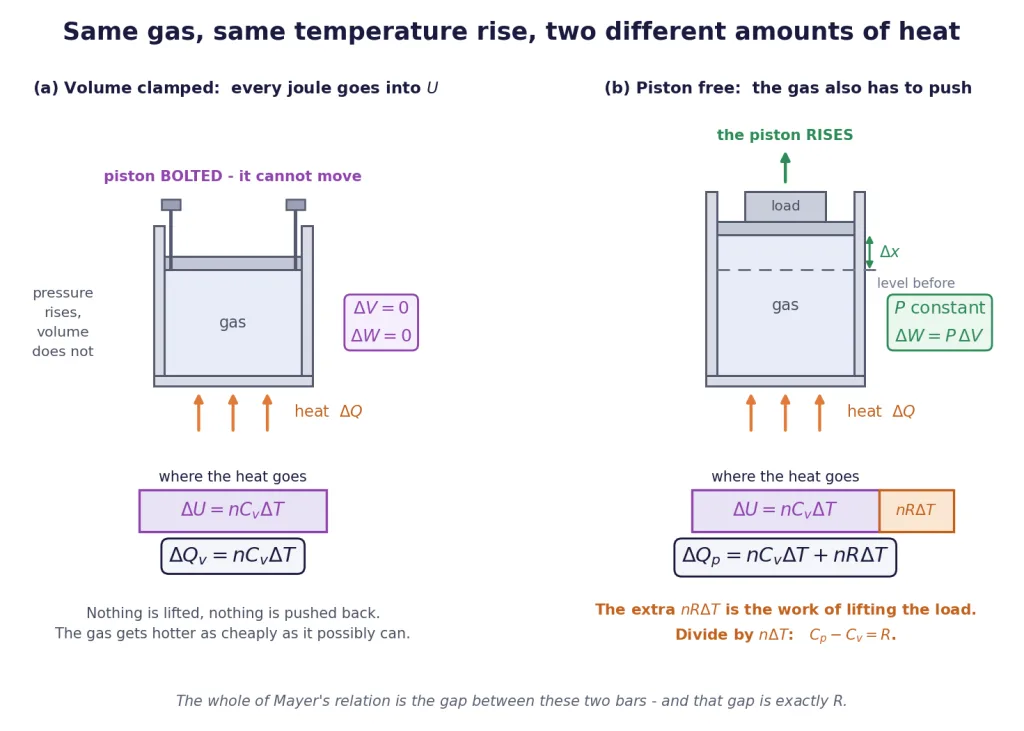
Look at the two cylinders. Same gas, same number of moles, same 1 K rise. On the left the piston is bolted so the gas cannot expand. On the right the piston floats under a fixed load, so as the gas warms it pushes the piston up and lifts that load.
The gas on the right has done a job on the way. It has pushed the atmosphere and the load back, and that work had to be paid for out of the heat you supplied. So it needed more heat for the same temperature rise.
Before going further, fix the bookkeeping.
This chapter's sign convention: is positive when heat is added TO the system. is positive when work is done BY the system. The first law is then
Chemistry writes the first law as , with the work done on the system — the same physics with one sign moved.
So a gas needs two specific heats
A solid needs only one because a solid barely expands. Heat a copper block by 100 K and its volume changes by about 0.5% — the work it does pushing the air aside is a fraction of a percent of the heat supplied, far below the accuracy anyone quotes. So for a solid and are the same number for all practical purposes, and nobody bothers with the subscript.
A gas is different by a factor of thousands. Heat one mole of gas at constant atmospheric pressure from 300 K to 400 K and its volume runs from about 24.6 litres up to about 32.8 litres — an expansion of roughly 8200 cm, which is 8.2 litres. That is enough to push the atmosphere back through a real distance and do real work:
Keep those two numbers apart, because they are the pair most often collapsed into one: cm is how much the gas expands, and J is the work that expansion does. Different quantities, different units. hands you the joules; you get the cubic centimetres only after dividing by the pressure, .
Key Point — the two molar specific heats of a gas:
- , at constant volume: heat supplied with the volume held fixed, so and every joule goes into internal energy.
- , at constant pressure: heat supplied with the pressure held fixed, so the gas expands and also does work on its surroundings.
Because the constant-pressure gas has to pay for that work as well,
[JEE Tip] There is a sharper version of this. For a gas, the molar specific heat is not a property of the gas at all — it is a property of the gas together with the process. Squeeze the gas as you heat it and you can make come out negative. Hold the temperature fixed and pour heat in, and while , so is infinite. Let no heat in at all and . Constant volume and constant pressure are simply the two processes worth naming, because they are the two that turn up everywhere.
: Where the Whole Joule Goes into Internal Energy
Start with the easy cylinder — the one with the piston bolted down.
The definition, and the first law
Hold the volume fixed and supply heat to moles, raising the temperature by . Since the volume cannot change, , and the work done by the gas is
The first law then collapses to
Every joule of heat has become internal energy. Nothing was spent pushing anything. So
Key Point — molar specific heat at constant volume: and in the limit of a small change,
The subscript says "at constant volume". Rearranged, the form you will actually use is
The line that decides more exam questions than any other
Read that boxed equation again and notice what is not in it. There is no pressure, no volume, no mention of how the gas got from the first temperature to the second.
That is not an accident, and it is not sloppiness.
For an ideal gas, the internal energy depends only on the temperature — not on the volume, not on the pressure. Section 2 set this out: is a state function, and for an ideal gas that state is pinned by alone, because the molecules have no potential energy of interaction to speak of. Squash an ideal gas at fixed temperature and you have not changed its internal energy at all.
So if depends only on , then a given change in always produces the same change in , whatever route the gas took.
Key Point — the most reusable equation in the chapter: isothermal, adiabatic, isobaric, a wiggly path drawn freehand — all of them. appears in the formula, but the process does not have to be at constant volume. got its name from where it is most easily measured, not from where it is allowed to be used.
[JEE Tip] This is worth reading three times. Students happily write for an isochoric leg and then refuse to write it for an isobaric one, on the grounds that "the volume is changing". The volume changing is irrelevant. The moment you know for an ideal gas, you know , and is the constant that converts one to the other.
There is a good way to remember why. Take the gas from to by any path you like. is fixed by the endpoints because is a state function. Now choose, out of all the possible paths, the constant-volume one. Along that path . But was the same for every path — so is the answer for every path.
What this means in practice
Three consequences you will use immediately:
- In an isochoric process, . Heat in, temperature up, no work at all. Section 7 develops this.
- In an isothermal process, , so for an ideal gas, no matter how much heat crosses the boundary. The first law then reads : everything you put in comes straight out as work.
- In an adiabatic process, , so . If the gas expands it does positive work, so is negative and the gas cools itself. Section 6 does this properly.
And what actually measures
is a measure of how much energy a mole of the gas can absorb per kelvin internally — how many separate ways its molecules have of storing energy. A single atom can only fly about. A dumbbell molecule can fly about and tumble. A floppier molecule has more options still.
More ways of storing energy means more energy needed per kelvin, which means a bigger . That single sentence explains every number in the next block, and it is why is not the same for helium and for carbon dioxide.
, and Mayer's Relation Derived from the First Law
Now the free-piston cylinder.
Setting it up
Hold the pressure constant at and supply heat to moles, raising the temperature by . The gas expands by , and in doing so does work (Section 2 derived that from force times distance; Section 5 draws it.) The first law gives
Divide by :
The first term on the right is exactly — and this is where the previous block earns its keep. holds for any process of an ideal gas, so it holds here even though the volume is changing. That is the step students skip, and it is the whole derivation.
The second term, from the equation of state
For an ideal gas, . Hold fixed and let change:
So the second term is , and we are done.
Key Point — Mayer's relation: where and are the molar specific heats of an ideal gas and J/(mol K) is the universal gas constant.
The difference is exactly — not approximately, not for some gases. It does not depend on the temperature, on the pressure, or on which gas it is. Helium, nitrogen, methane: same difference, J/(mol K).
Reading the result
The physics is right there in the derivation. Take one mole and raise its temperature by 1 K.
- At constant volume you pay joules, all of it banked as internal energy.
- At constant pressure you pay joules for exactly the same internal-energy rise, plus joules to push the surroundings back.
So is not an abstract constant here. is the work, in joules, that one mole of an ideal gas does against a constant pressure when its temperature rises by one kelvin. That is a physical meaning for worth carrying around.
[Board Important] A three-mark derivation, in the order examiners want it: (1) write the first law for moles at constant pressure; (2) divide by and identify , stating that of an ideal gas depends only on ; (3) differentiate at constant to get ; (4) conclude . Miss step (2)'s justification and you lose the mark that separates the two grades.
The per-kilogram version
Divide Mayer's relation by the molar mass in kg/mol. Since ,
Now the difference does depend on which gas it is, because does. For hydrogen ( kg/mol) the gap is J/(kg K); for oxygen () it is only J/(kg K). This is exactly why the molar form is the one to learn — the per-kilogram form hides the universality behind a molar mass.
[NEET Important] A favourite one-liner: given and per kilogram for a gas, find its molar mass. Answer: . For nitrogen, with and J/(kg K), that gives kg/mol, which is 28 g/mol. Correct.
Why the relation is only for an ideal gas
Two things were assumed. First, that depends only on — true for an ideal gas, only approximately true for a real one, because real molecules attract each other and pulling them apart costs energy. Second, that — again an idealisation. For real gases at ordinary pressures comes out within a percent or so of , which is why the relation is used freely; near a liquefaction point it fails outright. For a solid or a liquid, is so tiny that is a small fraction of , and the two are treated as equal.
The Ratio , and the Numbers You Cannot Do Without
Mayer's relation gives the difference of the two specific heats. Their ratio turns out to matter even more.
Key Point — the ratio of specific heats: a pure number with no units, and always greater than 1, because always. It is sometimes called the adiabatic index.
The ratio is unitless, so the molar and the per-kilogram versions give the same — a rare place where it does not matter which you use.
Combine with Mayer's relation and both specific heats fall out of alone. From and :
Learn this pair. Almost every adiabatic problem hands you and expects you to produce .
The values of — and why they are here
The values of , and the molecular counting that produces them, sit outside the rationalised syllabus body text, yet Boards, JEE and NEET ask them every single year and no adiabatic problem in this chapter can be solved without them, so they are set out here from first principles.
The counting rule is short. Energy gets shared out equally among every independent way a molecule has of storing it, and each way contributes to the molar specific heat at constant volume. Call the number of ways . Then
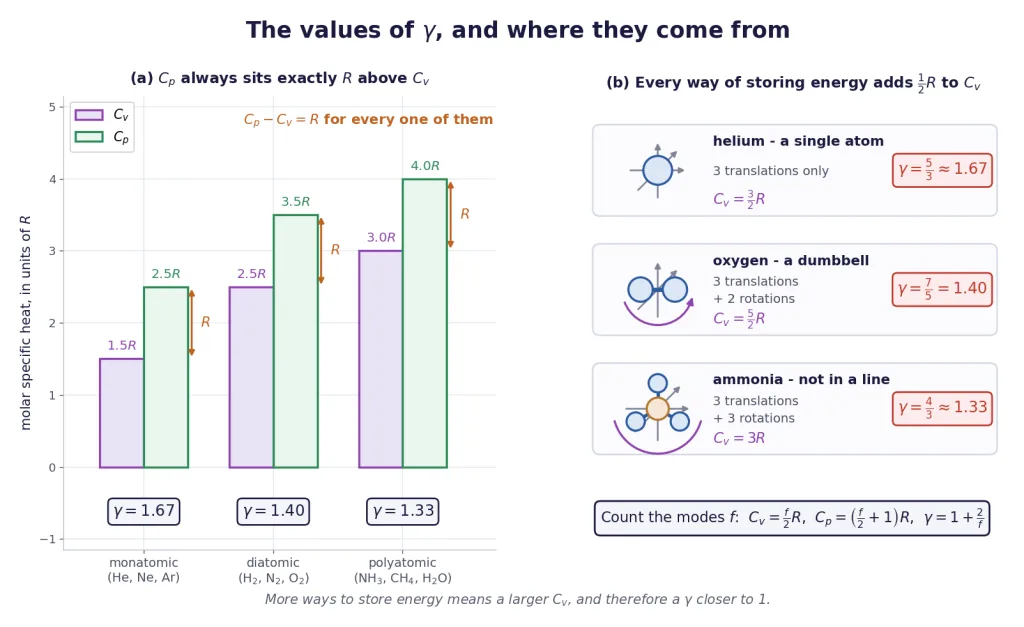
Now count, for the three families:
- Monatomic (helium, neon, argon, and metal vapours). A single atom is a point as far as this goes. It can move along three independent directions and that is all — it has no shape to tumble. So .
- Diatomic (hydrogen, nitrogen, oxygen, carbon monoxide, and air, which is mostly the first two). A dumbbell can move three ways and tumble about two axes — end over end in two independent planes. Spinning about its own long axis does not count; there is essentially nothing out there to spin. So .
- Polyatomic, not in a straight line (ammonia, methane, water vapour). A lopsided molecule can tumble about all three axes, so .
The table — commit it to memory
| Type of gas | (J/(mol K)) | (J/(mol K)) | ||||
|---|---|---|---|---|---|---|
| Monatomic — He, Ne, Ar | 3 | 12.47 | 20.79 | |||
| Diatomic — H, N, O, air | 5 | 20.79 | 29.10 | |||
| Polyatomic — NH, CH, HO | 6 | 24.94 | 33.26 |
Every value in the last three columns uses J/(mol K).
Read down the column and the pattern is clean: the more ways a molecule has of storing energy, the closer sits to 1. A monatomic gas has the fewest options and so the largest ; a floppy polyatomic has the most and so the smallest. And since can never be less than 3, can never exceed for any gas. That is a genuine upper bound and it makes a good multiple-choice trap: an option offering is wrong on sight.
[NEET Important] Three numbers, memorised cold: 1.67 monatomic, 1.40 diatomic, 1.33 polyatomic. And the pair that goes with them — for a diatomic gas and J/(mol K). Air is diatomic for this purpose, so is the default whenever a question says "a gas" without saying which.
Where the counting comes from
Everything above is the law of equipartition of energy, and it is properly a result of the kinetic theory of gases, which is the very next chapter. There it is derived rather than quoted: you will show that each independent quadratic way of holding energy carries an average per molecule, hence per mole, hence per kelvin in .
For thermodynamics, all we need is the output — the three values of and the two of — and the assurance that they are not arbitrary. Treat this block as the bridge: the numbers are used here, and earned there.
Real Gases, the Staircase, and the Traps
The table in the last block is a prediction. Here is what measurement actually says.
Measured values
| Gas | Type | (J/(mol K)) | (J/(mol K)) | ||
|---|---|---|---|---|---|
| Helium (He) | monatomic | 12.47 | 20.79 | 8.3 | 1.67 |
| Argon (Ar) | monatomic | 12.47 | 20.79 | 8.3 | 1.67 |
| Hydrogen (H) | diatomic | 20.4 | 28.8 | 8.4 | 1.41 |
| Nitrogen (N) | diatomic | 20.8 | 29.1 | 8.3 | 1.40 |
| Oxygen (O) | diatomic | 21.0 | 29.4 | 8.4 | 1.40 |
| Air | mostly diatomic | 20.8 | 29.1 | 8.3 | 1.40 |
| Carbon dioxide (CO) | polyatomic | 28.5 | 36.9 | 8.4 | 1.29 |
| Ammonia (NH) | polyatomic | 27.8 | 36.1 | 8.3 | 1.30 |
Values near room temperature and ordinary pressure. Helium and argon carry identical entries because at this precision they genuinely measure the same: a lone atom is a lone atom, and a helium atom and an argon atom store energy in exactly the same three ways however different their masses. Every in the last column is just that row's own divided by its own — check one or two and you will see the table is self-consistent, which is the first thing to test on any table of measured specific heats.
Two things jump out. The column is or all the way down — Mayer's relation holding to better than 1% across gases whose molecules could hardly be more different. And the predicted values of (12.47, 20.79, 24.94) land on top of the measured ones for the monatomic gases and very close for the diatomic ones.
The polyatomic row is the soft one: carbon dioxide measures where the simple count predicts . The extra comes from the molecule's vibration — the bonds stretch and bend, and that is one more place to put energy. Which brings us to the interesting part.
Why climbs in steps
If the counting were the whole story, would be a fixed number for each gas at every temperature. Measure it carefully over a wide range and it is nothing of the sort.
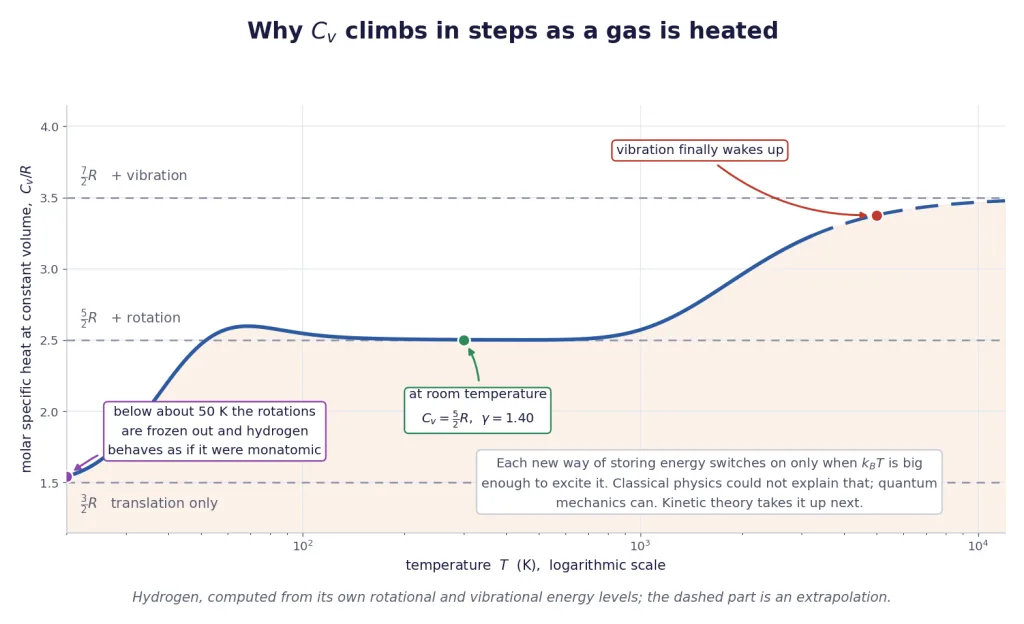
Take hydrogen. Below about 50 K its sits near — the value for a monatomic gas. Warm it through room temperature and settles at : the tumbling has switched on. Push it above about 2000 K and starts climbing again towards as the bond begins to vibrate.
The molecule has not changed shape. What changes is whether it has enough energy to use a mode at all. Classical physics has no answer to this — a classical dumbbell tumbles at any temperature, however cold. Quantum mechanics does: rotational and vibrational energies come in discrete steps, and until a typical collision carries more energy than the first step, the mode simply cannot be excited and stays frozen out.
This staircase was one of the earliest hard clues that classical mechanics was incomplete, decades before anyone had a quantum theory to explain it. You will meet it again in kinetic theory.
[JEE Tip] For every problem in this chapter, use the plain table values — , , . The staircase is worth understanding, not worth applying. If a question wants vibration included it will say so, usually by handing you or a value of to use.
And why a solid gets away with one number
Run the same count for a solid. Each atom is pinned to a lattice site and oscillates about it in three directions, and an oscillator stores energy in two forms, kinetic and potential — so it carries per direction, giving
For copper, kg/mol, so this predicts a specific heat of J/(kg K) against a measured 385 — about 2% out. The rule works for most solids at ordinary temperatures (carbon is a famous exception) and it fails at low temperatures, for exactly the quantum reason above.
And because a solid hardly expands, it does almost no work when heated, so its and differ by far less than . One number does the job.
The five traps
- Molar or per kilogram. is the molar statement. Per kilogram it is . Check the units of the numbers you were given before you subtract.
- is not restricted to constant volume. It works for every process of an ideal gas. Refusing to use it on an isobaric leg is the classic self-inflicted wound.
- is restricted — to a constant-pressure process, and nothing else. It is a heat formula, and heat is a path function.
- Kelvin. is the same number in kelvin and in Celsius, so a difference is safe. But the moment a gas-law step appears — , or any ratio of temperatures — the temperature must be absolute.
- is impossible. So is . Use both as sanity checks on an answer before you write it down.
Solved Examples
Constants used throughout, unless a problem says otherwise: J/(mol K); 1 atm Pa; K. Monatomic with and J/(mol K); diatomic with and ; polyatomic with and .
Example 1: The same gas, the same heating, two different bills
Two moles of a diatomic ideal gas are taken from 300 K to 400 K, (a) at constant volume and (b) at constant pressure. For each, find , and , state the sign of each and say what it means physically.
Solution:
Fix the constants. Diatomic, so and J/(mol K). Both temperatures are already absolute and positive; K.
(a) Constant volume. The volume cannot change, so Signs: is positive, so heat was added to the gas. is positive, so its internal energy rose. is zero — the gas neither pushed nor was pushed.
(b) Constant pressure. Now is the same, because the temperature change is the same and depends only on : The work follows from : Cross-check with J. Agreed. Signs: positive — heat added. positive — same rise as before. positive — the gas expanded and did work on its surroundings.
Compare. The second case needed J more, and that is exactly : the work of pushing the surroundings back. The ratio of the two heats is .
Final Answer: (a) J, J, . (b) J, J, J.
Takeaway: Same two temperatures means the same , whatever the process. All the difference between the two cases sits in , and the ratio of the heats is .
Example 2: Getting out of laboratory data
For nitrogen, measurement gives J/(kg K) and J/(kg K). The molar mass of nitrogen is 28 g/mol. Show that these figures reproduce the universal gas constant, and find .
Solution:
These are per-kilogram values, so the difference is , not :
Multiply by the molar mass in kg/mol, which is : Against the accepted , that is a 0.02% agreement from two ordinary measured numbers.
The ratio needs no conversion at all, since the molar mass cancels: Nitrogen is diatomic, so is exactly what the counting predicts.
Final Answer: J/(mol K); .
Takeaway: Multiply a per-kilogram difference by to get a molar one; divide a molar one by to go back. And is the same number either way, which makes it the safest quantity to compute when you are unsure which units you were handed.
Example 3: From alone to both specific heats
A gas has . Find its molar specific heats at constant volume and at constant pressure, and then find the same two quantities per kilogram if the gas is oxygen, g/mol.
Solution:
Two equations, two unknowns. Mayer gives and the definition gives . Substituting,
Put the numbers in: Check: . Mayer holds.
Per kilogram, divide by kg/mol: And , as it must be.
Final Answer: and J/(mol K); for oxygen and J/(kg K).
Takeaway: and are the two most useful lines in the section. Nearly every adiabatic problem starts by using them.
Example 4: What fraction of the heat becomes work?
A gas is heated at constant pressure. What fraction of the heat supplied leaves as work done by the gas? Evaluate for a monatomic, a diatomic and a polyatomic gas.
Solution:
Write both quantities for the same . At constant pressure,
Divide. The and the cancel:
Evaluate for each family:
- Monatomic, : fraction , so 40%.
- Diatomic, : fraction , so 28.6%.
- Polyatomic, : fraction , so 25%.
- Why the trend runs that way. A monatomic gas has the fewest places to bank energy internally, so a larger slice of the heat is left over to do work. A floppier molecule swallows more of the heat internally and pushes less.
Final Answer: : 40%, 28.6% and 25% respectively.
Takeaway: In an isobaric process the split between and is decided entirely by . The rest goes into internal energy: .
Example 5: One gram of helium under a free piston
One gram of helium in a cylinder fitted with a frictionless piston is heated at constant atmospheric pressure from 27°C to 127°C. Take the molar mass of helium as 4 g/mol. Find the heat supplied, the change in internal energy and the work done by the gas.
Solution:
Kelvin first. K and K, both positive as they must be. The rise is K.
Moles. mol.
Constants. Helium is monatomic: and J/(mol K).
Heat supplied, at constant pressure:
Internal energy, always through :
Work, from the first law or directly from :
The signs. All three are positive: heat flowed into the gas, its internal energy rose, and it did work on its surroundings by lifting the piston. Note that 40% of the heat left as work — exactly the monatomic fraction from Example 4.
Final Answer: J, J, J.
Takeaway: Convert the mass to moles before anything else, and convert the temperatures to kelvin even when only the difference is needed — it costs one line and it stops the habit of forgetting when a ratio does appear.
Example 6: Same heat, two containers
1000 J of heat is supplied to one mole of a diatomic gas, once at constant volume and once at constant pressure. Find the temperature rise in each case, and the ratio of the two.
Solution:
Constant volume. All 1000 J becomes internal energy:
Constant pressure. Now some of the 1000 J is spent on work:
The ratio:
Read the physics. The same 1000 J heats the gas 40% more when it is not allowed to expand, because none of it is diverted into work. In the constant-pressure case J went into pushing, and only J into .
Final Answer: K at constant volume, K at constant pressure; the ratio is .
Takeaway: A gas that is free to expand is harder to heat. The ratio of the two temperature rises for the same heat is always exactly — a one-line answer worth recognising.
Example 7: An isobaric expansion, worked in full
Five moles of a monatomic ideal gas expand at a constant pressure of 2 atm from m to m. Find the work done by the gas, the temperature change, the change in internal energy and the heat supplied. Verify the first law.
Solution:
SI. Pa; m.
Work done by the gas. Pressure is constant, so Positive, because the gas expanded.
Temperature change, from : (The initial temperature, if you want it, is K — positive and absolute, as required.)
Internal energy. Monatomic, :
Heat supplied, two ways:
Signs. : heat entered. : the gas got hotter. : the gas did work on its surroundings. And closes exactly.
Final Answer: J, K, J, J.
Takeaway: When a problem gives you and both volumes, get first from , then from . You never need the individual temperatures.
Example 8: Naming a gas from one number
An unknown gas is found to have a molar specific heat at constant volume of J/(mol K). Identify the type of gas, and predict and .
Solution:
Express it in units of , which is where the structure shows:
Match to the table. means , so : three translations plus three rotations. That is a polyatomic molecule that is not in a straight line — ammonia, methane, water vapour.
Predict the other two:
Sanity check. lies between 1 and , as every must.
Final Answer: A polyatomic (non-linear) gas; J/(mol K) and .
Takeaway: Divide any molar specific heat by before you try to interpret it. , and for — or , and for — identify the gas instantly.
Example 9: Helium against carbon dioxide
One mole of helium and one mole of carbon dioxide are each heated through 50 K at constant pressure. Which needs more heat, and by what factor? Treat carbon dioxide as an ideal polyatomic gas with .
Solution:
Pick the right for each. Helium is monatomic: . Carbon dioxide, treated as polyatomic: J/(mol K).
Heat each:
The factor:
Why. Both gases contain the same number of molecules and both push their surroundings back by the same J. The whole difference is internal: a carbon dioxide molecule has six ways to hold energy against helium's three, so it swallows twice as much internally. Both values are positive — heat added — as is each , and each is J.
Final Answer: Carbon dioxide needs 1.6 times as much heat: J against J.
Takeaway: Per mole, the more complicated molecule always costs more to heat. Per kilogram the comparison can invert completely, because a mole of helium weighs 4 g and a mole of carbon dioxide weighs 44 g.
Example 10: Hydrogen's staircase, in joules
How much heat is needed to raise the temperature of one mole of hydrogen by 10 K at constant volume (a) around 100 K, where only translation is active, (b) at room temperature, where rotation has switched on, and (c) around 3000 K, where vibration has also switched on and ?
Solution:
Use for each regime, and with and K.
(a) : , so
(b) : , so
(c) : , so
All three are positive and, since the volume is fixed, and in every case. The same gas, the same ten kelvin, and the bill more than doubles between the coldest and the hottest case — purely because more storage modes have woken up.
Final Answer: (a) J; (b) J; (c) J.
Takeaway: is not a constant of a gas; it is a constant of a gas in a temperature range. For everything in this chapter, use the room-temperature value unless told otherwise.
Example 11: Predicting the specific heat of copper
Use the counting rule for a solid to predict the specific heat capacity of copper in J/(kg K), given g/mol, and compare with the measured value of 385 J/(kg K).
Solution:
Count for a solid. Each atom oscillates about a fixed site in three directions, and an oscillator stores energy both as kinetic and as potential — two forms per direction, so six in all:
Convert to per kilogram with kg/mol:
Compare. The measured value is 385, so the prediction is high by which is remarkable for a calculation containing no information about copper except how heavy one mole of it is.
A note on against . For a solid this argument gives essentially both at once. Copper's volume expands by roughly 0.005% per kelvin, so the work it does pushing the atmosphere aside is a few thousandths of a joule per mole per kelvin — utterly negligible beside 24.9 J. Hence one specific heat, not two.
Final Answer: J/(kg K), about 2% above the measured 385 J/(kg K).
Takeaway: J/(mol K) for most solids at room temperature. Divide by the molar mass to get the per-kilogram value, and expect agreement within a few percent.
Example 12: When "the molar specific heat" is a meaningless question
A gas is taken through (a) an isothermal expansion in which 500 J of heat is absorbed, and (b) an adiabatic expansion. What is the molar specific heat of the gas in each process? What does this tell you?
Solution:
Start from the definition, , and read each process honestly.
(a) Isothermal. By definition the temperature does not change, so , while J is definitely not zero: The molar specific heat is infinite. Physically: you can pour in any amount of heat and the temperature will not move a millikelvin, because all of it leaves again as work. Signs: J (heat added), (temperature fixed, ideal gas), so J (all of it done by the gas).
(b) Adiabatic. By definition , while the temperature certainly does change: The molar specific heat is zero. Physically: the gas cools as it expands without any heat leaving at all. Signs: , for an expansion, so — the internal energy falls and the gas gets colder.
The lesson. Between and lies every value, including negative ones for suitably chosen processes. So "the molar specific heat of oxygen" is an incomplete question. and are singled out and given names because those two processes are the ones that recur.
Final Answer: Isothermal, ; adiabatic, .
Takeaway: belongs to the process, not to the gas. Whenever you write a , be able to name which process it goes with — and if you cannot, you do not yet have enough information to answer.