
Carnot's Question, and Why the Answer Has to Be Reversible
Section 9 left us with an uncomfortable gap. We know every heat engine has , and we know the second law forbids . But how close to 1 can we actually get? Is there a ceiling, or can a clever enough engineer creep up towards 100% for ever?
In 1824 a young French engineer named Sadi Carnot answered that question completely, and he did it before anyone had settled what heat even was. The answer turned out to be startlingly simple, and it is the high point of this chapter.
Fix the problem properly first
Give yourself a hot reservoir at and a cold reservoir at , and nothing else. What is the greatest efficiency any engine can have between those two temperatures, and what cycle achieves it?
Start by asking what would spoil it. Section 8 identified the two sources of irreversibility — processes that are not quasi-static, and dissipative effects such as friction and viscosity. Both of them destroy useful work: friction turns work into heat that runs straight to the sink, and a non-quasi-static step lets the gas pass through states that are not in equilibrium, from which some work can never be recovered.
So the best engine must have neither. Every step must be quasi-static and every step must be free of dissipation. That is precisely the definition of a reversible process.
Key Point: The most efficient engine possible between two given temperatures must be completely reversible. Any irreversibility, anywhere in the cycle, lowers the efficiency. A reversible heat engine working between two reservoirs is called a Carnot engine.
Which four processes, and why exactly those four
Now a real constraint bites. A process is not quasi-static if there is a finite temperature difference between the system and whatever it is touching — heat then rushes across the gap and the gas is never in equilibrium. So:
- Whenever the gas is in contact with a reservoir, it must be at the same temperature as that reservoir. That contact step is therefore isothermal.
- Whenever the gas has to change temperature — and it must, because it has to visit both and — it cannot be touching a reservoir at all, or heat would cross a finite gap. It must be insulated. That step is therefore adiabatic.
There is no third option. The cycle is forced to be two isotherms joined by two adiabats, and that is the Carnot cycle.
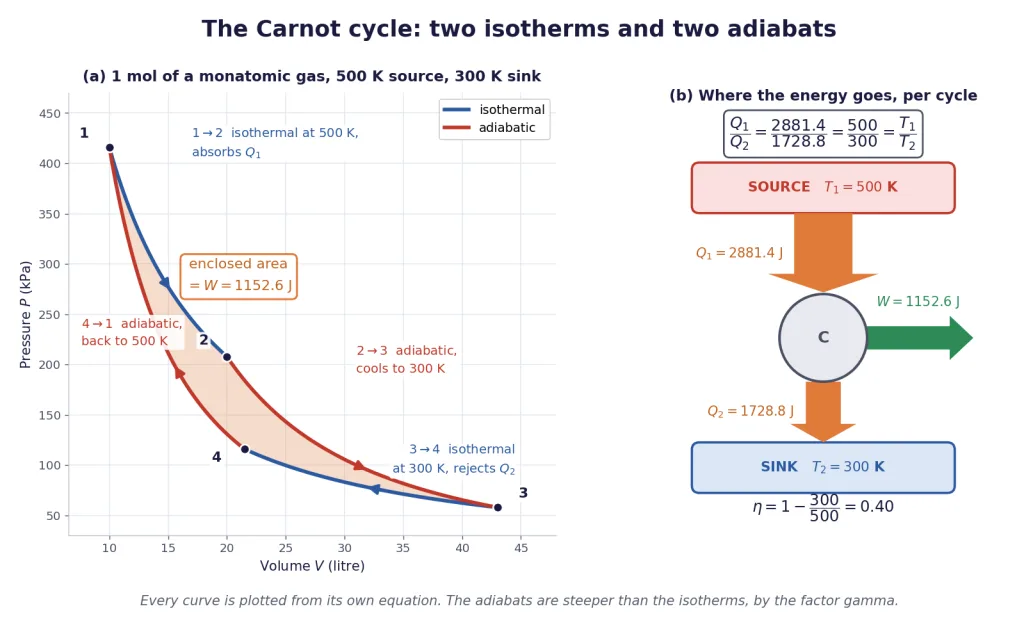
Key Point — the four steps of the Carnot cycle, starting from state 1 at :
- Isothermal expansion at . The gas sits on the hot reservoir and expands slowly, absorbing heat .
- Adiabatic expansion. Insulated, the gas goes on expanding and cools from down to .
- Isothermal compression at . The gas sits on the cold reservoir and is compressed slowly, rejecting heat .
- Adiabatic compression. Insulated, the gas is compressed back to state 1, warming from to .
The loop is clockwise, so the enclosed area is the net work done by the gas. Heat enters only on step 1 and leaves only on step 3.
Reading the diagram
Two things on that figure are worth pausing over, because examiners test both.
The adiabats are steeper than the isotherms. Where an adiabat and an isotherm cross, the adiabat's slope is exactly times as steep, as Section 6 showed. That is why the four curves close into a proper loop instead of collapsing.
The loop is thin, and that is honest. Real Carnot cycles enclose modest areas. An engine with a spectacular efficiency is not one with a fat loop; it is one whose two isotherms sit at very different temperatures.
[Board Important] "Why must a Carnot cycle consist of two isothermal and two adiabatic processes?" is a standard three-mark question. The answer is the paragraph above: contact with a reservoir must be isothermal to avoid a finite temperature difference, and temperature changes must be adiabatic because the gas must be isolated while it changes temperature. Say quasi-static and say finite temperature difference.
The Cycle, Leg by Leg, and the Result That Falls Out
Now we do the arithmetic. Take moles of an ideal gas as the working substance, with ratio of specific heats . Every formula used here was derived in Sections 6 and 7; nothing new is needed except patience.
Step 1, the hot isotherm
Isothermal, so , so all the heat absorbed comes straight out as work:
Positive, because : the gas expands and does work, and heat flows in from the source to keep the temperature at .
Step 2, the adiabatic expansion
, so and the gas does work at the cost of its own internal energy:
Positive, and the gas cools from to paying for it.
Step 3, the cold isotherm
Isothermal again, , and now the gas is compressed from to , with :
Negative — work is done on the gas. The magnitude of the heat rejected to the sink is therefore
quoted as a positive number, with its direction stated in words as always.
Step 4, the adiabatic compression
Negative — work is done on the gas, warming it from back to .
The first thing to notice: the adiabats cancel
Look at steps 2 and 4 side by side:
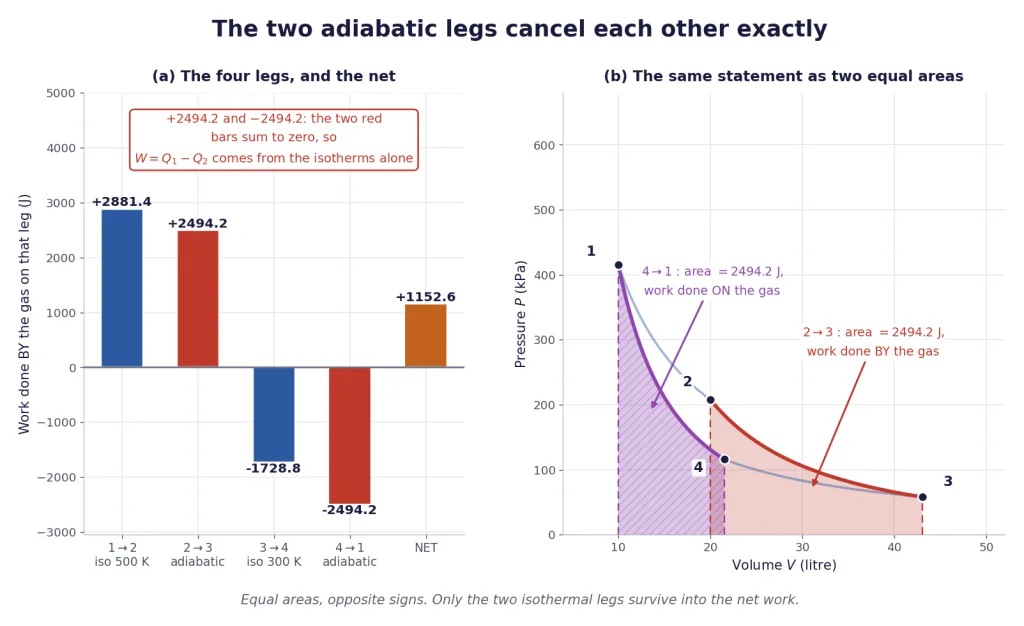
Key Point: The two adiabatic legs of a Carnot cycle contribute exactly equal and opposite amounts of work, and cancel completely. This is not an approximation and it does not depend on the numbers — the same two temperatures appear in both, in opposite order.
So the net work is carried entirely by the two isotherms:
which is exactly the that Section 9 got from round any cycle. Two completely different routes, same answer. That is a good sign.
The efficiency, so far
Ugly, and full of volumes. But we have not yet used the fact that steps 2 and 4 are adiabatic. Do that now, and the volumes vanish.
Killing the volumes with constant
Section 6 gave the adiabatic relation in the temperature-volume form. Apply it to each adiabat.
On , the gas goes from to :
On , the gas goes from to :
The right-hand sides are identical. Therefore
The two volume ratios are the same. The gas expands by exactly the same factor on the hot isotherm as it is compressed by on the cold one. Put that back into the efficiency and the two logarithms cancel outright:
And the central relation
Comparing with :
Key Point — the central result of the chapter:
For a Carnot engine, The ratio of the heats exchanged with the two reservoirs equals the ratio of their absolute temperatures — and nothing else appears. Not , not , not the volumes, not the pressures, not what the gas is made of.
here is kelvin, always. Every quantity in that equation is absolute. Put Celsius numbers into and you get nonsense, and Example 3 shows how spectacular the nonsense is.
[JEE Tip] is the single most useful line in this section, because it converts any statement about heats into a statement about temperatures and back. It is only true for a reversible engine — a real engine rejects more than this, which is precisely why its efficiency is lower.
The Carnot Efficiency, and What It Actually Buys You
Key Point — the Carnot efficiency: with the absolute temperature of the source and the absolute temperature of the sink, both in kelvin.
Sit with how strange that is for a moment. To predict the efficiency of the best possible engine you need two numbers, and they are both thermometer readings. You do not need to know whether the working substance is helium, steam, air or something not yet invented. You do not need to know the size of the cylinder, the design of the valves, the mass of gas, or the pressures involved. All of that cancelled.
Key Point: The efficiency of a Carnot engine depends on nothing but the two reservoir temperatures. It is independent of the working substance, of the design, and of the size of the machine. Section N4 below shows why that had to be true.
Four consequences, each of them examinable
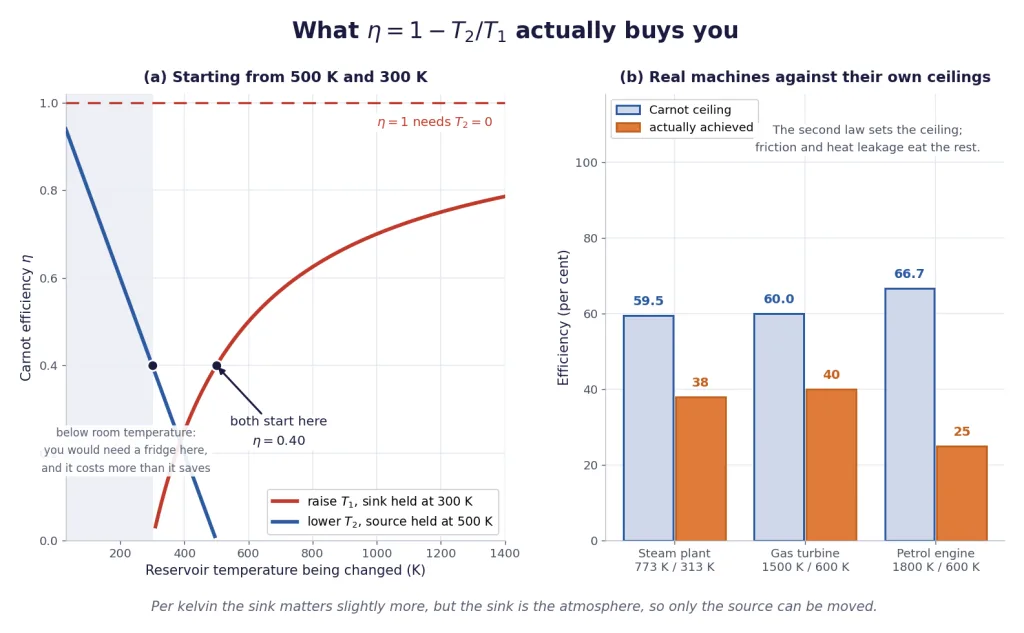
1. is always less than 1, and needs an impossible sink. demands K — a sink at absolute zero, which the third law of thermodynamics says cannot be reached. There is your Kelvin-Planck statement again, arriving from a completely different direction.
2. when . Two reservoirs at the same temperature give you nothing at all, no matter how much heat is sloshing about in them. A heat engine needs a temperature difference, not a temperature. The ocean holds an unimaginable amount of internal energy and you cannot run a ship on it, because there is nowhere colder to reject to.
3. The bigger the gap, the better. Efficiency depends on the ratio , so what matters is how far apart the reservoirs are in proportion, not in degrees.
4. In practice, only the source can be moved. This one needs care, because the honest answer has two halves.
Raising the source against lowering the sink
Differentiate. Holding fixed, ; holding fixed, . Their ratio is , which is less than 1 — so on paper, one kelvin taken off the sink buys slightly more efficiency than one kelvin added to the source.
And yet every engineer raises . Why?
Key Point — the practical reading:
The sink is not yours to move. It is the atmosphere, a river, or the sea, and it sits at whatever temperature the weather decides. To push below ambient you would have to run a refrigerator, and that refrigerator would consume more work than the extra efficiency ever returns.The source is yours to move. Burn hotter, use better alloys, raise the boiler pressure — every one of those is an engineering problem with an engineering answer.
So although the derivative slightly favours the sink, raising is in practice the only lever there is, and the entire history of engine development is the history of higher and higher source temperatures.
Worked numbers make this concrete: with K and K, . Raise to 550 K and becomes 0.4545. Lower to 250 K and becomes 0.50 — a slightly bigger gain, but 250 K is , and you would need a freezer running day and night to hold a river at that temperature.
Real engines against their ceilings
| Machine | Carnot ceiling | Typically achieved | ||
|---|---|---|---|---|
| Steam power plant | 773 K | 313 K | 59.5% | about 38% |
| Gas turbine | 1500 K | 600 K | 60.0% | about 40% |
| Petrol engine | 1800 K | 600 K | 66.7% | about 25% |
Two separate things are going on in the gap between the last two columns, and Section 9 named them both. The ceiling is the second law, and no amount of engineering will ever lift it. The shortfall below the ceiling is friction, turbulence, heat leaking through cylinder walls, and combustion that is nothing like quasi-static — and every bit of that is, in principle, fixable.
[NEET Important] Whenever a question gives temperatures in Celsius, convert first and convert every one of them. An engine between and has a ceiling of about 40%, not the 88% you get by dividing 27 by 227. That single mistake is the most common wrong answer in this entire chapter.
Carnot's Theorem, and the Most Elegant Argument in the Chapter
We have found the efficiency of one particular reversible cycle, using an ideal gas. That is not yet an answer to Carnot's question. Two things are still missing:
- Could some other engine — with a cleverer cycle, or a different working substance — beat it?
- Would a Carnot cycle using liquid mercury, or a rubber band, give a different answer from one using helium?
Carnot's theorem settles both, and its proof needs no calculus at all — only the second law and a willingness to bolt two machines together.
Key Point — Carnot's theorem:
(a) Working between two given temperatures and , no engine can have a greater efficiency than a reversible (Carnot) engine working between the same two temperatures.
(b) The efficiency of a Carnot engine is independent of the nature of the working substance, so all reversible engines between the same two reservoirs have exactly the same efficiency.
The proof of (a), by contradiction
Suppose someone disagrees. Let them bring an engine which they claim beats the Carnot engine between the same two reservoirs:
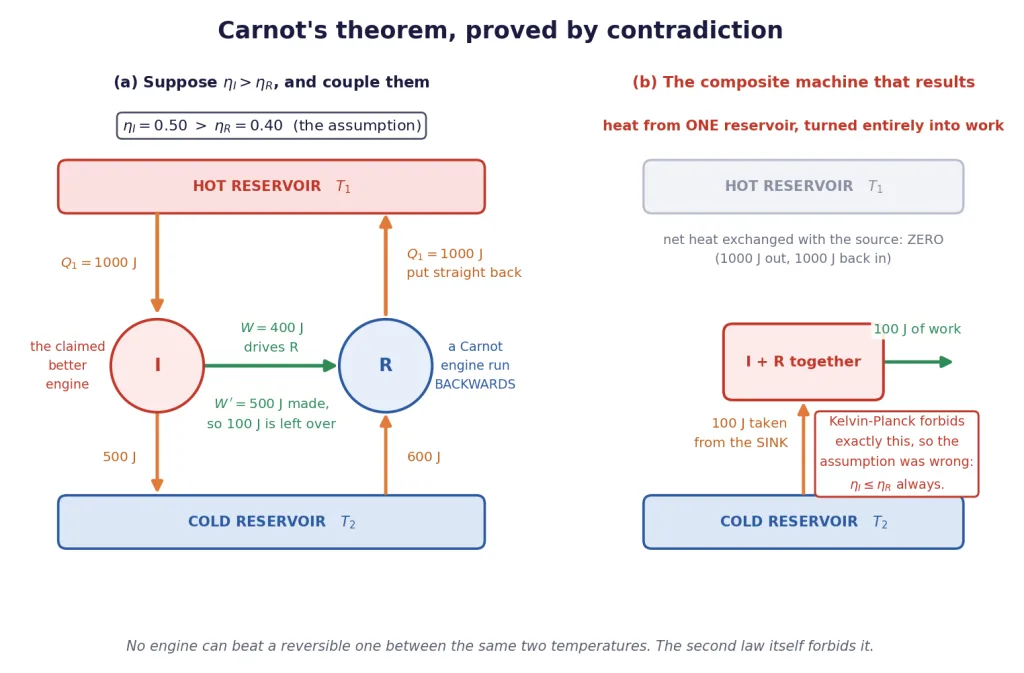
Step 1 — couple them. Let run as an engine, drawing heat from the source, delivering work , and rejecting to the sink.
Now is reversible — that is the whole point of it — so we may run it backwards, as a refrigerator. Arrange it to take heat from the sink and return exactly the same to the source, which requires work to be done on it. Use part of 's output to drive it.
Step 2 — look at the hot reservoir. took out of it and put back in. Net change: zero. The source is untouched at the end of every cycle, exactly as it was at the beginning.
Step 3 — use the assumption. By hypothesis , and both machines handle the same at the hot end, so produces more work than needs. There is a surplus of left over every cycle.
Step 4 — look at the cold reservoir. delivered into it and removed from it. The net heat taken out of the sink per cycle is
Step 5 — read what the pair, taken as one machine, has done. In one cycle the composite has:
- exchanged no net heat at all with the hot reservoir;
- extracted from the cold reservoir alone;
- delivered exactly of work to the outside world;
- and returned every internal part to its starting state.
That is heat taken from a single reservoir and converted entirely into work, with no other change anywhere. It is a perfect heat engine.
Step 6 — the contradiction. The Kelvin-Planck statement forbids exactly that. Our only assumption was , so the assumption is false:
No engine can beat a reversible engine between the same two temperatures.
The proof of (b), in one extra sentence
Now let itself be reversible. Then by the argument above. But we can run the whole argument again with the roles swapped — as the engine and reversed as the refrigerator, which is allowed because is now reversible too — and that gives .
Both inequalities hold at once, so
Every reversible engine between the same two reservoirs has exactly the same efficiency, whatever it is made of and however it is built. And since our ideal-gas Carnot cycle gave , that must be the common value.
Key Point: The ideal gas was only ever a convenience. We used it because makes the integrals easy, but part (b) of Carnot's theorem guarantees that the answer holds for any reversible engine whatsoever.
Why this matters beyond exams
Because holds for every reversible engine regardless of substance, it can be turned around and used to define temperature. Measure the two heats of a reversible engine and you have measured the ratio of the two temperatures, using no thermometer, no mercury, no gas — nothing that depends on any particular material. That is the absolute thermodynamic temperature scale, and for an ideal gas it agrees exactly with the kelvin scale you have been using all along.
[JEE Tip] The theorem is a ready-made lie detector. Given any claimed engine, compute with both temperatures in kelvin. If the claim exceeds it, the claim is impossible — no discussion required. If the claim exactly equals it, the engine is being described as reversible. If it falls below, the engine is a normal irreversible one.
The Carnot Refrigerator, and the Ceiling on the Coefficient of Performance
Every step of the Carnot cycle is reversible, so the whole cycle can be run backwards. Trace the loop anticlockwise and, as Section 10 showed, you have a refrigerator: heat lifted from the cold reservoir, work supplied, heat delivered to the hot reservoir.
The heats and the work keep exactly the same magnitudes — that is what reversible means — so still holds. Feed it into the definition of the coefficient of performance.
Divide top and bottom by and use :
Key Point — the Carnot limits for a reversed cycle: These are the greatest possible values for any refrigerator or heat pump working between and . Every real machine falls short. Both temperatures are in kelvin, and is the same number in kelvin or Celsius because it is a difference — but the numerator is not, so convert everything.
Notice how neatly survives: . The relation was never about the machine's quality; it is pure bookkeeping, and it holds for the ideal case exactly as it holds for the real one.
What the formula says out loud
blows up when and are close. Cooling a room from to is almost free. Cooling it to is not.
collapses when the gap is wide. A deep freezer at 240 K in a 310 K kitchen has a ceiling of ; a fridge compartment at 280 K in the same kitchen has a ceiling of . This is exactly the qualitative fact Section 10 asserted — the colder you want the cold space, the smaller becomes — now with a number attached.
is finite for any real pair of temperatures. Infinite would need , and then there is nothing to refrigerate. So the second law's statement that the coefficient of performance can never be infinite now has a sharp form: , always.
The whole family of relations, in one table
| Quantity | Any engine or fridge | Carnot (reversible) value |
|---|---|---|
| Engine efficiency | ||
| Refrigerator | ||
| Heat pump | ||
| Between them | , | the same, with the Carnot |
The left column is always true. The right column is the ceiling, reached only by a reversible machine and approached by a good real one.
Why no real engine reaches its Carnot value
Carnot's engine is a thought experiment with a fatal practical flaw: it is infinitely slow. Every step has to be quasi-static, which means the gas must be in equilibrium at every instant, which means each step must be carried out infinitesimally slowly. An engine that takes for ever to complete one cycle delivers zero power, however impressive its efficiency.
Real engines are built to deliver power, so they run fast, and running fast means:
- finite temperature differences at every heat exchange, so heat rushes across gaps and the process is not quasi-static;
- friction in bearings, pistons and gas, turning work into heat;
- turbulence and unrestrained expansion in the cylinder;
- heat leaking through the cylinder walls between the strokes.
Every one of those is irreversible, and Carnot's theorem then guarantees the efficiency falls short.
Key Point: A real engine falls below for two quite different reasons, and a good answer names both. The ceiling itself is the second law and is unbeatable. The gap below the ceiling is friction, turbulence and heat leakage, and is an engineering problem. Confusing the two is the classic wrong answer to "why is a real engine less efficient than a Carnot engine?"
[Board Important] A three-mark favourite: "Carnot's engine has the maximum efficiency, yet it is never used in practice. Why?" Because every step must be quasi-static and frictionless, so a single cycle would take an infinite time and the power output would be zero. Add that the isothermal steps also need perfectly conducting walls and the adiabatic steps perfectly insulating ones, which cannot both be arranged in the same cylinder.
Solved Examples
Constants used throughout, unless a problem says otherwise: J/(mol K), K, for a monatomic gas and for a diatomic one.
Example 1: A complete Carnot cycle, every leg
One mole of a monatomic ideal gas () is the working substance of a Carnot engine between a source at 500 K and a sink at 300 K. The isothermal expansion takes it from 10.0 litre to 20.0 litre. Find the four state volumes, the work on each leg, , , the net work and the efficiency, and verify .
Solution:
Kelvin check first. K and K are both already absolute and positive. m, m.
State 3, from the adiabat . Using constant with :
State 4, from the adiabat , the same way: and the promised identity holds:
Leg , isothermal at 500 K. , so positive (the gas expanded and did work); positive (heat entered from the source).
Leg , adiabatic. and positive, negative — the gas did work by cooling itself.
Leg , isothermal at 300 K. and Negative, so 1728.8 J of work was done on the gas, and J, so J was rejected to the sink.
Leg , adiabatic. , J, J. The two adiabatic works cancel exactly, as they always do.
The ledger, with column sums:
| Leg | (J) | (J) | (J) |
|---|---|---|---|
| isothermal | |||
| adiabatic | |||
| isothermal | |||
| adiabatic | |||
| Sum |
as it must round a cycle, and
Efficiency, both ways:
The central relation:
Final Answer: L, L; J absorbed, J rejected, net work J done by the gas, .
Takeaway: Get and from constant, and everything else follows. The moment you see you know the logarithms will cancel and the answer will be .
Example 2: The everyday Carnot calculation
A Carnot engine works between a source at 500 K and a sink at 300 K, absorbing 1000 J from the source per cycle. Find its efficiency, the work output and the heat rejected.
Solution:
Both temperatures are absolute, so go straight in:
Work output: Positive — work done by the engine on the surroundings.
Heat rejected: and as a check
Signs, over one cycle: ; J (done by the gas); J (net heat in). The first law closes.
Final Answer: , J of work done by the engine, J rejected to the sink.
Takeaway: Six hundred of the thousand joules were thrown away, and no design change can save them — only a different pair of temperatures can.
Example 3: The Celsius trap, shown in full
An engine works between a source at and a sink at . Find its maximum possible efficiency. Then compute what you would get by putting the Celsius numbers straight into the formula, and say why it is nonsense.
Solution:
Convert, and show the conversion. Using : Both positive, both absolute.
Maximum efficiency, which is the Carnot value:
The wrong answer, for contrast. Substituting Celsius values:
Why it is nonsense. The Celsius zero is an arbitrary human choice — the freezing point of water. Nothing physical happens there. A ratio of two temperatures therefore has no meaning on the Celsius scale: it changes if you move the zero, and physics cannot depend on where a Swede decided to put a mark on a glass tube. The kelvin scale has its zero at the point where a thermodynamic system has the least possible energy, which is why only absolute temperatures may be divided.
A useful sanity habit. 88% for a two-hundred-degree difference should have felt wrong. Steam plants working over a larger gap manage under 40%.
Final Answer: . The Celsius substitution gives 88.1%, which is meaningless.
Takeaway: Convert every temperature to kelvin before it goes anywhere near a ratio. If a Carnot answer comes out suspiciously high, this is the first thing to check.
Example 4: Raise the source or lower the sink?
A Carnot engine works between 500 K and 300 K. Find the new efficiency if (a) the source is raised by 50 K, (b) the sink is lowered by 50 K. Compare the two gains, compute the sensitivity of to each temperature, and say which change an engineer would actually make.
Solution:
Baseline: .
(a) Source raised to 550 K: a gain of 0.0545.
(b) Sink lowered to 250 K: a gain of 0.100 — almost twice as much.
The sensitivities, to see why. Differentiating : Their ratio is , which is always less than 1. So per kelvin, the sink is always the more effective place to act, on paper.
And yet the engineer raises the source. Because 250 K is , and the sink is the atmosphere or a river. Holding it at would require a refrigerator running continuously, and that refrigerator would consume more work than the extra 10 percentage points of efficiency ever return. The source, by contrast, can be pushed up with better materials and higher combustion temperatures.
Final Answer: (a) 45.45%; (b) 50.0%. Lowering the sink gains more on paper (0.0020 per K against 0.0012 per K), but the sink is fixed by the surroundings, so in practice only can be raised.
Takeaway: Quote both halves of this answer. The mathematics favours the sink; the world does not let you move it. An answer that gives only one half is only half right.
Example 5: Designing for a target efficiency
A Carnot engine is required to have an efficiency of 60%. (a) If the sink is at 300 K, what source temperature is needed? (b) If instead the source is fixed at 500 K, what sink temperature would be needed, and is that practical?
Solution:
Rearrange the Carnot formula once, carefully. From ,
(a) Source needed, with K: That is — hot, but entirely achievable in a boiler.
(b) Sink needed, with K: That is .
Is it practical? No. Holding a sink at 200 K means running a refrigerator between 200 K and the ambient 300 K, and by the Carnot limit derived in this section that refrigerator has , so every joule dumped into it costs at least half a joule of work. You would spend far more work maintaining the sink than the raised efficiency ever gives back.
Check both answers by substituting back: and
Final Answer: (a) K; (b) K, which is impractical because holding a sink below ambient costs more work than it saves.
Takeaway: and are the two rearrangements worth having ready. Then always ask whether the number you got is a temperature anyone could actually maintain.
Example 6: Testing an inventor's claim
An inventor claims to have built an engine that takes 1000 J per cycle from a source at 400 K, rejects heat to a sink at 300 K, and delivers 300 J of work per cycle. Test the claim.
Solution:
Compute the claimed efficiency:
Compute the ceiling, both temperatures already absolute:
Compare. . By Carnot's theorem, no engine working between two given temperatures can exceed the efficiency of a reversible engine between the same two. The claim is impossible.
Show what it would imply. The claimed engine rejects J at 300 K while absorbing 1000 J at 400 K. Couple it to a reversed Carnot engine as in the proof, and the pair extracts heat from the 300 K reservoir alone and turns all of it into work — a violation of the Kelvin-Planck statement.
What is honestly available. The best possible work from 1000 J between those reservoirs is so the inventor is claiming 50 J per cycle that cannot exist. A real engine would deliver considerably less than 250 J.
Final Answer: The claim is impossible: it needs 30% where the Carnot ceiling is 25%. At most 250 J of work is available from 1000 J between 400 K and 300 K.
Takeaway: Always compute first when a problem gives you two temperatures and a performance claim. If the claim beats it, the problem is asking you to say so, not to find a subtlety.
Example 7: A Carnot refrigerator
A Carnot refrigerator keeps a freezer at 260 K while rejecting heat to a kitchen at 300 K. Find its coefficient of performance, the work needed to remove 1000 J from the freezer, the heat delivered to the kitchen, and the coefficient of performance if the same machine were sold as a heat pump.
Solution:
Kelvin check. 260 K and 300 K are both absolute; the difference K.
Coefficient of performance: Comfortably greater than 1, as a coefficient of performance usually is.
Work needed to remove J:
Heat delivered to the kitchen: Check against the temperature ratio:
As a heat pump:
Signs, over one cycle of the refrigerant: ; J, work done on the gas; J, net heat out. Residual zero.
Final Answer: ; J; J; .
Takeaway: puts the cold temperature on top. Writing by mistake gives you the heat-pump value, exactly 1 too big — which is a good way to catch the slip.
Example 8: One machine, run both ways
A Carnot engine works between 500 K and 300 K. Show that when it is run backwards as a refrigerator, its coefficient of performance satisfies , and find and .
Solution:
As an engine:
As a refrigerator, from the temperatures:
From the efficiency, as the Section 10 relation predicts: The two routes agree, as they must — the relation was derived from alone and does not care whether the cycle is reversible.
Heat pump:
Read the message. This engine is a rather good engine at 40%, and a rather poor refrigerator at . That is not a coincidence: a large means little heat reaches the cold end, which is exactly the wrong property for a refrigerator. The same temperature pair cannot be good for both jobs.
Final Answer: , , , and holds exactly.
Takeaway: A good engine is a bad refrigerator, and the formula says so quantitatively. Push towards 1 and collapses towards zero.
Example 9: A heat pump for a cold winter
A house is to be kept at 300 K while the outside air is at 275 K. (a) Find the largest possible coefficient of performance of a heat pump working between them. (b) Find the least electrical work needed to deliver J of heat to the house. (c) A real pump achieves only ; how much work does it need for the same job?
Solution:
Kelvin check. 300 K and 275 K are absolute; K.
(a) The ceiling: and correspondingly
(b) Least work for J:
(c) The real machine, at : three times as much, because the real pump achieves only a third of the ideal coefficient. It is still four times better than an electric heater, which would need the full J.
A consistency check. corresponds to , which is comfortably below the ceiling of 11.0 — so this machine is possible, just not ideal.
Signs: per cycle; negative (work on the refrigerant); negative, equal to . Residual zero.
Final Answer: (a) ; (b) J at best; (c) J for the real pump, still four times better than a heater.
Takeaway: A small temperature gap gives an enormous ideal coefficient of performance. That is why heat pumps make sense for mild winters and get progressively less attractive as the outside temperature falls.
Example 10: Two Carnot engines in series
A Carnot engine A works between 800 K and 500 K, absorbing 1000 J from the 800 K source. All the heat it rejects is fed to a second Carnot engine B working between 500 K and 300 K. Find the work from each engine, the heat finally rejected at 300 K, and the overall efficiency. Compare with a single Carnot engine between 800 K and 300 K.
Solution:
Engine A.
Engine B, absorbing that 625 J.
Overall. Total work J, drawn from an original 1000 J:
Compare with a single engine between the two outer temperatures: Identical. The intermediate temperature made no difference at all.
Why it had to come out this way. The pair, taken as one machine, is a reversible engine working between 800 K and 300 K, since every step of both is reversible. Carnot's theorem part (b) then says it must have exactly the efficiency of any other reversible engine between those temperatures. The 500 K stage cancels out, exactly as and combine to leave .
Final Answer: J, J, 375 J finally rejected at 300 K, — identical to a single Carnot engine between 800 K and 300 K.
Takeaway: Cascading reversible engines gains you nothing in efficiency, and Carnot's theorem told you so before you calculated. The intermediate temperature always cancels.
Example 11: A real power plant against its ceiling
A steam power plant has a boiler at and a condenser at , and achieves an overall efficiency of 38%. Find the Carnot ceiling, the fraction of it the plant achieves, and explain the two separate reasons for the gap.
Solution:
Convert both temperatures.
The ceiling:
The fraction achieved: which is respectable engineering, and typical of a large modern plant.
The two reasons for the gap, and they are different in kind.
- The 59.5% ceiling itself is the second law. No design, material or budget will ever lift it. The only way past it is a different pair of temperatures.
- The 21.5 percentage points between 59.5% and 38% are engineering losses — friction in the turbine bearings, turbulence in the steam, heat leaking from pipes, pumps that consume some of the output, and combustion that is nothing like quasi-static. Every one of those is in principle reducible, and plant engineers spend their careers reducing them.
- Why not raise the boiler further? Because 773 K is already near the limit of what the steel of the pipework will take at high pressure. The materials science, not the thermodynamics, is what caps .
Final Answer: Ceiling ; the plant achieves 38%, which is 63.9% of the maximum. The ceiling is the second law; the shortfall below it is friction, turbulence and leakage.
Takeaway: Name both causes when a question asks why a real engine falls short. "Because of friction" alone misses the second law, and "because of the second law" alone misses everything an engineer can actually do.
Example 12: A Carnot cycle from a volume ratio
Two moles of an ideal gas run a Carnot cycle between 600 K and 300 K. During the isothermal expansion the volume doubles. Find the efficiency, the heat absorbed, the heat rejected, the net work, and the ratio during the isothermal compression.
Solution:
Efficiency, from the temperatures alone:
Heat absorbed on the hot isotherm. there, so the heat equals the work: positive, positive on that leg.
The compression ratio. By the result proved in the notes, . The gas is compressed on the cold isotherm by exactly the factor it expanded by on the hot one.
Heat rejected: and the check:
Net work: Positive — done by the gas. And
Cycle ledger: (the adiabatic changes cancel and the isothermal ones are zero); J . Closes.
Final Answer: ; J absorbed; J rejected; J done by the gas; .
Takeaway: When the temperature ratio is 2 : 1, the heat ratio is 2 : 1 and exactly half the absorbed heat comes out as work. You never needed a single pressure or volume in absolute terms — only the ratio.