
The Engine, Run Backwards
Section 9 built a heat engine: it takes from a hot source at , converts part of it into work , and dumps the leftover into a cold sink at . Heat flows downhill in temperature, and the engine skims some work off the flow on the way past.
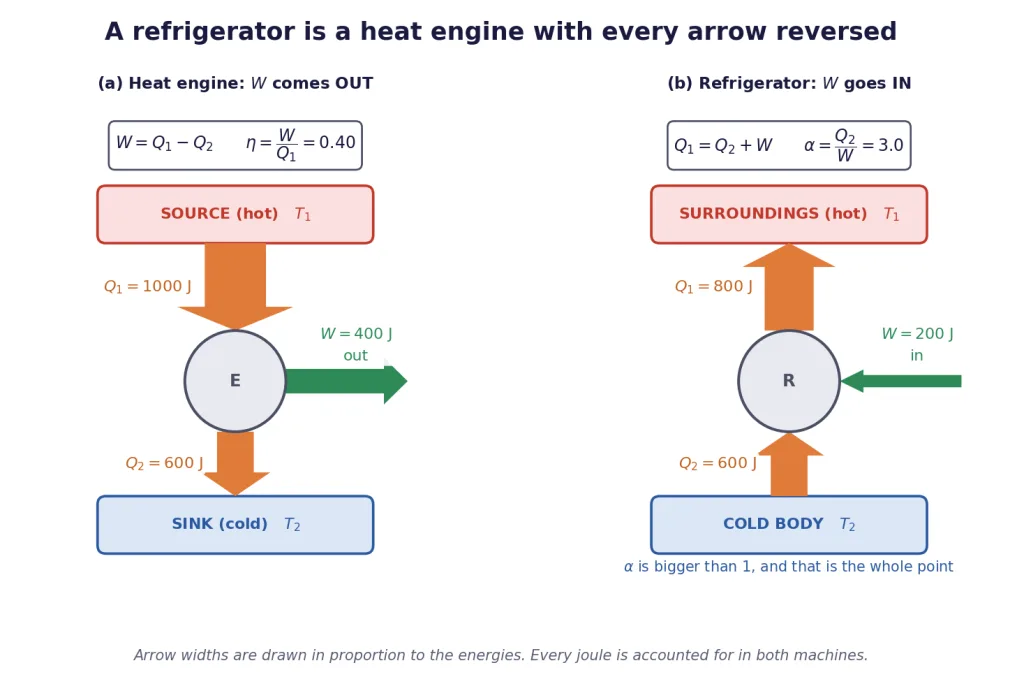
Now do something almost childishly simple. Turn every arrow around.
Instead of letting heat fall from hot to cold and taking work out, we will pay work in, and use it to push heat uphill — from a cold body to a hot one. That machine has two names, depending on which end of it you care about. Care about the cold end and it is a refrigerator. Care about the hot end and it is a heat pump. They are the same machine.
Before we go a step further, one honest note. The coefficient of performance and the heat pump both sit outside the rationalised syllabus body text, yet Boards, JEE and NEET ask about them every year, so this section develops both from first principles rather than assuming you have met them.
What a refrigerator actually is
Key Point — the refrigerator:
A refrigerator is a device that, in a cycle,
- absorbs heat from a body at the lower temperature (the freezer compartment, the room being cooled),
- has work done on it by an external agent (the mains electricity driving the compressor),
- and rejects heat to a body at the higher temperature (the kitchen, the outside air).
Because the working substance returns to its starting state every cycle, over the cycle, and energy conservation gives the whole story in one line:
Notice that we are keeping the chapter's subscripts exactly as Section 2 fixed them: 1 is always the hot side, 2 is always the cold side, whichever direction the energy happens to be moving. That is the whole reason for choosing subscripts by temperature rather than by "in" and "out" — the labels survive when the machine is reversed.
Read the equation before you use it
says something you should be able to say out loud: everything that goes in comes out at the hot end. The heat scraped out of the cold body and the work bought from the electricity board both end up in the same place — the warm surroundings. There is no third destination.
Three consequences follow immediately, and each one is worth a mark somewhere.
- is always bigger than . The hot end always receives more than the cold end gave up, by exactly the amount of work supplied. A refrigerator is a very effective room heater pointed the wrong way.
- can never be zero. If it were, we would have : heat moving from cold to hot with nothing else changing anywhere. Section 8 already told you what that is called. It is forbidden.
- The machine is a cycle, not a one-off. The refrigerant goes round and round; it is never used up. Over one full loop , exactly as for the engine, and that is what makes the bookkeeping so clean.
The sign convention, applied to a reversed cycle
Section 2 fixed the convention for the whole chapter and this section obeys it without exception: is positive when heat is added TO the system and is positive when work is done BY the system.
Apply it to one complete cycle of the refrigerant, taken as the system:
| Quantity | Value | Sign | What it means |
|---|---|---|---|
| — | it is a cycle; the refrigerant is back where it started | ||
| negative | work is done on the gas by the compressor, not by it | ||
| negative | more heat leaves at the hot end than enters at the cold end |
and the first law closes: . Every worked example below carries this ledger, because a refrigerator problem solved without it is a refrigerator problem solved by luck.
[Board Important] The symbols , and in are magnitudes, with their directions carried in words. That is the standard way engine and refrigerator problems are set, and it is why the sign ledger has to be written separately. Never mix the two habits inside one solution.
On a - diagram
Section 7 showed that a clockwise loop encloses positive net work — the gas does work on the world, which is an engine. A refrigerator is the same loop traced anticlockwise. The enclosed area is the same size; the net work is now negative, meaning work has been done on the gas. If a question hands you an anticlockwise cycle, it has handed you a refrigerator, whatever the question calls it.
Why This Does Not Break the Clausius Statement
Every student meets this objection, and most of them meet it silently, in the middle of an exam, and lose confidence at exactly the wrong moment. So let us meet it out loud.
The Clausius statement, from Section 8, says:
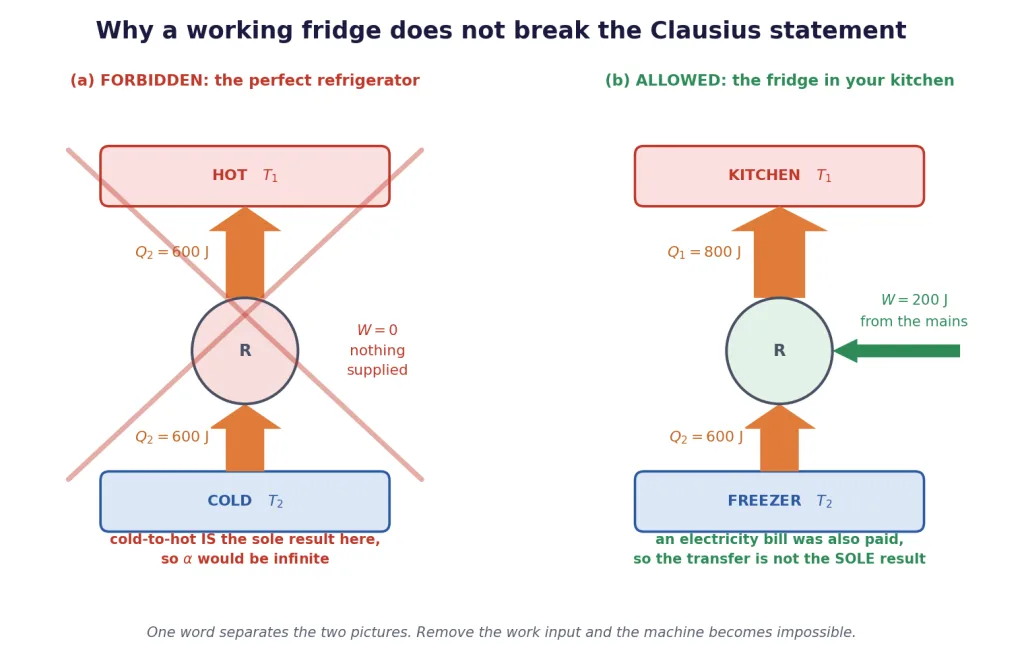
No process is possible whose sole result is the transfer of heat from a colder object to a hotter object.
And here is a refrigerator, taking heat out of a freezer at and delivering it to a kitchen at . Heat has plainly gone from cold to hot. Has the second law just been broken by an appliance you can buy for twenty thousand rupees?
No. And the entire answer is in one word that most students read straight past.
The word is "sole"
Key Point — what "sole" is doing:
Clausius does not forbid heat from moving from cold to hot. It forbids that transfer from being the only thing that happened.In a real refrigerator it is not the only thing that happened. Work was supplied from outside, and the electricity meter recorded it. The surroundings have permanently changed — a bill was paid, a generator burned fuel somewhere. That change is the price, and the second law charges it every single time.
Take the price away and the machine becomes impossible immediately. A device with and would move heat uphill leaving nothing else altered anywhere in the universe. That is the perfect refrigerator, and it is exactly what Clausius denies. Section 8 calls it a perpetual motion machine of the second kind, and no one has ever built one, though a great many people have tried.
The same word, in the same place, in the other statement
This is not a special pleading invented for refrigerators. Look at the Kelvin-Planck statement and you find the identical word doing the identical job: no process is possible whose sole result is the absorption of heat from a reservoir and the complete conversion of that heat into work.
An isothermal expansion converts heat completely into work — and it is allowed, because the gas ends up bigger, which is another result. Take the other result away by insisting on a cycle, and the process becomes impossible.
Key Point: In both statements of the second law, the forbidden thing is a clean transfer or conversion with no side effects. Real machines are always allowed to do the "forbidden" thing as long as they pay for it with a permanent change somewhere else. The second law is not a ban. It is a price list.
What each statement forbids, side by side
| Impossible machine | Which statement forbids it | What it would do |
|---|---|---|
| Perfect heat engine | Kelvin-Planck | take from one reservoir, give out , reject nothing, |
| Perfect refrigerator | Clausius | move from cold to hot with , so would be infinite |
[JEE Tip] A standard one-mark trap: "A refrigerator transfers heat from a cold body to a hot body. Does it violate the second law?" The full-credit answer is no, because work is supplied, so the transfer is not the sole result — and then, if there is room, the sentence "with it would be a perfect refrigerator, which the Clausius statement forbids." Writing only "no, it is allowed" earns nothing.
And the two statements are the same statement
Section 8 asserted that Kelvin-Planck and Clausius are equivalent. You can now see one half of why. Suppose someone hands you a perfect refrigerator — heat from cold to hot, free of charge. Run an ordinary engine alongside it between the same two reservoirs, and set the perfect refrigerator to return to the hot reservoir exactly the heat the engine rejected to the cold one. The cold reservoir now ends every cycle unchanged, and the pair as a whole has taken heat from the hot reservoir alone and turned all of it into work. That is a perfect heat engine, which Kelvin-Planck forbids.
So a perfect refrigerator would hand you a perfect heat engine for free. Break one statement and you break the other. Section 11 uses precisely this style of argument — couple two machines, look at what the pair does — to prove something much more useful.
The Coefficient of Performance
We now need a number that says how good a refrigerator is. The obvious move is to copy the engine and define an efficiency. The obvious move is wrong, and understanding why is the point of this whole block.
What are you paying for, and what are you getting?
For an engine you pay for (the fuel) and you get (the useful work), so . Ask the same two questions about a refrigerator:
- What do you pay for? The electricity. That is .
- What do you get? Heat removed from the cold space. That is .
So the natural figure of merit is divided by , and it gets its own symbol and its own name.
Key Point — the coefficient of performance:
The coefficient of performance of a refrigerator is where is the heat drawn from the cold body per cycle and is the work supplied per cycle. It is a pure number with no units. It is also written or .
The second form comes straight from , and it is the one you want whenever a problem gives you the two heats and not the work.
Why it is deliberately not called an efficiency
Here is the fact that surprises everyone the first time: is routinely bigger than 1. A domestic refrigerator has of about 3 to 5. A good air conditioner is around 3 to 4.
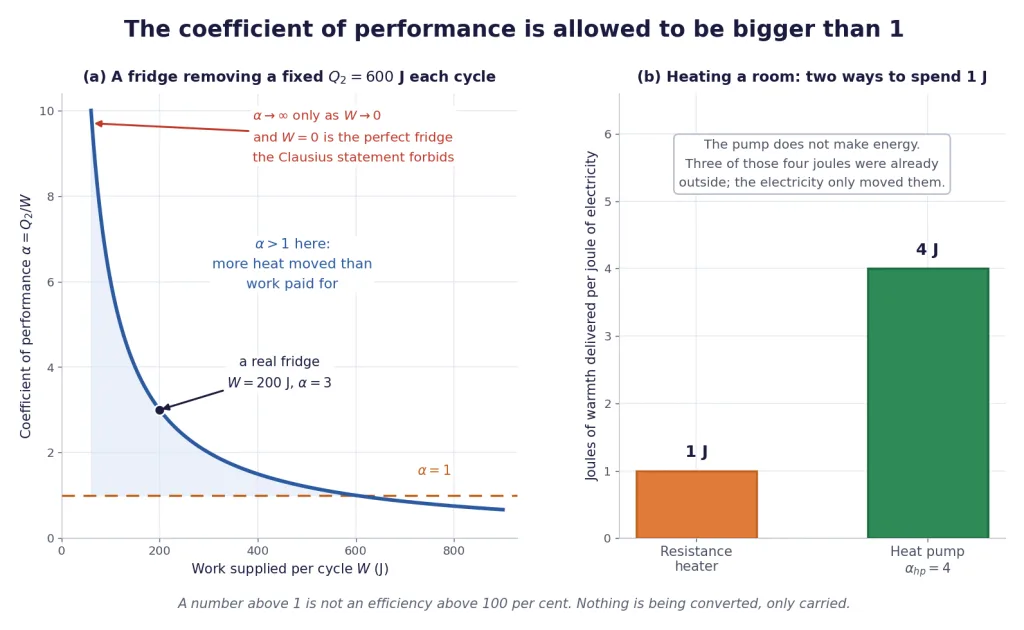
If we had called it an efficiency, would read as "400% efficient", and every physics teacher in the country would have to spend a lesson explaining that no law has been broken. So we do not call it an efficiency. We call it a coefficient of performance, and the name is a deliberate warning label.
Key Point — why is perfectly legal:
Efficiency measures a conversion: how much of the energy you put in came back out in the form you wanted. It can never exceed 1 because you cannot get out more energy than you put in.measures a transport: how much heat you managed to move per joule of work you spent. Nothing is being converted, so there is no conservation law that caps the ratio at 1. Moving four joules of heat for one joule of work is not creating energy — the four joules were already sitting in the food, and the electricity only carried them out.
Never call an efficiency, and never quote it as a percentage.
Why can never be infinite
Look at with fixed. As shrinks, grows, and the only way to make infinite is to make exactly zero.
But is the perfect refrigerator of the previous block — heat from cold to hot as the sole result. The Clausius statement forbids it. So:
Key Point: can be large, and it is usually greater than 1, but it can never be infinite, because that would require and hence a perfect refrigerator. Section 11 goes further and puts an exact finite ceiling on for any two given temperatures.
That single sentence — the coefficient of performance of a refrigerator can never be infinite — is the standard way the second law is stated for refrigerators, and it is the exact counterpart of the efficiency of a heat engine can never be unity.
The bridge to efficiency
The same hardware, run forwards, would be an engine with efficiency . Divide top and bottom of by :
using from Section 9. Turn it round and you get .
[JEE Tip] is one of the highest-yield one-liners in the chapter. Read what it says: a good engine makes a poor refrigerator. Push towards 1 and collapses towards 0; push towards 0 and blows up. The two jobs pull in opposite directions, because a big means very little heat reaches the cold end, which is exactly the wrong thing for a refrigerator.
Typical magnitudes worth carrying in your head
| Machine | typical | meaning |
|---|---|---|
| Domestic refrigerator | 3 to 5 | 3 to 5 J of heat pulled out per joule of electricity |
| Deep freezer (much colder inside) | 2 to 3 | colder target, so the same work buys less |
| Room air conditioner | 3 to 4 | 1 kW of electricity moves 3 to 4 kW of heat |
| Water cooler | 3 to 4 | similar temperatures, similar performance |
These are order-of-magnitude figures, not exam data — but the pattern in the last column is examinable. The colder you want the cold space, the smaller becomes, because you are pushing the heat further uphill. A freezer set to costs more per joule removed than the same freezer set to , and Section 11 makes that precise.
The Heat Pump: The Same Machine, Sold the Other Way Round
A refrigerator throws into the kitchen and nobody wants it. Now imagine standing on the other side. Put the cold coils outside the house in winter and the hot coils inside, and that unwanted becomes exactly what you are paying for.
The machine has not changed by a single component. Only what you value has changed. Sold this way it is called a heat pump.
Its coefficient of performance
Same two questions:
- What do you pay for? Still the electricity: .
- What do you get? Now the heat delivered to the warm space: .
Key Point — the heat pump:
A heat pump is a refrigerator valued for the heat it delivers to the hot reservoir rather than the heat it removes from the cold one. Its coefficient of performance is and since ,
That last line is worth memorising exactly as it stands.
Key Point: For the same machine between the same two reservoirs, the heat-pump coefficient is always exactly one greater than the refrigerator coefficient. Not "about one greater" — exactly, because the extra joule delivered per joule of work is the work itself, which ends up in the hot space along with everything else.
An immediate and useful corollary: since , we always have . A heat pump can never deliver less warmth than the electricity you fed it. At its very worst it matches a heater; in practice it beats one by a factor of three or four.
Make that concrete, because this is the part that sticks
Suppose a heat pump consumes 750 J of electrical work per cycle and delivers 3000 J of heat to a room.
So of the 3000 J warming the room, 750 J came from the wall socket and 2250 J was scooped out of the cold air outside. Now put a plain resistance heater in the same room and give it the same 750 J of electricity. It delivers 750 J of heat. Exactly 750 J — a heater is a device for converting electrical work into heat, and conversion is capped at 1.
Key Point — the headline:
An electric heater turns 1 J of electricity into 1 J of warmth. A heat pump delivers three or four joules of warmth per joule of electricity, and no heater can ever do that.It is not creating energy. Three of those four joules were already outside in the cold air; the electricity only paid the transport charge for bringing them indoors. That is why heat pumps are the standard way of heating buildings in cold countries, and why the same box, flipped, is the air conditioner in your classroom.
One box, two seasons
A reversible air conditioner (sold as an "inverter AC with heating mode") does exactly this. A four-way valve swaps which coil is inside and which is outside.
| Season | Which coil is indoors | You pay for | You are getting | Figure of merit |
|---|---|---|---|---|
| Summer | the cold one (evaporator) | heat removed, | ||
| Winter | the hot one (condenser) | heat delivered, |
[NEET Important] Read a question carefully enough to know which coefficient it wants. "Heat removed from the cold reservoir" is ; "heat supplied to the room" is . The two differ by exactly 1, and that difference is the commonest single-mark loss on this topic.
A summary of every relation in this section
| Quantity | Formula | Notes |
|---|---|---|
| Energy balance | over one cycle | |
| Refrigerator | usually ; never infinite | |
| Heat pump | always | |
| Link to the engine | , | of the same cycle run forwards |
Inside a Real Refrigerator, and the Open-Door Question
The physics so far has been three symbols and one equation. Here is the hardware they describe, because Boards ask for it in words and because it makes the equation memorable.
The four components, in the order the refrigerant meets them
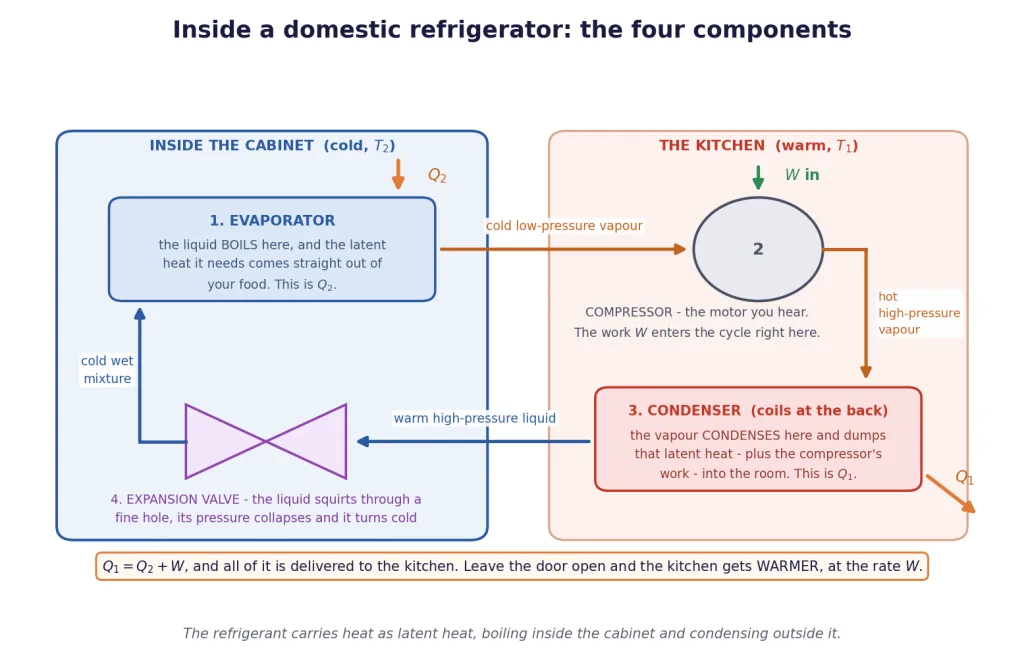
A sealed loop of pipe carries a refrigerant — a substance chosen because it boils at a conveniently low temperature under modest pressure. It goes round and round for ever; none of it is consumed.
- The evaporator — the coils inside the cabinet. The refrigerant arrives as a cold low-pressure liquid and boils. Boiling needs latent heat, and the only place to get it is from the air, the walls and the food inside the box. This is . The food gets colder because its heat has been spent turning liquid into vapour.
- The compressor — the motor you hear humming, usually at the back near the floor. It squeezes the cold low-pressure vapour into a hot high-pressure vapour. This is where the work enters the cycle, and it is the only place any energy is paid for.
- The condenser — the black grille on the back of the fridge, or the outdoor unit of an air conditioner. Here the hot high-pressure vapour condenses back to a liquid, giving up its latent heat to the room. This is — the latent heat from the evaporator plus the compressor's work, which is why the grille is warm to the touch and why you must never push a fridge flat against a wall.
- The expansion valve — a deliberately narrow constriction. The warm high-pressure liquid squirts through it, its pressure collapses, and it cools sharply. It comes out cold enough to boil in the cabinet again, and the loop closes.
Key Point — the mechanism in one sentence: The refrigerant carries heat as latent heat, absorbing it by boiling inside the cold space and releasing it by condensing outside, while the compressor supplies the work that makes the round trip possible and the expansion valve resets the pressure.
[Board Important] A frequent two-mark question is simply "name the four main parts of a refrigerator and state the function of each." Answer in the flow order above and say latent heat at the evaporator and the condenser. That word is what separates a full-mark answer from a half-mark one.
Why the freezer is at the top of an old fridge
A small bonus that Section 9 of the previous chapter would recognise: the evaporator was traditionally placed at the top because the air it chills becomes denser and sinks, setting up a convection current that cools the whole cabinet without a fan. Put the cold plate at the bottom and the cold air would just sit there.
The open-door question
Now the famous one, and it is worth doing carefully because the wrong answer feels so obviously right.
Can you cool a closed, well-insulated kitchen by leaving the refrigerator door open and switching it on?
Think about where the energy actually goes. Draw a boundary around the whole kitchen, fridge included, and count what crosses it. With the door open, the "cold body" and the "hot surroundings" are now the same room, so:
- the evaporator removes from the room's air;
- the condenser puts back into the room's air;
- and .
The net heat delivered to the room per cycle is
Key Point — the open-door result:
Leaving the refrigerator door open in a closed room does not cool the room. It warms it, at exactly the rate at which the compressor consumes electrical power. A 200 W refrigerator with its door open is a 200 W room heater — a slightly noisy one that also blows a small cold draught at your feet while heating everything else.
Nothing about enters that answer. A better refrigerator, with a larger , moves more heat round the loop — 800 W out of the box and 1000 W back into the room if and W — but the net is still exactly , because that is the only energy crossing the kitchen's boundary from outside.
[JEE Tip] The same trick answers a family of questions. An air conditioner is placed in the middle of a sealed room instead of in the window — what happens? It heats the room, at the rate of its electrical power draw. An air conditioner only cools because its condenser is outside, so leaves the room and only is taken from it, giving a net cooling rate of per unit time. Move the boundary and the answer flips: that is the whole skill being tested.
Where the "cooling" actually happens, then
A working refrigerator does not destroy heat and an air conditioner does not create cold. Both are pumps. They pick heat up in one place and put it down in another, and they charge you work for the trip. Every joule you ever removed from your food is, right now, somewhere in the air of your kitchen — along with every joule the compressor ever drew from the mains.
Solved Examples
Constants used throughout, unless a problem says otherwise: latent heat of fusion of ice J/kg, specific heat capacity of water J/(kg K), K, 1 kWh J.
Example 1: A refrigerator, from the ground up
A refrigerator removes 600 J of heat from its freezer compartment in each cycle while the compressor does 200 J of work on the refrigerant. Find (a) the heat rejected to the kitchen per cycle, (b) the coefficient of performance, and (c) write out the first-law sign ledger for one cycle.
Solution:
Identify the three quantities by the chapter's labels. The cold body is the freezer, so the heat drawn from it is J. The hot body is the kitchen, so the heat delivered there is . The work supplied is J.
(a) Energy balance. Over one cycle the refrigerant returns to its initial state, so and everything that entered must leave: More comes out at the kitchen end than went in at the freezer end, by exactly the work supplied. That is always true.
(b) Coefficient of performance: Three joules of heat moved out of the food for every joule bought from the mains. Greater than 1, and entirely legal — nothing is being converted, only carried.
(c) The sign ledger, taking the refrigerant as the system:
| Quantity | Value | Sign | Physical meaning |
|---|---|---|---|
| J | — | a complete cycle: the refrigerant is back where it began | |
| J | negative | work was done on the gas by the compressor | |
| J | negative | net heat left the refrigerant over the cycle |
Check: . The first law closes exactly.
- A bonus you get for free. , so if this same machine were used to warm the kitchen it would deliver 800 J of warmth per 200 J of electricity.
Final Answer: (a) J rejected to the kitchen; (b) ; (c) , J (done on the gas), J (net heat out).
Takeaway: and solve most refrigerator problems between them. Write the ledger anyway — it is what stops you calling positive out of habit.
Example 2: Working backwards from the coefficient of performance
A refrigerator has a coefficient of performance of 5.0. In each cycle it extracts 500 J of heat from the cold chamber. Find the work that must be supplied and the heat rejected to the surroundings.
Solution:
Rearrange the definition rather than guessing:
Then the energy balance:
Signs, briefly: over the cycle; J because the work is done on the refrigerant; J, net heat out. The residual is zero.
Sanity check on the size. is a good but perfectly ordinary domestic figure, and came out much smaller than , as it must whenever .
Final Answer: J of work supplied per cycle; J rejected.
Takeaway: A large means a small for a given . If your work ever comes out larger than the heat removed while , you have divided the wrong way round.
Example 3: Freezing water, and the power it takes
A freezer must turn 1.0 kg of water, already at , into ice at in 20 minutes. Its coefficient of performance is 4.0 and the latent heat of fusion of ice is J/kg. Find the heat that must be removed, the work required, the electrical power of the compressor, and the heat delivered to the kitchen.
Solution:
The heat to be removed is all latent, because the water is already at the freezing point and only has to change state: No term appears — the temperature never changes.
The work required, from :
Power is work per unit time. Twenty minutes is s:
Heat delivered to the kitchen: The kitchen receives more than the ice tray gave up, and it always will.
Signs: ; J, done on the refrigerant; J, net heat out of the refrigerant. Residual zero.
Final Answer: J removed; J; compressor power W; J into the kitchen.
Takeaway: Ask whether the heat to be removed is latent, sensible, or both, before you touch . Water already at needs only ; water at room temperature needs first, as Example 10 shows.
Example 4: The same machine, forwards and backwards
A heat engine working between two reservoirs has an efficiency of 25%. It absorbs 1200 J from the source per cycle. The identical cycle is now run in reverse as a refrigerator between the same two reservoirs. Find the work, the heat exchanged at each end, the coefficient of performance as a refrigerator and as a heat pump.
Solution:
As an engine. With and J,
Reverse every arrow. The magnitudes are unchanged; only the directions flip. The machine now takes J from the cold reservoir, is given J of work, and delivers J to the hot reservoir.
As a refrigerator: Check it against the shortcut derived in the notes:
As a heat pump: and equally .
Signs, as a refrigerator: ; J (on the gas); J. Closes.
Final Answer: J, J, J; and .
Takeaway: and convert an engine problem into a refrigerator problem in one line. Both are worth memorising, and both fall straight out of .
Example 5: A heat pump against an electric heater
A heat pump delivers 3000 J of heat to a room in each cycle while consuming 750 J of electrical work. Find , the heat drawn from the cold outside air, and the coefficient of performance the same machine would have as a refrigerator. Compare its performance with a resistance heater given the same 750 J.
Solution:
Heat-pump coefficient, because what we are buying is the heat delivered:
Heat drawn from outside:
As a refrigerator:
Against a resistance heater. A heater converts electrical work into heat, and conversion is capped at 1, so 750 J of electricity gives exactly 750 J of warmth. The pump gave 3000 J for the same money — a factor of better.
Where did the extra 2250 J come from? Not from nowhere. It was already in the cold air outside; the electricity paid only for carrying it indoors. That is transport, not creation, and no conservation law is threatened.
Signs: ; J; J. Residual zero.
Final Answer: ; J from outside; ; the heat pump delivers four times the warmth of a heater on the same electricity.
Takeaway: A heater's "efficiency" of 1 is a ceiling; a heat pump's of 4 is not an efficiency at all. Comparing them directly is the whole point of the example, and it is the standard exam framing.
Example 6: What a heat pump saves you in a winter
A house loses heat to the outside and needs J of heat delivered per day to stay comfortable. Compare (a) a heat pump with and (b) an electric resistance heater, in terms of the electrical energy each needs per day and the daily running cost at Rs 8 per kWh. Take 1 kWh J.
Solution:
The heat pump's electrical requirement. We want J delivered, so In kWh:
The heater's electrical requirement. It must supply every joule itself:
Daily cost at Rs 8 per kWh: a saving of Rs 38.10 per day, or a factor of exactly .
Where the rest comes from. The pump also drew out of the cold outdoor air, free of charge.
Signs: over each cycle; is negative (work done on the refrigerant); is negative, and equal to . Residual zero.
Final Answer: Pump 1.905 kWh (Rs 15.24) per day; heater 6.667 kWh (Rs 53.33) per day; saving Rs 38.10 per day.
Takeaway: The cost ratio between a heat pump and a heater is exactly . Convert to kWh before you multiply by a tariff, and remember that 1 kWh is J, not J.
Example 7: The refrigerator door left open
A refrigerator with is left with its door open inside a well-insulated kitchen that exchanges no heat with the outside. Its compressor draws 200 W. Find (a) the rate at which heat is pulled out of the cabinet, (b) the rate at which heat is dumped at the condenser, (c) the net rate at which the kitchen gains heat, and (d) the heat gained by the kitchen in one hour.
Solution:
Work the rates exactly as you would work energies per cycle — every relation is linear, so watts behave like joules here.
(a) Heat removed from the cabinet:
(b) Heat dumped at the condenser:
(c) The net effect on the kitchen. With the door open, the cabinet's air is kitchen air. So the kitchen loses 800 W at the evaporator and gains 1000 W at the condenser: The kitchen warms up, at exactly the compressor's electrical power. Notice that cancelled out completely: the net is whatever the machine's quality.
(d) In one hour:
Why it must be so. Draw the boundary around the whole kitchen. The only energy crossing it from outside is the electrical work entering the compressor. Everything else is internal shuffling. Energy conservation then leaves no other possible answer.
Final Answer: (a) 800 W out of the cabinet; (b) 1000 W into the room at the coils; (c) net gain of 200 W, so the kitchen warms; (d) J in an hour.
Takeaway: Choose the boundary first, then count only what crosses it. An open fridge is a heater of exactly its own electrical rating, and a better does not change that by one watt.
Example 8: A refrigerator read off an anticlockwise cycle
An ideal gas is taken round a closed cycle in the anticlockwise sense on a - diagram. During the low-temperature part of the loop it absorbs 900 J of heat, and during the high-temperature part it rejects 1500 J. Find the net work and its direction, identify what the machine is, and find its coefficient of performance as a refrigerator and as a heat pump.
Solution:
Start from the cycle condition. is a state function, so around any closed loop
Add the heats with their signs, using this chapter's convention ( means heat added to the gas): Negative, so over the full cycle heat has left the gas on balance.
Therefore the work: Negative, which by our convention means 600 J of work was done ON the gas by the surroundings. That is exactly what an anticlockwise loop must give, and it is why an anticlockwise loop is a refrigerator.
Identify the labels. The heat absorbed at the low temperature is J; the heat rejected at the high temperature is J; the work supplied is J. Check the balance:
The two coefficients:
Sign ledger: , J (on the gas), J (net out). Residual zero.
Final Answer: J, i.e. 600 J done on the gas; the machine is a refrigerator; and .
Takeaway: An anticlockwise loop on a - diagram is a refrigerator, always. Add the heats with their signs, set , and the negative answer tells you the direction without any further thought.
Example 9: An air conditioner, in rates
A room air conditioner removes heat from a room at 3.5 kW while drawing 1.0 kW of electrical power. Find its coefficient of performance, the rate at which it dumps heat outdoors, and the electrical energy consumed and heat removed in 8 hours of running.
Solution:
Coefficient of performance:
Rate of heat dumped outdoors: The outdoor unit has to get rid of more than the room ever contained — that is why it is the noisy, hot part of the machine.
In 8 hours, which is s: and
Why the room actually cools. Unlike Example 7, the condenser here is outside the room. The room loses and gains nothing back, so the net cooling rate is the full 3.5 kW.
Signs: ; J over the eight hours; J. Residual zero.
Final Answer: ; 4.5 kW dumped outdoors; in 8 hours, 8.0 kWh consumed, J removed from the room and J dumped outside.
Takeaway: Coefficients of performance work identically with powers and with energies, because every relation between them is linear. Just keep all three quantities in the same units.
Example 10: Cooling and then freezing
A refrigerator with must cool 2.0 kg of water from to and then freeze it completely, in 30 minutes. Take J/(kg K) and J/kg. Find the total heat removed, the work required, the average compressor power, and the heat delivered to the kitchen.
Solution:
Two stages, so two terms. First the sensible heat, cooling the water to the freezing point: The temperature difference is 25, the same number in kelvin and in Celsius, because only a difference appears.
Then the latent heat, freezing it at :
Total heat that must be removed from the water: Notice the latent stage is more than three times the sensible stage. Freezing is the expensive part.
Work required:
Average power over s:
Heat delivered to the kitchen:
Signs: ; J; J. Residual zero.
Final Answer: J; J; average power W; J into the kitchen.
Takeaway: Do the calorimetry first and the refrigerator physics second. never touches the water; it only converts the heat you must remove into the work you must pay for.
Example 11: What it costs to set the freezer colder
A refrigerator has at its normal setting. Turned down to a much colder setting, while the kitchen stays at the same temperature, its coefficient of performance falls to 2.5. In both cases it must still remove 2000 J of heat per cycle from the cabinet. Find the work required in each case, the extra work per cycle, and the heat rejected in each case.
Solution:
At the normal setting:
At the colder setting:
The extra work: The coefficient of performance halved, so the work for the same job doubled. The bill doubles with it.
Why fell. The kitchen temperature did not move, but the cabinet temperature did — downwards. The refrigerator is now pushing the same heat up a steeper hill, and hills cost work. Section 11 turns this qualitative statement into the exact formula for the best any machine can have between two given temperatures.
Signs, at the colder setting: ; J; J. Residual zero.
Final Answer: J at and J at ; 400 J extra per cycle; heat rejected 2400 J and 2800 J respectively.
Takeaway: Halving doubles the work for the same cooling job. This is why a deep freezer costs so much more to run than a fridge that only has to reach .
Example 12: One machine, two seasons
A reversible air conditioner has when used for cooling in summer. In winter it is switched to heating mode, working as a heat pump between the same pair of temperatures. Find (a) the work needed in summer to remove 5000 J of heat from the room, and (b) the work needed in winter to deliver 5000 J of heat to the room, together with the heat drawn from outdoors in that case.
Solution:
(a) Summer — the machine is a refrigerator. What we want is heat removed, so the relevant coefficient is :
(b) Winter — the same machine is a heat pump. What we want now is heat delivered, so the relevant coefficient is
Heat drawn from the outdoor air in winter: So more than three-quarters of the winter warmth was carried in from outside for free.
Read the two answers side by side. Delivering 5000 J of warmth is cheaper than removing 5000 J of coldness on the very same hardware — 1190.5 J against 1562.5 J — for one reason only: in heating mode the compressor's own work also ends up in the room, so it is not wasted. That is the whole content of .
Signs, in either mode: over a cycle; is negative because the compressor does work on the refrigerant; , also negative. Residual zero in both cases.
Final Answer: (a) J in summer; (b) J in winter, drawing 3809.5 J from outside.
Takeaway: Decide which coefficient the question wants before you divide. "Removed from the room" is ; "supplied to the room" is . Those two words are worth a mark every time this topic appears.