
What JEE Adds to This Chapter
Sections 1 to 12 built this chapter properly. The first law, the two specific heats, the - diagram, the four processes, the second law, engines, refrigerators and the Carnot ceiling are all in place, and for the Board paper that build is complete.
What JEE adds is almost no new physics. It is still , still , still , still . What changes is that the process stops being one of the four tidy ones you were given a formula for.
The one idea that organises this whole section
Here it is, up front, because everything below is a variation on it.
Key Point — the four processes are one process. Every quasi-static path we have met satisfies for some fixed number , called the polytropic index. Isobaric is . Isothermal is . Adiabatic is . Isochoric is . They are not four unrelated cases with four unrelated formulas; they are four points on one line, and one pair of formulas covers all of them:
Once you see that, a question about "a gas taken along constant" stops being exotic. It is the same problem as an adiabat with a different exponent, and you already know how to do it.
A note on symbols before we go further: is the number of moles everywhere in this chapter, so where the polytropic index and the mole count appear in the same line, the index is written . Everywhere the meaning is obvious from context, a bare in is the index.
Some of what follows sits outside the rationalised syllabus body text — polytropic processes, the effective of a mixture, coupled machines — but JEE Main and JEE Advanced ask this material every year, so it is developed here from first principles.
The ten things this section teaches
| # | Skill | Why it earns marks |
|---|---|---|
| 1 | Work along an arbitrary path — a straight line, a parabola, anything | The area must be integrated; a chord read off a curve is simply wrong |
| 2 | The polytropic family and | One formula replaces four, and it explains negative molar specific heats |
| 3 | Mixtures of gases and the effective | Two lines of algebra, and the plain average is never the answer |
| 4 | Two chambers with a partition, a movable piston or a conducting wall | Gas law plus energy conservation, and knowing which is fixed |
| 5 | Adiabatic free expansion into vacuum | The one place where but does not apply |
| 6 | A gas column trapped by a mercury thread or a spring-loaded piston | Mechanics and the gas law in the same problem |
| 7 | Three- and four-leg cycles | The efficiency has to be assembled leg by leg; it cannot be quoted |
| 8 | Engines and refrigerators coupled in series | The composite machine, and where the intermediate temperature sits |
| 9 | The Carnot relation used backwards | Two efficiencies, two unknown temperatures, one linear pair |
| 10 | The four standing traps | Celsius in a ratio, forgotten, misread, conventions mixed |
Conventions, fixed now
This section uses the chapter's convention and symbol table without exception. Restating the five that matter most here:
This section's sign convention: is positive when heat is added TO the system; is positive when work is done BY the system. The first law is therefore Your chemistry course writes with the work done ON the system — the same physics with one sign moved. Translate it once and then forget it; every line below uses the form above.
- is an absolute temperature in kelvin, always. Write or for Celsius. Every ratio, every gas-law step, every efficiency needs kelvin.
- is the source (hot), the sink (cold), and is absorbed from the source while is rejected to the sink. They are also written and ; the subscripts here never swap.
- is the number of moles (also written ), J/(mol K).
- and are molar specific heats in J/(mol K); . Lower case , are per kilogram.
- is efficiency and is coefficient of performance. is never called an efficiency; it routinely exceeds 1.
Constants used throughout, unless a problem states otherwise:
| Quantity | Value |
|---|---|
| J/(mol K) | |
| , monatomic | |
| , diatomic | |
| , polyatomic | about |
| , monatomic | J/(mol K) |
| , diatomic | J/(mol K) |
| , monatomic | J/(mol K) |
| , diatomic | J/(mol K) |
| 1 atm | Pa |
| K | |
| , , | , , |
Every solution restates the constants it uses. No problem here mixes two values of the same constant.
[Exam Tip] Four questions, asked before any algebra, choose the method for almost every problem below. What is held fixed — pressure, volume, temperature, heat, or nothing at all? Is the path drawable, or is the process a sudden irreversible jump? Are the temperatures in kelvin? Does the answer I am about to write have a sign, and does that sign mean what I think it means? Answer those four and you have chosen your method before writing a symbol.
Work Along an Arbitrary Path
Section 5 established the statement everything here rests on: the work done by a gas along a quasi-static path is
which is the area under the path on a - diagram. For the four standard processes you were handed the answer. Here you are not.
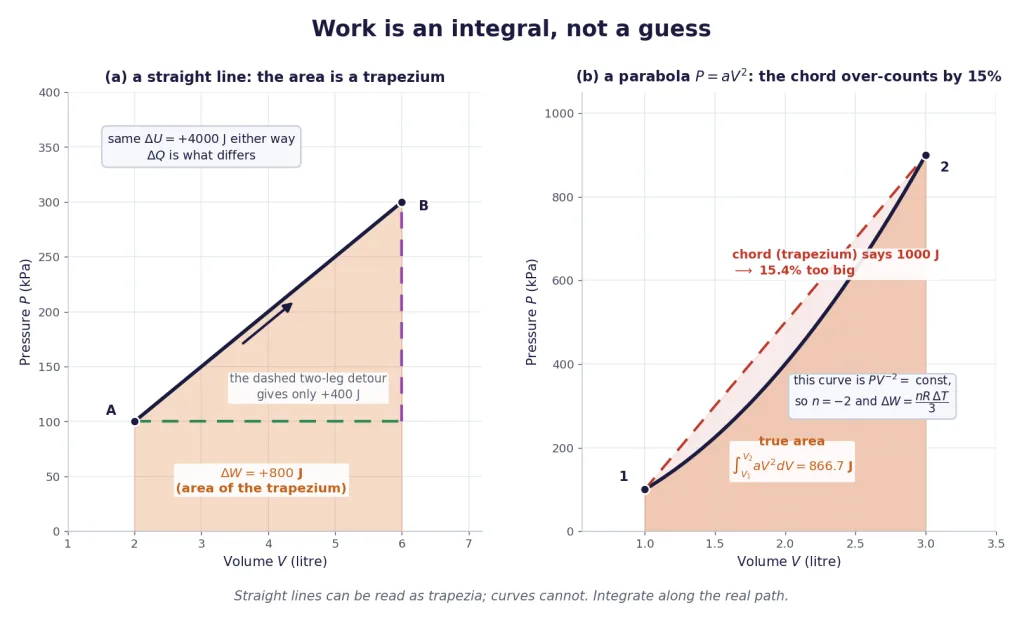
A straight line: the one curve you may read off
If a question gives you a path that is a straight segment from to , the area under it is a trapezium and you do not need calculus:
Key Point — the straight-line path: This is exact, because the average of a linear function over an interval is the average of its end values. It is the only curve for which the chord trick is exact.
The internal energy change comes free, because depends only on the end states:
That last form is worth memorising. It needs no value of and no temperatures — just the two corners of the path and . Half the marks in this section are picked up by people who know it.
Anything else: integrate
For any other path you must actually do the integral. The recipe never changes:
- Get as a function of on that path.
- Integrate from to .
- Attach the sign: positive if the volume increased, negative if it fell.
Two examples of step 1, both of which appear in the solved problems below:
- A parabola . Then .
- A spring-loaded piston. The spring compression is proportional to the volume swept, so is linear in and the trapezium rule applies after all.
Key Point — the chord is not the curve. For the parabola in the figure, the true area is 866.7 J and the chord (trapezium) estimate is 1000 J. That is 15.4% too high, which in a four-option question is enough to land you cleanly on a distractor. Read a chord off only when the path really is a straight line.
The maximum temperature on a sloping path
A favourite. A gas is taken along a straight line of negative slope, and you are asked for the highest temperature it reaches. Since , and falls linearly while rises, the product has an interior maximum.
Write on the path. Then
which is a downward parabola in , maximised at , that is at
Read the middle one physically: the temperature peaks exactly where the pressure has fallen to half its intercept value. If that lies outside the segment you were given, the maximum is at an end point instead — always check.
[Exam Tip] Before integrating anything, ask whether the path happens to be a polytropic one, constant. A parabola is constant; a straight line through the origin is constant. If it is, the next block's single formula does the integral for you in one line and also hands you the heat.
The Polytropic Family, and the Specific Heat That Comes With It
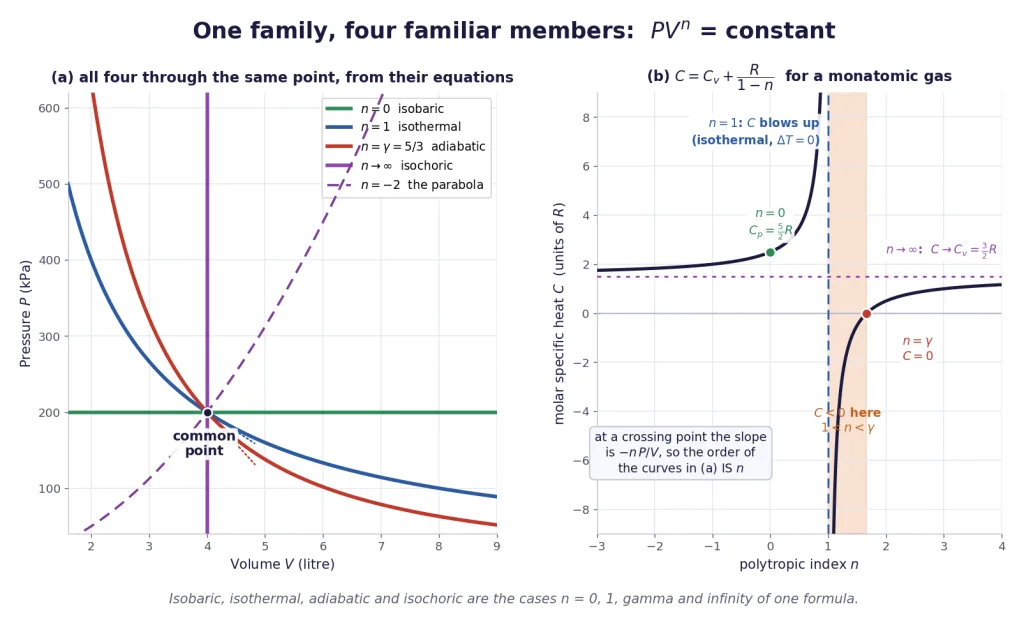
The work, in one line
Take a path , with any fixed real number except 1. Then and
Now use to collapse each term, and then :
Key Point — polytropic work: Put and it becomes , the isobaric result. Put and it becomes , the adiabatic result. The isothermal case is the one exception, where the integral gives a logarithm instead: .
The molar specific heat
Now feed that into the first law. Over the path, always, and by definition the molar specific heat of the process is . So
and dividing through by :
Key Point — the polytropic molar specific heat: Check it against everything you know. gives . gives , correct, because an isothermal process absorbs heat with no temperature change at all. gives , correct, because an adiabatic process changes temperature with no heat at all. gives , the isochoric case. Four checks, four ticks.
The negative specific heat, which is real
Look at the formula again for . The second term is negative and bigger in size than , so
A gas can absorb heat and get colder. That is not a misprint and it is not a violation of anything. The gas is expanding so vigorously that the work it does exceeds the heat you supply, and the shortfall comes out of its internal energy. Panel (b) of the figure shades exactly that window.
The panel also shows the two branches. Outside , is positive; inside, it is negative; at the two ends it passes through and respectively.
A comparison table you can rebuild in ten seconds
| Process | Path on - | |||
|---|---|---|---|---|
| Isobaric | horizontal line | |||
| Isothermal | rectangular hyperbola | infinite | ||
| Adiabatic | steeper hyperbola-like | |||
| Isochoric | vertical line | |||
| General | in between |
The slope of a polytropic curve at any point is
so at a point where several of these curves cross, the steepness is in the order of — which is exactly why the adiabat is steeper than the isotherm by the factor , as Section 6 showed. That result is not a separate fact; it is this one formula with two values put in.
[Exam Tip] If a question tells you the molar specific heat of a process instead of naming the process, invert the formula: . A gas with that is monatomic, for instance, has , so the path is constant, and now you can do the work integral.
Mixtures of Gases, and the Effective Gamma
Put moles of one ideal gas and moles of another into the same container and heat the mixture. What is for the mixture?
It is not the average of the two values of . That is the single most common wrong answer here, and the reason is easy to see: is a ratio, and ratios do not average. What averages is the thing that is actually additive — the energy.
Deriving it from energy, which always works
Raise the whole mixture by at constant volume. Each gas takes its own share of heat and none of them does any work, so the heats simply add:
Key Point — the mixture's specific heats: Both are mole-weighted averages. And because Mayer's relation holds for each gas separately, it holds for the mixture too, so you only ever need to compute one of them:
The compact form worth memorising
Substituting for each gas turns the weighted average into something much easier to use under time pressure:
Key Point — the mixture identity: It extends to any number of gases with the obvious extra terms. Read it as: the quantity is additive, which is true because is the mixture's total heat capacity at constant volume.
Worth checking on a case you already know: 1 mole of helium () with 1 mole of hydrogen () gives , so and exactly. The plain average would have said — close enough to be tempting and wrong enough to be a distractor.
What you can and cannot do with the mixture
Once you have and , the mixture behaves like one ideal gas with those constants. Every formula in the chapter applies: with , adiabatic relations with , polytropic work with , all of it.
Two cautions:
- The gases must be non-reacting and each must be ideal. Chemistry is not invited.
- Molar masses do not enter any of this. If a question hands you masses in grams, convert to moles first, and if it asks for the specific heat per kilogram you divide at the very end by the mean molar mass .
[Exam Tip] Two monatomic gases mixed in any proportion still give , and two diatomic gases still give . The formula is only interesting when the gases differ in atomicity. If a question mixes helium with neon and offers you , it is testing whether you noticed they are both monatomic.
Two Chambers, Pistons, and a Column of Trapped Gas
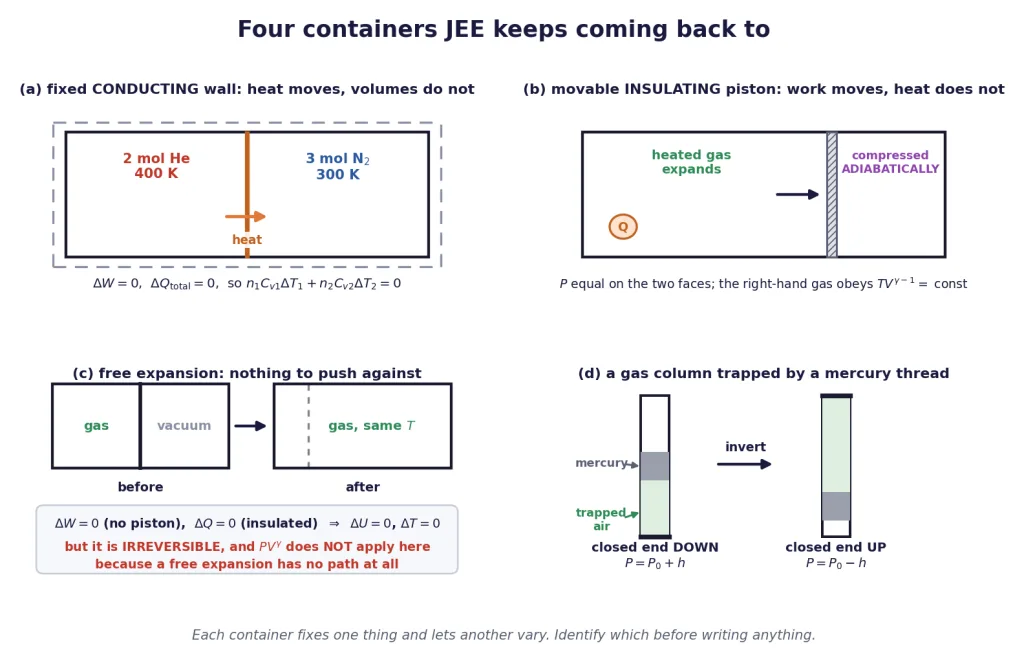
Every one of these problems is solved the same way: list what the wall or the piston forbids, and write one equation for each thing it allows.
The reading key
| The divider is | It forbids | So the equation you write is |
|---|---|---|
| Fixed and conducting | any volume change | becomes common; energy conservation |
| Fixed and insulating | volume change and heat flow | nothing happens at all; each side keeps its own state |
| Movable and conducting | a pressure difference, and a temperature difference | and both become common; total volume fixed |
| Movable and insulating | a pressure difference | becomes common; each side follows its own adiabat |
| Removed entirely | nothing | the gases mix; use mole-weighted and energy conservation |
Alongside that, two conservation laws are always available in a rigid, insulated outer vessel: because the outer walls never move, and because nothing crosses them. The first law for the whole vessel then reads — the two sides' internal-energy changes must cancel exactly. That single statement solves most of these problems.
Key Point — the fixed conducting wall. Two gases at and in a rigid insulated vessel, separated by a fixed conducting partition, reach a common temperature a heat-capacity-weighted average. Note what it is not: it is not the plain average of the temperatures, and it is not mole-weighted either, unless the two gases happen to have the same .
The movable insulating piston
Here the two sides are not at the same temperature, and that is the whole point. What they share is pressure, because a massless frictionless piston cannot support a pressure difference.
If the piston is moved slowly, the compressed side undergoes a reversible adiabatic compression, so constant applies to it. Its temperature rises, and it is that rise which tells you the final pressure. The heated side then follows from with the pressure it now shares and the volume it now occupies.
And a piece of accounting that saves a lot of time: with a massless piston, the work done by the gas on one side equals the work done on the gas on the other side. If the left gas does then the right gas does . Nothing is stored in the piston.
The spring-loaded piston
Now the piston pushes back against a spring as well as the atmosphere. Force balance on the piston at any displacement gives
Since , the pressure is linear in volume, so the work is a trapezium area after all. There is a beautiful cross-check available:
Key Point — work with a spring: The second form says the gas pays the atmosphere and puts into the spring. Compute both and check they agree — they always do, and a disagreement is a caught error.
A gas column trapped by mercury
A capillary tube, closed at one end, holds an air column shut in by a thread of mercury of length . The pressure of the trapped air, in centimetres of mercury, depends only on where the mercury sits relative to the gas:
| Orientation | Trapped-gas pressure |
|---|---|
| Closed end down, mercury above the gas | |
| Closed end up, mercury below the gas | |
| Tube horizontal |
Read it as a free-body statement about the mercury: the gas has to hold the mercury up when the mercury is above it, so the gas pressure exceeds atmospheric; the gas is hanging below the mercury when the closed end is up, so its pressure falls short by the same . Then apply Boyle's law if the temperature is fixed, or the full gas law if it is not.
Two things to check every single time:
- Does the mercury spill? The gas column plus the mercury thread must still fit inside the tube. If they do not, mercury runs out of the open end and itself changes.
- Are you in consistent units? Working the whole problem in centimetres of mercury is legitimate and much faster, provided every pressure in it is in centimetres of mercury.
[Exam Tip] In these problems the trapped column's length is a stand-in for its volume, because the bore is uniform. So replaces and you never need the cross-section at all. If a question gives you the bore area, it is either irrelevant or it wants a mass, not a pressure.
Free Expansion, Assembled Cycles, and Machines in Series
Adiabatic free expansion: the process with no path
A rigid, insulated vessel is divided in two. One half holds gas, the other is evacuated. The partition is punctured.
Work through what each term of the first law does:
- . The gas expands, yes — but into a vacuum. There is nothing to push against, no piston, no external pressure. with is zero.
- . The vessel is insulated.
- Therefore , and for an ideal gas that means .
Key Point — free expansion: , , , and the temperature of an ideal gas is unchanged. The pressure falls in proportion to the volume, so holds — but for the reason that the temperature is the same at the two ends, not because the process is isothermal in the usual sense.
Now the two traps, and they are both worth four marks.
Trap one: ", so it is adiabatic, so constant." No. constant is derived for a reversible, quasi-static adiabatic process, by integrating along a path. A free expansion is violent and irreversible; the gas is not in equilibrium at any moment in between, so there is no path, no curve on the - diagram, and no relation to integrate. In the worked example below, the correct answer for the final temperature is 300 K and the answer is 119.1 K. One of those is on the option list to catch you.
Trap two: " and , so nothing happened." Plenty happened. The process is emphatically irreversible — the gas will never gather itself back into one half. Run the same expansion reversibly and isothermally between the same two states and the gas would have delivered of useful work. The free expansion delivers none. That lost work is what irreversibility costs, and it is the clearest quantitative statement of the second law you will meet in this chapter.
Cycles with three or four legs
Section 7 taught the discipline; JEE just uses more legs and refuses to give you .
Key Point — the leg-by-leg ledger. Build a table with one row per leg and three columns, , , . Fill in whichever two of each row you can compute and get the third from the first law. Then run the three checks: Only then compute the efficiency, and compute it as
That denominator is the trap. means the heat absorbed, summed over only those legs where heat went in. Legs that reject heat belong in the numerator through the net work, never in the denominator.
And one sanity check that costs five seconds. Find the highest and lowest temperatures anywhere on the cycle. Then
because no cycle can beat a Carnot engine running between its own extremes. If your computed efficiency exceeds that, you have made an arithmetic error — go back rather than write it down.
Machines coupled in series
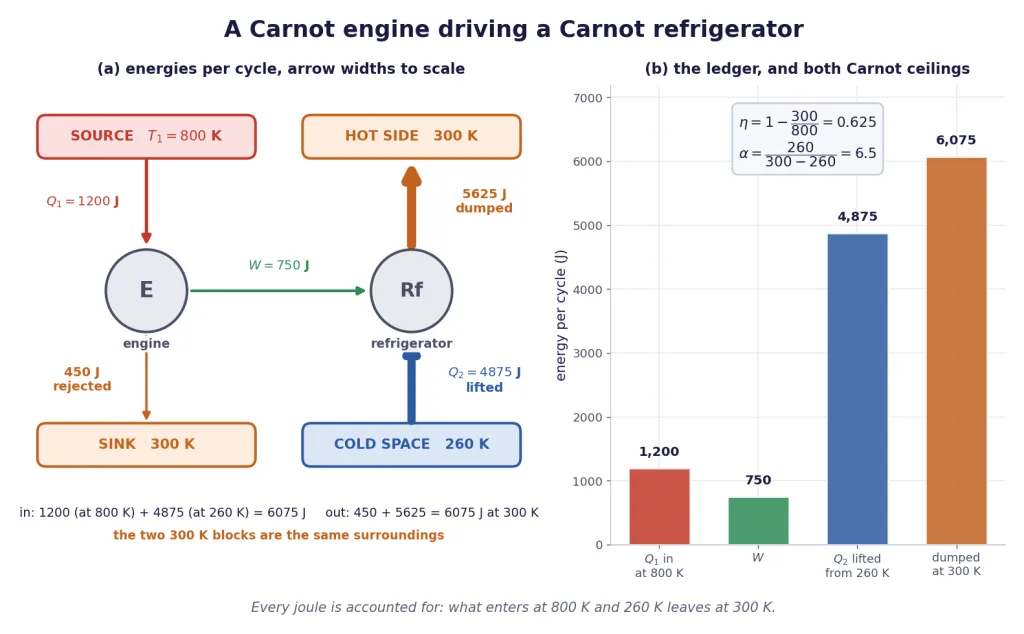
Two arrangements come up.
Two engines in series. Engine A works between and an intermediate , and rejects all its waste heat into engine B, which works between and . If both are reversible then and , and the combination has
exactly the same as a single Carnot engine between the extremes — the intermediate temperature cancels out completely, which is Carnot's theorem showing its hand. Two special values of are asked constantly:
| Condition | Intermediate temperature |
|---|---|
| The two engines have equal efficiency | , the geometric mean |
| The two engines deliver equal work | , the arithmetic mean |
Derive the second in one line: equal work means , and for reversible engines , so .
An engine driving a refrigerator. The engine's work output is fed straight into a refrigerator, as in the figure. Nothing new is needed — just do them one at a time and let be the link:
and finish with an energy audit: everything that went in at the hot and cold ends must come out at the middle. In the figure, 1200 J enters at 800 K and 4875 J is lifted from 260 K, and exactly 6075 J is dumped at 300 K.
The Carnot relation used backwards
has two unknowns, so one efficiency is never enough. Give a student two efficiencies and it becomes a pair of linear equations:
That last step is the whole problem. The change in efficiency, times the source temperature, equals the change in sink temperature — and the same rearrangement handles a raised source instead. Every "when the sink is lowered by 65 K the efficiency becomes…" question is one line once you see it.
[Exam Tip] In any coupled-machine problem, write on the page as a single symbol and resist substituting until the very end. The link between the two machines is , and keeping it symbolic stops you from mixing up which machine's you are holding.
The Four Traps, and How to Kill Each One
Everything above is method. This block is about the four errors that cost the most marks in this chapter, in the order they cost them.
Trap 1: Celsius inside a ratio
is a statement about absolute temperatures. An engine between and has
and someone who divides the Celsius numbers gets , an efficiency of 88%, which is not merely wrong but wrong in the flattering direction, so it never looks suspicious.
Key Point — where kelvin is compulsory: any ratio ; any Carnot efficiency or coefficient of performance; any gas-law step ; any adiabatic relation or . The only place Celsius is safe is inside a difference , where the two scales give the same number.
The habit that fixes it: write K after every temperature you put on the page. If you cannot write K, you have not converted it.
Trap 2: forgetting that depends only on temperature
For an ideal gas,
whatever the process is. Isobaric, isochoric, polytropic, a wiggly line — as long as the end temperatures are the same, is the same. The in that formula is not a claim that the volume is constant; it is just the constant that turns a temperature change into an energy change.
Two consequences students routinely miss:
- If the two ends of a path have the same , they have the same temperature, so and on that leg — even if the leg is a sloping straight line and looks nothing like an isotherm.
- Round any closed cycle , however many legs it has and however ugly they are.
Trap 3: reading as
These are completely different statements and they are only both true in a very special case.
| Statement | Means | Implies |
|---|---|---|
| adiabatic: no heat crossed the boundary | ; the temperature changes unless no work is done either | |
| isothermal: temperature unchanged | , so ; heat generally does flow |
An insulated gas that expands cools. An insulated gas that is compressed heats. Only if the process is both adiabatic and does no work — the free expansion — do both hold at once, and that case is a curiosity precisely because it is so rare.
Trap 4: two sign conventions in one solution
This chapter writes with the work done BY the system. Your chemistry course writes with the work done ON the system. Both are correct. Mixing them inside one solution is not.
Key Point: the safest habit is never to write a bare number for work. Write " J, so 450 J of work is done ON the gas", every time. The sentence is its own check: if the gas was compressed and your sentence says work was done by it, you have caught the error before it propagated.
A quick sign audit for any solution, which takes ten seconds:
| Quantity | Sign | Physical meaning |
|---|---|---|
| gas expanded | system did work on the surroundings | |
| gas was compressed | surroundings did work on the system | |
| heat entered | system was heated | |
| heat left | system rejected heat | |
| temperature rose | for an ideal gas, that is the whole content of |
And then the closing check, which every solved example below performs explicitly: does actually hold, with the signs you wrote? If it does not, one of the three is wrong, and you know it before the examiner does.
[Exam Tip] Two more small ones, since they show up together. First, litres and kilopascals: joule exactly, because , so a diagram drawn in kPa and L gives areas in joules with no conversion at all. Second, against : heat supplied at constant pressure uses , at constant volume uses , and uses always. Those two habits alone are worth several marks a paper.
Solved Examples, Part 1: Paths, Polytropes and Mixtures
Values used throughout, unless a problem says otherwise: J/(mol K), for a monatomic gas, for a diatomic one, . Every constant is restated inside the solution that uses it.
Example 1: A straight line on the diagram, and the same trip by a detour
A diatomic ideal gas is taken along a straight line on the - diagram from at to at . (a) Find , and for this path. (b) The same gas is now taken from to by a two-leg detour: first isobarically at Pa out to 6.0 L, then isochorically up to Pa. Find and for that route.
Solution:
The work is the area under the straight line, which is a trapezium: Positive: the gas expanded, so the work is done BY the gas.
The internal energy change needs only the two corners. With for a diatomic gas, , so Positive: the temperature rose, by a factor of 9 in fact, since went from 200 J to 1800 J.
The first law gives the heat. Positive: 4800 J of heat entered the gas. Check: closes exactly.
(b) The detour. On the isobaric leg the pressure is constant at Pa: On the isochoric leg nothing moves, so . Total J.
The internal energy change is unchanged, because and are unchanged: J. Hence
Final Answer: Straight line: J, J, J. Detour: J, J, J.
Takeaway: Two routes, same end points, same and different everything else. The 400 J difference in work shows up as exactly 400 J difference in heat, which is what "state function" and "path function" mean in numbers rather than words. And note step 2: needed neither the number of moles nor a single temperature.
Example 2: A parabolic path, where the chord will not do
One mole of a monatomic ideal gas is expanded from L to L along the path , where the pressure at is Pa. Find the work done, the change in internal energy and the heat supplied. Then identify the process as a member of the polytropic family and check the heat a second way.
Solution:
Fix the constant. Pa/m, and the final pressure is
Integrate. The chord is not allowed here. Positive: the gas expanded and did the work.
Internal energy, from the corners. J, and for a monatomic gas : Positive: the temperature rose 27-fold, since went from 100 J to 2700 J.
First law. Positive: heat entered. The residual is zero.
Now recognise the family. means , a constant. So this is a polytropic process with , and the general work formula must agree:
And the heat, a second way, through the molar specific heat.
Final Answer: J, J, J; the path is constant, with J/(mol K).
Takeaway: The chord estimate gives 1000 J here, 15.4% too high, because a convex curve lies below its own chord. Step 5 is the real lesson: the moment you recognise a path as polytropic, one formula gives the work and a second gives the heat, and neither needs an integral.
Example 3: A polytropic process with a negative molar specific heat
Two moles of a diatomic ideal gas are expanded along constant, cooling from 400 K to 300 K. Find the molar specific heat of the process, the work done, the change in internal energy and the heat exchanged. Comment on the signs.
Solution:
Kelvin check first. Both temperatures are already absolute: K, K, so K. Nothing to convert.
The molar specific heat. For a diatomic gas , and with : Negative — and that is not an error. We have , since , which is precisely the window where .
The work. Positive: the gas expanded and did 8314 J of work on its surroundings.
The internal energy. Negative: the gas cooled, so its internal energy fell.
The heat, two ways. From the definition of : and from the first law: Positive: heat was supplied to the gas.
Final Answer: J/(mol K); J, J, J.
Takeaway: Read those three signs together. Heat was added, and the gas got colder. There is nothing paradoxical about it: the gas did 8314 J of work while receiving only 4157 J, and the missing 4157 J came out of its own internal energy. That is exactly what a negative molar specific heat means, and it happens for every polytropic process with .
Example 4: A mixture, and then an adiabatic compression of it
A vessel contains 2.0 moles of helium (monatomic) and 3.0 moles of oxygen (diatomic), which do not react. (a) Find , and for the mixture. (b) The mixture, initially at 300 K in 5.0 L, is compressed adiabatically and reversibly to half its volume. Find the final temperature and the work done.
Solution:
Mole-weighted , using for helium and for oxygen:
Mayer's relation carries over, so
Cross-check with the mixture identity. so and . Agrees. Note it is not the average .
(b) The adiabatic compression. Kelvin check: the initial temperature is 300 K, absolute. Using constant with the volume halved, The gas heated up, which is what adiabatic compression does.
The work. Negative: 10242 J of work was done ON the gas.
First law audit. Adiabatic means , so and independently J. The two agree, and closes.
Final Answer: J/(mol K), J/(mol K), ; after the compression K, with 10242 J of work done on the gas.
Takeaway: Step 3 is the check to build a habit around — compute once from the specific heats and once from the identity, and if they disagree you have a slip. And once is in hand, part (b) is an ordinary adiabatic problem; the mixture behaves as a single gas with those constants.
Solved Examples, Part 2: Chambers, Pistons and Free Expansion
Example 5: Two gases either side of a fixed conducting wall
A rigid, perfectly insulated cylinder is divided into two equal halves by a fixed partition that conducts heat. The left half contains 2.0 moles of helium at 400 K; the right half contains 3.0 moles of nitrogen at 300 K. Find the final common temperature and the internal-energy change of each gas. Treat helium as monatomic and nitrogen as diatomic.
Solution:
What the container forbids. The outer walls are rigid, so . They are insulated, so . The first law for the vessel as a whole then gives That one line is the entire physics of the problem.
What the partition allows. It is fixed, so neither volume changes and neither gas does any work individually either. It conducts, so heat flows until the temperatures are equal at some .
Write out. With for helium and for nitrogen: The cancels:
Kelvin check. Both starting temperatures were absolute and the answer lies between them, closer to the nitrogen's 300 K because the nitrogen has the larger heat capacity ( against ). A plain average would have given 350 K, which is wrong.
The individual internal-energy changes. Helium cooled and lost energy; nitrogen warmed and gained the identical amount. They sum to zero, as step 1 demanded.
First-law audit for the vessel. , , . Closes.
Final Answer: K; helium loses 1781.6 J of internal energy and nitrogen gains exactly the same.
Takeaway: The final temperature is a heat-capacity-weighted average, not a mole-weighted one and certainly not a plain one. Two moles of a monatomic gas carry less heat capacity () than three moles of a diatomic gas (), so the answer sits much nearer the colder gas's temperature. If a problem gives you the same on both sides, the weighting collapses to moles and only then does the familiar mixing formula appear.
Example 6: A movable insulating piston, driven by a heater
A thermally insulated cylinder of total volume 10.0 L is divided into two equal halves by a frictionless, massless, insulating piston. Each half contains 1.0 mole of the same monatomic ideal gas at 300 K. A small electric heater in the left half is switched on and warms that gas slowly, pushing the piston right until the right-hand gas has been compressed to 2.5 L. Find the final temperature of each gas, the work done on the right-hand gas, and the heat the heater supplied.
Solution:
What the piston allows. It is insulating, so no heat crosses it. It is frictionless and massless, so the two pressures are always equal. It moves slowly, so the right-hand gas is compressed reversibly and adiabatically.
The right-hand gas, on its adiabat. With and its volume halved from 5.0 L to 2.5 L, It heated up without receiving any heat, purely from the work done on it.
Its pressure. The initial pressure of either gas was and the right-hand gas rises along constant to
The left-hand gas. It shares that pressure and now occupies L, so Quick sanity check: at equal pressure and equal moles, , and the left gas has three times the right gas's volume — indeed K. Consistent.
Work on the right-hand gas. Adiabatic, so and Negative: 2197.6 J of work was done ON the right-hand gas. Since the piston is massless it stores nothing, so the left gas did exactly J.
The heat supplied. Positive: the heater put 16273 J into the left-hand gas.
Audit the vessel as a whole. (rigid outer walls), J (the heater), J. First law closes.
Final Answer: K, K; 2197.6 J of work is done on the right-hand gas; the heater supplies about 16273 J.
Takeaway: The right-hand gas is the key that unlocks everything, because it is the only one following a law you can write down straight away. Solve it first, get the shared pressure from it, and the left-hand gas then falls out of in one line. Note also that only 13.5% of the heater's energy ended up as work on the other gas — the rest went into heating the left gas itself.
Example 7: Free expansion into vacuum, and the work it threw away
A rigid, insulated container of total volume 20.0 L is divided by a partition. One compartment of 5.0 L holds 2.0 moles of a monatomic ideal gas at 300 K; the other 15.0 L is evacuated. The partition is punctured. (a) Find , , and the final temperature and pressure. (b) A student argues that since the process is adiabatic, so . What answer does that give, and why is it wrong? (c) How much work would the same gas have delivered expanding reversibly and isothermally between the same two states?
Solution:
The work. The gas expands, but into a vacuum. There is no piston, no external pressure, nothing to push against:
The heat. The container is insulated: .
The internal energy, from the first law. For an ideal gas , so and Unchanged. All three of , and are zero, and the first law closes trivially.
The pressures, from with unchanged: The pressure fell to a quarter, exactly as the volume quadrupled.
(b) The student's answer. With , That is wrong, and here is why. constant and its cousins are derived by integrating along a quasi-static path, with the gas's own equilibrium pressure at every instant. A free expansion has no such path: the gas rushes into the empty space, pressure and temperature are not even defined throughout it, and the process cannot be drawn as a curve on a - diagram at all. There is nothing to integrate. "" is necessary for the adiabatic relations, not sufficient; they also need reversibility.
(c) The reversible isothermal route. The same gas going from 5.0 L to 20.0 L at 300 K would have done absorbing an equal 6915 J of heat from a reservoir, since on that route too.
Final Answer: , , , K, Pa. The route wrongly gives 119.1 K. The reversible isothermal route would have delivered 6915 J of work.
Takeaway: The two end states are identical on both routes, so on both. But one route hands you 6915 J of usable work and the other hands you nothing, and you can never get it back — the gas will not spontaneously return to one corner. That 6915 J is the price of irreversibility, quoted in joules. It is also why the process is a favourite: every quantity in it is zero except the one thing that matters, which is that it only runs one way.
Example 8: A mercury thread, inverted and then heated
A uniform capillary tube 100 cm long, sealed at one end, is held vertically with the sealed end downwards. It contains a 40 cm column of air trapped by a 20 cm thread of mercury, the rest of the tube being open to the atmosphere. Atmospheric pressure is 76 cm of mercury and the temperature is 300 K. (a) The tube is inverted so the sealed end is uppermost. Find the new length of the air column, and confirm that no mercury spills. (b) With the tube still inverted, to what temperature must the air be raised for the mercury to just reach the open end?
Solution:
Pressure of the trapped air, sealed end down. The mercury sits above the air, so the trapped gas must support both the atmosphere and the mercury:
Pressure after inverting. Now the sealed end is up, the air column is at the top and the mercury hangs below it, so the air pressure falls short of atmospheric by the mercury column:
Boyle's law, since the temperature is unchanged and the bore is uniform, so length stands in for volume: The air column has expanded, which makes sense — its pressure dropped from 96 to 56.
Does the mercury spill? The tube must hold the air column plus the mercury thread: There is 11.4 cm of empty tube below the mercury, so the thread is intact and cm of Hg was legitimate.
(b) Heating at constant pressure. As long as the full 20 cm thread stays in the tube, the trapped air's pressure remains cm of Hg, so the expansion is isobaric. The mercury just reaches the open end when the air column has grown to
Kelvin check and the gas law. The starting temperature is 300 K, already absolute. At constant pressure :
Final Answer: (a) the air column becomes 68.6 cm long, and 88.6 cm of the 100 cm tube is occupied, so nothing spills; (b) the mercury just reaches the open end at 350 K, that is at .
Takeaway: Two habits carry every mercury-thread problem. First, decide the pressure by asking where the mercury is relative to the gas — above it means add , below it means subtract , horizontal means neither. Second, always test whether the mercury still fits; if it does not, some of it runs out, shrinks, and the pressure equation you wrote is no longer the right one. Working the whole problem in centimetres of mercury, as here, is perfectly legal and much faster than converting to pascals.
Solved Examples, Part 3: Cycles, Coupled Machines and Carnot Backwards
Example 9: A spring-loaded piston, and the two ways to count its work
A horizontal cylinder of cross-sectional area m contains a monatomic ideal gas at Pa occupying m. The piston is frictionless and initially the spring attached to it is at its natural length; atmospheric pressure outside is Pa and the spring constant is 8000 N/m. Heat is now supplied slowly and the piston moves out by 0.10 m. Find the final pressure, the work done by the gas, the change in internal energy and the heat supplied.
Solution:
The volume change.
Force balance on the piston at the end. The gas must now beat the atmosphere and the compressed spring:
The work — and note first that is LINEAR in , because the spring compression is proportional to the swept volume. So the area under the path is a trapezium: Positive: the gas expanded and did the work.
The cross-check, by energy destination. Whatever the gas does must go somewhere — some into shoving the atmosphere back, the rest into the spring: The two routes agree exactly.
The internal energy, monatomic so : Positive: the gas got hotter, by a factor of in temperature.
The heat. Positive: 720 J of heat was supplied. The audit closes.
Final Answer: Pa, J, J, J.
Takeaway: Step 4 is the reason this problem is set. Two completely different arguments — a geometric area on the - plane, and an energy bookkeeping over the atmosphere and the spring — must give the same number, and if they do not you have a sign or a factor wrong. Note also that only of the heat you paid for ended up in the spring; most of it went into heating the gas.
Example 10: A three-leg cycle, assembled from scratch
A fixed quantity of a monatomic ideal gas is carried round the cycle , where is , is and is . is isothermal, is isobaric and is isochoric. Tabulate , and for each leg, verify the column sums, and find the efficiency of the cycle as an engine. Take .
Solution:
Check that really can be isothermal. J and J. Equal, so . Good. (Working in kPa and litres gives joules directly, since .)
Leg , isothermal expansion. , and Heat in, gas expands, temperature unchanged.
Leg , isobaric compression at 25 kPa from 8.0 L to 2.0 L: Compression, cooling, heat rejected — all three negative, all three consistent.
Leg , isochoric heating. No volume change, so : Heat in, all of it into internal energy.
The ledger.
| Leg | (J) | (J) | (J) |
|---|---|---|---|
| isothermal | |||
| isobaric | |||
| isochoric | |||
| Sum |
All three checks pass: as it must for a closed cycle, and J.
The efficiency. Heat was absorbed on and only:
The Carnot sanity check. Temperature is proportional to , which is 200 J at and and 50 J at . So , and Our 25.3% is comfortably below it. The cycle is legal.
Final Answer: the ledger above; net work J per cycle, heat absorbed 502.3 J, efficiency 25.3%.
Takeaway: The denominator is where the marks go. It is 502.3 J, the heat absorbed, not the net heat 127.3 J and not the total 877.3 J of heat traffic. And run step 7 every time — it costs five seconds and it catches an arithmetic slip before it becomes a wrong answer, because an efficiency above the Carnot ceiling is not a surprising result, it is a mistake.
Example 11: An engine driving a refrigerator
A Carnot engine works between a source at 800 K and the surroundings at 300 K, absorbing 1200 J from the source in each cycle. Its entire work output drives a Carnot refrigerator which extracts heat from a cold space at 260 K and rejects to the same 300 K surroundings. Per cycle, find the work, the heat lifted from the cold space, and the total heat delivered to the surroundings.
Solution:
Kelvin check. 800 K, 300 K and 260 K are all absolute. Nothing to convert.
The engine. and it rejects J to the surroundings.
Check the engine against its ceiling. It is a Carnot engine, so equals exactly. At the limit, not beyond it.
The refrigerator. Its coefficient of performance, working between 300 K and 260 K, is Note that is far greater than 1, which is exactly why it is not called an efficiency: the machine is moving heat, not converting it.
The heat lifted. and by energy conservation on the refrigerator, the heat it rejects at 300 K is
Total heat arriving at the surroundings.
The full energy audit. In: 1200 J from the 800 K source and 4875 J from the 260 K space, total 6075 J. Out: 6075 J at 300 K. Every joule accounted for.
Final Answer: J per cycle; 4875 J is lifted from the cold space; 6075 J in total is delivered to the surroundings.
Takeaway: The composite machine takes 1200 J of high-grade heat and uses it to move 4875 J out of a cold room — four times as much heat as it consumed. There is no violation anywhere: the second law limits the work you can extract from the 1200 J, and once you have that work it can shift a great deal of heat because across a 40 K gap is large. Notice how the whole problem is stitched together by the single symbol , computed once in step 2 and used once in step 5.
Example 12: The Carnot relation used backwards
A Carnot engine has an efficiency of 40%. When the sink temperature is lowered by 65 K, the source being unchanged, the efficiency rises to 50%. (a) Find the two original temperatures. (b) Suppose instead the sink had been left alone and the source raised until the efficiency reached 50%. By how much would the source have had to rise? (c) Comment on which is the better strategy.
Solution:
Write both conditions. With the source and the sink, both in kelvin,
Subtract. Substituting the first into the second:
Check both statements. ✓. And ✓. Both hold.
(b) Raising the source instead. Keep K and solve which is a rise of K.
(c) Compare. Lowering the sink by 65 K and raising the source by 130 K achieve exactly the same efficiency, so the sink change is twice as effective per kelvin here. That is a general feature: differentiating gives and , whose ratio is — so per kelvin the sink is 1.67 times more powerful. In practice, though, the sink is usually the atmosphere or a river and cannot be lowered at all, which is why real engineering pushes the source temperature up.
The trap, shown deliberately. If someone had read 650 K and 390 K as Celsius, they would be and , and computing would give an efficiency of 69% instead of 40%. Every temperature in every step above is absolute.
Final Answer: K and K; raising the source instead would need a 130 K rise, to 780 K.
Takeaway: One efficiency is never enough — has two unknowns. Two efficiencies make it a pair of linear equations, and the fastest route is always to subtract them, which kills and leaves in one line: here straight away.