
Conservation of Energy, Written for a System That Can Do Things
Section 2 gave you three quantities and the rule for their signs. This section connects them, and the connection is the most reliable statement in physics.
The statement
A system has an internal energy . Only two things can change it: heat crossing the boundary, and work crossing the boundary. Nothing else. So if you add up what came in and subtract what went out, the books must balance.
Key Point — THE FIRST LAW OF THERMODYNAMICS: where, in this chapter's convention,
- is the heat supplied TO the system (positive when heat is added),
- is the work done BY the system (positive when the gas expands),
- is the change in the internal energy of the system.
In words: the heat supplied to a system goes partly into raising its internal energy and partly into the work it does on its surroundings.
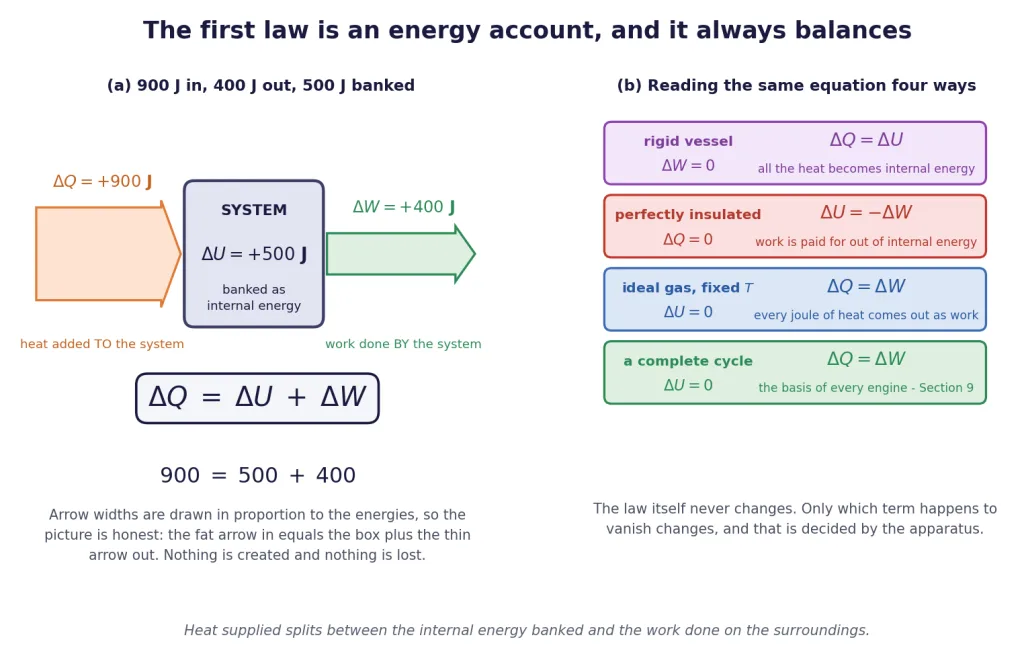
That is all it says. It is the general law of conservation of energy, applied to a system that is allowed to exchange energy with the world in both of the available ways.
The differential form
For a small change, and for the particular case of a gas that expands quasi-statically so that :
Key Point: This is the form you will use for the rest of the chapter, because it makes the work term explicit in terms of quantities you can read off a diagram.
Three ways to say the same thing
The equation can be rearranged, and each arrangement is worth having ready.
They are one equation, and which one you write first is decided by what the question asks for. The second is the most useful for beginners, because it puts the state function on its own on the left, where it belongs.
Why it is more than accountancy
An honest question at this point: if it is just conservation of energy, and you have been using that since Class 9, why does it get a number and a name?
Three reasons, and they are all worth knowing.
One — it extends conservation of energy to a new kind of energy. In mechanics, energy is conserved only when there is no friction; the moment friction appears, mechanical energy visibly disappears. The first law says it does not disappear at all: it becomes internal energy, and if you count that too, the total is conserved after all. Joule's paddle wheel is what proved that, and it is why the first law had to be discovered rather than assumed.
Two — it makes a measurable quantity. Look at the equation again. and are both things you can measure at the boundary with instruments. Their difference is — a property of the inside of the system, obtained entirely from outside measurements. Without the first law, internal energy would be an idea; with it, it is a number.
Three — it forbids something. A law that permits everything says nothing. The first law rules out a specific, once-fashionable class of machine, and the next block is about exactly that.
One thing it does not say
Key Point: The first law says nothing whatever about direction. It is perfectly happy for a cold cup of tea to grow hot while the room cools, provided the energy balances — and it does balance. Every process forbidden by experience but allowed by the first law is left for the second law, in Section 8. The first law tells you how much. The second tells you which way.
[Board Important] "State the first law of thermodynamics" is a guaranteed question. The full-mark answer is the equation plus the sign convention (" heat supplied to the system, work done by the system") plus the sentence that it is the law of conservation of energy applied to a thermodynamic system. Three parts, and most answers give only the first.
Reading the Equation in Every Direction
One equation, four apparatus. The law never changes; what changes is which term happens to vanish, and that is decided entirely by the container you put the gas in.
Case 1 — a rigid container:
Bolt the piston down, or use a sealed steel vessel. The volume cannot change, so , so no matter how high the pressure climbs.
Every joule of heat you supply becomes internal energy. Nothing is spent on pushing, because there is nothing to push. This is the cheapest way to heat a gas, and Section 4 builds the molar specific heat on exactly this arrangement.
Case 2 — a perfectly insulated container:
Wrap the cylinder in a perfect insulator, or simply do the process so fast that no appreciable heat has time to cross. Then
Read this carefully, because it contains the most counter-intuitive result in the chapter.
- If the gas expands (), then : the gas cools. It paid for the work out of its own energy, and there was no other source.
- If the gas is compressed (), then : the gas heats up. The work done on it had nowhere else to go.
This is why a bicycle pump gets hot as you compress air into the tyre, and why a can of deodorant goes cold in your hand as it sprays. Both are the same equation with opposite signs. Section 6 develops the adiabatic process properly.
Case 3 — an ideal gas held at constant temperature:
For an ideal gas the internal energy depends on temperature alone (there is no intermolecular potential energy to speak of). Hold the temperature fixed and cannot change, so
Every joule of heat that goes in comes straight back out as work. The gas is acting as a perfect pass-through: heat in one side, work out the other, nothing retained. Section 6 works out how much.
Case 4 — a complete cycle:
Take the system all the way round and back to its exact starting state. is a state function, so it must come back to its starting value:
Identical in form to Case 3, but for a completely different reason — not because the temperature was held fixed, but because the system came home. This one is important enough to have its own block below, because it is the entire basis of every heat engine in Sections 9 to 11.
The four in one table
| Apparatus | What vanishes | The law becomes | Physical reading |
|---|---|---|---|
| rigid, sealed vessel | all the heat is banked | ||
| perfectly insulated | work is paid for out of | ||
| ideal gas at fixed | heat passes straight through | ||
| any complete cycle | net heat in equals net work out |
[JEE Tip] Read a problem for which term is zero before you read it for numbers. "Rigid" or "constant volume" kills . "Insulated", "adiabatic" or "suddenly" kills . "Isothermal, ideal gas" or "returns to its initial state" kills . Once one term is gone, the other two are equal and the problem is usually one line long.
What the First Law Forbids
A law earns its keep by ruling something out. Here is what this one rules out, and it used to be a serious industry.
The perpetual motion machine of the first kind
For centuries inventors proposed machines that would run for ever and deliver useful work with no fuel, no heat and no input of any kind: over-balanced wheels, self-filling water screws, arrangements of magnets. Some were honest mistakes and some were frauds, and none of them ever worked.
Key Point — perpetual motion machine of the first kind:
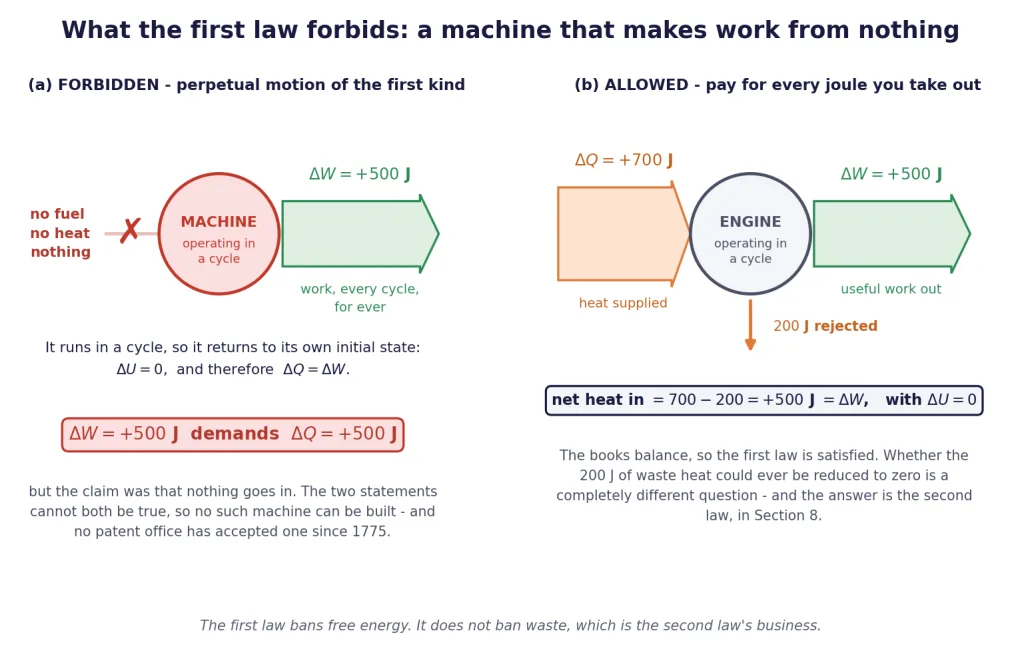
A perpetual motion machine of the first kind (PMM1) is a device that delivers work continuously without any energy input. The first law forbids it absolutely.
The proof, in three lines
A machine that runs continuously must work in a cycle — it must return to its own starting configuration, otherwise it changes permanently and eventually stops. So over one complete cycle:
Now suppose the machine delivers J of work per cycle. The equation immediately says It must absorb 500 J of heat (or be given 500 J of energy in some other form) every single cycle. But the whole claim was that nothing goes in.
Contradiction. The machine cannot exist. Not "we have not managed to build one yet" — it cannot exist, in the same way that a triangle cannot have four sides.
That is why the British and American patent offices have refused for well over a century to consider any perpetual motion application unless a working model is supplied, and why no such model has ever been supplied.
What it does NOT forbid
This is where the marks are, because students routinely over-claim.
It does not forbid a machine that runs for a very long time. A satellite orbiting in a vacuum coasts almost indefinitely because there is almost nothing to dissipate its energy — but it is not delivering work to anybody. Getting work out is what costs.
It does not forbid a machine that is 100% efficient. A device that took in 700 J of heat and gave out 700 J of work would satisfy the first law perfectly. Energy in equals energy out; nothing is created. And yet no such engine has ever been built or ever will be. That prohibition is a completely separate law — the second law, in Section 8, which bans a perpetual motion machine of the second kind. Do not confuse the two.
It does not forbid a refrigerator from moving more heat than the work you put in. A fridge with a coefficient of performance of 4 moves 4 J of heat out of the cold space per joule of work. Nothing is created, because the heat came from somewhere and was merely moved. Section 10 makes this exact.
Key Point — the two kinds of perpetual motion, kept apart:
- PMM1 creates energy from nothing. Banned by the first law.
- PMM2 takes heat from a single reservoir and converts all of it into work, creating nothing. Banned by the second law (Section 8).
A device that violates the first law also violates common sense. A device that violates only the second law looks perfectly reasonable on paper, and that is exactly why the second law had to be discovered separately.
[JEE Tip] A question that describes a machine and asks whether it is possible is asking you to do two separate tests. First, does energy balance? If not, it is a PMM1 and the first law kills it. Second, if energy does balance, is its efficiency above the Carnot limit? If so, the second law kills it (Section 11). Answering with only the first test is a half-answer.
The Asymmetry at the Heart of the Law
Look at the first law once more, but this time notice what kind of quantity sits in each place.
Two path functions on the outside, one state function in the middle. That mismatch is not an accident of notation; it is the most useful structural fact in the chapter.
What it means
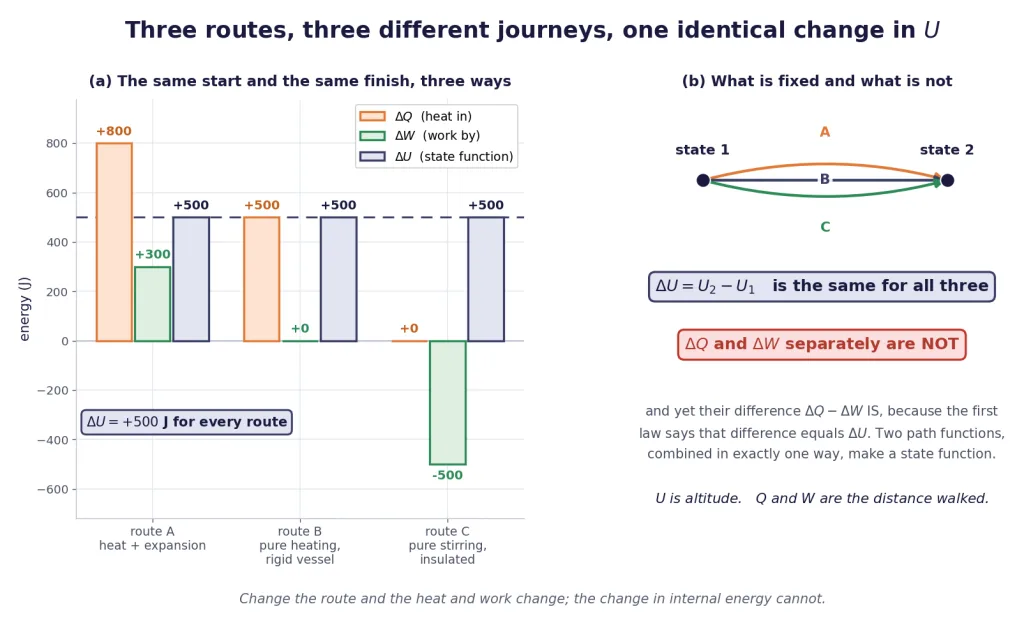
Fix two states, 1 and 2, and join them by as many different processes as you like.
- is the same for every one of them, because depends only on the state.
- and are different for each of them, because they depend on the route.
- And yet the combination is the same for every one of them, because the first law says it equals .
Key Point — the state-versus-path asymmetry:
and are individually path-dependent, but their difference is not. Two path functions, combined in exactly one way, produce a state function — and the first law is the statement that this particular combination is the one that works.Everything that makes thermodynamics powerful comes from this. It is why you can compute along any convenient imaginary path and use the answer for the real one, however messy the real one was.
Three routes to the same place
Take a system from state 1 to state 2, where rises by 500 J. Here are three completely different ways to do it.
| Route A: heat and expansion | Route B: pure heating | Route C: pure work | |
|---|---|---|---|
| Apparatus | cylinder with a free piston | rigid sealed vessel | insulated rigid vessel with a paddle |
| J | J | ||
| J | J | ||
| J | J | J |
Look down the last row. Identical, every time. Now look down the first two rows: they have nothing in common at all. Route C involved no heat whatsoever, and Route B involved no work whatsoever, and they finish in exactly the same state as Route A.
That single table proves three things at once, and each of them is examinable.
- is a state function, because it is unmoved by changing the route.
- and are not, because they moved.
- A system cannot contain heat. Hand someone the final system and ask how much heat is in it. Route C put in none. The question has no answer, and therefore it is not a real question.
The same by pure heating, pure work, or any mixture
Read the table one more time, sideways. The 500 J of internal energy was delivered:
- entirely as heat (Route B),
- entirely as work (Route C),
- or as a mixture, with some of it immediately spent again on expansion (Route A).
The system cannot tell. Once inside, energy has no memory of the door it came through. That is why the internal energy of a gas is fixed by its state and by nothing else, and it is why is allowed to be a function of , and alone.
[JEE Tip] Whenever a problem gives you two paths between the same two states and asks for a missing quantity on the second path, the move is always the same: compute from the path you know completely, then transfer it to the other path. It is the only quantity you are allowed to carry across, and it is always enough.
The Cyclic Process: , and Everything That Follows
Now the single most productive special case of the first law.
The argument
A cyclic process is one in which the system, after a series of changes, returns to exactly its initial state — the same pressure, the same volume, the same temperature, the same everything.
is a state function. It depends only on the state. So if the state is the one you started from, is the value you started with.
Key Point — the cyclic consequence:
For any complete cycle, however complicated, The net heat absorbed in one complete cycle equals the net work done by the system in that cycle. Exactly. Not approximately, and not only for special cycles.
Two things to be careful about.
It is the net quantities that are equal. Individual legs of the cycle will have heat flowing in and out, and work done both by and on the gas. Add them all up, with their signs, and the two totals must match.
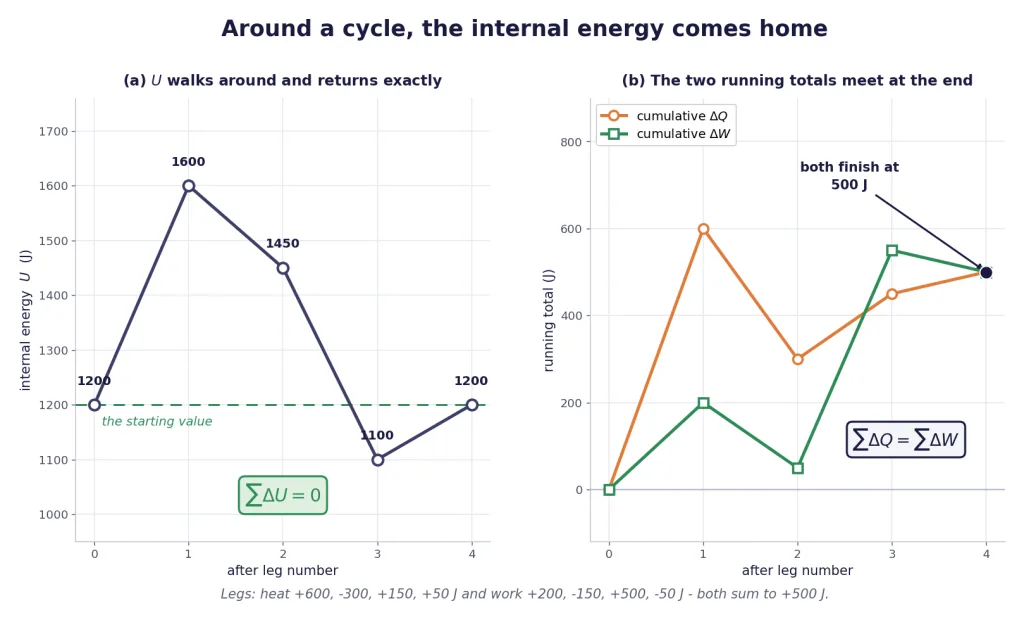
does not mean never changed. It changed constantly during the cycle — it went up, it came down, it went up again. It just happens to end where it began. The figure below shows exactly that.
How to work a cycle, leg by leg
This is a method, and it never fails. Draw a table with one row per leg and three signed columns.
| Leg | |||
|---|---|---|---|
| J | J | J | |
| J | J | J | |
| J | J | J | |
| J | J | J | |
| totals | J | J |
Three checks fall out of the bottom row, and you should perform all three every time:
- . If it does not, one of your legs is wrong.
- . These must agree, and here they both come to J.
- Every row satisfies on its own.
Notice how the third leg behaves: heat is being added ( J) and yet the internal energy falls by 350 J, because the gas does far more work ( J) than the heat supplied. There is nothing paradoxical about it — the extra energy came out of . Sign-by-sign bookkeeping catches this automatically; intuition does not.
Why this is the foundation of the entire second half of the chapter
A heat engine is a device that produces work continuously. To produce work continuously it must return to its starting configuration over and over, so it must run in a cycle. And the moment it runs in a cycle:
where is the heat absorbed from the hot source and the heat rejected to the cold sink. The work an engine delivers per cycle is exactly the difference between the heat it takes in and the heat it throws away. Sections 9, 10 and 11 build everything on that one line — the efficiency of an engine, the coefficient of performance of a refrigerator, and Carnot's theorem — and every bit of it comes from the fact that is a state function.
Key Point: An engine does not "use up" heat. It takes in , rejects , and hands you the difference as work. The first law leaves completely free — it says nothing about how small it can be made. Making small is the second law's problem, and it turns out to be impossible to make it zero.
[NEET Important] Two one-line facts from this block get asked constantly. For a cyclic process , and therefore . If a question tells you a system has returned to its initial state, those two statements are usually the entire solution.
The Other Convention, the Card, and the Traps
The other convention, in full
Section 2 mentioned it in a sentence. It is worth one careful paragraph here, because you will meet it in your chemistry course this year and the collision causes real damage.
Chemistry defines as the work done ON the system. Call that . Their first law then reads
Key Point — the two forms are the same physics: Substitute that into and you get , which is our form rearranged. One sign has been moved, and nothing else.
Physics Chemistry Symbol for work , done BY the system , done ON the system Gas expands Gas compressed First law Heat added — the same Note that the two conventions agree completely about heat. Only work is flipped.
Why do the two subjects differ? Physics grew out of engine design, where the point of the machine is the work it gives you, so the useful output was made positive. Chemistry cares about what happens to the substance, so anything that increases its energy was made positive. Both are sensible; neither is more correct.
What to do about it. Use one convention per solution and never mix them. The form used throughout is , with done by the system. If a question hands you a formula in the other convention, translate the question before you start.
The card
Key Point — everything above, compressed:
- heat added to the system; work done by the system.
- Rigid vessel: , so .
- Insulated: , so — expansion cools, compression heats.
- Ideal gas at fixed : , so .
- Any complete cycle: , so .
- is path-independent; and are not; their difference is.
- The law forbids a PMM1, a machine delivering work with no input. It does not forbid 100% efficiency — that is the second law's job.
- Other convention: with done on the system. Same physics, one sign moved.
The traps, in the order they are set
Trap 1 — writing while using this chapter's sign for . That is the two conventions welded together, and it is wrong by . In our convention the sign is a minus: .
Trap 2 — forgetting that for a cycle. It is free information, and it is usually the whole solution.
Trap 3 — thinking means the system did nothing. Around a cycle moves constantly; it merely finishes where it started.
Trap 4 — assuming an isothermal process always has . It does for an ideal gas, whose internal energy depends on temperature alone. For a real gas, or for anything undergoing a phase change, can change enormously at constant temperature — boiling water is the standard counterexample, and Section 2 worked the numbers.
Trap 5 — claiming the first law forbids a perfectly efficient engine. It does not. A 100% efficient engine balances its books perfectly. What kills it is the second law.
Trap 6 — dropping a sign in one leg of a cycle. Build the three-column table, fill in every sign, and check that before you answer anything. If it does not come to zero, do not proceed.
Trap 7 — using for a single process just because is zero somewhere else in the question. has to be established for the process you are actually working on.
What belongs to the sections either side
- Section 2 owns internal energy, heat, work, the derivation and the sign convention. This section assumes all of it.
- Section 4 applies the first law at constant volume and at constant pressure to get , and Mayer's relation .
- Section 5 draws the pressure-volume diagram and shows that is the area under the curve, which turns the path dependence argued for above into something you can see.
- Sections 6 and 7 work out , and for each named process — isothermal, adiabatic, isobaric, isochoric and cyclic — with real formulas. This section deliberately stops short of those: it establishes what the law says, not what each process does with it.
- Section 8 supplies the direction the first law is silent about.
Solved Examples
Constants used throughout, unless a problem states otherwise: J/(mol K), 1 atm Pa, K, 1 kcal J.
Example 1: The law applied straight
200 J of heat is supplied to a gas, and it expands, doing 150 J of work on its surroundings. Find the change in its internal energy and say what the sign means.
Solution:
- Assign the signs before doing any arithmetic.
- Heat is supplied to the gas, so J.
- The gas expands and does work on the surroundings, so J.
Apply the first law, rearranged to put the state function on the left:
Read the signs out loud. is positive, so energy entered as heat. is positive, so the gas did work on its surroundings. is positive, so the internal energy of the gas rose by 50 J, and since increases with temperature, the gas ended up hotter.
Sanity check. Three-quarters of the heat supplied was spent immediately on pushing the piston out, and only a quarter stayed behind. That is entirely normal for an expansion at ordinary pressures.
Final Answer: J — the internal energy rises, so the gas is left hotter.
Takeaway: Assign both signs first, then substitute. Doing the arithmetic before the signs is how a becomes a or a .
Example 2: Squeezing an insulated gas
A gas is contained in a perfectly insulated cylinder. The piston is pushed in, doing 400 J of work on the gas. Find , and with their signs, and say what happens to the temperature.
Solution:
The insulation is the key word. No heat can cross the boundary, so
The work. 400 J of work is done ON the gas, and our convention counts work done by the gas as positive, so Negative — the surroundings did the work, not the gas.
The first law: Positive, and every joule of it came from the work, because the heat channel was shut.
What that means for the temperature. The internal energy of a gas rises with its temperature, so the gas gets hotter — despite the fact that nothing hot was ever brought near it. It was heated purely by being squeezed.
Where you have met this. The barrel of a bicycle pump gets noticeably warm after a few strokes. A diesel engine has no spark plug at all: it compresses air so hard and so fast that the temperature rises past the ignition point of the fuel. Both are this calculation.
Final Answer: , J (done on the gas), J — the gas warms up.
Takeaway: Adiabatic compression heats a gas and adiabatic expansion cools it, and no heat is involved either way. Section 6 turns this into formulas.
Example 3: Heating a gas in a sealed steel bottle
500 J of heat is supplied to a gas held in a rigid, sealed steel container. Find , and .
Solution:
Rigid is the key word this time. The volume cannot change, so and Zero, no matter how high the pressure inside climbs. Work needs a displacement, and there is none.
The heat is supplied to the system:
The first law: All of the heat became internal energy.
The comparison worth making. Supply the same 500 J to the same gas in a cylinder with a free piston and part of it would be spent on expansion, so the internal energy — and therefore the temperature — would rise by less. Heating at constant volume is the most efficient way to raise a gas's temperature, and Section 4 turns exactly this observation into the statement .
Final Answer: , J, J.
Takeaway: "Rigid" or "constant volume" means , always. Spot the word and the problem collapses to .
Example 4: An ideal gas kept at constant temperature
An ideal gas is expanded slowly while its temperature is held constant by keeping it in contact with a large water bath. During the expansion it does 1200 J of work. Find and , and say where the energy came from.
Solution:
The temperature is held constant, and for an ideal gas the internal energy depends only on the temperature. So (This step relies on the gas being ideal. For a real gas, or for a substance changing phase, it would be wrong — boiling water is at a constant temperature and its internal energy changes by thousands of joules.)
The first law with the middle term gone:
Read the signs. J, positive, work done by the gas. J, positive, heat absorbed from the water bath. , so the gas ends exactly as energetic as it began.
Where the energy came from, in one sentence. The gas took 1200 J out of the water bath and handed all 1200 J straight to the piston, keeping nothing. It acted as a pure conveyor of energy from heat to work, which is precisely what makes the isothermal expansion the most useful single stroke in engine design — and Section 11 puts it at the heart of the Carnot cycle.
Where the water bath comes in. Without it the gas would have cooled as it expanded (that is Example 2 in reverse). The bath's job is to trickle in exactly enough heat, moment by moment, to hold the temperature steady.
Final Answer: and J, absorbed from the bath and delivered entirely as work.
Takeaway: for an isothermal process on an IDEAL gas — and the word "ideal" is load-bearing. Quote it in your answer; examiners look for it.
Example 5: Working a four-leg cycle
A system is taken round a cycle in four steps. The heats and works of the first three legs, and the work of the fourth, are:
| Leg | ||
|---|---|---|
| J | J | |
| J | J | |
| J | J | |
| ? | J |
Find the heat exchanged on the last leg, and the net work done per cycle.
Solution:
Build the third column first, using on each leg you know completely:
Use the one free fact a cycle gives you. The system returns to its initial state, so the internal energy must come back to its initial value:
Now get the missing heat from that leg's own first law: Positive, so heat was absorbed on that leg, even though work was being done on the system.
The completed table:
| Leg | |||
|---|---|---|---|
| J | J | J | |
| J | J | J | |
| J | J | J | |
| J | J | J | |
| totals | J | J |
Run the two checks. , as it must be. And J, which is the cyclic result confirming itself.
One leg worth a second look. On leg heat was added ( J) and yet the internal energy fell by 350 J — because the gas did 500 J of work, far more than the heat supplied, and had to find the difference in its own energy. Bookkeeping catches that; intuition does not.
Final Answer: J (absorbed), and the net work per cycle is J, done by the system.
Takeaway: Three signed columns, then . That method solves every cycle question in this chapter, and the two totals at the bottom check themselves.
Example 6: The machine that cannot exist
An inventor claims a machine that runs in a cycle at 20 cycles per second and delivers 500 J of useful work per cycle, drawing no fuel, no heat and no energy of any kind. Show, using the first law, that the claim is impossible, and state the power being claimed.
Solution:
The machine runs in a cycle. That is not an incidental detail — a device that delivers work continuously must return to its own initial configuration over and over, or it would change permanently and stop. So over one complete cycle:
Apply the first law to one cycle: The machine must absorb 500 J of energy per cycle. This is not a design suggestion; it is forced by the equation.
Compare with the claim. The claim is that nothing goes in, that is . The shortfall is of energy created from nothing. The two statements cannot both be true. The machine is a perpetual motion machine of the first kind, and the first law forbids it absolutely.
The power being claimed: Ten kilowatts of free power, for ever. If it worked, one such machine would run five houses.
A careful footnote on what has and has not been shown. We have shown the machine violates the first law. We have not shown that a 100% efficient engine is impossible — an engine taking in 500 J of heat and delivering 500 J of work would satisfy the first law perfectly. Killing that takes the second law, in Section 8. The two prohibitions are separate and must not be confused.
Final Answer: the machine would have to absorb 500 J per cycle, contradicting the claim that nothing goes in; it is a PMM1 and cannot exist. The claimed output is 10 kW.
Takeaway: Any continuously running machine has per cycle, so exactly. Work out is always paid for, joule for joule.
Example 7: Two paths, one missing number
A gas is taken from state to state along a path in which 800 J of heat is absorbed and 300 J of work is done by the gas. It is then returned to and taken to again by a different path, along which it does only 120 J of work. Find the heat absorbed on the second path.
Solution:
Find the one quantity that transfers between paths. On the first path, both and are known, so
Carry it across. is the change in a state function, so it depends only on the states and . The second path starts at the same and ends at the same , so identical, without needing to know anything at all about what the second path looked like.
Now use that leg's own first law: Positive — heat was absorbed on the second path too, but less of it.
Compare the two paths:
| Path 1 | Path 2 | |
|---|---|---|
| J | J | |
| J | J | |
| J | J |
The heat and the work both changed by 180 J — and they changed together, so their difference did not move. That is not a coincidence; it is the first law.
Final Answer: 620 J of heat is absorbed on the second path.
Takeaway: is the only quantity you may carry from one path to another, and it is always enough. Compute it on the path you know completely, then transfer it.
Example 8: How much work did it do?
A system absorbs 1500 J of heat and its internal energy is found to have risen by 900 J. Find the work done, and say whether it was done by or on the system.
Solution:
Assign the signs. Heat is absorbed, so J. The internal energy rose, so J.
Rearrange the first law for the unknown:
Interpret the sign. is positive, and in this chapter's convention that means 600 J of work was done BY the system on its surroundings. The system almost certainly expanded.
Read the split. Of the 1500 J absorbed, 900 J stayed in the system as internal energy and 600 J was handed out as work. Forty per cent of the heat supplied was converted to work on this one stroke — which sounds impressive until Section 9 points out that an engine must complete a cycle, and the return stroke will cost most of it back.
Final Answer: J, done by the system.
Takeaway: Whichever of the three quantities is missing, the first law hands it to you. The only skill required is getting the other two signs right first.
Example 9: A human being as a thermodynamic system
Over one day a person does J of external mechanical work and loses J of energy to the surroundings as heat. Find the change in the internal energy of the person's body over the day, and hence the food energy that must be eaten to keep their weight steady. Take 1 kcal J.
Solution:
- Define the system and get the signs right. The system is the person's body.
- Heat leaves the body (a person is warmer than the room), so J. Negative.
- The person does work on the surroundings — lifting, walking, climbing — so J. Positive.
The first law: Negative, and large — the body's internal energy has fallen by 8.0 MJ over the day.
What must be replaced. For the person's weight and condition to be unchanged from one day to the next, the body must end the day with the internal energy it started with. So the food eaten must supply J of chemical energy: which is about 1900 food calories — a perfectly ordinary daily intake, and a good sign that the model is not silly.
Look at the split. Of the 8.0 MJ eaten, only came out as useful external work. Everything else left as heat. That is why a room full of people warms up, why exercise makes you hot, and why a human being is, thermodynamically, mostly a heater.
Final Answer: J, J, J; about 1900 kcal of food must be eaten to restore it.
Takeaway: The first law applies to living systems exactly as it does to gases. The only trick is being disciplined about which way the heat is going, and a body almost always loses heat, so is negative.
Example 10: Squeezing a gas at constant temperature
An ideal gas is compressed slowly while in contact with a large reservoir that holds its temperature at 27°C. 800 J of work is done on the gas. Find and , with their signs.
Solution:
Kelvin check. The temperature is K, absolute and positive. It stays there throughout.
Constant temperature, ideal gas, so the internal energy cannot change:
The work. 800 J is done on the gas, so Negative.
The first law: Negative — 800 J of heat was rejected by the gas into the reservoir.
Why it had to be negative. Compressing a gas would normally heat it (that was Example 2). Here the temperature is not allowed to rise, so the reservoir must carry away exactly as much energy as the compression put in — 800 J, no more and no less. Every joule of work done on the gas leaves again as heat.
Compare with Example 4. That was the same process run the other way: expansion took heat in and gave work out. Here compression takes work in and gives heat out. An isothermal process on an ideal gas is a perfect two-way converter between heat and work, and that reversibility is exactly why Section 11 builds the Carnot cycle out of isothermal strokes.
Final Answer: , J (done on the gas), J (rejected to the reservoir).
Takeaway: In an isothermal process on an ideal gas, heat and work are equal and opposite in effect. Whichever one you supply, the other leaves.
Example 11: A cycle described only by its heats
In each complete cycle, an engine absorbs 1000 J of heat from a hot source and rejects 700 J to a cold sink. Find the net work done per cycle, the work done in five cycles, and the fraction of the absorbed heat that is converted into work.
Solution:
Net heat exchanged in one cycle, with the signs applied carefully — 1000 J in is positive, 700 J out is negative:
The system returns to its initial state, so
The first law then gives the work directly: Positive — 300 J of net work is done BY the engine on its surroundings each cycle.
Over five cycles, since each cycle is identical:
The fraction converted:
What the other 70% is doing, and what the first law says about it. 700 J out of every 1000 was thrown away into the cold sink. The first law is entirely comfortable with that — the books balance either way. It places no lower limit on the rejected heat at all, and as far as the first law is concerned, an engine rejecting nothing and converting 100% would be perfectly legal. Sections 8 and 11 show why it is not, and how small can actually be made.
Final Answer: 300 J of net work per cycle, 1500 J in five cycles, with 30% of the absorbed heat converted into work.
Takeaway: For any engine, net work per cycle , purely because round a loop. That one line is the foundation of Sections 9 to 11.
Example 12: Using the differential form
Three moles of a gas are heated at a constant pressure of 1 atm, and the temperature rises from 300 K to 350 K. The internal energy is measured to increase by 1870 J. Take J/(mol K) and 1 atm Pa. Find the work done and the heat supplied, computing the work by two independent routes.
Solution:
Kelvin check. Both temperatures are given as absolute, 300 K and 350 K, both positive. Nothing to convert.
Route one — through the volumes, using the equation of state at each end:
Route two — the constant-pressure shortcut. Since when the pressure is fixed: Same answer, one line, no volumes needed. Positive, so the gas expanded as it was heated and did work on the atmosphere.
The heat supplied, from the differential form integrated over the process: Positive — heat was supplied to the gas.
Read the split. Of the 3117 J supplied, 1870 J (60%) went into internal energy and 1247 J (40%) was spent immediately on expansion. Had the vessel been rigid, only the 1870 J would have been needed for the same temperature rise. That extra 1247 J is the entire reason a gas has two different specific heats, and Section 4 turns the observation into .
Final Answer: J (done by the gas), J (supplied), J.
Takeaway: At constant pressure, — and this is the calculation that Mayer's relation comes from. Notice that heating a gas at constant pressure always costs more than heating it at constant volume, by exactly .