
How to Use This Section
This is the last section of the chapter and it has exactly one job: to be read the night before the paper, and again in the queue outside the hall.
Nothing new is taught here. Every card below compresses something an earlier section built properly, in the same notation and with the same numbers. So if a line here surprises you, that is not a line to memorise — it is a signal to go back and reread the section that owns it.
Five cards, three figures, the four-process table, one decision chart, one mistake checklist, a 60-second list and a fast self-test. Screenshot the four-process table and the decision chart.
The sign convention, before anything else
Thermodynamics is the one chapter where a sign error does not give you a slightly wrong answer. It gives you a confidently wrong one, in the opposite direction, with full working. So this comes first, before a single formula.
Key Point — THIS CHAPTER'S SIGN CONVENTION. Read this before you read anything else on this page.
- is positive when heat is added TO the system, and negative when heat leaves it.
- is positive when work is done BY the system (the gas expands), and negative when work is done ON the system (the gas is compressed).
With those two choices, and only with those two choices, the first law reads Every formula on every card below assumes exactly this.
Read it in words and it explains itself: heat put into a system goes partly into raising its internal energy and partly into the work it does on the outside world. Everything on the right is something the system did with the energy you gave it.
| Situation | ||
|---|---|---|
| Heat supplied to the gas | — | |
| Heat rejected by the gas | — | |
| Gas expands | — | |
| Gas is compressed | — | |
| Rigid container | — | |
| Perfectly insulated | — |
The other convention. Chemistry writes the first law as , with the work done ON the system. That is the same physics with one sign moved: put into the form above and it becomes theirs. Translate a question if you meet it in that form.
In every answer, say by or on. "The work done is 500 J" is not an answer in this chapter. "500 J of work is done by the gas, so J" is.
The notation, in one table
| Symbol | Means | Notes |
|---|---|---|
| absolute temperature in kelvin — always | write or for Celsius | |
| , | the source (hot) and the heat absorbed from it | |
| , | the sink (cold) and the heat rejected to it | |
| number of moles | ||
| , | molar specific heats, J/(mol K) | lower case , are per kilogram |
| , always greater than 1 | , , | |
| efficiency of a heat engine | a fraction, never greater than 1 | |
| coefficient of performance | never an efficiency; routinely greater than 1 | |
| internal energy | a state function | |
| , | heat and work | path functions |
Three of those decide more marks than the rest of the chapter put together. is kelvin in every ratio, every gas-law step and every efficiency formula. is hot and is cold, and the subscripts never swap. is not an efficiency — a refrigerator with moves four joules out of the cold space per joule of work, and calling that "400% efficient" is meaningless.
The constants sheet
Write these at the top of your working and use them everywhere. Never mix with inside one problem — pick one and stay with it.
| Constant | Value |
|---|---|
| Universal gas constant | 8.314 J/(mol K) |
| monatomic (He, Ne, Ar) | |
| diatomic (H, N, O, air) | |
| polyatomic (CO, NH, CH) | |
| , monatomic | 12.47 and 20.79 J/(mol K) |
| , diatomic | 20.79 and 29.10 J/(mol K) |
| , polyatomic | 24.94 and 33.26 J/(mol K) |
| Standard atmosphere | Pa |
| Ice point | 273.15 K, rounded to 273 K in most problems |
| Mechanical equivalent of heat | 1 cal J |
| Handy logarithm |
Four things on these cards that the body text does not carry
The coefficient of performance, heat pumps and , work as the area under a - curve, and the values of all sit outside the rationalised syllabus body text. Boards, JEE Main and NEET ask about them every year and no adiabatic problem can be finished without the values, so they are on these cards in full.
Card 1 — The First Law, and the Two Specific Heats
State functions against path functions
Key Point: is a state function: it depends only on the present state, so between two given states is the same for every path. and are path functions: it is meaningless to ask how much heat or work a system contains, only how much crossed the boundary, and that depends on the route.
That single asymmetry decides more exam questions than any formula in the chapter. Two paths from to give the same and generally different and — but the difference comes out the same both times, which is the first law.
For an ideal gas there is a stronger statement still, and it is worth memorising on its own:
Key Point: For an ideal gas, depends on temperature alone, so on every path — isothermal, adiabatic, isobaric, isochoric, or a random squiggle. The subscript is part of the formula's history, not a restriction on where you may use it.
The first law itself
Key Point:
What it gives you, in the order you will use it:
- Two known, one free. Never compute all three independently and hope they agree. Compute the two the process hands you, and let the first law supply the third.
- Round a cycle, the system returns to its initial state, so and therefore exactly.
- What it forbids: the perpetual motion machine of the first kind, a device that delivers work with no energy input. What it does not forbid is anything about direction — that is the second law's job.
The two specific heats, and why a gas needs two
A gas heated at constant pressure expands and does work as well as warming up, so it needs more energy for the same rise in temperature. Hence , always.
Key Point — Mayer's relation: Exact for an ideal gas, the same 8.314 J/(mol K) for every ideal gas, monatomic or not.
| Gas | in J/(mol K) | in J/(mol K) | Examples | |
|---|---|---|---|---|
| Monatomic | He, Ne, Ar | |||
| Diatomic | H, N, O, air | |||
| Polyatomic | CO, NH, CH |
Three readings that are examined directly:
- is always greater than 1, because is always bigger than by exactly . A quoted of 0.9, or of 1.0, is impossible for any gas.
- falls as the molecule gets more complicated, because more ways of storing energy means a larger and so a ratio closer to 1.
- Per kilogram instead of per mole: , with the molar mass in kg/mol. The ratio is the same either way, since the mass cancels.
[Board Important] "Why is greater than ?" is a standard two-marker and wants one sentence: at constant pressure the gas also does work against the surroundings as it is heated, and that work must be paid for out of the heat supplied.
Card 2 — The Four Processes on One Page
This is the single most useful table in the chapter. Learn the pattern of it, not the digits.
| Isothermal | Adiabatic | Isobaric | Isochoric | |
|---|---|---|---|---|
| Held constant | temperature | heat, | pressure | volume |
| Gas law becomes | const | const | const | const |
| Named law | Boyle | none | Charles | Gay-Lussac |
| Path on a - plot | rectangular hyperbola | steeper curve | horizontal line | vertical line |
| Slope | infinite | |||
| Work | ||||
| Heat | ||||
| Change | ||||
| Molar specific heat | infinite | |||
| Everyday example | slow expansion in a water bath | tyre burst, pump stroke | boiling in an open pan | sealed pressure cooker |
Notice what the table is really telling you: three of the four processes kill one term of the first law outright. Isothermal kills , adiabatic kills , isochoric kills . That is why they are named at all, and it is why the first law finishes each of them in one line.
The adiabatic relations, all three of them
Key Point — the same statement written three ways. Use whichever pair of variables the question gives you. and the work, An adiabatic expansion cools the gas (, so , paid for out of ). An adiabatic compression heats it.
The second and third forms are not extra results to memorise: substitute into the first and they drop out.
The adiabat is steeper, by exactly
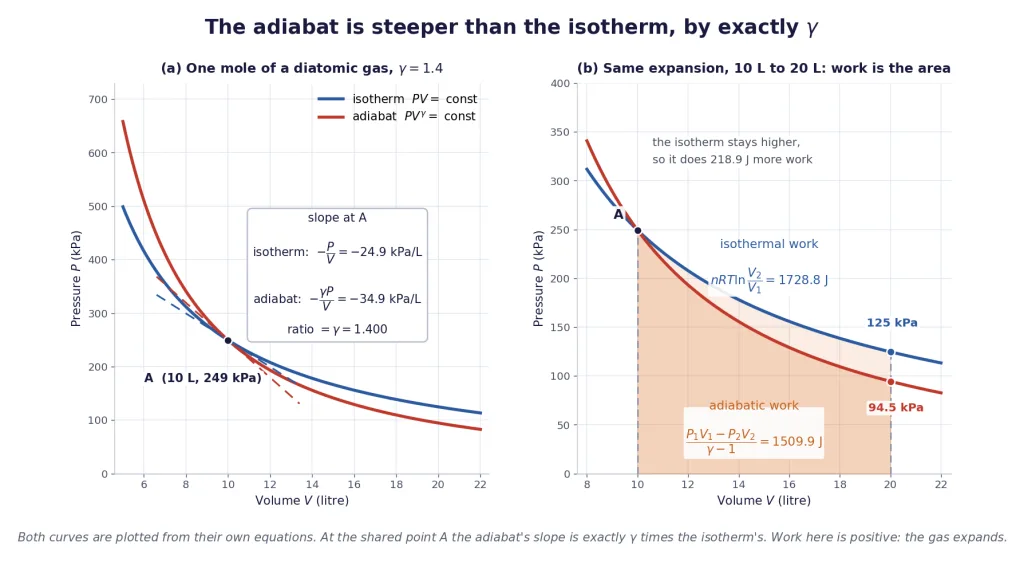
Differentiate each path at a shared point and the reason is immediate: against , and . In the figure, one mole of a diatomic gas at 300 K in 10 litre sits at 249 kPa on both curves, and the slopes there are and kPa per litre — a ratio of exactly 1.40.
Panel (b) is the consequence you will actually be asked about. Expanding from 10 litre to 20 litre, the isotherm stays higher, so it encloses more area, so it does more work: 1728.8 J against 1509.9 J, a gap of 218.9 J. The adiabat sags faster because the gas is cooling as it expands, and no heat comes in to hold the pressure up.
Key Point — work is the AREA under the - curve, . Positive for an expansion, negative for a compression, and different for different paths between the same two states — which is exactly what makes a path function.
The ordering of the work, from one state
Take one mole of a diatomic gas at 300 K in 10 litre out to 20 litre four different ways:
| Route | Work by the gas | Heat absorbed | |
|---|---|---|---|
| Isobaric | J | J | J |
| Isothermal | J | J | |
| Adiabatic | J | J | |
| Isochoric | heat only |
Isobaric does the most work, then isothermal, then adiabatic, and isochoric does none. The reason is purely visual — the higher a path sits on the diagram, the more area it sweeps out with the volume axis.
The fifth case, which is not on the table
Free expansion into a vacuum, in a rigid insulated vessel: there is nothing to push against, so ; nothing can cross the walls, so ; hence , and for an ideal gas as well. And yet it is irreversible, because it is not quasi-static — the gas is never in equilibrium during the rush, so the process cannot even be drawn as a curve. It is not an isothermal process, even though the temperature ends where it started.
Card 3 — Cycles, Engines, Refrigerators and the Carnot Limit
Cyclic processes
Key Point: round a complete cycle the system returns to its initial state, so Clockwise loop: net work positive, the gas delivers work — an engine. Anticlockwise loop: net work negative, work must be supplied — a refrigerator.
Working a cycle is bookkeeping, not cleverness. Tabulate , and for every leg, then check the columns: the column must sum to zero, and the and columns must sum to the same number. If they do not, a sign is wrong and there is no point going on.
The second law, in two sentences
Key Point — Kelvin-Planck: no process is possible whose sole result is the complete conversion of heat from a reservoir into work. That forbids the perfect engine.
Key Point — Clausius: no process is possible whose sole result is the transfer of heat from a colder body to a hotter one. That forbids the perfect refrigerator.
The word "sole" carries both statements. A working fridge does move heat from cold to hot — but not as the sole result, because work was supplied, so nothing is violated.
Heat engines
Key Point: absorbed from the source at , rejected to the sink at , both quoted as magnitudes. is always less than 1, because would need , which is the perfect engine Kelvin-Planck forbids.
Refrigerators and heat pumps
Key Point: same cycle, run backwards. , and is a coefficient of performance, never an efficiency, and it routinely exceeds 1 — that is the entire point of defining it. The machine is not converting anything; it is moving heat, and it is allowed to move a lot.
The line is worth one sentence of understanding: the same device delivers to the warm room everything it took from the cold outside plus the work you paid for, so its output beats a refrigerator's by exactly that one joule per joule. That is why a heat pump can deliver three or four joules of warmth per joule of electricity, and a resistive heater never can.
The Carnot cycle and the ceiling it sets
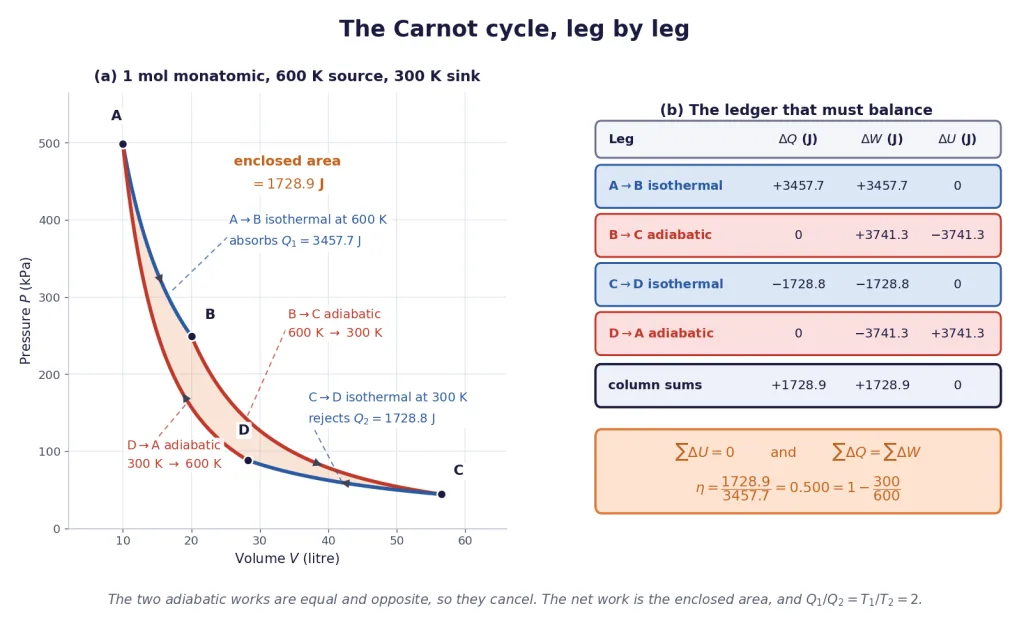
Two isothermal legs and two adiabatic legs, every step reversible. Isothermal expansion at absorbing ; adiabatic expansion down to ; isothermal compression at rejecting ; adiabatic compression back to the start. The two adiabatic works are equal and opposite, so they cancel exactly, and the net work is what the two isotherms leave behind.
Key Point — the central result and everything that follows from it: Both temperatures in kelvin. The efficiency depends on nothing else at all — not the working substance, not the design, not the size.
In the figure, one mole between 600 K and 300 K absorbs 3457.7 J, rejects 1728.8 J, and delivers 1728.9 J as the enclosed area. Check it three ways and they agree: ; ; and .
Key Point — Carnot's theorem: no engine working between two given temperatures can be more efficient than a reversible engine working between the same two, and all reversible engines between those temperatures have the same efficiency. The proof couples a supposedly better engine to a reversed Carnot engine and watches the pair transfer heat from cold to hot with nothing else changed, which Clausius forbids.
The claim test, which takes ten seconds. Given an engine's numbers, compute and compare it with in kelvin. If the claimed efficiency is larger, the claim is impossible — not remarkable, impossible. And would demand a sink at absolute zero.
Which knob helps more — the exam's favourite follow-up. Per kelvin, lowering the sink always beats raising the source. Differentiate and the two sensitivities are whose ratio is , and that is always less than 1. Between 500 K and 300 K it is 0.0012 per kelvin against 0.0020 per kelvin, so a kelvin off the sink buys about 1.7 times as much efficiency as a kelvin onto the source (the ratio is exactly ).
But you cannot actually turn that knob. The sink is the atmosphere, or a river, or the sea — it is whatever the surroundings happen to be, and dragging it below ambient means running a refrigerator that costs more work than the extra efficiency ever returns. So the practical lever is the other one: raise , with hotter steam and hotter combustion, even though it is the weaker of the two per kelvin. Both halves are examinable — the theory question asks which gains more (the sink), the applied question asks which engineers actually do (the source).
Card 4 — Which Process Is the Question Describing?
Almost nobody loses marks in this chapter on the arithmetic. They lose them by reaching for the wrong row of the four-process table in the first five seconds, and then computing a perfectly accurate answer to a question nobody asked.
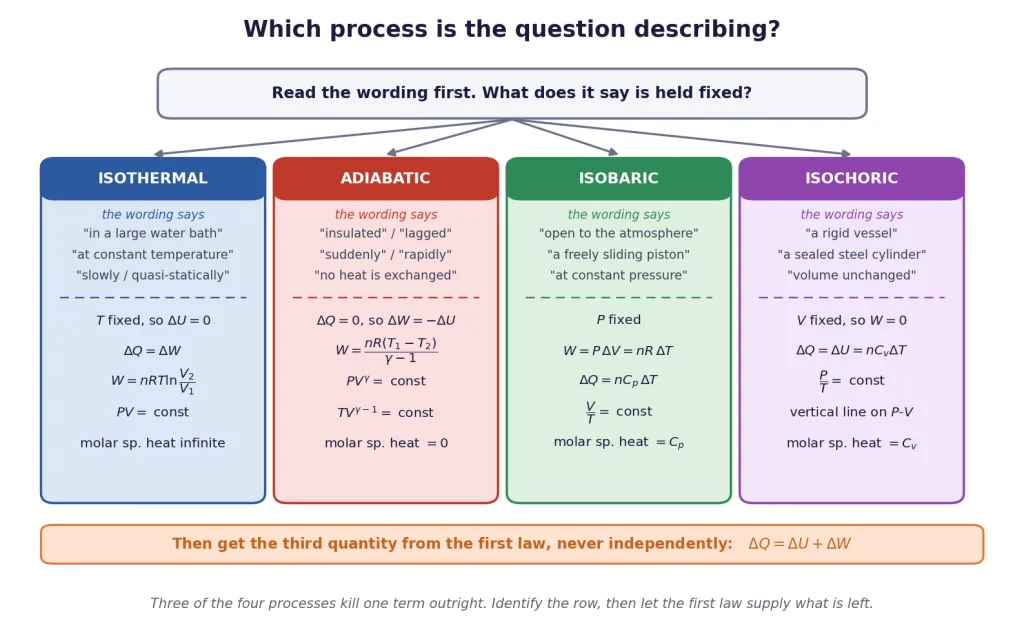
The three questions, asked in this order
- What does the wording say is held fixed? The problem always tells you, usually in disguise. The cue table below is the translation.
- Which of , , is therefore zero? In three of the four rows exactly one of them is.
- Get the third from the first law, . Then check the signs read back as physics.
The cue words, which is what you will actually recognise
| Wording in the question | What it is telling you |
|---|---|
| "in a large water bath", "at constant temperature", "very slowly" | isothermal, |
| "insulated", "lagged", "suddenly", "rapidly", "no heat is exchanged" | adiabatic, |
| "open to the atmosphere", "a freely sliding piston", "under a free piston" | isobaric, |
| "a rigid vessel", "a sealed steel cylinder", "the volume is unchanged" | isochoric, |
| "returns to its initial state", "traced once round the loop" | cyclic, , |
| "into an evacuated vessel", "rigid and insulated", "against vacuum" | free expansion: all three are zero, and it is irreversible |
| "source", "sink", "per cycle", "efficiency" | heat engine, |
| "keeps the chamber cold", "the compressor consumes" | refrigerator, |
| "warms the room by drawing heat from outside" | heat pump, |
| "the maximum possible", "an ideal engine", "the best any engine could do" | Carnot, , kelvin |
| "is this claim possible?" | compare the claimed with |
Reading a graph instead of a sentence
When the question is a - diagram rather than a paragraph, you never need to compute anything to label the legs:
- Horizontal is isobaric. Vertical is isochoric.
- Of two curves falling to the right, the steeper one is the adiabat; the gentler is the isotherm.
- Area under a leg is the work on that leg. Area enclosed by a loop is the net work of the cycle.
- Rightward motion means the gas expands, so . Leftward means compression, so .
- A clockwise loop is an engine; an anticlockwise loop is a refrigerator.
[NEET Important] In a graph question the temperatures are sitting at the corners already: , so the corner with the largest product is the hottest state. That one line answers most "at which point is the temperature greatest" questions without any arithmetic.
Card 5 — The Mistakes That Cost the Most Marks
Ordered by how often they actually turn up in answer scripts. The first two are worth more than the rest of the list combined.
1. Celsius where kelvin is required. This is the commonest error in the chapter. Any temperature entering a ratio, a product or a power must be absolute. , , , , — all kelvin. An engine between C and C has , not . Only a difference is safe in Celsius, because a rise of C and a rise of 1 K are the same interval. Write "K" beside every temperature you substitute.
2. Mixing the two sign conventions inside one solution. Here , with the work done BY the system. Chemistry uses with done ON it. Both are correct; using one for the heat and the other for the work in the same line is not. Pick one, write the sign of each quantity as you substitute it, and say what the sign means physically before you move on.
3. Quoting a work or a heat without saying by or on, added or rejected. "Work done J" is not an answer. A number with no direction cannot be marked, and it is usually the direction that the question was testing.
4. Calling an efficiency. It is a coefficient of performance. It is routinely 3, 4 or 6, and a value above 1 is normal, not a mistake. And — the heat pump number is always the larger of the two.
5. Swapping and , or and . and belong to the source; and belong to the sink. Getting them the wrong way round turns into a negative number, which is a free warning if you glance at the answer.
6. Assuming means . Adiabatic is not isothermal. In an adiabatic process no heat crosses the boundary, so the gas does work entirely out of its own internal energy and its temperature must change. The two words look similar on a page and mean opposite things about .
7. Forgetting that holds on every path. The is historical. For an ideal gas depends on temperature alone, so that formula is legal for an isobaric leg, an adiabatic leg and any curve at all — you do not need the volume to be constant.
8. Using with in the wrong direction. . A cooling gas has a negative and therefore a negative , and in an adiabatic expansion that negative is precisely the positive work.
9. Treating the area under a - curve as path-independent. Two different paths between the same two states enclose different areas and therefore involve different work and different heat. Only is the same for both. A cycle traced anticlockwise has a negative net work, not a positive one.
10. Calling a free expansion isothermal. The temperature does return to its starting value for an ideal gas, but the process is not quasi-static, cannot be drawn as a curve, and is irreversible. here even though the volume changes, because there is nothing to push against.
11. Believing an engine that beats Carnot. If a problem's numbers give , the claim is impossible and the answer is "impossible", not a number. Run that comparison on every engine you are given.
12. Using for the wrong kind of gas. monatomic, diatomic, polyatomic. Air, hydrogen, nitrogen and oxygen are diatomic; helium, neon and argon are monatomic. Reading "helium" and using 1.4 changes every number in an adiabatic problem.
13. Dropping the number of moles, or leaving a volume in litres. needs ; needs cubic metres if you want joules. A litre is m, and a kilopascal is Pa — so kPa times litres does give joules directly, which is worth knowing.
14. Forgetting that a ratio of volumes does not care about units. Inside or the units cancel, so litres are perfectly safe there. It is only in that they are not.
Key Point: Three that cost single marks each — writing as a percentage when the question asked for a fraction, forgetting that has no unit, and quoting in J/(kg K) when the formula wanted J/(mol K).
The 60-Second Revision
You are in the queue outside the hall. This is the irreducible minimum.
Convention. positive means heat into the system. positive means work done by the system. . Chemistry's is the same physics with one sign moved.
State against path. is a state function, so is the same for every path. and are path functions. For an ideal gas always.
Specific heats. ; , , ; . J/(mol K).
Work. , the area under the curve. Isothermal ; adiabatic ; isobaric ; isochoric zero.
Adiabatic. , . , and are each constant. Expansion cools, compression heats. The adiabat is steeper than the isotherm by exactly .
Isothermal. , so . Every joule in leaves as work.
Cycles. , so the enclosed area. Clockwise positive and an engine; anticlockwise negative and a refrigerator.
Second law. Kelvin-Planck forbids the perfect engine; Clausius forbids the perfect refrigerator. The word "sole" does the work in both.
Engine. , , always less than 1.
Refrigerator and heat pump. , . Not efficiencies; routinely greater than 1.
Carnot. , , . Kelvin, always. No engine can beat it between the same two temperatures.
Free expansion. , , , for an ideal gas — and irreversible all the same.
Habits. Convert to kelvin before any ratio. Say by or on for every work, added or rejected for every heat. Compute two of the three and let the first law give the third. Check the column of a cycle sums to zero.
The Fast Self-Test
Cover the answers. Fifteen questions, five minutes. Anything you miss tells you which card to reopen tonight.
- State this chapter's sign convention for and , and write the first law that follows.
- What is the one sentence that separates a state function from a path function, and which of , , is which?
- On which paths is valid for an ideal gas?
- Why must exceed , and by exactly how much?
- Give , and for a monatomic and for a diatomic gas.
- Write the work done in each of the four standard processes.
- Write the three adiabatic relations. Does an adiabatic expansion warm or cool the gas?
- Why is an adiabat steeper than an isotherm, and by what factor exactly?
- What are and for a complete cycle, and what does the enclosed area represent?
- State the Kelvin-Planck and Clausius statements, and say what each forbids.
- Write the efficiency of a heat engine two ways, and say why it can never reach 1.
- Define for a refrigerator and for a heat pump, and say why neither is called an efficiency.
- Write the Carnot efficiency and the Carnot refrigerator limit. What units must the temperatures be in?
- What are , and for a free expansion, and is the process reversible?
- A question says the gas is "compressed suddenly in a lagged cylinder". Which row of the table do you want, and which term dies?
Answers. 1. positive when heat is added to the system, positive when work is done by the system, giving . 2. A state function depends only on the present state, so its change is the same for every path between two given states; is a state function, and are path functions. 3. On every path, because for an ideal gas depends on temperature alone. 4. Because at constant pressure the gas also does work as it is heated; the difference is exactly per mole. 5. Monatomic , , ; diatomic , , , all in J/(mol K). 6. ; ; ; and zero. 7. , and constant; an adiabatic expansion cools the gas, since it does its work out of its own internal energy. 8. Their slopes are and at a shared point, and ; the factor is exactly . 9. and ; the enclosed area is the net work, positive clockwise and negative anticlockwise. 10. Kelvin-Planck: no process whose sole result is the complete conversion of heat into work, forbidding the perfect engine. Clausius: no process whose sole result is heat flowing from colder to hotter, forbidding the perfect refrigerator. 11. ; would need , the perfect engine Kelvin-Planck forbids. 12. and ; neither converts energy from one form to another, they move heat, so both may exceed 1. 13. and , with both temperatures in kelvin. 14. All three are zero, and so is for an ideal gas — but the process is irreversible, because it is not quasi-static. 15. Adiabatic: "lagged" and "suddenly" both say no heat crosses, so and ; the compression makes negative, so is positive and the gas warms.
That is the whole chapter. Go and get the marks.