
Give It Room, or It Will Take Room
Section 3 left us with a number: for a metal, is about per kelvin, so a fractional change of about one part in a thousand across the temperature range of an Indian year. This section is about what that innocent-looking number actually does to bridges, railway lines, thermostats and lakes.
Here is the sentence the whole section hangs on. A material that is free to expand does so, and nothing happens. A material that is not free to expand pushes — and it pushes very hard indeed. Every application below is an engineer choosing one of those two options on purpose.
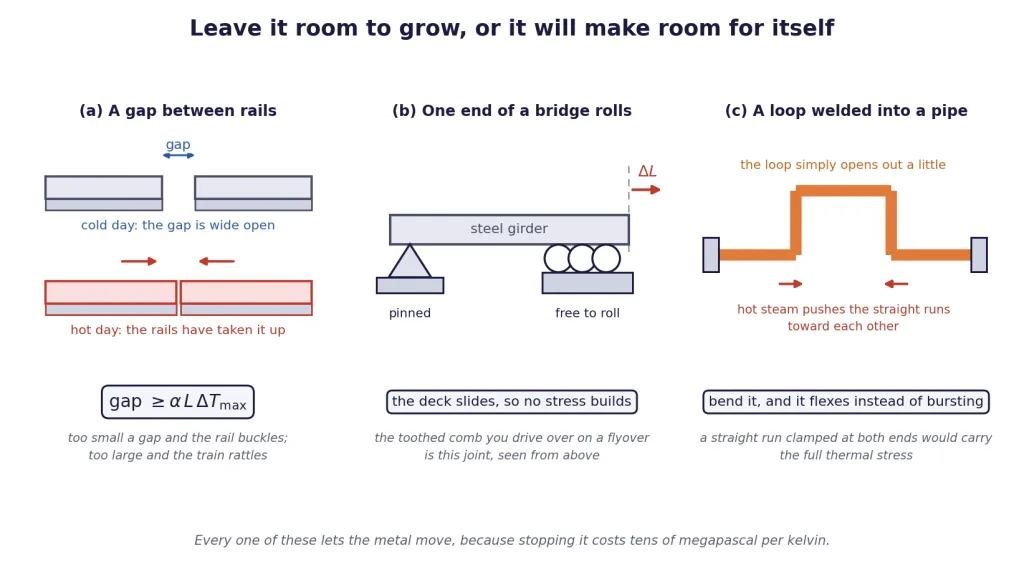
Railway lines
Look at a railway track where two rails meet and you will see a deliberate gap, a few millimetres wide, with the fishplate bolts running through slotted holes so the rails can slide. That gap is not sloppy workmanship. It is a calculation.
A rail of length laid at temperature must be able to reach its length at the hottest temperature it will ever see. So:
Key Point — sizing an expansion gap: where is the largest rise above the laying temperature that the structure will meet.
Take a 12.0 m steel rail laid on a 25°C morning in a place where the rail itself can reach 50°C in the afternoon sun. With K:
Three and a half millimetres. That is the tick-tick you hear from a train. Leave it out and the rail cannot lengthen, so it does the only other thing available to it: it buckles sideways, which is how a track gets a sun kink and how trains get derailed.
Modern lines often use continuously welded rail with no gaps at all — but only because the rail is clamped with enormous force to concrete sleepers and pre-stressed to a chosen neutral temperature, so it lives permanently in tension or compression instead. The physics did not go away; the engineers simply chose the other option.
Bridges
A 60 m steel girder that lives between C in winter and 45°C in summer changes length by
Three and a half centimetres of movement, twice a year, every year. So a bridge is pinned at one end and left free at the other, with the free end sitting on rollers or on a slab of laminated rubber. Look at the picture again: the girder simply slides.
The toothed metal comb you drive over on a flyover — the one that makes a noise under the tyres — is the same joint seen from above. Its teeth interlock loosely, and the gap between them opens and closes as the deck breathes.
Concrete does the same thing, with also close to K, which is a happy accident: it is why steel reinforcement can be buried in concrete without the two tearing each other apart on a hot day. A 5.0 m pavement slab through a 40 K annual swing moves 2.4 mm, and that is exactly the width of the tar-filled groove between slabs.
Pipes
A steam pipe carrying steam at 150°C, installed at 30°C, sees a 120 K rise. Over a 40 m run that is nearly 6 cm of growth. Since a pipe is welded to fixed equipment at both ends, engineers weld in an expansion loop — a big U-shaped detour, as in the third panel. The loop does not stop the expansion; it lets the pipe take it up by flexing sideways rather than by pushing along its own axis. Bending a pipe is easy; compressing one is not, as the next block but two will make painfully clear.
Key Point — the design rule:
Anywhere a long metal object is anchored at both ends, an engineer must either provide a gap, a roller or a loop, or else design the structure to survive the thermal stress. There is no third choice.
Fitting by Heating, and the Ruler That Grew
The shrink fit
A blacksmith who has to put an iron tyre onto a wooden cartwheel makes the tyre deliberately too small. Then he heats it in a fire until it has grown enough to drop over the rim, lets it settle into place, and pours water on it. As it cools it tries to shrink back to its original size, cannot, and grips the wheel with enormous force. No bolts, no glue, and the joint outlasts the wheel.
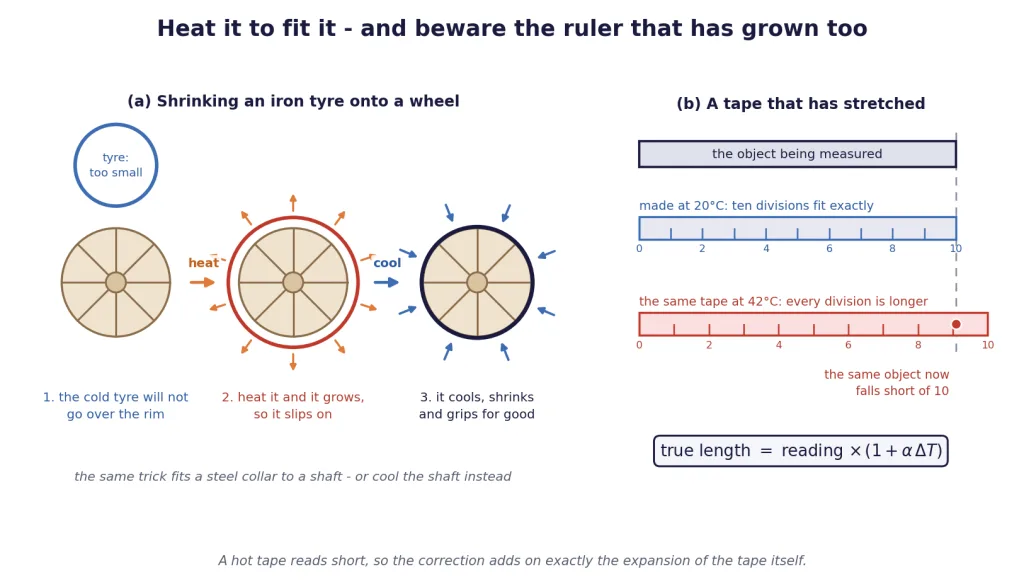
The calculation is a single application of linear expansion, using the fact from Section 3 that a ring's inner diameter grows just like any other length.
Key Point — the shrink-fit condition:
To make a ring of diameter grow to fit a rim of diameter , you need
Notice how small a mismatch needs how large a temperature. Fitting a tyre of inner diameter 99.85 cm onto a rim of 100.00 cm — a difference of 1.5 mm, one and a half parts in a thousand — needs so the tyre must go from 27°C to about 152°C. A tenth of a percent of length costs you well over a hundred kelvin. That is speaking again.
The same trick, run backwards
Engineering does the identical thing with a steel collar on a shaft, a gear on an axle, a bearing race in its housing. You have two choices, and both work:
- Heat the outer part, so its hole grows, slip it on, let it cool and grip.
- Cool the inner part with dry ice or liquid nitrogen, so the shaft shrinks, slide the collar over, and let it warm up.
Which you choose is practical, not physical. You cool the shaft when heating the collar would spoil its temper or its lubricant, and you heat the collar when you have no dry ice.
[JEE Tip] Read carefully which part is being heated or cooled, and use that part's diameter and in the formula. A question that cools the shaft and a question that heats the collar have different answers even for the same mismatch, because is applied to a different starting diameter — a small difference, but examiners set it deliberately.
A tape that has grown
Now a subtler application, and the one students most often get backwards.
A steel measuring tape is engraved with its divisions at some calibration temperature, usually 20°C or 27°C. At that temperature, and only at that temperature, its divisions are the length the engraving claims.
Use the tape on a 42°C afternoon and the tape itself has expanded. Every division is now slightly longer than a true division. So when you lay it against an object, fewer divisions fit along it than would have fitted at the calibration temperature — the tape reads short.
Key Point — correcting a tape reading: with , taken with its sign. The correction is exactly the expansion of the tape itself.
- Hotter than calibration: , the divisions are stretched, the tape under-reads, and the true length is greater than the reading.
- Colder than calibration: , the divisions are shrunk, the tape over-reads, and the true length is less than the reading.
A worked instance. A steel tape calibrated at 20°C is used at 42°C and reads 25.000 m for a bridge span. Then K and The span is 6.6 mm longer than the tape said. On a 100 m survey line on a cold 5°C morning, the same tape would over-read by 18 mm in the other direction.
[Board Important] The one-line reasoning that gets the sign right every time: a longer division means fewer divisions fit, so a hot tape reads less than the truth, so you add the correction on. Say it that way and you will never solve it backwards.
[NEET Important] The tape's own material is what matters, not the object's. If a steel tape measures a brass rod on a hot day, the correction to the READING involves . What the brass rod has done to itself is a separate question, and a question that asks for both is asking you to keep them apart.
The Bimetallic Strip
A note on where this sits. The bimetallic strip sits outside the rationalised syllabus body text, but Boards, JEE Main and NEET ask about it every year — usually for its bending direction and its use as a switch — so it is developed here from first principles.
Take two thin strips of different metals, say brass and iron, of the same length. Rivet or weld them together face to face along their whole length, so that neither can slide over the other. That is a bimetallic strip, and it is one of the neatest pieces of applied physics in the syllabus.
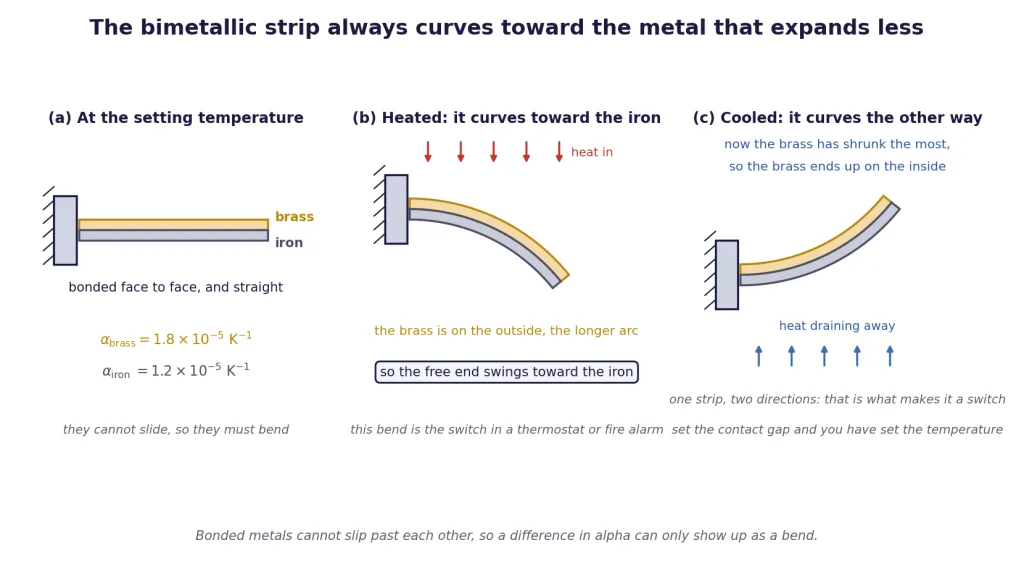
What happens when you heat it
Brass has K; iron has K. Heat the pair through 100 K and each strip, on its own, would become
The brass wants to be 0.060 mm longer than the iron. But they are joined, so neither can have what it wants. The only shape that lets a longer strip and a shorter strip stay stuck together along their whole length is a curve — with the longer strip on the outside of the bend, where the arc is longer, and the shorter strip on the inside.
Key Point — which way it bends:
On heating, a bimetallic strip bends toward the metal with the smaller — the one that expands less. That metal ends up on the concave (inner) side of the curve.
On cooling, everything reverses: it bends toward the metal with the larger , because that is now the one that has shrunk the most and become the shorter, inner arc.
For brass and iron: heat it and it curves toward the iron; cool it and it curves toward the brass. One strip, two directions, and the middle position at the temperature it was made straight at. That is a switch.
Two ways to remember the rule, and you only need one:
- "Longer goes outside." The strip that grew more must travel the longer path, and on a curve the outer path is longer. So the strip that expanded more is on the outside, and the bend points the other way.
- "It bends away from the metal that grew." Same thing said backwards.
[JEE Tip] The commonest wrong answer is "it bends toward the metal that expands more." Test yourself with the extreme case: imagine one strip that does not expand at all bonded to one that expands a lot. The rigid one cannot get longer, so it must be the inner, shorter arc, and the strip curls around it. It bends toward the strip that did nothing.
What it is for
The bend is small — a strip 10 cm long bending a fraction of a millimetre — but it is a mechanical movement produced directly by a temperature change, with no electronics at all, and that turns out to be worth a great deal.
- A thermostat. Mount the strip so that its free end carries an electrical contact. In an iron, a geyser or a room heater, the strip is straight and the contact closed when the appliance is cold, so current flows and the heater runs. As the temperature climbs the strip bends, the contact opens, and the heating stops. It cools, the strip straightens, the contact closes, and round it goes. The temperature setting is nothing more than a screw that adjusts the gap the contact has to travel.
- A fire alarm. The same idea with a much bigger gap, arranged so that the strip closes a circuit rather than opening one when the temperature rises past the trigger. Bend enough, touch the contact, ring the bell.
- A flashing indicator lamp in an older vehicle. Current through the lamp also heats a bimetallic strip; the strip bends and breaks the circuit; the lamp goes out; the strip cools and remakes the circuit. The blinking rate is set by how fast the strip heats and cools.
- A bimetallic thermometer. Wind the strip into a spiral and fix the inner end. As the temperature changes, the spiral coils or uncoils and drives a pointer round a dial. That is the dial thermometer in an oven or a car.
[Board Important] A common two-mark question: "Why must the two metals be firmly bonded along their whole length?" The answer is short and complete: if they could slide, each would simply expand to its own natural length independently and the strip would stay straight. It is precisely the refusal to let them slide that converts a difference in into a bend.
The amount of bending — the radius of curvature of the strip in terms of , , the thickness and — is a standard advanced result and is developed in the JEE Corner. At this stage, get the direction right and know what it is used for; that is what almost every question actually asks.
When Expansion Is Forbidden: Thermal Stress
Now the other option from the first block. What if a rod simply is not allowed to expand?
Clamp a rod rigidly between two immovable walls and heat it. It wants to get longer by . The walls do not permit it. Something has to give, and what gives is the internal state of the rod: it ends up compressed, carrying an internal stress, exactly as if you had let it expand freely and then squashed it back to its original length by force.
That two-stage picture is the whole derivation, and it is worth writing out because it is a favourite three-mark question.
The derivation, in two stages
Stage 1 — let it expand freely. The rod would become
Stage 2 — squeeze it back. Now apply whatever compressive force is needed to return it to length . The strain involved is
Bring in the elasticity chapter. Young's modulus is defined as stress divided by longitudinal strain, . So the stress needed to produce that strain is
Key Point — thermal stress: and the force with which the rod pushes on its supports, for a cross-sectional area , is Here means a stress, in pascal — the same the elasticity chapter used. From Section 10 of this chapter onward, will mean the Stefan-Boltzmann constant instead; the two never appear in the same problem, but it is worth knowing that the symbol is shared.
The length has vanished. Look at the result: is not in it. A 10 cm rod and a 10 m rod, of the same material, cross-section and temperature rise, push on their supports with exactly the same force. That is genuinely surprising the first time, and it is the single most-asked feature of this formula. The reason is that the longer rod wants to expand more, but it also has more length over which to distribute the same strain, and the two effects cancel exactly.
How big is it?
This is where stops looking harmless. Take steel, with Pa and K, and a rise of only 40 K:
Ninety-six megapascal from a forty-degree warm afternoon. For scale, that is roughly a third of the stress at which mild steel begins to yield permanently, and it is about a thousand times atmospheric pressure. On a rod of cross-section 4.0 cm it works out at a force of which is the weight of about four tonnes.
Key Point — the number to carry away:
For steel, the thermal stress is about 2.4 MPa per kelvin of prevented temperature change. Ten kelvin is 24 MPa; fifty kelvin is 120 MPa and you are into trouble.
Now look back at the first block. That is why railway lines have gaps, why bridges sit on rollers, and why steam pipes have loops. Nobody leaves a gap for the sake of neatness; they leave it because the alternative is tens of megapascal.
Cooling does the same thing, the other way
If the rod is cooled while clamped, is negative, so is negative: the rod is in tension, pulling its supports inward, and the wire or rod itself may snap.
A copper wire 2.0 m long and 1.0 mm in diameter, held taut between rigid supports at 40°C and cooled to C, has K. With Pa and K, the tensile stress is 102 MPa, and with a cross-section of m the tension is about 80 N. That is a hefty pull for a wire you could bend with your fingers — and it is why overhead lines are strung with a deliberate sag, and why the sag is measured on a cold day.
[JEE Tip] A composite rod — one half brass, one half steel, clamped between rigid walls — is the standard advanced version. The two halves must carry the same force (they are in series), but they have different and different , so the junction moves. That problem is set up in the JEE Corner; at this stage the thing to hold on to is for a single material and the fact that it does not depend on the length.
[Board Important] Do not forget the units. in pascal, in K, in kelvin, and the answer in pascal. If your area was in cm and you did not convert, your force is out by a factor of ten thousand.
The Anomalous Expansion of Water
Almost everything expands on heating. Water, over one narrow and extremely important range, does the opposite.
Key Point — water's anomaly:
Between 0°C and 4°C, water CONTRACTS as it is heated and expands as it is cooled. Above 4°C it behaves normally and expands on heating.
As a result water has its maximum density at about 4°C, close to 1000 kg/m.
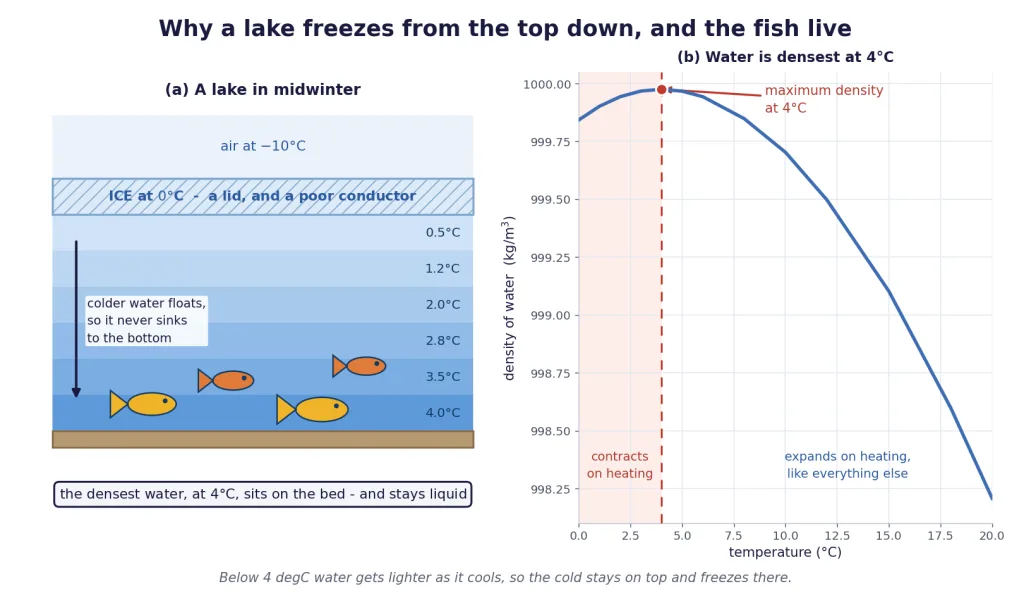
The right-hand panel is a plot of measured densities. The curve rises from 0°C, peaks at 4°C, and falls away thereafter. Locating that peak numerically from the measurements — without ever assuming the answer — puts it at 3.98°C, which is why "4°C" is the number everyone quotes.
Two ways of saying the same thing, and you should be comfortable with both:
- In terms of volume: take a fixed mass of water at 0°C and warm it. Its volume shrinks until 4°C, then starts to grow.
- In terms of density: cool water from room temperature and it gets denser, as any liquid does, until 4°C. Cool it further and it gets lighter again.
Effectively, water's coefficient of volume expansion is negative between 0°C and 4°C and positive above it. Differentiating the measured density curve gives an effective of about K at 2°C and about K at 20°C.
Why does it happen?
In liquid water the molecules are held by hydrogen bonds, and those bonds are directional — they prefer a wide, open, tetrahedral arrangement, which is exactly the arrangement ice locks into. Just above the melting point a good fraction of the water still carries fragments of that open, roomy ice-like structure. Warming the water breaks those open clusters down and lets the molecules pack more closely, which reduces the volume. At the same time, ordinary thermal agitation is trying to push the molecules apart, which increases the volume.
Below 4°C the collapse of the open structure wins, and the volume falls. Above 4°C ordinary thermal expansion wins, and the volume rises. At 4°C the two effects exactly balance, and that is the density maximum.
Ice itself is even more extreme. Freezing locks every molecule into the fully open lattice, so ice is less dense than the water it came from: 917 kg/m against 999.8 kg/m. Water expands by about 9% on freezing. That is why a sealed bottle of water bursts in a freezer, why water pipes split in a hard winter, and why ice floats with about 91.7% of its volume submerged and only 8.3% showing.
The lake in winter, step by step
This is the story the left-hand panel tells, and Boards ask for it in words nearly every year.
1. Autumn. The whole lake is at, say, 10°C. The air turns cold and the surface water cools.
2. Down to 4°C — ordinary convection. As the surface water cools it gets denser, so it sinks, and warmer water from below rises to take its place and be cooled in its turn. The whole lake circulates and cools together. This continues until the entire body of water has reached 4°C.
3. Below 4°C — the circulation stops. Now cool the surface further. Below 4°C, cooling makes water less dense. So the cold surface water is now lighter than what is beneath it, and it stays on top. Convection shuts down completely. Only a thin surface layer keeps cooling.
4. At 0°C — ice forms, on top. The surface layer reaches 0°C and freezes. Ice, being 8% less dense than water, floats. It forms a lid.
5. Under the lid. Ice and the layer of snow that usually sits on it are poor conductors of heat, so the ice sheet insulates the water beneath it. The temperature under the ice rises smoothly from 0°C just below the surface to 4°C at the bottom of the lake, where the densest water has settled.
Key Point — why the fish live:
A lake freezes from the top down, and the water at the bottom stays liquid at 4°C. Fish, plants and everything else in the lake survive the winter in that layer. Had water behaved like every other liquid, the coldest water would have sunk, the lake would have frozen from the bottom up, and every deep lake in a cold climate would be a solid block of ice with nothing alive in it.
Where else it shows up
- Ice floats, so polar ice caps sit on the ocean rather than under it, and a floating berg shows about one part in twelve above the surface.
- Frost heave and rock weathering. Water seeps into a crack, freezes, expands by 9% and levers the rock apart. Over centuries this is a serious geological force, and over one winter it is what wrecks a road surface.
- Burst pipes. A pipe full of water that freezes solid must find 9% more room. It does not; it splits. The split usually goes unnoticed until the thaw.
- The 4°C layer is a refuge in summer too. Deep lakes stay cold and dense at the bottom all year, which is why the water at depth is a different world from the surface.
[NEET Important] The exact wording matters. Water is densest at 4°C, not at 0°C. Its volume is minimum at 4°C. And between 0°C and 4°C, heating causes contraction — if a question says "expansion", read it twice.
[Board Important] The full-mark answer to "why does a lake freeze from the top downward?" has three beats: (1) water is densest at 4°C; (2) once the surface falls below 4°C it becomes less dense than the water below, so it stops sinking and stays on top to freeze; (3) ice floats and insulates, so the water below stays at 4°C and aquatic life survives. Three sentences, three marks.
Pulling It Together
Everything in this section, on one page
| Situation | Formula or fact | Watch out for |
|---|---|---|
| Expansion gap | measured from the laying temperature | |
| Shrink fit | use the and of the part being heated or cooled | |
| Tape correction | true reading | with its sign; hot tape reads short |
| Bimetallic strip, heated | bends toward the smaller | reverses on cooling |
| Thermal stress | independent of the length | |
| Thermal force | area in m, not cm | |
| Steel, rule of thumb | about 2.4 MPa per kelvin prevented | so 40 K gives about 96 MPa |
| Water | densest at 4°C, contracts on heating from 0°C to 4°C | not 0°C |
| Freezing | water expands about 9%; ice is 917 kg/m | ice floats with 91.7% submerged |
| A lake in winter | freezes top down; bottom stays at 4°C | convection stops below 4°C |
The seven traps
Trap 1 — the bimetallic strip bending the wrong way. It bends toward the metal that expands less. If you cannot remember, imagine one of the metals having : it cannot lengthen, so it must be the inner arc, and the strip curls around it.
Trap 2 — correcting a tape the wrong way. A hot tape has stretched divisions, so fewer of them fit and the reading is too small; the true length is larger than the reading. Multiply by and let the sign of do the rest.
Trap 3 — putting a length into the thermal-stress formula. has no in it. If your answer depends on the length of the rod, you have gone wrong.
Trap 4 — leaving an area in cm. cm is m. Forget that and your force is out by ten thousand.
Trap 5 — saying water is densest at 0°C. It is densest at 4°C. At 0°C it is already on its way back down, and ice at 0°C is a long way down.
Trap 6 — saying a lake freezes from the bottom. It freezes from the top, because the cold water below 4°C is the lighter water.
Trap 7 — mixing up which part is heated in a shrink fit. Heating the collar and cooling the shaft are different problems with different starting diameters. Underline the part that changes temperature.
The habit that saves marks
- Name the two options. Every mechanical problem here is either "let it move" (a gap, a roller, a loop) or "stop it moving" (thermal stress). Decide which the question is, and the formula follows.
- Carry the sign of . Heating and cooling give opposite answers for tapes, for stresses and for bimetallic strips. Write and let the minus signs look after themselves.
- Sanity-check the stress. Anything in the tens of megapascal is right for a few tens of kelvin in steel. If you got kilopascal, you dropped a factor somewhere; if you got gigapascal, you probably used twice.
[Board Important] Two applications come up as short-answer questions more than any others: why a gap is left between rails, and why a lake freezes from the top down. Both want three beats, not one, and both want a number or a mechanism, not just a statement. Learn them as short paragraphs rather than as single sentences.
Solved Examples
Constants used throughout, unless a problem states otherwise: K, K, K, Pa, Pa, kg/m, kg/m.
Example 1: Sizing the gap between two rails
Steel rails 12.0 m long are laid on a morning when the rail temperature is 25°C. In summer the rails can reach 50°C. What gap must be left between consecutive rails?
Solution:
Find the largest rise the rail will see above the temperature at which it was laid:
The gap must be at least the free expansion over that rise:
Check what the alternative would cost. If the gap were left out, the rail would have to take up a strain of , and with Pa that is a stress of 60 MPa. The gap is cheaper.
Final Answer: A gap of at least 3.6 mm.
Takeaway: Measure from the laying temperature, not from zero. The rail does not care what 0°C is; it cares how much hotter it will get than it was when it was bolted down.
Example 2: How far does a bridge move?
A steel girder in a bridge is 60.0 m long. Over the year its temperature ranges from C to 45°C. Find the total movement its expansion joint must accommodate.
Solution:
The full temperature range:
The change in length:
What it means for the design. The pinned end does not move; the roller end travels the whole 3.6 cm, back and forth, twice a year for the life of the bridge. The joint has to be able to do that a few hundred thousand times without wearing out.
Final Answer: The joint must allow 3.6 cm of movement.
Takeaway: Subtracting a negative temperature is where this one goes wrong. From C to 45°C is 50 kelvin, not 40. Write the subtraction out rather than doing it in your head.
Example 3: The blacksmith's iron tyre
An iron tyre has an inner diameter of 99.85 cm at 27°C. It must be fitted onto a wooden cartwheel of diameter 100.00 cm. To what temperature must the tyre be heated?
Solution:
State the condition for a fit. The tyre's inner diameter must grow to at least the diameter of the wheel: with cm and cm.
Solve for :
Add it to the starting temperature:
Check by substituting back. At 152.2°C the tyre's inner diameter is cm. It just fits.
What happens next. As the tyre cools back to 27°C it tries to shrink by 1.5 parts in a thousand and cannot, because the wheel is in the way. That leaves a hoop strain of about , which for steel would be a hoop stress near 300 MPa — an enormous grip, and in practice the wood compresses a little and takes the edge off it.
Final Answer: The tyre must be heated to about 152°C, a rise of 125 K.
Takeaway: A mismatch of one and a half parts in a thousand costs you a hundred and twenty-five kelvin. With of order , temperatures in shrink-fit problems are always in the hundreds; if you get an answer of a few degrees, check your powers of ten.
Example 4: Cooling a shaft instead
A steel collar has a hole of diameter 5.995 cm at 27°C. It must be slipped over a steel shaft whose diameter is 6.000 cm. (a) To what temperature must the shaft be cooled? (b) What would the answer be if the collar were heated instead?
Solution:
(a) The shaft must shrink to 5.995 cm. Set up the condition on the shaft:
So the shaft must be cooled from 27°C by 69.4 K: which dry ice, at about C, does comfortably.
(b) Heating the collar instead. Now the hole must grow from 5.995 cm to 6.000 cm, and the starting diameter is the hole's:
Notice the two temperature changes are not quite equal in size, 69.4 K against 69.5 K, because the fractional change is taken on a slightly different starting diameter. The difference is one part in a thousand and is usually ignored, but it is the reason the two answers are not exact mirror images.
Final Answer: (a) cool the shaft to about C; (b) or heat the collar to about 96°C.
Takeaway: Whichever part changes temperature is the part whose diameter and go into the formula. Read the sentence in the question that says what goes into the dry ice or the furnace, and start from that part's diameter.
Example 5: A survey on a hot afternoon
A steel tape is correctly calibrated at 20°C. It is used at 42°C to measure a bridge span, and reads 25.000 m. What is the true length of the span?
Solution:
Decide the direction before calculating. The tape is hotter than its calibration temperature, so its divisions have stretched. Longer divisions mean fewer of them fit along the span, so the reading is too small and the true length is larger.
Find the factor by which each division has grown, with K:
Multiply the reading by it:
The correction is 6.6 mm, which is exactly the expansion the 25 m of tape itself has undergone: mm.
Final Answer: 25.0066 m — about 6.6 mm longer than the reading.
Takeaway: The correction to a tape reading is literally the expansion of the tape. If you compute and add it on, you have done the whole problem, and the sign of tells you whether to add or subtract.
Example 6: The same tape on a cold morning
The same steel tape, calibrated at 20°C, is used at 5°C to lay out a 100.000 m survey line. What is the true length of the line?
Solution:
Direction first. The tape is colder than its calibration temperature, so its divisions have shrunk. Shorter divisions means more of them fit, so the tape over-reads and the true length is smaller.
The temperature change, with its sign:
Apply the correction:
So the line is 18 mm shorter than the tape claimed. On a construction site that is the difference between a wall in the right place and a wall that has to come down.
Final Answer: 99.982 m, so the tape over-read by 18 mm.
Takeaway: One formula does both directions; you never need two rules. Write true reading with and the arithmetic will hand you the right sign.
Example 7: Which way does the strip bend?
A bimetallic strip is made from a brass strip and an iron strip, each 10.0 cm long at 20°C, bonded face to face. It is heated to 120°C. (a) By how much would each strip lengthen on its own? (b) Which way does the strip bend? (c) What happens if it is instead cooled to C?
Solution:
(a) Compute the two lengths independently, with K: using millimetres for the 10.0 cm length.
The mismatch: Sixty micrometres, on a strip 100 mm long.
(b) They are bonded, so neither gets what it wants. The only shape that lets a longer and a shorter strip stay stuck together is a curve, with the longer one on the outside. Brass is longer, so brass is on the outside and the strip curves toward the iron.
(c) Cooled to C, K, and now brass shrinks more than iron: by 0.090 mm against 0.060 mm, a mismatch of 0.030 mm the other way. Brass is now the shorter strip, so brass is on the inside and the strip curves toward the brass — the opposite direction.
Final Answer: (a) brass 0.180 mm, iron 0.120 mm; (b) it bends toward the iron; (c) cooled, it bends toward the brass.
Takeaway: Work out the two lengths and let "longer goes outside" do the rest. You never have to remember a rule about which metal it bends toward; you can rebuild it in ten seconds from two multiplications.
Example 8: A rod that is not allowed to grow
A steel rod of cross-sectional area 4.0 cm is clamped rigidly between two immovable walls at 20°C and then heated to 60°C. Find (a) the strain the rod would have had if free, (b) the thermal stress in it and (c) the force it exerts on each wall. Take Pa.
Solution:
(a) The free strain, with K: That is the strain the walls are refusing to allow, so it is the compressive strain now locked into the rod.
(b) The stress, from Young's modulus:
(c) The force, converting the area to SI first: cm m.
Feel the size of that. Nearly 40 kilonewton, the weight of about four tonnes, from a rod warmed by forty degrees. And it does not depend on how long the rod is.
Final Answer: (a) ; (b) 96 MPa; (c) N.
Takeaway: The length never appears. A short rod and a long rod of the same material and cross-section push equally hard, because the longer one wants to expand more but has more length to spread the same strain over. If your answer contains , you have added something that should have cancelled.
Example 9: A wire that is cooled instead
A copper wire 2.0 m long and 1.0 mm in diameter is held taut with negligible tension between two rigid supports at 40°C. It is cooled to C. Find the tension that develops. Take Pa and K.
Solution:
The temperature change, with its sign: The wire wants to get shorter and cannot, so it ends up in tension, pulling the supports inward.
The magnitude of the stress:
The cross-sectional area, with radius mm m:
The tension:
Note what the length did. Nothing. The 2.0 m never entered the calculation.
Final Answer: A tension of about 80 N, pulling the supports together.
Takeaway: A negative turns compression into tension, and that is the only thing that changes. Take the magnitude for the arithmetic and state the direction in words: heated and clamped means a push, cooled and clamped means a pull.
Example 10: What a rail would do if you did not let it move
A steel rail of cross-sectional area 40 cm is prevented from expanding while its temperature rises by 20 K. Find the compressive stress and the force it exerts on its supports. Take Pa.
Solution:
The stress:
The area in SI: cm m.
The force:
Two hundred kilonewton, the weight of about twenty tonnes, from a twenty-degree afternoon. Two such rails pushing against each other at a joint can lift and twist the track — which is exactly what a sun kink is, and exactly why the gap in Example 1 is left.
Final Answer: 48 MPa, and a force of about N.
Takeaway: Steel gives roughly 2.4 MPa of thermal stress per kelvin. Twenty kelvin gives 48 MPa; you can do these in your head once you carry that one number, and it makes every answer instantly checkable.
Example 11: Freezing, floating and the fish
(a) Water at 0°C has a density of 999.8 kg/m and ice has 917 kg/m. By what percentage does water expand on freezing? (b) What fraction of a floating block of ice is below the surface of the water? (c) Explain in three sentences why a fish survives a winter in a frozen lake.
Solution:
(a) Mass is conserved, so volumes go inversely as densities. For 1 kg of water:
The fractional increase:
(b) Float the ice and balance the forces. For a floating block, the weight of the block equals the weight of water displaced. If a fraction of its volume is submerged, So 91.7% is under water and only 8.3% shows.
(c) The three sentences. Water is densest at 4°C, so as a lake cools the denser water sinks and circulates until the whole lake reaches 4°C. Cooled below 4°C the surface water becomes less dense than the water beneath it, so it stays on top, stops circulating, and freezes there. The floating ice then insulates the lake, and the water at the bottom stays liquid at 4°C, which is where the fish spend the winter.
Final Answer: (a) about 9.0%; (b) 91.7% submerged; (c) the lake freezes top down and keeps a 4°C layer at the bottom.
Takeaway: Every one of these numbers comes from the same fact: ice is less dense than water. The 9% expansion, the floating berg and the surviving fish are three faces of one anomaly, and an exam answer that links them together reads much better than three separate assertions.