
Close the Notes. Start the Clock.
Sections 1 to 13 taught you this chapter — temperature against heat, the scales and the gas thermometer, linear, areal and volume expansion, the applications from rails to bimetallic strips, specific and molar heat capacity, calorimetry, latent heat and the heating curve, conduction and thermal resistance, convection, radiation with Wien and Stefan-Boltzmann, Newton's law of cooling, a full set of worked problems and an advanced toolkit on top.
This section asks one different question: can you use any of it with a timer running?
There is no new theory below. There are 30 single-correct questions built to the exam pattern, and a marking scheme designed to punish the three habits this chapter rewards most cruelly — putting a Celsius number where a fourth power demands kelvin, forgetting that a hole expands along with everything else, and assuming a phase change went to completion when it did not.
The rules of engagement
Key Point: This is not a reading exercise. Blank sheet, pen, timer. Attempt all 30 questions in one unbroken sitting, and do not open a single explanation until the last answer is written.
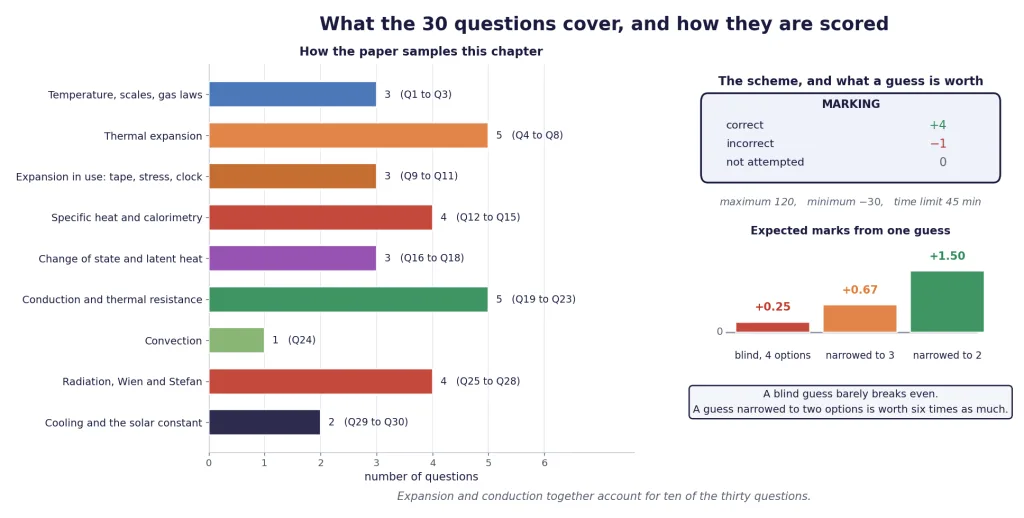
| The setup | What it is |
|---|---|
| Number of questions | 30, single correct option |
| Marking scheme | correct, incorrect, unattempted |
| Maximum score | marks |
| Minimum possible score | marks |
| Suggested time limit | 45 minutes (a shade under a minute and a half per question) |
| Take 0°C as | 273 K throughout, unless a question says 273.15 |
| Allowed | rough sheet, your own head |
| Not allowed | calculator, formula sheet, a glance back at the earlier sections |
The constants sheet
Every question that needs a number uses these and no others. Copy them to the top of your sheet before you start.
| Quantity | Value |
|---|---|
| Specific heat capacity of water | 4186 J/(kg K) |
| Specific heat capacity of ice | 2100 J/(kg K) |
| Specific heat capacity of air | 1005 J/(kg K) |
| Latent heat of fusion of ice, | J/kg |
| Latent heat of vaporisation of water, | J/kg |
| K | |
| K | |
| K | |
| 1.6 W/(m K) | |
| Stefan-Boltzmann constant | W/(m K) |
| Wien's constant | m K |
| Density of air | 1.2 kg/m |
| Solar constant | 1.4 kW/m |
| Useful values | , |
The constants used throughout this drill. Nothing else is needed.
A note on symbols, so nothing is ambiguous under time pressure. is always an absolute temperature in kelvin and or a Celsius one. bare is a length; and are the latent heats. is linear expansion, areal, volume, and for an isotropic solid. is specific heat capacity in J/(kg K), is thermal conductivity in W/(m K), and lowercase is the cooling constant in Newton's law. is the Stefan-Boltzmann constant, emissivity, absorptive power. Where a question says "net", it means net.
What this set covers
| Topic | Questions | How many |
|---|---|---|
| Temperature, scales and the gas laws | Q1 to Q3 | 3 |
| Thermal expansion of solids and liquids | Q4 to Q8 | 5 |
| Expansion in use: tape, stress, clock | Q9 to Q11 | 3 |
| Specific heat capacity and calorimetry | Q12 to Q15 | 4 |
| Change of state and latent heat | Q16 to Q18 | 3 |
| Conduction and thermal resistance | Q19 to Q23 | 5 |
| Convection | Q24 | 1 |
| Radiation, Wien and Stefan-Boltzmann | Q25 to Q28 | 4 |
| Newton's law of cooling and the solar constant | Q29 to Q30 | 2 |
That spread mirrors how the paper actually samples this chapter. Expansion and conduction together are 10 of the 30, because those two topics carry the most multi-step questions and therefore the most marks, and because a slip in either ruins everything downstream.
The difficulty mix is roughly 25% easy, 45% medium and 30% hard. A handful will feel brutal. They are meant to.
[Exam Tip] That changes the arithmetic of guessing. A blind guess among four options returns marks on average — barely worth the minute it costs. A question narrowed to two options returns marks on average, six times as much. Narrow first, then commit. Leave blank only what you could not narrow at all.
[Exam Tip] Before you start, write five lines at the top of your sheet: kelvin or Celsius?, does the vessel expand too?, did I include the phase change?, is this heat added or heat removed?, is it , or ? Those five questions catch the overwhelming majority of the marks lost in this chapter.
Scoring Yourself Honestly
Mark your sheet with the real scheme — , , — and total it. No half marks for "I knew that one really". The number you get is the number that matters.
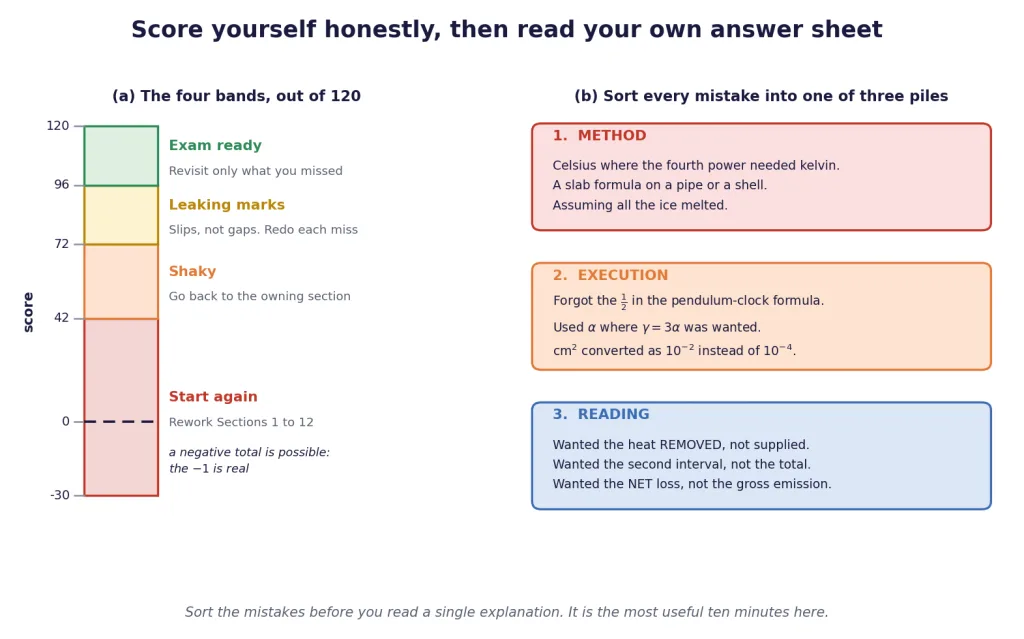
The bands
| Your score (out of 120) | Verdict | What to do next |
|---|---|---|
| 96 to 120 | Exam ready. 80% or more on a hard set, inside the time. | Move on. This chapter will not cost you marks. Revisit only the specific items you missed. |
| 72 to 95 | Solid, but leaking marks. | Almost always slips rather than gaps — a Celsius temperature in a fourth power, a where an was wanted, cm converted as instead of . Redo every wrong question without the explanation first. |
| 42 to 71 | Shaky. The ideas are there; the execution is not. | For each wrong answer go back to the section that owns it (use the topic map above) and rework its solved examples before re-attempting. |
| Below 42 | Start again. | Work Sections 1 to 11 properly, then Section 12's worked problems, then Section 13. Re-attempting this set now teaches you nothing but the answer key. |
Read your own answer sheet
Before you touch a single explanation, sort your mistakes into three piles. This is the most valuable ten minutes in the whole section.
- Method errors — you put a Celsius temperature into a fourth power or a temperature ratio. You used a slab formula on a pipe or a shell. You assumed all the ice melted, or all the steam condensed, instead of testing it. You used where the question wanted . These are the expensive ones, because the whole solution is wrong from line one.
- Execution errors — right method, wrong arithmetic. The classic four in this chapter: the factor of dropped from the pendulum-clock formula; used where was wanted; cm converted as m instead of m; and a thickness in centimetres left unconverted inside .
- Reading errors — the question asked for the heat removed, not supplied; for the time of the second interval, not the total; for the net rate of loss, not the gross emission; for the apparent expansion, not the real one; for the mass expelled, not the mass remaining.
Key Point: In this chapter pile 3 is unusually fat, because so many quantities in it come in near-identical pairs: kelvin against Celsius, real against apparent expansion, gross emission against net exchange, against , latent heat against specific heat, total time against interval time. Underline the quantity the question actually wants before you start solving.
The eight habits this set is drilling
- Write K next to every absolute temperature. Fourth powers, ratios and the gas equation demand kelvin. Only a difference may be quoted in either scale, and then the number is the same.
- A hole expands. Rings, bores, gaps and cavities all grow by the same factor as solid material of the same substance.
- . Areas use , volumes use . Check which one the question is about before substituting.
- A liquid in a vessel shows only its apparent expansion, .
- Never skip the phase change. If a body crosses 0°C or 100°C, an or term belongs in the balance, and you must test whether the change goes to completion.
- Thermal resistance adds in series and combines reciprocally in parallel. Almost every conduction question is a two-resistor circuit in disguise.
- The temperature drop divides in proportion to thermal resistance, so a junction always sits close to the end of the better conductor.
- Newton's law of cooling is a linearisation. Reliable for a small excess, badly optimistic for a large one.
[Exam Tip] Every explanation below is a full step-by-step solution, so this set doubles as revision. Read the explanation even for the questions you got right — several of these have a two-line route and a two-page route, and it is the two-line route you will need in the hall.