
The Same Flame, Different Answers
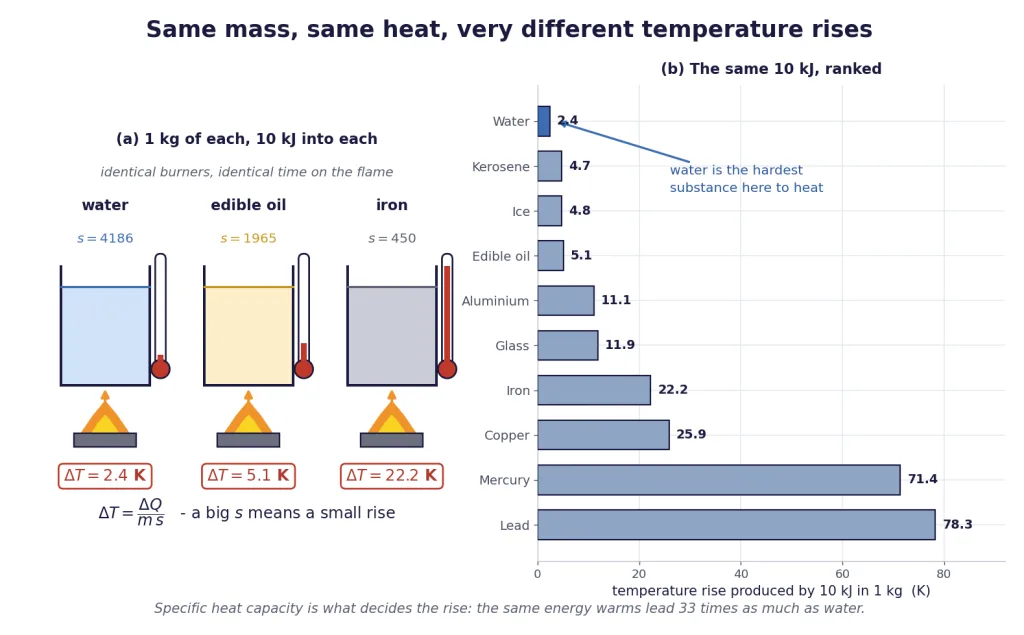
Put a pan of water on a stove and a pan of cooking oil beside it, same mass, same burner, same time. Come back in two minutes and put a thermometer in each. The oil is scorching. The water is barely warm.
Nothing is wrong with your stove. The two liquids have taken in almost the same amount of heat — you gave them the same flame for the same time — and they have done completely different things with it. That difference has a name, and it is the single most useful number in this whole chapter.
What the rise actually depends on
Do the experiment properly and three things show up, one at a time.
Double the temperature rise you want, and you need double the heat. Heat water through 20 K, note the time. Heat the same water through 40 K, and the stopwatch says twice as long.
Double the mass, and you need double the heat. Two kilograms take twice as long as one, for the same rise.
Change the substance, and everything changes. Same mass, same rise, different time — because it is a different material.
So the heat needed is proportional to the mass , proportional to the temperature change , and multiplied by something that depends on what the stuff is. That "something" is what we are about to define.
Three quantities, three symbols, and they are not the same thing
This chapter has the worst symbol collisions in the book, so we fix them here and hold them for the rest of it.
Key Point — heat capacity of a BODY: The heat needed to raise this particular object by one kelvin. SI unit J/K. It is a property of the object: a big copper block and a small copper block have different values of .
Key Point — specific heat capacity of a SUBSTANCE: The heat needed to raise one kilogram of the substance by one kelvin. SI unit J/(kg K). It is a property of the material, not of the sample — every piece of copper in the world has the same .
Key Point — molar specific heat capacity: The heat needed to raise one mole by one kelvin, where is the number of moles. SI unit J/(mol K). The third block below shows why this one hides a beautiful pattern that completely conceals.
Rearrange the middle one and you get the working equation of the entire chapter:
Key Point — the equation you will use a hundred times: Heat supplied equals mass times specific heat capacity times temperature change. Every calorimetry problem in Section 6 and every heating-curve problem in Section 7 is built on this line.
Holding the symbols apart
- (capital) is the heat capacity of a whole body, in J/K. It already has the mass baked into it: .
- (small) is the specific heat capacity, per kilogram, in J/(kg K).
- (capital) is the molar specific heat capacity, per mole, in J/(mol K).
Specific heat capacity is also written , and sometimes — which is exactly the collision being avoided here. Check the unit rather than the letter: J/K, J/(kg K) and J/(mol K) can never be confused with one another.
[Board Important] A very common one-mark question: "Two bodies made of the same material have masses 1 kg and 3 kg. Compare their heat capacities and their specific heat capacities." The heat capacities are in the ratio 1 : 3, because . The specific heat capacities are equal, because does not know about mass at all. Say both halves.
The units, and the one you meet in old questions
, so has units of joule per kilogram per kelvin. Because a temperature difference of one kelvin and of one Celsius degree are the same size, you may write J/(kg K) or J/(kg °C) and mean exactly the same number. That is only true for differences — never substitute a Celsius temperature where an absolute one is wanted.
The old unit is the calorie: 1 cal is the heat that raises 1 g of water by 1 °C, and 1 cal = 4.186 J. In calorie units the specific heat capacity of water is exactly 1 cal/(g °C) by definition, which is why so many older problems quote it as 1. In SI it is 4186 J/(kg K), and that is the number we use.
[JEE Tip] If a question hands you specific heats in cal/(g °C) and asks for an answer in joule, multiply by 4186 to get J/(kg K) — the gram-to-kilogram factor of 1000 and the calorie-to-joule factor of 4.186 are already combined in that one number.
Water, and the Number 4186
Here is the table this section is really about. These are measured values at ordinary room temperature and atmospheric pressure.
| Substance | in J/(kg K) | Substance | in J/(kg K) |
|---|---|---|---|
| Water | 4186 | Aluminium | 900 |
| Kerosene | 2118 | Glass | 840 |
| Ice | 2100 | Carbon | 506.5 |
| Edible oil | 1965 | Iron | 450 |
| Steam | 2010 | Copper | 386.4 |
| Ethanol | 2440 | Silver | 236.1 |
| Sea water | about 3900 | Mercury | 140 |
| Human body | about 3470 | Lead | 127.7 |
Read the left column, then the right one, and notice the gap. Water sits at the top of this table by a wide margin, and nothing else in ordinary life comes close. It takes 4186 J to warm one kilogram of water by one kelvin, and only 128 J to do the same to a kilogram of lead. Feed the same 10 kJ into a kilogram of each and the water rises by 2.4 K while the lead rises by 78.3 K — thirty-three times as much.
Key Point: Water has an exceptionally large specific heat capacity. Two consequences follow from that single fact, and between them they explain almost everything else in this block:
- water is hard to heat up — it soaks up a lot of energy for a small rise;
- water is hard to cool down — it gives out a lot of energy for a small fall.
In one phrase: water is a thermal flywheel. It resists changes of temperature in both directions.
Why it is so large, in one paragraph
In liquid water each molecule is hydrogen-bonded to its neighbours in a loose, constantly rearranging network. When you supply heat, a good part of it goes into stretching and breaking those bonds rather than into speeding the molecules up — and it is the speeding up that a thermometer reads. So a lot of energy disappears into the bonding and the temperature creeps. In a metal there is no such network to feed, so the energy goes almost straight into the vibration of the atoms and the temperature climbs.
Where the number does real work
Water as a coolant. A car engine, a power-station condenser and a nuclear reactor all have to move a great deal of waste heat somewhere else, and they all use water. The reason is read backwards: with a large , a small mass of water carries away a large amount of heat for a modest rise in its own temperature. Use oil instead and you need more than twice the mass flowing per second for the same duty. Water is also cheap, non-toxic and pumps easily — but the specific heat capacity is why it is chosen in the first place.
Water as a heat store. A hot-water bottle beats a hot brick of the same mass and the same starting temperature, and not slightly: cooling from 80°C to 40°C, two kilograms of water release 3.35 x 10^5 J against a brick's 6.7 x 10^4 J. Five times the comfort from the same weight. Solar water heaters and the hot-water tank in a house work on the same principle.
Sea water moderating a coast. This is the big one.
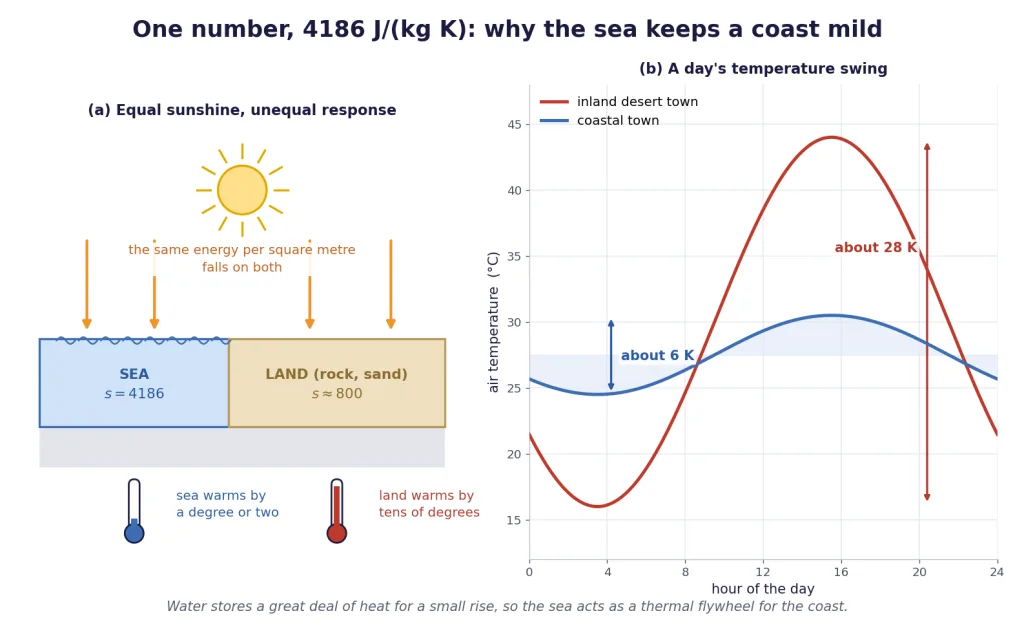
The sun delivers roughly the same energy per square metre to the sea and to the land beside it. The land — rock, sand, soil, around 800 J/(kg K) — heats fast and cools fast. The sea does neither. Two things work together:
- Water's specific heat capacity is about five times that of dry soil, so the same energy produces about a fifth of the rise.
- The sea mixes. Sunlight penetrates several metres and waves and currents stir the water further, so the energy is shared among a huge mass. On land, heat gets no further than the top few centimetres because rock is a poor conductor, so a small mass takes the whole load.
Put realistic numbers on it: six hours of 800 W/m into a two-metre column of sea water raises it by about 2 K, while the same energy into the top half-metre of rock would raise it by about 16 K if none escaped. That is why Mumbai and Chennai have a daily temperature swing of a few degrees while Jaisalmer swings by twenty-five or thirty, and why the desert that is unbearable at noon is genuinely cold before dawn.
The land and sea breeze, in outline
Because the land heats faster by day, the air above it warms, expands, rises, and cooler air flows in from the sea to the land — a sea breeze, and it is why the beach is pleasant on a hot afternoon. At night the land cools faster than the sea, the sea is now the warmer surface, and the flow reverses: a land breeze blows out to sea in the small hours.
Notice what is doing the work here. The breeze itself is a convection current, and Section 9 develops it properly — the circulation, the monsoon, the timing, the reversal. What belongs here is the reason there is a temperature difference to drive it at all, and that reason is one number: 4186 J/(kg K).
[NEET Important] The examiners' favourite version: "Why is the climate of a coastal town milder than that of a town in the interior at the same latitude?" The full-mark answer names the mechanism, not just the fact — the large specific heat capacity of water means the sea warms and cools far less than the land for the same heat exchange, so it acts as a reservoir that keeps the air above it, and the air blowing inland, close to a steady temperature.
[Board Important] Two more classics with the same one-line answer. Why is water used in hot-water bags? Large , so a given mass carries a lot of heat and gives it out slowly. Why does the earth's surface in a desert warm quickly by day and cool quickly at night? Sand has a small and there is no water to buffer it.
Per Mole: the Pattern That Was Hiding
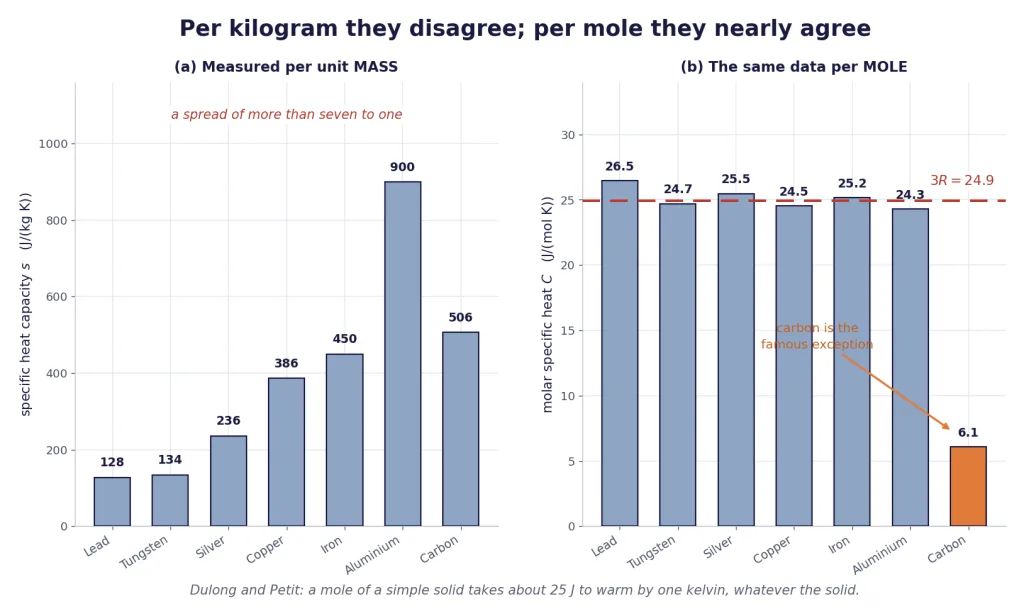
Look at the specific heat capacities of the metals again — 900 for aluminium, 450 for iron, 386 for copper, 236 for silver, 128 for lead. That is a spread of seven to one and it looks like pure chaos. There is no pattern there at all.
Now divide differently. Instead of asking how much heat a kilogram needs, ask how much a mole needs — that is, a fixed number of atoms rather than a fixed mass.
Key Point — molar specific heat capacity: where is the number of moles and is the molar mass in kg/mol. Multiply the specific heat capacity by the molar mass and you have the molar specific heat capacity, in J/(mol K).
Do it for the same five metals.
| Solid | in kg/mol | in J/(kg K) | in J/(mol K) |
|---|---|---|---|
| Lead | 0.2072 | 127.7 | 26.5 |
| Tungsten | 0.1838 | 134.4 | 24.7 |
| Silver | 0.1079 | 236.1 | 25.5 |
| Copper | 0.0635 | 386.4 | 24.5 |
| Iron | 0.0559 | 450 | 25.2 |
| Aluminium | 0.0270 | 900 | 24.3 |
| Carbon | 0.0120 | 506.5 | 6.1 |
The chaos is gone. Six of those seven numbers sit between 24.3 and 26.5 — inside a few per cent of one another, for metals whose densities, melting points and specific heat capacities have nothing in common.
Key Point — the Dulong-Petit result:
For most simple solids at ordinary temperatures, where is the gas constant. A mole of a simple solid needs about 25 J to warm by one kelvin, whatever the solid is.
Note carefully which that is. In this section J/(mol K) is the gas constant; in Section 8 the letter is reused for thermal resistance. They appear in different equations and we will say which is which each time.
Why a fixed number of atoms behaves the same way
The reason is worth one paragraph even though the full argument belongs to a later chapter. In a solid every atom is fixed to a lattice site and can vibrate about it in three independent directions. Each of those directions stores energy in two ways — kinetic and potential — and classical physics gives each of those a share of per atom. Three directions, two shares each, gives per atom, which is per mole. Differentiate with respect to and you get .
So the number 25 is really a statement about counting, not about chemistry: a mole is the same number of atoms whatever the substance, and each atom, sitting in its own little well, takes the same share of energy. Aluminium's is seven times lead's only because an aluminium atom is about eight times lighter, so a kilogram of aluminium contains about eight times as many atoms.
Where it fails, and why that matters
- Carbon (diamond) sits at 6.1, a quarter of the expected value, and boron and beryllium are also low. These are stiff, light-atom solids whose vibrations are so energetic that at room temperature many of the vibrational modes are simply not switched on. Explaining this needed quantum mechanics, and it was one of the first things quantum theory got right.
- Cool any solid down and falls, tending to zero as the temperature approaches absolute zero — the same effect for the same reason.
- Water is not a simple solid, and its molar value, J/(mol K), is nowhere near . Water is a molecular liquid with rotations and hydrogen bonds to feed as well.
[JEE Tip] Dulong-Petit is a genuinely useful shortcut in an exam. If a problem gives you the molar mass of an unknown metal and asks you to estimate its specific heat capacity, use and you will usually land within a few per cent. Going the other way, estimates the molar mass of a metal from a calorimetry experiment, and that is historically how several atomic masses were first pinned down.
A Gas Has Two Specific Heats, Not One
Everything so far has quietly assumed the substance keeps its volume while you heat it. For a solid or a liquid that is nearly true — Sections 3 and 4 showed that solids expand by parts in a hundred thousand per kelvin, which changes nothing. For a gas it is not true at all, and the consequence is that the question "what is the specific heat capacity of oxygen?" has no answer until you say how you heated it.
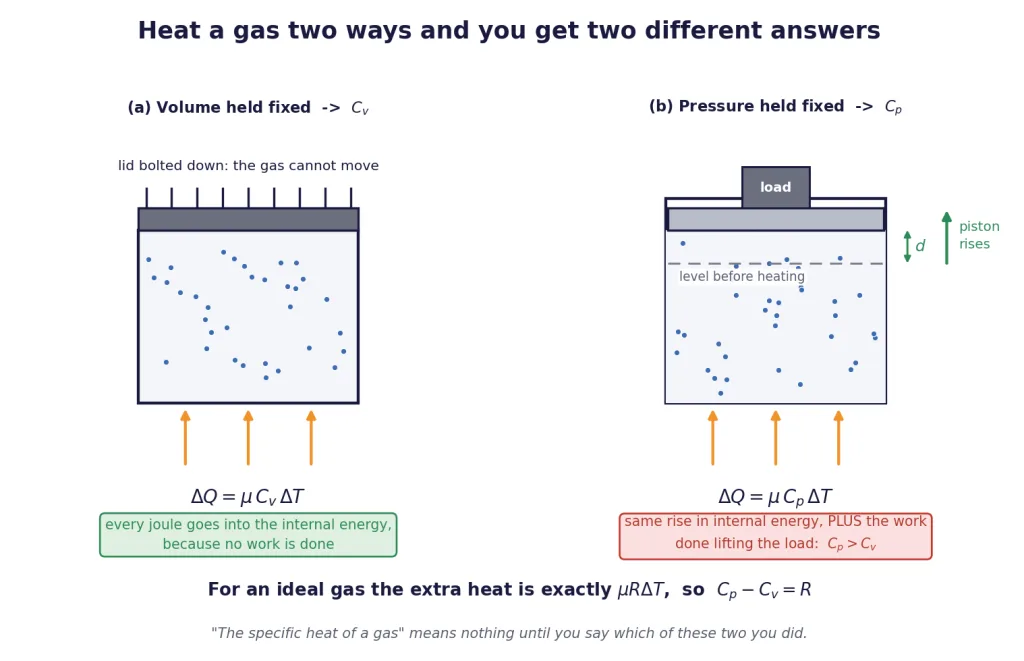
Two ways to give a gas the same rise in temperature
Way one: bolt the lid down. The gas is sealed in a rigid vessel. Supply heat and the gas cannot expand, so it pushes nothing and does no work on anything. Every joule you put in ends up as internal energy — as faster molecules — and the temperature climbs. The heat needed is and is the molar specific heat capacity at constant volume.
Way two: let the piston move. The gas is under a piston carrying a load, so its pressure is held fixed while its volume is free to grow. Supply heat and two things now happen: the molecules speed up and the gas pushes the piston up, lifting the load. Lifting the load costs energy, and that energy has to come out of the heat you supplied. So to get the same rise in temperature you must supply more heat: and is the molar specific heat capacity at constant pressure.
Key Point:
At constant pressure part of the heat is spent doing work against the surroundings instead of raising the temperature, so more heat is needed for the same rise. There is no gas anywhere for which this fails.
How much bigger, exactly
For an ideal gas the extra heat is precisely the work done, , and the ideal-gas equation from Section 2 turns that into . Divide through by :
Key Point — Mayer's relation: The gap between the two molar specific heats of an ideal gas is the gas constant itself — the same for every gas, monatomic or not.
Check it against measurement. These are our own tabulated values at room temperature.
| Gas | in J/(mol K) | in J/(mol K) | |
|---|---|---|---|
| Helium | 20.8 | 12.5 | 8.3 |
| Hydrogen | 28.8 | 20.4 | 8.4 |
| Nitrogen | 29.1 | 20.8 | 8.3 |
| Oxygen | 29.4 | 21.1 | 8.3 |
| Carbon dioxide | 37.0 | 28.5 | 8.5 |
Five gases, five different pairs of numbers, and the same difference every time to within a couple of per cent of . That column is one of the neatest experimental confirmations in the whole of Class 11 physics.
[JEE Tip] Notice that helium, a monatomic gas, has much smaller values than carbon dioxide, which is triatomic — a molecule with more ways to store energy takes more heat per kelvin. The pattern behind that ( for degrees of freedom) belongs to kinetic theory. What belongs here is the difference, which is regardless.
So "the specific heat of a gas" is meaningless on its own
Take nitrogen, molar mass 0.028 kg/mol, and convert both molar values to per-kilogram values:
- at constant volume, J/(kg K);
- at constant pressure, J/(kg K).
Same gas. Two specific heat capacities, differing by 40%. And those are only the two standard processes — there are infinitely many others, and two of them are worth knowing because they are the extreme cases:
- Isothermal. Heat the gas but hold its temperature fixed by letting it expand. Then while , so is infinite.
- Adiabatic. Let the gas expand with no heat crossing the walls at all. Then while the temperature falls, so is zero.
Key Point: For a gas, the specific heat capacity depends on the process, and it can be anything from zero to infinity, including negative values for some compressions. Quoting "the specific heat of a gas" without naming the process is like quoting a speed without saying relative to what. For solids and liquids the distinction exists too, but is so small that it is normally ignored, which is why we can get away with a single for them.
Loose Ends, and the Traps
Specific heat capacity is not quite a constant
We have been treating as a fixed property, and for exam purposes it is. Strictly it depends on temperature, and the honest form of the working equation is which collapses to whenever barely changes over the interval.
How good is that? For water between 0°C and 100°C, varies by less than one per cent, dipping to a shallow minimum near 35°C. So over any ordinary range, treating it as 4186 is excellent. For a solid taken from room temperature down towards absolute zero it is a disaster, because heads for zero — but no Class 11 problem asks you to do that.
[JEE Tip] If a question gives as a function of temperature, do not average it by eye. Integrate: . That is a standard Advanced-level twist on an otherwise routine problem.
One page of everything in this section
| Quantity | Symbol | Definition | SI unit | Property of |
|---|---|---|---|---|
| Heat capacity | J/K | the body | ||
| Specific heat capacity | J/(kg K) | the substance | ||
| Molar specific heat capacity | J/(mol K) | the substance | ||
| Working equation | J | |||
| Link between them | and | |||
| Dulong-Petit | J/(mol K) for simple solids | |||
| Mayer | for an ideal gas |
The six traps
Trap 1 — mixing up , and . Check the unit before you check the letter. J/K means the whole body, J/(kg K) means per kilogram, J/(mol K) means per mole. If your answer's unit does not match the quantity asked for, you have used the wrong one.
Trap 2 — forgetting to convert grams. Specific heats are quoted per kilogram. A mass given as 250 g is 0.250 kg. This single slip changes an answer by a factor of a thousand and it is the commonest arithmetic error in the topic.
Trap 3 — using a temperature instead of a temperature difference. needs the change. Water at 80°C cooled to 30°C has K, not 80 and not 30. Because it is a difference, kelvin and Celsius give the same number here — which is exactly why students then use a raw Celsius reading somewhere it does not belong.
Trap 4 — quoting one specific heat for a gas. Always ask which process. If the vessel is rigid it is ; if the gas is open to the atmosphere or under a free piston it is ; if neither is stated, the question is incomplete.
Trap 5 — assuming is some other combination. It is , the gas constant, per mole. Not , not . If you are working per kilogram instead of per mole, then it becomes — and say which you are doing.
Trap 6 — thinking a big specific heat means a hot substance. It means the opposite: for the same heat, a big gives a small temperature rise. Water is the hardest common substance to heat, not the easiest.
The habit that saves marks
Before you write a final answer here, run three checks.
- Units. in J/(kg K), in kg, in K, in J. Nothing in grams, nothing in calories unless you converted.
- Direction. Was the body heated or cooled? A body that cools gives out heat. Section 6 makes this a signed quantity; here, just be sure your has the sign the physics wants.
- Size. Warming a kilogram of water by ten kelvin takes about 42 kJ. If your answer for something of that scale comes out in joules or in megajoules, find the factor of a thousand before you move on.
[Board Important] Two definition questions are almost guaranteed somewhere in the paper: "Define specific heat capacity and give its SI unit" and "Why is water used as a coolant?" Both are one clean sentence, and both are free marks if you have the units right.
Solved Examples
Constants used throughout, unless a problem states otherwise: J/(kg K), J/(kg K), J/(kg K), J/(kg K), J/(kg K), J/(kg K), J/(kg K), J/(kg K), J/(kg K), J/(kg K), and the gas constant J/(mol K).
Example 1: Boiling the kettle
A kettle holds 1.5 kg of water at 25°C. (a) How much heat is needed to bring it to 100°C? (b) If the kettle is rated 2000 W and all of that power reaches the water, how long does it take?
Solution:
Identify what changes. Mass kg, J/(kg K), and the temperature change is (a difference, so kelvin and Celsius degrees are interchangeable here).
(a) Apply the working equation:
(b) Power is energy per second, so
Sanity check. Real kettles take about that long, and a real one is a little slower because some heat warms the kettle itself and some leaks away. Both effects push the time up, never down.
Final Answer: (a) J; (b) about 235 s, or 3.9 minutes.
Takeaway: Heat and power are different quantities joined by time. Whenever a problem gives you watts, your first move is ; whenever it gives you a temperature change, your first move is . Setting those two equal is most of the work.
Example 2: The same heat into two different substances
5000 J of heat is supplied to 0.50 kg of water, and the same 5000 J to 0.50 kg of iron, both starting at 20°C. Find the temperature rise of each and the ratio between them.
Solution:
Rearrange for the rise:
Water:
Iron:
The ratio, and notice the masses cancel completely:
Final Answer: Water rises 2.39 K, iron rises 22.2 K — the iron by 9.30 times as much.
Takeaway: For equal masses given equal heat, the temperature rises are in the INVERSE ratio of the specific heat capacities. Write the ratio symbolically first and the masses and the heat both vanish, leaving one division.
Example 3: Heat capacity of a body against specific heat capacity
An aluminium block has mass 2.5 kg. (a) What is its heat capacity? (b) How much heat raises it by 12 K? (c) A copper calorimeter has mass 0.14 kg; find its heat capacity. (d) Two aluminium blocks have masses 1 kg and 3 kg — compare their heat capacities and their specific heat capacities.
Solution:
(a) Heat capacity is mass times specific heat capacity: Read that as: this block needs 2250 J for every kelvin.
(b) Twelve kelvin, then: Identical to , which is exactly what says.
(c) The copper vessel: Small, but Section 6 shows it is not negligible in a calorimetry experiment.
(d) The two blocks. J/K and J/K, so the heat capacities are in the ratio 1 : 3. But J/(kg K) for both, so the specific heat capacities are equal — it is the same metal.
Final Answer: (a) 2250 J/K; (b) J; (c) 54.1 J/K; (d) heat capacities 1 : 3, specific heat capacities equal.
Takeaway: belongs to the object, belongs to the material. Cut a block in half and its heat capacity halves while its specific heat capacity does not budge.
Example 4: A drill heating its workpiece
A 750 W electric drill works on a 1.2 kg aluminium block initially at 30°C. Sixty per cent of the electrical power ends up as heat in the block, the rest going into the tool, the noise and the surroundings. Find the temperature of the block after 3.0 minutes, assuming no heat escapes from it.
Solution:
Find the heat that actually reaches the block. Three minutes is 180 s, and 60% of 750 W is the useful power:
Convert that to a temperature rise, with J/(kg K):
Add it to the starting temperature:
Comment on the assumption. In reality the block loses heat to the air and to the bench the whole time, so the true final temperature is lower. Our answer is an upper bound, and saying so is worth a mark.
Final Answer: About 105°C.
Takeaway: Efficiency percentages multiply the power, not the temperature. Convert to a heat in joules first, then and only then divide by .
Example 5: Sizing the coolant flow in an engine
An engine rejects 25 kW of waste heat to its cooling water, which enters the jacket at 85°C and leaves at 95°C. (a) What mass of water must flow past every second? (b) What flow would be needed if oil of J/(kg K) were used instead?
Solution:
Per second, the heat carried away must equal the heat rejected. With the mass flowing per second,
(a) Water, with K: About 0.6 litre of water every second.
(b) Oil, same duty, same temperature rise:
Compare. The ratio is — the oil system would have to pump more than twice the mass every second, needing bigger pipes, a bigger pump and more space under the bonnet.
Final Answer: (a) 0.597 kg/s; (b) 1.27 kg/s, 2.13 times as much.
Takeaway: This is the whole engineering case for water as a coolant, in one division. A large means a small mass flow does the job.
Example 6: The hot-water bottle against the hot brick
A hot-water bottle holds 2.0 kg of water at 80°C; a brick of the same mass has been heated to the same 80°C. Both are placed in a bed and cool to 40°C. How much heat does each give out, and what is the ratio? Take J/(kg K).
Solution:
Cooling gives out heat, and the magnitude uses the same equation with K.
The water:
The brick:
The ratio:
Final Answer: Water gives out J, the brick J — five times less.
Takeaway: A large specific heat capacity makes a substance a good heat store as well as a good coolant. The two applications look opposite but are the same property read in the two directions.
Example 7: From specific to molar, and back to
Copper has J/(kg K) and molar mass 63.5 g/mol. (a) Find its molar specific heat capacity. (b) Compare it with . (c) Repeat for aluminium, molar mass 27.0 g/mol, J/(kg K).
Solution:
Convert the molar mass to SI before anything else: g/mol kg/mol.
(a) Multiply:
(b) Compare with : Within 1.6% — a very good agreement for a rule this simple.
(c) Aluminium, with kg/mol: also within 3% of , even though aluminium's is 2.3 times copper's.
Final Answer: (a) 24.5 J/(mol K); (b) 0.984 of ; (c) 24.3 J/(mol K), again close to .
Takeaway: The units tell you which way to multiply. J/(kg K) times kg/mol gives J/(mol K). If you find yourself dividing, you have the molar mass upside down.
Example 8: Predicting a specific heat you were never given
An unknown metal has molar mass 108 g/mol. (a) Estimate its specific heat capacity from the Dulong-Petit result. (b) The measured value is 236.1 J/(kg K). How good was the estimate?
Solution:
Turn the rule round. Dulong-Petit says , so
(a) Substitute, with kg/mol:
(b) Compare:
The historical point. Run the argument the other way — measure in a calorimeter and compute — and you have an estimate of the atomic mass of a metal from a heat experiment alone. That is exactly how several atomic masses were first settled in the nineteenth century.
Final Answer: (a) about 231 J/(kg K); (b) low by 2.2%.
Takeaway: , with in kg/mol, is worth committing to memory. It gives you a specific heat capacity for almost any metal to within a few per cent when a question forgets to supply one.
Example 9: Heating nitrogen two different ways
2.0 mol of nitrogen is warmed by 40 K. Take J/(mol K) and J/(mol K). Find (a) the heat needed in a rigid sealed vessel, (b) the heat needed under a free piston at constant pressure, (c) the difference, and (d) check it against Mayer's relation.
Solution:
(a) Rigid vessel means constant volume:
(b) Free piston means constant pressure:
(c) The difference:
(d) Mayer's relation predicts that difference to be agreeing to 0.2%, the small gap being the fact that nitrogen is not perfectly ideal.
Final Answer: (a) 1664 J; (b) 2328 J; (c) 664 J extra; (d) matches J.
Takeaway: The extra 664 J did not vanish — it is out there as work. Constant pressure always costs more heat for the same rise, and the excess is exactly the work the gas did pushing its surroundings back.
Example 10: Where the extra heat went
For the gas of Example 9, heated at constant pressure Pa from 27°C to 67°C, compute the work done by the gas directly from and confirm it accounts for the difference.
Solution:
Convert both temperatures to kelvin, because the gas equation demands absolute temperature and nothing else will do: The difference is 40 K either way, but the individual volumes need the absolute values.
Find the two volumes from :
The work done at constant pressure:
Compare with Example 9. The extra heat needed at constant pressure was 664 J; the work done is 665 J. They are the same quantity arrived at from opposite directions.
Final Answer: J, matching the extra heat to within 0.2%.
Takeaway: The kelvin conversion is not optional. The temperature difference is the same in both scales, but needs the absolute value — using 27 and 67 here would have given volumes wrong by a factor of eleven.
Example 11: Why the sea does not boil and the sand does
(a) 20 kJ of solar energy falls on 1 kg of sea water and on 1 kg of dry soil ( J/(kg K)). Compare the temperature rises. (b) Now allow for depth: six hours of sunshine at 800 W/m falls on one square metre. The sea mixes to a depth of 2.0 m (density 1000 kg/m); the ground warms only in its top 0.50 m (density 2600 kg/m, J/(kg K)). Compare again.
Solution:
(a) Equal masses first. For the water, and for the soil, a ratio of 5.23 : 1 in the soil's favour.
(b) The total energy arriving on each square metre:
The mass involved is wildly different. Sea: kg. Ground: kg.
The two rises: a ratio of 7.7 : 1.
Read the two effects apart. The specific heat capacity alone gives a factor of about five. Mixing to a greater depth supplies the rest. Neither figure is the real temperature of a beach, because both surfaces also lose heat by radiation, convection and evaporation — but the comparison is exactly right, and it is the comparison that drives the breeze.
Final Answer: (a) 4.78 K against 25.0 K; (b) about 2.1 K against about 15.8 K.
Takeaway: Two things make the sea sluggish: a big and a big mass. The first is physics you can quote; the second is why the effect in the real world is even larger than the table suggests.
Example 12: One gas, two specific heat capacities
A student writes "the specific heat capacity of nitrogen is 743 J/(kg K)". Another writes "no, it is 1039 J/(kg K)". Molar mass of nitrogen is 28 g/mol, and J/(mol K). Who is right?
Solution:
Convert both molar values to per-kilogram values by dividing by the molar mass in kg/mol:
So both students are right, and both are incomplete. The first has computed the specific heat capacity at constant volume, the second at constant pressure. They differ by 40%.
Their ratio is a number you will meet constantly in thermodynamics:
This is a pure number and has nothing to do with the coefficient of volume expansion, which carries the same letter and is measured in K. The units tell them apart at a glance.
- And the extremes are worse than a 40% disagreement. Heat the gas isothermally and with , so the specific heat capacity is infinite. Heat it adiabatically and while changes, so it is zero.
Final Answer: Both, depending on the process — 743 J/(kg K) at constant volume, 1039 J/(kg K) at constant pressure.
Takeaway: For a gas, "specific heat capacity" is not a single number but a family of them, one for every process. Always name the process; for a solid or liquid the family is so tightly bunched that we can safely ignore the distinction.