
How to Use This Section
This is the last section of the chapter, and it has exactly one job: to be read the night before the paper, and again in the queue outside the hall.
Nothing new is taught here. Every card below compresses something an earlier section worked through properly, in the same notation and with the same numbers. So if a line here surprises you, that is not a line to memorise — it is a signal to go back and reread the section that owns it.
Six cards, three figures, four reference tables, one decision chart, one mistake checklist, one 60-second list and one fast self-test. Screenshot the heating curve and the blackbody spectrum.
Seven Notation Reminders
This chapter has the worst symbol collisions in the whole year's physics. Hold to these and you can read anybody's formula sheet without stumbling.
- is an absolute temperature in KELVIN. or is Celsius. Every fourth power, every ratio and every gas-law substitution in this chapter needs kelvin. Only a difference is safe in Celsius, because a rise of C and a rise of 1 K are the same interval.
- with a subscript is latent heat; a bare is a LENGTH. So for fusion, for vaporisation, and a plain for the length of a rod or the thickness of a slab.
- is the coefficient of linear expansion and nothing else. is areal (superficial), is volume. They are also written , , .
- , and are three different quantities. is the specific heat capacity per kilogram in J/(kg K); is the molar specific heat per mole in J/(mol K); is the heat capacity of a whole named body in J/K, so .
- is thermal conductivity in W/(m K); lowercase is the cooling constant in Newton's law, in s. Conductivity is also written or , so check which one a formula sheet means before you trust it.
- In radiation, absorptive power is , never , and emissivity is . Absorptivity is also written or ; here belongs to expansion. is always the Stefan-Boltzmann constant and is always Wien's constant.
- does double duty. In the conduction cards is thermal resistance in K/W. In the one place molar specific heats appear, is the gas constant, 8.31 J/(mol K). They never share an equation, but say which one you mean.
The constants sheet
Every number on these cards uses one of these. Never mix and inside one problem, and never mix with — pick one, write it at the top of your working, and use it everywhere.
| Constant | Value |
|---|---|
| Specific heat capacity of water | 4186 J/(kg K) |
| Specific heat capacity of ice | 2100 J/(kg K) |
| Specific heat capacity of steam | 2010 J/(kg K) |
| Latent heat of fusion of ice | J/kg |
| Latent heat of vaporisation of water | J/kg |
| Stefan-Boltzmann constant | W/(m K) |
| Wien's displacement constant | m K |
| Gas constant | 8.31 J/(mol K), so J/(mol K) |
| Triple point of water | 273.16 K, the defining fixed point |
| Ice point | 273.15 K, rounded to 273 K in most radiation problems |
| Mechanical equivalent of heat | 1 cal J |
The comparison table — learn the pattern, not the digits
One table for all three material properties, so you can see at a glance that they are unrelated to one another.
| Substance | in J/(kg K) | in W/(m K) | in K |
|---|---|---|---|
| Silver | 236.1 | 406 | |
| Copper | 386.4 | 385 | |
| Aluminium | 900 | 205 | |
| Brass | — | 109 | |
| Iron | 450 | 79 | |
| Steel | 450 | 50.2 | |
| Lead | 127.7 | 34.7 | |
| Ice | 2100 | 1.6 | — |
| Glass (ordinary) | 840 | 0.8 | |
| Brick | — | 0.72 | — |
| Water | 4186 | 0.6 | |
| Body fat | — | 0.20 | — |
| Wood | — | 0.12 | — |
| Thermacole (EPS) | — | 0.033 | — |
| Air | about 1005 | 0.024 | |
| Invar | — | — |
Typical values at ordinary room temperature. Water and air are liquids and gases, so the volume coefficient is quoted for them instead of a linear ; a dash means the chapter never needed that number.
Six readings off it, every one of which has been an examination question:
- Thermal conductivity spans nearly four orders of magnitude — silver at 406 down to air at 0.024, a factor of about 17000. Nothing else in the table varies remotely that much.
- Specific heat capacity varies by only a factor of about 30 across the whole table, and water sits at the top of it. That one number, 4186 J/(kg K), is behind the car radiator, the sea breeze and the moderate coastal climate.
- Expansion coefficients are all around K for metals — lead is the largest at and iron and steel the smallest at , a factor of about two and a half across every ordinary metal in the list. Invar, engineered to sit still, is the deliberate exception. Liquids are about ten times larger than a metal and a gas is about a hundred times larger again.
- The three properties are independent of one another. Lead conducts about forty times better than glass and expands more than three times as much, yet stores only about a seventh as much heat per kilogram. Knowing one tells you nothing about the others.
- Air is the best insulator in the table, which is why fur, feathers, wool, thermacole and double glazing all work by trapping still air rather than by being clever materials themselves.
- Invar barely moves at all, which is exactly what it was invented for — pendulum rods, measuring tapes and anything that must not change length with the weather.
Five topics on these cards that the body text does not carry
Areal expansion and the ratio, bimetallic strips, thermal resistance in series and in parallel, Kirchhoff's law and Prevost's theory, and the greenhouse effect and solar constant all sit outside the rationalised syllabus body text. Boards, JEE Main, JEE Advanced and NEET ask them every year, so they are on these cards in full.
Card 1 — Temperature, the Scales, and Thermal Expansion
Heat and temperature, kept apart
Key Point: Temperature measures the degree of hotness and decides the direction heat flows. Heat is energy in transit, flowing only because of a temperature difference. A body does not contain heat — it contains internal energy, and heat is what crosses the boundary.
A bucket of warm water holds far more internal energy than a red-hot spark, yet the spark is at the higher temperature and heat flows from spark to water.
Key Point — the zeroth law: if is in thermal equilibrium with , and is in thermal equilibrium with , then and are in thermal equilibrium with each other. This is what makes temperature a measurable quantity and a thermometer possible at all.
A diathermic wall lets equilibrium happen; an adiabatic wall prevents it. Units: cal J.
The scales
Key Point — the conversion, from the two fixed points: and the absolute scale, A degree Celsius and a kelvin are the same size, so a rise of C is a rise of 50 K. Only the zero differs.
- The two scales read alike at : C F. It is the one temperature where they agree.
- Normal body temperature C is F, which is where clinical thermometers get that number.
- A temperature interval converts differently from a temperature: a rise of C is a rise of F, because only the applies, not the 32.
Key Point — the absolute scale: the triple point of water, 273.16 K, is the single defining fixed point, chosen because a triple point occurs at exactly one pressure and one temperature and therefore cannot drift. A constant-volume gas thermometer reads and its readings become independent of which gas is used as the pressure is reduced. Absolute zero, 0 K C, is where the pressure of an ideal gas would extrapolate to zero. It can be approached, never reached.
The ideal-gas equation needs in kelvin, always.
Key Point — THE KELVIN RULE, the most valuable line in this section:
Wherever temperature appears as a ratio, a product or a power — , , , — it must be in kelvin.
Wherever only a difference appears — , , , — Celsius and kelvin give the same number.
Here is that rule doing its job. A body goes from C to C. The rise is C, and also 300 K. The ratio of absolute temperatures is , not . One of those is a factor of six wrong.
Thermal expansion
Key Point — the three coefficients: and for an isotropic solid All three coefficients have the unit K.
Where the 2 and the 3 come from, and what they cost. Every length is multiplied by , so an area is multiplied by and a volume by . Writing , Keeping only the linear term gives and . These are first-order approximations, not identities. For aluminium heated through 100 K, , and the neglected terms are 0.115% of the areal answer and 0.23% of the volume answer. Genuinely negligible — but earned, not assumed.
| Result | Formula | The thing that catches people |
|---|---|---|
| New length | the factor multiplies every length in the body | |
| A hole in a plate | the hole gets BIGGER, exactly as if filled with the metal | |
| Apparent expansion of a liquid | the vessel expanded too | |
| Density | density falls on heating | |
| An ideal gas | in kelvin; about K near C | |
| Constrained rod | thermal stress | independent of the length; enormous for steel |
Key Point — the hole. Heat a plate with a hole in it and the hole expands. Imagine the disc of metal that was drilled out: it would grow by , and it must still fit, so the hole grows by exactly the same amount. A ring, a washer, a bearing and the bore of a pipe all get larger on heating.
Typical sizes, three decades apart: metals about K, liquids about K, a gas about K at room temperature.
Where it shows up: expansion gaps in rails and bridges, the loop in a steam pipe, shrink-fitting a rim onto a wheel, the systematic error of a steel tape used at the wrong temperature, and the bimetallic strip, which always bends towards the metal that expands less — brass on iron curls towards the iron on heating.
Key Point — the anomaly of water: between C and C water contracts when heated, so it is densest at C. That is why a lake freezes from the top down, why the water at the bottom stays at C, and why fish survive the winter.
[Board Important] "Why does a hole in a metal plate get bigger when the plate is heated?" and "Why does a lake freeze from the top downwards?" are both standard three-markers. Neither needs a number — they need the reasoning above, written out.
Card 2 — Heat Capacity, Calorimetry and Latent Heat
The three capacities, kept apart
| Quantity | Symbol | Definition | SI unit | Belongs to |
|---|---|---|---|---|
| Heat capacity | J/K | the body | ||
| Specific heat capacity | J/(kg K) | the substance | ||
| Molar specific heat capacity | J/(mol K) | the substance |
They are linked by and , with the molar mass in kg/mol.
Key Point — the working equation that runs through the rest of the chapter:
Two experimental facts worth carrying:
- Dulong-Petit. Most simple solids have J/(mol K). Check it: copper, ; aluminium, ; lead, . Carbon is the famous exception at about 6.1 J/(mol K).
- Mayer's relation. For an ideal gas , so always — at constant pressure the gas also does work as it expands, and that work has to be paid for. "The specific heat of a gas" is meaningless until you say which process.
Water's 4186 J/(kg K) is exceptionally large, and a great deal follows from that single number: water as the coolant in engines and reactors, the sea moderating a coastal climate, the land and sea breeze reversing between day and night, and a hot-water bottle beating a hot brick.
Calorimetry
Key Point — the principle: in a thermally isolated system, heat lost by the hot bodies equals heat gained by the cold ones: It is nothing but conservation of energy. The marks are in the bookkeeping.
Key Point — water equivalent: the mass of water that would absorb the same heat as the calorimeter. Its SI unit is the kilogram. Once you have it, fold the vessel into the arithmetic as though it were that much extra water — a calorimeter of water equivalent 30 g holding 170 g of water behaves in every heat balance exactly like 200 g of water.
The five-step recipe, in order:
- List every body: the hot one, the cold one, the calorimeter, the stirrer, the thermometer if its heat capacity is given.
- Decide which are losing heat and which are gaining.
- Write one equation, , with a term for every body and an or term for every phase change.
- Solve for the single unknown.
- Check that the answer lies between the two starting temperatures. If it does not, a sign is wrong.
Key Point — the trap that catches everyone. If a phase change is possible, compute the heat available and the heat required separately, and compare them before assuming a final temperature.
For ice at C dropped into warm water: the heat available is and the heat needed to melt all the ice is .
- Available more than needed: all the ice melts and the mixture settles somewhere above C.
- Available less than needed: the temperature pins at C with only of the ice melted, and ice and water coexist.
Never assume the ice all melts. That assumption is the single most expensive habit in this topic.
Latent heat, and the curve
Key Point: with J/kg and J/kg for water, both in J/kg. During a change of state the temperature does not change at all — the energy goes into breaking the bonds that hold the state together, not into raising kinetic energy.
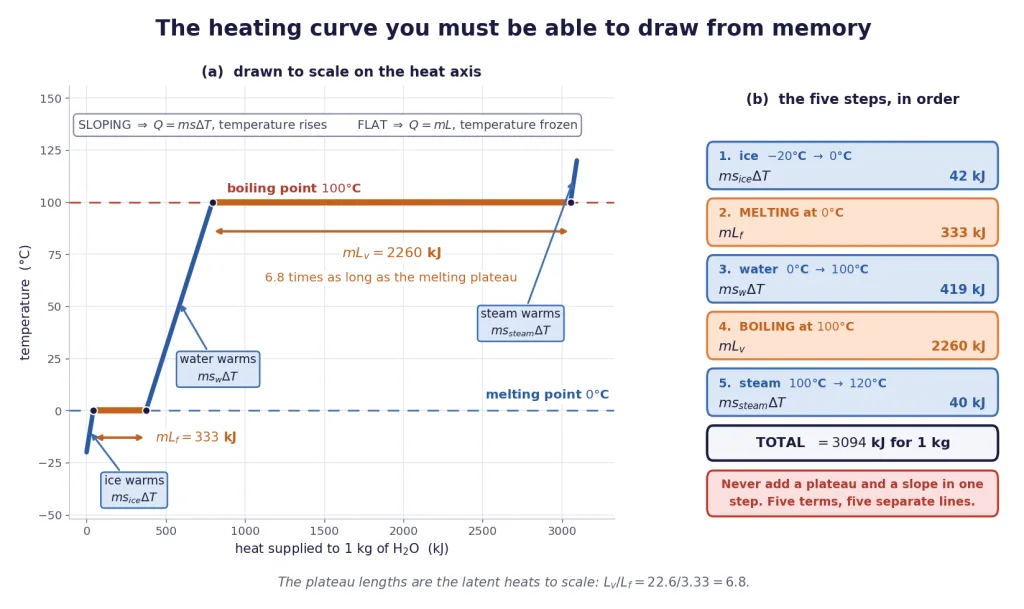
Read the figure and you have the whole topic:
- Sloping segment , temperature rising, one phase only. Flat segment or , temperature frozen, two phases coexisting.
- The steeper the slope, the smaller the specific heat capacity. Ice and steam are steeper than water because 2100 and 2010 are smaller than 4186.
- The vaporisation plateau is 6.8 times as long as the fusion plateau, because . Melting only loosens the lattice; boiling has to separate the molecules altogether.
- Taking 1 kg from ice at C to steam at C costs kJ, and 73% of that is the boiling plateau alone.
- That is why steam at C scalds far worse than water at C: every gram of steam that condenses on the skin delivers 2260 J/g before it even begins to cool.
Pressure moves both points, in opposite directions. Raising the pressure lowers the melting point of ice — that is regelation, and it is why a loaded wire passes through a block of ice leaving it whole. Raising the pressure raises the boiling point, which is a pressure cooker; lowering it drops the boiling point, which is why rice will not cook properly on a mountain.
Evaporation is a surface process at any temperature, it cools what is left behind, and it is not boiling — boiling happens throughout the bulk at one fixed temperature. Sublimation is solid straight to vapour, as dry ice and camphor do.
[NEET Important] Latent heat is quoted per kilogram, so a mass in grams must be converted before it is multiplied. Half the wrong answers in this topic are a factor of 1000, not a misunderstanding.
Card 3 — Conduction, Convection and Thermal Resistance
The three modes in one line each
| Mode | What actually moves | Needs a medium? |
|---|---|---|
| Conduction | energy passed particle to particle, no bulk motion | yes, solids especially |
| Convection | the fluid itself, carrying energy with it | yes, must be a fluid |
| Radiation | electromagnetic waves | no |
Conduction
Key Point — the conduction law, in the steady state: is the heat current in watt, the thermal conductivity in W/(m K), the area perpendicular to the flow and the thickness along it. The quantity is the temperature gradient, in K/m.
Because only a difference appears, C and K give the same number here.
In the steady state the temperature at each point has stopped changing, the same passes every cross-section, and for a uniform lagged bar the temperature falls linearly along the length.
Metals conduct far better than non-metals because free electrons carry the energy as well as the lattice vibrations — the same electrons that make them electrical conductors.
Thermal resistance — the tool that makes composite problems easy
Key Point: in exact analogy with Ohm's law. The SI unit of thermal resistance is K/W.
| Electricity | Heat |
|---|---|
| potential difference | temperature difference |
| current | heat current , in watt |
| resistance | thermal resistance |
Key Point — series and parallel:
In SERIES (slabs joined end to end, one behind the other): the same passes through both, the temperature drops add, and In PARALLEL (slabs side by side between the same two reservoirs): the same sits across both, the currents add, and
Three consequences worth memorising:
- In series, the bigger resistance takes the bigger temperature drop. A thin layer of a poor conductor can dominate an entire wall.
- In parallel, the better conductor carries the bigger share of the current, in the ratio of the conductances.
- The junction temperature between two rods in series comes from setting the two currents equal, , and solving for . For a copper rod and a steel rod of equal size with free ends at C and C, the junction sits at C — right up near the hot end, because copper's resistance is tiny compared with steel's.
Why insulation works. Fur, feathers, wool, thermacole and double glazing all work by trapping still air, whose conductivity is 0.024 W/(m K) — about 16000 times worse than copper. Two thin blankets beat one thick one because of the air layer between them. A metal spoon feels colder than a wooden one at the same temperature because it conducts heat away from your finger far faster; the spoon is not colder, your finger is.
Convection, in one card corner
Convection is bulk transport of the fluid itself. The heated fluid expands, becomes less dense, rises, and cooler fluid sinks to replace it. It is therefore impossible in a solid and impossible in free fall or orbit, where there is no effective gravity to sort the fluid by density.
- Natural convection is driven by that density difference: a pan of water, a chimney, a room heater at floor level.
- Forced convection is driven by a pump or fan: a car radiator, a room fan, and the blood in your circulatory system carrying heat from the core to the skin.
- The sea breeze by day and the land breeze by night follow directly from water's large specific heat capacity: the land heats and cools quickly, the sea barely changes. The monsoon is the same mechanism on a continental scale.
- A heater goes at floor level and an air conditioner high on a wall, because each needs to sit where its treated air will be carried through the room by the circulation it sets up.
[JEE Tip] Almost every conduction question at this level is a resistance network in disguise. Convert each slab or rod to first, combine them as series and parallel, then use once at the end. It replaces three lines of algebra with one.
Card 4 — Radiation, and Newton's Law of Cooling
The vocabulary, settled first
Thermal radiation is electromagnetic waves, travelling at m/s, needing no medium at all. That is what gets the Sun's energy across empty space.
Key Point — Prevost's theory of heat exchange: every body emits and absorbs radiation at all times, at every temperature above absolute zero. A body in equilibrium with its surroundings is not idle — it is emitting and absorbing at equal rates.
- Absorptive power is the fraction of incident radiation absorbed. It is a pure number between 0 and 1.
- Emissivity is the ratio of a body's emissive power to that of a blackbody at the same temperature. Also a pure number between 0 and 1.
- A blackbody absorbs everything falling on it, so and . A small hole in a large cavity is the practical realisation: a ray that enters is reflected so many times inside that it has essentially no chance of finding its way out again.
Wien's displacement law
Key Point: is the wavelength at which the emission is most intense, and is in kelvin. Hotter means a shorter peak wavelength.
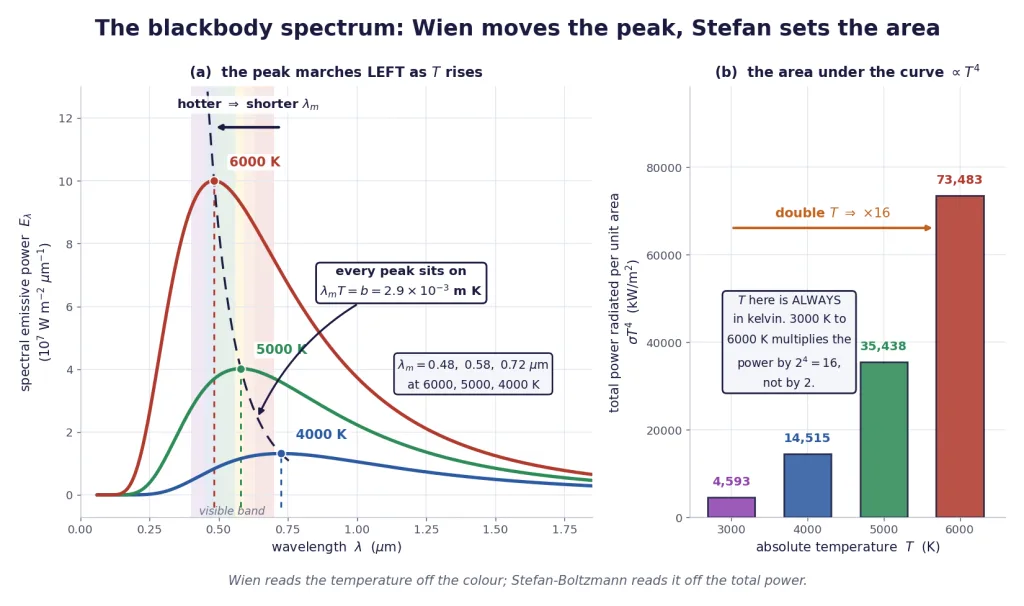
This is why a heated body glows dull red, then orange, then white as it gets hotter — the peak marches in from the infrared towards the blue. It is also how a star's surface temperature is read off its colour: the Sun peaks near 500 nm, giving about 5800 K.
The Stefan-Boltzmann law
Key Point: with W/(m K). Both temperatures in kelvin, always.
The fourth power is unforgiving and it is what questions are built on. Doubling the absolute temperature multiplies the radiated power by , so a body at 6000 K radiates sixteen times as much per square metre as one at 3000 K, not twice as much. Panel (b) of the figure is that statement drawn.
The substitution, done properly. A body at C in surroundings at C: put K and K, giving W/m per unit emissivity. Putting the Celsius numbers in instead gives W/m — nearly five thousand times too small, and instantly recognisable as wrong.
Kirchhoff's law
Key Point: at a given temperature and a given wavelength, the ratio of the emissive power to the absorptive power is the same for every body, and equals the emissive power of a blackbody. In short: a good absorber is a good emitter.
Its evidence, all examinable:
- A blackened vessel of hot water cools faster than an identical polished one, and a blackened one also warms faster in the sun.
- Wearing white in summer helps because a poor absorber of sunlight is what you want; the same cloth is a poor emitter too, which is why the choice matters much less at night.
- The dark Fraunhofer lines in the solar spectrum: the cooler gases of the Sun's atmosphere absorb exactly the wavelengths they would themselves emit.
Newton's law of cooling
Key Point — the law, and its honest status: It is an approximation, obtained from the Stefan-Boltzmann law by a binomial expansion of and valid only while the excess is small compared with . It is not a law of nature in its own right.
Key Point — Celsius is safe here, and only here. Newton's law contains nothing but the difference , and a difference is the same number in Celsius and in kelvin. So a cooling problem may be worked entirely in C. The moment a fourth power or a ratio appears — including inside the expression for , where is cubed — you are back to kelvin.
The two forms you actually use:
| Form | Statement | When |
|---|---|---|
| Exponential | , so the excess decays exponentially | any drop, and compulsory for a large one |
| Log plot | : a straight line of slope | reading a laboratory graph |
| Average temperature | a small drop across one stage; what most exam problems want | |
| Time constant | , the time for the excess to fall to , about 37% | reading a |
How good is each approximation? Both have been measured.
- The average-temperature shortcut is excellent while the drop in one stage is small compared with the excess. Water cooling from C to C, then C to C, in a C room: the shortcut gives 6.43 min against an exact 6.45 min, an error of %. But a body falling from C to C in a C room in one step is off by %, and there the logarithm is compulsory.
- Newton's law itself understates the true radiative loss, because the binomial expansion throws away positive terms. At an excess of 10 K it predicts 95.1% of the true rate, and the half-life of the excess comes out about 3.7% too long. At an excess of 100 K it predicts only 61.7% of the true rate, and the half-life is about 42% too long. Do not present the law as exact.
Key Point — the range of validity, stated honestly: for radiation alone, Newton's law is good to about 5% out to an excess of roughly 10 K. In a real laboratory, where convection also carries heat away and convective loss is much closer to linear in , it works usefully out to about 30 to 40 K.
Two applications that carry marks
The solar constant is the solar energy received per unit time per unit area on a surface held perpendicular to the Sun's rays just outside the atmosphere, about 1.4 kW/m. At ground level roughly 1.0 kW/m survives the journey down.
The greenhouse effect. Short-wavelength sunlight passes freely through the atmosphere and warms the ground. The ground, being far cooler than the Sun, re-radiates in the long-wavelength infrared — exactly where carbon dioxide, water vapour and methane absorb strongly. That energy is trapped and re-emitted downwards, and the surface settles about C warmer than it otherwise would. It is what makes the planet habitable; raising the concentration of those gases shifts the balance. A parked car in the sun is the same physics on a small scale.
[JEE Tip] Before applying Newton's law of cooling, form the ratio in kelvin. Below about 0.05 the law is excellent; above about 0.15 it is doing real damage, and if the question asks you to comment, that ratio is the answer.
Card 5 — Which Tool Does This Question Want?
This is the most valuable card in the section. Almost nobody loses marks in this chapter because they cannot do the arithmetic. They lose them by reaching for the wrong equation in the first five seconds, and then computing a perfectly accurate answer to a question nobody asked.
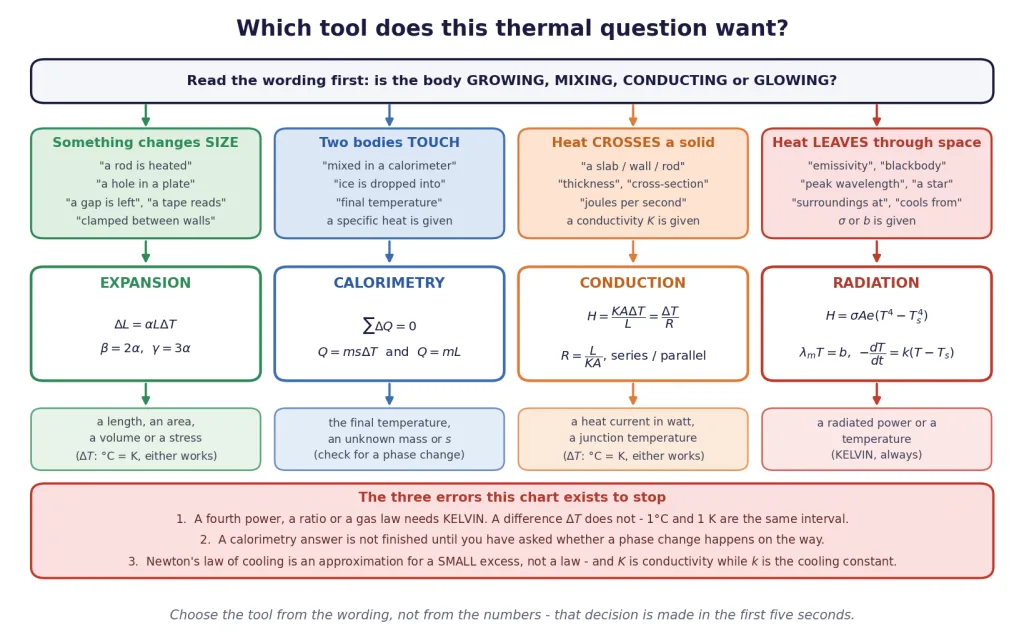
The one question that decides it
Is the body growing, mixing, conducting or glowing? Four verbs, four tools. Everything in the chapter is one of them.
| If the question is about a body that… | you want | and the formula is |
|---|---|---|
| changes SIZE when heated | expansion | , with and |
| touches another body and they settle | calorimetry | , with and or terms |
| lets heat cross a solid | conduction | , |
| loses heat through space | radiation | , , |
The cue words, which is what you will actually recognise
| Wording in the question | What it is telling you |
|---|---|
| "a rod is heated through", "a gap is left between rails" | linear expansion, |
| "a circular hole in a plate", "an iron ring is slipped onto" | areal expansion, and the hole gets bigger |
| "filled to the brim and heated", "overflows" | apparent expansion, |
| "clamped between rigid walls", "cannot expand" | thermal stress |
| "a steel tape reads", "a pendulum clock" | an expansion error, not a length |
| "mixed in a calorimeter", "the final temperature of the mixture" | calorimetry, |
| "water equivalent", "a calorimeter of mass and specific heat" | fold the vessel in as extra water |
| "ice at C is dropped into", "steam is passed into" | calorimetry with a phase change — branch before you assume |
| "how much heat to melt / to boil / to freeze" | latent heat, or |
| "a heater takes so many minutes" | power time the heat, then or or |
| "a wall of thickness", "a slab", "a lagged rod", "" | conduction, |
| "joined end to end" / "placed side by side" | thermal resistances in series / in parallel |
| "the temperature of the junction" | equate the two heat currents |
| "ice forms on a pond", "the boiler base", "the icebox wall" | conduction, usually with a latent heat at one end |
| "emissivity", "a blackbody", "surroundings at" | Stefan-Boltzmann, , kelvin |
| "peaks at a wavelength of", "the colour of a star" | Wien, , kelvin |
| "a good absorber is a good emitter", "blackened and polished" | Kirchhoff |
| "cools from … to … in … minutes" | Newton's law of cooling, average-temperature form |
| "a graph of against " | slope , intercept |
Six traps that live in exactly this decision
- Celsius where kelvin is required. A fourth power, a ratio or a gas law needs the absolute temperature. A difference does not. This decides more marks than everything else on this card put together.
- Assuming all the ice melts. Compute the heat available and the heat required, compare them, and only then decide whether the answer pins at C.
- Reaching for conduction when the question says "in a vacuum" or "in space". No medium means radiation only — conduction and convection are both out.
- Using Newton's law of cooling at a large excess. It is a small-excess approximation. At an excess of 100 K it is wrong by nearly 40% on the rate.
- Confusing with . is thermal conductivity, W/(m K). is the cooling constant, s. Different quantities, different units, and a formula sheet that uses for conductivity will happily let you mix them.
- Forgetting that a hole expands. A ring, a washer, a bearing and the bore of a pipe all get larger on heating, never smaller.
[JEE Tip] When a question gives you a mass, a specific heat and a latent heat, it is telling you that the substance crosses a phase boundary somewhere in the answer. Write down every stage of the journey before you compute anything — , then , then again — and add them at the end.
Card 6 — The Mistakes That Cost the Most Marks
Every one of these was flagged somewhere in the earlier sections. They are ordered by how often they actually turn up in answer scripts.
1. Celsius where kelvin is required. This is the commonest error in the entire chapter. Any temperature that enters a power, a product or a ratio must be absolute. , , , , and the inside the cooling constant — all kelvin. A body at C radiates as , not as , and the difference is a factor of eleven. Write "K" next to every temperature you substitute.
2. Assuming all the ice melts. Compare the heat available with the heat required before you assume anything. If the water cannot supply , the mixture pins at C with only part of the ice melted, and the answer is C with a mass, not a temperature above zero.
3. Forgetting the latent-heat term altogether. If the journey crosses C or C, an or term belongs in the balance. A calculation that takes ice at C straight to water at C with a single has left out the largest term in the sum.
4. Thinking a hole gets smaller when the plate is heated. It gets bigger, by , exactly as though it were filled with the same metal. Rings, washers, bearings and pipe bores all grow.
5. Treating Newton's law of cooling as exact. It is a binomial approximation to the Stefan-Boltzmann law, valid only for a small excess. At an excess of 10 K it gives 95.1% of the true rate of loss; at 100 K, only 61.7%. If a question asks you to comment on its validity, form in kelvin and say what you find.
6. Writing a bare for latent heat. Use and . A bare in this chapter is a length — the length of a rod, the thickness of a slab — and the two appear in the same problem more often than you would like.
7. Confusing , and — or and . is per kilogram, is per mole, belongs to a whole body. is conductivity in W/(m K); is the cooling constant in s. Write the unit beside the symbol and the confusion cannot survive.
8. Using the wrong area or the wrong length in the conduction law. is the area perpendicular to the heat flow; is the thickness along it. For a rod it is the cross-section and the length; for a wall it is the wall's face and its thickness. Swapping them is common and expensive.
9. Adding conductivities instead of resistances. Slabs in series add their resistances; slabs in parallel add their conductances. is never the simple average unless the geometry happens to make it so.
10. Leaving a mass in grams inside a latent-heat or specific-heat term. and are quoted per kilogram. A factor of 1000 is the commonest arithmetic slip in this chapter.
11. Quoting and as exact identities. They are first-order results from and . The neglected terms are tiny — a fraction of a per cent for a metal over 100 K — but if a question asks you to justify the relations, that expansion is the mark.
12. Forgetting that water is densest at C. Between C and C water contracts when heated. Every lake question turns on this.
13. Ignoring the surroundings in a radiation problem. A body in a room does not simply radiate ; it also absorbs, so the net loss is . Leaving out the term overstates the answer, sometimes badly.
14. Losing the sign in a cooling problem. : the body's temperature falls, so is negative and is positive. And equal temperature drops take longer and longer as the body cools. Any answer where the second stage is quicker than the first is wrong on sight.
Key Point: Three more that cost single marks each — quoting a specific heat capacity with the units of a molar specific heat, forgetting that emissivity and absorptive power are pure numbers with no unit at all, and mixing with inside one problem.
The 60-Second Revision
You are in the queue outside the hall. This is the irreducible minimum.
Scales. ; the scales agree at . . Triple point 273.16 K. Absolute zero 0 K. in a power or a ratio is always kelvin; is the same in both.
Expansion. , , , with , , ratio . A hole gets bigger. . Clamped rod: stress . Water is densest at C.
Heat capacity. ; in J/K; in J/(mol K); J/(mol K) for simple solids; . Water 4186 J/(kg K), the largest in the table.
Calorimetry. . Water equivalent , in kg. Check the phase change before assuming a final temperature.
Latent heat. or ; and J/kg, a ratio of 6.8. Temperature is constant during a change of state. Steam scalds because of that 2260 kJ/kg.
Conduction. with in K/W. Series: , same . Parallel: conductances add, same . Air 0.024 W/(m K) is the insulator; copper 385 is the conductor.
Convection. Bulk motion of the fluid; impossible in a solid. Natural against forced; sea breeze by day, land breeze by night.
Radiation. , net , . Double and the power goes up sixteen times. Wien m K, hotter means shorter. Kirchhoff: a good absorber is a good emitter. Blackbody: , .
Cooling. , , an approximation for a small excess. ; against is a straight line of slope . Average form . Celsius is safe here.
Habits. Convert every temperature to kelvin before a power or a ratio. Convert grams to kilograms. Ask whether a phase change happens. Write the unit beside every symbol. Check that a mixture's answer lies between the two starting temperatures.
The Fast Self-Test
Cover the answers. Sixteen questions, five minutes. Anything you miss tells you which card to reopen tonight.
- State the zeroth law, and say why it is needed before a thermometer can mean anything.
- Convert C to Fahrenheit, and say at what temperature the two scales read alike.
- Why is the triple point of water preferred to the melting point of ice as the defining fixed point?
- In which of these may Celsius be substituted directly: , , , ?
- Write the three expansion coefficients, their ratio, and where that ratio comes from.
- A circular hole is cut in a metal plate and the plate is heated. What happens to the hole, and why?
- Distinguish , and , with units. What is the Dulong-Petit value?
- State the principle of calorimetry, and define water equivalent with its SI unit.
- Ice at C is dropped into warm water. What must you check before assuming a final temperature?
- Why is the temperature constant during melting? Which is bigger, or , and by what factor?
- Write the conduction law and define the temperature gradient. Does it need Celsius or kelvin?
- Write the thermal resistance of a slab, and the rules for combining slabs in series and in parallel.
- State Wien's law and the Stefan-Boltzmann law. What happens to the radiated power if the absolute temperature is doubled?
- State Kirchhoff's law and give one piece of everyday evidence for it.
- Write Newton's law of cooling, both forms. Why is it only an approximation, and how far can it be trusted?
- Name the four tools of this chapter and the verb that selects each one.
Answers. 1. If and are each in thermal equilibrium with , they are in equilibrium with each other; without it, "temperature" would not be a consistent property and a thermometer could not stand in for direct contact. 2. F; they agree at . 3. Because a triple point occurs at exactly one pressure and one temperature, so it cannot drift with the surrounding conditions, while a melting point shifts with pressure. 4. and — both contain only a difference. The other two contain a product and a fourth power, so they need kelvin. 5. , , ; ; from keeping the linear term of and . 6. It gets bigger, by — the hole expands exactly as the disc of metal removed from it would have. 7. is per kilogram, J/(kg K); is per mole, J/(mol K); belongs to a whole body, J/K, with ; Dulong-Petit is J/(mol K). 8. In an isolated system heat lost equals heat gained, ; the water equivalent is the mass of water that would absorb the same heat as the calorimeter, in kilograms. 9. Whether the heat available from the water, , is enough to supply ; if it is not, the mixture pins at C with only part of the ice melted. 10. Because the energy goes into breaking the bonds holding the state together rather than into kinetic energy; is bigger, by a factor of . 11. , gradient in K/m; only a difference appears, so Celsius and kelvin give the same number. 12. in K/W; series with the same , parallel with the same . 13. m K and ; doubling the absolute temperature multiplies the power by 16. 14. At a given temperature and wavelength the ratio of emissive to absorptive power is the same for all bodies, so a good absorber is a good emitter; a blackened vessel cools faster than an identical polished one. 15. , solving to , with the average-temperature form ; it is a binomial approximation to the fourth-power law, trustworthy to about 5% out to an excess of roughly 10 K for pure radiation and to about 30 to 40 K when convection is also acting. 16. Expansion when a body grows, calorimetry when two bodies mix, conduction when heat crosses a solid, radiation when heat leaves through space.
That is the whole chapter. Go and get the marks.