
Measuring Heat by Watching Something Warm Up
You cannot see heat. You cannot put a joule in a jar. The only way to measure a quantity of heat is to let it do something you can measure — and the easiest thing to measure is a temperature.
That is the whole idea of calorimetry: literally, heat-measuring. Drop a hot object into cold water, wait, and read the thermometer. The rise in the water's temperature tells you how much energy came out of the object. Every value in the specific-heat table of Section 5 was obtained this way.
The principle, which is just conservation of energy
Seal a system off so that no heat leaks in or out — an isolated system. Now put a hot body and a cold body inside it and let them touch. Heat flows from hot to cold until both reach the same temperature. Where did that energy go? Nowhere except from one body into the other, because there is nowhere else for it to go.
Key Point — the principle of calorimetry:
In an isolated system, or, written with signs so that it works no matter which body turns out to be which, This is not a new law. It is the conservation of energy applied to a system where the only energy transfer is heat.
The signed form is worth getting used to. Adopt the convention that is positive when a body gains heat and negative when it loses heat. Then for every body in the mixture, and the whole problem is the single statement that those add to zero. Bodies that started hot get a negative automatically, without you having to decide in advance which is which. That matters more than it sounds — in a three-body mixture it is genuinely not obvious beforehand whether the middle body will warm or cool.
The apparatus
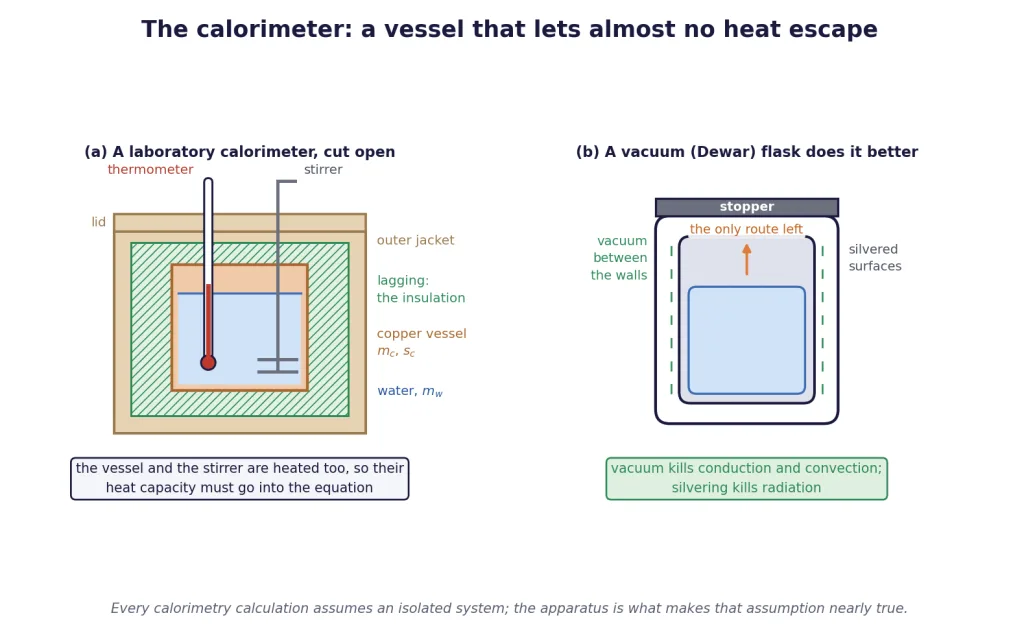
A calorimeter is the box that makes "isolated" nearly true. In the school version:
- an inner metal vessel, usually copper or aluminium, because a metal reaches a uniform temperature quickly;
- a stirrer of the same metal, so that the liquid does not end up hot at the bottom and cold at the top;
- a thermometer through a hole in the lid;
- the vessel standing on insulating supports inside a wooden outer jacket, with the gap packed with glass wool or a similar lagging;
- a lid, because the fastest heat leak from an open vessel of hot water is evaporation from the top.
The vacuum flask does the same job far better and is worth knowing as a contrast. Its double wall has the air pumped out, which kills conduction and convection between the walls at a stroke, and both facing surfaces are silvered, which kills radiation. Almost the only route left is conduction up the stopper and the thin neck. That is why a laboratory that needs a good result uses a Dewar flask rather than a lagged copper pot.
Key Point: The point of the calorimeter is not to stop heat moving — heat must move, or there is nothing to measure. The point is to stop heat moving anywhere except between the bodies inside it.
The one thing beginners forget
The vessel and the stirrer are inside the system. They warm up too, and the energy that warms them came out of the hot body along with everything else. A calorimeter is one of the cold bodies in the balance, and leaving it out is the single commonest mistake in this topic. Its contribution is , exactly like any other body.
[Board Important] "State the principle of calorimetry." Full marks: when bodies at different temperatures are mixed in a thermally isolated system, the heat lost by the hotter bodies equals the heat gained by the colder ones, since energy is conserved and no heat escapes to the surroundings. The phrase "thermally isolated" is doing real work — say it.
Water Equivalent: Turning the Vessel Into Water
The calorimeter's own term, , is a nuisance. It has a different specific heat from everything else in the equation and it makes the algebra untidy. There is a neat trick for absorbing it, and it has a name.
This idea sits outside the rationalised syllabus body text, but Boards, JEE Main and NEET set it every year, so it is developed here from first principles.
Ask: what mass of water would absorb exactly as much heat as this vessel, for the same temperature rise? Call that mass . Then by definition and the cancels straight away.
Key Point — water equivalent: The water equivalent of a body is the mass of water that has the same heat capacity as that body. Its unit is a unit of mass — kilogram or gram — even though it is describing a thermal property.
Equivalently, , the heat capacity of the body. So water equivalent and heat capacity carry exactly the same information in different clothes: in J/K, in kg.
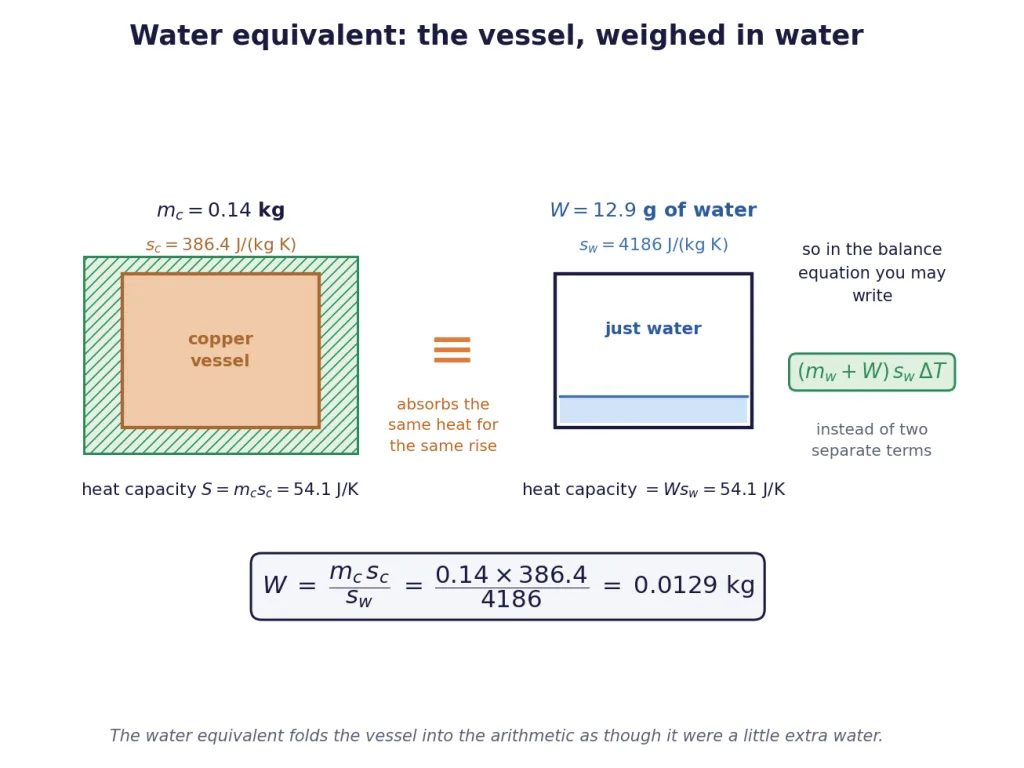
Work one out. A copper calorimeter of mass 0.14 kg, with J/(kg K):
Check it makes sense: copper's specific heat capacity is about a tenth of water's, so 140 g of copper should behave like roughly 14 g of water. It does.
Why this is worth the trouble
Because now the vessel simply joins the water. If the calorimeter holds of water, the two cold terms collapse into one:
You are no longer tracking two substances on the cold side — just a slightly larger mass of water. In a problem with a phase change as well, where the bookkeeping is already crowded, that simplification is genuinely worth having.
[JEE Tip] Exam questions very often hand you the calorimeter as "a copper calorimeter of water equivalent 0.025 kg" rather than giving you its mass and specific heat. When they do, they have done this step for you: add 0.025 kg to the mass of water and carry on. If instead you are given the mass and , you may either compute or keep the separate term — the answer is identical, and our check confirms the two routes agree to the last decimal.
Key Point — a caution about the words:
- Heat capacity , unit J/K.
- Water equivalent , unit kg.
- They are numerically different (54.1 against 0.0129 for that copper vessel) and only the units tell you which is meant. A question asking for "the water equivalent in J/K" is asking the wrong question.
Setting Up a Mixture Problem So It Cannot Go Wrong
Most lost marks in calorimetry are not physics errors. They are bookkeeping errors — a body left out, a temperature difference written backwards, a mass in grams. So use a fixed procedure, every time, even when the problem looks easy.
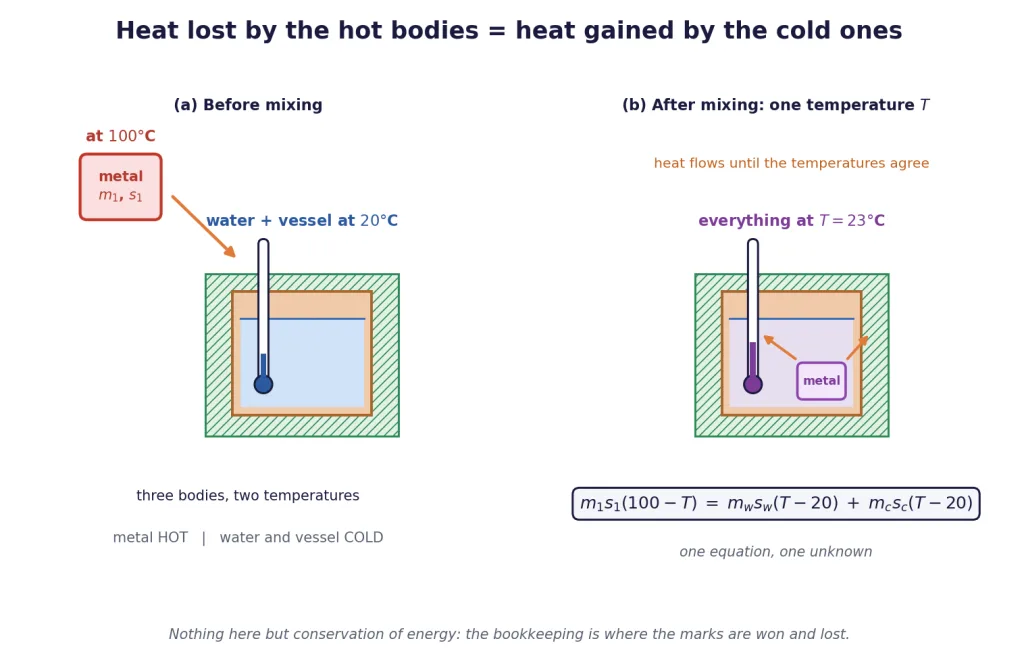
Key Point — the five-step method:
- List every body in the system, with its mass, its specific heat capacity and its starting temperature. The calorimeter is a body. The stirrer is a body. Write them all down even if one turns out to be negligible.
- Guess the final temperature as a symbol, not a number. Every body ends at the same — that is what thermal equilibrium means.
- Check for a possible phase change before writing anything else. If any water could freeze or any ice could melt at the temperatures involved, stop and go to the next block, because the method changes.
- Write one equation: heat lost by the bodies that cool = heat gained by the bodies that warm, with every written as a positive quantity, or use and let the signs sort themselves out.
- Solve for and sanity-check it. The answer must lie between the coldest and the hottest starting temperatures. If it does not, you have made an arithmetic slip — no mixture ever ends up hotter than its hottest ingredient.
The three standard cases
Case 1 — find the final temperature. Everything is known except . The equation is linear in and the answer is a weighted average: weighted by each body's heat capacity. That formula is worth recognising, though it is safer to rebuild it each time than to memorise it.
Case 2 — find an unknown specific heat capacity. A hot block of known mass goes into a calorimeter with water at a known temperature, and the final temperature is measured. Everything is known except of the block, and the equation is linear in . This is how the numbers in Section 5's table were actually measured, and it is a standard practical.
Case 3 — find an unknown mass. Same equation, different unknown. It is again linear, so there is nothing new to learn.
A worked template
A block of metal, mass , specific heat , at C is dropped into a copper calorimeter of mass containing water of mass , both at C. The mixture settles at . Then:
Losing heat: the block, from C down to :
Gaining heat: the water and the vessel, from C up to :
Equate, and solve. One equation, one unknown, whichever of the six quantities is the one you are missing.
[Board Important] Write the balance equation down before you substitute any numbers. Examiners award marks for the correct balance statement even when the arithmetic afterwards goes astray, and you cannot earn those marks if the equation never appears on the page.
Key Point — the sanity check that catches nearly everything: the final temperature must lie strictly between the lowest and the highest starting temperature. Mixing water at C with a block at C cannot possibly give C or C. If it does, check your signs first and your unit conversions second.
The Trap: When a Phase Change Gets Involved
Here is the problem that catches almost everyone the first time.
Ice at C is added to water at C. Find the final temperature.
The instinct is to write and solve. That answer is wrong, and not slightly wrong, for two separate reasons. First, ice at C does not warm up as ice — it melts, and melting takes an enormous amount of energy with no temperature change at all. Second, and worse, there may not be enough energy available to melt all of it, in which case the final temperature is not something you solve for: it is pinned at C, and what you solve for is how much of the ice melted.
The energy the phase change eats
Section 7 develops latent heat properly. All we need here are two numbers and one equation.
Key Point — the extra term: with J/kg and J/kg for water. Note the subscripts: for fusion, for vaporisation, never a bare — a bare means a length.
Feel the size of . Melting one kilogram of ice at C takes 333 kJ. Warming one kilogram of water from C to C takes kJ. Those are the same. Melting the ice is as expensive as heating the resulting water most of the way to boiling — which is exactly why the naive calculation goes so badly wrong.
The branching method
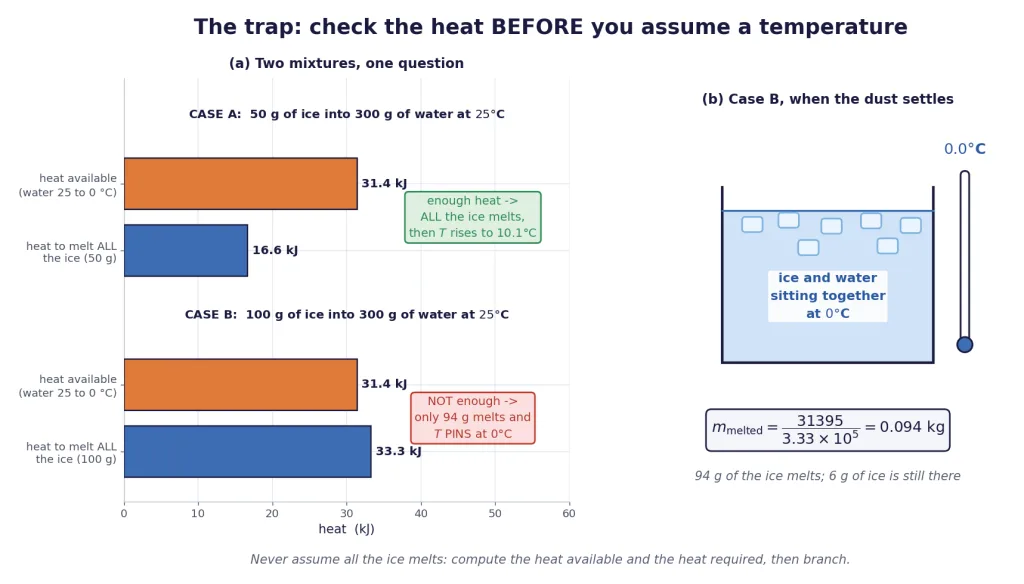
Key Point — never assume the ice all melts. Compute, then branch:
Step 1. Compute the heat available: the heat the warm bodies can give up in cooling all the way down to C. Step 2. Compute the heat required to melt all the ice: (If the ice starts below C, add to bring it up to C first — and that heat is required before any melting can begin.)
Step 3. Compare, and take the branch:
- — all the ice melts, there is energy left over, and the final temperature is above C. Now do an ordinary mixture calculation on the leftover heat with the total mass of water.
- — all the ice just melts, and the final temperature is exactly C with no ice left.
- — only part of the ice melts. The final temperature is C, and the answer to the question is the melted mass:
- And if the warm body is small and the ice is cold, the balance can go the other way: some of the water freezes, the temperature still sits at C, and the frozen mass is what you report.
The same two mixtures, worked
Case A: 50 g of ice at C into 300 g of water at C.
Available beats required, so all the ice melts and 14745 J is left over. That surplus now warms the whole 350 g of water:
Case B: 100 g of ice at C into the same 300 g of water at C.
Now required beats available. The ice cannot all melt. The temperature stops falling at C and stays there, and the melted mass is
So 94 g of the ice melts and 6 g of ice is still sitting there, floating in 394 g of water at C. Doubling the ice did not halve the final temperature; it changed the kind of answer the question has.
[JEE Tip] The tell-tale sign that a question is testing this is that it asks "find the final temperature and the composition of the mixture", or gives you a suspiciously large mass of ice. If the answer comes out as a temperature below C in a problem containing liquid water, or above C in a problem where ice is left over, you have skipped the branch check.
[NEET Important] Steam is the mirror image and it is even more dramatic, because is nearly seven times . A small mass of steam at C condensing into cold water releases a huge amount of energy — 20 g of steam gives up 45 kJ just in condensing, before its temperature has fallen by a single degree. That is why questions about steam heating give final temperatures that look far too high until you check them.
Where the Experiment Goes Wrong, and How to Pull It Together
The four real sources of error
1. Heat leaking to the surroundings. The calorimeter is good, not perfect. During the minute or two the experiment takes, some heat escapes through the lagging, up the thermometer stem and out of the open top by evaporation.
Which way does that bias the answer? Work it through for the standard experiment — a hot block dropped into cool water, measuring the block's specific heat capacity. If heat escapes to the room, the observed final temperature is lower than it should be. We then compute the heat gained by the water from that too-small rise and set it equal to the heat lost by the block. But the block really lost more than that — some of it went to the room. So the value of we compute comes out too small.
Key Point: Ignoring heat losses to the surroundings makes the measured specific heat capacity of a hot body an underestimate. The true value is larger than the measured one.
Put a number on it. In the worked experiment of the examples, losing 300 J to the room shifts the answer from 449 J/(kg K) up to 463 J/(kg K) — an underestimate of about 3%.
2. The stirrer, in two ways. It has to be there, or the water is warm at the bottom and cool at the top and the thermometer reads neither. But stirring does mechanical work on the water, which turns into heat, and the stirrer itself has a heat capacity. Stir gently, stir consistently, and include the stirrer in the balance.
3. The finite time of the measurement. Equilibrium is not instant. Read too early and the bodies have not finished exchanging; read too late and the whole system has cooled towards the room. The standard cure is to plot temperature against time, and extrapolate the cooling curve back to the instant of mixing — the reading you would have had if equilibrium were instantaneous.
4. Transferring the hot body. The block is heated in boiling water at C and then carried across the bench to the calorimeter. It cools on the way, and drops of hot water cling to it. Transfer fast, and shake it dry.
What actually fixes them
- A vacuum flask instead of a lagged pot, which cuts the largest error by an order of magnitude.
- Starting below room temperature. Cool the water so that the mixture ends up as far above room temperature at the end as it was below at the start. Then the system gains heat from the room during the first half of the experiment and loses it during the second half, and the two errors very nearly cancel. This trick is called Rumford's correction and it is elegant enough to be worth remembering.
- A lid, because evaporation from an open surface is a bigger leak than conduction through good lagging.
Everything in this section, on one page
| Idea | Statement | Watch out for |
|---|---|---|
| Principle of calorimetry | heat lost = heat gained, or | only true for an isolated system |
| Heat term for a body | mass in kg, as a difference | |
| The calorimeter | is itself one of the bodies | is never zero |
| Water equivalent | it is a mass, in kg | |
| Using it | replaces two terms with one | |
| Phase change | add or | compare available with required, then branch |
| Pinned temperature | C with ice left over | then solve for the melted mass, not for |
| Sanity check | lies between the extremes | outside that range means an error |
The five traps
Trap 1 — leaving the calorimeter out of the balance. It absorbs heat like everything else. If the question gives you a water equivalent, it is telling you the vessel matters.
Trap 2 — assuming all the ice melts. Compute the available heat and the required heat and compare them before you write a single balance equation.
Trap 3 — writing backwards for one body. Every hot body has ; every cold body has . Both must come out positive if you are using the "lost = gained" form.
Trap 4 — mixing grams and kilograms. Specific heats are per kilogram, latent heats are per kilogram. Convert everything at the top of the page.
Trap 5 — forgetting that ice below C has two jobs to do. It must first be warmed to C at 2100 J/(kg K), and only then can it start melting at J/kg. Two separate terms, in that order.
[NEET Important] A favourite one-liner: "Why does a calorimeter have a stirrer, and why is it made of the same metal as the vessel?" Because without stirring the liquid is not at one temperature, so the thermometer reading is meaningless; and using the same metal means the stirrer's heat capacity can be folded in with the vessel's without a second specific heat capacity to look up.
Solved Examples
Constants used throughout, unless a problem states otherwise: J/(kg K), J/(kg K), J/(kg K), J/(kg K), J/(kg K), J/kg and J/kg for water.
Example 1: The gentlest possible mixture
0.20 kg of water at C is mixed with 0.30 kg of water at C in a vessel of negligible heat capacity. Find the final temperature.
Solution:
List the bodies. Two, both water, so is the same for both and will cancel. No phase change is possible anywhere between C and C, so no branch check is needed.
Write the balance. The hot water cools from to ; the cold water warms from to :
Cancel the 4186 — it appears on both sides — and expand:
Sanity check. 44 lies between 20 and 80, and it is nearer to 20 than to 80 — which is right, because there is more cold water than hot.
Final Answer: C.
Takeaway: When both bodies are the same substance, the specific heat capacity cancels and the answer is the mass-weighted average of the temperatures. Spotting that cancellation early saves half the arithmetic.
Example 2: Two different liquids
0.15 kg of edible oil at C is poured into 0.25 kg of water at C in a vessel of negligible heat capacity. Find the final temperature. Take J/(kg K).
Solution:
Now nothing cancels, because the two liquids have different specific heat capacities. Compute each body's heat capacity first — it makes the algebra much cleaner:
Balance:
Expand and collect:
Read the answer physically. The oil started K above the water and ended only K above where the water started. The water's heat capacity is 3.6 times the oil's, so the water barely moved and the oil did nearly all the changing.
Final Answer: C.
Takeaway: Compute for every body before you write the equation. The final temperature is always pulled towards the body with the larger , and once you have those two numbers you can predict the answer's rough size before solving.
Example 3: Measuring the specific heat capacity of a metal
A 0.25 kg block of an unknown metal is heated to C and dropped into a copper calorimeter of mass 0.10 kg containing 0.20 kg of water, both at C. The mixture settles at C. Find the specific heat capacity of the metal, and suggest what it is.
Solution:
List the bodies. Three: the metal block (hot), the water (cold), the copper vessel (cold). No phase change anywhere between C and C.
Heat gained by the water and the vessel, both rising through K:
Heat lost by the block, falling through K:
Equate and solve:
Identify it. Iron has J/(kg K). The block is almost certainly iron or a steel.
Final Answer: J/(kg K), consistent with iron.
Takeaway: This is the actual experiment behind every specific-heat table. Note how much the copper vessel mattered: it contributed 38.64 J/K out of 875.84, about 4.4% — small, but leaving it out would have made the answer 429 instead of 449.
Example 4: The same experiment, done with a water equivalent
For the calorimeter of Example 3 — copper, mass 0.10 kg — (a) find its water equivalent, and (b) redo the heat-gained calculation using it. (c) What is the water equivalent of a 0.14 kg copper calorimeter?
Solution:
(a) Apply the definition:
(b) Now the vessel is just extra water. The cold side has an effective water mass of kg: identical to the two-term version, as it must be.
(c) A heavier vessel:
A word on the unit. The answer is a mass. If you write "12.9 J/K" you have quoted the heat capacity instead, which for this vessel is J/K — a completely different number describing the same fact.
Final Answer: (a) 9.23 g; (b) 9459 J, the same as before; (c) 12.9 g.
Takeaway: The water equivalent is a relabelling, not a new physics. Use it when it tidies the algebra, ignore it when the two-term form is clearer, and never let its unit drift from kilograms.
Example 5: Ice added, and all of it melts
50 g of ice at C is dropped into 300 g of water at C in a vessel of negligible heat capacity. Find the final temperature and the final composition.
Solution:
Do the branch check first. Heat available from the water cooling all the way to C:
Heat required to melt all the ice:
Compare. , so all the ice melts and there is surplus energy left:
The surplus warms everything, and "everything" is now 350 g of water, because the melted ice has become water at C: Starting from C, the final temperature is C.
Final Answer: C, with 350 g of water and no ice left.
Takeaway: After the ice melts it is water, and it takes part in the rest of the calculation. Warming only the original 300 g would give C — a classic slip worth a whole mark.
Example 6: The same mixture with twice the ice
100 g of ice at C is dropped into 300 g of water at C. Find the final temperature and the final composition.
Solution:
Branch check again. The water side has not changed:
But the requirement has doubled:
Compare. . There is not enough heat to melt all the ice. So the temperature falls to C, some ice melts, and everything stops there — as long as any ice remains, the mixture cannot go below C and the water cannot go above it.
Solve for the melted mass instead of the temperature:
State the whole final state, because that is what the question asked: the mixture sits at C and contains g of water and g of ice.
Final Answer: C, with 394.3 g of water and 5.7 g of unmelted ice.
Takeaway: When the ice wins, the question changes from "what temperature?" to "how much melted?" Doubling the ice did not halve the answer — it changed what the answer is.
Example 7: Cold ice, and now the water freezes
300 g of ice at C is added to 50 g of water at C. Find the final temperature and the composition. Take J/(kg K).
Solution:
The ice has two jobs before it can melt, so account for them separately. Heat needed just to warm the ice from C to C:
Heat available from the water cooling to C:
Compare. : the water cannot even warm the ice to C by cooling alone. So the water reaches C and then starts to freeze, releasing per kilogram as it does. The deficit is
How much water must freeze to supply that? That is less than the 50 g available, so the process stops there rather than freezing everything.
Final state. Everything sits at C: g of ice and g of water.
Final Answer: C, with 322.1 g of ice and 27.9 g of water.
Takeaway: The branch can run either way. A big cold mass of ice makes the water freeze rather than the ice melt, and the temperature still pins at C — that pinning is the signature of a phase change in progress, whichever direction it is going.
Example 8: Steam, and why it packs such a punch
20 g of steam at C is passed into 300 g of water at C in a calorimeter of water equivalent 10 g. Find the final temperature. Take J/kg.
Solution:
Branch check, steam version. How much heat can the steam give up before its temperature even starts to fall? Just by condensing:
How much heat would take the cold side all the way to C? With the water equivalent folded in, the effective cold mass is kg:
Compare. , so the cold side cannot reach C. Therefore all the steam condenses, and the final temperature lies somewhere below C. Now write the full balance.
Heat given out = condensing + cooling the condensed water from C to : Heat taken in by the original water and the vessel:
Equate and solve:
Feel the size of it. Twenty grams of steam — a small puff — raised the water by nearly K. Replace it with 20 g of boiling water at C, carrying no latent heat at all, and the same calculation gives only C, a rise of K. Steam does almost eight times the heating.
Final Answer: C.
Takeaway: Almost all of steam's heating power is the latent heat, delivered before the temperature moves at all. Always compute the condensation term first, then check whether the cold side can reach C.
Example 9: A hot block on a big slab of ice
A 1.5 kg copper block is heated to C and placed on a very large block of ice at C. What is the maximum mass of ice that can melt?
Solution:
Note what "very large" is telling you. There is far more ice than the block can possibly melt, so the final temperature is C — this is the pinned branch, guaranteed by the wording.
All the heat the copper can give up is what it releases in cooling from C to C:
Every joule of that goes into melting ice, at per kilogram:
Why "maximum"? Because in practice the block also warms the air and the bench, and some meltwater runs away carrying heat with it. The calculation gives the ceiling, not the observation.
Final Answer: About 0.696 kg, that is 696 g of ice.
Takeaway: "A large block of ice" is a hint, not scenery. It tells you the final temperature is C without any branch arithmetic, so the whole problem is one division.
Example 10: Finding an unknown mass
What mass of water at C must be added to 0.40 kg of water at C to bring the mixture to C? Assume the vessel has negligible heat capacity.
Solution:
Same balance, different unknown. Let the added mass be . It cools from to , a drop of K; the original water warms from to , a rise of K.
Write it out:
The 4186 cancels, because both bodies are water:
Check it. Twice the mass of cold water, half the temperature change — exactly what a mass-weighted average demands.
Final Answer: 0.20 kg of hot water.
Takeaway: An unknown mass is no harder than an unknown temperature. Write the same balance, then solve for whichever letter is missing; only the algebra at the end changes.
Example 11: What a heat leak does to your answer
In the experiment of Example 3 the measured specific heat capacity came out as 449 J/(kg K). Suppose 300 J escaped to the surroundings during the experiment. (a) What is the true specific heat capacity? (b) In general, does neglecting heat losses make the measured value too large or too small?
Solution:
(a) The block really lost more than the water and vessel gained. The missing 300 J went to the room, so the block's true heat output was
Divide by the same for the block, which is kg K:
Size of the error: The measured value was 3.1% low.
(b) The general rule. Heat leaking away means the observed final temperature is lower than the ideal one, so the computed heat gained is too small, so the computed of the hot body is too small. Neglecting heat losses always underestimates the specific heat capacity of the hot body.
Final Answer: (a) about 463 J/(kg K); (b) too small — the measured value is an underestimate.
Takeaway: Know the direction of your errors, not just their existence. "My answer is a little low because of heat losses to the surroundings" is a complete answer to a very common examination question, and it takes one line.
Example 12: Three bodies, and one of them is in the middle
0.10 kg of aluminium at C and 0.15 kg of copper at C are both dropped into 0.25 kg of water at C in a vessel of negligible heat capacity. Find the final temperature, and say which bodies warmed and which cooled.
Solution:
Do not try to guess in advance which way the water goes — it starts in the middle. Use the signed form, where every body contributes and the sum is zero.
Compute each heat capacity:
Sum the products and the capacities:
The weighted average is the answer:
Now read off who did what. The aluminium cooled from to ; the copper warmed from to ; the water warmed from to . The water barely moved because its heat capacity, 1046.5 J/K, is more than seven times the other two put together.
Final Answer: C. The aluminium cooled; the copper and the water both warmed.
Takeaway: With three or more bodies, use and stop guessing which body warms. The signed form does the deciding for you, and the body with the largest always sits closest to the answer.