
How to Use This Problem Bank
Eleven sections of theory, and now the part that actually earns marks. What follows is 50 worked problems, arranged easy first and hard last, covering the whole chapter — from "which formula is this?" up to the multi-step problems that decide ranks.
Work them with a pen and paper. Cover the solution, try it, then compare — including the check at the end of each one, because the check is where the marks usually leak away.
The four questions to ask before you write anything
Almost every mistake in thermal physics is made in the first ten seconds, before any arithmetic starts. Ask these four, in this order:
- Does this expression need kelvin, or will Celsius do? If the temperature appears as a ratio, a product or a power — , , , — it must be in kelvin. If only a difference appears — , , — Celsius and kelvin give the identical number. Getting this wrong is the single commonest wrong answer in the chapter.
- Can a phase change happen here? If ice, water and steam are all in play, you may not assume the ice all melts or the steam all condenses. Compute the heat available and the heat required, compare them, and only then decide.
- Is this conduction, convection or radiation? A solid with two faces at different temperatures is conduction. A moving fluid is convection. A vacuum, a fourth power or a colour is radiation.
- Series or parallel? Slabs stacked face to face share the same heat current and add their resistances. Slabs side by side share the same temperature difference and add their conductances. Deciding this first turns most conduction problems into one line.
Key Point — the master formulas, all in one place:
A note on symbols, once
Throughout this chapter is an absolute temperature in kelvin and or is a Celsius temperature. A bare is a length; latent heat always carries a subscript, for fusion and for vaporisation. is specific heat capacity in J/(kg K), also written , while is molar specific heat in J/(mol K) and is the heat capacity of a whole named body in J/K. is thermal conductivity, also written or ; lowercase is reserved here for the cooling constant in Newton's law. In radiation, is absorptive power — also written or , but here belongs to linear expansion and nothing else — is emissivity, is the Stefan-Boltzmann constant and is Wien's constant. is thermal resistance everywhere except in the molar-specific-heat problems, where it is the gas constant; each solution says which.
The data used below
Unless a problem states its own numbers, every solution here uses this table, and each problem also restates the constants it uses inside its own solution, so you never have to scroll back.
| Quantity | Value used |
|---|---|
| Specific heat capacity of water | 4186 J/(kg K) |
| Specific heat capacity of ice | 2100 J/(kg K) |
| Specific heat capacity of steam | 2010 J/(kg K) |
| Latent heat of fusion of ice, | J/kg |
| Latent heat of vaporisation of water, | J/kg |
| Coefficient of linear expansion : steel | K |
| copper / brass / aluminium / glass | / / / , each K |
| Thermal conductivity : copper / aluminium | 385 / 205 W/(m K) |
| brass / steel / brick / glass | 109 / 50.2 / 0.72 / 0.80 W/(m K) |
| water / thermacole (EPS) / still air | 0.6 / 0.033 / 0.024 W/(m K) |
| Stefan-Boltzmann constant | W/(m K) |
| Wien's displacement constant | m K |
| Gas constant | 8.31 J/(mol K) |
| Triple point of water | 273.16 K |
On the value of : the two problems that need it both use m/s, and say so. No problem here mixes and .
[Board Important] Every solution below writes the formula on its own line before any number goes into it, and every temperature that enters a ratio or a fourth power is written with the letter K next to it. Do both in the exam. A correct formula with an arithmetic slip still earns most of the marks; a Celsius value inside a fourth power loses them all.
Solved Examples
Part 1: Temperature, Scales and Thermometers
Six warm-ups. Everything here is a straight line drawn between two known points, and the only real skill is deciding whether the problem wants an interval or a reading.
Key Point: A Celsius degree and a kelvin are the same size, so a temperature rise of 40°C is a rise of 40 K. A Fahrenheit degree is only as big. But a reading on one scale is never the same number as a reading on another, except at the one crossing point each pair of scales has.
Example 1: A weather bulletin in three scales
A summer bulletin reports a peak of 46.0°C in the plains, while a cold-storage warehouse across town is held at °C. Express both on the Fahrenheit and the Kelvin scales, and find the difference between them on all three scales.
Solution:
Write the two conversions before any number goes in.
The hot reading.
The cold reading. The minus sign stays with the number all the way through:
Now the difference — and this is the part worth slowing down for. On the Celsius scale it is degrees. On the Kelvin scale it is K — the same number, because a kelvin and a Celsius degree are the same size. On the Fahrenheit scale it is Fahrenheit degrees, which is , because a Fahrenheit degree is smaller.
The lesson in one line. The shifts where zero sits and therefore changes every reading; it cancels out of every difference. Only the factor survives into an interval.
Final Answer: 46.0°C is 114.8°F and 319.15 K; °C is °F and 255.15 K. The gap is 64.0 Celsius degrees, 64.0 K, and 115.2 Fahrenheit degrees.
Takeaway: Converting a reading needs the ; converting an interval does not. Read the question twice and decide which one it is asking for before you write anything.
Example 2: Two cryogenic triple points on three scales
The triple point of hydrogen is 13.81 K and that of oxygen is 54.36 K. Express both on the Celsius and Fahrenheit scales.
Solution:
Go through Celsius, because both other conversions are anchored to it.
Hydrogen.
Oxygen.
Sanity check the size of the answers. Both are far below the coldest natural temperature on Earth, and both Fahrenheit values are below , which is fine — the Fahrenheit scale only runs out at absolute zero, °F. Any answer below that would be impossible and would tell you the arithmetic had gone wrong.
Why these temperatures are quoted in kelvin in the first place. Below about °C, Celsius numbers are large, negative and awkward, and every gas-law calculation you might want to do with them needs the absolute value anyway. Cryogenics is one field that simply never uses Celsius.
Final Answer: hydrogen °C and °F; oxygen °C and °F.
Takeaway: Route every unfamiliar conversion through Celsius. Two conversions you know beat one you have to reconstruct, and the °F floor is a free check on the answer.
Example 3: Translating between two invented absolute scales
Two absolute temperature scales and are defined by assigning the triple point of water the values 400 P and 250 Q respectively. Find the relation between a temperature on the first scale and on the second, and check it at the normal boiling point of water, 373.15 K.
Solution:
What makes a scale absolute. An absolute scale has its zero at absolute zero, so a reading is simply the kelvin temperature multiplied by a fixed number of scale units per kelvin. That number is fixed by the one assigned point: where is in kelvin.
Divide one by the other and watch vanish. The relation holds at every temperature, not just at the triple point, precisely because both scales share the same zero.
Check it at the boiling point. and indeed .
Why this would fail for Celsius and Fahrenheit. Neither of those has its zero at absolute zero, so their relation carries an offset, , and no simple ratio exists. The clean proportionality here is a direct consequence of the word absolute in the question.
Final Answer: ; at the boiling point of water, 546.4 P and 341.5 Q.
Takeaway: Two absolute scales are always related by a pure multiplying factor, never by a factor plus an offset. Spot the word "absolute" and you have saved yourself half the work.
Example 4: A nickel sensor calibrated at two fixed points
The electrical resistance of a nickel sensor varies with temperature approximately as . It reads at the triple point of water, 273.16 K, and at the normal boiling point of sulphur, 717.8 K. What temperature does a reading of correspond to?
Solution:
Take the triple point as the reference, so K and .
Find from the second fixed point.
Now invert the law for the unknown reading.
A one-line check that needs no at all. Because the law is linear in , the resistance and the temperature must be at the same fractional position between the two fixed points: so sits almost exactly halfway: K. The two routes agree.
In Celsius, that is °C.
Final Answer: about K, that is °C.
Takeaway: A linear thermometric property means proportional interpolation. Once you notice that, you can answer the question by taking the fraction of the way along, and the constant becomes a check rather than a necessity.
Example 5: An unfamiliar scale, and where it agrees with Celsius
A scale is proposed on which the ice point of water is 10°X and the steam point is 130°X, both at one atmosphere. (a) What does a body at 60°C read on this scale? (b) What Celsius temperature does 46°X correspond to? (c) At what temperature do the Celsius and scales read the same number? (d) How big is one degree in Celsius degrees?
Solution:
Both scales are linear and share the same two physical fixed points, so the fraction of the way between the fixed points is the same on both:
Rearrange once and use it for every part.
(a) At 60°C.
(b) At 46°X.
(c) Where the two agree, set : So °C is °X. Every pair of linear scales with different slopes crosses exactly once, and this is where.
(d) The size of one degree. The interval from ice to steam is 100 Celsius degrees but 120 degrees, so The degree is the smaller one, which is why 60°C came out as the larger number, 82°X.
Final Answer: (a) 82°X; (b) 30°C; (c) they agree at on both scales; (d) one degree equals Celsius degrees.
Takeaway: Any two-fixed-point scale is fixed by "the same fraction of the way up". Write that sentence as an equation and every part of this question type falls out of one line of algebra.
Example 6: Why helium and nitrogen disagree about zinc
Two constant-volume gas thermometers, one filled with helium and the other with nitrogen, are used to measure the normal freezing point of zinc. The helium thermometer reads Pa at the triple point of water and Pa at the zinc point. The nitrogen thermometer reads Pa and Pa at the same two points. (a) What absolute temperature does each give for the zinc point? (b) Why do they disagree, and what would you do about it?
Solution:
The defining relation of the constant-volume gas thermometer. With the volume fixed, the pressure of an ideal gas is proportional to the absolute temperature, and the triple point is the single assigned fixed point at 273.16 K: This is a ratio of temperatures, so the answer must come out in kelvin — there is no version of this formula in Celsius.
(a) The helium thermometer.
The nitrogen thermometer.
The discrepancy. a difference of about one part in a thousand.
(b) Why. Neither thermometer is faulty. Helium and nitrogen are real gases, and a real gas obeys only approximately; the deviations differ from gas to gas and grow with the amount of gas present. The ideal-gas law is exact only in the limit of vanishing density.
What to do about it. Repeat the measurement with less and less gas in the bulb, so that falls, and plot the deduced temperature against . As the two curves converge on one and the same value, and that common limit is the true thermodynamic temperature. This convergence is exactly why the gas thermometer, and not the mercury thermometer, defines the absolute scale.
Final Answer: (a) 692.6 K from helium and 693.3 K from nitrogen; (b) they differ by 0.7 K because both gases are real; extrapolate both readings to zero pressure and they agree.
Takeaway: The gas thermometer is trusted not because a real gas is ideal but because every real gas becomes ideal as its pressure goes to zero. The extrapolation is the measurement.
Part 2: Expansion of Rods, Plates, Holes and Liquids
Eight problems on and its two relatives. Only appears in all three, so Celsius and kelvin are interchangeable throughout this Part — which is exactly why these are the easy marks.
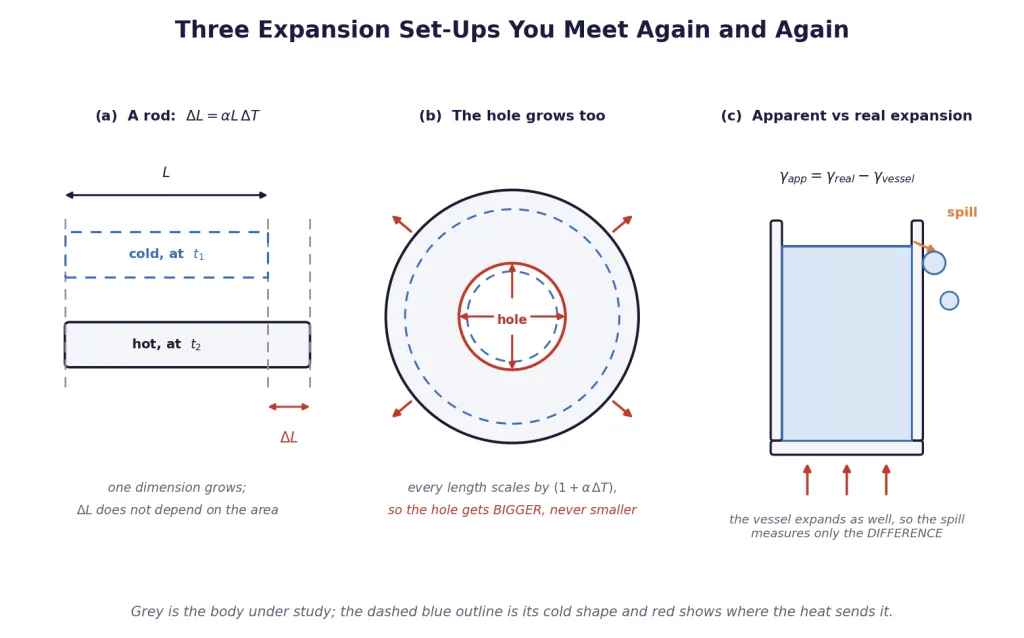
Key Point:
with and for an isotropic solid. Every length in a heated body — including the diameter of a hole — is multiplied by the same factor .
Example 7: How much does an overhead line lengthen in summer?
An aluminium conductor is strung in a span 250 m long when its temperature is 15°C. On a summer afternoon the current and the sun together take the conductor to 65°C. Taking K, how much longer does the conductor become?
Solution:
Write the law first.
The temperature change. degrees, and since only a difference appears, this is 50 K as well — no conversion needed.
Substitute.
Feel the size. Nearly 29 cm of extra conductor in a single span. That is why an overhead line is always strung with a deliberate sag rather than pulled tight: the sag is the slack that lets this expansion happen without the tension climbing until something breaks. Line engineers size the sag for the hottest day of the year, then check the tension on the coldest night.
A useful ratio. The fractional change is , about one part in 870. Small — but over 250 m, "small" is still 29 cm.
Final Answer: the conductor lengthens by m, about 29 cm.
Takeaway: A fractional change of sounds negligible until you multiply it by a long object. Always convert into an actual length before you decide whether it matters.
Example 8: A glass pane grows in two directions
A window pane measures 1.60 m by 0.90 m at 12°C. Direct sun raises it to 52°C. Taking K, find the increase in its area, and show that neglecting the second-order term is justified.
Solution:
Areal expansion, with .
The starting area and the temperature change.
Substitute. which is cm — about the area of a large postage stamp.
Now earn the approximation. Each side is multiplied by , so the true new area is The term we dropped is . Here , so
Compare. That is , or 0.018% of the answer. The approximation is not a hope; it is a measured 0.018%.
Final Answer: the area grows by m, that is cm. The neglected second-order term is 0.018% of that.
Takeaway: is not an assumption, it is a binomial expansion whose next term you can actually evaluate. Evaluate it once and you will never worry about it again.
Example 9: How much petrol spills out of a full tanker
A steel road tanker of capacity 12.0 m is filled to the brim with petrol at 8°C. During the day the whole tanker and its contents reach 38°C. Taking K and K, how much petrol overflows?
Solution:
Both the liquid and its container expand. The spill is the difference, and the difference is governed by the apparent coefficient:
Get the tank's volume coefficient from its linear one.
Substitute, with K.
What the tank's expansion was worth. Had you forgotten it, you would have got m, that is 342 litres — an error of 13 litres, about 4%. Small here only because steel expands so much less than petrol.
Which is exactly why tankers are never filled to the brim. An ullage space, typically a few per cent of the capacity, is left deliberately so that a hot afternoon does not push fuel out of the vent.
Final Answer: about m, that is 329 litres, spills. Ignoring the tank's own expansion would overstate this by 13 litres.
Takeaway: A liquid in a container always expands by less than you think, because the container grows too. Subtract from before you multiply by anything.
Example 10: A drilled hole, heated two hundred degrees
A hole of diameter 3.60 cm is drilled in an aluminium plate at 15°C. The plate is heated to 215°C. Taking K, find the change in the diameter of the hole and the change in its area.
Solution:
Settle the direction first, because everyone's intuition says the wrong thing. Imagine the disc of metal that was drilled out, put back in place. On heating, the plate and that disc expand identically — they are the same material at the same temperature — so the disc still exactly fills the hole. The hole therefore expands exactly as though it were made of the metal, and it gets bigger.
So the hole's diameter obeys the ordinary linear law.
Substitute, with K. so the diameter goes from 3.6000 cm to 3.6166 cm.
The area of the hole. Its original area is and areal expansion gives
Check it the long way. The new area is cm, and cm. The two agree, as they must.
Final Answer: the hole's diameter increases by mm to cm; its area increases by cm.
Takeaway: A hole is not a thing that can be squeezed — it is a shape, and every shape in a heated body scales up by . Rivet holes, bearing races and the eye of a needle all get larger when the metal is heated.
Example 11: What a warm steel tape really measured
A steel measuring tape is correctly calibrated at 20°C. On a hot day at 44°C it is used to measure a steel girder and reads 12.500 m. Taking K, what is the girder's true length on that day, and what would it be at 20°C?
Solution:
Understand what a warm tape does. Every division engraved on the tape has itself grown by the factor . So each "metre" mark now spans slightly more than a metre, the tape fits fewer times into the girder, and it under-reads. The correction is therefore an addition.
The true length on the hot day. with K: The tape was 3.6 mm short over 12.5 m.
Now the girder at 20°C. The girder is steel too, so on cooling from 44°C to 20°C it shrinks by exactly the same fractional amount:
Read what just happened. When the tape and the object are made of the same material, the tape's reading is automatically the object's length at the tape's calibration temperature — the two errors cancel exactly. That is a genuinely useful piece of workshop physics, and it is also why surveyors' tapes are made of invar, whose is tiny, when the object being measured is not steel.
Say which figure answers which question. On the hot day the girder really is 12.5036 m long. At 20°C it is 12.5000 m long. Both are correct; they are lengths at different temperatures.
Final Answer: m at 44°C, and m at 20°C.
Takeaway: A tape that has expanded reads low, so you add the correction. And when the tape and the object share a material, the raw reading is already the length at the calibration temperature.
Example 12: Heating a pulley until it slips onto its shaft
A steel shaft has an outer diameter of 5.000 cm at 25°C. An aluminium pulley whose central hole is 4.988 cm in diameter at the same temperature is to be fitted onto it. To what temperature must the pulley alone be heated so that it just slides on? Take K.
Solution:
The hole must grow to match the shaft, and it grows by the ordinary linear law:
Substitute.
Solve for the rise.
The temperature required. Comfortably reached in an oil bath or an oven, and well below any temperature that would damage the aluminium.
What happens next, and why the fit is so strong. As the pulley cools it tries to shrink back to 4.988 cm but the shaft will not let it, so the pulley is left in permanent tension and grips the shaft with a large radial force. This is a shrink fit — no keyway, no adhesive, just thwarted contraction. The same physics puts an iron tyre on a cartwheel and a steel collar on a rotor.
Final Answer: heat the pulley through K, that is to about °C.
Takeaway: To assemble a shrink fit you can heat the outer part or cool the inner one; the equation is the same, only the sign of changes. Solve for first and add it to the starting temperature last.
Example 13: What a temperature rise does to a liquid's density
Turpentine has a coefficient of volume expansion K and a density of 870 kg/m at 20°C. Find the fractional change in its density and its new density when it is warmed to 70°C.
Solution:
Mass is conserved; volume is not. With and growing to ,
The fractional change, to first order. Expanding the denominator, a decrease of 4.7%. The minus sign is the physics: heating a liquid always makes it less dense — with water between 0°C and 4°C as the famous exception.
The new density, done exactly.
The new density, done to first order. The two differ by 1.8 kg/m, about 0.2% — acceptable for most purposes, but note that the exact route is no harder, so use it.
Why this matters commercially. Fuels and edible oils are bought by volume but priced on mass, so every delivery is corrected to a standard temperature, usually 15°C. A 4.7% density change is a 4.7% billing error.
Final Answer: the density falls by , from 870 to kg/m.
Takeaway: — same magnitude as the volume change, opposite sign. When the change is more than a per cent or two, divide rather than subtract.
Example 14: Overflow from a steel vessel, and the coefficient it hides
A steel vessel of capacity 500 cm is filled to the brim with glycerine at 20°C. When the whole thing is heated to 80°C, cm of glycerine overflows. Taking K, find the apparent and the real coefficient of volume expansion of glycerine.
Solution:
What the overflow actually measures. The spilt volume is the amount by which the liquid out-expands its container, so it gives the apparent coefficient directly:
Substitute, with K.
Add back what the vessel did.
Check the answer against reality. Glycerine's accepted coefficient of volume expansion is about K, so the experiment has landed within about 1% — which is roughly the accuracy such a measurement deserves.
The order of operations matters. You measure the apparent value and add the vessel's contribution to get the real one. Doing it the other way round — subtracting — is a standard slip, and gives , which is 15% low.
Final Answer: K and K.
Takeaway: The overflow only ever measures the difference . Whatever a problem gives you about the container, put it back in before you claim to have found a property of the liquid.
Part 3: Expansion in Service — Joints, Fits, Strips and Stress
Six problems in which expansion is either allowed for or forbidden. When it is forbidden, the force that appears is enormous, and that force is the whole point.
Key Point: A rod that is heated but not allowed to expand develops a compressive stress independent of its length and its area. The force on the supports, , does depend on the area. Cool a clamped rod instead and the same formula gives a tension.
Example 15: The tension a cooled wire pulls with
A copper wire of diameter 1.5 mm is stretched with negligible tension between two rigid supports 2.4 m apart at 30°C. It is then cooled to °C. Taking K and Young's modulus Pa, find the tension that develops.
Solution:
The wire wants to contract but cannot. Free contraction would give a strain The supports hold the ends apart, so this strain is exactly cancelled by an elastic tensile strain of the same size.
Turn that strain into a stress with Young's modulus. using K.
Find the cross-sectional area. The radius is mm m:
Multiply.
Notice what never entered. The length 2.4 m appears nowhere in the answer. A wire twice as long would contract twice as much in absolute terms, but it also has twice as much length over which to stretch, so the strain — and therefore the stress and the tension — is unchanged. Length is a distractor in every problem of this shape.
Final Answer: a tension of about N, corresponding to a tensile stress of Pa.
Takeaway: Thermal stress depends on , and and on nothing else; the force additionally needs the area. If a problem hands you a length, check whether it is doing any work before you use it.
Example 16: Two rods end to end, free to grow
An aluminium rod 40.0 cm long is joined end to end to a copper rod 60.0 cm long, both of diameter 4.0 mm. The pair is heated from 20°C to 180°C with both outer ends free to move. Taking K and K, find the change in the total length. Is there a thermal stress at the junction?
Solution:
Each rod expands according to its own and its own length. They are in series, so their extensions simply add:
The temperature change is K.
The aluminium.
The copper.
Add. so the combined rod goes from m to m. Notice that the copper contributes more even though its is smaller, because it is half as long again.
Is there a stress at the junction? No. Stress requires that something be prevented from reaching its natural length, and here nothing is: both ends are free, so each rod expands to exactly the length it wants and the junction simply moves along. The joint has to carry no force at all. Clamp one end and the answer changes completely — but the question says free.
The diameter, 4.0 mm, is not needed for the length question. It would be needed only if a force were asked for, and there is no force.
Final Answer: the combined rod lengthens by mm; there is no thermal stress at the junction because both ends are free.
Takeaway: Free ends mean zero thermal stress, however different the two materials are. Stress appears only when a rigid constraint refuses the expansion — look for the word "clamped", "rigid" or "fixed" before you reach for .
Example 17: When does the brass rod overtake the steel one?
At 0°C a brass rod and a steel rod are each exactly 1.200 m long. Both are heated through the same temperature rise. At what temperature is the brass rod 1.0 mm longer than the steel one? Take K and K.
Solution:
Write both lengths at temperature , measured from the common starting point of 0°C:
Subtract, and watch the common length factor out. This is the key structural fact: the difference in length grows in proportion to the difference in the coefficients.
Substitute the required gap of 1.0 mm.
Solve.
Check the scale of it. Nearly 140 degrees to open a gap of one millimetre between two rods more than a metre long. Differential expansion is a small effect — which is exactly why it needs a lever, or a long strip, or a fine screw to be made visible. That is the next problem.
Final Answer: at about °C, that is a rise of 139 K above the starting point.
Takeaway: Differential expansion depends on , not on either separately. Two metals with a large gap between their coefficients make a sensitive device; two with similar coefficients make none at all.
Example 18: How hot before a fire-alarm strip closes its contact?
A bimetallic strip is made of a brass strip and an iron strip, each 8.0 cm long, bonded face to face and straight at 25°C. The alarm is set to trip when the difference between the free lengths of the two metals would reach 30 micrometres. Taking K and K, at what temperature does the alarm trip, and which way does the strip bend?
Solution:
The mechanism, in one sentence. The two metals are bonded, so they must stay the same length; but on heating brass wants to be longer than iron. The only way to satisfy both is for the strip to curve, with the brass on the outside of the arc where there is more room.
So the direction is settled before any arithmetic. The strip bends towards the iron, the metal with the smaller . Cool it below 25°C instead and it bends the other way, towards the brass.
The quantity that drives the bend is the difference in free lengths:
Set it equal to the trip value m.
Solve for the rise and add it on.
Why this is a good alarm. The trip point is set purely by the geometry and the two coefficients — no electronics, no power supply, nothing to fail. The same strip, run the other way, is the thermostat in an iron, a geyser and an oven, and it was the flasher in every old indicator lamp.
Final Answer: the alarm trips at about °C, and the strip bends towards the iron.
Takeaway: A bimetallic strip always curves towards the metal with the smaller when heated, and away from it when cooled. Decide the direction from that sentence, then do the arithmetic.
Example 19: The force a clamped girder pushes with
A steel girder of cross-sectional area 45 cm is fitted between two rigid abutments at 10°C. In summer its temperature rises to 42°C. Taking K and Pa, find the thermal stress and the force it exerts on each abutment.
Solution:
The girder is prevented from expanding, so it is compressed by exactly the amount it wanted to grow. with K.
Convert to stress.
Convert the area to SI before multiplying.
The force.
Put that in human terms. N is the weight of about 35 tonnes — roughly two loaded trucks pressing on each abutment, produced by nothing more than a 32-degree change in the weather. The stress itself, 77 MPa, is a serious fraction of structural steel's yield strength of around 250 MPa, so it cannot be shrugged off.
Which is why bridges have expansion joints. Let the steel move a few millimetres and the stress is zero; refuse it those millimetres and you get 35 tonnes.
Final Answer: a compressive stress of Pa and a force of N on each abutment.
Takeaway: Thermal stress is savage because is huge. A strain of only becomes 77 MPa once it is multiplied by a Young's modulus of Pa.
Example 20: Sizing the loop in a steam pipe
A straight run of steel steam pipe 42 m long is installed at 22°C. In service it carries steam at 180°C. Taking K, how much movement must the expansion loop at the end of the run absorb?
Solution:
The loop has to swallow exactly the free expansion of the straight run.
The temperature change. K. Note that this is the temperature of the pipe metal, which reaches the steam temperature, not the temperature of the room.
Substitute.
Design the loop for more than that, not exactly that. A designer would allow perhaps 12 cm — the pipe may be commissioned on a cold night rather than at 22°C, and a loop that runs out of travel transmits the full stress straight into the pipe flanges and the anchor points.
Compare with what would happen without a loop. Clamp the run rigidly and the stress would be which is well past the yield strength of ordinary structural steel. The pipe would buckle. Eight centimetres of designed-in slack is what stands between the plant and that.
Final Answer: the loop must absorb about cm of movement.
Takeaway: Every long hot run of metal needs somewhere to put its expansion — a loop, a joint, a gap or a sliding support. Compute , then design in more than that.
Part 4: Specific Heat, Molar Heat, and Work Turned into Heat
Six problems on and its cousins. Again only appears, so Celsius and kelvin are interchangeable — except in the one problem that starts in Fahrenheit, where you must convert before you subtract.
Key Point:
is in J/(kg K), in J/(mol K), in J/K. When several bodies are heated together, add their products — that total is the heat capacity of the whole arrangement.
Example 21: Heating the pot as well as the water
An aluminium pan of mass 0.60 kg holds 1.8 kg of water at 24°C and is put on a 2.0 kW hob. Taking J/(kg K) and J/(kg K), how long does it take to reach 95°C if no heat is lost? What fraction of the energy goes into the pan?
Solution:
Both the pan and the water are heated through the same , so add their heat capacities:
Compute each heat capacity separately — it is worth seeing the two numbers side by side.
The heat required, with K:
The time.
The pan's share. Only about a fifteenth of the gas bill goes into the metal. Water's enormous specific heat capacity dominates so completely that ignoring the pan would have cost you only 6.7% — but in a calorimetry experiment, where you are chasing 1% accuracy, 6.7% is a disaster. That is precisely why a calorimeter's own heat capacity is always accounted for.
Final Answer: about s, that is minutes; the pan takes of the energy.
Takeaway: When several bodies are heated together, add their products, not their masses. And always check what fraction the "small" body takes — sometimes it is negligible and sometimes it decides the answer.
Example 22: Reading a table of molar specific heats
The table below gives measured molar specific heats at constant volume, at room temperature, for several common gases. A monatomic gas such as helium or argon measures about 12.2 J/(mol K). Explain the difference, and comment on chlorine's noticeably larger value. Take J/(mol K).
| Gas | measured, J/(mol K) |
|---|---|
| Hydrogen | 20.4 |
| Nitrogen | 20.8 |
| Oxygen | 21.0 |
| Nitric oxide | 20.9 |
| Carbon monoxide | 21.0 |
| Chlorine | 25.8 |
| A monatomic gas, for comparison | 12.2 |
Measured values for common gases near room temperature, rounded to three figures. In this problem is the gas constant, not a thermal resistance.
Solution:
Start with the monatomic gas, which is the simplest case. A single atom can only move — three independent directions of translation, and nothing else. Each such degree of freedom carries per mole, so which matches the measured 12.2 nicely.
Now a diatomic molecule. It is a dumbbell, so besides moving through space it can also rotate — about two axes perpendicular to the bond. Rotation about the bond itself carries no appreciable energy. That gives two extra degrees of freedom, so
Compare with the table. Hydrogen 20.4, nitrogen 20.8, oxygen 21.0, nitric oxide 20.9, carbon monoxide 21.0. Every one of them is a diatomic molecule, and every one of them sits right on . The agreement is the point: the extra heat a diatomic gas needs is the energy going into rotation.
Now chlorine, at 25.8. That is well above and heading towards J/(mol K), which is what you get by adding a vibrational mode — the two atoms oscillating along the bond, contributing both kinetic and potential energy, so rather than .
Why chlorine and not nitrogen? Chlorine's atoms are heavy and its bond is comparatively weak, so its vibration is slow and low in energy — low enough to be appreciably excited at room temperature. Nitrogen's bond is a strong triple bond between light atoms, so its vibration needs far more energy and stays frozen out until the gas is very hot. The measured is therefore a direct readout of which internal motions a molecule has switched on.
Final Answer: the diatomic gases sit at J/(mol K) because they rotate as well as translate, against for a monatomic gas; chlorine exceeds this because its low-frequency vibration is already partly excited at room temperature.
Takeaway: Count the ways a molecule can hold energy and you have predicted its molar specific heat. A number above for a diatomic gas is a signature of vibration.
Example 23: A drill, a copper block and three minutes
A 6.0 kW drilling machine is used on a copper block of mass 20 kg for 3.0 minutes. Sixty per cent of the machine's power ends up heating the block, the rest going into the machine itself and the surroundings. Taking J/(kg K), find the rise in the block's temperature.
Solution:
Mechanical work done against friction reappears as heat. The useful power is
The energy delivered in 3.0 minutes. Convert the time to seconds first — min s:
Turn that into a temperature rise.
Where the block ends up. Starting from a workshop temperature of about 30°C, the block would reach roughly 114°C — hot enough to burn a hand and hot enough to matter for the tool's cutting edge. This is why deep drilling uses a cutting fluid: it carries the heat away by convection instead of letting it pile up in the workpiece.
Watch the two traps in this problem. First, the 40% that is lost never enters the block, so it must be removed before you multiply by the time. Second, minutes are not seconds; forgetting that gives an answer 60 times too small.
Final Answer: the block warms by about K.
Takeaway: Work against friction is a heat source like any other; the only new step is deciding what fraction of the power actually lands in the body you care about. Apply the efficiency before the time, not after.
Example 24: How much warmer is the water at the foot of a waterfall?
Water falls 105 m over a waterfall. Assuming all the kinetic energy gained in the fall turns into internal energy of the water itself, by how much does the water warm up? Take m/s and J/(kg K).
Solution:
Work out the energy per kilogram, because the mass will cancel and it is cleaner to see that in advance. A mass falling through height loses potential energy
Set that equal to the heat that appears in the same mass of water.
Cancel the mass and solve.
Substitute.
Read the answer honestly. A quarter of a degree, from a 105 m fall — and even that is an over-estimate, because in reality a good deal of the energy goes into churning the air, into sound and into spray that evaporates. Joule famously looked for exactly this effect on his honeymoon and could not measure it reliably. The reason it is so small is water's specific heat capacity: 4186 J will raise one kilogram by one kelvin, and one kilogram falling 105 m only releases about 1000 J.
The scaling is worth storing. You would need a fall of roughly 427 m to warm the water by a full kelvin.
Final Answer: about K.
Takeaway: Gravity is a feeble heater because for water is enormous. Whenever mechanical energy is converted to heat in water, expect an answer in fractions of a degree unless the speeds are very large.
Example 25: The sweat that brings a fever down
A child of mass 28 kg has a temperature of °F. A medicine is given that works by increasing the rate of evaporation of sweat, and the temperature falls to °F in 25 minutes. Assuming evaporation is the only route by which heat leaves, and taking the specific heat capacity of the human body as that of water, 4186 J/(kg K), with the latent heat of evaporation of water at body temperature as J/kg, find the average extra rate of evaporation caused by the drug.
Solution:
Convert both temperatures to Celsius before subtracting. This is the one place in this Part where the conversion matters, because a Fahrenheit degree is not the same size as a kelvin. So the fall is K. (Doing it wrong — subtracting the Fahrenheit readings to get and calling that kelvin — would inflate the answer by 80%.)
The heat that had to leave the body.
All of it is carried away as latent heat of evaporation.
The rate. or kg/s.
Sanity check the physiology. About 73 g of sweat — a small glassful — over 25 minutes. That is entirely plausible, and it explains why a feverish patient must be kept hydrated: the cooling mechanism is literally spending the body's water.
Final Answer: about g of sweat, an average rate of g per minute.
Takeaway: Evaporation is a spectacularly efficient coolant because is huge. Evaporating one gram of water removes as much heat as cooling 578 grams of water by one kelvin.
Example 26: How long does the geyser take?
A 2.0 kW immersion geyser heats 20 litres of water from 18°C to 55°C. If 12% of the electrical energy is lost to the surroundings and the tank, how long does it take? Take the density of water as 1000 kg/m and J/(kg K).
Solution:
Convert the volume to a mass, since needs a mass. Twenty litres is m, so For water, litres and kilograms are numerically the same, which is convenient but worth stating rather than assuming.
The heat the water actually needs.
The power that reaches the water. Only 88% of the input arrives:
The time. which is minutes.
What the 12% cost. With no losses at all the time would have been s, that is 26 minutes. The losses added about three and a half minutes and, over a year, a noticeable amount to the bill — which is the whole argument for lagging a hot-water tank.
A useful rule of thumb worth remembering. Raising one litre of water by one kelvin needs about 4.2 kJ. So a 2 kW heater raises one litre by about half a kelvin per second, and 20 litres by about 0.025 K/s. Multiply by 37 K and you get about 1500 s before losses — the answer, near enough, without a calculator.
Final Answer: about s, that is 29 minutes.
Takeaway: Efficiency reduces the power, it does not reduce the heat required. Compute from the water alone, then divide by the power that actually gets there.
Part 5: Calorimetry, With and Without a Phase Change
Seven problems built on one equation — heat lost equals heat gained — and one habit that separates a correct answer from a wrong one: never assume all the ice melts.
Key Point — the branch test, and do it every single time:
Before writing a final temperature, compute two numbers separately:
- the heat available, that is how much the warm bodies can give up before they reach the change-of-state temperature;
- the heat required to complete the change of state.
If available required, the change of state finishes and the final temperature moves past it. If available required, the change of state stops part-way and the final temperature pins itself at the change-of-state temperature, with a mixture left behind. Say which branch you took, in words, in your answer.
Example 27: Tea, tumbler and final temperature
A steel tumbler of mass 0.180 kg is at 22°C. Into it is poured 0.220 kg of tea at 88°C. Taking J/(kg K) and the tea's specific heat capacity as that of water, 4186 J/(kg K), and assuming no heat escapes, find the final temperature.
Solution:
Branch test first. The only phase change available would be boiling or freezing, and nothing here is near 100°C or 0°C. So no phase change is possible and we can go straight to a temperature balance.
Write the balance. The tea loses heat, the tumbler gains it:
Compute the two heat capacities before substituting — it keeps the algebra clean.
Substitute and solve.
Check that the answer sits between the two starting temperatures. It does — 82.7 lies between 22 and 88 — and it sits much closer to the tea's temperature, which is right, because the tea's heat capacity is more than eleven times the tumbler's. Any answer outside the range 22 to 88 would be impossible, and that check costs two seconds.
The physical reading. The tea drops only 5.3 K. A steel tumbler steals surprisingly little heat, because steel's specific heat capacity is about one ninth of water's and the masses are comparable.
Final Answer: °C — the tea cools by K.
Takeaway: Compute for every body first, then write one equation. The body with the larger always drags the final temperature towards itself, and that gives you a free check on the answer.
Example 28: Pinning down an unknown metal's specific heat
A 0.15 kg block of an unknown metal at 180°C is dropped into a calorimeter of water equivalent 0.020 kg containing 200 cm of water at 25°C. The final temperature is °C. Taking J/(kg K), find the specific heat capacity of the metal. If some heat did leak away, is the answer too big or too small?
Solution:
What "water equivalent" buys you. The water equivalent of the calorimeter is the mass of water that would absorb the same heat for the same temperature rise. So the calorimeter can be folded into the arithmetic simply as 0.020 kg of extra water — no separate term needed.
The mass of water. 200 cm of water is g kg.
The heat gained by the water plus calorimeter.
Set that equal to the heat lost by the metal.
Does the answer make sense? About 492 J/(kg K) is in the region of iron and steel, well above copper's 386 and well below aluminium's 900. A plausible identification.
Now the error question, which is worth reasoning out rather than guessing. If heat leaks to the surroundings, the metal really gave out more heat than the water and calorimeter received. Our equation credited the metal with only what the water gained, so it under-counted the heat the metal supplied, and therefore under-counted . The measured value is smaller than the true one.
How the experiment fights back. Start the water a few degrees below room temperature and finish it a few degrees above, so that the leak runs inwards for the first half and outwards for the second, and the two roughly cancel. A vacuum flask does the same job by brute force.
Final Answer: J/(kg K); with heat losses, this is an under-estimate of the true value.
Takeaway: Water equivalent turns the calorimeter into extra water, and that is the whole reason the quantity exists. And a heat leak always makes the hot body look as though it had less heat to give, so a measured specific heat comes out low.
Example 29: How much ice can a hot iron block melt?
A block of iron of mass 1.8 kg is heated to 400°C and then placed on a large block of ice at 0°C. Taking J/(kg K) and J/kg, what is the greatest mass of ice that can melt?
Solution:
Branch test. The ice block is described as large, which is doing real work in this problem: it means there is more ice available than the block can possibly melt. So the ice never all melts, the final temperature pins at 0°C, and this is the partial-melt branch.
The most heat the iron can give up is what it releases in cooling all the way to 0°C — it cannot go below the temperature of the ice it is sitting on.
Turn that into melted ice.
Read the answer. Not quite one kilogram of ice — from a block of iron heated almost to visible red heat. Nearly a kilogram of ice absorbs as much energy in melting as 1.8 kg of iron gives up in falling 400 degrees. That single comparison is the best argument for how large really is.
Why the word "maximum" is in the question. In practice some of the heat warms the air and the puddle of meltwater, so less ice melts. The calculation gives the ceiling.
Final Answer: at most kg, about g of ice. Branch taken: partial melt, final temperature 0°C.
Takeaway: "A large block of ice" is a statement about the branch, not about the geometry. It tells you the final temperature is 0°C before you compute anything.
Example 30: Ice into a glass of water — does it all melt?
40 g of ice at 0°C is dropped into 250 g of water at 35°C in an insulated glass whose own heat capacity is negligible. Taking J/(kg K) and J/kg, find the final temperature.
Solution:
- Do the branch test before anything else.
Heat available — what the warm water can give up before it reaches 0°C:
Heat required to melt all the ice:
Compare. , so there is more than enough heat. Branch: all the ice melts, and the final temperature will be above 0°C. Now, and only now, write the balance.
The heat balance, with all three terms. The warm water cools from 35°C to ; the ice melts and then the meltwater warms from 0°C to :
Substitute.
Solve.
Check. The answer is above 0°C, which is consistent with the branch we chose — if it had come out negative, the branch would have been wrong and we would have had to go back. That self-consistency check is free and it catches the commonest error in the topic.
Final Answer: °C. Branch taken: all 40 g of ice melts.
Takeaway: The branch test costs two multiplications and decides the whole answer. Do it before you write the balance, not after your answer comes out looking odd.
Example 31: The same question with far more ice
150 g of ice at 0°C is dropped into 120 g of water at 28°C, again in an insulated vessel of negligible heat capacity. Find the final temperature and the state of the contents.
Solution:
- Branch test.
Heat available from the water cooling to 0°C:
Heat required to melt all 150 g of ice:
- Compare, and stop. — the water can supply only about 28% of what is needed. Branch: partial melt. The melting stops when the water runs out of heat, and both the meltwater and the remaining ice sit at 0°C.
How much ice actually melted. All the available heat went into melting:
The final contents.
- ice remaining: g at 0°C
- water: g at 0°C
- The trap, spelled out. Anyone who wrote the full balance without testing first would have got which gives °C — a "final temperature" below the melting point of the ice that was supposed to have melted, and below the freezing point of water that was supposed to be liquid. Physically impossible. A negative answer here is the equation telling you that you chose the wrong branch.
Final Answer: °C, with g of ice and g of water left in the vessel. Branch taken: partial melt.
Takeaway: When the answer pins at 0°C, the question stops being "what temperature?" and becomes "how much melted?" An impossible temperature is not a arithmetic slip — it is a branch error.
Example 32: Twenty grams of steam into a beaker
20 g of steam at 100°C is passed into 300 g of water at 20°C held in a copper calorimeter of water equivalent 0.020 kg. Taking J/(kg K) and J/kg, find the final temperature.
Solution:
- Branch test, in the direction that matters here. The question is whether the steam can push everything up to 100°C — if it can, some steam is left uncondensed and the answer is exactly 100°C.
Heat available from condensing all the steam:
Heat required to raise the water and calorimeter from 20°C to 100°C:
Compare. — not nearly enough. Branch: all the steam condenses and the final temperature lies below 100°C.
Write the full balance. Steam condenses at 100°C, then the condensate cools from 100°C to ; the water and calorimeter warm from 20°C to :
Substitute.
Solve.
Notice what did the work. Of the total J the steam delivered, J — 93% of it — came from condensation alone, before the condensate had cooled a single degree. Twenty grams of steam heated 320 grams of water by 36 K. This is exactly why steam scalds so much worse than boiling water, and why steam is used to heat buildings rather than hot water.
Final Answer: °C. Branch taken: all the steam condenses.
Takeaway: When steam meets water, the latent heat usually dominates every other term. Compute first — it will tell you at a glance whether the answer will be anywhere near 100°C.
Example 33: When the mixture ends up partly frozen
80 g of ice at °C is added to 60 g of water at 12°C in an insulated container. Taking J/(kg K), J/(kg K) and J/kg, find the final temperature and the final contents.
Solution:
- This one runs the other way, so test the other direction. Can the water supply enough heat merely to bring the ice up to 0°C? If not, the water will start to freeze.
Heat available from the water cooling from 12°C to 0°C:
Heat required to warm the ice from °C to 0°C:
Compare. — the water cannot even get the ice to its melting point, let alone melt any of it. Branch: no ice melts; instead some of the water freezes, and the final temperature is 0°C.
Find the shortfall. This must come from somewhere, and the only source left is the latent heat released when water at 0°C turns into ice at 0°C.
How much water freezes.
The final contents, at 0°C.
- ice: g
- water: g
- A word on why this feels strange. Nothing melted; something froze. That is the correct physics whenever cold ice meets a small amount of barely-warm water — the ice is the bigger thermal reservoir here, and it wins. Notice that the answer was decided entirely by comparing 3014 with 3360; had the water started at 14°C instead of 12°C, the comparison would have flipped and some ice would have melted.
Final Answer: °C, with g of ice and g of water. Branch taken: partial freezing of the water.
Takeaway: Cold ice can freeze the water you add to it. Test whether the warm body can even reach the melting point before you assume anything melts at all.
Part 6: The Heating Curve and Latent Heat
Three problems that walk the whole journey from ice to steam. The figure is the map; the arithmetic is just bookkeeping along it.
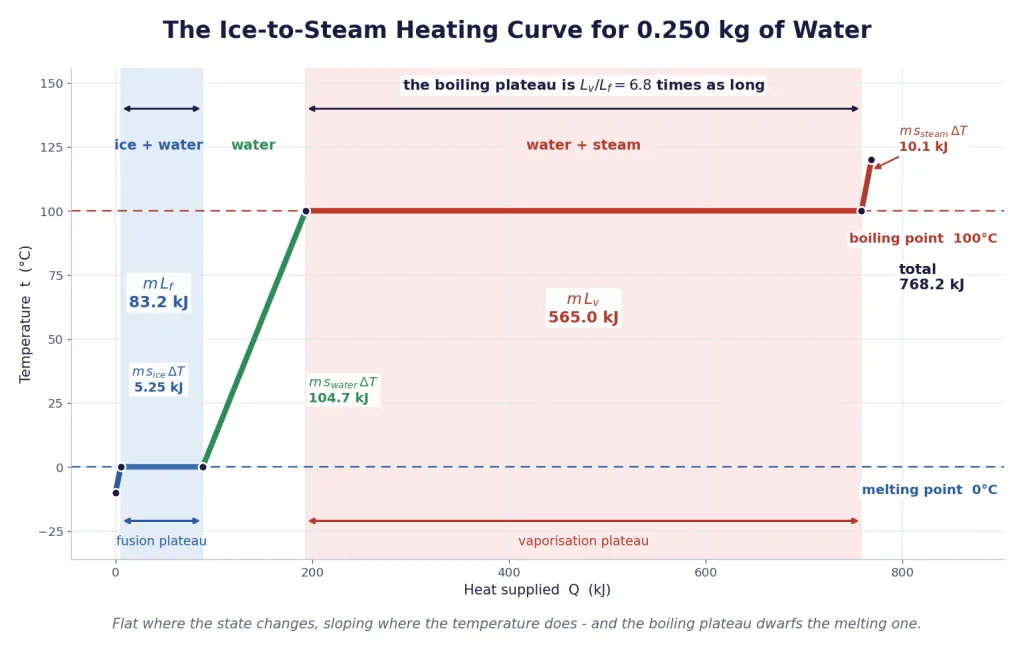
Key Point: Along a sloping stretch the heat is and the temperature rises. Along a flat stretch the heat is or and the temperature does not move at all — the energy is breaking bonds, not speeding molecules up. Every ice-to-steam problem is these five pieces added in order, and the commonest lost mark is leaving one of them out.
Example 34: From ice at °C to steam at 120°C — the whole ledger
How much heat is needed to convert 0.250 kg of ice at °C into steam at 120°C at one atmosphere? Use , and J/(kg K), with J/kg and J/kg.
Solution:
Break the journey into five pieces and name each one before computing. Two of them are flat.
Piece 1 — warm the ice from °C to 0°C.
Piece 2 — melt it at 0°C.
Piece 3 — warm the water from 0°C to 100°C.
Piece 4 — boil it at 100°C.
Piece 5 — superheat the steam from 100°C to 120°C.
Add.
Now read the ledger, because the proportions are the physics. Boiling alone took J — 73.5% of the total. Melting took 10.8%. Everything else, all the temperature-raising put together, took under 16%. The two flat stretches between them account for more than five-sixths of the energy.
The ratio that gives the curve its shape. which is exactly why the vaporisation plateau in the figure is nearly seven times as long as the fusion one. Melting only has to loosen the lattice so molecules can slide past one another; boiling has to pull them apart completely and push back the atmosphere while doing it.
Final Answer: J, of which goes into boiling alone.
Takeaway: Five pieces, in order, none skipped. Write the five headings down before you compute anything, and the marks look after themselves.
Example 35: A 700 W heater, and a stopwatch on each stage
A 700 W heater is switched on under 0.40 kg of ice at °C. Assuming all the heat is absorbed by the sample, find how long each stage takes and the total time to convert it entirely into steam at 100°C.
Solution:
Every stage takes , with W throughout. So the times are in the same ratios as the energies — which means the stopwatch is drawing the heating curve for you.
Stage 1 — warm the ice to 0°C.
Stage 2 — melt it.
Stage 3 — warm the water to 100°C.
Stage 4 — boil it all away.
Total.
The check that ties this to the previous problem. the same 6.79 as before, because cancels out of the ratio. This is why you can read straight off a laboratory graph without ever knowing the heater's power — the ratio of the two plateau widths is the ratio of the two latent heats, whatever the power was.
Something worth noticing about the first stage. Eighteen seconds to warm the ice, 190 s to melt it. If you were watching a thermometer you would see it climb briskly, then sit dead still for over three minutes. Students who have not seen the curve often assume the heater has failed.
Final Answer: s, s, s and s, a total of about s, that is 29 minutes.
Takeaway: At constant power, time is a direct measure of energy. Any question about the shape of a heating curve can be answered in seconds or in joules interchangeably.
Example 36: Steam meets ice — what is left at the end?
30 g of steam at 100°C is passed into 200 g of ice at 0°C in an insulated vessel. Find the final temperature and the final contents. Use J/kg, J/kg and J/(kg K).
Solution:
Two phase changes are possible here, so there are two branch tests, and both must be done.
Test 1 — does all the ice melt? The most the steam can supply, if it condenses and its condensate then cools all the way to 0°C, is The heat needed to melt all the ice is Since , all the ice melts.
Test 2 — does all the steam condense, or does the mixture reach 100°C? To carry everything up to 100°C would need but condensing all the steam releases only J. Nowhere near. So all the steam condenses and the final temperature is below 100°C.
Both branches settled, now write one balance. Heat given out by the steam equals heat taken in by the ice:
Substitute.
Solve.
The final contents. Everything is liquid: g of water at °C.
The astonishing part. Thirty grams of steam melted 200 grams of ice and warmed the resulting 230 grams of water by more than 14 degrees. Steam carries roughly seven times as much energy per gram as melting ice absorbs, and that ratio does all the work here.
Final Answer: °C, with g of water and no ice or steam left. Branches taken: all the ice melts, and all the steam condenses.
Takeaway: Two possible phase changes means two branch tests, both done before you write a single balance equation. Test the extreme case in each direction and the algebra becomes routine.
Part 7: Conduction — Single Slabs, Series, Parallel and Networks
Six problems on steady-state conduction. The moment there is more than one material, stop writing for each piece and switch to thermal resistances — the algebra becomes identical to a d.c. circuit.
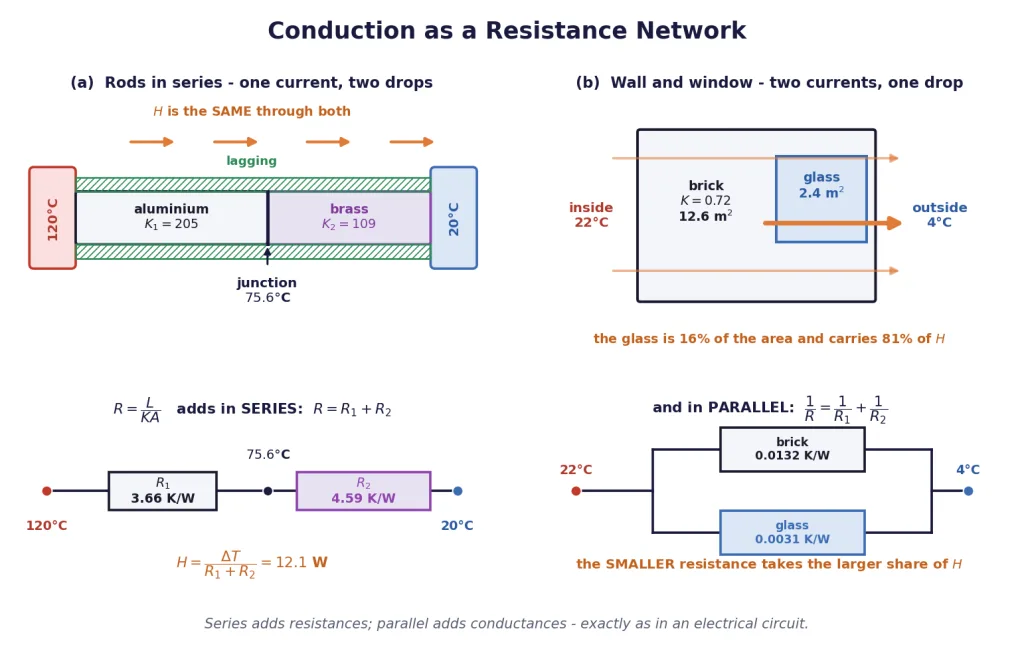
Key Point:
In series (slabs stacked face to face) the heat current is the same through each and
In parallel (slabs side by side) the temperature difference is the same across each and
Since only appears, Celsius and kelvin are interchangeable everywhere in this Part.
Example 37: How much heat crosses a brick wall in a day?
An external brick wall measures 4.0 m by 2.6 m and is m thick. The inside face is at 24°C and the outside face at 8°C. Taking W/(m K), find the rate of heat flow, the temperature gradient and the heat lost in one day.
Solution:
Write the conduction law and identify each symbol. Here is the area across which the heat flows — the face of the wall — and is the thickness along which it flows. Mixing these two up is the standard error.
The area and the temperature difference.
Substitute.
The temperature gradient. That is, the temperature falls by about 0.67 K for every centimetre you go into the brick — and because the wall is uniform and in the steady state, it falls linearly, so a point halfway through the wall is at 16°C.
The heat lost in a day. which is kWh — a real and expensive number, and only for one wall.
Cross-check with the resistance form, which is the way you should be thinking from here on: The same answer, and now the wall is a component you can wire other components to.
Final Answer: W, a gradient of K/m, and J — that is kWh — in a day.
Takeaway: Compute the thermal resistance even for a single slab. It costs nothing extra and it is the form every harder conduction problem is built from.
Example 38: An aluminium-brass pair and the temperature where they meet
An aluminium rod 0.30 m long is joined end to end to a brass rod 0.20 m long. Both have a cross-section of 4.0 cm and the sides are perfectly lagged. The free end of the aluminium is held at 120°C and the free end of the brass at 20°C. Taking and W/(m K), find the junction temperature, the heat current, and the equivalent conductivity of the compound rod.
Solution:
In the steady state the same heat current passes through both rods — nothing accumulates anywhere and nothing escapes through the lagged sides. That single sentence is the whole method.
Convert the area and compute both resistances. cm m. The brass rod, though shorter, has the larger resistance — its conductivity is barely half the aluminium's.
Series, so the resistances add.
The heat current.
The junction temperature. Walk down from the hot end, losing across the aluminium:
Check it from the other end, which costs one line and catches sign errors: The two agree. Notice how the temperature drop divides: 44.4 K across the aluminium and 55.6 K across the brass, in exactly the ratio . The bigger resistance always takes the bigger share of the drop, precisely as in a series circuit.
The equivalent conductivity. Treat the pair as one rod of length m and the same area: It lies between 109 and 205, as it must, and closer to the brass end because the brass dominates the resistance.
Final Answer: junction at °C; W; W/(m K).
Takeaway: The junction temperature is found by walking down from one end through one resistance — then check it by walking up from the other. Two lines, and the check is free.
Example 39: A wall that is part brick and part glass
An external wall of total area 15 m contains a glass window of area m. The brick is m thick with W/(m K); the glass is mm thick with W/(m K). The inside is at 22°C and the outside at 4°C. Find the total rate of heat loss and the share carried by the window.
Solution:
These two paths are side by side, so they are in parallel. They share the same temperature difference of 18 K, and their heat currents add. Their thicknesses are quite different, which is fine — parallel does not require equal thickness, only a shared .
The brick area is what is left over.
The two resistances. The glass has about one quarter the resistance of all that brick, despite covering only a sixth of the area — because it is twenty times thinner.
The two heat currents, computed separately.
Add them.
Check with the parallel-resistance formula. Agreement.
Read the shares, because this is the point of the problem. The window is of the area but carries of the heat. Insulating the brick further would be almost pointless; double-glazing the window would transform the wall. In a parallel network, the path of least resistance dominates, and improving any other path is wasted effort.
Final Answer: W in total, of which W — — goes through the window.
Takeaway: In parallel, find the weakest link and fix that. A thin, conducting patch in an otherwise good wall carries a wildly disproportionate share of the loss.
Example 40: Ice left in a cool box after eight hours
A cubical thermacole cool box of side 40 cm has walls cm thick and holds 5.0 kg of ice. The outside is at 40°C. Taking W/(m K) and J/kg, estimate how much ice remains after 8.0 hours.
Solution:
The inside temperature is pinned at 0°C for as long as any ice remains — that is what a melting solid does. So K throughout, and the heat current is constant.
The total area of the six faces.
The heat current. About twenty watts — roughly what a small LED bulb dissipates, spread over nearly a square metre of wall with 40 K across it. That is what good insulation buys you.
The heat that gets in over 8.0 hours.
Convert that into melted ice.
The ice remaining. About 37% has gone after a full working day in 40-degree heat.
Check the assumption we leaned on. Some ice is left at the end, so the interior really did stay at 0°C for the whole eight hours, and the constant- calculation is self-consistent. Had the answer come out negative, the ice would have run out part-way and the calculation would have needed splitting into two stages.
Final Answer: about kg of ice remains, roughly kg having melted.
Takeaway: While ice is present, the inside temperature does not move, so the heat current is constant and the arithmetic is easy. Always confirm at the end that some ice survived — otherwise the assumption collapses.
Example 41: Estimating the flame temperature under a boiler
A copper boiler has a base of area m and thickness mm. Standing on a stove, it boils off water at 5.0 kg per minute. Taking W/(m K) and J/kg, estimate the temperature of the part of the flame in contact with the base.
Solution:
Work out the heat current from what the boiler is doing, not from the conduction formula — the boiling rate is the measurement here. Nearly 190 kW. Large, but this is an industrial boiler, and boiling water is expensive.
Now run the conduction law backwards to find the temperature difference that drives this current through the base:
Substitute.
The inner surface of the base is in contact with boiling water, so it sits at 100°C. Therefore
What the answer actually means, and its limits. This is the temperature of the outer surface of the boiler base — of the gas immediately touching it. It is nowhere near the temperature at the heart of the flame, which is over a thousand degrees; the flame gives up its heat to the metal across a boundary layer of gas, and most of the temperature drop happens there, not in the copper. The calculation gives a floor on the flame's temperature, not its true value.
Why the drop across the copper is so small. Copper's conductivity is 385 W/(m K) and the base is only 8 mm thick, so its thermal resistance is tiny: K/W. Even 190 kW only produces a 33 K drop across it. That is exactly what you want from a pan base.
Final Answer: about °C at the flame-side surface of the base, a drop of K across the copper.
Takeaway: When a problem tells you a boiling rate or a melting rate, that is the heat current handed to you. Compute from the phase change first, then use conduction to find whatever temperature is asked for.
Example 42: A three-layer wall, solved as a resistance chain
A cold-room wall of area 6.0 m is built of m of brick (), then m of polyurethane foam (), then m of plywood lining (), all in W/(m K). Outside it is 38°C, inside it is °C. Find the heat current and both junction temperatures.
Solution:
Three slabs face to face means three resistances in series. Compute each with , with m throughout.
The brick.
The foam.
The plywood.
Add them. The foam alone is 84.4% of the total resistance, even though it is a quarter of the thickness of the brick. Its conductivity is nearly thirty times smaller, and that is what insulation means.
The heat current.
Junction 1, between brick and foam. Walk in from the outside:
Junction 2, between foam and plywood.
Check by finishing the walk. which is the inside temperature. The chain closes.
Read the temperature profile. The brick drops 5 K, the foam drops 36 K, the plywood drops 1.7 K. The drop across each layer is proportional to its resistance — 84.4% of the resistance takes 84.4% of the drop. In a series network the temperature does the work where the resistance is, and everywhere else it barely changes.
Final Answer: W; the brick-foam junction is at °C and the foam-plywood junction at °C.
Takeaway: In a series stack, divides in proportion to , exactly as voltage divides in proportion to resistance. Find the biggest and you have found where almost the whole temperature drop lives.
Part 8: Radiation and Cooling — the Hard Finishers
Eight problems to end on. Every one of them needs at least one temperature in kelvin, and the fourth power is merciless about it: a Celsius value inside does not give a slightly wrong answer, it gives an answer wrong by a factor of hundreds.
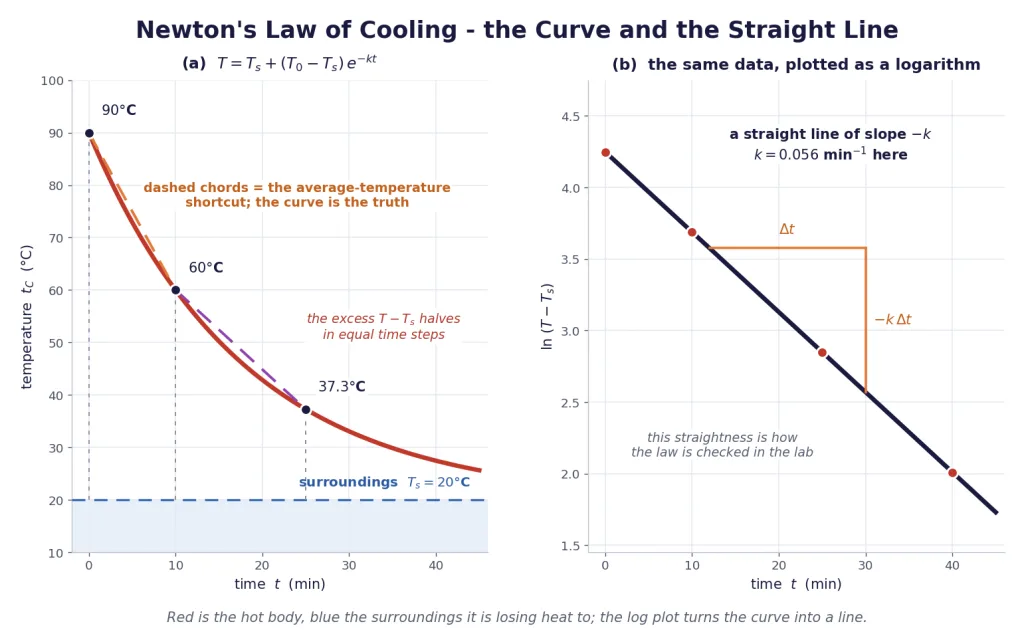
Key Point: Wien and Stefan-Boltzmann demand kelvin. Newton's law only involves differences, so Celsius is safe there — but it is an approximation valid only while is small compared with .
Example 43: Two colours, two temperatures
(a) A red supergiant star radiates most strongly at a wavelength of 850 nm. What is its surface temperature? (b) A tungsten lamp filament runs at 2800 K. At what wavelength does it radiate most strongly, and what does that tell you about the lamp? Take m K.
Solution:
Wien's displacement law, and it is a product of a wavelength and an absolute temperature, so the temperature must be in kelvin and comes out in kelvin:
(a) The star. Convert the wavelength to metres first: nm m m. About 3410 K. Cool, as stars go — the Sun is near 5800 K — and that is exactly why it looks red.
(b) The filament.
Read what that means. Visible light runs from about 400 nm to 700 nm. The filament's peak, at 1040 nm, is in the infrared — outside the visible range altogether. An incandescent lamp is therefore mostly a heater that happens to leak a little visible light off the short-wavelength shoulder of its spectrum. That single number is why filament lamps have been replaced.
A useful comparison to store. For the Sun at 5800 K, m nm — right in the middle of the visible band, and no coincidence at all: our eyes evolved to use the light that is actually there.
The trap. Had you put 2800 in as a Celsius value and used K, you would get 944 nm. Wien's law needs the absolute temperature and the problem gave you one — read the unit before you divide.
Final Answer: (a) about K; (b) micrometres, in the infrared — the lamp radiates mostly heat, not light.
Takeaway: Hotter means bluer, and the product is a constant. One number read off a spectrum gives the temperature of an object you can never touch.
Example 44: How much power does a room radiator give off?
A panel radiator has an exposed surface area of m and its surface sits at 78°C in a room whose walls are at 19°C. Taking its emissivity as and W/(m K), find the net rate at which it radiates.
Solution:
Convert both temperatures to kelvin, and write them down. This is not a formality — it is the whole problem.
The net exchange law. The radiator emits according to its own temperature and absorbs according to the walls' temperature, and what matters is the difference:
Evaluate the two fourth powers separately — they are big numbers and it is worth seeing them.
Substitute.
Now the trap, worked out so you can see how bad it is. Suppose you had left the temperatures in Celsius: Two and a half watts instead of 566 — wrong by a factor of about 215. Not a small error, not a rounding issue: a completely different physical claim. There is no situation in this chapter where a fourth power takes a Celsius value.
Sanity check the answer. 566 W of radiation from a panel radiator is entirely sensible; a domestic radiator is typically rated between 500 W and 1500 W, and radiation is only part of its output — the rest goes into the room by convection, which is why it is called a radiator somewhat unfairly.
Final Answer: about W net.
Takeaway: Write both temperatures in kelvin on their own line before you touch the fourth power. It takes five seconds and it is the difference between 566 W and 2.6 W.
Example 45: Comparing two stars by radius and colour
Star A has a radius times the Sun's and its spectrum peaks at 480 nm. Star B has a radius times the Sun's and peaks at 720 nm. Both radiate as blackbodies. How many times more power does A radiate than B? Take m K.
Solution:
Get both temperatures from Wien's law, in kelvin, because they are about to be raised to the fourth power.
Note the ratio before substituting, because it is exact and clean: The temperature ratio is just the inverse ratio of the peak wavelengths — the constant cancels. Useful shortcut.
The total power radiated by a sphere.
Take the ratio, and watch and disappear.
Substitute.
Unpack the two contributions. Being 2.9 times larger in radius multiplies the output by 8.4. Being only 1.5 times hotter multiplies it by 5.1 — and that from a temperature difference of just 2000 K. The fourth power is what makes stellar temperature so much more important than it looks. Double the absolute temperature and the output rises sixteenfold.
A note on the Sun's radius. It never entered the arithmetic. Both radii were expressed as multiples of it, and it cancels in the ratio — so the answer is exact regardless of what the solar radius actually is.
Final Answer: star A radiates about times as much power as star B.
Takeaway: In any ratio problem, write symbolically first. Constants cancel, absolute temperatures survive, and the arithmetic shrinks to two multiplications.
Example 46: Cooling tea, in two stages
A cup of tea cools from 70°C to 50°C in minutes in a room at 25°C. How long will it take to cool from 50°C to 40°C?
Solution:
Use Newton's law in its average-temperature form, which is what makes these problems one line. For a fall from to in time , taking the average excess as representative, Only temperature differences appear, so Celsius is fine throughout — no kelvin conversion needed here.
Stage 1, to find . The average temperature is °C, so the average excess over the room is K.
Stage 2, using that same . The average temperature is now °C, an excess of K.
Solve.
Look at what the answer says. The tea took 6 minutes to shed the first 20 degrees and takes 5.25 minutes to shed the next 10. Cooling slows down as the excess shrinks — which is Newton's law working exactly as advertised.
How good is the shortcut here? Solving the differential equation properly gives min and a second-stage time of min. The average-temperature answer of 5.25 min is high by 0.7%. Over intervals this small the shortcut is excellent — and that is a claim worth checking rather than assuming, as the next problem shows.
Final Answer: about minutes, which the exact treatment puts at minutes.
Takeaway: The average-temperature form turns Newton's law into simple proportion, and over a 10 or 20 degree fall it is accurate to about one per cent. Use the same for both stages — that is the whole point of finding it.
Example 47: The exponential form, and where the shortcut drifts
A body at 90°C is left in a room at 20°C and cools to 60°C in 10 minutes. (a) Find the cooling constant and the temperature after 25 minutes. (b) Find the time to cool from 90°C to 40°C, both exactly and by the average-temperature shortcut, and say how far the shortcut is off.
Solution:
Start from the differential equation and its solution. Rearranged for :
(a) Find from the given 10-minute measurement.
The temperature after 25 minutes.
(b) The exact time to reach 40°C.
Now the shortcut, in one step from 90°C to 40°C. First get its own from the given stage: average temperature °C, excess 55 K, Then apply it across the whole 50-degree fall: average temperature °C, excess 45 K,
Compare. Exact 22.4 min, shortcut 20.4 min — the shortcut is 9% short. Over a 10 or 20 degree fall it was good to 1%; stretched across 50 degrees in one step it is not. The reason is that the average-temperature form replaces an exponential by a straight chord, and the longer the chord the worse the fit.
The practical rule. Use the average-temperature form over intervals of 10 to 20 degrees, and use the exponential whenever the fall is large or a time longer than about one is involved. And plot against when you want to check the law — a straight line of slope is the signature, and that is exactly how the law is verified in a school laboratory.
One boundary worth stating. Newton's law itself is an approximation, obtained from the Stefan-Boltzmann law by keeping only the first term of a binomial expansion, and it holds only while . Here starts at 70 K against a of 293 K, so we are already stretching it; for a body at 400°C in a room the law is simply the wrong tool.
Final Answer: (a) min and °C after 25 minutes; (b) minutes exactly against minutes from the shortcut, which is short.
Takeaway: The average-temperature shortcut is a chord across a curve. Short chord, tiny error; long chord, a real one — so state the interval before you trust it.
Example 48: A rod between steam and ice — how much melts per minute?
A copper rod m long with a cross-section of cm is perfectly lagged along its sides. One end is kept in steam at 100°C and the other in ice at 0°C. Taking W/(m K) and J/kg, how much ice melts per minute in the steady state?
Solution:
Two ideas are chained here. Conduction sets the heat current; latent heat converts that current into a melting rate. Do them in that order.
The heat current. Convert the area first: cm m.
Why the two ends stay at 100°C and 0°C. Steam condensing and ice melting are both phase changes, so both ends are held at fixed temperatures no matter how much heat flows. That is what makes the steady state genuinely steady, and it is why this apparatus is the classical way to measure a conductivity.
The heat delivered to the ice in one minute.
The ice melted.
Scale it up as a check on plausibility. In an hour that is 260 g — a quarter of a kilogram of ice melted by a rod you could hold in one hand. Copper is a very good conductor, and a 100 K difference across only 40 cm is a steep gradient of 250 K/m.
Run the experiment backwards, which is how it is actually used. Measure the melting rate, and you have ; measure , and , and falls out. This is Searle's method in outline.
Final Answer: about g of ice melts per minute, driven by a heat current of W.
Takeaway: A phase change at each end of a conducting bar clamps both temperatures, which is what makes the steady state exact. Conduction gives you the watts; latent heat turns watts into grams per second.
Example 49: One rail, three questions
A steel rail 25.0 m long has a cross-sectional area of 65 cm and is made of steel of density 7800 kg/m. Its temperature rises from 18°C to 48°C. Taking K, Pa and J/(kg K), find (a) how much it lengthens if free, (b) the force it exerts on its supports if rigidly clamped, and (c) the heat it absorbed.
Solution:
The temperature change is K, and it is the same 30 in Celsius degrees. Every part of this problem uses a difference only, so no kelvin conversion is needed anywhere.
(a) Free expansion. Nine millimetres. That is the size of the gap a track layer must leave between rails, and it is why you hear the rhythmic knock of an older track.
(b) Clamped instead. No expansion is permitted, so the strain is converted entirely into elastic compression: Almost half a meganewton — about 48 tonnes-force — from a warm afternoon. At 72 MPa the rail is at roughly a third of the yield strength of structural steel, so a longer rail or a hotter day starts to threaten buckling. This is exactly the failure mode called a sun kink.
(c) The heat absorbed. First the mass: Then the heat: about 17 MJ, or 4.8 kWh — supplied free by the sun, over several hours.
Notice how the three parts use three different properties of the same object. answers (a), and together answer (b), and and answer (c). None of them helps with either of the others. Sorting out which property a question needs is half the work in a multi-part problem.
Final Answer: (a) mm; (b) N at a stress of Pa; (c) J.
Takeaway: Read a multi-part question as three separate problems that happen to share an object. Identify which material property each part needs before you compute anything.
Example 50: Five "explain why" answers, done properly
Give the physical reason for each of the following.
(a) A body with a large reflectivity is a poor emitter. (b) A brass tumbler feels much colder than a wooden tray on a chilly day, though both are at room temperature. (c) An optical pyrometer calibrated for blackbody radiation reads too low for a red-hot iron bar in the open air, but reads correctly for the same bar inside a furnace. (d) The Earth without its atmosphere would be inhospitably cold. (e) Heating systems that circulate steam warm a building more effectively than those circulating hot water.
Solution:
(a) Kirchhoff's law is the whole answer. At a given temperature and wavelength, the ratio of a body's emissive power to its absorptive power is the same for every body — so a good absorber is a good emitter. A highly reflective surface reflects most of what falls on it, therefore absorbs little, therefore has a small absorptive power , and therefore must have a correspondingly small emissive power. A polished silver teapot stays hot far longer than a matt black one for exactly this reason.
(b) This is conduction, and it is about the rate, not the temperature. Both objects are at the same room temperature; what differs is how fast each carries heat away from your skin. Brass has a thermal conductivity of order W/(m K), wood of order — a factor of about a thousand. The brass drains heat from your fingertips rapidly and the nerve endings, which report rate of heat loss rather than temperature, call that "cold". The wood cannot conduct heat away nearly fast enough, so its surface warms to skin temperature almost at once and feels neutral.
(c) Emissivity is the key, and so is the cavity. An optical pyrometer infers temperature from the radiation it receives, assuming the source is a blackbody with . In the open, hot iron has an emissivity well below 1, so it emits less than a blackbody at the same temperature, and the instrument — reading a smaller flux — reports a lower temperature than the true one. Inside a furnace the bar is surrounded by walls at its own temperature, and the radiation leaving the furnace opening is cavity radiation, which is blackbody radiation regardless of what the walls are made of. The instrument's assumption is then true and the reading is correct.
(d) The greenhouse effect. Sunlight arrives mostly as short-wavelength visible radiation, which passes through the atmosphere with little absorption and warms the ground. The ground, being far cooler than the Sun, re-radiates in the long-wavelength infrared — which is precisely where carbon dioxide, water vapour and methane absorb strongly. That energy is trapped and re-radiated back downwards, holding the surface roughly 33 K warmer than it would otherwise be. Strip the atmosphere away and the Earth's mean surface temperature would fall to about °C, well below freezing everywhere.
(e) Latent heat, and the numbers make the case decisively. One kilogram of steam condensing at 100°C releases One kilogram of hot water cooling from 100°C to 60°C releases only The steam delivers 13.5 times as much energy per kilogram, and it delivers it all at a constant 100°C rather than over a falling temperature. So a steam system moves far more heat through a pipe of the same size, and does it at a steadier radiator temperature.
Final Answer: (a) Kirchhoff's law — a poor absorber must be a poor emitter; (b) brass conducts heat away from the skin about a thousand times faster than wood; (c) hot iron in the open has and under-radiates, while a furnace supplies true cavity radiation; (d) greenhouse gases absorb the Earth's outgoing infrared and hold the surface about 33 K warmer; (e) makes a kilogram of steam worth 13.5 kilograms of hot water falling 40 degrees.
[Board Important] Each of these is worth two marks and takes half a minute if you have said it once. Always name the mechanism — Kirchhoff's law, conductivity, emissivity, infrared absorption, latent heat — rather than describing what is observed. "It feels colder because it is a metal" earns nothing; "because brass conducts heat away from the skin about a thousand times faster than wood" earns the marks.
Takeaway: A "why" question wants a named mechanism plus one supporting number. Learn the five mechanisms in this chapter — Kirchhoff, conduction rate, emissivity, infrared trapping, latent heat — and almost every explanation question in the paper is already answered.