
When Heat Goes In and the Temperature Refuses to Move
Put a beaker of crushed ice on a steady burner and stand over it with a thermometer and a stopwatch. Read the temperature every minute.
For the first few minutes the reading climbs, slowly, from wherever the ice started up towards C. Then something strange happens. The ice begins to melt — and the thermometer stops. Minute after minute the burner pours energy in, and the reading sits at C and will not budge. Only when the last piece of ice has gone does the temperature start climbing again.
Then it happens a second time, at C, and this time it lasts far longer.
That is the whole of this section. Energy is going in, and it is not going into temperature. Where is it going?
The three states and the six ways between them
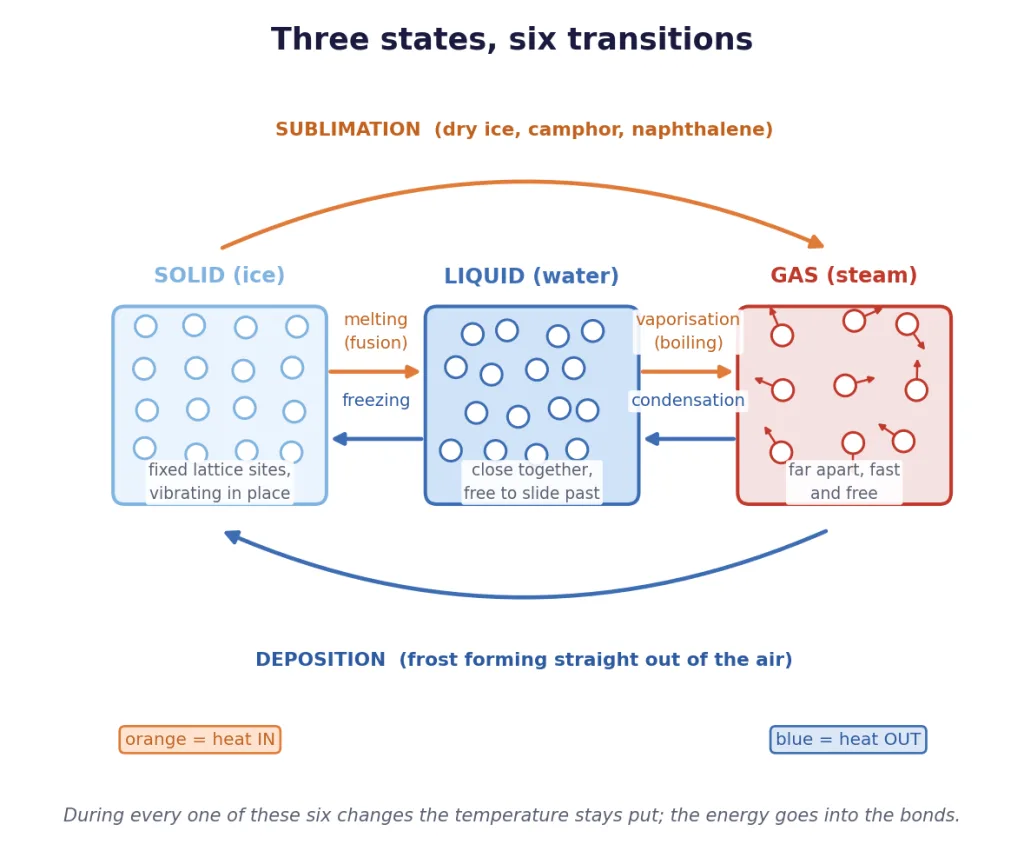
Matter normally exists in three states, and the difference between them is not what the molecules are but how tightly they are held.
- In a solid each molecule sits at a fixed lattice site and vibrates about it. It cannot wander. The bonds to its neighbours are strong and numerous.
- In a liquid the molecules are still almost touching, but they are free to slide past one another. Some bonds have been broken; most remain.
- In a gas the molecules are far apart and hardly interact at all except when they collide. Essentially all the bonds are gone.
Key Point — the six transitions, and their names:
From To Name Heat solid liquid melting (fusion) absorbed liquid solid freezing (solidification) given out liquid gas vaporisation (boiling) absorbed gas liquid condensation given out solid gas sublimation absorbed gas solid deposition given out The three on the left of the table need energy put in; the three on the right give energy back out. Every pair is the exact reverse of the other, and the energy involved is the same in both directions.
The temperature stays constant — and why
During every one of those six changes, as long as both phases are present, the temperature does not change. Ice and water can sit together in the same beaker all afternoon, and the mixture will read exactly C the whole time.
The reason is the point of the section. The heat you supply has two possible destinations:
- it can make the molecules move faster, which raises the temperature; or
- it can pull the molecules apart against the forces holding them together, which does not.
During a change of state, all of it goes to the second. Melting means dismantling the lattice: every bond broken costs energy, and that energy is stored as the potential energy of molecules now further from one another. Their average kinetic energy — which is what the thermometer reports — is untouched. So the reading holds steady while the beaker quietly fills with water.
Key Point: No temperature change does not mean no heat. During a phase change the heat goes into potential energy, breaking bonds, not into kinetic energy. This is the misconception that costs the most marks in the whole chapter.
Melting point and boiling point
The temperature at which the solid and liquid states of a substance coexist in thermal equilibrium is its melting point; the temperature at which the liquid and vapour coexist is its boiling point. Both are characteristic of the substance, and both depend on pressure — the last block of this section is about exactly that. Measured at standard atmospheric pressure they are called the normal melting point and the normal boiling point.
[Board Important] "Why does the temperature of a substance remain constant during a change of state?" Full marks in one sentence: the heat supplied is used in overcoming the intermolecular forces and changing the potential energy of the molecules, not in increasing their kinetic energy, and it is the average kinetic energy that determines the temperature.
The Heating Curve, Drawn to Scale
Here is the whole experiment on one graph. Take one kilogram of ice at C and supply heat steadily until it is steam at C, and plot temperature against the total heat you have supplied.
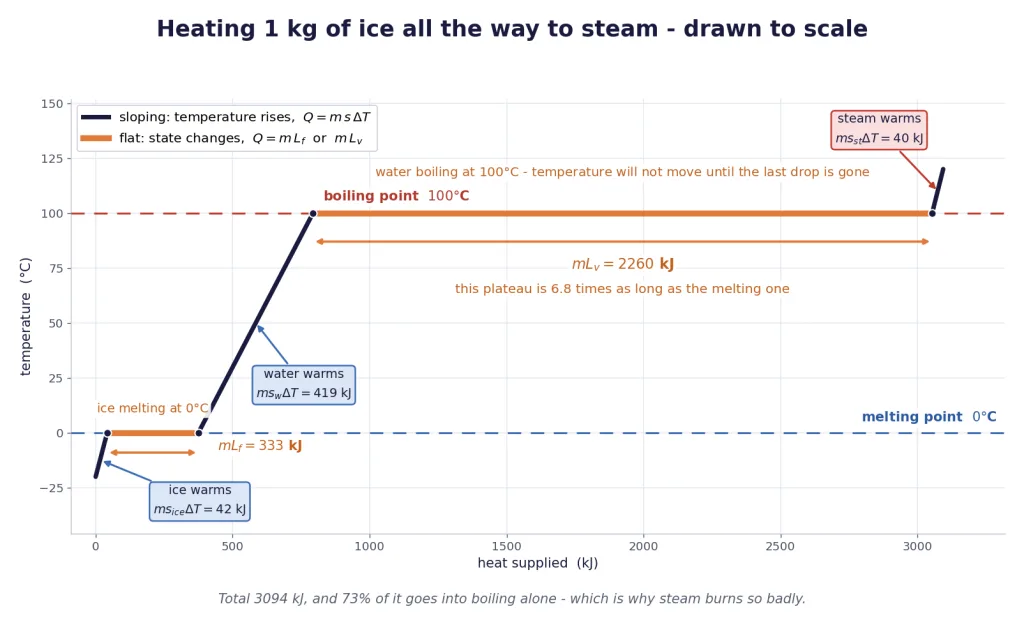
Read it left to right. There are exactly five stretches, and they come in two kinds.
| Stretch | What is happening | Heat needed |
|---|---|---|
| Sloping | ice at C warms to C | kJ |
| FLAT at C | ice melts to water | kJ |
| Sloping | water warms from C to C | kJ |
| FLAT at C | water boils to steam | kJ |
| Sloping | steam warms from C to C | kJ |
Total: 3094 kJ.
Key Point — the two kinds of stretch, and the two formulas:
- A sloping stretch means one phase warming up. Use , with the of that phase.
- A flat stretch means a change of state at constant temperature. Use or .
Never use a specific heat capacity across a plateau, and never use a latent heat across a slope.
Four things to read off the picture
1. The three slopes are different, and that is information. The steeper the line, the smaller the specific heat capacity, because a small means a big rise per joule. Ice is steeper than water because is half of . Steam is steeper still. A question that shows you a heating curve and asks which phase has the largest specific heat capacity is asking which stretch is least steep.
2. The plateaus are horizontal, not merely gentle. During the change of state, the temperature is genuinely constant, for as long as both phases are present.
3. The boiling plateau is enormously longer than the melting one. On this graph the vaporisation plateau is 6.8 times the length of the fusion plateau, and that ratio is not decoration — it is the ratio drawn to scale.
4. Boiling dominates the whole journey. Of the 3094 kJ, the vaporisation plateau alone accounts for 2260 kJ, or 73% of everything. Taking ice from C to boiling water is the easy part; turning that water into steam costs nearly three times as much again.
[JEE Tip] Heating-curve questions almost always give you a constant power heater and ask about times rather than energies. Since with fixed, the horizontal axis is just time in disguise, and every ratio of lengths is a ratio of times. If melting takes 3 minutes, boiling the same mass away takes minutes, and you never need the power at all.
[NEET Important] Read the curve backwards and it is a cooling curve: steam condenses at C giving out , water cools, water freezes at C giving out , ice cools. The plateaus are in the same places and the same lengths. Cooling curves for other liquids are used to identify substances by their freezing points.
Latent Heat: the Energy That Hides
The heat that a plateau swallows has a name.
Key Point — latent heat:
The latent heat of a substance for a given change of state is the heat per unit mass transferred during that change, at constant temperature. Written out for the two changes that matter here, SI unit: J/kg. "Latent" means hidden — hidden because it produces no change in temperature to give itself away.
- Latent heat of fusion — solid to liquid. For ice, J/kg.
- Latent heat of vaporisation — liquid to gas. For water, J/kg.
Always write the subscript. In this chapter a bare means a length; latent heat is always or . Mixing them up in a mixed expansion-and-calorimetry problem is a real and avoidable disaster.
Latent heat depends on pressure, and the values quoted are at standard atmospheric pressure. It is also the same in both directions: freezing one kilogram of water at C releases exactly the J that melting it absorbed.
Real values, so the symbols mean something
This is our own reference table for the chapter, at 1 atm.
| Substance | Melting point (C) | (10 J/kg) | Boiling point (C) | (10 J/kg) |
|---|---|---|---|---|
| Water | 0 | 3.33 | 100 | 22.6 |
| Ethanol | 1.0 | 78 | 8.5 | |
| Mercury | 0.12 | 357 | 2.7 | |
| Lead | 328 | 0.25 | 1744 | 8.67 |
| Gold | 1063 | 0.645 | 2660 | 15.8 |
| Nitrogen | 0.26 | 2.0 | ||
| Oxygen | 0.14 | 2.1 |
Two patterns run right through that table. is always several times for the same substance, and water's values are far larger than anything else's — as they were for specific heat capacity in Section 5, and for the same underlying reason: hydrogen bonding.
Why is about seven times
Because melting and boiling are not equally destructive.
Melting only loosens the lattice. The molecules leave their fixed sites and become free to slide, but they stay in contact with roughly the same number of neighbours. Only a fraction of the bonds actually break, and the volume barely changes.
Boiling separates the molecules completely. Every remaining bond must be broken and the molecule carried right out of the liquid into a region where its neighbours are, on average, ten molecular diameters away. On top of that, the vapour occupies about 1600 times the volume of the liquid it came from, so the escaping vapour has to push the atmosphere back to make room — real work, done against a real pressure, paid for out of the same latent heat.
More bonds broken, plus work done against the atmosphere. Hence the factor of nearly seven.
Why steam burns are so much worse
This is the standard application, and it deserves a number rather than a slogan.
Suppose 1 g of steam at C lands on skin at C. It first condenses, releasing J, all of it at C. Then the resulting water cools from C to C, releasing a further J. Total: 2524 J.
Now suppose 1 g of boiling water at C lands on the same skin. There is no condensation to do, so it just cools: 264 J.
Key Point: Gram for gram, steam at C delivers 9.6 times as much energy to your skin as boiling water at the same temperature. The extra is entirely latent heat, released before the temperature has moved at all. Same temperature, wildly different injury — which is exactly why "it's only at C" is no defence.
[NEET Important] The same arithmetic explains why steam-based heating systems warm a building more effectively than hot-water ones. The steam gives up in the radiator as it condenses, then the condensate is pumped back to be boiled again — so each kilogram circulated carries an enormous payload compared with hot water, which can only give up .
Pressure Moves Both Fixed Points
The melting point and the boiling point are not constants of nature. Both depend on pressure — and, in one of the few genuinely surprising results in this chapter, they move in opposite directions for water.
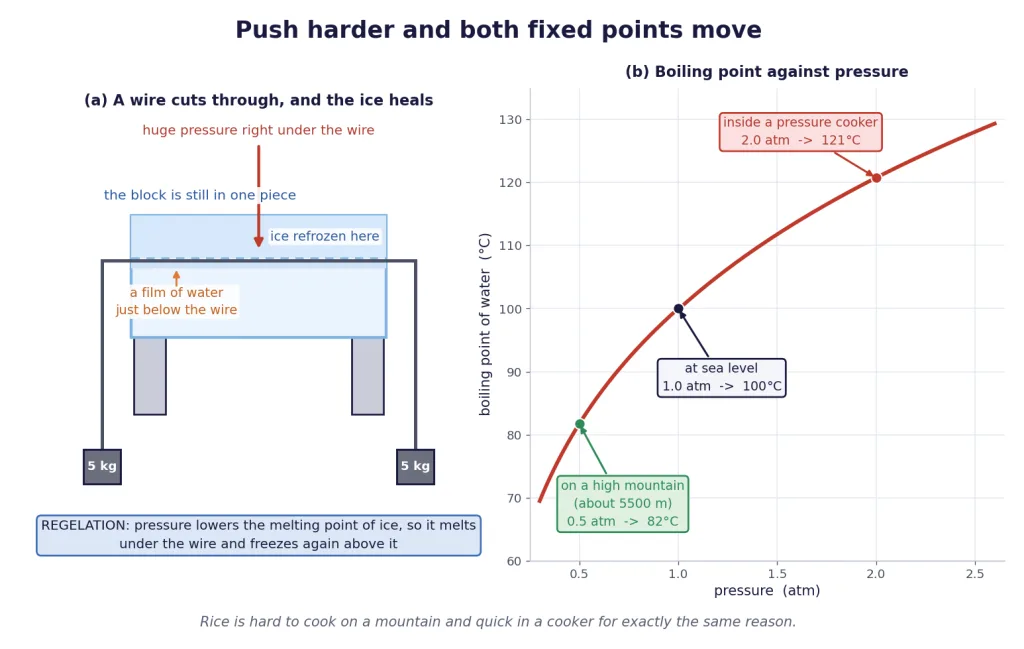
Boiling point rises with pressure
This one is intuitive. Boiling happens when bubbles of vapour can form inside the liquid and survive, and a bubble survives only if the vapour pressure inside it can push back the pressure outside. Raise the outside pressure and you need a hotter, more energetic liquid to make bubbles that can hold their own — so the boiling point rises.
You can see it in a flask. Boil water, then close the outlet for a few seconds; the boiling stops, and more heat is needed before it restarts. Or remove the flame, let the water cool to about C, seal the flask and pour cold water over it: the vapour inside condenses, the pressure above the water drops, and the water starts boiling again at C.
The numbers, from the pressure curve:
| Where | Pressure | Water boils at |
|---|---|---|
| High mountain, about 5500 m | 0.5 atm | C |
| Sea level | 1.0 atm | C |
| Inside a pressure cooker | 2.0 atm | C |
The pressure cooker. A weighted valve lets steam escape only above a set pressure, so the inside settles at about 2 atm and the water boils at about C instead of C. Food cooks faster because chemical reaction rates climb steeply with temperature — not because the pressure itself does anything to the food.
Cooking on a mountain. Reverse it. At 5500 m the air pressure is about half an atmosphere and water boils at only C — call it about 82°C. Rice put into water at that temperature simply never gets hot enough, and no amount of extra flame helps: the water is already boiling, so its temperature cannot rise. Boiling harder makes steam faster, not food quicker. This is why a pressure cooker is standard equipment on a Himalayan expedition.
Melting point of ice FALLS with pressure
Water is one of the very few substances that does this, and the reason connects straight back to Section 4's anomalous expansion: ice is less dense than water, so when ice melts it shrinks. Squeeze a mixture of ice and water and the system responds by shifting towards the phase that takes up less room — which is the liquid. So pressure encourages melting, and the melting point goes down.
How far down? Thermodynamics gives , and putting in the densities of ice (917 kg/m) and water (1000 kg/m) at K gives about K per atmosphere. Roughly one-hundredth of a degree per atmosphere — real, but small.
Regelation, and the wire through the block
Lay a thin wire across a block of ice and hang a heavy weight from each end. Come back later and the wire has passed right through the block — and the block is still in one piece.
Key Point — regelation:
The wire is thin, so the pressure directly beneath it is enormous. That pressure lowers the melting point there, the ice under the wire melts, and the wire sinks into the film of water. The water squeezes out above the wire, where the pressure is back to normal, so it is now below its melting point and refreezes. The whole cycle is called regelation — literally, re-freezing.
Two extra details make it work: the latent heat released by refreezing above the wire is conducted down through the wire to supply the melting below, which is why a metal wire works and a nylon thread does not.
The skater, told honestly
The standard story is that a skate blade's pressure melts the ice and the skater glides on a film of water. Let us check it.
Take a kg skater on a blade with about cm of contact. The pressure is Pa, which is 58 atmospheres. At K per atmosphere, that lowers the melting point by about 0.44 K.
Under half a degree. So pressure melting genuinely happens, and it is genuinely enough to explain skating on ice at C — but people skate happily at C, where it plainly is not enough on its own. The rest of the answer is frictional heating by the moving blade and a thin, permanently disordered surface layer that ice has even well below C.
[JEE Tip] Answer the exam question that was asked. If it says "explain skating using the effect of pressure on the melting point of ice", give the regelation argument — that is the syllabus answer. If it invites you to comment, add that the pressure effect is only a fraction of a degree and that friction contributes as well. Knowing the limits of the standard story is worth a mark, and quoting the wrong story confidently is worth none.
Sublimation: skipping the middle
Not everything passes through the liquid state at all. Sublimation is a direct change from solid to vapour, and it happens for substances whose triple-point pressure is above atmospheric.
- Dry ice, solid carbon dioxide, sublimes at C at ordinary pressure and never puddles — hence the name, and hence its use for chilling things that must stay dry. Its latent heat of sublimation is about J/kg, which is 1.7 times the latent heat of fusion of ordinary ice.
- Camphor, naphthalene and iodine all sublime slowly at room temperature, which is why mothballs shrink and vanish without ever leaving a stain.
- Ice itself sublimes slowly in dry, freezing air — which is how snow disappears from a mountainside on a cold, cloudless day with the temperature never rising above zero, and how frozen washing dries on a line in winter.
The reverse process, vapour straight to solid, is deposition, and it is how frost forms on a cold window: water vapour in the air turns directly to ice crystals without ever being liquid.
Evaporation Is Not Boiling
A puddle dries up on a cool morning. Wet clothes dry on a line in the shade. Sweat disappears from your skin at C. None of that is boiling, and mixing the two up is one of the commonest errors in the topic.
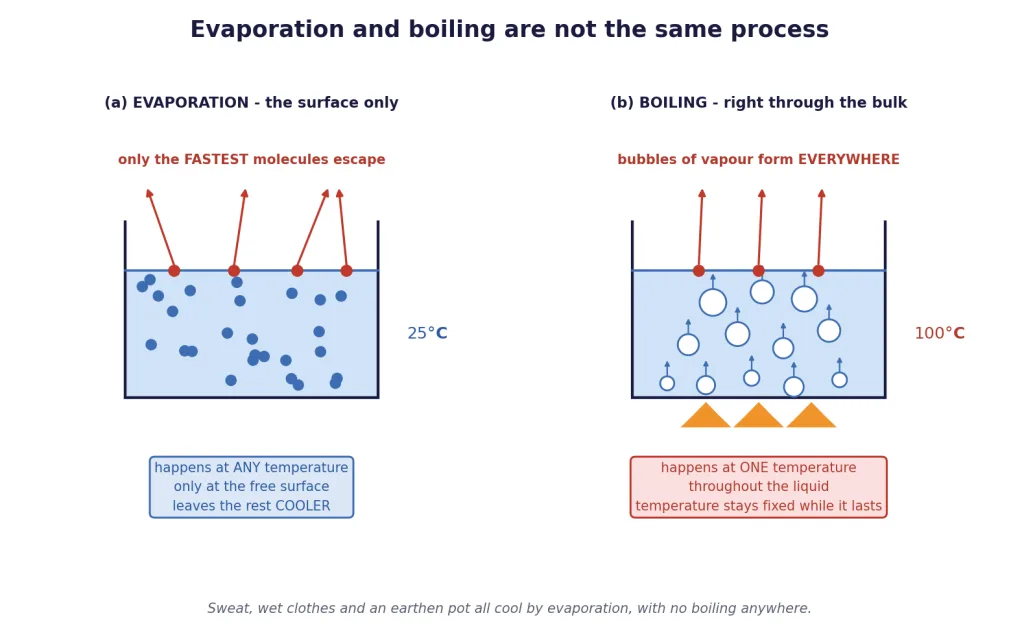
What evaporation actually is
In any liquid the molecules do not all move at the same speed. There is a spread — some slow, most middling, a few very fast. A molecule right at the surface, moving fast enough and in the right direction, can break free of its neighbours' pull and escape into the air. That is evaporation, and it needs no special temperature at all: at any temperature there are always some molecules fast enough.
Two consequences follow immediately, and both are examinable.
It happens only at the surface, because only surface molecules have anywhere to escape to. So evaporation is a surface phenomenon, and its rate depends on the surface area — which is why spreading clothes out dries them faster than leaving them bundled.
It cools what is left behind. The molecules that escape are the fastest ones. Remove the fastest members of a population and the average speed of the rest goes down — and average kinetic energy is temperature. So the remaining liquid gets colder, and it draws heat from whatever it is touching to make up the loss.
Key Point — evaporation causes cooling:
The molecules that leave carry away more than their share of the energy, so the liquid left behind cools. The energy they carry is exactly the latent heat of vaporisation, supplied by the liquid and its surroundings rather than by a flame.
This is why sweating cools you, why a wet earthen pot keeps water cool — water seeps through the porous walls and evaporates, taking latent heat from the pot — why a desert cooler works, and why you feel cold stepping out of a swimming pool on a windy day.
The four things that speed evaporation up
- Temperature. Warmer liquid means more molecules fast enough to escape.
- Surface area. More surface, more escape routes.
- Humidity. If the air is already nearly saturated, as many molecules return as leave, and the net rate falls to nothing. This is why washing will not dry on a muggy monsoon day even when it is hot.
- Wind. Moving air carries escaped molecules away before they can return, so it keeps the net rate high. Hence the clothesline in a breeze.
Side by side
Key Point — the comparison worth memorising:
Evaporation Boiling Temperature at any temperature only at the boiling point Where at the surface only throughout the bulk of the liquid Speed slow and quiet rapid and vigorous Bubbles none bubbles form, rise and burst Effect on the liquid cools it temperature stays fixed Depends on surface area strongly not really Energy source mostly from the surroundings from the heat source Both are liquid turning to vapour, and both absorb the latent heat of vaporisation. Everything else about them is different.
Everything in this section, on one page
| Idea | Statement | Watch out for |
|---|---|---|
| Latent heat | or | always subscript it; bare is a length |
| Fusion, water | J/kg | at C, both directions |
| Vaporisation, water | J/kg | at C, about |
| A sloping stretch | use the of that phase | |
| A flat stretch | or | temperature constant throughout |
| Boiling point | rises with pressure | cooker C, half an atmosphere C |
| Melting point of ice | falls with pressure | about K per atmosphere |
| Regelation | melt under, refreeze above | needs ice's odd density |
| Sublimation | solid straight to vapour | dry ice, camphor, iodine |
| Evaporation | surface, any temperature, cools | not the same as boiling |
The five traps
Trap 1 — using across a plateau. There is no across a plateau. Use or .
Trap 2 — writing a bare . In this chapter is a length. Latent heat is or , always.
Trap 3 — forgetting a stretch. Ice at C to steam at C is five terms, not two. Draw the heating curve in the margin and count the stretches before you compute anything.
Trap 4 — using the wrong specific heat capacity. Ice is 2100, water is 4186, steam is about 2010 J/(kg K). They are different numbers for different stretches of the same journey.
Trap 5 — saying evaporation happens at the boiling point. It happens at every temperature, and only at the surface. If your answer contains the word "bubbles", you are describing boiling.
[Board Important] Three questions from this section appear year after year, and each is one clean sentence. "Why do burns from steam hurt more than burns from boiling water?" — steam gives out its latent heat of vaporisation as it condenses, about 2260 J per gram, before its temperature falls at all. "Why does evaporation cause cooling?" — the fastest molecules leave, so the average kinetic energy of the rest falls. "Why is cooking difficult at high altitude?" — lower pressure means a lower boiling point, so the water is not hot enough.
Solved Examples
Constants used throughout, unless a problem states otherwise: J/(kg K), J/(kg K), J/(kg K), J/kg, J/kg, m/s, 1 atm Pa.
Example 1: Ice at C all the way to steam
Calculate the heat required to convert 2.0 kg of ice at C into steam at C at atmospheric pressure.
Solution:
Sketch the heating curve first and count the stretches. There are four: warm the ice, melt it, warm the water, boil it. Missing one of these is the whole difficulty of the problem.
Stretch 1 — warm the ice from C to C, using the specific heat capacity of ice:
Stretch 2 — melt it, at a constant C:
Stretch 3 — warm the water from C to C, now with the specific heat capacity of water:
Stretch 4 — boil it, at a constant C:
Add them:
Look at the breakdown. The boiling stretch alone is 4.52 MJ out of 6.09 MJ, that is 74% of the total, while warming the ice was barely 1%.
Final Answer: J, about 6.1 MJ.
Takeaway: Count the stretches before you compute anything. Four stretches means four terms and three different constants; the marks are lost by dropping one, almost never by arithmetic.
Example 2: The same journey run backwards
How much heat is given out when 0.50 kg of steam at C is condensed and cooled to water at C? What fraction of it is latent heat?
Solution:
Two stretches this time, and both release energy.
Condensation at a constant C:
Cooling the condensed water from C to C:
Total given out:
The latent fraction:
Final Answer: J released, of which 87.1% is latent heat.
Takeaway: Latent heat is released, not absorbed, when a substance condenses or freezes — and it dominates. Almost nine-tenths of the energy here came out before the temperature moved a single degree.
Example 3: Measuring the ratio off the graph
For 1 kg of water, (a) find the length of the fusion plateau and the vaporisation plateau in kJ, (b) find their ratio, and (c) find what fraction of the whole journey from ice at C to steam at C is spent boiling.
Solution:
(a) The two plateaus:
(b) The ratio, which is just the ratio of the latent heats:
(c) Add up all five stretches for the full journey:
The boiling share:
Final Answer: (a) 333 kJ and 2260 kJ; (b) 6.79; (c) 73% of the total.
Takeaway: On a properly drawn heating curve the plateau lengths are the latent heats, to scale. If a graph shows two plateaus of similar length, it is not water — or it is not to scale.
Example 4: Why a steam burn is so much worse
Compare the energy delivered to skin at C by (a) 1.0 g of steam at C and (b) 1.0 g of boiling water at C.
Solution:
(a) The steam does two things. First it condenses, at a constant C: Then the water it has become cools from C to C:
(b) The boiling water only does the second thing, since it is already liquid:
The ratio:
Read what that means physically. Both arrive at exactly the same temperature. The steam delivers almost ten times the energy anyway, and it delivers 2260 J of it while still at C, holding the skin at that temperature the whole time.
Final Answer: (a) 2524 J; (b) 264 J — the steam delivers 9.6 times as much.
Takeaway: Same temperature does not mean same energy. The latent heat is invisible on a thermometer and it is what does the damage.
Example 5: A 500 W heater and a block of ice
A 500 W immersion heater is placed in 200 g of ice at C in an insulated container. Find the time to (a) melt the ice, (b) then raise the water to C, and (c) then boil it all away.
Solution:
Constant power means , so every time is an energy divided by 500 W.
(a) Melting: about 2.2 minutes.
(b) Heating the water to C: about 2.8 minutes.
(c) Boiling it away: just over 15 minutes.
The whole journey takes s, that is 20.1 minutes — and three-quarters of that is spent watching the last stage.
Final Answer: (a) 133 s; (b) 167 s; (c) 904 s; 20.1 minutes in total.
Takeaway: With a constant heater, time is heat in disguise. Every ratio of times on a heating curve is a ratio of energies, which is why a pan of water boils in a few minutes and takes a quarter of an hour to boil dry.
Example 6: Dry ice, which never gets wet
Solid carbon dioxide sublimes directly to vapour at C, with a latent heat of sublimation of J/kg. (a) How much heat does 0.10 kg absorb in subliming? (b) Compare with the heat needed to melt 0.10 kg of ordinary ice at C.
Solution:
(a) Sublimation uses the same form, with the latent heat of sublimation, which we write :
(b) Melting ordinary ice:
The ratio:
Why dry ice is used. It absorbs 1.7 times as much heat per kilogram as melting ice, it does it at C rather than C, and it leaves no liquid behind — so anything packed with it stays both cold and dry. That last point is the one the name is about.
Final Answer: (a) J; (b) 1.7 times the heat that melting the same mass of ice would need.
Takeaway: Sublimation is not a special case needing a special formula. It is with the latent heat of sublimation, exactly parallel to and — and the subscript is what keeps the three apart.
Example 7: How much does an athlete sweat?
An athlete produces waste heat at 700 W and removes all of it by evaporating sweat. Taking the latent heat of vaporisation of water at body temperature as J/kg, find the mass of sweat evaporated per hour.
Solution:
Set the heat removed per second equal to the heat produced per second. If a mass evaporates each second, it carries away joules each second:
Solve:
Convert to an hour: just over a litre an hour, which is why endurance athletes drink constantly.
Note which latent heat was used. J/kg is the value at C. At C the molecules start slower and need more help to escape, so the latent heat is larger, about J/kg. The problem gave us the right one; using the boiling-point value would have overestimated the sweating by about 8%.
Final Answer: About 1.04 kg of sweat per hour.
Takeaway: Evaporation removes heat at any temperature, and it removes a great deal of it. This is the body's main cooling mechanism, and it is why still, humid air is dangerous for exercise — it stops the evaporation, not the sweating.
Example 8: What pressure does a pressure cooker actually reach?
A pressure cooker's safety valve is a weight of mass 0.12 kg sitting on an outlet hole of area m. Take m/s and atmospheric pressure as Pa. (a) What gauge pressure does the cooker hold? (b) What is the absolute pressure inside? (c) At roughly what temperature does the water boil?
Solution:
(a) The valve lifts when the force from inside exceeds its weight, so at the working point which is 1.16 atmospheres above the outside.
(b) The absolute pressure is that plus the atmosphere:
(c) Read the boiling point at 2.16 atm from the pressure curve: about C. (At exactly 2 atm it is C, and the curve is fairly flat there.)
So the food cooks at C instead of C. Twenty-three kelvin does not sound like much, but reaction rates roughly double for every K, so the cooking rate goes up by a factor of about five.
Final Answer: (a) Pa gauge; (b) 2.16 atm absolute; (c) about C.
Takeaway: The valve mass and the hole area set the working pressure, and the working pressure sets the temperature. A heavier weight or a narrower hole means a hotter cooker — which is exactly why you must never modify either.
Example 9: Does the skater really melt the ice?
A skater of mass 60 kg stands on one blade with a contact area of cm. (a) Find the pressure under the blade. (b) The melting point of ice falls by about K for every atmosphere of pressure. By how much is it lowered? (c) Comment on the usual explanation of skating.
Solution:
(a) Pressure is force over area, with the area in SI units — cm m:
In atmospheres, which is the unit the depression is quoted in:
(b) The depression: So under the blade the ice melts at about C instead of C.
(c) Comment honestly. That is enough to melt ice that is only a fraction of a degree below freezing, and no more. People skate at C, where pressure melting cannot be the answer. The film of water is really produced by frictional heating from the moving blade, together with a thin, permanently mobile surface layer that ice possesses even far below C. Pressure melting is a real effect and a genuine part of the story — just not the whole of it.
Final Answer: (a) Pa, that is 58 atm; (b) about K; (c) too small on its own — friction and the surface layer do most of the work.
Takeaway: Put a number on a standard explanation and you find out whether it is enough. Being able to say how big an effect is, and where it runs out, is exactly what separates a good answer from a recited one.
Example 10: Melting against heating
Which needs more heat: melting 1 kg of ice at C, or raising 1 kg of water from C to C?
Solution:
Melting:
Heating:
They are essentially equal. To one significant figure both are 330 kJ; the heating is larger by about half a per cent.
Turn it into a fact worth carrying. The heat that melts a kilogram of ice would instead raise a kilogram of water by So melting ice costs about as much as heating the resulting water almost to boiling. That single comparison is why ice is such an effective coolant, and why the phase-change trap of Section 6 catches so many people.
Final Answer: They are almost exactly the same, about J each.
Takeaway: K is worth memorising. It converts a latent heat into a temperature rise instantly, and it makes the size of a phase change intuitive rather than abstract.
Example 11: Reading times off a curve without knowing the power
A constant heater takes exactly 3.0 minutes to melt a block of ice at C completely. Without knowing the heater's power or the mass of ice, find (a) how long it then takes to raise that water to C, and (b) how long to boil it all away.
Solution:
Constant power means time is proportional to heat, and the same mass appears in every term, so every ratio of times is a ratio of the constants alone.
(a) Heating the water against melting the ice:
(b) Boiling against melting:
Total from ice at C to steam: minutes.
Final Answer: (a) about 3.8 minutes; (b) about 20.4 minutes.
Takeaway: Both the power and the mass cancel out of every ratio. When a problem withholds them, that is the hint: work in ratios and never look for the missing number.
Example 12: Rice on a mountain
At an altitude of about 5500 m the atmospheric pressure is roughly 0.5 atm. (a) At what temperature does water boil there? (b) Explain why rice will not cook properly, and why turning up the flame does not help. (c) What is the fix?
Solution:
(a) Read the boiling point at 0.5 atm from the pressure curve: C, about 82°C. The drop from the sea-level value is K.
(b) Why the rice stays hard. Cooking is a set of chemical changes whose rate climbs steeply with temperature, and at C those changes crawl. The crucial point is that the water cannot be made hotter: once it is boiling, all the extra heat you supply goes into latent heat, turning water into steam at a constant C. So a bigger flame boils the pot dry faster without raising its temperature by a single degree.
(c) The fix is to raise the pressure, which is exactly what a pressure cooker does. Sealing the pot until the inside reaches 2 atm brings the boiling point back up to about C — hotter than at sea level, so the rice actually cooks faster on the mountain than it would in an open pot at the coast.
Final Answer: (a) C, about 82°C; (b) the food never gets hot enough, and boiling harder cannot raise the temperature of boiling water; (c) a pressure cooker.
Takeaway: A boiling liquid is a temperature clamp. While both phases are present, the temperature is fixed by the pressure and nothing else — so if you want it hotter, the only handle you have is the pressure.