
Thirty Questions. Thirty Minutes. Go.
Section 15 taught you the fast way through this chapter — the statements the paper asks for almost word for word, the recognition table of every formula with a hook attached, the single-step numericals, the rankings on specific heat and conductivity and expansion, the mixture, conduction and cooling templates, the heating curve and the blackbody spectrum read off their axes, the biology-adjacent applications, the two special formats and the elimination habits. This section finds out whether any of it survives contact with a clock.
There is no new physics below. There are 30 questions built the way this paper builds them, and one rule that matters more than the rest: you are being tested on pace, not on cleverness. If a question here takes you five lines of algebra, you have misread it.
How to attempt this set
Key Point: Blank sheet, pen, timer. Attempt all 30 questions in one unbroken sitting, and do not read a single explanation until your last answer is written. A drill you pause to check is a reading exercise, and reading exercises do not build speed.
| The setup | What it is |
|---|---|
| Number of questions | 30, single correct option |
| Marking scheme | correct, incorrect, unattempted |
| Maximum score | marks |
| Minimum possible score | marks |
| Suggested time limit | 30 minutes (45 Physics questions in about 45 minutes, so roughly a minute each) |
| Allowed | a rough sheet and your memory |
| Not allowed | calculator, formula sheet, or a glance back at Section 15 |
The constants sheet
Every question that needs a number uses these and no others.
| Quantity | Value |
|---|---|
| specific heat capacity of water | 4186 J/(kg K) |
| specific heat capacity of ice / of steam | 2100 / 2010 J/(kg K) |
| specific heat capacity of copper / aluminium / lead | / 900 / 128 J/(kg K) |
| specific heat capacity of blood / of the body as a whole | 3600 / 3470 J/(kg K) |
| latent heat of fusion of ice, | J/kg |
| latent heat of vaporisation of water, | J/kg |
| Stefan-Boltzmann constant, | W/(m K) |
| Wien's displacement constant, | m K |
| for steel / brass / copper / aluminium | / / / , all K |
| for copper / steel / glass / still air | 385 / / / W/(m K) |
| absolute zero | C, so |
Two housekeeping notes on those. Every temperature that enters a fourth power, a ratio or a gas law in this set must be converted to kelvin, and every answer below states the conversion. Where only a difference appears, Celsius and kelvin give the same number and no conversion is wanted — knowing which of the two situations you are in is the single most valuable habit in this chapter. And the symbols hold to the chapter's convention throughout: is absolute and is Celsius; and are latent heats while a bare is a length; is specific heat capacity, is molar specific heat and is the heat capacity of a whole body; is thermal conductivity and lowercase is the cooling constant; is absorptive power and is emissivity.
[Important] The 30-minute limit is the entire exercise. Most students can get 27 of these right given an hour — and an hour is exactly what the real paper will not give you. Finishing in 30 minutes with 24 correct puts you in far better shape than taking 55 minutes to get 27. Keep the timer where you can see it, and the moment a question passes 60 seconds, mark your best surviving option and move on.
Here is the arithmetic that makes that instruction safe. A blind guess among four options is worth , essentially nothing. But once you have eliminated two options, a guess between the survivors is worth marks on average. Eliminate first, then commit. Leave blank only what you could not narrow down at all.
What this set covers
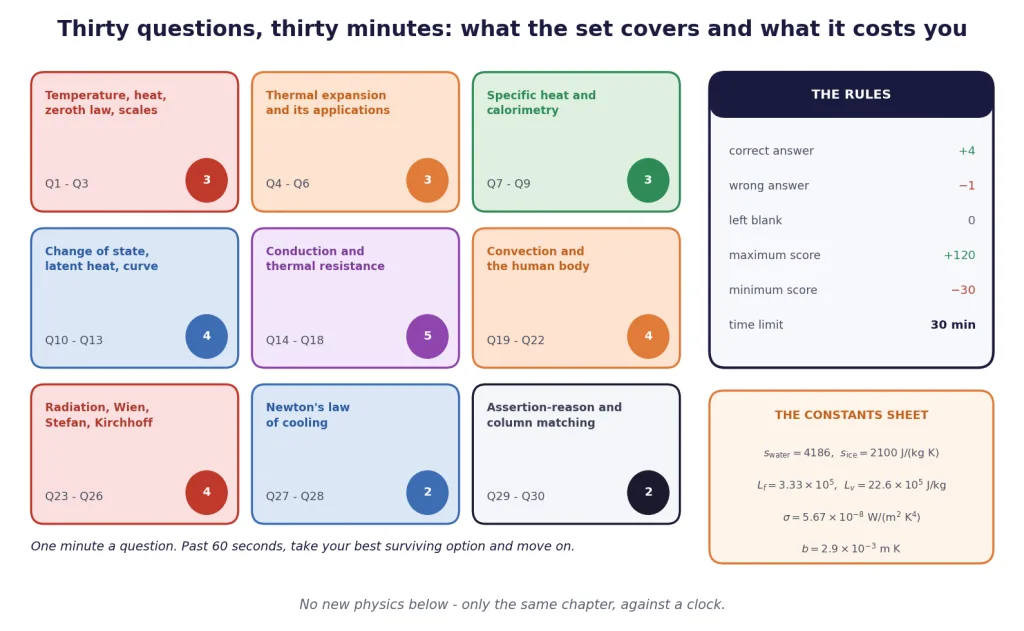
| Topic | Questions | How many |
|---|---|---|
| Temperature, heat, the zeroth law and the scales | Q1 to Q3 | 3 |
| Thermal expansion and its applications | Q4 to Q6 | 3 |
| Specific heat capacity and calorimetry | Q7 to Q9 | 3 |
| Change of state, latent heat and the heating curve | Q10 to Q13 | 4 |
| Conduction, thermal resistance, series and parallel | Q14 to Q18 | 5 |
| Convection and the human body | Q19 to Q22 | 4 |
| Radiation, Wien, Stefan-Boltzmann, Kirchhoff | Q23 to Q26 | 4 |
| Newton's law of cooling | Q27 to Q28 | 2 |
| Assertion-reason and column matching | Q29 to Q30 | 2 |
That weighting is deliberate and it mirrors the real paper. Conduction and radiation between them supply nearly a third of the set, because between them they supply nearly a third of what this chapter is asked about. And four questions are about a human body, because this paper never lets that opportunity pass.
Mark It Honestly, Then Read Your Own Answer Sheet
Score with the real scheme: for every correct answer, for every wrong one, for every blank. No half marks for "I nearly had that one". The number you end up with is the number that means something.
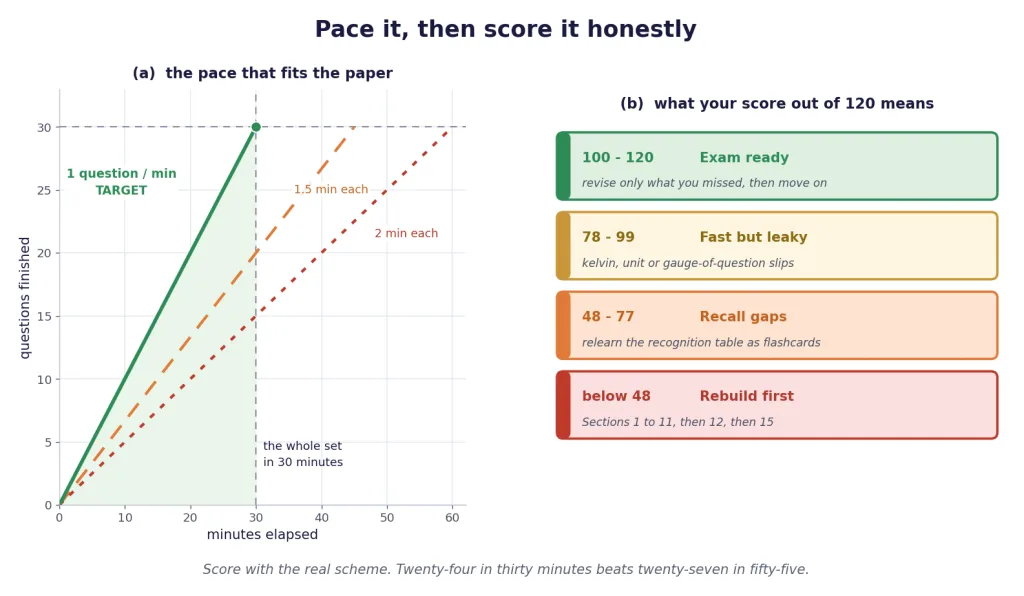
The bands
| Your score (out of 120) | Verdict | What to do next |
|---|---|---|
| 100 to 120 | Exam ready. Over 80% on a full-length set, inside the time. | This chapter is now free marks for you. Revisit only the items you missed, then move to the next chapter. |
| 78 to 99 | Fast but leaky. You know the material; something leaks on the way to the answer sheet. | Almost always a Celsius value used where kelvin was required, a centimetre left unconverted, or a latent heat left out of a mixture — not a gap in knowledge. Redo every wrong question without the explanation first, and count how many you fix alone. |
| 48 to 77 | Recall gaps. The speed is not the problem; the lookup is. | Go back to Section 15's recognition table and unit card — conductivity in W/(m K), in W/(m K), in m K, the cooling constant in s, emissivity in nothing at all — and learn them as flashcards. Then re-attempt this set cold. |
| Below 48 | Rebuild first. | Work Sections 1 to 11 properly, then Section 12's worked problems, then Section 15. Re-attempting this set today would teach you nothing except the answer key. |
Sort your mistakes into three piles
Do this before you read a single explanation. It is the most useful ten minutes in this section.
- Did not know it. A formula you could not recall, a unit you had never learnt precisely, whether a hole grows or shrinks, whether is or . Cheapest to fix — it is a memory job, and it takes an evening.
- Knew it, computed it wrong. You put a Celsius value into a fourth power, left a thickness in centimetres, forgot to divide by the mass, or used where the question wanted . Slow down for four seconds on the final line.
- Knew it, answered a different question. You gave the heat needed to melt the ice when it asked for the final temperature; the total power when it asked for the power per unit area; the temperature after 5 more minutes when it asked for the temperature 5 minutes from the start. The distractors here are built specifically to reward this mistake.
Key Point: Two students both score 88. The first has four pile-1 mistakes and a syllabus gap that revision closes in a day. The second has nine pile-3 mistakes and a reading habit that will follow them into the exam hall. Pile 3 is the expensive one — count it before you explain it away.
The fourteen facts this set keeps testing
- Heat is energy in transit. A body owns internal energy; it never owns heat.
- The zeroth law is what makes temperature measurable and a thermometer possible.
- , and . The two scales read the same at , and C is exactly F.
- A hole in a plate grows when the plate is heated, because every linear dimension scales by .
- . Count the dimensions.
- on a slope, or on a plateau. Never mix them, and always ask whether a phase change is possible before writing a mixture equation.
- for water, which is why the vaporisation plateau is that many times longer and why steam scalds so much worse than boiling water.
- Heat lost equals heat gained in an isolated system, and the water equivalent is .
- , and adds in series and adds reciprocally in parallel. In series the poorer conductor takes the larger temperature drop; in parallel the smaller resistance carries almost all the heat.
- Convection needs a fluid that can move, which is why blood is the body's coolant and why conduction through tissue is hopeless.
- with in kelvin: hotter means a shorter peak wavelength.
- , net , with both temperatures in kelvin.
- Kirchhoff: a good absorber is a good emitter, and a body in equilibrium is still radiating — it is a balance, not a stop.
- Newton's law of cooling holds only for a small excess temperature, and for equal intervals .
[Important] If you got fewer than 24 right, count how many of your errors were a Celsius value that should have been kelvin. In this chapter that single mistake usually accounts for more lost marks than everything else put together, and it is the cheapest one in the book to fix: write the letter K next to every temperature the moment you substitute it into a power, a ratio or a gas law.