
The Mechanism That Needs Nothing At All
Conduction needs a material to pass the vibration along. Convection needs a fluid that can physically get up and move. Both of them stop dead the moment you take the matter away.
And yet.
Between the Sun and the Earth there are about 150 million kilometres of vacuum. No solid, no liquid, no gas — nothing to conduct through and nothing to circulate. Every second, that vacuum delivers about kW to every square metre of the Earth that faces the Sun. Something is crossing it.
Stand a metre from a bonfire on a still night and you feel the heat on your face at once. Air is a dreadful conductor, and convection carries hot air upwards, not sideways towards you. Step behind someone and the warmth vanishes instantly, as though a shadow had fallen — because a shadow has.
Key Point — the third mechanism:
Radiation is the transfer of energy by electromagnetic waves. It needs no medium at all, it travels through vacuum at the speed of light m/s, and it travels in straight lines and casts shadows.
The energy carried this way is called radiant energy. Radiation emitted by a body because of its temperature is called thermal radiation.
Four things that follow immediately
1. It is the fastest of the three. Conduction through a metre of copper takes minutes to settle; convection takes seconds to organise itself. Radiation crosses a room in about three nanoseconds. The warmth of a fire arrives the instant the flame does.
2. Every body emits it, always. Solid, liquid or gas; hot or cold; glowing or not. A block of ice at C is radiating right now. So are you, so is this page, so is the wall behind you. The next block makes that idea precise, because it is the single most useful sentence in this whole section.
3. It is not one wavelength but a whole spectrum. Thermal radiation is spread continuously over wavelengths, with different amounts at different wavelengths. Which wavelength carries the most turns out to depend only on the temperature — and that is Wien's law, later in this section.
4. Hot enough, and you can see it. At room temperature the radiation is entirely infrared, so you feel it but cannot see it. Heat a poker and at about 800 K it begins to glow dull red; hotter still and it goes orange, then yellow, then white. Nothing new has switched on — the poker was radiating all along. The spectrum has simply shifted far enough that some of it has walked into the visible band.
What happens when radiation lands on something
Radiation arriving at a surface has three, and only three, options. Part of it is absorbed, part is reflected, and part is transmitted straight through.
Key Point — the three fractions add to one: where is the fraction absorbed, the fraction reflected, and the fraction transmitted. They are pure numbers with no units.
A body for which is opaque — most solids. A body for which absorbs everything and is called a blackbody.
Note the symbol carefully. Absorptive power is written , never — here is the coefficient of linear expansion and nothing else. Absorptivity is also written or elsewhere.
The everyday evidence
You already use all of this without calling it physics.
| What you do | Why it works |
|---|---|
| Wear white or light clothes in summer | Light surfaces have a small , so they absorb little of the Sun's radiation |
| Wear dark clothes in winter | Dark surfaces have a large , so they soak up whatever sunlight there is |
| Blacken the bottom of a cooking vessel | A blackened base absorbs almost all the radiation from the flame and passes it on to the food |
| Silver the walls of a vacuum flask | A silvered wall has a tiny , so it reflects the radiation back to where it came from |
| Paint water tanks and petrol tankers white | Small , so they take up as little solar energy as possible |
The vacuum flask is the whole chapter in one object. Its double wall is evacuated, which kills conduction and convection — there is no matter in the gap to carry heat. Its two facing surfaces are silvered, which kills radiation by reflecting it straight back. It is supported on cork, which kills conduction through the neck. Three mechanisms, three separate defences.
[Board Important] "Why is the space between the walls of a thermos evacuated, and why are the walls silvered?" is a two-mark question that comes up constantly. The vacuum stops conduction and convection; the silvering stops radiation. Say both, and say which stops which.
Prevost's Theory: Nothing Ever Stops Radiating
This idea sits outside the rationalised syllabus body text, but it is the foundation everything else in this section is built on, and Boards, JEE and NEET ask about it every year — so it is developed here from first principles.
Here is the question that trips people up. A cup of tea sits on a table in a room, and after an hour it has reached room temperature. Is it still radiating?
The instinctive answer is no — it has stopped losing heat, so it must have stopped radiating. That answer is wrong, and understanding why is worth more than any formula in this section.
Key Point — Prevost's theory of heat exchange:
Every body, at every temperature above absolute zero, emits thermal radiation continuously, and the rate at which it emits depends only on its own temperature, its area and the nature of its surface. It emits whether or not there is anything around to receive.
At the same time it absorbs whatever radiation happens to fall on it from its surroundings.
What we observe as heating or cooling is only the difference between these two, never one of them alone.
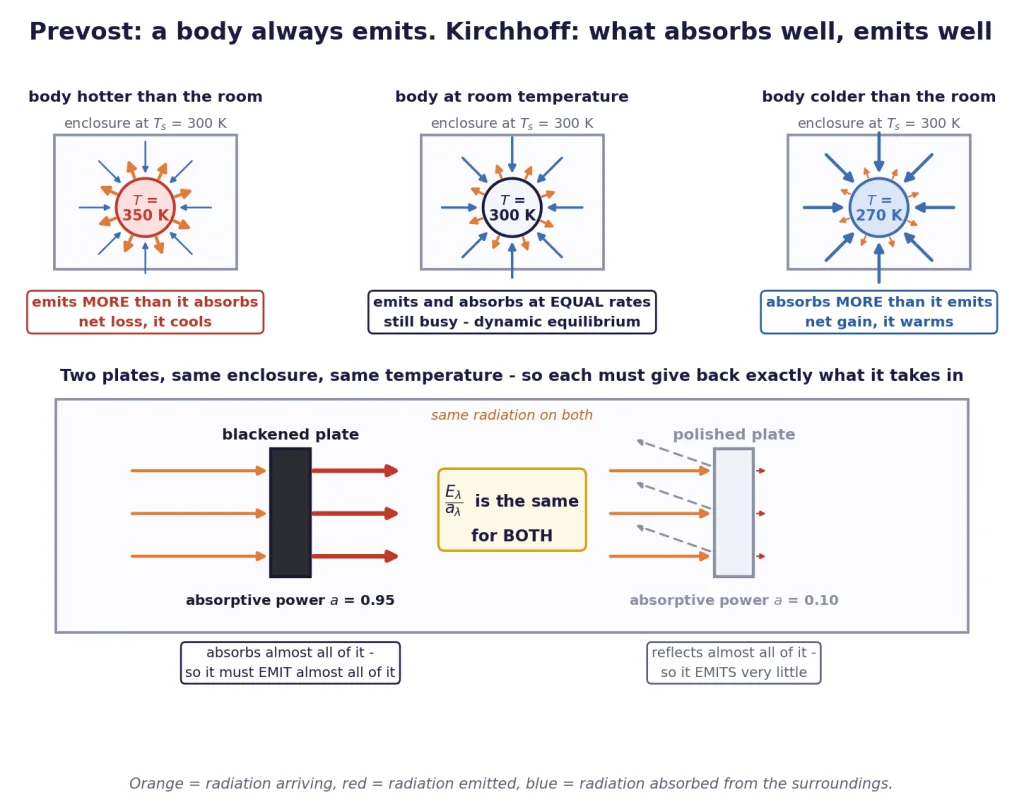
The three cases, and there are only three
Put a body at temperature inside an enclosure whose walls are held at .
| Case | Emission vs absorption | What you see |
|---|---|---|
| emits more than it absorbs | the body cools | |
| emits and absorbs at exactly equal rates | nothing changes | |
| emits less than it absorbs | the body warms |
The middle row is Prevost's point. Thermal equilibrium is not silence; it is a draw. The body is still pouring energy out and still taking energy in, and the two flows are equal. It is a busy stalemate, not an empty room. Physicists call this a dynamic equilibrium, and the same idea will come back in chemistry, in evaporation, and in half a dozen other places this year.
Put a number on it, because that is what makes it real. A body of surface area 0.50 m and emissivity 0.80 sits in a room, and both are at 27°C, that is 300 K. It is radiating away and it is soaking up 184 W from the walls at the same instant. Net: zero. Idle: absolutely not.
Absorptive power and emissive power, defined properly
These two definitions were also cut from the body text, and they are what Kirchhoff's law is about, so here they are.
Key Point — absorptive power :
The absorptive power (or absorptivity) of a surface is the fraction of the radiation falling on it that it absorbs. It is a pure number between 0 and 1, it has no unit and no dimensions, and for a perfectly black surface .
Written wavelength by wavelength it is , the spectral absorptive power, because a surface can be a greedy absorber at one wavelength and a poor one at another.Key Point — emissive power :
The emissive power of a surface at temperature is the radiant energy it emits per unit area per unit time. Its dimensions are .
The spectral emissive power is the energy emitted per unit area per unit time per unit wavelength interval at wavelength — unit W/m, or more usefully W m m. It is that is plotted against in the blackbody curves you will meet in a moment, and its area under the curve is the total .
Do not confuse the two. is a fraction with no unit; is a power per unit area, measured in watts per square metre. One is about what comes in, one is about what goes out, and the next few pages are about the astonishing fact that they are locked to one another.
[JEE Tip] Questions love the phrase "a body in thermal equilibrium with its surroundings". It never means the body has stopped radiating. It means emission and absorption are equal. If a question asks whether a body at room temperature emits radiation, the answer is always yes.
The Blackbody, and How to Build One
Physics likes a perfect case to measure everything else against. For springs it is the ideal spring; for gases it is the ideal gas. For radiation it is the blackbody.
Key Point — a blackbody:
A blackbody (or perfectly black body) is one that absorbs completely all the radiation of every wavelength that falls on it. Nothing is reflected, nothing is transmitted.
So for a blackbody, , , at every wavelength and at every angle.
Read the definition again, because there is a trap in it. It says nothing about what the body looks like. It says only that everything arriving gets absorbed.
It is not the same as "something black"
Lamp black — the soot deposited by a smoky flame — absorbs about 96% of visible light, and platinum black about 98%. They are very good, but they are not perfect, and no ordinary surface is. Meanwhile the Sun is very nearly a blackbody, and it is the brightest object you will ever see. Blackness in the everyday sense has nothing to do with it.
Here is the resolution. A body that absorbs everything and emits nothing would break the second law of thermodynamics: it would keep heating up forever. So a blackbody must also be a perfect emitter — and at 5800 K a perfect emitter is blinding white. A blackbody at 300 K would look genuinely black, because everything it emits is infrared. Same object, same law, different temperature.
The cavity: how you actually build one
You cannot buy a perfect absorber. You can, however, build something that behaves exactly like one, and it is beautifully simple.
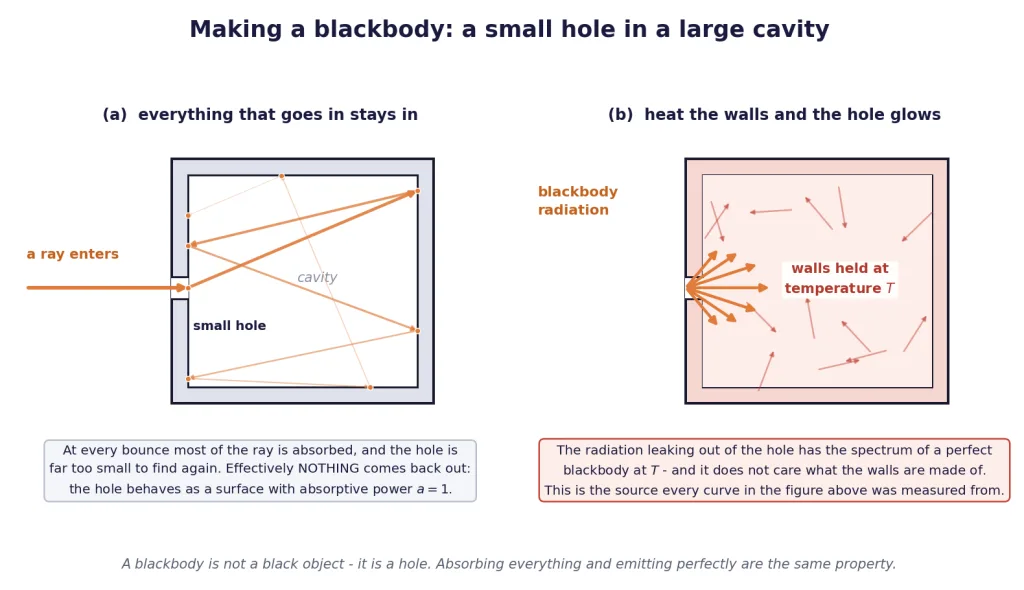
Take a hollow box with a rough, blackened inner surface, and pierce a small hole in one wall. Now think about a ray of light that finds its way in through the hole.
- It strikes the inner wall. Most of it is absorbed; a little is scattered off in some new direction.
- That remnant strikes another part of the wall. Most of it is absorbed too.
- And again, and again. After only a handful of bounces there is essentially nothing left.
- The chance of what is left happening to find the tiny hole again and escaping is minute.
So the hole absorbs, effectively, everything that enters it. The hole — not the box — is the blackbody, with .
This is why the doorway of a distant room looks pitch black on a bright day, and why the pupil of your eye is black. It is not that either is painted black. It is that light which goes in does not come back out.
Key Point — the cavity, both ways round:
- Cold cavity: radiation entering the hole is completely absorbed, so the hole behaves as a perfect absorber.
- Hot cavity: heat the walls to a temperature and the radiation streaming out of the hole is exactly blackbody radiation at , whatever the walls are made of.
Every experimental blackbody curve ever measured came out of a hole like this.
The practical laboratory version — a Ferry blackbody — is a double-walled copper sphere blackened on the inside, with a small aperture and a conical projection opposite the aperture so that nothing can bounce straight back out of it.
The curves are universal, and that is the real news
Measure the spectrum coming out of that hole and you find something remarkable. The curve does not depend on:
- what the cavity is made of — copper, iron, ceramic, it makes no difference;
- how big the cavity is;
- what shape it is.
It depends on one number only: the temperature. Two blackbodies at the same temperature have identical spectra, full stop.
That universality is a very strong hint that something deep is going on, and it was. Explaining the shape of these curves defeated classical physics completely — the best classical theory predicted that the emission should rise without limit at short wavelengths, which is obviously absurd. Max Planck fixed it in 1900 by supposing that energy is emitted in discrete packets, and the quantum revolution began. The humble curve in the next block is where quantum mechanics started.
[NEET Important] Two one-liners that are asked directly: a blackbody is a perfect absorber and a perfect emitter; and a small hole in a cavity is the practical realisation of one.
The Spectrum, and Wien's Displacement Law
Here is the measurement. Spectral emissive power plotted against wavelength, for a blackbody at several temperatures.
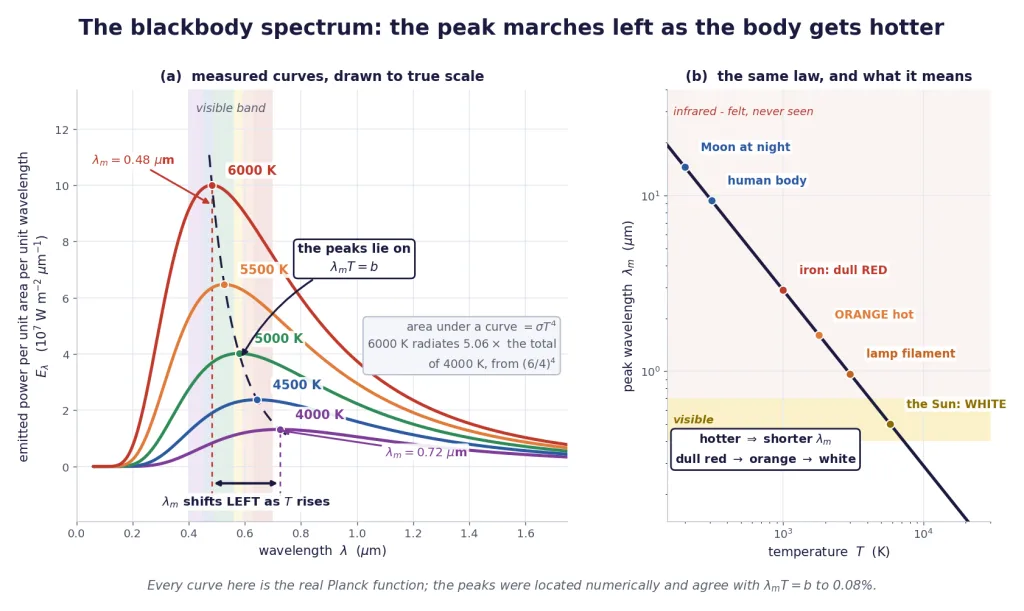
Look at the left-hand panel and read off three facts.
First, every curve is continuous. A blackbody emits at every wavelength, not at a few special ones. But it does not emit equally at all of them: each curve starts near zero at very short wavelengths, climbs to a maximum, and then falls away with a long tail towards long wavelengths.
Second, the curve for a hotter body lies entirely above the curve for a cooler one. At every single wavelength, the hotter body emits more. Nothing crosses.
Third, and this is the important one, the peak moves LEFT as the body gets hotter. The wavelength at which the emission is greatest is written . At 4000 K it sits at 0.72 m, out in the near infrared. At 6000 K it has marched in to 0.48 m, right in the middle of the visible band.
Join the peaks and they lie on a smooth curve, and the equation of that curve is one line long.
Wien's displacement law
Key Point — Wien's displacement law: where is the wavelength at which a blackbody's emission peaks, is its absolute temperature in kelvin, and is Wien's displacement constant: and are inversely proportional. Double the absolute temperature and the peak wavelength halves.
Two warnings, both worth marks.
must be in kelvin. is a product, and every product or ratio of temperatures in this chapter is an absolute temperature. A Celsius number here is simply wrong.
The unit of is metre kelvin, m K — a metre multiplied by a kelvin. It is not "millikelvin". If you put in metres you get in kelvin, and that is the only combination that works without conversion.
How we know the law is real, and not just a curve fit
The curves above are the actual Planck function, not a sketch. The peak of each one was located numerically — by searching for the maximum of directly, without using Wien's law at all — and only then was the product formed. Across temperatures from 200 K to 6000 K, a range of a factor of thirty, that product came out as every single time, to five figures. The value quoted in every formula sheet, m K, is that number rounded, and it is high by 0.077%. The law is not an approximation; the constant is just rounded for convenience.
The colour of hot things, explained
Now the payoff. Heat a piece of iron in a flame and watch it.
| Temperature | from | Where that sits | What you see |
|---|---|---|---|
| 300 K | 9.7 m | far infrared | nothing at all |
| 800 K | 3.6 m | infrared, tail just reaching red | first dull red glow |
| 1300 K | 2.2 m | infrared, strong red tail | orange |
| 2000 K | 1.45 m | near infrared, broad visible tail | yellow |
| 5800 K | 0.50 m | middle of the visible | white |
Note the subtlety, because good questions test it. Even at 1300 K the peak is still in the infrared — what you see is the short-wavelength tail of the curve poking into the visible band. As rises the whole curve marches left and swells, so more and more of the visible band gets covered, and the mixture of colours reaching your eye grows steadily whiter. Red first, white last — always in that order, never the reverse.
Reading the temperature of things we can never touch
This is Wien's law doing its best work.
The Sun. Its spectrum peaks near nm m. So which is why the Sun's surface temperature is quoted as about 6000 K. And note that word: this is the temperature of the photosphere, the visible surface. The core is around K, and Wien's law tells us nothing whatever about it.
The Moon. Moonlight peaks near 14 m, deep in the infrared, giving K, about C. That is the night-time lunar surface, and it is why the Moon looks silver-white in the sky while being colder than any freezer.
Every star's temperature in every catalogue was obtained this way. So was every reading a thermal camera has ever taken, and so is the temperature of a furnace measured by an optical pyrometer through a window.
[JEE Tip] If a question gives you a peak wavelength and asks for a temperature, or vice versa, convert wavelengths to metres first, then divide. Nanometres and angstroms are where the marks go: 1 nm m, and 1 Å m.
The Stefan-Boltzmann Law: The Fourth Power
Wien's law tells you where a blackbody's spectrum peaks. It says nothing about how much energy comes out altogether. For that you need the total area under the curve, and that area obeys a law of its own.
Key Point — the Stefan-Boltzmann law:
The total energy radiated per unit time by a blackbody of surface area at absolute temperature is where is the Stefan-Boltzmann constant, For a real body, which radiates only a fraction of that, where is the emissivity, a pure number between 0 and 1. for a blackbody.
is in kelvin. Always. This is not negotiable — it is a fourth power.
Stefan found this experimentally in 1879; Boltzmann derived it thermodynamically five years later, which is why it carries both names. And it really is the area under those curves: integrating the Planck function over all wavelengths at 300 K, 1000 K and 3000 K reproduces to better than one part in ten thousand each time.
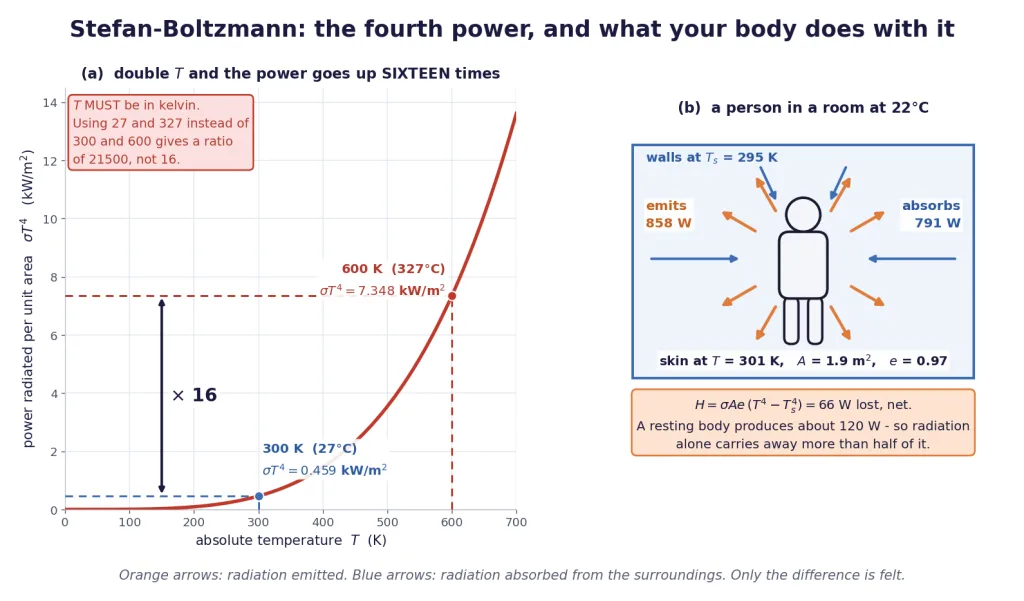
What a fourth power actually feels like
This is the steepest law in the chapter and it is worth pausing on.
| per m | compared with 300 K | |
|---|---|---|
| 300 K (27°C) | 459 W/m | |
| 400 K (127°C) | 1452 W/m | |
| 600 K (327°C) | 7348 W/m | |
| 1200 K (927°C) | 117570 W/m |
Double the absolute temperature and the radiated power goes up by sixteen. Triple it and you get eighty-one times. This is why a furnace at 1200 K pours out radiation two hundred and fifty times as fiercely as a warm wall, and why the last few hundred degrees of a filament's temperature matter so much more than the first few.
Key Point — the mistake that costs the most marks in this chapter: For 27°C and 327°C the correct ratio is .
Using the Celsius numbers gives , which is wrong by a factor of more than a thousand.
Convert first. Every time. Write the kelvin value down before you cube or raise to the fourth.
Emissivity: how far short of perfect a real surface falls
is the fraction of the blackbody rate that a real surface actually manages. It has no unit, and it depends on the material and — this matters — on the finish, not just the substance.
| Surface | Emissivity |
|---|---|
| A blackbody (the ideal) | 1.00 |
| Lamp black, matt black paint | 0.95 to 0.97 |
| Human skin (in the infrared) | 0.97 |
| Water | 0.96 |
| Brick, concrete, wood | 0.90 to 0.94 |
| Oxidised, tarnished iron | 0.6 to 0.8 |
| Tungsten filament at 3000 K | 0.4 |
| Polished aluminium | 0.05 |
| Polished silver | 0.02 |
Read the bottom two rows carefully. Aluminium foil is a shockingly poor radiator — it emits about one twentieth of what a blackbody at the same temperature emits. That single fact is why survival blankets are shiny, why the shiny inner layer of modern arctic clothing works, and why fire-fighting suits are aluminised.
The net exchange — what a body actually loses
A body at is not radiating into empty space; it is sitting in surroundings at that are radiating back at it. Prevost's theory said so, and now we can put numbers on both flows.
Emission depends on the body's own temperature; absorption depends on the surroundings' temperature. Subtract.
Key Point — net rate of loss: If this is positive and the body cools. If it is negative and the body warms. If it is zero — and both flows are still running, exactly as Prevost said.
is not . Raise each temperature to the fourth power separately, then subtract.
The worked case that matters most: your own body
Take a person's skin area as 1.9 m, skin temperature 28°C and room temperature 22°C. Skin has in the infrared. Converting first, as always: 28°C K and 22°C K.
Emitting:
Absorbing from the walls:
Net:
Three things to take from that.
One: the gross flows are enormous and the net is small. You are throwing out 858 W and catching 791 W back. A six-degree difference between skin and wall is all that separates them, and it leaves 66 W.
Two: 66 W is a lot. A resting adult produces about 120 W. So radiation alone carries away more than half of your resting heat output — before evaporation, convection or conduction have done anything at all.
Three: this is why a cold wall feels cold even in a warm room. Your body does not care about the air temperature nearly as much as it cares about , the temperature of the surfaces around you. Sit beside a big cold window and you lose heat fast even if the air is at 22°C, because that window is a large, cold staring at you.
[NEET Important] The 66 W calculation, or something very like it, is a standard question. The two things that must be right are the kelvin conversion and remembering to subtract the absorbed term — not just computing and stopping.
Kirchhoff's Law: A Good Absorber Is A Good Emitter
Kirchhoff's law was also cut from the rationalised syllabus body text. It is asked in Boards, JEE Main, JEE Advanced and NEET every year, and it explains half of what you have already read, so it is developed here from first principles.
We have quietly used two symbols for two apparently unrelated things: , the fraction of arriving radiation a surface absorbs, and , the power it emits per unit area per unit wavelength. Kirchhoff showed in 1859 that they are not independent at all.
The argument, and it takes about six lines
Put two plates inside a sealed enclosure whose walls are held at a steady temperature , and wait until everything has settled. One plate is blackened, one is polished. Both are at , because everything in the enclosure is.
Now, both plates are in thermal equilibrium. Neither is heating up and neither is cooling down. So, by Prevost, each plate must be giving back exactly as much energy as it takes in — and that has to be true not just in total but at every wavelength separately, because otherwise energy would pile up in one part of the spectrum and drain out of another, and you could build a machine to exploit it.
The blackened plate takes in a great deal, because its is near 1. Therefore it must give back a great deal. The polished plate takes in very little. Therefore it must give back very little.
Write that as an equation. If is the spectral emissive power of a surface and its spectral absorptive power, and is the spectral emissive power of a blackbody at the same temperature, then energy balance at each wavelength demands
Rearranged, that is Kirchhoff's law.
Key Point — Kirchhoff's law of radiation:
At a given temperature and a given wavelength, the ratio of the emissive power to the absorptive power is the same for every body, and equals the emissive power of a blackbody at that temperature: Since and emissivity is defined by , it follows immediately that Emissivity equals absorptivity. A good absorber is a good emitter, and a poor absorber is a poor emitter.
That last sentence is the one to memorise, and it is the answer to a startling number of questions.
Four pieces of evidence, all of which you can check
1. The black-and-white cloth. Take a piece of cloth, half white and half black, and hold it in front of a hot flame — or leave it in strong sunlight for an hour. The black half becomes noticeably hotter, because it absorbs more. So far so obvious.
Now do it the other way round. Heat the same cloth in an oven until it is thoroughly hot, take it into a dark room, and look. The black half glows more brightly than the white half. It emits more, because it absorbed more. Same cloth, same temperature, and the difference is entirely Kirchhoff.
2. Fraunhofer lines in the solar spectrum. Spread the Sun's light into a spectrum and you find it crossed by thousands of fine dark lines. Sodium vapour, for example, emits strongly at 589 nm — so by Kirchhoff it must also absorb strongly at 589 nm. The relatively cool sodium in the Sun's outer atmosphere absorbs exactly the wavelengths it would itself emit, out of the fierce continuous radiation coming up from the hot photosphere below, and leaves a dark gap where that wavelength should have been.
And here is the beautiful confirmation. During a total solar eclipse, the moment the bright photosphere is covered, those same dark lines flash out as bright lines, because the cool outer layer is now seen against a dark sky and its own emission is all that is left. Dark when seen against something brighter, bright when seen against something darker, at exactly the same wavelengths. That is Kirchhoff's law written across the sky.
3. The polished versus blackened calorimeter. Fill two identical vessels with hot water at the same temperature, one blackened on the outside, one polished. The blackened one cools noticeably faster, because a high means a high . Turn it round: fill both with cold water and stand them in the sun, and the blackened one warms faster. Which one is faster depends only on which way the heat is going; the ordering of the two never changes. This is precisely why a calorimeter is polished — a shiny outside has small and so leaks the least radiation during an experiment.
4. The heated china cup. Take a white china cup with a coloured pattern on it, heat it in a furnace, and look at it in the dark. The pattern glows brighter than the white body of the cup, and if the pattern is dark enough it can look like a bright design on a dark ground — the exact reverse of how it looks in daylight. The parts that absorbed the most are the parts that emit the most.
Where Kirchhoff has already been used in this section
Go back and re-read three things, and notice that all three were Kirchhoff in disguise.
- A blackbody is a perfect absorber, therefore a perfect emitter. , so .
- Silvering the walls of a vacuum flask works both ways. The silver has a tiny , so it reflects incoming radiation. It also has a tiny , so it barely radiates. Hot contents stay hot; cold contents stay cold. One coating, two jobs.
- A cavity's hole radiates a perfect blackbody spectrum. It absorbed everything, so it must emit like a blackbody.
The traps in this block
| The trap | The truth |
|---|---|
| "A black body absorbs but does not emit" | It is the best emitter there is, at any given temperature |
| "A good absorber is a good reflector" | The opposite. Good absorber poor reflector, good emitter |
| "A shiny surface stays hot because it is a good insulator" | It stays hot because it has small and so radiates little |
| " and are equal for all bodies at all times" | They are equal for the same body, at the same temperature, at the same wavelength. Say all three conditions |
| "White clothes keep you cool because they emit more" | They keep you cool because they absorb less. Their is low too |
[Board Important] "State Kirchhoff's law of radiation and give one experimental verification." Two marks: the ratio is the same for all bodies at a given temperature and wavelength, so a good absorber is a good emitter; the Fraunhofer lines, or the black-and-white cloth, is the verification.
The section on one card
| Idea | Statement | Watch out for |
|---|---|---|
| Radiation | EM waves, no medium, speed m/s | It casts shadows |
| The three fractions | , not | |
| Prevost | Every body emits always; equilibrium is a draw | Not "stops radiating" |
| Blackbody | at every ; a hole in a cavity | Not the same as "black-looking" |
| Wien | , m K | in kelvin; in metres |
| Stefan-Boltzmann | , | in kelvin; a fourth power |
| Net exchange | Not | |
| Kirchhoff | Same body, same , same |
Solved Examples
Constants used throughout, unless a problem states otherwise: W/(m K), m K, and 0°C K.
Example 1: Reading a furnace's temperature off its colour
Radiation from a furnace is found to be most intense at a wavelength of 1.45 m. (a) What is the temperature inside? (b) If the furnace is made twice as hot on the absolute scale, where does the peak move to?
Solution:
(a) Convert the wavelength to metres first. This is where the marks live:
Apply Wien's law, rearranged for temperature:
(b) Double the absolute temperature to 4000 K. Since , the peak wavelength halves:
Sanity check on the answer. At 2000 K the peak is at 1.45 m, still in the infrared, with a good visible tail — the furnace glows yellow. At 4000 K the peak is at 0.725 m, right at the red edge of the visible band, and the furnace is much whiter and vastly brighter.
Final Answer: (a) 2000 K; (b) 0.725 m, exactly half.
Takeaway: and are inversely proportional, so any factor applied to one is the reciprocal factor on the other. You often do not need to compute either value — just apply the factor.
Example 2: The Sun and the Moon, measured from 150 million kilometres away
Sunlight peaks at a wavelength of 483 nm. Radiation from the Moon at night peaks at 14 m. Find the surface temperature of each, and comment.
Solution:
Convert both to metres. 483 nm m; 14 m m.
The Sun:
The Moon: which is C.
Comment. The Sun's figure is the temperature of its visible surface, not its interior — the core runs at about K, and no measurement of the emitted spectrum can see it. The Moon's 207 K is genuinely icy, and the reason the Moon looks bright and silver in the night sky is that most of what reaches your eye is reflected sunlight, not the Moon's own thermal emission, which is entirely infrared.
Final Answer: Sun about 6000 K; Moon about 207 K.
Takeaway: Wien's law measures the surface, and only the surface. Whenever a question mentions the temperature of a star, a planet or a furnace read from its spectrum, it is the emitting surface that is being measured.
Example 3: The power output of a lamp filament
A tungsten filament in a lamp has a surface area of 0.30 cm and runs at 3000 K. Tungsten has emissivity 0.40 at that temperature. At what rate does the filament radiate energy?
Solution:
Convert the area to SI. cm m, so
The temperature is already in kelvin, which is what the fourth power needs. K.
Substitute into :
Feel the size of that. A filament smaller than a grain of rice is throwing out 55 W. That is what a temperature of 3000 K buys you — and it is why filament lamps run so hot and fail so readily.
Final Answer: W.
Takeaway: cm to m is a factor of , not . Getting that wrong makes the answer a hundred times too big, and it is the commonest slip in Stefan-Boltzmann numericals.
Example 4: The fourth power, and the trap sitting inside it
A body radiates at a certain rate when its temperature is 27°C. By what factor does the rate increase when it is heated to 327°C, the surroundings being negligible? A student answers 21515. What went wrong?
Solution:
Convert both temperatures to kelvin, and write them down:
Take the ratio, with the area and emissivity cancelling because it is the same body:
What the student did. They used the Celsius numbers directly: which is wrong by a factor of over 1300.
Why the mistake is fatal here and harmless elsewhere. In expressions such as or , a Celsius difference and a kelvin difference are the same number, so nothing goes wrong. Here the temperatures appear as a ratio raised to a power, and the two scales have different zeros. Absolute temperature is compulsory.
Final Answer: The rate goes up by a factor of 16. The student forgot to convert to kelvin.
Takeaway: Write " K" on the page before you take any ratio or any power. Two extra characters, and the single commonest error in the chapter disappears.
Example 5: What your own body radiates
A person has a body surface area of 1.9 m and a skin temperature of 28°C. The room is at 22°C, and the emissivity of skin in the infrared is 0.97. Find (a) the rate at which the person radiates energy, (b) the rate at which they absorb it from the room, and (c) the net rate of loss. A resting adult produces about 120 W. Comment.
Solution:
Convert both temperatures to kelvin:
(a) The rate of emission depends only on the body's own temperature:
(b) The rate of absorption depends only on the surroundings' temperature, the same and the same :
(c) The net loss is the difference:
Comment. 66 W out of a 120 W resting output is more than half, carried away by radiation alone — with no help from convection, conduction or sweating. Note also how large the gross flows are compared with the net: 858 W and 791 W, differing by only 8%, because the temperatures differ by only 2%.
Final Answer: (a) 858 W; (b) 791 W; (c) 66 W net, over half of the body's resting output.
Takeaway: Compute and separately and then subtract. would give and an answer wrong by orders of magnitude.
Example 6: A blackened sphere in a room
A blackened metal sphere of radius 5.0 cm is heated to 500 K and hung in a room whose walls are at 300 K. Find the net rate at which it loses energy by radiation. What would the answer be if the sphere were only partly blackened, with ?
Solution:
Find the surface area of the sphere. For a sphere, with cm m:
Both temperatures are already in kelvin. K, K. Take the fourth powers separately:
Blackened, so :
With , everything else is unchanged and the answer simply scales:
Final Answer: 96.9 W when black; 58.1 W with .
Takeaway: multiplies the whole answer, so once you have the blackbody result the rest is one multiplication. Do the hard part first with , then scale.
Example 7: Two spheres, one twice the size
Two solid spheres are made of the same material and are at the same temperature, in the same surroundings. One has radius , the other . Compare (a) the rates at which they lose energy, and (b) the rates at which their temperatures fall.
Solution:
(a) The rate of energy loss goes as the area. Since and , with everything else identical: So the big sphere loses energy four times as fast.
(b) The rate of temperature fall is a different question. The energy lost has to come out of the body's own heat capacity:
Put in the geometry. For a sphere of density , and , so
So the rate of cooling is inversely proportional to the radius: The big sphere loses more energy but cools more slowly — by a factor of two.
Final Answer: (a) 4 : 1 in favour of the big sphere; (b) 1 : 2 — the big sphere's temperature falls at half the rate.
Takeaway: "Loses heat faster" and "cools faster" are two different questions. Energy loss goes as ; rate of temperature fall goes as , which for a sphere is . Small things cool fast — which is why a chip cools before the potato it came from.
Example 8: Is a body in equilibrium still radiating?
A body of surface area 0.50 m and emissivity 0.80 sits in a room, and both the body and the room are at 27°C. (a) At what rate does the body emit radiation? (b) At what rate does it absorb? (c) What is the net rate of loss? (d) A student says "it is in equilibrium, so it emits nothing". Correct them.
Solution:
Convert. K.
(a) The emission rate depends only on the body's own temperature:
(b) The absorption rate. The surroundings are at the same 300 K and the body presents the same area with the same absorptivity, so
(c) The net rate:
(d) The correction. The body emits 184 W and absorbs 184 W, continuously and simultaneously. Equilibrium means the two are equal, not that either is zero. This is Prevost's theory of heat exchange, and the equilibrium is a dynamic one.
Final Answer: (a) 184 W; (b) 184 W; (c) zero net; (d) it emits 184 W the whole time — equilibrium is a draw, not a stoppage.
Takeaway: Never write "it is in equilibrium so it does not radiate". Write "it emits and absorbs at equal rates, so the net exchange is zero".
Example 9: Absorptive power, and what Kirchhoff does with it
A certain surface reflects 25% and transmits 15% of the radiation falling on it. (a) Find its absorptive power. (b) What is its emissivity? (c) If it is held at 400 K, at what rate does each square metre of it radiate?
Solution:
(a) Use . With and :
(b) Kirchhoff's law says emissivity equals absorptivity, for the same body at the same temperature and wavelength: This is not an approximation and not a coincidence — it is forced by the requirement that a body in equilibrium give back exactly what it takes in, at every wavelength.
(c) The emissive power is that fraction of the blackbody value at 400 K:
Final Answer: (a) ; (b) ; (c) 871 W/m.
Takeaway: The moment a question gives you reflectivity and transmissivity, it is asking about Kirchhoff. Find from , set , and carry on.
Example 10: The size of a star
A star has a surface temperature of K and radiates 25 times as much power as the Sun, whose total output is W. Treating the star as a blackbody sphere, find its radius. The Sun's radius is m.
Solution:
Write down the total power radiated by a spherical blackbody of radius :
The star's power:
Rearrange for :
Substitute, with K:
Compare with the Sun:
Final Answer: m, about 1.67 times the Sun's radius.
Takeaway: A star's luminosity fixes the product , not either one alone. A star can be brilliant because it is huge and cool, or small and blazing hot; only Wien's law, applied to its colour, tells you which.
Example 11: Measuring an emissivity
A flat plate of total surface area 0.020 m is held at 500 K in a room whose walls are at 300 K, and is found to lose energy at 20.0 W. Find its emissivity.
Solution:
First work out what a perfect radiator would lose. With :
The real plate manages only 20.0 W, so
Check the answer is sensible. must lie between 0 and 1, and 0.32 is the kind of value you would expect for a dull, lightly oxidised metal — much better than polished aluminium at 0.05, much worse than matt black paint at 0.96.
Final Answer: .
Takeaway: Emissivity is always "what you got divided by what a blackbody would have got". Compute the blackbody figure first and divide; if your answer comes out above 1, you have made an arithmetic error, because nothing radiates better than a blackbody.
Example 12: When the colour changes, what happens to the power?
The peak of a body's radiation shifts from 1.20 m to 0.60 m. (a) By what factor has its absolute temperature changed? (b) By what factor has the total power it radiates changed? (c) What were the two temperatures?
Solution:
(a) Wien's law says is constant, so . The peak wavelength has halved, so The absolute temperature has doubled.
(b) Stefan-Boltzmann says , with the same body and the same area:
(c) The actual temperatures, for completeness:
What that looks like. At 2417 K the body glows a strong yellow-orange. At 4833 K it is close to white and sixteen times as bright in total. Notice how little the colour appears to change compared with how much the brightness does.
Final Answer: (a) temperature doubled; (b) power up 16 times; (c) 2417 K and 4833 K.
Takeaway: Wien and Stefan-Boltzmann are a pair, and questions chain them. Wien turns a wavelength change into a temperature ratio; Stefan-Boltzmann turns that temperature ratio into a power ratio. Learn to do it without ever computing an actual temperature.