
When the Fluid Carries the Heat Itself
Section 8 finished with a bar of copper, its ends clamped to two reservoirs, quietly passing heat along without a single atom moving anywhere. Now heat a saucepan of water on a gas ring and try to tell the same story.
You cannot. Here is why, in one number.
The thermal conductivity of water is 0.6 W/(m K) — twenty-five times better than air, and about six hundred times worse than copper. Take a pan with a base of 0.020 m holding water 10 cm deep, with the bottom at 100°C and the top at 20°C. If conduction were the only route, the heat crossing the water would be
Under ten watts. A domestic gas burner delivers something like 1800 W. Conduction can account for about half of one per cent of what the pan is actually doing, and on conduction alone that kilogram of water would take nearly ten hours to reach boiling instead of three minutes.
So something else is carrying the other 99%. That something is the water.
The mechanism
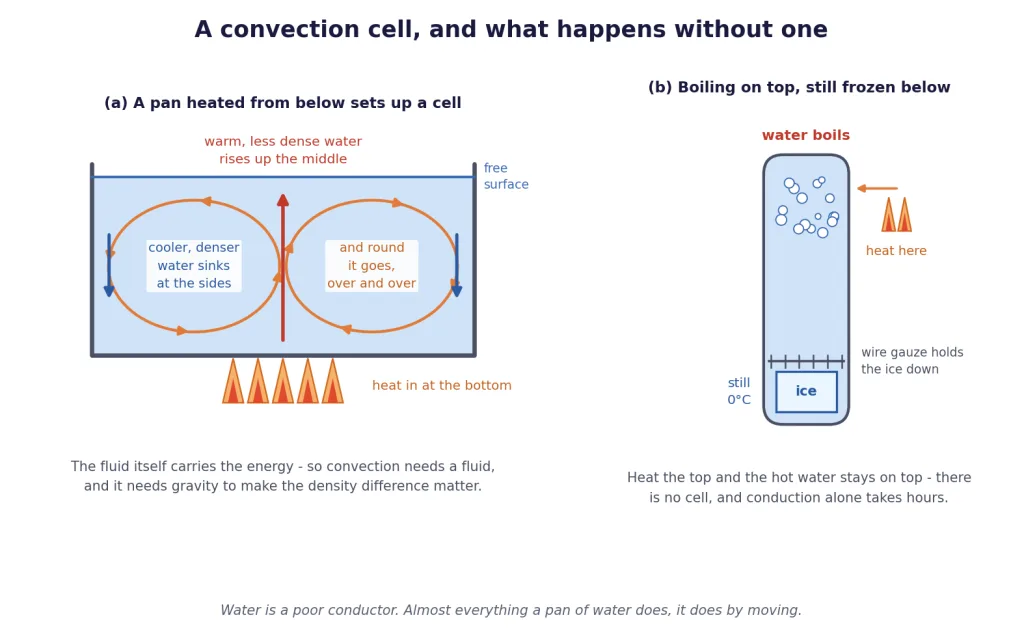
Follow one parcel of water sitting on the hot base.
- It is heated. Conduction across the thin layer touching the metal does this bit, and it is quick because the layer is thin.
- It expands. Section 3's coefficient of volume expansion does the work — the parcel's volume goes up, its mass does not, so its density falls.
- It rises. It is now less dense than the fluid around it, so the buoyant force on it exceeds its weight and up it goes.
- Colder, denser fluid falls in behind it to take its place — and is heated in turn.
- The risen parcel spreads out at the surface, gives up its heat, cools, becomes dense again, and sinks at the sides.
The loop closes. Nothing was created and nothing was destroyed; the fluid simply goes round, carrying energy from the bottom of the pan to the top on its back.
Key Point — convection:
Convection is the transfer of heat by the actual bulk motion of the fluid itself. Unlike conduction, matter really does travel from the hot region to the cold one.The closed circulation it sets up is a convection current, or a convection cell.
Two consequences follow immediately:
- Convection is impossible in a solid. The particles are locked to their lattice sites, so nothing can be carried anywhere. A solid has conduction and radiation, and that is all.
- Convection is possible only in a fluid — a liquid or a gas.
The demonstration that settles it
Fill a test tube with water. Wedge a small lump of ice at the bottom under a piece of wire gauze so it cannot float up. Now heat the water near the top with a small flame.
The water at the top boils. The ice at the bottom stays frozen.
Nothing carries the heat downwards. Warm water at the top is less dense than the cold water below it, so it has no reason at all to sink — the arrangement is already stable and no cell can form. Only conduction is left, and conduction through 15 cm of water is worth about 0.06 W, so melting even 5 g of that ice would take nearly eight hours. The demonstration finishes in two minutes with the ice untouched.
Flip the experiment — put the flame under the bottom — and the whole tube boils in seconds.
Key Point — you must heat from below.
A fluid heated from below becomes top-heavy in density, which is unstable, and it overturns: convection starts. A fluid heated from above is already stable and nothing moves. This is why the heating element of a kettle is at the bottom and why a chimney's fire is at its foot.
Convection needs gravity — really needs it
Look again at step 3. The rising happens because a less dense parcel floats in a denser fluid. That is buoyancy, and buoyancy is a gravitational effect: it exists only because the pressure in a fluid increases downwards, and that pressure gradient exists only because of .
Take the gravity away and the density difference stops mattering. A hot parcel is still less dense, but there is no buoyant force to lift it and nothing to make it go anywhere.
Key Point — no gravity, no natural convection.
In the free fall of an orbiting spacecraft the effective is essentially zero, so natural convection does not happen at all. A candle flame aboard a space station does not form a teardrop shape — it burns as a dim blue sphere, because there is no upward flow of hot gas to stretch it and no inflow of fresh air to feed it.That is why spacecraft use fans everywhere: without forced air movement, an astronaut asleep in still air would slowly build up a shell of exhaled carbon dioxide around their own face. On Earth, natural convection carries it away for free.
[JEE Tip] The one-line exam version: "Why is convection not possible in a solid, and why would it not occur in a satellite in orbit?" Two separate reasons, both needed for full marks: in a solid the particles cannot move bodily, and in orbital free fall there is no effective gravity, so a density difference produces no buoyant force.
Natural Convection and Forced Convection
The pan, the chimney and the sea breeze all run on the density difference that gravity turns into a buoyant force. Sometimes, though, we do not wait for the fluid to move on its own — we push it.
Key Point — the two kinds:
- Natural (free) convection — the fluid circulates by itself, driven by the buoyancy that the temperature-induced density difference produces. Gravity is essential.
- Forced convection — the fluid is driven by a pump, a fan, a blower or a heart. Gravity is not required, and the flow can be made as fast as you like.
| Natural convection | Forced convection | |
|---|---|---|
| What drives the flow | buoyancy from a density difference | a pump, fan or blower |
| Needs gravity? | yes | no |
| Typical speeds | slow, centimetres per second | fast, metres per second |
| Rate of heat transfer | modest | several times larger |
| Everyday examples | a pan of water, a chimney, a room heater, a sea breeze, the trade winds | the human circulatory system, a car radiator, a ceiling fan, a computer's cooling fan, forced-air heating, a hair dryer |
A useful way to remember the split: if switching something off would stop the circulation, it is forced. If the circulation would carry on regardless, it is natural.
The chimney, and why height helps
A chimney is natural convection turned into a machine. Hot combustion gases inside the flue are far less dense than the outside air, so the column of gas inside weighs less than an identical column of outside air. The difference in weight per unit area is a pressure difference at the base: and it is that pressure difference — the draught — which sucks fresh air in at the bottom and expels smoke at the top.
Three things follow, and all three are examinable:
- A taller chimney draws better, because is proportional to . Doubling the height doubles the pressure difference and multiplies the draught speed by .
- A hotter fire draws better, because it makes smaller.
- The fire needs the draught as much as the draught needs the fire. The inrush of air at the bottom is what supplies the oxygen. Block the base and the fire dies; and a cold chimney on a still day may refuse to draw at all until the flue itself warms up.
Note the shape of that expression: at constant pressure, and there is an absolute temperature in kelvin. Every density ratio in this section demands kelvin. This is the one place in a convection problem where using Celsius will destroy your answer, and the worked examples show by how much.
Putting a number on a convective rate
Convection is genuinely harder to calculate than conduction — the flow pattern depends on the shape of the object, the properties of the fluid and how fast it is moving, and there is no tidy waiting for you. Engineers get round this with one honest, empirical shortcut.
Key Point — the convective heat transfer coefficient: is the convective heat transfer coefficient in W/(m K). It is not a property of the material — it depends on the shape, the fluid and the flow speed — and it is measured, not derived.
This is a modelling tool for estimates, not a syllabus formula to memorise. It is worth meeting because it makes the difference between natural and forced convection quantitative, and because Section 11 builds Newton's law of cooling on exactly this proportionality to .
Do not confuse the lowercase here with , the heat current in watt. And it is not the cooling constant of Section 11 either.
Rough values, enough to reason with:
| Situation | (W/(m K)) |
|---|---|
| Air, natural convection (still room) | 5 to 25 |
| Air, forced (a fan, a breeze) | 25 to 250 |
| Water, natural convection | 100 to 1000 |
| Water, forced (a pump) | 500 to 10 000 |
| Boiling or condensing water | 2500 to 100 000 |
Read the pattern, not the digits. Forcing the fluid buys you roughly a factor of ten. Using water instead of air buys you roughly another hundred. That single table explains why a car engine is cooled by pumped water and not by still air, why a fan makes you feel cooler without changing the air temperature by a single degree, and why boiling is such a violently effective way of taking heat out of a pan.
[NEET Important] "How does a fan cool you if it does not cool the air?" The full answer has two halves: it raises , so convective loss from your skin goes up; and it sweeps away the saturated layer of air next to your skin, so evaporative loss from sweat goes up too. It does not lower the air temperature — in a sealed room the motor's work slightly raises it.
The Sea Breeze, the Land Breeze and the Monsoon
Section 5 handed this over deliberately. It established the reason there is a temperature difference between land and sea at all — water's enormous specific heat capacity of 4186 J/(kg K), against roughly 800 for dry soil and rock. Here we build the circulation that difference drives.
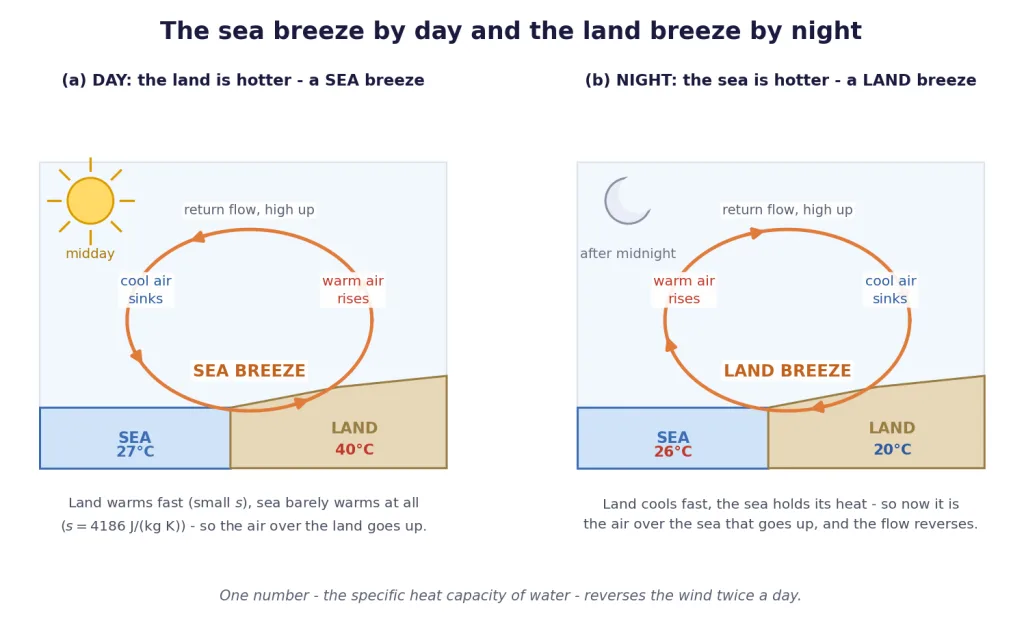
By day: the sea breeze
Stand on any Indian coast on a hot afternoon and the wind is blowing off the water. Trace why.
- Both surfaces receive the same sunshine, perhaps 800 W/m around midday.
- The land gets much hotter. Four separate effects push the same way: its specific heat capacity is about a fifth of water's; sunlight penetrates only the top few centimetres of opaque soil while it reaches metres down into clear water; the sea's waves and currents stir the absorbed heat through a huge mass; and evaporation from the sea carries away energy the land does not lose. The land surface may reach 40°C while the sea holds 27°C.
- The air above the land is heated from below — by conduction across the thin layer touching the ground, exactly the mechanism the pan used.
- That air expands, becomes less dense, and rises. Its density is about 3% below the air over the sea, which is enough to give a rising parcel an upward acceleration of about 0.3 m/s.
- Removing air upwards lowers the surface pressure over the land, so air flows in along the surface from the sea to fill the gap. That inward flow is the sea breeze.
- The loop closes aloft: the risen air drifts back out over the water, cools, and sinks — completing a convection cell tens of kilometres across.
Timing matters and is often asked. The sea breeze does not start at sunrise. It needs the land to build up a temperature lead first, so it typically sets in mid-morning, strengthens through the afternoon, and peaks when the land-sea contrast does.
By night: the land breeze
After sunset, both surfaces radiate heat away to the sky. Now the same physics runs backwards.
The land, with its small heat capacity and thin heated layer, cools quickly — it may fall to 20°C. The sea, holding an enormous store of energy in a deep, well-mixed layer, barely changes and stays near 26°C. The sea is now the warmer surface. Air rises over the water, and the surface flow reverses: a land breeze blows out to sea.
Key Point — the two breezes:
- Sea breeze, daytime: land hotter, air rises over land, surface wind blows from sea to land.
- Land breeze, night: sea warmer, air rises over sea, surface wind blows from land to sea.
- The cause of both is the difference in specific heat capacity between water and land. Nothing else changes.
- The land breeze is the weaker of the two, because the night-time land-sea temperature contrast is smaller than the daytime one.
Fishing communities along the Konkan and Coromandel coasts have used this for centuries: sail out before dawn on the land breeze, come home in the afternoon on the sea breeze. The wind is free and it reverses on schedule.
The monsoon: the same cell, seasonal and continental
Take the sea breeze, make it four thousand kilometres wide, and change its clock from twelve hours to six months. That is the monsoon.
Summer (roughly June to September). The Indian landmass, and especially the Thar and the Gangetic plain, heats enormously through spring. The Indian Ocean, all that water, warms hardly at all. A vast region of low pressure builds over north-west India; air rises over the land; and moist air is drawn in from the ocean across the whole subcontinent. That is the south-west monsoon, and because the incoming air has crossed thousands of kilometres of warm sea, it arrives loaded with water vapour — which is why the monsoon brings rain and the sea breeze does not.
Winter. The land now cools far below the ocean, the pressure pattern reverses, and the flow runs from land to sea: the north-east monsoon, dry over most of India, though it picks up moisture over the Bay of Bengal and delivers Tamil Nadu's rain.
Key Point — breeze against monsoon:
Sea and land breeze Monsoon Scale tens of kilometres thousands of kilometres Period daily, reverses twice a day seasonal, reverses twice a year Driven by daily heating cycle annual heating cycle Physics identical — convection driven by water's large specific heat capacity identical
[Board Important] "Explain the origin of the sea breeze and the land breeze." A full-mark answer must contain four things: (i) water's specific heat capacity is much larger than that of land; (ii) so by day the land is hotter and by night the sea is; (iii) air over the hotter surface expands, becomes less dense and rises; (iv) the cooler air flows in along the surface to replace it, and that flow is the breeze. Naming the direction of each breeze correctly is usually worth a mark on its own.
Convection on a Planetary Scale
Why there is a wind at all
The equator receives far more solar energy per square metre than the poles do — the Sun stands overhead there while its rays strike a polar surface at a glancing angle and spread the same energy over a much larger area. So the planet is a fluid (the atmosphere) sitting on a surface that is heated from below, unevenly. That is a convection cell waiting to happen.
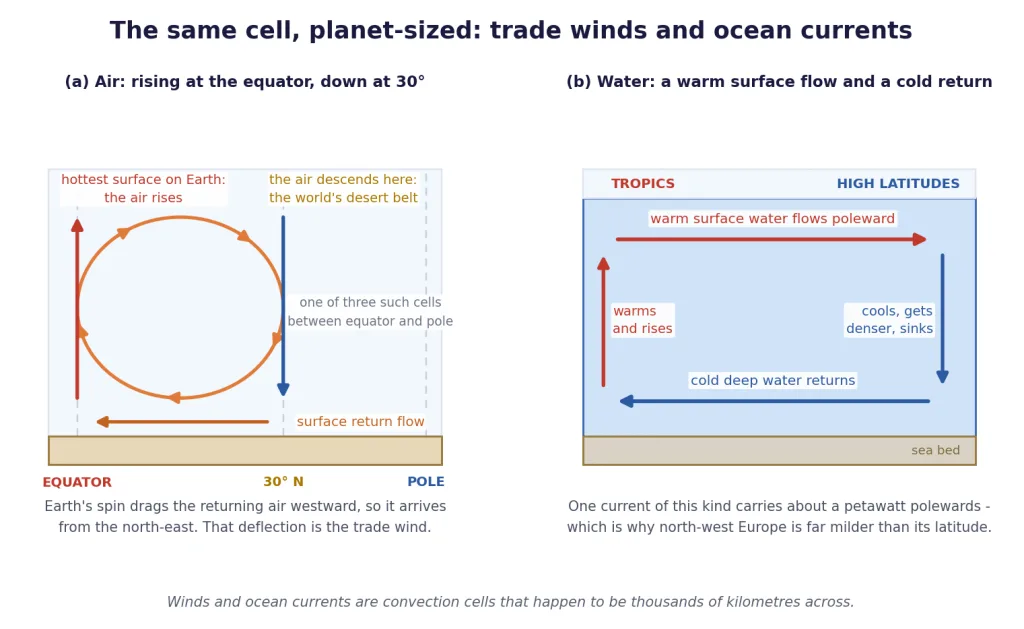
In outline the cell is exactly the pan's: air rises at the equator, moves poleward high in the atmosphere, cools, sinks, and returns along the surface towards the equator.
The trade winds, and why they blow from the north-east
If the Earth did not rotate, that returning surface air would blow due south towards the equator in the northern hemisphere, and that would be that. But the Earth does rotate, and the rotation bends the flow.
Here is the reason in one sentence. A point on the equator is carried eastward by the Earth's spin at about 1600 km/h, while a point near a pole is barely moving at all. Air that starts its journey at a high latitude carries that small eastward speed with it. As it moves towards the equator it arrives over ground that is rushing eastward much faster than the air is — so relative to the ground, the air appears to lag behind, drifting westward.
The result is a steady surface wind arriving from the north-east in the northern hemisphere, and from the south-east in the southern. These are the trade winds, and they were the highways of sailing commerce for four centuries. The apparent sideways deflection of anything moving over a rotating Earth is called the Coriolis effect.
The same rotation prevents the cell from reaching all the way to the pole. Instead the poleward-moving air aloft descends at around 30° of latitude and returns from there. That descending branch is dry — the air lost its moisture as rain when it rose at the equator — and that is why the world's great deserts sit in a belt near 30° north and south: the Sahara, the Arabian, the Thar, the Kalahari and the Australian interior. One convection cell, drawn on a rotating sphere, explains both the trade winds and the deserts.
Ocean currents
The oceans run the same circulation in water, and because water's specific heat capacity is so large, they carry a staggering amount of energy.
- The surface limb. Warm water flows away from the tropics towards the poles — the Gulf Stream in the North Atlantic, the Kuroshio in the Pacific.
- The sinking limb. At high latitudes that water cools, and because cold water is denser (and evaporation and ice formation have left it saltier), it sinks.
- The deep return. Cold dense water creeps back towards the equator along the ocean floor, warms, and eventually rises again.
The scale is hard to grasp until you compute it. A single current of this kind carries of order a petawatt — watt — polewards, some sixty times the entire human race's rate of energy use. It is why Britain and Norway are habitable at latitudes that, in Canada, are frozen tundra.
Key Point: Winds and ocean currents are not a separate subject bolted onto physics. They are convection cells — the pan on the stove, drawn thousands of kilometres across, with the Sun for a burner and the Earth's rotation bending the flow.
One place where convection is deliberately switched off
Section 4 showed the anomalous expansion of water: below 4°C, water expands as it cools further. In a pond in winter, that inverts the usual density arrangement — the coldest water is no longer the densest, so the cold surface layer cannot sink and the convection that would otherwise stir the whole pond stops dead. The lake then freezes from the top down, and the fish survive beneath. That belongs to Section 4; what this section adds is the name for what has been prevented: the convection cell.
Convection Indoors, and Inside You
Why the heater sits on the floor and the air conditioner high on the wall
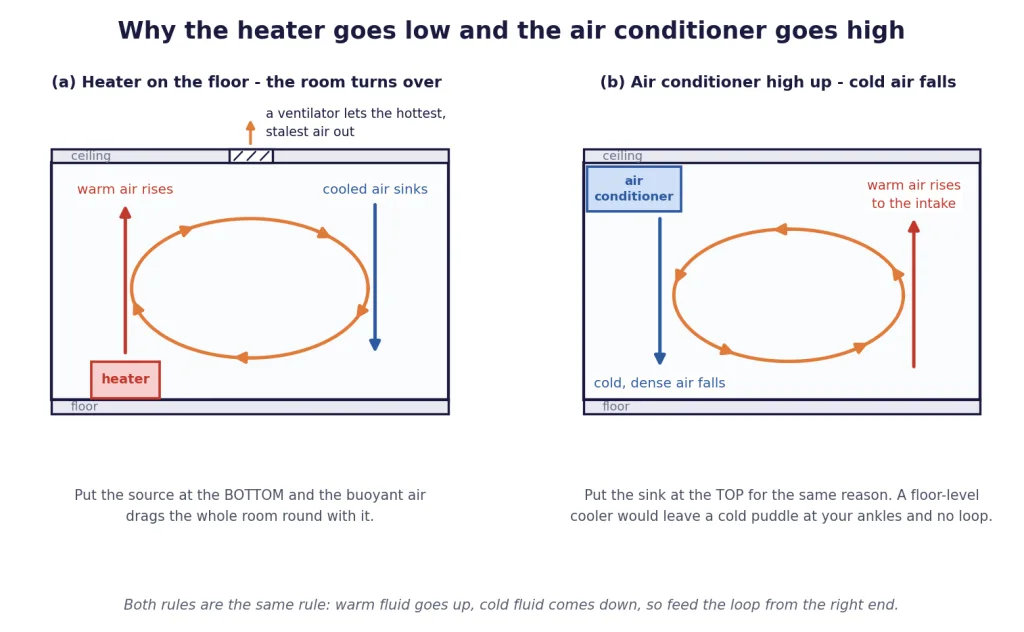
A room heater goes at floor level. Air warmed at the floor becomes less dense, rises to the ceiling, spreads across it, cools against the walls and windows, and sinks back down at the far side of the room. One cell, and it stirs every cubic metre of the room. A 2 kW heater takes about six minutes to raise a 4 m by 5 m by 3 m room by 10 K if the air circulates.
Mount that same heater high on the wall and you break the loop. The warm air it makes is already at the top, is already less dense than everything beneath it, and has nowhere to go. It forms a hot stratified layer under the ceiling — reaching the target temperature there in a couple of minutes while your feet stay cold all evening.
An air conditioner goes high on the wall. The identical argument run backwards. Air chilled at ceiling height is denser than the room, so it falls, sweeping down through the whole room and cooling it on the way; warm air rises to the unit's intake, closing the loop. Put the cooler on the floor and the cold air stays where it is made, a cold puddle round your ankles with a warm room above it.
Key Point — the placement rule, one line:
Put a heat source at the BOTTOM and a heat sink at the TOP. Warm fluid rises and cold fluid sinks, so this is the only arrangement in which the fluid completes a loop and stirs the whole volume.
Everything else in the house obeys the same rule
- Ventilators are set near the ceiling. The hottest, stalest, most carbon-dioxide-laden air collects at the top of a room, being the least dense. Openings up there let it escape, while fresh air enters at door and window level — a deliberately engineered convection current through the room.
- A refrigerator's freezer compartment is at the top. Air chilled there sinks through the cabinet and cools everything below it. A freezer at the bottom would cool only the bottom.
- A "radiator" is badly named. A domestic hot-water radiator transfers most of its heat by convection, not radiation, which is why it is placed low and why blocking the space beneath it with furniture ruins it.
- A ceiling fan does not cool the air. It increases at your skin and sweeps away the humid layer clinging to it, so both convective and evaporative losses go up. The air's temperature is unchanged — in a closed room the motor's work makes it very slightly warmer.
- A thick soup burns at the bottom; a thin one does not. A viscous liquid resists the circulation, convection is feeble, and the layer touching the pan gets far hotter than the rest. Hence: stir it.
- A convection oven has a fan. Forced convection at the food's surface instead of natural convection roughly quadruples the rate of heat delivery, which is why fan ovens are set about 20°C lower than conventional ones for the same result.
- Trapped air only insulates while it is trapped. Section 8's blankets, fur, feathers and double glazing all depend on preventing a convection cell inside the gap. That is the whole reason the pockets have to be small: below a certain gap width, viscosity wins and no circulation can get going.
Convection inside the body
Your body is a forced-convection machine, and a rather good one.
Nearly all your metabolic heat — around 100 to 120 W at rest — is produced deep inside, in the liver, brain and working muscles. Your skin is where it has to be lost. Tissue is a poor conductor (body fat has W/(m K)), so conduction from core to skin would be hopelessly slow on its own.
Blood does the job instead. The heart pumps about 5 litres per minute at rest. Blood leaves the core at around 37°C, gives up heat in the vessels near the skin, and returns a couple of degrees cooler. With a specific heat capacity of roughly 3600 J/(kg K), a flow of about one litre a minute is enough to carry the whole resting metabolic output to the surface — some 19% of the cardiac output, spent entirely on temperature control.
The system is actively regulated, and you can watch it work:
- When you are hot, the vessels near the skin dilate. More blood reaches the surface, more heat is carried out, and your skin flushes visibly red. During hard exercise the heat production can reach 800 W, which would need more blood per minute than the whole resting cardiac output — which is precisely why the heart rate climbs and why you go red in the face.
- When you are cold, those vessels constrict. Blood is kept in the core, the skin is allowed to cool towards the surroundings, the temperature difference driving heat loss shrinks — and you go pale, and your fingers go numb. The body is deliberately raising the thermal resistance of its own outer shell.
[NEET Important] Three body-related facts get asked directly. Blood transports heat by forced convection, the heart being the pump. Vasodilation increases and vasoconstriction decreases the rate of heat loss to the surroundings. And convection, not conduction, is the dominant route from core to skin, because tissue conducts badly.
Conduction and Convection Side by Side, and the Traps
The comparison, in the form the exam asks for it
| Conduction | Convection | |
|---|---|---|
| What moves | energy only; the medium stays put | the fluid itself, carrying energy with it |
| Occurs in | solids mainly; also liquids and gases | fluids only — liquids and gases |
| Needs gravity? | no | yes for natural convection; no for forced |
| Speed | slow in insulators, fast in metals | usually much faster than conduction in the same fluid |
| Governing relation | , exact | , an empirical estimate |
| Material property | thermal conductivity , W/(m K) | no single material property; depends on flow |
| Works in a vacuum? | no | no |
| Everyday example | a spoon in hot tea, a wall | a pan of water, a sea breeze, a room heater |
(Radiation is the third mode, needs no medium at all, and is Section 10's business.)
The traps
Trap 1 — "heat rises". It does not. Hot fluid rises, because it is less dense than its surroundings. Heat itself has no preferred direction; it flows from hot to cold in whatever direction that happens to be. Say "the warm air rises" and you keep the mark.
Trap 2 — forgetting the kelvin. Every density ratio in convection uses at constant pressure, and that is absolute. Air at 40°C against air at 30°C differs in density by . Do it in Celsius and you get — wrong by nearly a factor of eight, and it is the commonest error in this section. Convert first, every time, and write the K.
Trap 3 — thinking a good insulator only has to stop conduction. It has to stop convection too, and in a gas that is usually the harder half. A wide air gap is a poor insulator; a narrow one, or a foam full of tiny closed pockets, is an excellent one.
Trap 4 — expecting convection where there is no fluid or no gravity. Not in a solid. Not in a vacuum. Not, for natural convection, in orbital free fall.
Trap 5 — heating a fluid from the top and expecting it to mix. It will not. The stable arrangement is already in place and nothing will overturn.
Trap 6 — treating the sea breeze and the monsoon as different physics. Same mechanism, different length scale and different clock.
What belongs to the sections either side
- The conduction law , thermal resistance and the series-parallel networks are Section 8, and they are what you use for the thin layer where the fluid actually touches the hot surface.
- Water's large specific heat capacity — the cause of the land-sea temperature difference this section circulates — is Section 5.
- The freezing lake and the anomalous expansion that shuts convection down are Section 4.
- Radiation, the only mode that crosses a vacuum, is Section 10 — and note that a hot object in a room is losing heat by convection and radiation simultaneously.
- Newton's law of cooling, which is really a statement about how a body loses heat convectively to its surroundings, and its exponential solution, are Section 11. This section only ever computes the rate at one instant; the time dependence is Section 11's.
Key Point — the section on one card:
Convection is heat carried by the bulk motion of a fluid. Warm fluid expands, becomes less dense, and is pushed up by buoyancy; cold fluid sinks to replace it; the loop is a convection cell. It needs a fluid and, if it is natural convection, it needs gravity. Heat from below, cool from above. Every density ratio is in kelvin.
Solved Examples
Constants used throughout, unless a problem states otherwise: m/s, J/(kg K), J/(kg K), J/(kg K), W/(m K), J/kg, density of air at 300 K kg/m.
Example 1: How badly does conduction fail in a pan of water?
A pan of base area 0.020 m holds water 10 cm deep. The base is at 100°C and the free surface at 20°C. (a) Find the rate at which heat would cross the water by conduction alone. (b) A gas burner supplies about 1800 W; compare. (c) Estimate how long 1.0 kg of water at 20°C would take to reach 100°C by conduction alone, and with the burner.
Solution:
(a) Conduction, with W/(m K):
(b) The comparison: Conduction accounts for about 0.5% of what the burner delivers. The other 99.5% has to reach the top of the water some other way.
(c) The heat needed: By conduction alone: s hours. With the burner: s minutes.
Read the honest caveat. The ten-hour figure is an upper bound on how slow it would be, because in reality the gradient would collapse long before then. But as an order of magnitude it makes the point beyond argument: a pan of water is heated by convection, and conduction is a rounding error.
Final Answer: (a) 9.6 W; (b) the burner delivers about 190 times as much; (c) about 10 hours by conduction against about 3 minutes in practice.
Takeaway: Whenever a fluid is heated from below, assume convection dominates until you have shown otherwise. The conduction number is worth computing precisely because it is so small.
Example 2: What actually lifts the air over hot land — and why kelvin matters
On a summer afternoon the air just above the land is at 40°C and the air just above the sea, at the same height and the same pressure, is at 30°C. (a) Find the fractional difference in their densities. (b) Find the initial upward acceleration of a parcel of the warm air. (c) Estimate its speed after rising 200 m, ignoring drag and mixing. (d) Show what a Celsius slip would have done to the answer.
Solution:
Convert first, and say the unit out loud. At constant pressure a gas has , and this is a ratio of temperatures, so must be absolute:
(a) The fractional density difference: The warm air is about 3.2% less dense. That is all the imbalance a sea breeze has to work with.
(b) The acceleration. A parcel of density in surroundings of density feels an upthrust and a weight , so
(c) After rising 200 m from rest, with that acceleration held constant: reached after about 36 s.
(d) The slip. Had you written , you would have claimed a 25% density difference — 7.8 times too large. That would give m/s and m/s. The physics would have been unrecognisable.
An honest note on (c). Real thermals top out at 3 to 5 m/s, not 11, because the rising parcel drags air with it and mixes with cooler air as it climbs, both of which sap the acceleration. The calculation gives the right order of magnitude and the right reason; a full treatment is fluid dynamics.
Final Answer: (a) 3.2%; (b) 0.31 m/s; (c) about 11 m/s after 200 m; (d) Celsius would have overstated the density difference by a factor of 7.8.
Takeaway: Any ratio of temperatures needs kelvin, and a convection problem is full of them. Convert before you divide, and write the K next to the number so you can see you did.
Example 3: How much power does a sea breeze carry?
A sea breeze blows along a 50 km stretch of coast in a layer 400 m deep at 5.0 m/s. The incoming air is 6.0 K cooler than the air it displaces. Taking the density of air as 1.2 kg/m and J/(kg K), estimate the rate at which the breeze removes heat from the land.
Solution:
The cross-section the air passes through:
The mass flow rate — density times area times speed: A hundred and twenty million kilograms of air every second. That is what a gentle sea breeze is.
Each kilogram carries away , so
Put that in context. W is 724 GW, roughly 1.8 times India's entire installed electrical generating capacity, running continuously all afternoon along one 50 km stretch of coastline.
Final Answer: About W, or 724 GW.
Takeaway: A convective power is always , and . Those two lines handle sea breezes, radiators, blood flow and ocean currents without change.
Example 4: The draught up a chimney
A chimney 12 m tall carries flue gas at 600 K. The outside air is at 300 K with a density of 1.18 kg/m. (a) Find the density of the flue gas. (b) Find the pressure difference driving the draught. (c) Estimate the speed of the rising gas. (d) What would doubling the chimney's height do?
Solution:
(a) Both temperatures are already in kelvin — check that first, because this is a ratio. At the same pressure, : Twice the absolute temperature, half the density. Neat, and only true in kelvin.
(b) The draught pressure. A column of outside air of height presses down harder than the lighter column of flue gas inside, and the difference appears at the base:
(c) The speed. Convert that pressure into kinetic energy per unit volume of the rising gas: (Real chimneys manage less, because friction along the flue takes its cut.)
(d) Double the height. , so it doubles to 139 Pa, and , so the speed rises by a factor of to about 21.7 m/s. A taller chimney really does draw better — and so does a hotter fire, since it lowers .
Final Answer: (a) 0.59 kg/m; (b) 69 Pa; (c) about 15 m/s; (d) the draught speed rises by .
Takeaway: A chimney is a buoyancy engine and its fuel is . Height and flue temperature are the only two things you can change, and the formula tells you exactly what each buys.
Example 5: How much heat does a person lose by convection?
A person has a body surface area of 1.7 m with a skin temperature of 33°C, standing in still air at 20°C. Take the natural-convection coefficient as W/(m K). (a) Find the rate of convective heat loss. (b) A fan raises to 25 W/(m K). Find the new rate and comment.
Solution:
The temperature difference is K — a difference, so the same number in either scale.
(a) Still air: Compare that with a resting metabolic rate of about 100 to 120 W. Convection alone is already carrying away roughly the whole of your resting heat production, which is why a room at 20°C feels slightly cool if you sit still in it — and why 27°C to 29°C is where most people are comfortable.
(b) With the fan: More than four times as much, and far more than you are producing, so your body temperature would start to fall — which is precisely the sensation of "the fan is cooling me".
The point that gets asked. The air is still at 20°C. Nothing about the air changed. What changed is : the fan sweeps away the warm, humid layer of air clinging to your skin and replaces it with fresh air, so both convective and evaporative losses jump. A fan in a sealed room actually adds a little heat, because the motor is doing work.
Final Answer: (a) 133 W; (b) 553 W, about 4.2 times more.
Takeaway: A fan does not lower the air temperature; it raises . That single sentence answers every "how does a fan cool you" question you will be set.
Example 6: Blood as a forced-convection coolant
A person at rest produces heat at 120 W, essentially all of it deep inside the body. Blood leaves the core at 37°C and returns from the skin 2.0 K cooler. Take J/(kg K) and the density of blood as 1060 kg/m. (a) What blood flow rate is needed to carry that heat to the skin? (b) Express it as a fraction of a resting cardiac output of 5 L/min. (c) What would hard exercise at 800 W demand?
Solution:
(a) The convective transport relation again:
Convert to a volume, since blood flow is quoted in litres:
(b) As a share of the cardiac output: Roughly a fifth of everything your heart pumps at rest is doing nothing but temperature control.
(c) At 800 W, the same relation with the same 2.0 K drop: That is more than the entire resting cardiac output. Which is exactly why hard exercise raises the heart rate sharply, why the skin flushes red as its vessels dilate, and why the body falls back on evaporating sweat as well — convection alone cannot keep up.
Final Answer: (a) about 1.0 kg/min, or 0.94 L/min; (b) about 19% of the resting cardiac output; (c) about 6.7 kg/min, more than the whole resting output.
Takeaway: The body moves heat from core to skin by forced convection, with the heart as the pump. Tissue conducts far too badly to do it any other way, and the same that handled a sea breeze handles a bloodstream.
Example 7: Sizing a car radiator, both sides of it
An engine rejects 40 kW of waste heat. (a) If the coolant, with J/(kg K), is allowed to drop 8.0 K across the radiator, what mass flow must the pump deliver? (b) On the air side, if the air is allowed to warm by 15 K, what mass and volume of air must the fan move each second? Take air density as 1.2 kg/m and J/(kg K).
Solution:
(a) The coolant side:
(b) The air side, same relation, different fluid:
Look at the two numbers together. To shift the same 40 kW you need 1.25 kg of water per second but 2.65 kg of air — and because air is eight hundred times less dense, that air occupies 2.2 cubic metres every second. A large fan, running hard.
Which is why it is done this way. Water carries heat far better per kilogram and per cubic metre, so it is used for the short, hot trip out of the engine block. Air is used only where a huge, cheap, endlessly available fluid is needed, and there it is given a vast finned area and a fan to raise .
Final Answer: (a) 1.25 kg/s of coolant; (b) 2.65 kg/s of air, which is 2.2 m/s.
Takeaway: Every heat exchanger is applied twice — once on each fluid — and the two mass flows are almost never the same.
Example 8: Does it matter where you put the heater?
A room measures 4.0 m by 5.0 m by 3.0 m. Air has a density of 1.2 kg/m and J/(kg K). A 2.0 kW heater is switched on. (a) How long to raise the whole room by 10 K, assuming the air circulates freely? (b) If the heater is mounted high on the wall so that only the top 1.0 m of air is stirred, how long before that layer is 10 K hotter?
Solution:
(a) The mass of air in the room:
(b) Only the top metre, a volume of 20 m and a mass of 24 kg:
Read what that means. The badly placed heater reaches its target three times faster — but only in the layer under the ceiling, where nobody is. The rest of the room is untouched, and because the thermostat is usually up there too, the heater then switches itself off. Meanwhile at floor level nothing has happened.
The physics behind the failure. Air warmed at the ceiling is already the least dense air in the room. It has no buoyant force acting on it, so it cannot rise, and nothing displaces it. No cell forms, so no mixing happens.
Final Answer: (a) about 6.0 minutes for the whole room; (b) about 2.0 minutes to overheat the ceiling layer alone.
Takeaway: Heating fast and heating usefully are different things. A source at the top heats a thin layer quickly and the room not at all; a source at the bottom sets up a cell that stirs everything.
Example 9: How fast does the cold air from an air conditioner fall?
A wall-mounted air conditioner discharges air at 12°C into a room at 30°C, from a height of 2.5 m above the floor. (a) Find the fractional density excess of the cold air. (b) Find its downward acceleration. (c) Estimate how fast it is moving, and how long it takes, when it reaches the floor.
Solution:
Kelvin first — this is a density ratio:
(a) At constant pressure, , so The cold air is about 5.9% denser than the room air.
(b) Its net downward acceleration — weight minus upthrust, per unit mass:
(c) Falling 2.5 m from rest at that acceleration:
What the answer is for. In about three seconds a sheet of cold air has swept from the unit to the floor, and in doing so it has displaced warm air upward through the whole height of the room, back towards the unit's intake. The loop is closed and the room is stirred. Put the same cooler on the floor and step 3 has nowhere to happen: the cold air is already at the bottom, no buoyancy acts on it, and it just spreads out and stays there.
Final Answer: (a) 5.9%; (b) 0.58 m/s; (c) about 1.7 m/s, arriving after about 2.9 s.
Takeaway: A 6% density difference and three seconds is all it takes to turn over a whole room. That is why the placement rule works, and it is worth knowing that the driving imbalance is only a few per cent.
Example 10: The heat an ocean current carries
A major warm surface current transports m of sea water per second polewards, and the returning deep water is 10 K colder. Take the density of sea water as 1025 kg/m and its specific heat capacity as 4000 J/(kg K). (a) Find the rate at which the current transports heat polewards. (b) Compare it with the world's total primary energy use of about W and with the W of sunlight the Earth intercepts.
Solution:
(a) Mass flow first: That is 1.2 petawatt.
(b) Two comparisons: One ocean current moves sixty-five times humanity's entire power consumption, and it is still less than one per cent of the sunlight arriving at the planet.
What that buys. Delivering a petawatt to high northern latitudes is why the British Isles and Norway sit ten degrees warmer than places at the same latitude with no such current — Labrador, at the latitude of London, is frozen for much of the year.
Final Answer: (a) W; (b) about 65 times world primary energy use, and about 0.7% of the sunlight the Earth intercepts.
Takeaway: Convection scales with mass flow, and the oceans have an enormous one. does not care whether the fluid is 1 g of blood or kg of sea water per second.
Example 11: Putting a number on the test-tube demonstration
A test tube of internal cross-section 1.5 cm holds a column of water 15 cm long, with 5.0 g of ice held at the bottom by a gauze and the water at the top kept boiling at 100°C. Using W/(m K) and J/kg, find how long conduction alone would take to melt the ice.
Solution:
SI first: m, m, and the ends of the column are at 100°C and 0°C, so K.
The conducted heat current — and note there is nothing else, because the arrangement is stable against convection: Sixty milliwatts. Next to nothing.
The heat the ice needs:
The time:
Which is why the demonstration works. The lesson lasts forty minutes and the water at the top boils in two. The ice at the bottom would need nearly eight hours, and it comes out of the tube still a solid lump.
Final Answer: About s, or 7.7 hours — against a boiling time of about two minutes at the top.
Takeaway: The demonstration is a measurement of how bad water is at conducting. Heat the tube from the bottom instead and the whole thing boils in seconds, because then a convection cell is allowed to form.
Example 12: Why a fan oven cooks faster
A joint of meat has a surface area of 0.12 m and a surface temperature of 20°C when it goes into an oven at 200°C. In a conventional oven, natural convection gives W/(m K). Switching on the fan gives W/(m K). Compare the initial rates at which heat enters the surface.
Solution:
The temperature difference is K in both cases; the fan does not change the oven's temperature at all.
Still oven:
Fan oven:
The ratio is 4.0, and it comes entirely from . Forced convection replaces the stagnant film of hot air clinging to the surface — the very layer that was insulating the food — with a fresh supply every fraction of a second.
Which is why recipes say to reduce the temperature. A fan oven set 20°C lower than a conventional one delivers a similar rate to the surface, because you have traded a smaller for a much larger .
Final Answer: 216 W in the still oven against 864 W with the fan — four times as fast.
Takeaway: Forced convection typically buys a factor of about four to ten over natural convection in air. The temperature difference is unchanged; it is the stagnant boundary layer you are destroying.