
Putting a Number on Hotness
Section 1 settled what temperature is: the degree of hotness, the thing that decides which way heat flows. It also showed that your skin cannot measure it. So how does a number get attached to hotness at all?
The answer is beautifully simple, and it is the whole idea behind every thermometer ever built.
Key Point — a thermometric property:
A thermometric property is any measurable physical property of some substance that changes smoothly, reproducibly and by a decent amount when the temperature changes. Measure that property, and you have measured the temperature.The property is the middleman. You never measure temperature directly; you measure a length, a pressure, a resistance or a voltage, and read the temperature off it.
Four of them, and the instruments they make
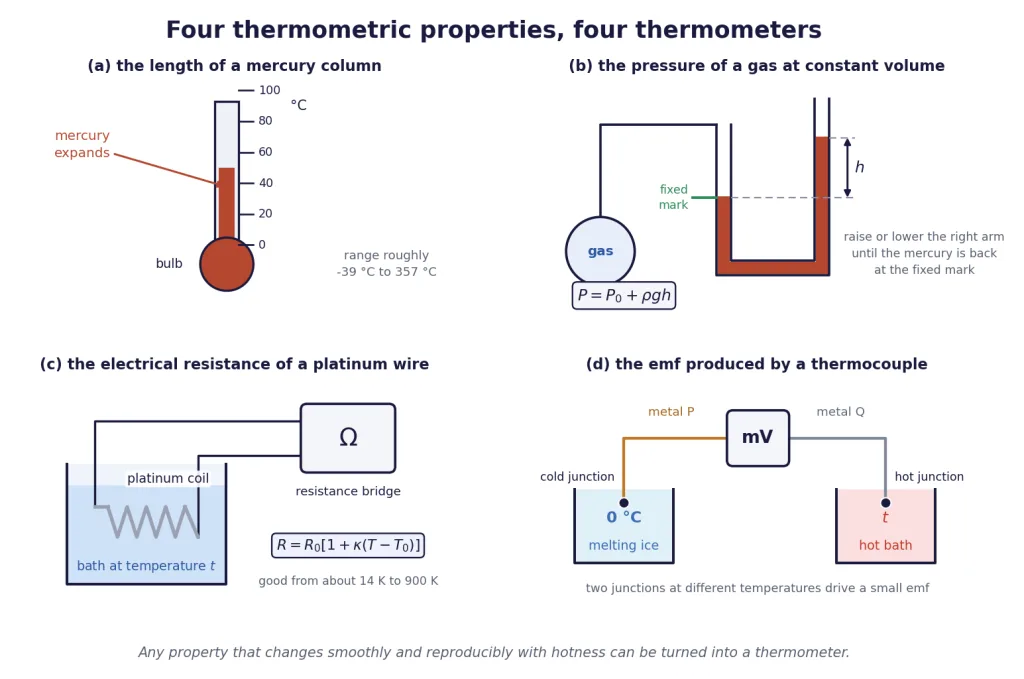
The volume of a liquid. Mercury or coloured alcohol sits in a bulb joined to a fine capillary tube. Warm the bulb and the liquid expands far more than the glass does, so the thread creeps up the tube. The length of the thread is the thermometric property. This is the thermometer in every clinic and every school laboratory, and it is cheap, direct and easy to read.
The pressure of a gas held at constant volume. Trap a fixed amount of gas in a bulb, connect it to a mercury manometer, and adjust the manometer so the gas always occupies the same volume. Then the pressure of the gas is the thermometric property. This one is clumsy and slow, and it turns out to be the most important thermometer in physics — the rest of this section explains why.
The electrical resistance of a wire. A coil of platinum wire changes its resistance in a very regular way with temperature: where is the resistance at some reference temperature and is the temperature coefficient of resistance. Measure with a bridge circuit and you have the temperature. Platinum resistance thermometers are the workhorses of accurate thermometry from about 14 K to 900 K.
Notation: the resistance coefficient is written , because is reserved for the coefficient of linear expansion and nothing else. Note too that this is an electrical resistance in ohms — later, in the conduction sections, will mean thermal resistance, and in the one place molar specific heats appear, is the gas constant 8.31 J/(mol K). Say which you mean whenever there is any doubt.
The emf of a thermocouple. Join two different metals into a loop with two junctions. If the junctions are at different temperatures, a small voltage appears in the loop. The emf is the thermometric property. Thermocouples are tiny, tough and fast, so they go inside furnaces and engines where nothing made of glass would survive.
What makes a property a good one
| Requirement | Why it matters | What goes wrong without it |
|---|---|---|
| It must change measurably with temperature | a tiny change is lost in the noise | the instrument has no sensitivity |
| It must change smoothly, with no jumps | a jump means one reading fits two temperatures | the scale becomes ambiguous |
| It must be reproducible | the same temperature must give the same reading tomorrow | the instrument drifts and is useless |
| It must be single-valued | the property must not go up and then come down | two temperatures give the same reading |
| The substance must stay in one state over the range | mercury freezes at °C and boils at 357°C | the thermometer simply stops working |
[JEE Tip] The single-valued requirement rules out one substance that would otherwise look attractive: the volume of water between 0°C and 4°C. Water contracts as it is warmed over that range and expands above it, so a water-in-glass thermometer would give the same reading for two different temperatures. Section 4 deals with that oddity properly; here it is a reminder that not every property that changes with temperature can be used.
| Thermometer | Property used | Usual working range |
|---|---|---|
| Mercury in glass | length of a liquid column | °C to 357°C |
| Alcohol in glass | length of a liquid column | °C to 78°C |
| Constant-volume gas | pressure of a trapped gas | about 3 K to 1300 K |
| Platinum resistance | electrical resistance | about 14 K to 900 K |
| Thermocouple | emf between two junctions | about 25 K to 1900 K |
| Radiation pyrometer | radiation emitted by a hot body | above 800°C, no contact needed |
That is our own summary table, and the pattern in it matters more than the digits: liquid thermometers are convenient but narrow, gas thermometers are awkward but fundamental, and electrical thermometers are what you use when the range gets extreme.
Two Fixed Points: the Celsius and Fahrenheit Scales
Having a property that changes with temperature is not yet a thermometer. You still have to decide what numbers to write on the stem. That needs a scale, and the traditional way to build one uses two fixed points.
Key Point — how a two-fixed-point scale is built:
- Choose two temperatures that nature reproduces reliably. The ice point (pure water melting under one atmosphere) and the steam point (pure water boiling under one atmosphere) are the classic pair.
- Put the thermometer in each in turn and mark where the property sits: call the marks and .
- Assign numbers to those two marks, by pure convention.
- Divide the gap between the marks into equal parts and assume the property changes uniformly in between.
Step 4 is an assumption, not a measurement. Hold on to that — the next block is entirely about what it costs.
For a thermometric property , the recipe reads which is nothing more than "what fraction of the way from the lower mark to the upper mark are we?", multiplied by 100.
The two familiar scales
Key Point — Celsius and Fahrenheit:
Ice point Steam point Divisions between them Celsius () 0°C 100°C 100 Fahrenheit () 32°F 212°F 180 Same two physical states. Different numbers written against them, and a different number of divisions in between. Nothing physical distinguishes the two scales at all.
Since both scales are linear in the same physical property, a graph of against is a straight line, and two points fix it.
Key Point — the conversion: Read it as "the same fraction of the way up both scales". Rearranged,
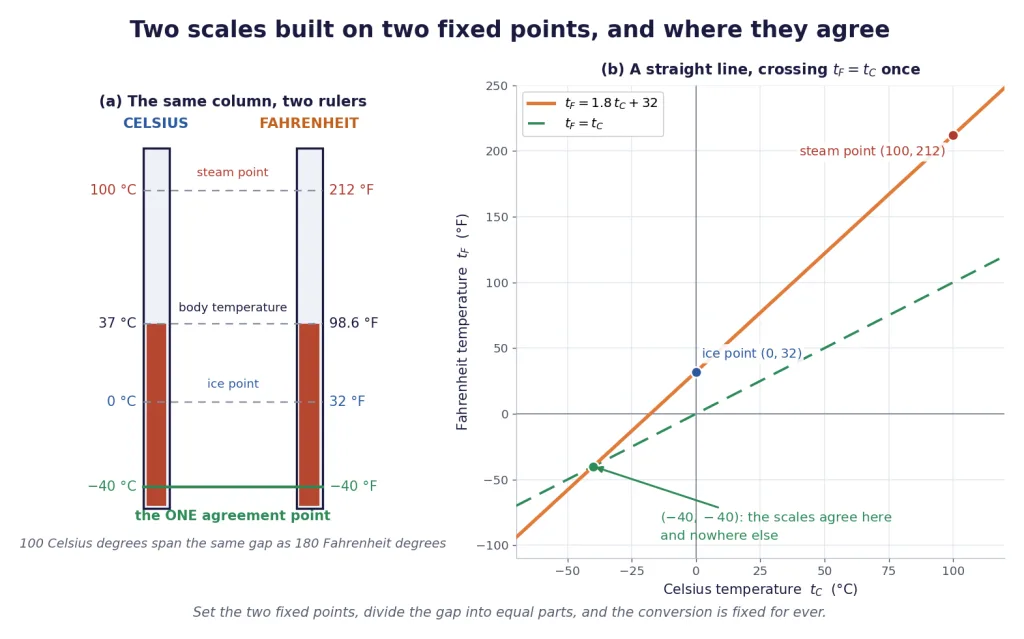
Two things the graph tells you at a glance
The slope is 1.8, so a Fahrenheit degree is smaller than a Celsius degree. A rise of 1°C is a rise of 1.8°F. This matters when a question asks for a temperature difference rather than a temperature: an interval of 50°C is an interval of 90°F, not of 122°F. The +32 belongs to a temperature, never to a difference.
The two scales agree at exactly one temperature. Set and solve:
Key Point: °C °F, and this is the only temperature at which the two scales give the same number. Every other temperature has two different numbers. Graphically, it is the single point where the line crosses the line ; two straight lines with different slopes cross once, so there cannot be a second agreement point.
A few conversions worth carrying in your head: 0°C is 32°F, 37°C (body temperature) is 98.6°F, 100°C is 212°F, and comfortable room temperature at 25°C is 77°F.
[Board Important] The two-mark version asks you to derive the relation from the two fixed points rather than quote it. Write the fraction-of-the-way expression, put the two pairs of numbers in, and rearrange. Quoting the final formula alone usually earns one mark out of two.
Why Two Fixed Points Are Not Good Enough
Everything so far looks tidy. Two fixed points, a linear interpolation, a number. So what is wrong with it?
Here is the problem, and it is fatal.
Two thermometers, calibrated identically, disagreeing anyway
Take a mercury-in-glass thermometer and an alcohol-in-glass thermometer. Calibrate both in exactly the way described above: mark 0 in melting ice, mark 100 in steam, divide each stem into a hundred equal parts.
By construction, the two now agree perfectly at 0 and at 100. Put them both in the same bath of warm water somewhere in between, and they do not agree. The mercury thermometer might read 50.0 while the alcohol one reads 50.4.
Neither is faulty. Neither has been badly made. The disagreement is built into the method.
Key Point — the flaw in a two-fixed-point scale:
Between the two fixed points, the scale is defined by the assumption that the chosen property changes uniformly with temperature. Different substances do not expand in step with one another, so different thermometers subdivide the same interval differently — and there is no way to say which one is "right", because "right" has not been defined anywhere except at the two fixed points.In other words, the two-fixed-point scale defines a temperature only at two temperatures. Everywhere else, the reading depends on what your thermometer happens to be made of.
That is intolerable. A scale in which the temperature of a bath depends on whether you measured it with mercury or alcohol is not a scale of a physical quantity at all.
The second problem: even the fixed points move
The ice point and the steam point are both defined "under standard atmospheric pressure". Change the pressure and both of them shift. Water boils at 100°C at sea level and at about 93°C in Shimla, and under half an atmosphere it boils near 81°C. A pressure cooker exists precisely because raising the pressure raises the boiling point.
So the two anchors of the scale are themselves tied to a third quantity that has to be controlled and measured. That is not a good foundation for a fundamental scale.
[JEE Tip] A favourite conceptual question is: "What is wrong with taking the melting point of ice and the boiling point of water as the standard fixed points?" The full answer has both halves: (i) different thermometric substances disagree between the fixed points, so the scale is not unique; and (ii) both fixed points depend on pressure, so they are not truly fixed. Give both and the mark is yours.
The way out
Two escapes are needed, and physics found both.
Escape one: find a thermometer that does not care what it is made of. Remarkably, one exists. Fill a constant-volume gas thermometer with oxygen and measure a temperature; empty it, fill it with hydrogen, and measure again. The readings differ — but as you use less and less gas, so that the pressure in the bulb gets lower and lower, the readings from different gases close in on one another. In the limit of vanishing pressure they agree exactly. That gives a thermometer whose readings are a property of nature rather than of a substance.
Escape two: stop using two fixed points. Use one — and choose one that cannot drift. That fixed point is the triple point of water, and it is the subject of the block after next.
Both escapes come out of the same instrument, so that is where we go now.
The Gas Thermometer and the Absolute Scale
What a low-density gas does
Trap a fixed amount of gas and keep its volume constant. Measure its pressure at several temperatures. The result is a straight line, and it is a straight line for every gas, provided the gas is thin enough:
Combine that with the two laws you already know for a fixed mass of low-density gas — constant at constant temperature (Boyle's law) and constant at constant pressure (Charles's law) — and they collapse into one statement.
Key Point — the ideal-gas equation: is the number of moles of gas and J/(mol K) is the universal gas constant. The number of moles is also written .
here is an absolute temperature in kelvin. It could not be anything else: the equation says and are proportional to , and a proportionality is meaningless unless the zero of the scale is the physical zero.
Extrapolate the line and something remarkable happens
Take several gas thermometers holding different gases and different amounts of gas. Plot pressure against Celsius temperature for each. You get a family of straight lines of different slopes — and if you extend every one of them backwards, past where any real gas could survive, they all cut the temperature axis at the same point.
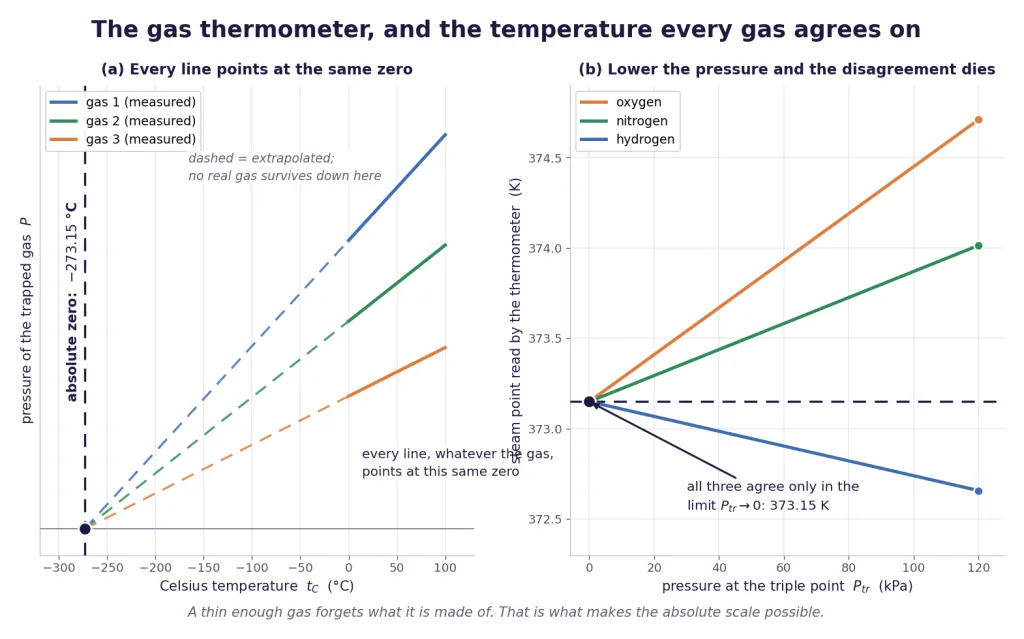
That point is at
Whatever the gas, whatever the amount, whatever the volume of the bulb. Nature is pointing at a particular temperature and saying: this one is special.
Key Point — absolute zero:
Absolute zero is the temperature at which the pressure of an ideal gas would extrapolate to zero. It lies at °C.
It is a limit, not a place any experiment has been. Real gases liquefy and then freeze long before they get there, so the last part of every one of those lines is extrapolation, drawn dashed. And the third law of thermodynamics says absolute zero can be approached as closely as you like but never actually reached.
Building the Kelvin scale on it
If there is a natural zero, then put the zero of the scale there. That is the Kelvin scale, or absolute scale, and its unit is the kelvin (K) — written without a degree sign, because the kelvin is a unit, not a "degree above something".
The size of the kelvin was chosen to equal the size of the Celsius degree, so that all the existing data would carry across unchanged. That fixes the conversion completely:
Key Point — kelvin and Celsius:
- The size of the unit is the same on both scales, so a temperature difference is the same number in K and in °C. A rise of 25°C is a rise of 25 K.
- The zero is not the same, so a temperature itself is a different number: 27°C is 300.15 K.
- Write "K" with no degree sign: 300 K, never °K.
In everyday problems people round 273.15 to 273, and at two or three significant figures nothing changes. Use 273.15 when a question is quoting temperatures to two decimal places, and 273 otherwise — but do not switch halfway through one problem.
The readings converge, and that is the point
The right-hand half of the figure above is the experimental fact that makes the whole scheme honest. Take three constant-volume gas thermometers, filled with oxygen, nitrogen and hydrogen, and use each to measure the same temperature — say the steam point. They give slightly different answers: that is the old problem again.
Now reduce the amount of gas in each bulb, so that the pressure at the reference temperature falls, and repeat. The three answers move closer together. Keep going, extrapolate to zero filling pressure, and all three land on exactly the same number, 373.15 K.
Key Point: A gas thermometer becomes independent of which gas it contains in the limit of vanishing pressure. That limit defines the ideal-gas temperature scale, and it agrees with the thermodynamic Kelvin scale over the whole range where gas thermometers work. This is the escape from the two-fixed-point trap: the answer no longer depends on the substance.
[NEET Important] The one-line reason two gas thermometers give slightly different readings is that real gases are not ideal at ordinary pressures. The one-line fix is to repeat the measurement at lower and lower pressures and extrapolate to zero pressure. Both lines are commonly asked for together.
One Fixed Point: the Triple Point of Water
The gas thermometer solved the "which substance?" problem. One problem is left: the fixed points themselves drift with pressure. The modern scale fixes that by using one fixed point instead of two, and choosing a very particular one.
What a triple point is
For any pure substance you can draw a phase diagram: pressure on one axis, temperature on the other, with curves marking where two phases can coexist. The fusion curve separates solid from liquid, the vaporisation curve separates liquid from vapour, and the sublimation curve separates solid from vapour.
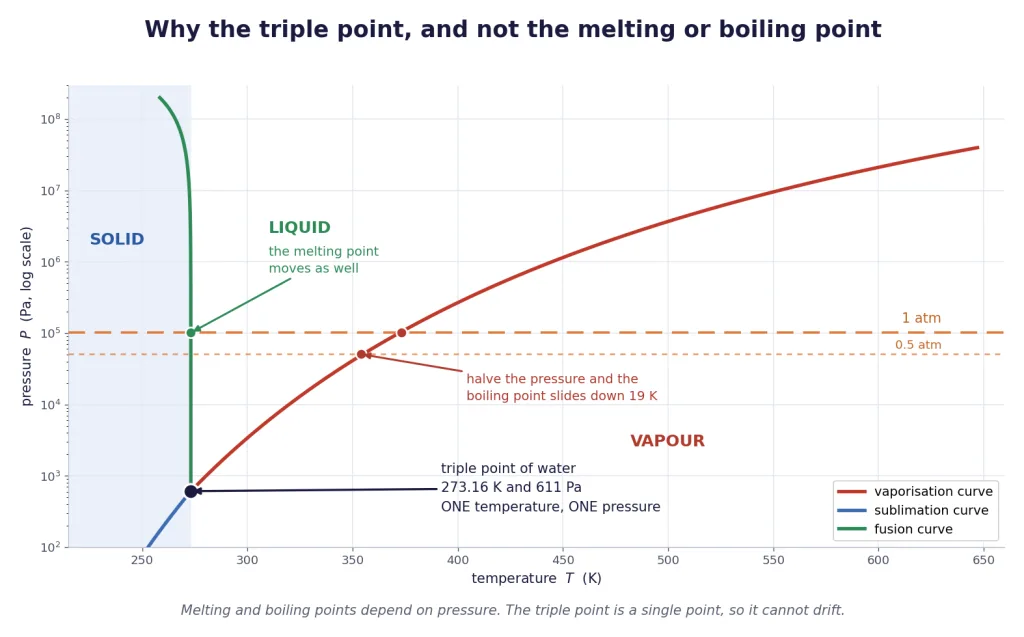
Those three curves meet at a single point.
Key Point — the triple point:
The triple point of a substance is the unique pressure and temperature at which its solid, liquid and vapour phases coexist in equilibrium.
For water it lies at which is about six-thousandths of an atmosphere.
Why a triple point beats a melting or a boiling point
Look at the figure again and compare what happens when the pressure changes.
A melting point is a curve. Slide up or down the fusion curve and the melting temperature slides with it. "The melting point of ice" is not one temperature; it is a different temperature at every pressure, so you have to specify and control the pressure to define it.
A boiling point is a curve too, and a much steeper one. Halve the pressure and water boils about 19 K lower. Anyone who has cooked at altitude knows this.
A triple point is a point. It occurs at exactly one temperature and exactly one pressure, and there is no dial you can turn to move it. Set up a sealed cell containing nothing but pure water, ice and water vapour in equilibrium, and the cell settles at 273.16 K by itself, in Delhi or in Antarctica, this year or in a hundred years.
Key Point — why the triple point is the standard:
- It is unique: one pressure, one temperature, no freedom left to specify.
- It is therefore reproducible anywhere without measuring or controlling the pressure — the coexisting phases fix the pressure themselves.
- It cannot drift, whereas both the ice point and the steam point move whenever the atmospheric pressure moves.
- Using it as the only fixed point removes the interpolation assumption between two fixed points, which was the other half of the problem.
The scale that comes out of it
With a single fixed point, calibration becomes one multiplication. Put a constant-volume gas thermometer into a triple-point cell and record the pressure . Then put it into whatever you want to measure and record the pressure . Since ,
Key Point — the definition of the Kelvin scale: read in the limit as the amount of gas in the bulb goes to zero. The number 273.16 is assigned by definition, not measured — it was chosen so that one kelvin would come out equal to one Celsius degree and the old data would still fit.
273.15 or 273.16? Both, and they are different numbers
This trips up almost everybody, so here it is plainly.
- K is the triple point of water: ice, water and vapour together, at 611 Pa.
- K is the ice point: ice and water together, at one atmosphere, with air dissolved in the water.
They are two different physical states and they differ by 0.01 K. Raising the pressure from 611 Pa to one atmosphere lowers the melting point very slightly, and dissolved air lowers it a little more; the two effects together come to that hundredth of a kelvin.
Key Point: The conversion uses because the Celsius scale is defined to put its zero at the ice point. The Kelvin scale is defined by putting at the triple point. Both statements are exact by choice, and the 0.01 K between them is real physics, not a rounding error.
A consequence worth noticing: because the triple point is now the definition, the melting point and boiling point of water at one atmosphere are no longer exactly 0°C and 100°C. They are extremely close — 0°C and about 99.97°C — but they are now measured quantities rather than defined ones. The definition and the convenient round numbers have swapped places.
[Board Important] "Why is the triple point of water preferred to the melting point of ice as a standard fixed point?" is asked almost every year. Answer: the triple point occurs at one unique temperature and one unique pressure, so it is perfectly reproducible anywhere, whereas the melting point changes with the pressure applied and so must be specified at a stated pressure.
Pulling It Together
Everything in this section, on one page
| Idea | The statement | Watch out for |
|---|---|---|
| Thermometric property | any property changing smoothly and reproducibly with temperature | it must be single-valued over the range |
| Two-fixed-point recipe | the uniformity between the points is an assumption | |
| Celsius / Fahrenheit | the belongs to a temperature, never to a difference | |
| The one agreement point | °C °F | there is exactly one, because two lines cross once |
| Why two fixed points fail | different substances disagree in between; both points move with pressure | give both halves of the answer |
| Gas thermometer | at constant volume, for any gas | the readings agree only as |
| Absolute zero | the extrapolated zero-pressure temperature, °C | it is approached, never reached |
| Kelvin scale | ; unit K, no degree sign | a difference is the same number in K and °C |
| Triple point of water | K at 611 Pa, assigned by definition | not the same as the ice point at 273.15 K |
| Single-point calibration | K | works only for a constant-volume gas thermometer |
| Ideal-gas equation | , J/(mol K) | in kelvin, always |
The six traps in this section
Trap 1 — putting Celsius into a gas-law ratio. needs kelvin on both sides. Heating a gas from 27°C to 127°C multiplies its pressure by , not by . This is the commonest wrong answer in the chapter.
Trap 2 — adding 32 to a temperature difference. A rise of 50°C is a rise of 90°F. Multiply differences by 1.8 and stop there.
Trap 3 — confusing 273.15 with 273.16. The ice point is 273.15 K; the triple point is 273.16 K. Use 273.15 in , and 273.16 in .
Trap 4 — writing °K. The kelvin is a unit in its own right, so it takes no degree sign. Write 300 K.
Trap 5 — saying two gas thermometers disagree because one is faulty. They disagree because real gases are not ideal at finite pressure. The cure is to lower the pressure and extrapolate, not to replace the instrument.
Trap 6 — answering "the triple point is more accurate". It is not about accuracy, it is about uniqueness: the triple point fixes the pressure as well as the temperature, so it cannot drift.
The habit that saves marks
- Write the unit next to every temperature you substitute. K or °C, every time. Most of the errors in this chapter announce themselves the moment you do.
- Ask whether the quantity is a temperature or a temperature difference. Differences are the same number in K and °C, and are multiplied by 1.8 to go to Fahrenheit degrees. Temperatures need the full conversion.
- If the expression involves a ratio, a product or a power of , convert to kelvin first, before anything else. Do it as line one of the solution, not as an afterthought.
[NEET Important] The recall questions from this section are always the same five: the value of the triple point of water, the conversion , the Celsius-Fahrenheit formula, the temperature at which the two scales agree, and the value of absolute zero in °C. Have all five ready.
Solved Examples
Constants used throughout: the triple point of water is 273.16 K by definition; the ice point is 273.15 K; ; J/(mol K).
Example 1: Four everyday conversions
Convert (a) 40°C to °F, (b) 98.6°F to °C, (c) °C to °F, and (d) a rise of 50°C into Fahrenheit degrees.
Solution:
(a) Use :
(b) Use the inverse, : which is body temperature, as it should be.
(c) The two scales agree here, and only here.
(d) This one is different, because it is a difference. The is an offset between the zeros of the two scales, and an offset cancels out of any difference. So only the factor 1.8 survives: Adding 32 as well would give 122, which is the temperature 50°C expressed in °F — a completely different quantity.
Final Answer: (a) 104°F; (b) 37.0°C; (c) °F; (d) a rise of 90 Fahrenheit degrees.
Takeaway: Ask "temperature or temperature difference?" before you touch the formula. A temperature needs the full conversion including the ; a difference needs the factor 1.8 alone.
Example 2: Where do the scales agree, and where does one double the other?
(a) Find the temperature at which the Celsius and Fahrenheit readings are numerically equal. (b) Find the temperature at which the Fahrenheit reading is exactly twice the Celsius reading.
Solution:
(a) Set the two readings equal. Let both be : So °C °F.
Why is there only one such temperature? Because and are two straight lines with different slopes, 1.8 and 1. Two straight lines of different slope meet at exactly one point, so there is one agreement temperature and there cannot be a second.
(b) Now set :
Check it: and indeed .
Final Answer: (a) on both scales; (b) 160°C, which is 320°F.
Takeaway: Every "where do the two scales stand in a given relation?" question is one linear equation. Write , impose the relation asked for, and solve. Do not hunt for the answer by trial.
Example 3: The triple points of neon and carbon dioxide
The triple points of neon and carbon dioxide are 24.57 K and 216.55 K. Express both on the Celsius and the Fahrenheit scales.
Solution:
Both given values are already absolute temperatures, so go to Celsius first with .
Neon:
Carbon dioxide:
A sanity check on the signs. Both are far below the ice point, so both must be strongly negative on both scales, and the Fahrenheit numbers must be more negative than the Celsius ones once past . Both are, so the arithmetic holds together.
Final Answer: neon: °C °F. Carbon dioxide: °C °F.
Takeaway: Go kelvin to Celsius first, then Celsius to Fahrenheit. There is no need to memorise a direct kelvin-to-Fahrenheit formula, and inventing one is how sign errors get in.
Example 4: Two absolute scales that are not the Kelvin scale
Two absolute temperature scales, and , assign the numbers 200 A and 350 B to the triple point of water. Find the relation between a temperature on scale and the same temperature on scale .
Solution:
What "absolute" buys you. Both scales put their zero at absolute zero. So on each scale, the reading is directly proportional to the physical temperature, with no offset at all:
The same physical state, the triple point, has both labels. So because both fractions equal the same "fraction of the triple-point temperature".
Rearranged:
Test it on the one state you know. Put : then . Correct.
Final Answer: , that is .
Takeaway: On an absolute scale there is no additive constant, so one shared fixed point is enough to relate two scales. If the scales were not absolute you would need two shared points, exactly as Celsius and Fahrenheit do.
Example 5: A platinum resistance thermometer
The resistance of a platinum wire varies with temperature approximately as It is 101.6 at the triple point of water, 273.16 K, and 165.5 at the normal melting point of lead, 600.5 K. What temperature does a resistance of 123.4 correspond to?
Solution:
Take the triple point as the reference, so and K.
Find from the second data point, at K:
Now put into the same law and solve for :
Express it in Celsius as well, since that is often what is wanted:
Final Answer: K, that is about 111.7°C.
Takeaway: A two-point calibration of any linear thermometric property is always the same three steps: pick a reference, get the coefficient from the second point, then invert the law. It works identically for resistance, for the length of a mercury thread and for a thermocouple emf.
Example 6: Two gas thermometers, one melting point
Two constant-volume gas thermometers, filled with oxygen and filled with hydrogen, give these readings:
| Thermometer | Thermometer | |
|---|---|---|
| Pressure at the triple point of water | Pa | Pa |
| Pressure at the melting point of sulphur | Pa | Pa |
(a) What absolute temperature does each thermometer give for the melting point of sulphur? (b) The thermometers are not faulty. Why do they disagree, and what should be done about it?
Solution:
(a) Use the single-fixed-point definition for each thermometer separately.
Thermometer :
Thermometer :
The disagreement is 0.71 K, which is small but far larger than the reading error of either instrument.
(b) Why they differ. The relation is exact only for an ideal gas. Real oxygen and real hydrogen deviate from it slightly at these pressures, and they deviate by different amounts because their molecules are different sizes and attract each other differently.
What to do about it. Repeat the whole measurement with less gas in each bulb, so that is smaller each time, and plot the temperature each thermometer reports against . The two curves close in on one another, and extrapolating both to gives one common value. That extrapolated value is the true absolute temperature.
Final Answer: (a) 392.69 K and 391.98 K; (b) real gases are not exactly ideal, so the readings must be taken at successively lower pressures and extrapolated to zero pressure.
Takeaway: A gas thermometer is only exact in the limit of zero pressure. That limit is not a technicality — it is the definition of the ideal-gas scale, and it is the reason a gas thermometer can be a standard at all.
Example 7: A single gas-thermometer reading
A constant-volume gas thermometer registers a pressure of Pa when its bulb is in a triple-point cell. Placed in a hot liquid, the pressure rises to Pa. What is the temperature of the liquid, in K and in °C?
Solution:
The pressure ratio does all the work, since the volume is held constant:
Both temperatures in this ratio are absolute, which is the whole reason a single fixed point suffices:
In Celsius:
Does that look right? A hot liquid just above the boiling point of water — a bath of oil or glycerine, perhaps. Comfortably plausible.
Final Answer: K, that is 102.4°C.
Takeaway: With one fixed point, thermometry is a single multiplication. But that multiplication is a ratio of temperatures, so it only works because both temperatures are absolute. Try it with Celsius values and the answer is nonsense.
Example 8: Finding absolute zero from two pressure readings
A constant-volume gas thermometer holds a fixed mass of gas. Its pressure is 80.0 kPa when the bulb is in melting ice and 109.3 kPa when it is in steam at one atmosphere. Assuming the pressure varies linearly with Celsius temperature, find the temperature at which the pressure would fall to zero.
Solution:
Write the assumed straight line in terms of the Celsius temperature: where is the pressure at 0°C and is the slope.
is given directly by the ice-point reading: kPa.
The slope from the two points:
Set and solve:
Compare with the accepted value. Absolute zero is at °C, so this two-point estimate is out by about 0.15 K, which is exactly the level of agreement two three-figure pressure readings can support.
Final Answer: The pressure extrapolates to zero at about °C.
Takeaway: This is the experiment that discovers absolute zero, and you can do it with two pressure readings and a ruler. The striking part is not the precision but the fact that changing the gas, or the amount of it, changes both and while leaving their ratio, and so the intercept, alone.
Example 9: A badly graduated thermometer
A mercury thermometer has been wrongly graduated. It reads 5°C when placed in melting ice and 99°C when placed in steam at one atmosphere. What is the true temperature when this thermometer reads 52°C?
Solution:
The scale is still linear, and its two fixed points are simply labelled wrongly. So work in fractions of the way up the stem.
The faulty scale's own interval between the two fixed points is while the true interval is 100 Celsius degrees.
How far up is the reading of 52?
Convert that fraction to the true scale:
Final Answer: The true temperature is 50.0°C.
Takeaway: Never "correct" a faulty thermometer by adding or subtracting a constant. Both the zero and the size of the division are wrong, so you must rescale using the fraction-of-the-way expression. Simply subtracting 5 here would give 47°C, which is wrong.
Example 10: The triple point on a Fahrenheit-sized absolute scale
An absolute temperature scale is set up whose unit interval is the same size as the Fahrenheit degree. What number does the triple point of water carry on this scale?
Solution:
"Absolute" means the zero is at absolute zero, so this new scale is a pure proportionality with the Kelvin scale, with no offset.
How big is the new unit? A Celsius degree spans 100 divisions between the fixed points; a Fahrenheit degree spans 180 of the same physical interval. So the Fahrenheit degree is as large as the kelvin, and there are of them in one kelvin.
So a temperature that is kelvin is
For the triple point, K:
Final Answer: 491.69 units on that scale. (This scale exists and is called the Rankine scale.)
Takeaway: Smaller degrees mean bigger numbers. The Fahrenheit degree is of a kelvin, so every absolute temperature carries a number times as large. If your answer came out smaller than 273.16, you inverted the ratio.
Example 11: 273.15 or 273.16?
(a) Why does the relation between the Kelvin and Celsius scales use 273.15 rather than 273.16? (b) On the Kelvin scale, what is the second fixed point, given that the triple point of water is assigned 273.16 K?
Solution:
- (a) They refer to two different physical states.
- 273.16 K is the triple point of water: ice, liquid water and water vapour all in equilibrium together, which happens only at 611 Pa.
- 273.15 K is the ice point: ice and air-saturated liquid water in equilibrium at one atmosphere.
Why the two differ by 0.01 K. Going from 611 Pa to one atmosphere pushes the melting point down very slightly, and the air dissolved in ordinary water pushes it down a little further. Together they account for the hundredth of a kelvin.
The Celsius scale is defined to put its zero at the ice point, so the offset between the two scales is 273.15 exactly, by choice:
(b) The other fixed point is absolute zero, 0 K. Once you have chosen an absolute scale, the zero is fixed by nature rather than by convention, so only one further point has to be assigned by hand — and that is the 273.16 given to the triple point. Two fixed points, but only one of them is a matter of choice.
Final Answer: (a) 273.15 K is the ice point at one atmosphere while 273.16 K is the triple point at 611 Pa, and the Celsius zero is defined at the ice point; (b) the other fixed point is absolute zero, 0 K.
Takeaway: The 0.01 K between the ice point and the triple point is physics, not rounding. It is the shift in the melting point caused by raising the pressure and by dissolving air, and knowing that is a two-mark answer on its own.
Example 12: A sealed gas cylinder in the sun
A rigid sealed cylinder contains a low-density gas at 27°C and Pa. It is left in the sun until the gas reaches 127°C. Find the new pressure. Then work out what answer a student would get by putting the Celsius numbers straight into the ratio, and by how much they would be wrong.
Solution:
The cylinder is rigid, so the volume is constant and the amount of gas is fixed. The ideal-gas equation then gives
Convert both temperatures to kelvin before anything else. This is the whole question:
Take the ratio and multiply:
Now the blunder. A student who writes gets which is 3.5 times too large. The pressure rises by a third, not by a factor of nearly five.
A quick sense check that catches it. A hundred-degree rise on top of 300 K is a third of the absolute temperature, so the pressure should rise by about a third. Any answer that multiplies the pressure several times over is a signal that Celsius has crept into a ratio.
Final Answer: Pa. The Celsius-ratio answer of Pa is 3.5 times too large.
Takeaway: Convert to kelvin on line one, before you write the ratio down. Doing it as an afterthought is how the error survives — by then the wrong numbers are already on the page.