
Heat Has Three Ways to Travel, and This Is the First
Everything so far in this chapter has been about what heat does to a body once it arrives — raises its temperature, expands it, melts it, boils it. We never asked how it got there.
There are exactly three answers, and only three.
| Mode | What actually moves | Needs a medium? | Where it rules |
|---|---|---|---|
| Conduction | energy, passed from particle to particle; no bulk motion | yes — solids especially | a metal spoon in hot tea, a wall, a cooking pot |
| Convection | the fluid itself, carrying energy with it | yes — must be a fluid | a pan of water, a sea breeze, a room heater |
| Radiation | electromagnetic waves | no | the Sun to the Earth, a fire on your face |
Section 9 takes convection and Section 10 takes radiation. This section is conduction, and it comes with the one tool that makes conduction problems easy: thermal resistance.
What conduction is
Hold a metal rod with one end in a flame. Within a minute the other end is too hot to keep hold of. No metal has moved from the flame to your hand — the rod is exactly where it was. Only energy has travelled.
Key Point — conduction:
Conduction is the transfer of heat through a body from its hotter part to its colder part without any bulk movement of the body itself. The particles stay where they are; only energy is handed along.It happens in solids, liquids and gases, but it is the dominant mode in solids, because in a solid the particles are locked in place and cannot carry the energy bodily anywhere.
The mechanism, part one: the atoms jiggle
Every atom in a solid sits in a potential well and vibrates about a fixed lattice site. Temperature is the average kinetic energy of that vibration — so the hot end of the rod has atoms swinging with large amplitude and the cold end has atoms barely moving.
Now put those two facts together. A wildly vibrating atom is bonded to its quieter neighbour. Every swing it makes, it tugs and pushes on that neighbour, and every push transfers a little energy. The neighbour starts swinging harder; it passes some on to its neighbour; and a pulse of vibrational energy works its way down the rod, one atom at a time.
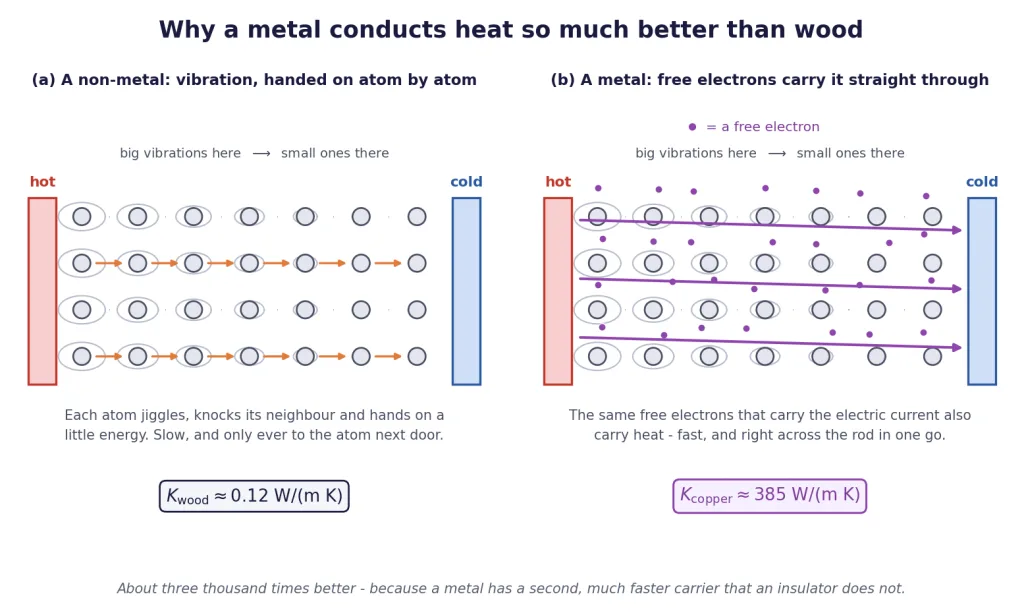
That is the whole story in wood, glass, brick, plastic and rubber. And it is slow, because the energy has to be handed over at every single atom along the way, like a bucket chain that stretches for a hundred million atoms across a centimetre.
The mechanism, part two: metals cheat
A metal has something an insulator does not — a sea of free electrons. When metal atoms pack into a lattice, each gives up its outermost electron or two, and those electrons are not tied to any particular atom. They wander through the whole lattice.
Those free electrons are light, they are fast, and they travel a long way between collisions. When one of them passes through the hot region it picks up kinetic energy from the vibrating ions, and then it carries that energy bodily to a distant part of the rod before giving it up. It does not wait for the bucket chain.
Key Point — why metals are good at both:
The same free electrons that carry electric current in a metal also carry heat. That is why every good electrical conductor is a good thermal conductor — silver and copper top both lists — and why insulators such as rubber, glass and wood are poor at both.This is not a coincidence and it is not a rule of thumb. It is one mechanism doing two jobs.
[JEE Tip] The examiners like the one-line version: "Why is a metal a good conductor of heat?" The full-mark answer names free electrons and says they transport energy over long distances, in addition to the lattice vibration that every solid has. Naming only "vibration" gets half the mark, because it does not explain why a metal is a thousand times better than wood.
And why gases are hopeless
In a gas the molecules are far apart and only exchange energy when they happen to collide. Between collisions a molecule carries its energy along, but there are so few molecules per cubic metre that the total energy carried across any surface each second is tiny. So gases are terrible conductors — and, as you will see, that turns out to be the most useful fact in the whole section.
Liquids sit in between: the molecules touch, so energy passes readily, but there is no free-electron sea. The exception proves the rule — mercury is a liquid metal, and it conducts heat about fourteen times better than water does.
Steady State, and the Temperature Gradient
The set-up that defines everything
Take a uniform bar of length and cross-sectional area . Clamp one end to a hot reservoir held at and the other to a cold reservoir held at , with . Wrap the curved surface in lagging — cork, felt, glass wool — so no heat can leak out sideways. All the heat that enters at one face must leave at the other.
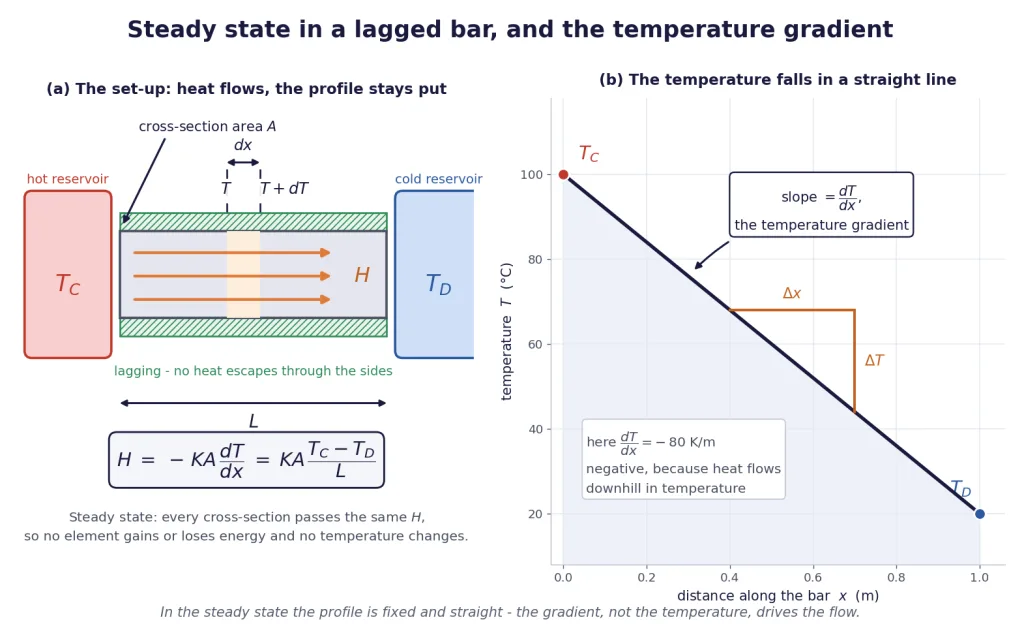
For the first minute or so, every slice of the bar is warming up: it takes in more heat from its left than it passes on to its right, and it banks the difference. This is the transient state, and it is genuinely hard to describe.
Wait long enough, though, and something clean happens. Every slice reaches a temperature at which the heat it receives per second exactly equals the heat it passes on per second. It has nothing left over to bank, so its temperature stops changing.
Key Point — the steady state:
A bar is in the steady state when the temperature at every point has stopped changing with time. Then:
- the same heat current flows across every cross-section, all along the bar;
- no element gains or loses energy;
- the temperature is still different at different points — it falls smoothly from to .
Steady state is NOT thermal equilibrium. In equilibrium everything is at one temperature and no heat flows at all. In the steady state heat is pouring through continuously, and the temperature varies from place to place. The one thing that is constant is time, not space.
The temperature gradient
The rate at which temperature falls as you walk along the bar has a name, and once you have the name the whole subject gets simpler.
Key Point — temperature gradient:
The temperature gradient is the rate of change of temperature with distance: measured in kelvin per metre (K/m, the same as °C/m). It is negative in the direction heat flows, because heat runs downhill in temperature.In the steady state, for a uniform bar, the gradient is the same everywhere, so the temperature falls in a straight line and
The temperature gradient as a named quantity sits outside the rationalised syllabus body text, yet Boards, JEE and NEET all ask for it by name every year, so it is developed here from first principles.
Here is why the name earns its keep. Heat flow is not driven by temperature; it is driven by the temperature difference per unit length. A rod with its ends at 100°C and 0°C conducts twice as fast if you halve its length, even though the end temperatures have not changed at all. The gradient is what doubled.
The conduction law
Experiment gives three proportionalities, and none of them is a surprise.
- — a bigger temperature difference drives more heat.
- — a fatter bar carries more, because it is really several thin bars side by side.
- — a longer bar carries less, because the same drop is spread over more distance, so the gradient is gentler.
Put them together and give the constant a name.
Key Point — the law of conduction: or, in the form that is true point by point,
- is the heat current — energy per second, in watt.
- is the thermal conductivity of the material, in W/(m K), also written J s m K.
- The minus sign in the second form says heat flows down the gradient. It is not optional in a derivation, and it disappears whenever you write the difference as with the hotter.
The unit and dimensions of , both examinable:
[Board Important] A one-line definition worth memorising: the thermal conductivity of a material is the heat flowing per second through unit area of a slab of unit thickness when its two faces differ in temperature by one kelvin. Say "per second" and "unit area" and the mark is yours.
The one place kelvin does not matter — say so out loud
Every other law in this chapter that involves temperature demands kelvin. This one does not, and it is worth knowing exactly why.
depends only on the difference . A rise of 50 degrees Celsius is a rise of 50 kelvin — the two scales have identical degree size, they only differ in where zero sits, and a difference does not care where zero sits. So in you may put in either unit and get the same number.
But the moment a problem asks you for a ratio of temperatures, or feeds a temperature into a fourth power, kelvin is compulsory again. Section 10 will not let you forget it. Here, write " K" and move on.
Real Conductivities, and What They Explain
Numbers make the symbol mean something. Every value in this table is used somewhere in this section or the next.
Thermal conductivities of common materials
| Material | (W/(m K)) | Material | (W/(m K)) |
|---|---|---|---|
| Silver | 406 | Ice | 1.6 |
| Copper | 385 | Concrete | 0.8 |
| Aluminium | 205 | Glass | 0.8 |
| Brass | 109 | Brick | 0.72 |
| Iron | 79 | Water | 0.6 |
| Steel | 50.2 | Body fat | 0.20 |
| Lead | 34.7 | Insulating brick | 0.15 |
| Mercury | 8.3 | Wood | 0.12 |
| Hydrogen (gas) | 0.14 | Felt / glass wool | 0.04 |
| Thermacole (EPS) | 0.033 | ||
| Air | 0.024 | ||
| Argon (gas) | 0.016 |
These values change a little with temperature, but over the range of these problems you can treat them as constant.
Read the table for the pattern
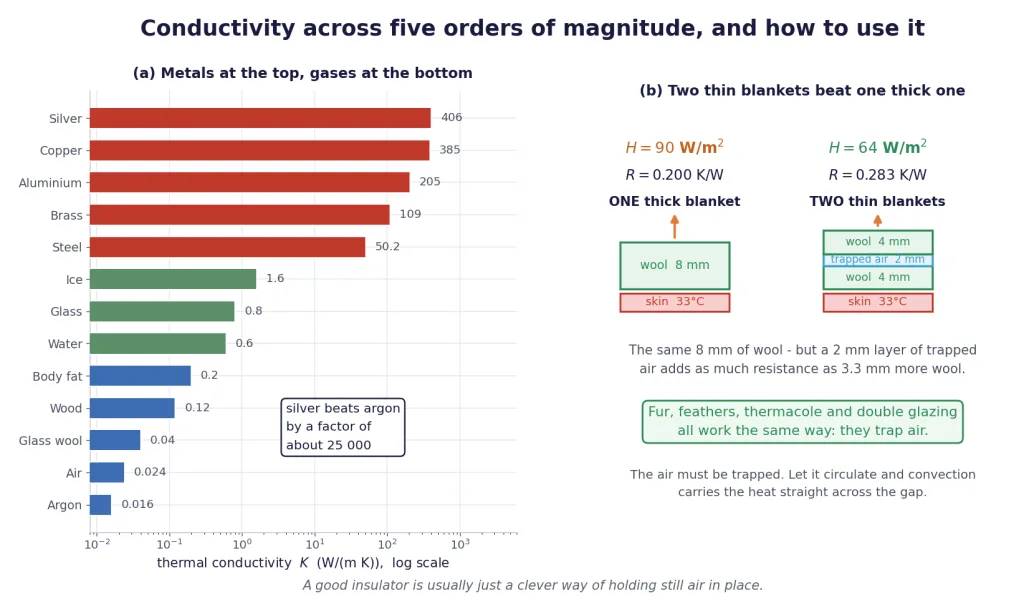
Silver beats argon by a factor of about 25 000. That is the span you are dealing with — more than four orders of magnitude — and it is the reason the same physical law produces such wildly different everyday behaviour.
- Metals sit at the top, exactly as the free-electron picture says they must. Silver is the best conductor of heat known at room temperature, and it is also the best conductor of electricity. Copper is a whisker behind and vastly cheaper, which is why it is used for both wiring and the base of a good pan.
- Non-metallic solids sit in the middle, from ice at 1.6 down to wood at 0.12.
- Gases sit at the bottom. Air is 0.024, sixteen thousand times worse than copper.
- Hydrogen is the odd one out among gases at 0.14, roughly six times better than air. Its molecules are the lightest there are, so at the same temperature they move fastest and shuttle energy across most quickly.
- Water at 0.6 is a poor conductor — worse than ice, and only twenty-five times better than air. Everything a kettle appears to do quickly, it does by convection, not conduction. Section 9 makes that quantitative.
[NEET Important] Two facts from this table get asked directly. Ice conducts nearly three times as well as liquid water (1.6 against 0.6), which matters for a frozen pond. And body fat is a genuine insulator at 0.20, which is why a layer of subcutaneous fat is a mammal's first defence against the cold.
Why a metal spoon feels colder than a wooden one
Leave a steel spoon and a wooden spoon on the same table overnight. In the morning both are at exactly the same temperature — say 25°C. Touch each. The steel feels distinctly colder.
Your skin is not a thermometer. It reports the rate at which heat is leaving it.
Your fingertip is at about 33°C. Press it on the steel and heat pours out of the skin into the spoon, which whisks it away into the rest of the metal as fast as it arrives. The surface of your skin cools quickly and sharply, and the nerve endings shout "cold". Press it on the wood and heat leaks out about four hundred times more slowly; the wood immediately under your finger warms up to nearly skin temperature and the flow almost stops. Your skin barely cools, and reports "not cold".
The same argument run backwards is a warning. A metal object at 60°C feels far hotter than a wooden one at 60°C, and will burn you when the wood will not — because the metal delivers heat into your skin just as efficiently as it took it away. This is why the handle of a good pan is wood or bakelite while the base is copper.
Key Point: The sensation of hot and cold is not a measurement of temperature. It is a measurement of the heat current between the object and your skin, and that depends on the object's conductivity as much as on its temperature.
A few more things this table explains
- Copper-bottomed pans. Copper spreads the flame's heat sideways across the whole base before it reaches the food, so nothing scorches over the burner while the rim stays cool.
- Concrete roofs get unbearable. Concrete at 0.8 is far worse than a metal, but it is nowhere near low enough. A layer of earth, foam or a false ceiling above the slab is what actually keeps the room habitable — and the numbers for that are in the worked examples.
- Mercury in a thermometer reaches the bulb's temperature quickly partly because, being a metal, it conducts well.
- A nuclear reactor core has to shift enormous power out of a small volume, which is why its coolant loops are engineered so hard. Conduction alone could never do it.
Thermal Resistance — The Idea That Makes This Easy
This is the most valuable thing in the section, so read it twice.
Thermal resistance and the series-parallel treatment sit outside the rationalised syllabus body text, yet they are the form in which JEE Main, JEE Advanced and NEET set almost every conduction question, so they are developed here from first principles.
The rearrangement that changes everything
Start from the law you already have and simply move the pieces around:
The bracket depends only on the slab — its material and its shape — and not at all on how hot you make it. Give it a name.
Key Point — thermal resistance: is the thermal resistance of the slab, measured in kelvin per watt (K/W).
Its reciprocal is the thermal conductance.(In this section always means thermal resistance. The only other place the letter appears in this chapter is as the gas constant alongside molar specific heats — a different quantity in a different equation, and we will say which one we mean whenever both are in view.)
Now look at what you have written:
It is Ohm's law. Not "a bit like" Ohm's law — the same equation, with the same structure, for the same reason.
| Electricity | Heat |
|---|---|
| potential difference | temperature difference |
| current (coulomb per second) | heat current (joule per second) |
| resistance | thermal resistance |
| conductivity | thermal conductivity |
Notice that sits where conductivity sits, not where resistivity sits — so a good conductor has a small thermal resistance, exactly as you would want.
Every habit you built in a circuits chapter now transfers. That is the payoff.
Slabs end to end: resistances in SERIES
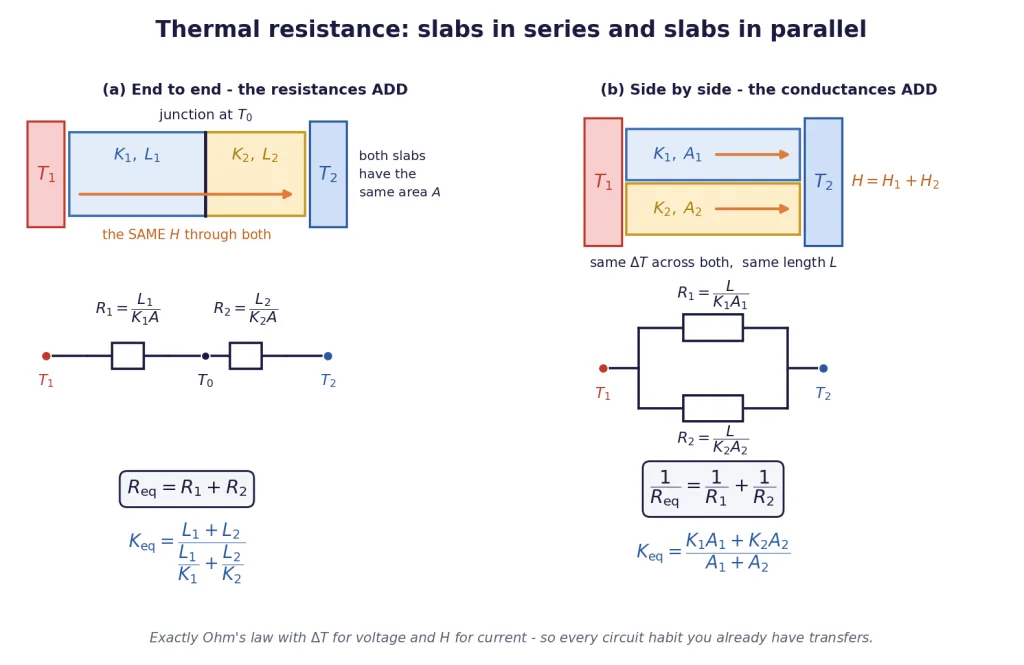
Two slabs of the same area , joined face to face, the outer faces held at and . Because the sides are lagged, all the heat that crosses the first slab must cross the second — there is nowhere else for it to go.
Same current through both: that is a series connection. So the temperature drops add:
Key Point — series: and the junction temperature follows from writing the same two ways: — the temperatures weighted by the conductances, not by the resistances. Sanity check: if slab 1 is a very good conductor ( tiny) the junction sits almost at , which is right.
The equivalent conductivity of a compound bar, in one line. Same area throughout, lengths and :
And if the two pieces are the same length, , this collapses to the harmonic mean:
That took one line. Deriving it by writing out both heat currents, eliminating the junction temperature and simplifying takes about eight, and most of the marks lost in this topic are lost in those eight lines.
Slabs side by side: conductances in PARALLEL
Now put the two slabs alongside one another, both spanning the full length , both with the same pair of faces at and . Each carries its own current and the two currents add:
Key Point — parallel: Conductances add. With the same length throughout and areas , : — an area-weighted arithmetic mean. If the areas are equal it is just .
Two useful sanity checks you should carry into an exam:
- In series the equivalent is always closer to the worse conductor. The bad slab is the bottleneck, and the harmonic mean is always less than the arithmetic mean. Concrete plus foam behaves almost like foam.
- In parallel the equivalent is always closer to the better conductor, because the heat takes the easy route. Copper plus steel side by side behaves almost like copper.
[JEE Tip] Before writing anything numerical, draw the network. One box per slab, marked with ; join them the way the heat actually flows; then read off series or parallel. Questions that look frightening — a wall with an insulating panel over half of it, a rod with a fatter middle section, a lagged pipe wrapped in two layers — become three lines of circuit algebra. Section 13 pushes this to the harder networks; get the two-element case automatic first.
Key Point — the four one-liners to memorise:
- , in K/W, and .
- Series (end to end): add . Same through each.
- Parallel (side by side): add . Same across each.
- Junction temperature: same both sides, so is the conductance-weighted average.
Insulation, and Why Everything Good Is Really Just Trapped Air
Look at the bottom of the conductivity table again. The worst conductors on it are gases. That single fact is the design principle behind almost every insulator you will ever meet.
Key Point — the trapped-air rule:
Fur, feathers, wool, cotton, thermacole, glass wool, a woollen sweater, a double-glazed window, a straw roof and a hollow brick are not good insulators because of what they are made of. Wool has , glass has — neither is remarkable.They are good insulators because they hold a large volume of air in small pockets where it cannot circulate. The air, at , does the insulating. The material's only job is to stop the air from moving.
Why two thin blankets beat one thick one
This is the classic, and now you can prove it in three lines instead of arguing about it.
Take one blanket 8 mm thick, of wool with . Per square metre:
Now use two blankets of 4 mm each, with a 2 mm layer of still air trapped between them. Three slabs in series, so the resistances simply add:
Same 8 mm of wool. Forty-two per cent more resistance. With skin at 33°C and a room at 15°C, the heat loss drops from 90 W per square metre to 64 — a saving of about 29%, from a 2 mm gap of nothing at all.
Look at where the resistance came from. That 2 mm of air contributed 0.0833 K/W — as much as 3.3 mm of extra wool would have. Millimetre for millimetre, still air is about 1.7 times better than the wool holding it.
But the air must be trapped. Leave the gap wide open and the air will start to circulate — warm air rising on the skin side, cold air falling on the outside — and convection will ferry heat straight across the gap, wiping out the resistance you just calculated. Every good insulator therefore breaks its air into pockets small enough that no circulation can get going. Section 9 explains exactly what it is that has to be prevented.
The same idea, six more times
- Fur and feathers. The hairs and barbs themselves are a small part of the volume. Their job is to hold a still layer of air against the animal's skin. A bird fluffing up in the cold is not adding feathers — it is thickening its air layer. Wet fur is a disaster precisely because water, at 0.6, has displaced the air — twenty-five times worse than the air it replaced.
- A woollen sweater. Loosely knitted wool is mostly air. Compress it — sit on it, or wear it soaked — and it stops working.
- Thermacole (expanded polystyrene) and a cool box. Roughly 98% trapped air by volume. This is why a thermacole box keeps ice for hours, and the worked examples put a number on it.
- Double glazing. Two panes of glass with a sealed gap between them. The glass contributes almost nothing to the resistance; the gap is nearly all of it, as the worked example shows. Some units use argon instead of air, at , for a further gain.
- Mud walls, hollow bricks and a straw roof. All the same trick, all much cooler inside than a bare concrete room in an Indian summer.
- Body fat. At it is a real insulator in its own right, which is why marine mammals carry blubber rather than fur.
Where insulation is deliberately not wanted
The same law run in the other direction is engineering. A heat sink on a processor and the fins on a motorcycle engine are shaped to give the largest possible area and the shortest possible path in a high- material — minimum thermal resistance, maximum heat current. Cooking pots get copper or aluminium bases. And a thermal paste is squeezed between a chip and its heat sink for exactly one reason: to drive out the layer of trapped air that would otherwise sit in the microscopic gaps and insulate the very thing you are trying to cool.
[Board Important] "Why do we feel warmer wearing two thin shirts than one thick one?" and "Why is a thermacole box a good container for ice?" are the same question, and the answer to both is the trapped air, named explicitly. Say "air has a very low thermal conductivity, about 0.024 W/(m K), and the material's role is to stop it circulating" and you have both marks.
How to Attack a Conduction Problem, and the Traps
The method, every time
- Draw the network. One box per slab or rod. Series where the same heat must cross both; parallel where the heat can choose.
- Write for each, with in metres and in square metres. Convert before you divide — this is where most marks are lost.
- Combine. Add in series; add in parallel.
- . The is across the whole network and is the same number in K and °C.
- Junction temperatures, if asked: go back to one slab you know, and use as the drop across it.
- Total heat, if asked: . Rate is not energy.
The traps, in the order they are set
Trap 1 — adding conductivities in series. is never for slabs end to end. It is the harmonic mean when the lengths are equal, and the general expression otherwise. Adding like that is a parallel result being used on a series problem, and it is the single commonest wrong answer in this topic.
Trap 2 — mixing up which is series and which is parallel. Ask one question: can the heat choose a path? If it must cross both slabs one after the other, it is series. If it can go through either, it is parallel. "End to end" is series; "side by side" is parallel.
Trap 3 — the area. In a parallel problem the two branches usually have different areas, and forgetting that turns a weighted average into a plain one. In a series problem the areas may differ too — then you must keep inside each and cannot cancel it.
Trap 4 — thinking needs converting. It does not, here. K and °C are the same number. Convert to kelvin when a ratio or a power of temperature appears — Section 10 — not for a difference.
Trap 5 — rate versus total. is watt. If a question asks how much ice melts in an hour, you need first and then .
Trap 6 — assuming the steady state has arrived. Every formula in this section is a steady-state formula. A question that says "immediately after the ends are connected" is not a steady-state question.
Trap 7 — a slab formula on a curved geometry. For heat flowing radially out of a pipe or a spherical shell, the area grows as you move outwards and is simply wrong; you have to integrate. Section 13 does exactly that.
Two scaling results worth knowing cold
- Cut a rod in half and lay the halves side by side across the same reservoirs. Each half has half the length, so twice the conductance; two of them in parallel gives four times the original heat current.
- Draw a rod out to twice its length at constant volume. The length doubles and the area halves, so goes up by a factor of four and falls to one quarter.
What belongs to the sections either side
- The moment the medium is free to move, this section stops and Section 9 starts. That includes why the trapped air in a blanket has to be trapped.
- Heat crossing a vacuum, a body glowing red, and anything with in it belongs to Section 10, and there the temperature must be in kelvin.
- Radial conduction through a pipe or a shell, conductivity that varies along a rod, ice thickening on a pond, and resistance networks with three or more elements are all built on this section's ideas and are worked in Section 13.
Key Point — the whole section on one card: Series: add , same . Parallel: add , same . in W/(m K), in K/W, in W.
Solved Examples
Conductivities used throughout, unless a problem states otherwise: , , , , , , , , , , , , , , all in W/(m K). Latent heats: J/kg and J/kg.
Example 1: Heat coming through a concrete roof
A flat concrete roof measures 4.0 m by 5.0 m and is 0.15 m thick. On a summer afternoon its outer surface sits at 45°C and its inner surface at 35°C. Take W/(m K). Find (a) the rate at which heat enters the room and (b) the total heat that enters in 8 hours.
Solution:
Collect the quantities in SI. m, m, and the temperature difference is The same 10, whether you call it kelvin or Celsius — only the difference appears.
(a) Apply the conduction law:
(b) Rate is not energy. Multiply by the time in seconds:
Feel the size of that. J is 8.53 kWh — the whole afternoon's output of a one-kilowatt heater, delivered into the room whether you want it or not. That is why a bare concrete roof is unbearable, and Example 7 shows what a 5 cm layer of foam does about it.
Final Answer: (a) 1067 W; (b) J, or 8.53 kWh.
Takeaway: Convert the thickness to metres before you divide, and multiply by the time in seconds at the end. A roof "15 cm thick" is m, and eight hours is 28 800 s.
Example 2: A copper rod — gradient, current and a point temperature
A copper rod 50 cm long with a cross-section of 2.0 cm has its ends held at 100°C and 0°C. The curved surface is perfectly lagged. Find (a) the temperature gradient, (b) the heat current, (c) the temperature at a point 20 cm from the hot end, and (d) the heat conducted in 5 minutes. Take W/(m K).
Solution:
SI first. m, m.
(a) The temperature gradient is the drop divided by the length: Written with its sign, K/m, because temperature falls as increases.
(b) The heat current:
(c) The point temperature. In the steady state, for a uniform rod, the gradient is the same everywhere, so the profile is a straight line. Walking 0.20 m from the hot end costs
(d) The heat in 5 minutes:
Final Answer: (a) 200 K/m; (b) 15.4 W; (c) 60°C; (d) 4620 J.
Takeaway: In a uniform lagged rod the temperature profile is a straight line, so you can interpolate. "The temperature two-fifths of the way along" needs no new physics — just the gradient times the distance.
Example 3: The steel-copper junction
A steel rod 15.0 cm long is joined end to end to a copper rod 10.0 cm long. The free end of the steel is held in a furnace at 300°C and the free end of the copper is at 0°C. The steel rod's cross-section is twice that of the copper. Both are lagged along their length. Find the temperature of the junction in the steady state. Take and W/(m K).
Solution:
Why a junction temperature exists at all. The lagging means heat cannot escape sideways, so in the steady state every cross-section of the pair passes the same heat current. Whatever crosses the steel must cross the copper.
Write the two conductances. Let the copper's area be , so the steel's is :
Set the two currents equal with the junction temperature: The unknown area cancels — it always does when only a ratio of areas is given.
Sanity check. Copper is by far the better conductor here, so it offers almost no resistance and the junction sits very close to the cold end's temperature. It does: 44.4°C is much nearer 0 than 300.
Final Answer: The junction is at 44.4°C.
Takeaway: The junction sits close to whichever end is joined through the smaller resistance. Use that to check your answer before you write it down — a junction temperature that lands near the high-resistance end is a sign you have inverted something.
Example 4: An iron-brass compound bar, all three parts
An iron bar ( m, m, W/(m K)) is soldered end to end to a brass bar ( m, same area, W/(m K)). The free ends are held at 373 K and 273 K. Find (a) the junction temperature, (b) the equivalent thermal conductivity of the compound bar, and (c) the heat current through it.
Solution:
(a) Equal currents give the junction. With the same and the same for both, the conductances are proportional to the conductivities alone: Note the junction is pulled towards the brass end, because brass conducts better and so drops less temperature across itself.
(b) The equivalent conductivity. Add the resistances in series, then ask what single conductivity would give that resistance over the full length : It lies between 79 and 109, and — as promised — nearer the poorer conductor.
(c) The heat current, from the compound bar as a whole:
Cross-check on a single bar, which must give the same number:
Final Answer: (a) 315 K; (b) 91.6 W/(m K); (c) 916 W.
Takeaway: Always finish a compound-bar problem by recomputing from a single bar. If the two routes disagree, your junction temperature is wrong, and you will find out in ten seconds instead of losing every mark that follows.
Example 5: Copper and steel side by side — a parallel pair
A copper rod and a steel rod, each 1.0 m long and each of cross-section 4.0 cm, are placed side by side so that both have one end at 100°C and the other at 0°C. Find (a) the heat current in each, (b) the total heat current, and (c) the equivalent thermal conductivity of the pair.
Solution:
Recognise the connection. Both rods span the same two reservoirs, so both have the same and the heat can go through either. That is parallel, and the currents add.
(a) Each rod separately, with m:
(b) Add them:
(c) The equivalent conductivity over the combined area m: which is exactly , the arithmetic mean, as it must be for equal areas.
The point of the exercise. Copper carries of the heat. In parallel the good conductor takes almost everything, and the equivalent sits close to it.
Final Answer: (a) 15.4 W and 2.01 W; (b) 17.4 W; (c) 217.6 W/(m K).
Takeaway: Series pulls the equivalent towards the WORSE conductor; parallel pulls it towards the BETTER one. Two rods of and give 91.6 in series (Example 4's arithmetic) but 218 in parallel. Same materials, opposite behaviour.
Example 6: Two thin blankets against one thick one
Compare, per square metre, (a) a single wool blanket 8.0 mm thick with (b) two wool blankets of 4.0 mm each trapping a 2.0 mm layer of still air between them. Take and W/(m K), skin at 33°C and the room at 15°C.
Solution:
Work per square metre, so m throughout and comes out directly in K/W.
(a) One thick blanket:
(b) Three slabs in series, so the resistances add:
Compare. The loss falls by with exactly the same 8 mm of wool. The whole gain came from a 2 mm gap of nothing.
Where the gain came from. The air layer contributed 0.0833 K/W. To buy that much resistance with wool you would need — 3.3 mm of extra wool. Millimetre for millimetre, still air beats wool by a factor of .
Final Answer: 90 W/m for one thick blanket against 63.5 W/m for two thin ones — a 29% reduction.
Takeaway: The trapped air is the insulator; the blanket is the container. And it only works while the air stays still — open the gap up and convection will short it out.
Example 7: A concrete roof with a foam layer, and the junction temperature
The roof of Example 1 — 20 m of concrete, 0.15 m thick, — is covered with 5.0 cm of foam insulation with W/(m K). The outer surface of the foam is at 45°C and the inner surface of the concrete at 25°C. Find (a) the rate of heat entry, (b) the temperature at the foam-concrete junction, and (c) the improvement over the bare roof.
Solution:
Draw the network: two slabs in series, same area 20 m.
(a) Add them and divide:
(b) The junction temperature. The same 278 W crosses the foam, so the drop across the foam alone is Starting from the outer face of the foam at 45°C: Check it closes. The drop across the concrete must then be K, and °C, which is exactly the inner face we were given. Good.
(c) Compare with the bare roof, from Example 1's geometry with the full 20 K across the concrete alone: The foam cuts the heat gain to about one-eighth.
Read the temperatures, not just the watts. Of the 20 K available, 17.4 K is dropped across the 5 cm of foam and only 2.6 K across the 15 cm of concrete. In a series stack, nearly all the temperature difference appears across the highest-resistance element — and that element is the one doing the work.
Final Answer: (a) 278 W; (b) 27.6°C at the junction; (c) the loss falls to 13% of the bare-roof value.
Takeaway: In series, the biggest resistance takes the biggest temperature drop. Spotting which slab that is tells you where the insulation actually lives before you compute anything.
Example 8: Two scaling questions with no numbers at all
A uniform rod conducts heat at a rate between two reservoirs. (a) It is cut into two equal halves and the halves are placed side by side between the same two reservoirs. What is the new rate? (b) A different rod is drawn out to twice its length at constant volume. What happens to its heat current under the same ?
Solution:
Work in resistances. It is far quicker. For the original rod, and .
(a) Each half has length and the full area , so Two of them in parallel:
(b) Constant volume means is fixed. Doubling therefore halves :
A word on why this is worth practising. Both answers are factors of four, arrived at from opposite directions: halving the length while keeping the area doubles the conductance twice over, and doubling the length while halving the area quarters it. Getting a factor of 2 for either is the standard slip.
Final Answer: (a) ; (b) .
Takeaway: For any "what if the rod is reshaped" question, write and track and separately. Never try to reason about directly — that is how the factors get lost.
Example 9: How fast does the ice in a thermacole box melt?
A cubical cool box of side 30 cm has walls 4.0 cm thick made of thermacole (expanded polystyrene), W/(m K). It is packed with ice at 0°C and left in a room at 35°C. Find (a) the rate at which heat leaks in and (b) the mass of ice that melts each hour. Take J/kg.
Solution:
Total surface area of a cube of side 0.30 m: (Strictly the outer surface is a little larger than the inner one; treating the wall as a flat slab of this area is the standard approximation and is good to a few per cent for a thin wall.)
(a) The heat current: Fifteen and a half watts through more than half a square metre of wall, with a 35 K difference across it. That is what 4 cm of thermacole buys you.
(b) Heat in one hour, then mass melted:
So about 169 g of ice per hour, and a kilogram of ice would last which is roughly what a real cool box manages, and the reason it does is 4 cm of trapped air.
Final Answer: (a) 15.6 W; (b) 169 g of ice per hour.
Takeaway: Conduction gives you a rate; latent heat converts it into a mass. Two steps, and the join between them is . Skipping straight from watts to kilograms is a guaranteed zero.
Example 10: Single glazing against double glazing
A window measures 1.5 m by 1.0 m. Compare (a) a single pane of glass 4.0 mm thick with (b) a double-glazed unit — two 4.0 mm panes with a sealed 12 mm gap of still air between them. Inside is at 25°C, outside at 5°C. Take and W/(m K).
Solution:
Area m, and K in both cases.
(a) One pane:
(b) Three slabs in series — glass, air, glass:
The ratio is 102. Two orders of magnitude, and look where it came from: the air gap contributes 0.3333 of the total 0.340 K/W, which is 98% of the resistance. The glass is very nearly irrelevant.
Two junction temperatures, for interest. The drop across each pane is K, so the inner pane's outer face is at 24.8°C and the outer pane's inner face at 5.2°C. Almost the entire 20 K is dropped across 12 mm of air.
An honest caveat. 6000 W through one windowpane is not what a real window loses — in practice a thin film of nearly still air clings to each glass surface and adds resistance that this idealised calculation ignores, so the true single-pane figure is far smaller. What the calculation does establish correctly is the comparison: the gas layer, not the glass, does the insulating, and that conclusion is unaffected.
Final Answer: (a) 6000 W idealised; (b) 58.8 W — about 100 times less, with 98% of the resistance in the air gap.
Takeaway: In a series stack, the element with the largest owns the problem. Here against — a hundred to one before you have touched the area.
Example 11: How hot is the bottom of the pan?
A copper-based pan has a base of area 0.030 m and thickness 3.0 mm. Water inside boils at 100°C, and 250 g of it evaporates in 5.0 minutes. Find the temperature of the outer (flame-side) face of the base. Take W/(m K) and J/kg.
Solution:
Work out the power actually crossing the base, from the water it is boiling away:
Now run the conduction law backwards to find the temperature difference that must exist across the base to push that current:
So the outer face is at
What the answer is telling you. Nearly two kilowatts is crossing that base, and it takes less than half a degree of temperature difference to drive it. That is what a thermal resistance of K/W means in practice. Try the same sum with a base of the same size made of glass () and you would need a drop of 235 K — the pan would glow before the water boiled.
Final Answer: The outer face of the base is at about 100.5°C.
Takeaway: A metal in a well-designed heat path has almost no temperature difference across it. When you find a huge across a metal component, suspect an error — or a contact gap full of air.
Example 12: Why the metal spoon feels colder
A steel spoon and a wooden spoon have both been sitting on a table at 25°C all night. You touch each with a fingertip at 33°C. Model the contact as a 1.0 cm patch conducting through the first 2.0 mm of the object, whose far side stays at 25°C. Compare the two rates of heat loss from your skin. Take and W/(m K).
Solution:
Both spoons are at the same temperature. So the difference cannot be temperature — it has to be the rate at which each drains heat from your finger.
Common quantities: m, m, K.
Steel:
Wood:
The ratio is the whole answer: Every geometric factor cancelled. Your skin loses heat to the steel more than four hundred times faster, and it is that rate your nerve endings report.
Honest about the model. The real contact problem is a transient one — the wood immediately under your finger warms up within a fraction of a second and the flow drops away, while the steel keeps draining because it carries the heat off. Doing that properly brings in the density and specific heat capacity as well as . But the conductivity ratio is the dominant term, and it is what the question is testing.
Final Answer: About 20 W into the steel against 0.05 W into the wood — a ratio of 418, equal to the ratio of the conductivities.
Takeaway: "Feels colder" means "takes heat out of me faster". Run the same argument at 60°C and the metal now feels hotter than the wood and will scald you — same physics, opposite direction.