
Hot Things Cool Fast At First, Then Slowly
Pour a cup of tea at 90°C and leave it on the table. Come back after five minutes and it has dropped a lot. Come back after another five minutes and it has dropped rather less. Come back an hour later and it is at room temperature and staying there.
That pattern — fast at first, slower as it goes, never quite arriving — is not special to tea. A hot casserole does it, a soldering iron does it, a cooling engine block does it. There is a law behind it, and Newton was the first to write it down.
The experiment, done properly
Take about 300 mL of water in a calorimeter with a stirrer, and cover it with a two-holed lid. Put the stirrer through one hole and a thermometer through the other, with its bulb well inside the water.
- Note the room temperature first. Call it . Everything in this section is measured against it.
- Heat the water to about 40°C above the room, then take the heat source away.
- Start a stopwatch and record the water's temperature every minute, stirring gently so the whole body of water is at one temperature.
- Keep going until the water is only about 5°C above the room.
- Plot the temperature against time.
What comes out is a curve that falls steeply at first and then flattens, approaching the room temperature but never crossing it. And the rate of fall at any instant is clearly larger when the water is hotter — that is, when the gap between the water and the room is larger.
Key Point — Newton's law of cooling:
For a body whose temperature is only a little above that of its surroundings , the rate of loss of heat is directly proportional to the temperature difference: Dividing by the body's heat capacity gives the form you will actually use: is the cooling constant, with unit s (or min). It depends on the area of the body, the nature of its surface, and its mass and specific heat capacity — but not on how hot the body is.
Two notes on symbols, before anything goes wrong
The cooling constant is lowercase . Capital means thermal conductivity, measured in W/(m K), and the two are different quantities with different units. The cooling constant is also written elsewhere; here it is , always.
is a difference, so Celsius and kelvin give the same number. This is the one place in the whole chapter where you may safely leave temperatures in degrees Celsius: a gap of 50°C is a gap of 50 K. Wien's law and the Stefan-Boltzmann law demand kelvin because temperatures appear there as ratios and powers. Newton's law only ever sees a difference. Know the difference between the two situations and you will never be caught.
What the law is telling you, in words
The excess temperature is the whole story. How hot the body is in absolute terms does not matter; how far above its surroundings it is does. A body at 60°C in a 20°C room and a body at 40°C in a 0°C room cool at exactly the same rate, other things being equal.
The rate of cooling falls as the body cools. That is why it takes far longer to go from 30°C to 25°C than from 90°C to 85°C, even though both are a 5°C drop.
It never quite gets there. The rate of cooling is proportional to the gap, so as the gap shrinks so does the rate, and the body approaches asymptotically. In practice you stop being able to measure the difference long before it becomes zero.
[Board Important] This law is the reason a cup of tea you want to drink later is better left to cool for a minute before you add the cold milk, not after — it spends that minute at a higher excess temperature, so it loses more heat. That is a genuine exam-favourite discussion question, and Newton's law is the whole answer.
Where the Law Comes From — and Where It Stops Working
Newton's law of cooling is not a fundamental law. It is an approximation to the Stefan-Boltzmann law, valid only in a particular circumstance, and the derivation makes that circumstance perfectly explicit. This is the most valuable block in the section, because once you have seen the derivation you will never misapply the law again.
The derivation, in five lines
Start from the exact statement of what a radiating body loses to its surroundings — the net exchange from the previous section: Here and must be in kelvin, because they appear as fourth powers.
Step 1. Write the body's temperature as its surroundings plus a small excess. Let
Step 2. Expand the fourth power binomially.
Step 3. Now impose the condition. If — and only if — the excess is small compared with the absolute temperature of the surroundings, then the squared, cubed and fourth-power terms are negligible against the linear one, and
Step 4. Substitute back. The terms cancel:
Step 5. Convert a heat rate into a temperature rate, using :
And there it is.
Key Point — Newton's law, derived: Every symbol in is a constant of the body and its surroundings, not of the body's own temperature — which is exactly what makes the law linear.
The law is an approximation, valid only while . It is not a law of nature in its own right.
Look at what that expression for tells you, because questions ask.
- — a body with more surface cools faster.
- — a heavier body, or one made of something with a large specific heat capacity, cools more slowly. This is why a mug of water stays hot far longer than a thin metal spoon.
- — a blackened body cools faster than a polished one, exactly as Kirchhoff's law predicted.
- — the constant depends on the surroundings' temperature. A body cooling in a cold room does not have the same as the same body cooling in a warm one. Most exam problems keep fixed and this never shows up, but it is worth knowing that is not a property of the body alone.
So how small is "small"?
The derivation dropped everything after the linear term. Let us measure what that cost, with K.
| Excess | Newton's predicted rate as a % of the true rate | Verdict |
|---|---|---|
| 5 K | 97.5% | excellent |
| 10 K | 95.1% | good |
| 20 K | 90.5% | getting shaky |
| 30 K | 86.2% | poor |
| 50 K | 78.2% | wrong |
| 100 K | 61.7% | badly wrong |
| 180 K (a body at 207°C in a 27°C room) | 43.2% | useless |
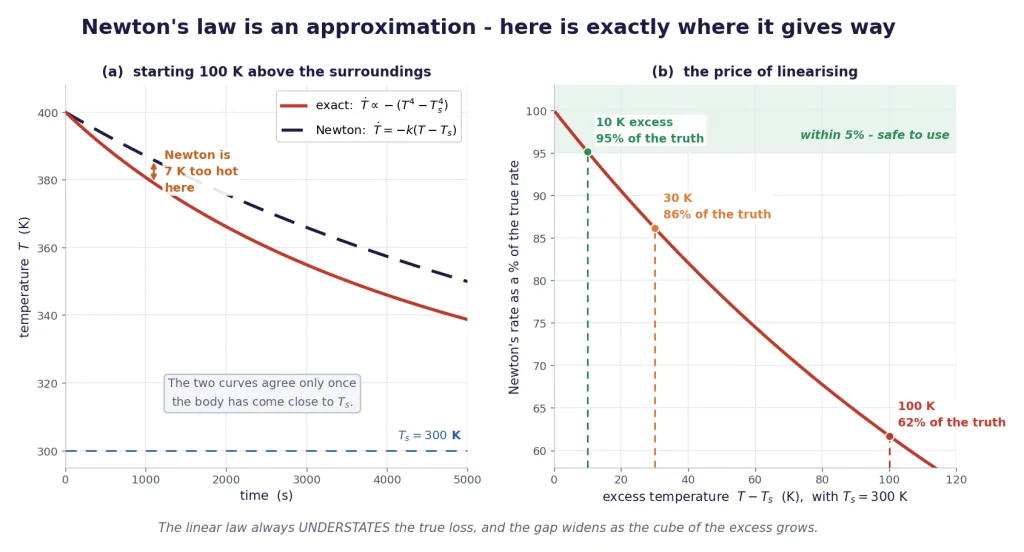
The right-hand panel of the figure is that table drawn out. The linear law always UNDERSTATES the true loss, because it throws away positive terms, and the shortfall grows steadily with the excess.
The left-hand panel shows what that does to a whole cooling curve. Take 300 g of water with 0.030 m of exposed surface and , starting 100 K above its surroundings. Integrating the exact fourth-power equation numerically, the excess halves in about 3520 s. Integrating Newton's linear version with the same , it takes 4990 s — Newton is 42% too slow. Only when the body has come down close to do the two curves finally agree.
Key Point — the range of validity, stated honestly:
For radiation alone, Newton's law is good to about 5% out to an excess of roughly 10 K, and should not be trusted much beyond 30 K.
In a real laboratory, where convection is also carrying heat away and convective loss is much closer to linear in , the law works usefully out to about 30 to 40 K — which is precisely why the standard experiment starts about 40°C above the room and not 200°C above it.
[JEE Tip] If a problem hands you a body at 200°C in a room at 20°C and asks you to apply Newton's law, the physics answer is that the law does not apply there. If the question insists, use it — that is what is being examined — but if you are asked to comment, say that the excess of 180 K is far too large a fraction of K for the binomial approximation to hold, and that the true rate of loss is more than twice what the linear law predicts.
Solving It: The Exponential, and the Straight Line That Proves It
Newton's law is a differential equation, and it is one of the two or three you can actually solve by hand this year. Do it once and the result is yours forever.
The integration
Start from
Separate the variables — everything with on one side, everything with on the other:
Integrate both sides. The left is a standard logarithm because is a constant:
Fix the constant from the starting condition. At the body is at , so :
Bring the logarithms together:
Take exponentials of both sides:
Key Point — the solved form: The excess temperature decays exponentially: At the body is at ; as it approaches and never crosses it.
is the time constant: the time in which the excess falls to , about 37%, of its starting value.
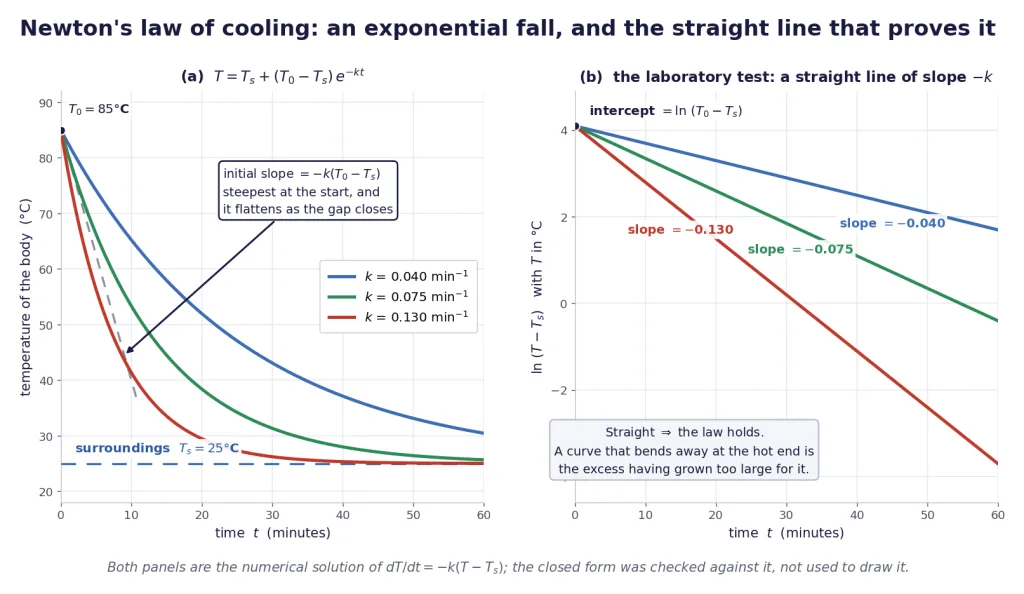
The left-hand panel is that solution drawn for three different cooling constants. All three start at 85°C, all three settle towards 25°C, and the only difference is how fast. A larger means a larger area, a blacker surface or a smaller heat capacity — and a visibly steeper fall.
Notice the dashed tangent at the start. Its slope is , the steepest the curve ever gets, and the curve flattens from there on because the gap it depends on is closing.
The straight line: how the law is actually tested
An exponential is hard to recognise by eye — plenty of curves look like that. So nobody verifies Newton's law from the cooling curve itself. They take logarithms.
From , compare with :
Key Point — the laboratory test:
A plot of against is a straight line with
- slope , always negative
- intercept on the vertical axis
A straight line means the law holds. Curvature means it does not — and in practice you see that curvature at the hot end of the run, where the excess was too large for the binomial approximation.
The right-hand panel of the figure shows three such lines, one for each cooling constant, all starting from the same intercept because all three bodies started at the same temperature.
The apparatus. A calorimeter of hot water sits inside a double-walled vessel that has water circulating between its walls, holding the surroundings at a steady . One thermometer reads the calorimeter, one reads the enclosure. Temperatures are taken at equal intervals, is plotted against , and the result is a straight line of negative slope. The double wall matters: without it, the "surroundings" would warm up as the experiment ran and would not be constant.
Getting out of two readings
You rarely need a whole graph. Two temperature readings and the time between them are enough, because from the solved form
Key Point — the two-reading formula: where the body goes from to in time . Once you have , every other cooling time for the same body in the same surroundings follows.
[JEE Tip] In a two-stage problem — "cools from A to B in time ; how long from C to D?" — you often do not need at all. Write the logarithm equation for each stage and divide one by the other; cancels and you are left with a single line of arithmetic.
The Average-Temperature Shortcut
Almost every exam problem on Newton's law is set up so that you can solve it in one line, without a single logarithm. Here is the trick, and — more importantly — here is exactly how much it costs you.
The approximation
If the body's temperature falls from to in a time , and that fall is not too large, then the average rate of fall over the interval is , and the average excess over the interval is . Assume Newton's law connects these averages:
Key Point — the average-temperature form: Read it as: (temperature drop) divided by (time taken) equals times (mean temperature minus room temperature).
Everything is a difference, so degrees Celsius are perfectly safe here.
This turns the calculus into arithmetic. And when a problem gives you one cooling stage and asks about another, write the equation twice and divide, so that cancels:
How good is it, really?
This is where most treatments wave a hand. Let us measure instead, by integrating the exact differential equation numerically and comparing.
Case 1 — a small drop. A pan cools from 94°C to 86°C in 2 minutes in a room at 20°C. How long to cool from 71°C to 69°C?
| Method | Answer |
|---|---|
| Exact, by integrating and finding the crossing | 41.96 s |
| The average-temperature shortcut | 42.00 s |
| Discrepancy | +0.10%, about four hundredths of a second |
Case 2 — a bigger drop. Water cools from 70°C to 60°C in 5 minutes in a room at 20°C. How long from 60°C to 50°C?
| Method | Answer |
|---|---|
| Exact | 6.446 min |
| Shortcut | 6.429 min |
| Discrepancy | %, about one second in six and a half minutes |
Case 3 — a large drop. A body falls from 90°C to 30°C in a room at 20°C — a drop of 60°C across an excess that starts at 70 and ends at 10.
| Method | time |
|---|---|
| Exact, | 1.946 |
| Shortcut, | 1.500 |
| Discrepancy | % |
Key Point — when the shortcut is safe:
The average-temperature form is an excellent approximation as long as the temperature drop across one stage is small compared with the excess temperature — a few degrees out of thirty or forty. Under those conditions it is accurate to a fraction of one per cent, and it is what every marking scheme expects.
It falls apart when a single stage covers a large fraction of the excess. If a body drops from 90°C to 30°C in a 20°C room in one step, use the logarithm.
Notice that this is a second, separate approximation, stacked on top of the binomial one. The binomial approximation replaced by something linear; the average-temperature shortcut then replaces an exponential decay by a straight line over one interval. Both are usually fine. Knowing which is which is what separates a confident answer from a lucky one.
Choosing between the two methods
| The question says | Use |
|---|---|
| "cools from 80°C to 78°C" — a small step | the average-temperature shortcut |
| "cools from 80°C to 78°C, then from 60°C to 58°C" — two small steps | divide one shortcut equation by the other; cancels |
| "cools from 80°C to 50°C" — a large step | |
| "find the temperature after time " | |
| "a graph of against " | slope , intercept |
[NEET Important] The commonest single mistake in this topic is forgetting to subtract — writing with no room temperature in it at all. The excess is what drives the cooling; the average temperature by itself means nothing.
The Solar Constant
The solar constant sits outside the rationalised syllabus body text. It appears in Board question papers and NEET papers every year, and it is the number the whole greenhouse discussion rests on, so it is developed here.
Everything so far has been about a body losing heat. The Earth is a body gaining it, and the accounting starts with a single number.
Key Point — the solar constant:
The solar constant is the energy from the Sun arriving per unit time on unit area held perpendicular to the Sun's rays, just outside the Earth's atmosphere. It is a flux, so its unit is watts per square metre. It is called a constant because it varies by only about 3% over the year, as the Earth's slightly elliptical orbit takes it nearer and further.
Where the number comes from
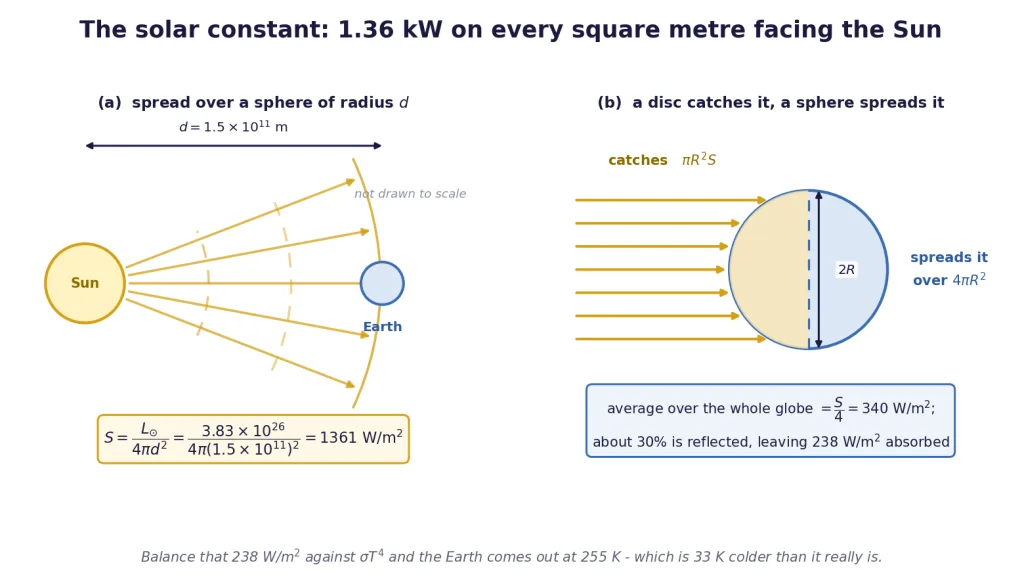
The Sun's total output, its luminosity, is W. That energy spreads out over a sphere, and by the time it reaches us that sphere has a radius equal to the Earth's distance, m. So
Run it the other way and you can weigh the Sun's temperature without leaving the room. The Sun's surface radiates per square metre, and by the time it has spread from the Sun's surface to our distance it has been diluted by : With m this gives K — in excellent agreement with the 6000 K that Wien's law read off the Sun's peak wavelength in the previous section. Two completely different measurements, one answer. That agreement is why we believe either of them.
The factor of four that everyone forgets
The Earth is a sphere, but sunlight arrives as a parallel beam. So:
- The Earth intercepts sunlight over its cross-sectional disc, of area . Total power caught: .
- The Earth radiates away from its whole surface, of area — day side and night side both.
Divide one by the other:
Key Point — the disc-to-sphere factor: The 1.36 kW/m that a solar panel sees at noon on the equator becomes only 340 W/m when averaged over the entire planet, day and night.
And not even all of that is absorbed. About 30% is reflected straight back to space by clouds, ice, snow and the ocean surface — that fraction is called the Earth's albedo. So the flux actually absorbed is
Hold on to 238 W/m. The next block is entirely about what happens to it.
[Board Important] "Define the solar constant and give its value" is a straight one-mark question. The definition must contain per unit area held perpendicular to the rays and just outside the atmosphere; the value is kW/m, routinely rounded to 1.4 kW/m in calculations.
The Greenhouse Effect
The greenhouse effect was also cut from the rationalised syllabus body text. It is asked in Boards and in NEET every year, and it is the single most consequential application of everything in these two sections, so it is developed here.
The calculation that says the Earth should be frozen
We know the Earth absorbs 238 W/m on average. In the long run it must radiate away exactly as much as it absorbs — otherwise it would heat up or cool down forever. That is Prevost's principle applied to a planet.
So set the outgoing Stefan-Boltzmann flux equal to the incoming absorbed flux:
255 K is C. That is the temperature the Earth's surface ought to have, on this accounting.
The observed global mean surface temperature is 288 K, that is C.
Key Point — the discrepancy that defines the problem: The Earth's surface is about 33°C warmer than a bare radiation balance predicts. Something is holding heat in, and that something is the atmosphere. It is called the greenhouse effect.
Notice how large 33°C is. At C every ocean on Earth would be ice and there would be no liquid water anywhere on the surface. The greenhouse effect is not a problem; it is the reason the planet is habitable. The problem is entirely about changing its size.
The mechanism: two wavelengths that do not overlap
Everything turns on Wien's displacement law, applied twice.
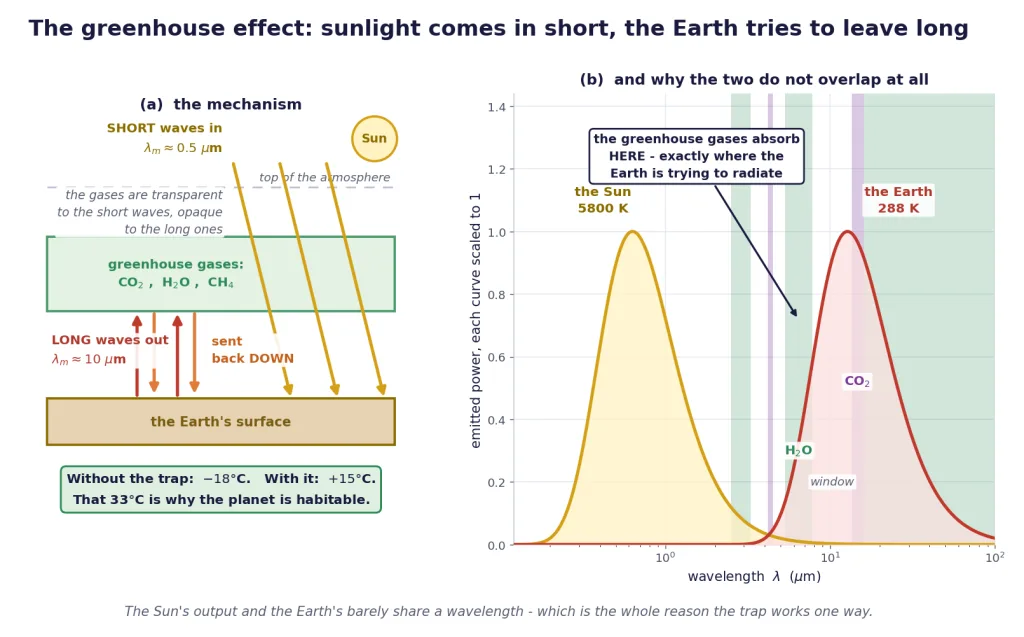
The Sun is at 5800 K. Its radiation peaks at which is visible light — short-wavelength radiation.
The Earth's surface is at 288 K. Its radiation peaks at which is deep in the infrared — long-wavelength radiation, twenty times longer than the Sun's.
Now the crucial fact about the atmosphere: it is not equally transparent at those two wavelengths.
- Sunlight comes in. Carbon dioxide, water vapour and methane hardly absorb at 0.5 m at all, so short-wave sunlight passes almost freely through the atmosphere and reaches the ground.
- The ground warms up and, being at about 288 K, radiates in the infrared around 10 m.
- That is exactly where those gases absorb strongly. The right-hand panel of the figure shows it: the absorption bands of water vapour and carbon dioxide sit squarely on top of the Earth's emission curve and nowhere near the Sun's.
- The absorbed infrared is re-radiated in all directions, and about half of it goes back down. The surface therefore receives energy twice — once from the Sun and once from the sky — and settles at a higher temperature than sunlight alone would give it.
- A little escapes through the so-called atmospheric window between about 8 and 13 m, where none of the gases absorb much. That leak is what keeps the effect finite.
Key Point — the greenhouse effect in one sentence:
The atmosphere is transparent to the Sun's short-wavelength radiation and opaque to the Earth's long-wavelength radiation, so energy comes in easily and leaves with difficulty, and the surface sits about 33°C warmer than it otherwise would.
The gases responsible are called greenhouse gases: carbon dioxide, water vapour, methane, nitrous oxide and the industrial fluorocarbons. Water vapour actually does most of the work; carbon dioxide and methane matter because their concentrations are the ones we are changing.
Why increasing the gases matters
Add more absorbing gas and the atmosphere becomes more opaque in the infrared. Less of the Earth's radiation gets out at a given surface temperature, so the surface has to warm until the outgoing flux again matches the 238 W/m coming in. A new balance is reached, at a higher temperature.
That is the entire physics of global warming, and every term in it appeared earlier in this chapter: Wien's law fixes the two wavelengths, the Stefan-Boltzmann law fixes the balance, and Kirchhoff's law guarantees that a gas which absorbs infrared also emits it.
The same physics, small scale
A glass greenhouse. Ordinary glass transmits visible light very well and infrared very poorly. Sunlight goes straight in, warms the soil and the plants, and the infrared they radiate cannot get back out through the glass. The inside warms up. (In an actual greenhouse a second effect helps: the glass also stops the warm air from being carried away by convection. Radiation is the part that matters for the analogy, and it is the part that gives the effect its name.)
A car parked in the sun. Exactly the same thing. The windscreen passes short-wave sunlight, the seats and dashboard absorb it and warm to 60 or 70°C, they re-radiate in the infrared, and the glass will not let that out. The inside of a closed car on a hot day can reach 60°C or more while the air outside is at 35°C. A windscreen shade works because it reflects the sunlight before it can be absorbed and converted to infrared — it attacks step 1, which is the only step you can reach from outside.
[NEET Important] Be ready to state the mechanism in three sentences: short-wave solar radiation passes through the atmosphere; the warmed surface re-radiates in the long-wave infrared; carbon dioxide, water vapour and methane absorb strongly at those long wavelengths and re-radiate downwards, trapping the energy and raising the surface temperature by about 33°C.
The section on one card
| Idea | Statement | Watch out for |
|---|---|---|
| Newton's law | It is an approximation, not a law | |
| Its origin | Binomial expansion of for | Kelvin in the derivation, Celsius fine in the law |
| The constant | , unit s | Lowercase ; is conductivity |
| Solved form | Never reaches | |
| The log plot | against : slope | Straight line means the law holds |
| The shortcut | Only for small drops; subtract | |
| Solar constant | kW/m; globe average W/m | The factor of 4 is disc over sphere |
| Greenhouse | Short waves in, long waves trapped, C | It is what makes Earth habitable |
Solved Examples
Constants used throughout, unless a problem states otherwise: W/(m K), m K, J/(kg K), J/(kg K), kg/m, and 0°C K.
Example 1: The classic two-stage cooling problem
A pan of hot food cools from 94°C to 86°C in 2 minutes in a room at 20°C. How long will it take to cool from 71°C to 69°C?
Solution:
Both drops are small compared with the excess, so the average-temperature shortcut is legitimate. Write it for the first stage. The mean of 94 and 86 is 90°C, which is 70°C above the room:
Write it for the second stage. The mean of 71 and 69 is 70°C, which is 50°C above the room:
Divide the first equation by the second so that cancels:
How good is that? Solving the differential equation exactly gives min, and the exact time is The shortcut is high by 0.10% — four hundredths of a second in forty-two. It has earned its place.
Final Answer: 42 s (exact value 41.96 s).
Takeaway: When two stages are given, divide one shortcut equation by the other and disappears. You never have to find the cooling constant, and no logarithms are needed.
Example 2: What temperature after the next five minutes?
A body cools from 80°C to 64°C in 5 minutes in surroundings at 24°C. What will its temperature be after a further 5 minutes?
Solution:
First stage, average-temperature form. Mean of 80 and 64 is 72°C, excess 48°C:
Second stage, from 64°C down to an unknown , in another 5 minutes. The mean is :
Clear the fractions and solve:
Check it against the exact solution. From the first stage, min, so after 10 minutes The two agree to four significant figures. For a drop of this size the shortcut is essentially exact.
Final Answer: About 52.6°C.
Takeaway: Notice that the body dropped 16°C in the first five minutes and only about 11°C in the second. The excess is shrinking, so the rate of cooling shrinks with it. Any answer in which the second drop is bigger than the first is wrong on sight.
Example 3: Reading a cooling experiment off its graph
In a cooling experiment a graph of against time is a straight line of slope min and intercept 4.00 on the vertical axis. Find (a) the cooling constant, (b) the initial excess temperature, and (c) how long the body takes for its excess to fall to 10°C.
Solution:
(a) Compare with the theory. The solution of Newton's law gives so the slope is directly:
(b) The intercept is , so The body started 54.6°C above its surroundings.
(c) Use the two-reading formula, with the excess falling from 54.6°C to 10°C:
Why the shortcut is not allowed here. The excess drops from 54.6 to 10, a fall of 82% of itself in one step. That is far too big for the average-temperature form, which would give min, wrong by nearly 19%.
Final Answer: (a) 0.025 min; (b) 54.6°C; (c) 67.9 min.
Takeaway: A log plot hands you as a slope and the starting excess as an exponential of the intercept. And once the excess changes by a large factor, the logarithm is compulsory.
Example 4: Where does actually come from?
A solid copper sphere of radius 2.0 cm, with emissivity 0.90, cools in surroundings at 27°C. Find (a) its cooling constant , and (b) the time in which its excess temperature falls to of its initial value. Take kg/m and J/(kg K).
Solution:
The surroundings' temperature must be in kelvin, because it enters the derivation as a cube:
Geometry of the sphere, with m:
(a) Substitute into the expression derived from the binomial expansion: The numerator is , and the denominator is 115.2. So
(b) The time constant is , and that is precisely the time for the excess to fall to :
A word of caution. This counts radiation only. A real copper sphere in still air also loses heat by convection, which for a small object at a modest excess is comparable or larger, so the real sphere will cool noticeably faster than 69 minutes suggests.
Final Answer: (a) s; (b) about 4160 s, roughly 69 minutes.
Takeaway: is , so it depends on shape, surface and material, and on the surroundings' temperature — but never on how hot the body itself is. That independence is what makes the law linear.
Example 5: Cooling water in a calorimeter
Water in a calorimeter cools from 70°C to 60°C in 5.0 minutes in a room at 20°C. How long will it take to cool from 60°C to 50°C?
Solution:
First stage, average-temperature form. Mean 65°C, excess 45°C:
Second stage. Mean 55°C, excess 35°C:
Compare with the exact treatment. From the first stage, The shortcut is low by 0.27% — about one second in six and a half minutes.
Notice the pattern. The same 10°C drop took 5.0 minutes the first time and 6.4 minutes the second, because the average excess fell from 45°C to 35°C. Cooling gets slower as you go down; it always does.
Final Answer: About 6.4 minutes.
Takeaway: Equal temperature drops take longer and longer. If your answer for the second stage comes out shorter than the first, you have subtracted the room temperature the wrong way round somewhere.
Example 6: The trap — a body far above room temperature
A metal block at 200°C is left in a room at 20°C. A student applies Newton's law of cooling. Estimate what fraction of the true rate of radiative loss the linear law predicts, and comment.
Solution:
Convert to kelvin, because the exact law is a fourth power:
The true net rate is proportional to
Newton's linear version keeps only the first term of the binomial expansion, which is proportional to
Take the ratio:
Comment. Newton's law predicts only about 42% of the true rate of loss — the block really cools well over twice as fast as the linear law says. The reason is visible in the derivation: the expansion demanded , and here , which is not small by any reading of the word.
Final Answer: About 42% of the true rate. Newton's law does not apply at this excess.
Takeaway: Before applying Newton's law, form the ratio in kelvin. Below about 0.05 the law is excellent; above about 0.15 it is doing real damage.
Example 7: The solar constant from the Sun's total output
The Sun radiates W in total and is m away. Find the solar constant.
Solution:
The energy spreads over a sphere whose radius is the Earth's distance. That sphere has area
Divide the total power by that area:
Sense check. That is about 1.36 kW/m, and it is the value just outside the atmosphere. At ground level, after absorption and scattering on the way down, a surface facing the noon Sun on a clear day receives roughly 1.0 kW/m — which is the figure solar-panel manufacturers quote.
Final Answer: W/m.
Takeaway: The solar constant is an inverse-square result and nothing more: total output divided by the area of the sphere the light has spread over.
Example 8: The Sun's surface temperature, from the solar constant alone
Take the solar constant as 1361 W/m, the Sun's radius as m and the Earth's distance as m. Treating the Sun as a blackbody, find its surface temperature.
Solution:
At the Sun's own surface the flux is per square metre. By the time that energy has spread out to our distance it has been diluted by the ratio of the two spherical areas:
Rearrange for :
Substitute. First the geometric factor: Then
Why this matters. The previous section obtained about 6000 K by reading the Sun's peak wavelength and applying Wien's law. This calculation uses a completely different measurement — a flux, not a wavelength — and a completely different law, and lands within 4% of the same answer. Independent routes agreeing is what turns a formula into knowledge.
Final Answer: About 5770 K.
Takeaway: The dilution factor is , the ratio of the areas, not . Flux falls as the inverse square of distance, and forgetting to square is the standard error here.
Example 9: Why the Earth ought to be frozen
The Earth absorbs an average of 238 W/m of solar radiation over its whole surface. (a) Assuming it radiates as a blackbody, find the surface temperature this implies. (b) The observed global mean surface temperature is 288 K. What does the difference tell you?
Solution:
(a) In the long run, in must equal out. Set the Stefan-Boltzmann flux equal to the absorbed flux:
Solve for : which is C.
(b) Compare with reality: The real surface is about 33°C warmer than a bare radiation balance allows. The atmosphere is holding that much heat in — the greenhouse effect.
What C would mean. Every ocean would freeze. There would be no liquid water on the surface of the planet, and no life of the kind we know. The 33°C is not an inconvenience; it is the margin by which the Earth is habitable at all.
Final Answer: (a) 255 K, that is C; (b) the real surface is 33°C warmer, and the greenhouse effect is the difference.
Takeaway: The 255 K figure is the Earth's "effective temperature", and it is what a thermometer in space actually measures looking at the Earth. It is the temperature of the layer from which infrared finally escapes, high in the atmosphere — not of the ground.
Example 10: Sizing a solar panel
A solar panel of area 2.0 m is set facing the noon Sun, where the flux at ground level is 1.0 kW/m. The panel converts 18% of the incident energy to electricity. (a) What is its electrical output? (b) How long must it run to deliver 1.0 kWh?
Solution:
(a) The power falling on the panel:
The electrical output is 18% of that:
(b) One kilowatt-hour is 1000 W for 1 hour, so
A note on the flux used. The solar constant just outside the atmosphere is 1.36 kW/m, but the atmosphere absorbs and scatters roughly a quarter of it, so 1.0 kW/m is the standard figure at ground level for a clear noon. That is why panel ratings are quoted at 1000 W/m.
Final Answer: (a) 360 W; (b) about 2.8 hours.
Takeaway: Use 1.36 kW/m above the atmosphere and about 1.0 kW/m at the ground. Which one a problem wants is always stated; using the wrong one costs a third of the answer.
Example 11: The two wavelengths that make the greenhouse effect work
Find the wavelength of peak emission for (a) the Sun's surface at 5800 K, and (b) the Earth's surface at 288 K. (c) Explain, using the two answers, why the atmosphere traps heat.
Solution:
(a) The Sun, by Wien's law with in kelvin: That is green-yellow light, in the middle of the visible band.
(b) The Earth: That is far infrared, invisible to the eye.
The ratio of the two: The Earth radiates at wavelengths twenty times longer than the Sun does.
(c) The explanation. Carbon dioxide, water vapour and methane are essentially transparent at 0.5 m but absorb strongly around 10 m. So sunlight comes in freely, the warmed ground re-radiates at a wavelength the atmosphere will not let through, that infrared is absorbed and re-emitted downwards, and the surface settles at a higher temperature than the incoming sunlight alone would give it. The whole effect rests on the fact that these two peaks do not overlap.
Final Answer: (a) 0.50 m; (b) 10.1 m; (c) the gases are transparent at the first wavelength and opaque at the second, so energy enters easily and leaves with difficulty.
Takeaway: Two applications of contain the entire mechanism of the greenhouse effect. If you can produce those two numbers you can explain the effect from scratch.
Example 12: The temperature of a satellite in Earth's orbit
A small spherical satellite is in orbit at the Earth's distance from the Sun, where the solar flux is 1361 W/m. Its surface behaves as a blackbody, and it is far enough from the Earth that the planet's own radiation may be ignored. Find its steady temperature.
Solution:
Set up the balance. In the steady state, the power absorbed equals the power radiated.
Power absorbed. A sphere of radius intercepts sunlight over its cross-sectional disc, of area , and being black it absorbs all of it:
Power radiated. The whole surface, area , radiates at per square metre:
Equate, and watch cancel — the answer does not depend on the satellite's size at all:
Substitute: which is C.
Compare with the Earth. The Earth's effective temperature came out at 255 K, colder than this. The difference is entirely the albedo: the Earth reflects about 30% of the sunlight straight back, while our blackbody satellite absorbs all of it. Put the 30% back in and falls by a factor , giving K exactly as before.
Final Answer: About 278 K, or 5°C.
Takeaway: The factor of four is the disc-to-sphere ratio, and the radius always cancels. Absorbing over and radiating over is the single most reused piece of geometry in planetary radiation problems.