
Everything Grows, and the Reason Is Lopsided
You have done this without thinking about it. A jar with a metal lid screwed on too tight goes under the hot tap for half a minute, and then it opens. A thermometer goes into warm water and the mercury thread climbs. A half-inflated balloon left in the sun puffs itself out.
Three different states of matter, one behaviour: heat a thing and it gets bigger. That is thermal expansion, and this section is about exactly how much bigger.
But first, why at all?
The explanation almost everyone gives, and why it is not enough
Ask around and you will be told: "the atoms vibrate more when you heat them, so they need more room." It sounds right. It is not, on its own, an explanation — and seeing why is one of those things that, once seen, you never get wrong again.
Picture two neighbouring atoms in a solid, joined by their mutual force. The energy stored between them depends on their separation , and that dependence is the interatomic potential, . There is one separation at which the energy is least; that is where the pair would sit at absolute zero.
Now heat the solid. The pair gets more energy, so it can climb further up the sides of that energy valley. It oscillates back and forth between two turning points, and it spends its time somewhere between them. The size of the solid is set not by how wide that oscillation is, but by where its midpoint sits.
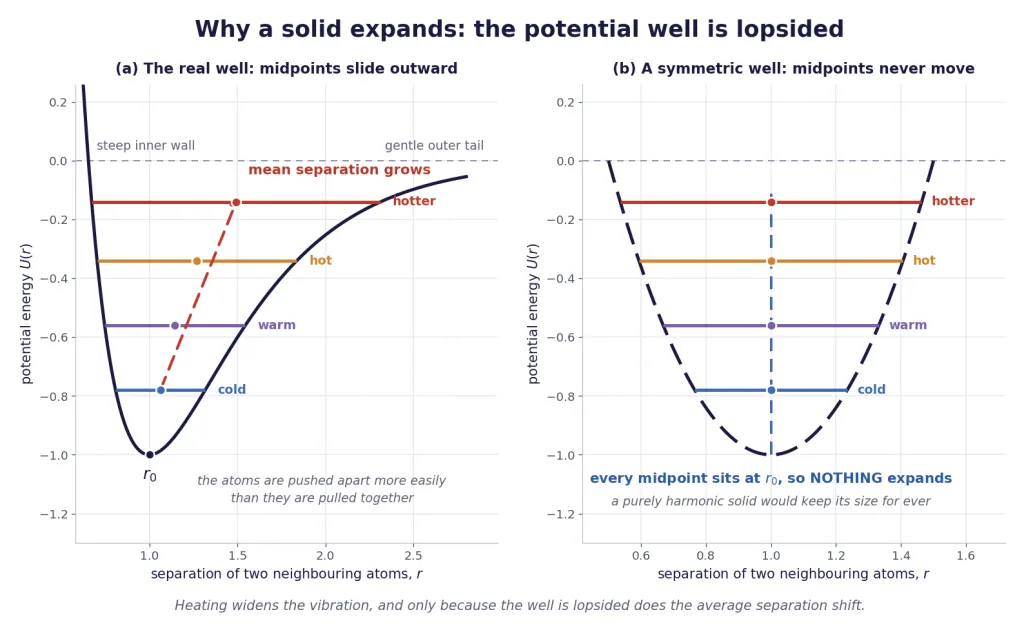
Look at the right-hand panel first. If the valley were a symmetric parabola — the same shape on both sides — then every horizontal chord across it would have its midpoint at exactly . Heat that solid as much as you like; the atoms would swing more violently, and the average separation would not move by a hair. A perfectly harmonic solid does not expand at all.
Now the left-hand panel, which is the real one. The valley is not symmetric. Push two atoms closer than and the repulsion rises viciously steeply — electron clouds do not like being squashed. Pull them apart and the attraction fades away gently. So the inner wall is steep and the outer wall is shallow, and every chord across such a valley has its midpoint to the right of . Climb higher and the midpoint slides further right still.
Key Point — why solids expand:
Thermal expansion happens because the interatomic potential well is asymmetric. As the temperature rises the atoms vibrate with larger amplitude, and because it is easier to move apart than to move together, the mean separation increases. This departure from a perfect parabola is called anharmonicity. Expansion is a consequence of anharmonicity, not of vibration by itself.
Two payoffs from that one idea, both examinable:
- Materials with deep, narrow, steep-sided wells expand least. That is why diamond, quartz and tungsten — all strongly bonded — have tiny expansion coefficients, and why soft metals like lead have large ones. Stiffness and low expansion travel together.
- Nothing says the shift has to be outward at every temperature. In a few substances the packing is odd enough that heating actually pulls the average separation in over some range. Water between 0°C and 4°C is the famous one, and Section 4 is where it earns a whole page.
Linear expansion: the equation you will use most
Take a rod of length and warm it through a temperature change . Experiment gives two facts that are almost obvious once stated:
- the increase in length is proportional to the temperature change;
- for the same temperature change, a longer rod grows more, in direct proportion.
Put them together and the increase in length must be proportional to :
Key Point — linear expansion: is the coefficient of linear expansion. It is the fractional increase in length per unit rise in temperature. Its unit is per kelvin, written K, and its dimensions are — or, if you prefer, it is dimensionless divided by temperature.
The new length is .
Three notes on that formula, all of which cost marks somewhere.
First, is the same number in kelvin and in Celsius. A rise of 40 kelvin is a rise of 40 degrees Celsius, because the two scales have the same size of degree. So in K and in per-degree-Celsius are numerically identical, and you never have to convert. This is the one place in the chapter where you may safely use Celsius — everywhere a temperature appears on its own rather than as a difference, convert to kelvin.
Second, is a property of the material, not of the object. A short copper wire and a long copper pipe have the same . What differs is , and therefore .
Third, is not perfectly constant. It drifts a little with temperature, more so at very high and very low temperatures. Every value quoted in this chapter is an average over the range 0°C to 100°C, which is all any problem you will meet requires.
Real numbers, so the symbol means something
This is our own reference table for the chapter; every value in it is used somewhere in this section or the next.
| Material | (K) | Comment |
|---|---|---|
| Lead | the largest of the common metals | |
| Aluminium | one of the larger metal values | |
| Silver | ||
| Brass | the bending half of a bimetallic strip | |
| Copper | ||
| Gold | ||
| Iron and steel | rails, girders, tapes, most of Section 4 | |
| Glass (ordinary) | ||
| Glass (pyrex) | why it survives boiling water | |
| Invar (an iron-nickel alloy) | made deliberately to barely move |
Read that table for its pattern. Metals cluster around per kelvin. Lead sits at the top of it, which is exactly what the potential-well argument promised a moment ago: lead is the softest and most weakly bonded metal in the list, its energy valley is the shallowest, and so its atoms drift apart fastest as the temperature climbs. Iron and steel, far stiffer, sit at less than half of lead's value, and invar — an alloy engineered to sit still — is about twenty-four times smaller again. Copper expands about five times as much as pyrex glass for the same rise in temperature, which is exactly why a pyrex dish takes boiling water and an ordinary tumbler cracks: the inner surface of ordinary glass tries to grow while the outer surface has not heard about it yet, and glass is brittle.
How big is , really?
Small enough to ignore in daily life and far too large to ignore in engineering. That sentence is worth putting numbers on.
Take a steel rod exactly 1.00 m long and heat it by 100 K — from a cold morning to hotter than boiling water. Then which is 1.2 mm. On a metre rule you would need to look carefully to see it. Nobody's ruler goes wrong because the room warmed up.
Now take the steel rails of a railway line. A single 12 m length that sees 25 K between a winter night and a summer afternoon changes by 3.6 mm. That does not sound like much either — until you remember that a line is thousands of such lengths bolted end to end, and that if you do not leave the 3.6 mm somewhere, the rail must instead take up a stress. Section 4 works out how big that stress is, and the answer is alarming.
[Board Important] The two-mark definition: "the coefficient of linear expansion is the increase in length per unit original length per unit rise in temperature", unit K. Say "per unit original length" — leaving it out turns a fraction into a length and loses the mark.
[JEE Tip] If a question gives you the length at some temperature and asks for it at another, do not fuss about which length is "original". Since is of order at most, using either end as the reference changes the answer by about one part in a thousand of an already tiny correction. Use the length you are given as and go.
From a Length to an Area to a Volume
A rod has one dimension worth talking about. A sheet has two, a block has three. What happens to an area and to a volume?
A note on where this sits. Areal (superficial) expansion, the coefficient , and the ratio sit outside the rationalised syllabus body text, but Boards, JEE Main, JEE Advanced and NEET ask them every year, so they are developed here from first principles.
One idea does all three
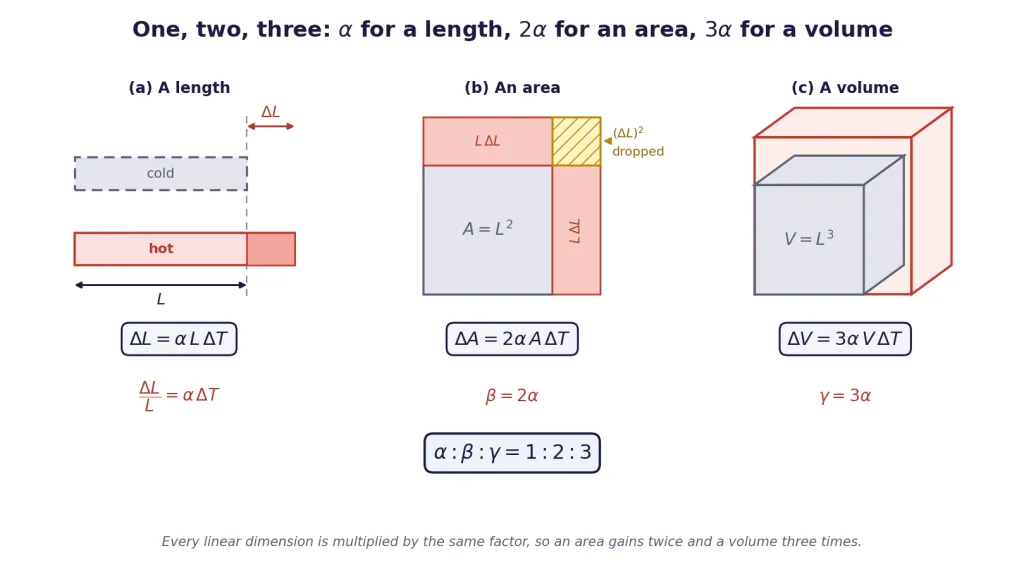
Here is the thing that makes this easy. When an isotropic solid is heated, every single linear dimension in it is multiplied by the same factor: Length, width, thickness, diameter, the diagonal, the distance between two scratches — all of them, by the same . The heated object is a photographic enlargement of the cold one. Nothing changes shape; everything changes scale.
Once you believe that, area and volume follow without any new physics at all.
Areal expansion, derived properly
Take a square plate of side , so its area is . Heat it by . Each side becomes , so the new area is
Now expand the bracket honestly, keeping every term. Write to save ink: so
The first term is what we want. The second term is the one everybody waves away — so let us not wave, let us measure it.
How big is the term we are about to throw away? Divide the second term by the first:
Put brass in, with , heated through 100 K. Then , and the discarded term is of the term we keep — nine parts in ten thousand, or 0.09%. Your slide rule could not see it and neither can your vernier callipers. Even for a 500 K rise in lead, the worst case in this chapter, and the discarded term is 0.73% of the answer.
So the approximation is not an article of faith. It is a calculation, and it comes out at less than a tenth of a percent.
Key Point — areal (superficial) expansion: is the coefficient of areal (superficial) expansion, unit K. The corner square of side , of area , is the term dropped; look at the shaded corner in the figure and you can see how little of the new area it is.
Volume expansion, the same way
A cube of side has volume . Every side is multiplied by , so
Again, measure what you are dropping. Relative to the term kept:
For brass through 100 K that is — 0.18%. Working the whole cube out at forty significant figures: a brass cube of side 10.0 cm has volume 1000 cm, the linear formula predicts an increase of 5.400 cm, and the exact cube gives 5.4097 cm. The difference is 0.0097 cm, one part in five hundred, on a change that is itself half a percent of the cube. Nobody is going to notice.
Key Point — volume expansion: is the coefficient of volume expansion (volume expansivity), unit K. The new volume is .
The ratio, and how to use it
Key Point — the one line to memorise: for an isotropic solid — one whose properties are the same in every direction, which covers every metal, glass and plastic you will be asked about. Equivalently , and .
This turns a whole family of questions into one line of arithmetic. If a plate's length grows by 0.06%, its area grows by 0.12% and, were it a block, its volume by 0.18%. Nothing to compute; the numbers are just doubled and tripled.
And it works backwards. Given for a solid, you have immediately. Here are the volume coefficients that go with the linear ones from the last block, with the value of printed beside them.
| Material | measured (K) | from the linear table (K) |
|---|---|---|
| Lead | ||
| Aluminium | ||
| Brass | ||
| Iron | ||
| Glass (ordinary) | ||
| Glass (pyrex) | ||
| Invar |
The two columns agree to within the rounding of the tables themselves, which is exactly what predicts; brass is the row where the two sit furthest apart, about 11%, and that gap is the rounding in two separately quoted measurements, not a failure of the relation. Where a problem gives you both, use the one it gives you and say which.
When does the approximation actually break?
Only when stops being small. Take iron through a 500 K rise: , the exact fractional volume change is 1.8108%, the linear formula says 1.80%, and the error is 0.60%. Still fine for three-figure work. You would need a of thousands of kelvin, or a material with a hundred times larger, before misled you — and long before that the solid would have melted.
[JEE Tip] For a crystal that is not isotropic — many crystals expand differently along different axes — the volume coefficient is the sum of the three linear coefficients, . The familiar is just this with all three equal. You will not be asked to compute with it, but recognising it protects you from the assertion-reason version.
[NEET Important] The single most common way to lose this mark is to write and then use it as though were three times bigger than it should be — that is, to use where the question wanted . Read the question for the word length, area or volume before you pick a coefficient, and write it down.
The Hole in a Heated Plate Gets Bigger
This is the most-loved trap in the whole chapter, and it is set every single year. Here it is.
A circular hole is drilled in a metal plate. The plate is heated. Does the hole get bigger, smaller, or stay the same?
The instinct is that the metal grows inward and squeezes the hole shut. The instinct is wrong.
Key Point — the expanding hole:
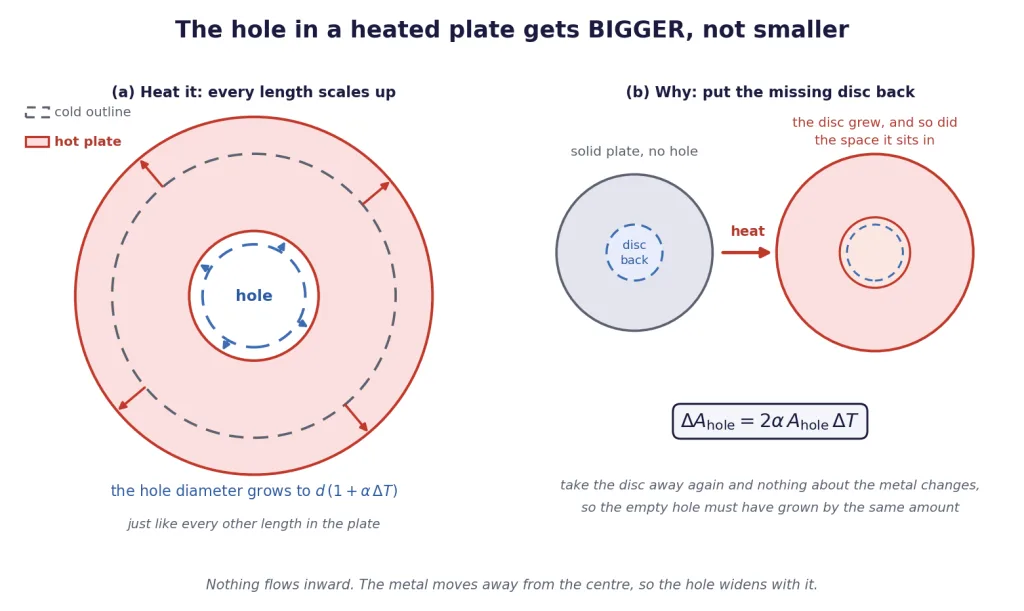
A hole expands exactly as though it were filled with the same material as the plate. Heat the plate and the hole gets bigger, and its diameter grows by the same fractional amount as every other length in the plate:
Two ways to see it, and you should be able to give either
The enlargement argument. The last block established that a heated isotropic solid is a photographic enlargement of the cold one, everything multiplied by . Enlarge a photograph of a plate with a hole in it and the hole in the enlargement is bigger. There is no mechanism by which a hole could be exempt; it is defined entirely by where the surrounding metal is, and all that metal has moved outward.
The cut-and-replace argument, which is the one to write in an exam. Take the disc that was drilled out and slot it back in, so you have a solid plate with a faint circle drawn on it. Heat the plate. The circle, being a line of atoms like any other, grows by the factor ; that is just linear expansion. Now lift the disc out again. Removing it changes nothing about where the surrounding metal sits — the metal was never held in place by the disc. So the empty hole is the same size as the disc that just came out of it, and the disc got bigger. Therefore the hole got bigger.
The numbers, so it is not just a story
Model a brass plate as an annulus: outer radius 10.0 cm, hole radius 3.0 cm, heated through 300 K with . Every material point is moved outward by the factor .
| Quantity | Cold | Hot | Fractional change |
|---|---|---|---|
| Hole radius | 3.0000 cm | 3.0162 cm | |
| Hole area | 28.274 cm | 28.581 cm | |
| Area of metal in the ring | 285.88 cm | 288.98 cm | |
| , the prediction for a length | |||
| , the prediction for an area |
Read the fourth column carefully, because it carries the point of the whole section: the radius grows by , and the areas grow by twice that. A length and an area do not change by the same fraction, and mixing the two up is the single most expensive slip in this topic. The hole's area and the metal's area grow by exactly the same fraction as each other, and both match to the third figure — the last digit of difference is the second-order term from the previous block, right on schedule. Scattering four million random points across the plate and counting how many land in metal before and after gives the same answer, which is about as formula-free a check as one can make.
Where it turns up
- A ring or a washer. Heat a metal ring and its inner diameter increases. This is the whole basis of the shrink fit in Section 4.
- A ball-and-ring demonstration. A metal ball that will not pass through a ring at room temperature will pass through it if you heat the ring. Heating the ball makes matters worse.
- A hollow sphere or a bottle. The volume of a cavity inside a solid expands with the of the surrounding solid, not with anything to do with what is inside it. A glass bottle's capacity grows by when it is warmed, and that innocent fact is the whole of apparent expansion in the next block.
- A metal lid on a glass jar. Under the hot tap both expand, but the metal's is two or three times the glass's, so the lid's diameter grows faster than the neck it grips. It loosens. That is why the trick works and why it does not work as well the other way round.
[JEE Tip] The trap has a cousin: "a metal plate has a hole; the plate is cooled." Everything reverses — the hole shrinks. And a nastier cousin: "a bimetallic ring" or "a steel ring on a copper disc", where the two materials have different and you must compare with . Section 4 handles that one.
[Board Important] The one-mark version asks only for the direction. The three-mark version asks you to explain. Give the cut-and-replace argument in three sentences and quote ; that is full marks.
Liquids and Gases: What You See Is Not What Happened
A liquid has only one coefficient
A liquid takes the shape of its container, so "the length of a liquid" means nothing. Only volume expansion is defined for a liquid, and only is quoted for it. There is no for water, and a question that offers you one is testing whether you know that.
For the same reason there is no for a liquid. That relation came from a solid whose every dimension stretched together; a liquid has no dimensions of its own to stretch.
The catch: the container expands too
Here is where the marks are. Fill a glass vessel to the brim with mercury, mark the level, and heat the whole thing. The mercury expands — but so does the glass, and the vessel gets roomier at the same time. What overflows, or what you see the level rise by, is therefore less than the liquid's true expansion.
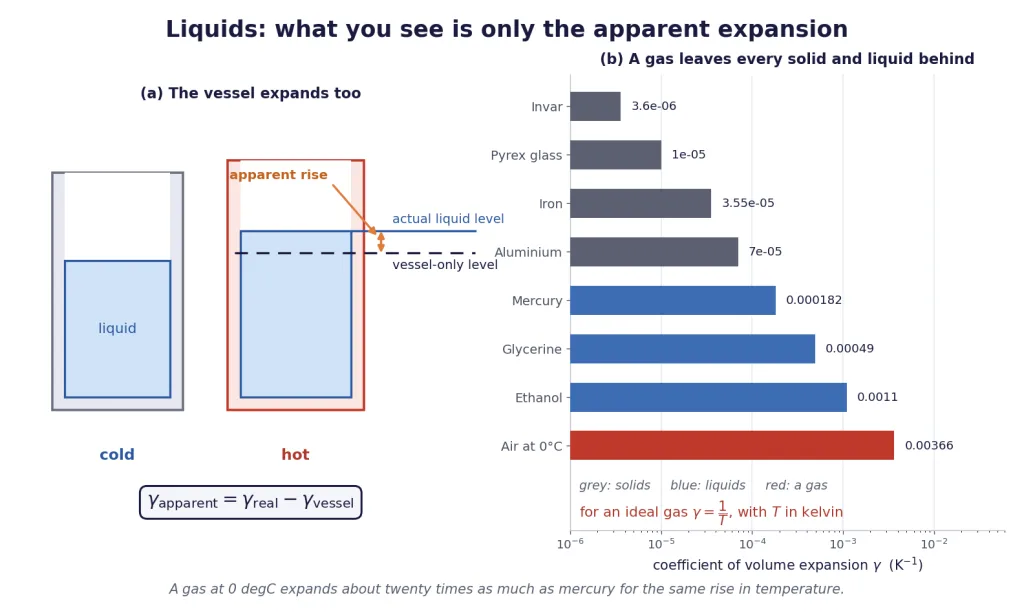
Work it through. Let the vessel hold volume of liquid at the start. After a rise : The spill — or the apparent increase, if the vessel is not full — is the difference:
Key Point — apparent and real expansion: The apparent (observed) expansion of a liquid is its real expansion minus the expansion of the vessel holding it. Since for a solid container, this is usually written
Some consequences that come up as one-mark questions:
- The apparent expansion depends on what the vessel is made of; the real expansion does not. The same mercury in glass and in steel gives two different apparent coefficients. That is how a real coefficient is measured: run the experiment in two containers of known and solve.
- The apparent expansion is always the smaller. Vessel coefficients are positive, so you always see less than actually happened.
- If the vessel expanded as much as the liquid, you would see nothing at all. Nothing would overflow and the level would not move, even though both had grown. Worth thinking about for a moment, because it is the assertion-reason trap in this topic.
Density falls as temperature rises
Mass does not change when you heat something; volume does. So density must fall.
Key Point — density with temperature: The approximate form comes from for small , and the fractional fall in density is to the same accuracy as everything else in this section.
Try mercury, , warmed through 50 K. The approximate answer is a fall of 0.91%; the exact expression gives 0.9018%. Mercury goes from 13600 kg/m to about 13477 kg/m. Small, but it is exactly why a mercury barometer reading has to be corrected for temperature before it means anything.
Here is our own table of volume coefficients for liquids, alongside a couple of solids for scale.
| Substance | (K) | Notes |
|---|---|---|
| Invar (solid) | for comparison | |
| Iron (solid) | for comparison | |
| Mercury | thermometers, barometers | |
| Water | an average value above 4°C | |
| Glycerine | ||
| Paraffin | ||
| Ethanol (alcohol) | expands about six times as much as mercury |
Read the pattern: liquids expand roughly ten times as much as solids. That is why a mercury thermometer works at all — the bulb of glass barely moves while the mercury inside it climbs the stem.
Gases run away from both
Now a gas, where the answer is not a table but a formula. For a fixed amount of ideal gas at constant pressure, Divide the second by the first:
Key Point — the volume coefficient of an ideal gas: It is not a constant of the substance. It is not even a constant: it falls as the gas is heated. Every ideal gas has the same value at the same temperature, whatever the gas is.
At 0°C, which is K: At 27°C, which is 300 K, it is .
Compare that with mercury's . A gas at 0°C expands about twenty times as much as mercury for the same rise in temperature, and roughly a hundred times as much as a typical metal. The bar chart in the figure is on a logarithmic scale for exactly that reason: a gas will not fit on the same linear axis as a solid.
The kelvin warning, and it is the big one for this chapter. is meaningless unless is an absolute temperature. Writing for a gas at 27°C is not a small error; it is off by a factor of eleven, and the answer is not even positive at temperatures below freezing. Any time a temperature appears anywhere except inside a difference, convert it to kelvin first and write the unit down.
[NEET Important] The three-substance ranking — solids smallest, liquids about ten times more, gases about a hundred times more again — is asked directly, and so is the reason. The reason is molecular spacing: in a solid the atoms are locked in a deep potential well and can shift their mean separation only slightly; in a liquid they are free to move past one another; in a gas the molecules are so far apart that intermolecular forces hardly matter at all and the volume is set by the temperature and pressure alone.
Pulling It Together
Everything in this section, on one page
| Quantity | Formula | Watch out for |
|---|---|---|
| Linear expansion | is per unit original length | |
| New length | the factor multiplies every length | |
| Areal expansion | , | dropped term is , about of the answer |
| Volume expansion | , | dropped terms are about of the answer |
| The ratio | isotropic solids only | |
| A hole | it gets bigger | |
| Apparent expansion | the vessel grew too | |
| Density | density falls on heating | |
| Ideal gas | in kelvin; not a constant | |
| Typical sizes | metals about , liquids about , gas about | three decades apart |
Throughout, , and it is of order for the temperature changes in this chapter.
The seven traps
Trap 1 — the hole. It gets bigger. It always gets bigger. Say the cut-and-replace argument out loud once and you will never lose this mark.
Trap 2 — using where the question asked for a volume. A block's volume change needs , not . Underline the words length, area or volume in the question before you choose.
Trap 3 — forgetting that the container expands. If a question says "how much overflows", the answer contains , never alone.
Trap 4 — using Celsius in . Kelvin. Every time. Write the conversion on the page.
Trap 5 — quoting for a liquid. It does not apply. Liquids have and nothing else.
Trap 6 — a radius given as a diameter. All the expansion formulas are linear in the length, so this one is only a factor of two — but in an area it is a factor of four.
Trap 7 — thinking expansion means "the atoms need more room". They do vibrate harder, but a symmetric potential well would give zero expansion no matter how hard they vibrated. The reason is the asymmetry.
The habit that saves marks
Before writing a final answer here, run three checks.
- Sign. Heating gives a positive ; cooling gives a negative one. If your was negative, your answer should be too, and you should say the object shrank.
- Size. A fractional change bigger than about 1% for an ordinary solid means you have used where you meant , or a of thousands. Go back.
- Units. , and are all K. If your coefficient came out with any other unit, something has gone wrong upstream.
[Board Important] The classic three-mark derivation in this section is: "show that the coefficient of volume expansion of a solid is three times its coefficient of linear expansion." Start from a cube of side , write , expand the cube of the bracket, say in words that terms in and are negligible because is of order , and finish with . All four steps carry marks, and the sentence about why the terms are negligible is the one most people leave out.
Solved Examples
Constants used throughout, unless a problem states otherwise: K, K, K, K, K, K, K.
Example 1: A copper rod on a hot afternoon
A copper rod is 2.00 m long at 25°C. It is heated to 125°C. Find (a) the increase in its length and (b) that increase as a percentage of the original length.
Solution:
Identify the temperature change. From 25°C to 125°C is a rise of 100 degrees Celsius, which is a rise of 100 kelvin. Differences are identical on the two scales, so K.
Apply the linear expansion formula, with K:
(b) As a fraction of the original length:
Feel the size. A 2 m rod, heated by more than the boiling point of water, grows by less than the thickness of three sheets of paper. That is what per kelvin means in the hand.
Final Answer: (a) 3.4 mm; (b) 0.17% of the original length.
Takeaway: The fractional change carries all the physics; the length only scales it. Compute the fraction first and you will always be able to tell instantly whether your answer is sensible.
Example 2: Measuring from two lengths
A metal rod is exactly 1.0000 m long at 0°C. When heated to 100°C its length is found to be 1.0023 m. Find the coefficient of linear expansion of the metal, and identify it from the reference table.
Solution:
Write the increase and the temperature change.
Rearrange the linear expansion formula for :
Substitute:
Look it up. That is aluminium.
Final Answer: K; the metal is aluminium.
Takeaway: This is how is actually measured. One length, one temperature change, one division. The whole of experimental linear expansion is this rearrangement — and note that the number 1.0000 in the denominator is doing nothing, which tells you the answer would be the same for a rod of any length.
Example 3: How much are we really throwing away?
A brass cube has a side of 10.0 cm at 20°C. It is heated to 120°C. (a) Find the increase in volume from . (b) Find it exactly from and say how much the approximation costs.
Solution:
Set up. m, so m = 1000 cm. K and K, so
(a) The linear formula:
(b) The exact calculation. Every side becomes , so
The cost of the approximation:
And that number is not a coincidence. The terms dropped were against the kept, and their ratio is . The measured 0.180% is exactly .
Final Answer: (a) 5.400 cm; (b) 5.4097 cm exactly, so the approximation is low by 0.180% — which is itself.
Takeaway: The error in using is , and you can quote that. It is about a fifth of a percent for a hundred-kelvin rise in brass, which is far below the precision of any you were given in the first place.
Example 4: A plate, and only its area
An aluminium plate measures 50 cm by 30 cm at 20°C. It is heated to 80°C. Find the increase in its area.
Solution:
Get the area in SI and the temperature change.
Use the areal coefficient, K:
Check it against the honest calculation. Each side is multiplied by , so the new area is m, an increase of 4.1429 cm. The linear form is low by 0.069%, which is with — exactly as the derivation promised.
Final Answer: The area increases by 4.14 cm, from 1500 cm to about 1504.14 cm.
Takeaway: The plate need not be square for to hold. The derivation used a square only for convenience; a rectangle of sides and becomes just the same, and so does any shape at all.
Example 5: The hole, with numbers
A brass plate has a circular hole of diameter 2.00 cm drilled in it at 20°C. The plate is heated to 320°C. Find (a) the new diameter of the hole and (b) the increase in the hole's area.
Solution:
Decide the direction first, before touching a calculator. The plate is heated, so every length in it grows, and the hole is defined by the metal around it. The hole gets bigger.
(a) Treat the diameter as any other length. With K and K: so The diameter has grown by 0.108 mm.
(b) The area, from the areal coefficient, with cm:
Cross-check by computing the two circle areas directly. cm — the same to three figures, with the difference being the usual second-order term.
Final Answer: (a) 2.0108 cm, an increase of 0.108 mm; (b) an area increase of about cm.
Takeaway: Nothing about a hole needs special treatment. Its diameter obeys and its area obeys , exactly as if the hole were a disc of the same metal.
Example 6: Reading the ratio backwards
A solid iron cube is heated. Its edge length increases by 0.060%. Find (a) the percentage increase in the area of one face, (b) the percentage increase in its volume and (c) the temperature rise.
Solution:
Write the given as a fraction.
(a) The area of a face goes as the square of the edge, so its fractional change is twice as large:
(b) The volume goes as the cube, so three times as large:
(c) The temperature rise, from with K:
Final Answer: (a) 0.12%; (b) 0.18%; (c) a rise of 50 K.
Takeaway: When a question gives you a percentage change in a length, double it for an area and triple it for a volume, and stop. No coefficients, no lengths, no arithmetic beyond a factor of two and a factor of three. The ratio is a shortcut, and this is the shape of question it was made for.
Example 7: Mercury overflowing a glass flask
A glass flask of capacity exactly 1000 cm is filled to the brim with mercury at 20°C. The whole thing is heated to 100°C. How much mercury spills? Take K and K.
Solution:
The trap is right at the start. The mercury expands, but so does the flask, and the flask's capacity — the volume of its cavity — expands with the of the glass. What spills is the difference.
Find the apparent coefficient:
Apply it, with K:
See the two pieces separately. The mercury grew to cm and the flask grew to cm. The difference is 12.40 cm, and the glass swallowed 2.16 cm of the mercury's expansion without your ever seeing it.
Final Answer: 12.40 cm of mercury spills.
Takeaway: Had you forgotten the flask, you would have answered 14.56 cm — an over-estimate of 17%. In an overflow question the first thing on your page should be .
Example 8: Finding the real coefficient from an experiment
A steel vessel of capacity 500 cm is filled to the brim with glycerine at 20°C and heated to 60°C. Exactly 9.28 cm of glycerine overflows. Find the real coefficient of volume expansion of glycerine. Take K.
Solution:
Get the apparent coefficient from what was measured, with K:
Get the vessel's coefficient from its , since steel is a solid and isotropic:
Add it back on:
Close the loop. Put back into the experiment: glycerine goes to 510.0 cm, the vessel to 500.72 cm, and the spill is 9.28 cm. It reproduces the measurement.
Final Answer: K, that is K.
Takeaway: Real equals apparent plus vessel — you add the container's expansion back on. Subtracting instead is the standard slip, and it gives , which is wrong by more than the whole correction.
Example 9: What the barometer reading hides
Mercury has a density of 13600 kg/m at 0°C and K. Find its density at 50°C, and the percentage fall.
Solution:
Mass is conserved, volume is not. So
Substitute, with K:
The percentage fall, exactly:
And by the approximation , the fall is simply . The two differ by less than one part in a hundred of the correction, which is itself again.
Final Answer: About 13477 kg/m, a fall of 0.90%.
Takeaway: Density goes down by , to the same accuracy as everything else here. But notice the exact form has in the denominator — if a question asks for four figures, do the division rather than the subtraction.
Example 10: A gas leaves them all behind
(a) Find the coefficient of volume expansion of an ideal gas at 0°C and at 27°C. (b) A balloon holds 2.00 L of air at 27°C. It is warmed to 87°C at constant pressure. Find its new volume, and check it against .
Solution:
(a) Convert to kelvin first — this is not optional. Taking :
Apply : The coefficient falls as the gas gets hotter, which no solid or liquid does.
(b) The balloon, at constant pressure. Both temperatures in kelvin: 300 K and 360 K.
Check against . Using the value at the starting temperature, which is the same 2.40 L. The two routes agree because came from the gas law in the first place.
See how far out of reach that is. A 20% volume change from a 60 K rise. The same rise would change a brass block's volume by 0.32% and mercury's by 1.1%.
Final Answer: (a) K at 0°C and K at 27°C; (b) 2.40 L, a 20% increase.
Takeaway: Write the kelvin conversion on the page before you divide. Using instead of would have given a coefficient eleven times too large and a balloon that more than trebled in size.
Example 11: Does survive a furnace?
An iron component is heated through 500 K. (a) Find the fractional increase in its volume from . (b) Find the exact value from and state the error in the approximation.
Solution:
Compute first, with K:
(a) The linear form:
(b) The exact form:
The error: and once again that is to two figures, exactly as predicted.
What this means in practice. Even at 500 K above room temperature — glowing dull red — the shortcut is good to better than one part in a hundred. That is far tighter than the uncertainty in itself, which is quoted to two figures at best and drifts with temperature anyway.
Final Answer: (a) 1.80%; (b) 1.8108%, so is low by 0.60% of the answer.
Takeaway: The approximation's error is always about , whatever the material and whatever the rise. So you can decide in one line whether it is safe: if is small compared with the precision you need, use and move on.