
Same Chapter, Half the Clock
Sections 1 to 11 took this chapter apart slowly, Section 12 worked forty-odd problems through it, and Section 13 pushed it further still — conduction by integration, ice thickening on a pond, a bimetallic strip's radius of curvature. If you worked through those, you already know far more thermal physics than this section will ever ask of you.
So why a separate corner? Because the skill being tested is different.
One paper hands you a hard problem and the time to think about it. This one hands you a manageable problem and almost no time at all. Physics is 45 questions, and inside a 180-minute paper shared with Chemistry and Biology those 45 deserve roughly 45 minutes. One minute each — and Thermal Properties of Matter reliably supplies three or four of them, sometimes five in a year when radiation and calorimetry both turn up. Every one of those has to be finished in well under a minute, correctly, so the time is banked for the questions that genuinely need it.
What is NOT asked from this chapter
This list matters as much as anything else here, because it tells you what to stop worrying about.
Key Point: Thermal physics at this level never leaves the core syllabus. No conduction through a rod of varying cross-section by integration. No radial conduction through a pipe or a spherical shell. No differential equation for the growth of ice on a pond. No bimetallic radius of curvature. No weight thermometer. No pendulum-clock timing correction. Everything on the paper is a statement you recall, one standard formula you substitute into, a set-up you have drilled, a graph you read, or one of the two special formats.
Every item on that list belongs to Section 13. If you find yourself writing , you have wandered into the wrong section's version of the question.
The five types, and what each should cost you
| Type | What it looks like | Your budget | The right instinct |
|---|---|---|---|
| 1. Direct recall | "State the zeroth law." "Why does a hole expand?" "Unit of thermal conductivity?" | 15-20 s | You either know it or you do not. Never derive a definition. |
| 2. One-step plug-in | , , , , | 25-35 s | Spot the picture, pick the card, substitute once. |
| 3. Standard template | The mixture, the composite slab, the two-interval cooling problem | 30-45 s | Recognise the set-up. You should already know the shape of the answer. |
| 4. Ranking or comparison | Four substances, four rods, four spheres — which is largest? | 20-30 s | Use the proportionality, not the formula. No calculator needed. |
| 5. Assertion-Reason / Column matching | Two special formats, both drilled below | 35-45 s | Judge each statement alone, then judge the link. |
[Important] A diagnostic worth internalising: if a thermal question needs a fifth line of working, you have misread it. You are handed two or three quantities and asked for one more. If your page is filling up, stop and reread the stem — you have almost certainly imported an assumption nobody made, most often that a phase change happens when the stem never allowed one.
The one mistake that costs more marks than every other combined
It is not a formula. It is a unit.
Key Point — the kelvin rule:
Wherever a temperature appears as a ratio, a product or a power — , , , — it must be in kelvin, .
Wherever only a difference appears — , , , in Newton's law — kelvin and Celsius give the same number, because a Celsius degree and a kelvin are the same size.
Here is what ignoring that costs. A body is warmed from 27°C to 127°C, and you are asked how much its radiated power grows.
- Right: K, K, so the power grows by times.
- Wrong: — out by a factor of 155.
That distractor is on the paper. Write the letter K next to every temperature you substitute into a power or a ratio, and you have banked four marks before you have thought about anything else.
The / arithmetic
Four marks for a correct answer, minus one for a wrong one, zero for a blank. On a doubtful item the real question is not "can I get this?" but "can I get this in 40 seconds?" If two options survive elimination and 40 seconds have gone, take the better one and move on — a 50-50 guess is worth marks on average. What you must never do is spend three minutes rescuing one mark's worth of doubt in a chapter where the very next question might be a one-liner about whether heat is a property of a body.
The numbers and symbols this section fixes, now
Every question in this section and the next uses these values and no others. A question that supplies its own number always wins.
| Quantity | Value |
|---|---|
| specific heat capacity of water | 4186 J/(kg K) |
| specific heat capacity of ice / of steam | 2100 / 2010 J/(kg K) |
| latent heat of fusion of ice, | J/kg |
| latent heat of vaporisation of water, | J/kg |
| Stefan-Boltzmann constant, | W/(m K) |
| Wien's constant, | m K |
| for steel / brass / copper / aluminium | / / / , all K |
| for copper / steel / glass / brick / still air | 385 / 50.2 / 0.8 / 0.72 / 0.024 W/(m K) |
| specific heat capacity of blood / of the body as a whole | 3600 / 3470 J/(kg K) |
| latent heat of vaporisation of sweat at skin temperature | J/kg |
Working values for this section. Every solution below states the constants it uses inside the solution.
Key Point — the symbol convention:
is always an absolute temperature in kelvin; or is Celsius. with a subscript is latent heat — for fusion, for vaporisation — while a bare is a length. is specific heat capacity in J/(kg K), is molar specific heat in J/(mol K), and is the heat capacity of a whole body in J/K; is also written . is thermal conductivity in W/(m K), also written or , so here lowercase is reserved for the cooling constant in Newton's law. In radiation, is absorptive power — also written or , but here belongs to linear expansion and nothing else — is emissivity, is the Stefan-Boltzmann constant and is Wien's constant.
What this section does, and what it does not repeat
We will not rebuild heat as energy in transit or the zeroth law (Section 1), rederive the temperature scales or the gas thermometer (Section 2), rederive (Section 3), redo the expansion applications (Section 4), rebuild specific heat capacity (Section 5), rederive the calorimetry principle (Section 6), rebuild the change of state and latent heat (Section 7), rederive the conduction law and the resistance network (Section 8), rebuild convection (Section 9), rederive blackbody radiation, Wien, Stefan-Boltzmann and Kirchhoff (Section 10), or rederive Newton's law of cooling (Section 11). What you get instead is the same material reorganised for recognition speed:
- The sentences that come back almost verbatim.
- Every formula in the chapter as a recognition table, with a hook for each.
- The biology-adjacent physics this paper reaches for every single year.
- The rankings on specific heat, conductivity and expansion.
- Three ready-made templates, with clean numbers.
- Graph reading, the two special formats, and the speed habits.
One housekeeping note. Areal expansion and the ratio, bimetallic strips, thermal resistance with rods in series and in parallel, Kirchhoff's law with absorptive and emissive power, Prevost's theory, the greenhouse effect, the solar constant, the temperature gradient and the water equivalent all sit outside the rationalised syllabus body text, yet every one of them is asked, so every one appears in the recognition table below and in the practice set that follows.
The Sentences That Come Back Almost Verbatim
This block is pure recall ammunition. Read it as flashcards, not as prose. Every item here has appeared as a complete question by itself.
Heat and temperature, word for word
Key Point:
- Heat is energy in transit. It is the energy that flows between a body and its surroundings because of a temperature difference between them, and nothing else. It exists only while it is crossing a boundary.
- A body does not contain heat. What a body owns is internal energy — the total kinetic and potential energy of its molecules. Heat is one of the two ways (work is the other) of changing that internal energy. The sentence "a hot body contains a lot of heat" is wrong at the word contains.
- Temperature is the property that decides the direction of the flow. Heat flows from the higher temperature to the lower one, whatever the sizes, masses or internal energies of the two bodies. A spark at 800°C dropped into a bucket of water at 40°C loses heat to the water, even though the bucket holds vastly more internal energy.
- SI unit of heat: the joule. cal J.
Say the "contains" answer as one sentence: heat is a transfer, not a store, so a body can possess internal energy but never heat. Anything offering "because heat and temperature are the same thing" is the standard distractor.
The zeroth law, word for word
Key Point: If two bodies A and B are each separately in thermal equilibrium with a third body C, then A and B are in thermal equilibrium with each other. The point of it is not that it is surprising — it is that it is what makes temperature a meaningful quantity at all, and what lets body C be a thermometer. Without it, "these two things are at the same temperature" would not be a statement you could check with an instrument.
Why a hole expands when the plate is heated
Set almost every year, and the popular answer is wrong.
Key Point: On heating, every linear dimension of the plate scales by the same factor — and the diameter of the hole is one of those dimensions. The plate expands as though the hole were filled with the same metal, so the hole grows, exactly as the disc that was cut out of it would have grown. Nothing "closes in" on the hole.
So for a hole of diameter : , and for its area .
If an option says "the hole shrinks because the metal around it expands inwards", it is the distractor this question exists to catch.
Why water is densest at 4°C
Key Point: Between 0°C and 4°C water contracts as it is warmed, and only above 4°C does it start to expand. So its density is greatest at about 4°C, and both ice at 0°C and water at 10°C are lighter than water at 4°C. This is the anomalous expansion of water, and it comes from the open, cage-like hydrogen-bonded structure of ice, which partly survives just above the melting point and collapses as the water is warmed a little further.
The consequence asked for is the lake. As the surface cools towards 4°C the cold water sinks and the whole lake overturns; below 4°C the surface water is now lighter than what is beneath it, so it stays on top, freezes there, and the ice — being lighter still — floats. The lake freezes from the top downwards, the ice insulates the water below, and the fish survive.
Why the temperature stays constant while something melts
Key Point: During a change of state the heat supplied does not raise the average kinetic energy of the molecules. It goes into potential energy: breaking the bonds that hold the crystal lattice together (fusion) or pulling the molecules right out of one another's reach (vaporisation). Temperature measures average kinetic energy, so it does not move. That energy is the latent heat, or , and it is given back when the substance changes state in the other direction.
Two follow-ups asked directly. Steam at 100°C scalds far worse than water at 100°C because each kilogram of it must first give up J of latent heat before it even begins to cool. And the vaporisation plateau on a heating curve is about times as long as the fusion plateau, because .
Why a good absorber is a good emitter
Key Point — Kirchhoff's law of radiation: At a given temperature and a given wavelength, the ratio of the spectral emissive power to the spectral absorptive power is the same for every body, and equals the spectral emissive power of a perfect blackbody at that temperature: Emissivity is defined by , so this says at once that : emissivity equals absorptivity, and both are pure numbers with no unit, while carries a unit.
So a body that absorbs strongly at some wavelength must emit strongly at that same wavelength. A good absorber is a good emitter; a good reflector is a poor emitter.
The mechanism worth being able to state in one line: a body sitting in an enclosure at a steady temperature must emit exactly what it absorbs, or its temperature would drift. That is Prevost's theory of exchanges — every body at every temperature above absolute zero is radiating all the time, and thermal equilibrium is a balance of emission and absorption, not a stopping of either.
The examples that follow from it, all set: the black bulb of a thermometer warms faster in sunlight; a blackened tea pot cools faster than a polished one; the dark Fraunhofer lines in the solar spectrum are wavelengths that the cooler outer gases of the Sun absorb strongly, and therefore emit strongly — but they emit in all directions and at a lower intensity, so they show up dark against the bright background.
Why Newton's law of cooling is only an approximation
Key Point: The exact law is Stefan-Boltzmann: the net loss goes as , not as . Write and expand: Only the first term is kept, and only a small excess temperature justifies that. So Newton's law holds for small temperature differences, and it also assumes the loss is by radiation into surroundings at a steady temperature, with the body at a uniform temperature throughout.
Put a number on it. For a body radiating into surroundings at 20°C, that is K:
| Excess above the surroundings | Newton's prediction, against the exact loss |
|---|---|
| 5 K | % low |
| 20 K | % low |
| 100 K | % low |
| 200 K | % low |
Computed by evaluating against , both temperatures in kelvin.
Under about 10 K of excess, Newton is fine. Over 100 K it is not even the right order of correction. A question that says "a body at 200°C is left in a room at 20°C" and then asks you to compare Newton with reality is asking about precisely this.
The rest of the recall list
Key Point:
- The triple point of water is assigned exactly K, which is C. It is preferred to the ice point because it occurs at one unique pressure and temperature and can be reproduced anywhere.
- (K) , and . The two Celsius-Fahrenheit landmarks: they read the same at , and normal body temperature C is exactly F.
- Absolute zero, K, is C — the intercept every low-density gas extrapolates to on a pressure-against-temperature plot, whatever the gas.
- for an isotropic solid. Count the dimensions being stretched.
- For an ideal gas at constant pressure, , so at 273 K it is about K — roughly a hundred times any solid's.
- J/(kg K) is the largest specific heat capacity of any common substance. That is why water is the coolant in radiators and reactors, why the sea warms and cools so slowly, and why coastal towns have a smaller daily temperature swing than inland ones.
- The molar specific heat capacity of most simple solids is close to J/(mol K) at ordinary temperature — the Dulong-Petit result.
- For an ideal gas , always, and because at constant pressure some of the heat goes into the work of expansion.
- Calorimetry: in a thermally isolated system, heat lost = heat gained. The water equivalent is the mass of water that would need the same heat for the same rise.
- Evaporation happens at all temperatures and only from the free surface; boiling happens at one temperature throughout the bulk. Evaporation cools what is left behind because the fastest molecules are the ones that escape.
- Increasing the pressure raises the melting point of almost everything — but lowers it for water, because water is the rare substance that contracts on melting. That is regelation: ice under a loaded wire melts, the wire sinks through, and the water refreezes above it.
- Sublimation is solid straight to vapour, as with solid carbon dioxide. It happens where the pressure is below the triple-point pressure.
- Metals conduct heat well because their free electrons carry energy, not just because their lattices vibrate. The same free electrons make them good electrical conductors.
- Thermal resistance adds in series and adds reciprocally in parallel, exactly like an electrical resistance. The temperature difference plays the part of the voltage and the heat current the part of the current.
- Wien: , with m K. Hotter means a shorter peak wavelength — the colour tells you the temperature.
- Stefan-Boltzmann: , and the net exchange with surroundings at is . For a blackbody .
- A small hole in a large cavity behaves as a blackbody, because radiation entering it is reflected around inside until it is entirely absorbed.
- Convection needs a fluid that can move, so it cannot happen in a solid and it cannot happen in free fall — a candle flame in orbit burns as a dim sphere for exactly that reason.
The always-true / never-true table
Speed comes from knowing which sentences are safe.
| Statement | Verdict |
|---|---|
| A hot body contains a large amount of heat | Never — it contains internal energy |
| Heat flows from the body at higher temperature to the one at lower temperature | Always |
| A hole in a metal plate gets larger when the plate is heated | Always |
| in may be taken in Celsius degrees | Always — it is a difference |
| in may be taken in Celsius degrees | Never — kelvin only |
| Water is densest at 0°C | Never — at about 4°C |
| The temperature rises while ice is melting at 0°C | Never — it is fixed until all of it has melted |
| Steam at 100°C burns more severely than water at 100°C | Always |
| Increasing the pressure raises the melting point of ice | Never — it lowers it |
| A good absorber of radiation is a good emitter | Always |
| A body in thermal equilibrium with its surroundings has stopped radiating | Never — it radiates and absorbs equally |
| Thermal resistances in series simply add | Always |
| Two identical rods side by side conduct twice as fast as one | Always |
| Newton's law of cooling is exact for any temperature difference | Never — small excess only |
| is greater than for any gas | Always |
| Convection can transfer heat through a solid iron bar | Never |
[Important] The four most reused distractors in this chapter are "a hole shrinks when the plate is heated", "the temperature rises during melting", "the Celsius temperature may be used in " and "a body in equilibrium has stopped radiating". Each appears somewhere almost every year, and each is worth four marks in under fifteen seconds.
The Recognition Table, With a Hook for Each
Sections 1 to 11 derived all of these. Your job here is different: see the situation, name the formula, substitute. No derivation, ever.
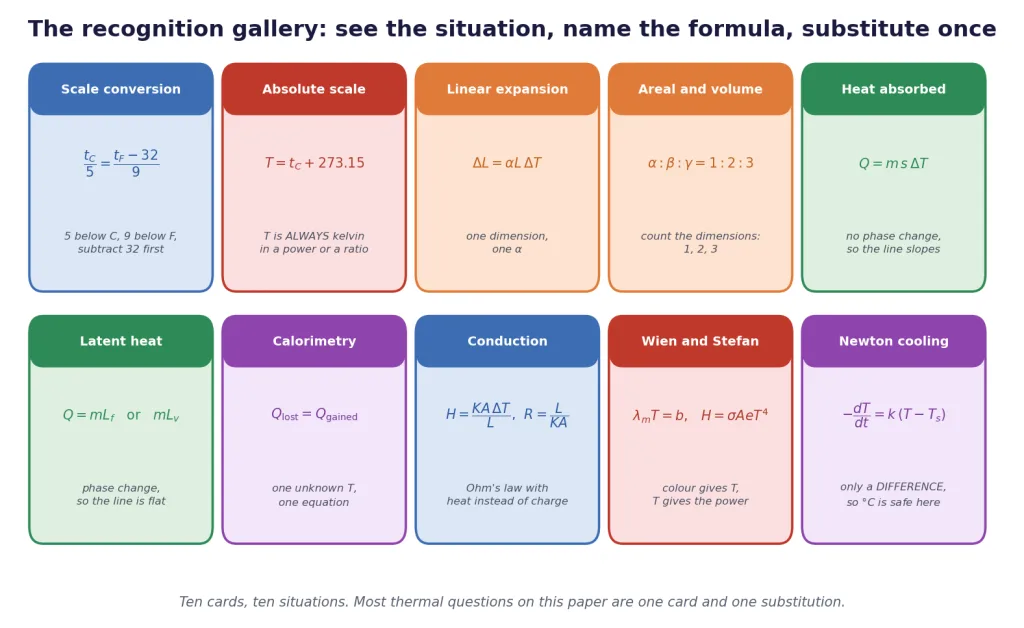
The twenty-two you must know cold
| # | Situation | Formula | Memory hook |
|---|---|---|---|
| 1 | Celsius to Fahrenheit | 5 under C, 9 under F; subtract 32 first | |
| 2 | Celsius to Kelvin | the letter K next to every power and ratio | |
| 3 | ideal gas | in kelvin, always | |
| 4 | linear expansion | one dimension, one | |
| 5 | areal expansion | , | two dimensions, so two |
| 6 | volume expansion | , | three dimensions, so three |
| 7 | a hole in a plate | the hole grows with the plate | |
| 8 | apparent expansion of a liquid | the vessel grows too, so you see the difference | |
| 9 | heat capacity of a body | one object, in J/K | |
| 10 | heat absorbed, no phase change | the sloping part of the curve | |
| 11 | molar specific heat | per mole, not per kilogram | |
| 12 | gas relation | expanding costs extra | |
| 13 | latent heat | or | the flat part of the curve |
| 14 | calorimetry | one unknown , one equation | |
| 15 | water equivalent | the calorimeter, weighed in water | |
| 16 | conduction | thick and thin: area helps, length hurts | |
| 17 | thermal resistance | , | Ohm's law with heat instead of charge |
| 18 | slabs in series / in parallel | / | end to end adds; side by side shares |
| 19 | temperature gradient | , in K/m | the slope down the bar |
| 20 | Wien's displacement law | colour gives the temperature | |
| 21 | Stefan-Boltzmann | , net | fourth power, kelvin only |
| 22 | Newton's law of cooling | only a difference, so Celsius is safe here |
Numbers 5, 6, 8, 15, 17, 18 and 19 sit outside the rationalised syllabus body text, but they are asked, so they belong on this card.
The values worth carrying in your head
| Substance | (J/(kg K)) | (W/(m K)) | ( K) |
|---|---|---|---|
| Water | 4186 | — | |
| Ice | 2100 | — | |
| Aluminium | 900 | 205 | 23 |
| Glass | 840 | 9 | |
| Iron / steel | 450 | 12 | |
| Copper | 385 | 17 | |
| Brass | 380 | 109 | 18 |
| Mercury | 140 | — | |
| Lead | 128 | 35 | 29 |
| Still air | 1005 | — |
Working values at ordinary temperature; a question that supplies its own number always wins. Mercury's entry is a volume coefficient, since it is a liquid.
Three patterns hide in that table and all three are examined. Water's specific heat capacity is about ten times iron's, which is why a kilogram of water absorbs ten times the heat for the same rise. Copper conducts about 16000 times better than still air, which is the whole of insulation in one number. And the metals that expand most are the ones that melt at the lowest temperatures — lead and aluminium at the top of the list, invar and pyrex at the bottom.
The ratio shortcuts, which are faster than substituting
Most questions in this chapter compare two situations rather than asking for one absolute number. Learn the proportionalities and you never touch a calculator.
Worked in one line each.
- Two rods of the same length, , same heating: is twice .
- Equal masses of water and iron given equal heat: the iron's rise is times the water's.
- A rod is cut in half and the two halves put side by side between the same reservoirs: each half has half the length, so half the resistance; two of those in parallel give a quarter. Heat flows four times as fast.
- Three identical slabs stacked face to face: the resistance triples, so the heat flow falls to a third.
- A body's absolute temperature is doubled: its radiated power goes up sixteen times.
- A body's peak wavelength halves: its absolute temperature has doubled, and its power is up sixteen times.
Key Point: The single most examined confusion in this chapter is kelvin against Celsius. It changes nothing in and it changes everything in . The second most examined is radius against diameter in an expansion question — works with either, as long as you use the same one on both sides.
[Exam Tip] Three units get asked directly and all three are easy marks. Thermal conductivity is in W/(m K), dimensional formula . The Stefan-Boltzmann constant is in W/(m K) — read that unit off the formula and you never have to memorise it. The cooling constant is in s, because divided by a temperature leaves one over a time. And emissivity, absorptive power and relative density have no unit at all.
Heat, the Body and the Ward
Here is the thing about this chapter: of every chapter in Class 11 Physics, this one and fluids reach furthest into biology — and a paper that spends two thirds of its length on living things is not going to let that pass. A human being is a 100 W heater wrapped in insulation, plumbed with a convective coolant, cooled by evaporation, and regulated to a fraction of a degree. Expect at least one of the questions this chapter gives you to be wearing a lab coat.
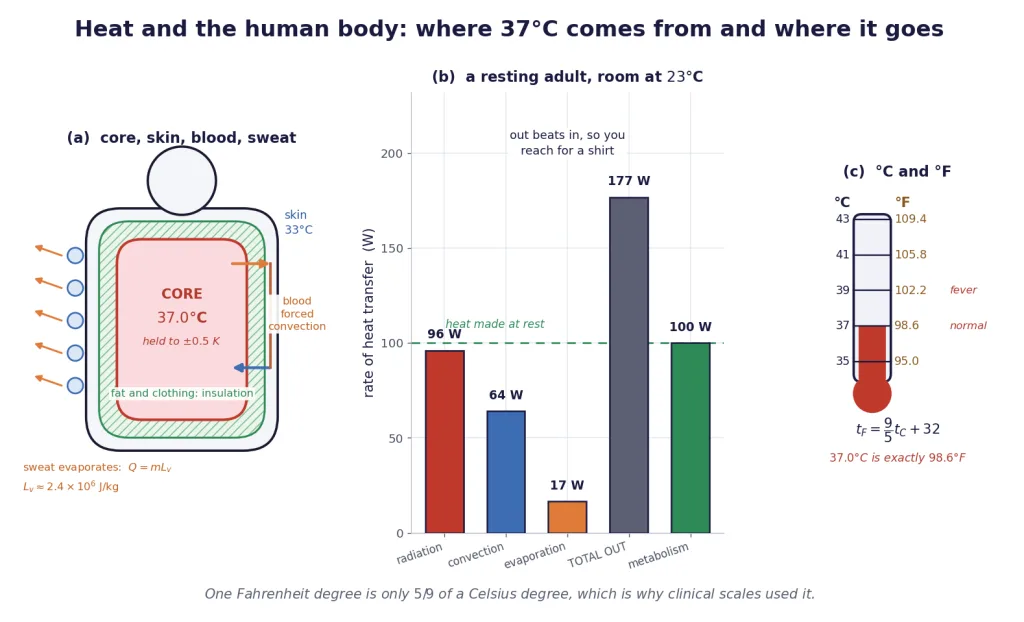
Why 37°C is defended so tightly
Every reaction in you is run by an enzyme, and an enzyme is a folded protein. Warm it and the reaction runs faster — roughly doubling for every 10 K over the biological range. Warm it too far and the fold comes apart, and above about 42°C the damage is irreversible. Cool it and everything slows: below about 35°C shivering, judgement and coordination start to fail.
So the useful window is narrow, and the body defends it with a genuine control loop. The hypothalamus compares the blood's temperature against a set point near 37°C and turns on sweating and vasodilation above it, shivering and vasoconstriction below it.
Now the physics of why that is hard work. At rest you produce about 100 W of heat — the basal metabolic rate, and it really is about the same as an old filament lamp. Take a 60 kg body with an average specific heat capacity of about 3470 J/(kg K), a little under water's because you are not entirely water. If none of that heat could escape:
In about four hours you would be at 44°C and dead. The whole apparatus of skin, sweat and circulation exists to get rid of 100 W continuously, and to get rid of five or six times that when you run.
The four routes out, with the numbers
Sit a bare adult of surface area 1.6 m in a room at 23°C, with skin at 33°C and the walls also at 23°C. Every route is one formula from the recognition table.
| Route | The formula | The number |
|---|---|---|
| Radiation | , with K and K, | 96 W |
| Convection | , with W/(m K) in still air | 64 W |
| Evaporation | , from about L a day of insensible loss | 17 W |
| Conduction | to the chair and the floor, over a small contact area | a few W |
Total: about 177 W out against 100 W in. You are losing more than you make, which is exactly why 23°C feels cool with no clothes on and comfortable with them. Notice which route is largest — radiation, not convection — and notice that both temperatures in the radiation line are in kelvin, because they sit inside a fourth power.
Key Point: Skin is very nearly a blackbody in the infrared, , whatever its colour. Skin colour is a visible-light property; at the 9 micrometre wavelengths a 306 K body actually radiates at, everybody's skin is black. That sentence has been a question.
Sweating, and the latent heat that makes it work
Evaporation is the body's high-capacity cooler, and the reason it works so well is the enormous latent heat of vaporisation of water. At skin temperature, J/kg — a little larger than the J/kg quoted at 100°C, because it takes slightly more energy to escape from cooler water.
To shed the resting 100 W by evaporation alone:
To shed the 700 W a hard-working athlete produces above resting:
About a litre an hour — which is why endurance athletes drink on a schedule rather than by thirst, and why the same mechanism fails in a heatwave.
Key Point: Evaporation cools because the fastest molecules are the ones that escape, so what stays behind has a lower average kinetic energy. The heat carried away is , and it is taken from the skin. Three consequences, all set as questions: a fan cools you not by chilling the air but by sweeping away the saturated layer so evaporation can continue; humid heat is far more dangerous than dry heat at the same temperature, because at 100% relative humidity evaporation stops and the body's best cooler is switched off; and a wet earthen pot keeps water cool by exactly the same mechanism.
Blood as a convective coolant
Heat made deep in the liver and the working muscles has to reach the skin, and conduction through tissue is hopeless at that — tissue conducts about as well as water, W/(m K). What actually carries it is forced convection: the blood itself, pumped by the heart.
Take a cardiac output of 5 litres a minute, blood of density 1060 kg/m and J/(kg K). That is a mass flow of
and if the blood comes back from the skin just K cooler than it went out,
A temperature drop you could not feel, carrying nearly twice the basal heat output. That is the whole trick: an enormous flow rate and a tiny temperature difference.
The control follows immediately. Vasodilation — widening the skin vessels — sends more blood to the surface and dumps more heat, which is why you flush when hot. Vasoconstriction does the reverse and is why fingers go pale and cold in winter: the body is sacrificing the extremities to protect the core.
Hypothermia, wind and wet clothing
Cooling is a race between the 100 W you make and the rate at which the environment takes heat away. Two things make the environment win.
Wind. Still air next to your skin is a superb insulator, W/(m K), and the layer that clings there is most of your natural insulation. Wind strips that layer off and replaces natural convection with forced convection, which raises the transfer coefficient from about 4 to 30 W/(m K) or more:
That factor of seven or so is what "wind chill" means physically. The air's temperature has not changed at all — and an option claiming that wind cools you by lowering the air temperature is the classic wrong answer.
Wet clothing. Two separate penalties, and you should be able to name both. Water has W/(m K) against still air's , so soaking a garment replaces its trapped air with a substance that conducts 25 times better; and the water then evaporates, taking per kilogram out of you as it goes. Dry clothing works by trapping air, not by being thick.
[Important] Wind and wet clothing accelerate hypothermia by increasing the rate of heat loss, never by lowering the surrounding temperature. Any option that says the air gets colder is wrong on principle.
Fat, fur and feathers
All three insulate the same way, and it is not what most people say.
Take 2.0 cm of subcutaneous fat over 1.6 m of body, with W/(m K):
and the same thickness of still air:
Trapped air is more than eight times the insulator that fat is. So fur, feathers, wool and a duvet do not insulate because the fibre conducts badly — they insulate because the fibre holds still air in place and stops it convecting. Compress a sleeping bag and it stops working; wet it and it stops working. Fat is a genuine insulator in its own right and matters most where trapped air is impossible, which is why the animal that relies on blubber is the one that lives in the sea.
The clinical thermometer, and where 98.6 comes from
A clinical thermometer covers only about 35°C to 42°C, because that is the whole of the useful range, and it has a constriction in the bore so the mercury thread breaks on cooling and holds the reading until you shake it down.
Why the Fahrenheit markings? Because a Fahrenheit degree is smaller. One Fahrenheit degree is of a Celsius degree, so the same physical scale carries almost twice as many divisions and a doctor could read a tenth of a degree by eye on a nineteenth-century instrument. The habit stuck long after the instruments improved.
And the famous number is not a measurement at all. It is a conversion:
98.6 is exactly 37.0°C converted, and the extra digit is entirely an artefact of the conversion. Normal core temperature is really a range of roughly 36.1°C to 37.2°C that drifts about half a degree through the day. A question that asks what is special about 98.6°F is asking whether you know it is 37°C in different clothes.
Two conversions worth having instantly:
| Celsius | Fahrenheit | What it is |
|---|---|---|
| 35.0 | 95.0 | the bottom of the clinical scale; mild hypothermia |
| 37.0 | 98.6 | normal core |
| 39.0 | 102.2 | a solid fever |
| 40.0 | 104.0 | high fever |
| 42.0 | 107.6 | proteins begin to denature |
The physics of a fever
A fever is not a failure of temperature control. It is the control loop working normally towards a raised set point — pyrogens shift the hypothalamic target from 37°C to, say, 39°C, and the body then does exactly what it always does when it is below its set point.
That explains the thing everybody notices. At the start of a fever you feel cold and shiver, even though your temperature is already above normal, because relative to the new set point you are cold. Shivering is muscular work turned entirely into heat; vasoconstriction cuts the losses. When the fever breaks the set point drops back to 37°C, you are now above it, and you sweat — sometimes soaking the sheets, which is doing its job.
What does the extra 2 K cost? For a 60 kg body:
Spread over two hours that is an extra W on top of the basal 100 W — a 58% increase in metabolic rate, which is exactly why a fever leaves you exhausted and why it burns through energy reserves.
The whole biology-adjacent list, one line each
| Observation | The physics |
|---|---|
| Sweating cools you | evaporation carries off from the skin |
| A fan helps even though it blows warm air | it sweeps away the saturated layer, so evaporation continues |
| Humid heat is dangerous | evaporation stalls, and it is the body's largest cooler |
| Blood carries heat from core to skin | forced convection: with a huge flow and a tiny |
| You flush when hot, go pale when cold | vasodilation and vasoconstriction, changing the flow to the skin |
| Wind makes cold far worse | forced convection raises several times over |
| Wet clothes are dangerous in the cold | water conducts 25 times better than trapped air, and then evaporates |
| Fur, wool and a duvet insulate | they trap still air, W/(m K) |
| Whales carry blubber instead of fur | trapped air is impossible under water |
| A fever makes you shiver at first | the set point has moved, not the control system |
| A clinical thermometer is marked in °F | a Fahrenheit degree is only as large, so the scale is finer |
| F | exactly C converted, nothing more |
| Ice packs on a high fever | J/kg absorbed at a fixed 0°C |
| A cold drink cools you less than you expect | 1 kg of body needs 3470 J per kelvin, and you drank kg |
The Rankings and Comparisons That Recur Every Year
Of all the thermal items on this paper, the ranking family is the most predictable. Four orderings answer nearly all of them, and none of them needs a calculator.
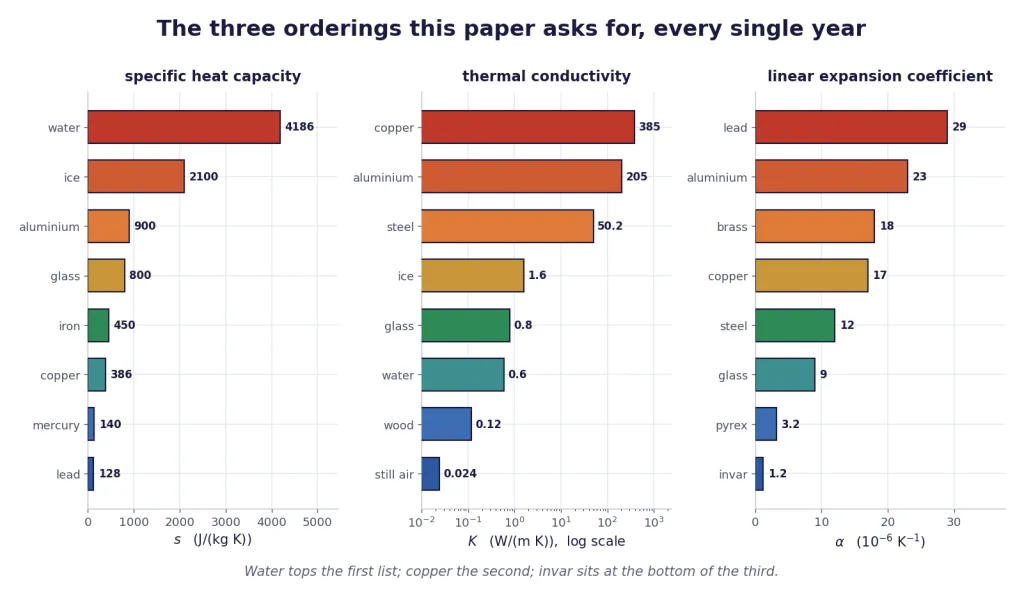
Ranking 1 — temperature rise, by
Equal masses of four substances are each given the same quantity of heat. Since with and common,
so the substance with the smallest specific heat capacity gets hottest. Put 10 kJ into 1 kg of each:
| Substance | (J/(kg K)) | Rise for 10 kJ into 1 kg |
|---|---|---|
| lead | 128 | K |
| copper | K | |
| aluminium | 900 | K |
| water | 4186 | K |
Water last, always. It is the whole reason water is a coolant.
Three variants, all set:
- The same rise, so which needs the most heat? Now the order flips: water needs the most, lead the least.
- Heat capacity against specific heat capacity. Two blocks of the same metal, 1 kg and 4 kg. Their specific heat capacities are equal — it is a property of the material. Their heat capacities are in the ratio . That single distinction is a whole question about once a year.
- The coastal town. Water's huge is why the sea's temperature barely moves through a day while the sand beside it burns, and why a coastal town's daily swing is a fraction of an inland town's at the same latitude.
Ranking 2 — conduction, by and by geometry
Four rods, and the question is which conducts fastest. Since ,
so read off all three factors, not just .
| Material | (W/(m K)) | Relative to still air |
|---|---|---|
| copper | 385 | 16000 |
| aluminium | 205 | 8500 |
| brass | 109 | 4500 |
| steel | 2100 | |
| ice | 67 | |
| glass | 33 | |
| water | 25 | |
| wood | 5 | |
| still air | 1 |
Working values at ordinary temperature. The spread is nearly five decades, which is why this table is drawn on a log scale.
The geometry variants are where the marks actually are, and all three are set:
- A rod is cut into two equal halves placed side by side between the same two reservoirs. Each half has half the length, so half the resistance; two of those in parallel give . The heat flow goes up four times.
- A rod is drawn out to twice its length at constant volume. The length doubles and the area halves, so falls by four and the heat flow falls to a quarter.
- Three identical slabs stacked face to face. Series, so the resistance triples and the flow falls to a third. Two thin blankets beat one thick one only if they trap a layer of air between them — otherwise they are simply the same total thickness.
Key Point: In a series stack the heat current is the same through every layer and the temperature difference divides in proportion to the resistances — so the best insulator takes the biggest temperature drop. In a parallel arrangement the temperature difference is the same across every branch and the currents add. Deciding which arrangement you are looking at, before anything else, is worth more than remembering any formula here.
Ranking 3 — expansion, by
Four rods of the same length are heated through the same rise. Since with and common, , and the ordering is simply the ordering of :
all in units of K.
Two things fall straight out of it. Pyrex survives boiling water poured into it and ordinary glass cracks, because pyrex expands about a third as much and so develops a third of the thermal stress. And invar is the alloy you make a pendulum rod or a survey tape out of, because its is almost zero.
For the areal and volume versions, do not look anything up — multiply:
So an aluminium plate's area grows at K and an aluminium block's volume at K. A bimetallic strip bends towards the metal with the smaller when heated, because the other side has grown longer and must sit on the outside of the curve.
Liquids and gases go on the end of the same ruler. Mercury's K, about five times a typical solid's volume coefficient; and an ideal gas at constant pressure has , which at 273 K is K — a further factor of twenty. Gases expand most, liquids next, solids least, and that ordering by itself answers a question every couple of years.
Ranking 4 — radiation, by and by area
Spheres, cubes and stars, all the same family. Since :
- Same material, same temperature, radii and : the areas are as , so the powers are as . Rates of cooling are a different question — those go as , so the small one cools faster.
- Same area, same temperature, a sphere against a cube: identical power. Emission depends on the area, the temperature and the emissivity, and on nothing else.
- Absolute temperature doubled: power up sixteen times, and the peak wavelength halved.
- Two vessels of hot water, one matt black and one polished: the black one is the better absorber, therefore by Kirchhoff the better emitter, therefore cools faster.
[Important] The two rankings students most often invert. A large body radiates more power but cools more slowly, because it also has more mass to cool. And a good absorber cools faster, not slower — students sometimes reason that black "holds" heat. It does not; it trades it in both directions more freely.
The Three Templates
Three set-ups account for most of the numerical questions this chapter gives you. Learn the shape of each and you will recognise it from the stem alone.
Template 1 — the mixture
You are shown: two or more bodies at different temperatures, put together in an insulated vessel. You are asked: the final temperature, or one unknown mass or specific heat capacity.
The drill, four lines and no more.
- Write down every body with its mass, its specific heat capacity and its starting temperature.
- Ask, before anything else: can there be a phase change? If ice appears at 0°C, or steam at 100°C, or water that might reach 0°C or 100°C, the answer is yes and you must check it.
- If there is no phase change, one equation: , which is just heat lost equals heat gained.
- If there might be one, compare the heat available with the heat the full change would need, and branch.
Worked, with the branch made explicit. 50 g of ice at 0°C is dropped into 200 g of water at 20°C, in a vessel of negligible heat capacity. Take J/(kg K) and J/kg.
Available beats required, by 94 J. So all the ice melts, and that last 94 J warms the whole 250 g:
Had the ice been 60 g instead, would have been 19980 J, more than is available, and the answer would have pinned at exactly 0°C with only kg of the ice melted and the rest still solid.
Key Point: When ice and water meet, 0°C is a magnet. If the arithmetic leaves you with a final temperature below 0°C or above the melting point of the ice you started with, you have skipped the branch. Compute the available heat and the required heat separately, compare them, and only then write an equation.
Template 2 — the composite conductor
You are shown: two or more slabs or rods between two reservoirs. You are asked: the heat current, the junction temperature, or the equivalent conductivity.
The drill: turn every piece into a resistance and forget it is thermal.
Worked, series. Two rods of the same length and cross-section, and W/(m K), joined end to end with the free ends held at 200°C and 0°C. Find the junction temperature.
In series the heat current is the same through both, so
The junction sits much nearer the cold end, because the poorer conductor takes the larger share of the drop. The bad conductor gets the big temperature difference — that one sentence answers half the conduction questions on this paper without any arithmetic.
Worked, parallel. The same two rods laid side by side between the same two reservoirs. The temperature difference across each is now the same and the currents add, so with equal and the equivalent conductivity is the plain average:
while for the series pair with equal lengths it is the harmonic mean:
Series gives the smaller number, always. If your series answer comes out bigger than either conductivity, you have used the parallel formula.
Template 3 — the two-interval cooling problem
You are shown: a body cooling from to in a time , in surroundings at . You are asked: its temperature after another equal interval .
This is the single most predictable numerical in the whole chapter, and it has a one-line answer that almost nobody is taught.
Let be the excess temperature. Both standard forms of Newton's law make fall by the same factor in each equal interval — the exponential form because obviously does, and the average-temperature form because rearranging
gives , a constant that does not depend on at all. So the excesses form a geometric progression, and
Worked. A body cools from 70°C to 60°C in 5 minutes, in surroundings at 30°C. What is its temperature after another 5 minutes?
Six seconds, no cooling constant, no logarithm. And it is not an approximation of a shortcut: integrating numerically gives °C, the closed-form exponential gives °C, and the average-temperature form gives °C. All three agree exactly, because all three make the excess fall geometrically.
Key Point: The shortcut works only for equal time intervals. If the second interval has a different length, you must go back to and find first. And the surroundings' temperature must be subtracted every time — forgetting it is the standard error, and it is what every wrong option in these questions is built from.
[Exam Tip] Newton's law is the one place in this chapter where Celsius is completely safe, because only the difference ever appears. Do not convert. Then, the moment you move to Wien or Stefan-Boltzmann, convert everything — because there only kelvin will do. Knowing which of the two situations you are in is the whole game.
Graphs, the Two Special Formats, and the Speed Habits
Four tasks live in this block. All four are mechanical once you know the drill, and none of them is really physics.
Reading the two graphs this chapter draws
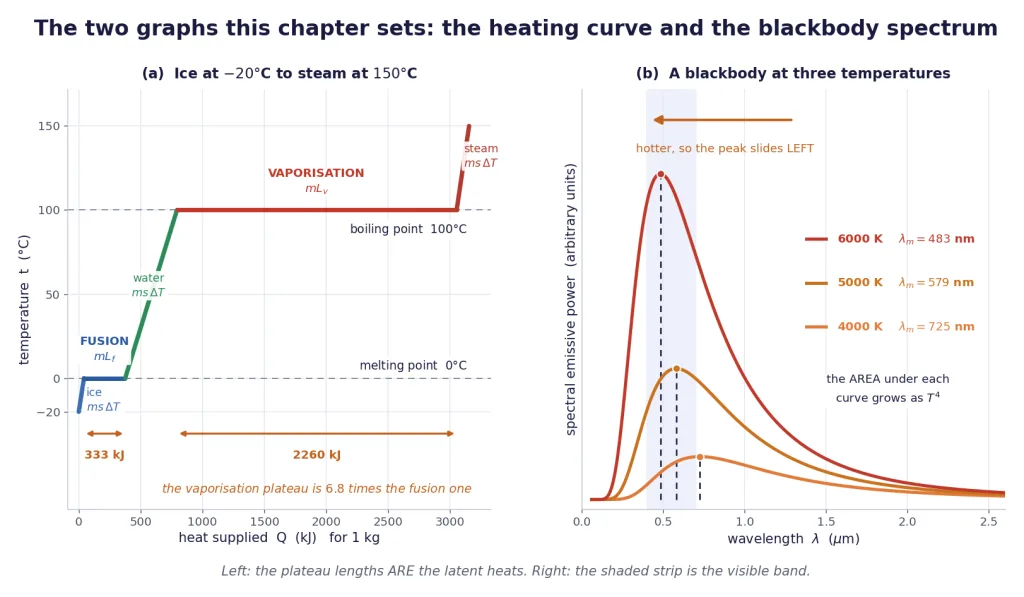
The heating curve — temperature against heat supplied, for a substance heated at a steady rate. Five readings cover every question set on it.
| What you see | What it means |
|---|---|
| a sloping segment | one phase, no change of state; |
| the slope of that segment | , so a steeper slope means a smaller specific heat capacity |
| a flat plateau | a change of state; the temperature is pinned while or is absorbed |
| the length of a plateau | the latent heat: (or ), which is if you are given the power and the time |
| the temperature of a plateau | the melting point or the boiling point at that pressure |
Two numbers to have ready. For 1 kg of water substance heated from ice at C:
| Segment | Heat | Running total |
|---|---|---|
| ice, to 0°C | 42 kJ | 42 kJ |
| fusion plateau | 333 kJ | 375 kJ |
| water, 0 to 100°C | 419 kJ | 794 kJ |
| vaporisation plateau | 2260 kJ | 3054 kJ |
| steam, 100 to 150°C | 100 kJ | 3154 kJ |
Computed segment by segment with , and J/(kg K), and J/kg.
The vaporisation plateau is times the fusion one, and that ratio IS the physics of the graph. Melting only has to loosen a lattice; boiling has to pull every molecule right out of the liquid's reach.
The blackbody spectrum — spectral emissive power against wavelength, one curve per temperature. Four readings, and all four have been questions.
- Every curve has a single peak, and it rises from zero and falls back to zero. It is never a straight line and it is not symmetric — the fall on the long-wavelength side is much gentler than the rise.
- The peak moves to shorter wavelength as the temperature rises, and m K. Halve and the absolute temperature has doubled.
- The area under a curve is the total emissive power, and it goes as . Double the temperature and the area is sixteen times bigger — which is why a hotter curve does not merely shift, it towers.
- The curves never cross. A hotter body emits more at every wavelength, not just near its peak.
Two quick reads worth practising until they take five seconds. A curve peaking at micrometres belongs to a body at K. A curve peaking at 500 nm belongs to a body at 5800 K, which is the Sun — and that is not a coincidence, since our eyes evolved to be most sensitive where the Sun puts out most of its light.
Two more graphs, one line each
- A cooling curve — temperature against time — falls steeply at first and flattens towards , approaching it but never crossing. A plot of against is a straight line of slope , and that straight line is how the law is verified in the laboratory.
- A pressure-against-temperature plot for a low-density gas at constant volume is a straight line, and extrapolating it back to zero pressure gives an intercept at C whatever gas you used. That common intercept is what defines absolute zero.
Assertion-Reason: the four codes
You are given an Assertion (A) and a Reason (R), and asked to choose:
| Code | Meaning |
|---|---|
| (a) | Both A and R are true, and R is the correct explanation of A |
| (b) | Both A and R are true, but R is not the correct explanation of A |
| (c) | A is true but R is false |
| (d) | A is false but R is true |
Read the option list before you start — the order of these four is not fixed between papers, and picking "option (a)" from memory when the paper has shuffled them is a self-inflicted wound.
Key Point: Three separate judgements, in this order, and never let one influence the next:
- Cover R. Is A true, on its own?
- Cover A. Is R true, on its own?
- Only if both are true: does R actually explain A, or is it merely another true fact about the same topic?
Step 3 is where the marks are, and it is the step people rush. "Both true" is not enough. Ask yourself: if R were false, would A stop being true? If yes, R explains A. If A would survive without R, the answer is (b).
Worked, four times.
Item 1. A: A lake freezes from the surface downwards. R: Ice is a poor conductor of heat. A alone: true. R alone: true — W/(m K), poor for a solid. But does R explain A? No. What makes the lake freeze at the top is the anomalous expansion of water: below 4°C the colder water is the lighter, so it stays on the surface and freezes there. Ice's poor conductivity explains why the water underneath then stays liquid — a different fact about the same lake. Both true, R does not explain A.
Item 2. A: A lake freezes from the surface downwards. R: Water below 4°C becomes less dense as it is cooled further, so the coldest water floats. A alone: true. R alone: true. And this time R is exactly why A holds. Both true, R explains A. Items 1 and 2 have the same assertion and different reasons, and completely different answers. That is precisely how the format is built.
Item 3. A: A circular hole in a metal plate becomes larger when the plate is heated. R: Every linear dimension of the plate, including the diameter of the hole, is multiplied by the same factor . A alone: true. R alone: true. R explains A completely — the hole is one of the plate's dimensions. Both true, R explains A.
Item 4. A: A body in thermal equilibrium with its surroundings has stopped emitting radiation. R: Every body above absolute zero emits radiation continuously. A alone: false — equilibrium is a balance of emission and absorption, not a stopping of either. R alone: true, and it is Prevost's theory. A is false but R is true.
Column matching: anchor, do not solve
You are given four items in Column I, four in Column II, and four codes. Never work out all four pairings. Find the one or two that are unmistakable, and use them to kill codes.
Key Point: Anchor on whatever is structurally unique in Column II — the only fourth power, the only quantity with a in it, the only dimensionless one, the only one with the units of a rate. Two anchors almost always leave exactly one surviving code.
Worked. Column I: (A) Wien's displacement law (B) Stefan-Boltzmann law (C) Newton's law of cooling (D) the conduction law. Column II: (i) (ii) (iii) (iv) .
Anchor 1: (ii) is the only expression containing a wavelength, so A-ii. Anchor 2: (iv) is the only one containing a derivative with respect to time, so C-iv. Two anchors, and any code that disagrees with either is dead. The remaining two fall out with no work: (iii) is the only fourth power, so B-iii, and (i) is the only one with a thickness in it, so D-i.
The speed habits that finish a thermal question in under 45 seconds
Six habits, in the order you should apply them.
1. Read the last line of the stem first. It tells you which formula you need, and half the time it also tells you which trap is being set — the words "gauge", "net", "further", "already at 0°C" and "in the next 5 minutes" all change the answer.
2. Write the letter K. Every temperature that will enter a power, a ratio or a gas law gets converted and labelled before you do anything else. Every temperature that only appears as a difference stays in Celsius and you save the conversion.
3. Convert the awkward units on line one. cm to m is , mm to m is , grams to kilograms is , and cm of thickness is where half the conduction errors live. Do it once, at the top.
4. Ask "is a phase change possible?" before writing any calorimetry equation. If ice, steam, or a temperature that could reach 0°C or 100°C appears anywhere in the stem, the answer is yes, and you compare available heat against required heat before you commit.
5. Prefer the ratio to the substitution. If the question compares two situations, cancel everything common and work with the proportionality. , , — these are ten-second answers where the full substitution is a ninety-second one.
6. Sanity-check the size before you look at the options. Water's specific heat capacity is big, so its temperature rises are small. Latent heats are big, so phase changes eat a lot of heat. Metals conduct thousands of times better than air. A body near room temperature radiates a few hundred watts per square metre, not a few. If your answer is three decades away from those, you have dropped a conversion.
[Important] And the elimination habit that is worth the most: look at the spacing of the options. In this chapter wrong options are almost never a few per cent away — they are a factor of 2 (dropping a factor in ), a factor of 4 or 16 (a fourth power taken as a square, or a radius taken as a diameter), a factor of or (a cm-to-m conversion done once instead of squared), or the Celsius-for-kelvin answer, which is wildly out. Identify which trap each option encodes and you can often eliminate two of them without computing anything at all.
Solved Examples
Twelve problems at exam level and exam pace. Give yourself 45 seconds on each before reading the solution. Throughout, J/(kg K), J/(kg K), J/kg, J/kg, W/(m K) and m K; other constants are stated where they are used.
Example 1: Eighteen one-liners, straight from the statements
Answer each in a single sentence, with no calculation.
(a) Why is "a hot body contains a lot of heat" wrong? (b) State the zeroth law of thermodynamics, and say what it is for. (c) What decides the direction in which heat flows? (d) Does a hole in a metal plate grow or shrink when the plate is heated? (e) What is the ratio for an isotropic solid? (f) At what temperature is water densest, and what follows from it? (g) Why does the temperature stay constant while ice melts? (h) Why does steam at 100°C scald worse than water at 100°C? (i) Which is longer on a heating curve for water, the fusion plateau or the vaporisation plateau, and by what factor? (j) State the principle of calorimetry. (k) What is the water equivalent of a body? (l) How does evaporation differ from boiling? (m) Why does raising the pressure lower the melting point of ice? (n) In , may be in degrees Celsius? (o) Why is a good absorber a good emitter? (p) Is a body in thermal equilibrium with its surroundings still radiating? (q) State Wien's displacement law, with the unit of . (r) Under what condition is Newton's law of cooling valid?
Solution:
(a) Because heat is energy in transit, not something a body stores. What a body owns is internal energy; heat exists only while it is crossing a boundary because of a temperature difference.
(b) If two bodies are each separately in thermal equilibrium with a third, they are in thermal equilibrium with each other. It is what makes temperature a measurable quantity and a thermometer possible.
(c) The temperature difference alone. Heat flows from the higher temperature to the lower, regardless of the masses or the internal energies involved.
(d) It grows. Every linear dimension of the plate, the hole's diameter included, is multiplied by .
(e) — one dimension, two dimensions, three dimensions.
(f) At about 4°C. Below that, cooling water expands, so the coldest water floats, and a lake freezes from the top downwards with the ice insulating the water beneath.
(g) Because the heat supplied goes into potential energy, breaking the lattice bonds, not into the average kinetic energy that temperature measures.
(h) Because each kilogram of steam must first release J of latent heat on condensing, before it begins to cool at all.
(i) The vaporisation plateau, by a factor of .
(j) In a thermally isolated system, heat lost by the hotter bodies equals heat gained by the colder ones.
(k) The mass of water that would need the same quantity of heat as the body for the same temperature rise: .
(l) Evaporation happens at any temperature and only at the free surface; boiling happens at one fixed temperature and throughout the bulk of the liquid.
(m) Because water is the rare substance that contracts on melting — the liquid is denser than the solid — so pressure favours the liquid state.
(n) Yes. Only a difference appears, and a Celsius degree and a kelvin are the same size.
(o) Kirchhoff's law: at a given temperature and wavelength, is the same for every body and equals the blackbody value , so and strong absorption forces strong emission.
(p) Yes. Equilibrium is a balance — it emits and absorbs at equal rates. That is Prevost's theory.
(q) with m K, and in kelvin.
(r) Only when the excess temperature is small, so that may be linearised as .
Takeaway: Every one of these eighteen has been a complete question by itself. None of them is worth more than fifteen seconds of your time, and none of them should be derived.
Example 2: Three conversions and the two coincidences
(a) A patient's temperature reads F. What is it in °C? (b) A body is warmed so that its temperature rises by 9 Fahrenheit degrees. What is that rise in kelvin? (c) At what temperature do the Celsius and Fahrenheit scales read the same number? (d) Why is F the famous "normal" number?
Solution:
(a) Subtract 32 first, then scale. A real fever, and comfortably below the C at which proteins start to denature.
(b) A rise is an interval, so use only the scale factor and never the offset: The 32 belongs to the zero of the scale, not to the size of a degree. Adding it here is the standard error.
(c) Set : C is F, the one place the two scales cross.
(d) It is a conversion, not a measurement: Normal core temperature is really a range of about 36.1°C to 37.2°C. The extra significant figure in 98.6 is entirely manufactured by multiplying 37.0 by .
Takeaway: For a reading, subtract 32 then scale by . For a rise, scale by and nothing else. And F is C wearing different clothes.
Example 3: The hole, and the ratio earned rather than quoted
A steel plate at 20°C has a circular hole of area cm cut in it. The plate is heated to 220°C. Take K.
(a) By how much does the area of the hole change, and in which direction? (b) Show that dropping the second-order term in is safe here, by saying how big it is. (c) If instead the plate were a solid steel block of volume cm, by how much would its volume grow?
Solution:
(a) The hole is not a special object. Every linear dimension scales by the same factor, so the hole's area obeys the ordinary areal law with : The hole gets bigger, by about half a percent of its area.
(b) Take a square of side . After heating, its side is , so its area is Here , so the kept term is and the dropped term is . The exact fractional growth is . One part in eight hundred — utterly negligible, which is why is written as an equality.
(c) Same argument, one dimension further: The exact cube gives a fractional growth of against the first-order — the dropped terms are % of what is kept.
Takeaway: The hole grows with the plate. And , are not sloppy — the terms they drop are of order smaller, which for any temperature you will meet is a fraction of a percent.
Solved Examples (continued)
Example 4: Four blocks, the same heat, four different rises
One kilogram each of lead, copper, aluminium and water is given kJ of heat. Take = 128, , 900 and 4186 J/(kg K) respectively.
(a) Rank them by temperature rise, largest first. (b) Compute each rise. (c) Two blocks of the same metal have masses 1 kg and 4 kg. Compare their specific heat capacities and their heat capacities.
Solution:
(a) From with and the same for all four, so the smallest gives the largest rise: lead, then copper, then aluminium, then water. That ordering is available in five seconds, with no arithmetic, and it is often all the question wants.
(b) One division each:
| Substance | (J/(kg K)) | |
|---|---|---|
| lead | 128 | K |
| copper | K | |
| aluminium | 900 | K |
| water | 4186 | K |
The spread is a factor of 33 from top to bottom, which is why water is the coolant in every radiator and every reactor: it soaks up heat with barely any temperature change.
(c) Specific heat capacity is a property of the material, so both blocks have the same value. Heat capacity belongs to the object, so it is in the ratio . The units settle it if you are unsure: J/(kg K) mentions a kilogram and cannot depend on the mass; J/K does not, and must.
Takeaway: for equal masses and equal heat. And belongs to the substance while belongs to the object — a distinction that is a question in its own right about once a year.
Example 5: A mixture that stops dead at zero
50 g of ice at 0°C is dropped into 200 g of water at 20°C in a vessel of negligible heat capacity. Find the final temperature and state how much ice melts. Take J/(kg K) and J/kg.
Solution:
Step 1 — resist the urge to write an equation. Ice at 0°C is in the stem, so a phase change is possible and the branch must be checked first.
Step 2 — how much heat is available? All the warm water can give up is what it releases cooling to 0°C:
Step 3 — how much would the full change need? The ice is already at its melting point, so there is no warming stage:
Step 4 — branch. , so there is enough — all the ice melts, with 94 J left over. That surplus warms the whole 250 g of water now present:
Step 5 — how close was that? Extremely. Had the ice been 60 g, melting it all would have needed 19980 J, more than the 16744 J available, and the answer would have pinned at exactly 0°C with only melting and 10 g of ice left floating. Same set-up, completely different answer.
Takeaway: Compute the available heat and the required heat separately, then branch. If a mixture question hands you a final temperature of C for an ice-and-water problem, you skipped this step.
Example 6: Reading the heating curve without a single formula
A 400 W heater is switched on under kg of ice at C, and the temperature is plotted against time. The trace shows a short slope, then a flat stretch lasting 416 s, then a longer slope.
(a) What does the flat stretch represent, and at what temperature is it? (b) Find the latent heat of fusion from the graph alone. (c) The slope of the first segment is steeper than the slope of the third. What does that tell you? (d) Estimate how long the second flat stretch would last if the heating continued to boiling.
Solution:
(a) A flat stretch on a heating curve means a change of state: heat is going in but the temperature is not moving, because it is being spent as latent heat. Here it is melting, at 0°C.
(b) All the heat the heater delivers during the plateau goes into melting: which is the accepted value. The length of a plateau measures a latent heat, and nothing else does.
(c) The slope of a sloping segment is , and the mass is the same throughout. So a steeper slope means a smaller specific heat capacity. Ice at 2100 J/(kg K) warms about twice as fast per joule as water at 4186 J/(kg K), and the graph shows exactly that.
(d) The second plateau is vaporisation, and . Since the heater's power is unchanged, the time goes in the same ratio: against seven minutes for melting. That ratio of about 6.8 is the single most asked number about this graph.
Takeaway: Flat means latent heat, and the plateau's length gives you or . Sloping means , and the slope gives you . You can answer almost every heating-curve question with those two sentences and a ruler.
Solved Examples (continued)
Example 7: What it costs to run a fever
A patient of mass 60 kg has a core temperature of C. Over two hours it rises to C and settles there. Take the body's average specific heat capacity as 3470 J/(kg K) and the basal metabolic power as 100 W.
(a) How much extra heat had to be produced and retained? (b) By what extra power, and what percentage of basal, is that? (c) Express the fever temperature in °F. (d) Why does the patient shiver and feel cold at the start of the fever, even though the temperature is already above normal?
Solution:
(a) No phase change, so one line: About 100 kilocalories — a slice of bread's worth of energy, which is a useful reminder that a body is a very large thermal mass.
(b) Spread over hours s: On top of the basal 100 W that is a 58% rise in metabolic rate — and the rate stays elevated for as long as the fever is held, because the body must also cover the larger losses that come with being hotter. That is why a fever is exhausting.
(c) .
(d) Because the set point has moved, not the control system. Pyrogens shift the hypothalamic target from 37°C to about 39°C, and at 37.5°C the patient is now below target. The body therefore does what it always does when it is too cold: it shivers (muscular work turned entirely into heat) and constricts the skin vessels (cutting the losses). When the fever breaks the set point drops back, the patient is suddenly above target, and the sweating begins.
Takeaway: A fever is a control loop chasing a raised set point, and the physics of it is with a very large . The "feeling cold while hot" question is asked almost every year and the answer is the set point, not the thermometer.
Example 8: Four routes out of a warm body
A bare adult of surface area m sits in a still room whose air and walls are at 23°C, with skin at 33°C. Take the skin's emissivity as , the convective coefficient in still air as W/(m K), the insensible water loss as litre a day, J/kg and W/(m K).
(a) Find the loss by radiation, by convection and by evaporation. (b) Compare the total with a basal production of 100 W and comment. (c) A wind raises to 30 W/(m K). What happens?
Solution:
(a) Radiation first, and the temperatures go into kelvin because they sit inside a fourth power:
Convection, where only a difference appears, so Celsius is safe:
Evaporation, from a mass flow of kg/s:
(b) Total out W, against 100 W made. You are losing 77 W more than you produce, so your core temperature would drift down — which is exactly why a room at 23°C feels cool with no clothes on. Put on clothing and you add thermal resistance to the radiation and convection paths until the two sides balance. Notice also that radiation is the largest single route, not convection; that ordering has been a question.
(c) Convection alone becomes a factor of about 7.5, and the total loss jumps past 590 W against a production of 100 W. The air's temperature has not changed at all — what changed is the transfer coefficient, because moving air keeps stripping away the insulating layer that clings to the skin. That is the whole physics of wind chill.
Takeaway: Radiation needs kelvin; convection and evaporation need only a difference. And wind kills by raising , not by lowering the air temperature — an option claiming otherwise is always wrong.
Example 9: A wall, a window, and the resistance shortcut
An external wall has a total area of 20 m, of which m is a single pane of glass mm thick and the remaining 18 m is brick m thick. Take and W/(m K), with 20 K between inside and outside.
(a) Find the thermal resistance of each part. (b) Find the total rate of heat loss. (c) What fraction of the loss goes through the window?
Solution:
Step 1 — decide series or parallel. The two materials sit side by side between the same two temperatures, so this is a parallel combination. That decision, taken first, is most of the question.
(a) for each: Look at those two numbers before going further. The window, one tenth of the area, has about one sixth of the resistance — because it is fifty times thinner.
(b) In parallel the reciprocals add:
(c) Through the glass alone:
Eighty-six percent of the heat leaves through ten percent of the area. That is why double glazing exists, and it is the parallel-branch lesson in one number: in a parallel arrangement the lowest resistance carries almost everything.
One honest note on the size of the answer: this is the conduction-only figure. A real wall also has thin, still films of air clinging to both faces, and those add resistance that brings the true loss down several-fold. The comparison between the two branches is unaffected.
Takeaway: Side by side means parallel, reciprocals add, and the smallest resistance dominates. End to end means series, resistances add, and the largest resistance dominates. Decide which you are looking at before you write anything.
Solved Examples (continued)
Example 10: A star's colour, then its power — kelvin twice
The radiation from a star peaks at a wavelength of 350 nm. Take m K and W/(m K), and treat the star as a blackbody.
(a) Find its surface temperature. (b) Find the power it radiates per unit area of its surface. (c) The Sun's surface is at 5800 K. How many times more power per unit area does this star emit? (d) What would have gone wrong had you worked in °C?
Solution:
(a) Wien's displacement law, with the wavelength in metres: Kelvin comes straight out — Wien's law has no Celsius version at all, because is defined with an absolute temperature.
(b) Stefan-Boltzmann, for a blackbody:
(c) Take the ratio and everything except the temperatures cancels: Ten seconds, and no need to evaluate either fourth power separately. For reference the Sun's own figure is W/m, and as it must.
(d) Everything. Wien's law would have been meaningless — there is no Celsius value of . And in the ratio, K and K are C and C, giving instead of . That looks like a small error here only because both temperatures are large. Take a body warmed from 27°C to 127°C and the same slip gives instead of — wrong by a factor of 155.
Takeaway: Wien and Stefan-Boltzmann both take kelvin, without exception. When a question compares two bodies, take the ratio of the fourth powers rather than evaluating them; it is four times faster and it cancels , and for free.
Example 11: Reading the blackbody spectrum off the axes
A graph shows the spectral emissive power of a blackbody against wavelength for three temperatures: 4000 K, 5000 K and 6000 K.
(a) Which curve peaks furthest to the left, and where? (b) By what factor is the area under the 6000 K curve larger than the area under the 4000 K curve? (c) Do the curves cross anywhere? (d) A fourth curve peaks at micrometres. What temperature is it, and would the body look red-hot or be invisible?
Solution:
(a) The hottest, since and a bigger gives a smaller : For comparison, nm and nm. The peak slides towards the blue as the body gets hotter — which is why a heated poker runs dull red, then orange, then white.
(b) The area under a curve is the total emissive power, and that goes as : So the hotter curve does not merely shift — it towers over the cooler one.
(c) No. A hotter blackbody emits more at every wavelength, so the curves nest inside one another without ever touching. Any sketch showing two blackbody curves crossing is wrong, and that is a question in its own right.
(d) K. At 2000 K the peak is in the near infrared, well outside the 400 to 700 nm visible band, but the tail of the curve reaches into the red — so the body glows a dull red, which is exactly what 2000 K metal looks like. A body has to reach roughly 5000 K before its peak itself lands inside the visible band.
Takeaway: Peak position gives you through ; area gives you power through ; and the curves never cross. Those three sentences answer every blackbody-graph question this paper sets.
Example 12: Two five-minute intervals, and why every route agrees
A body cools from 70°C to 60°C in 5 minutes, in surroundings held at 30°C.
(a) Find its temperature after a further 5 minutes, using the average-temperature form. (b) Do it again with the exponential form, and compare. (c) State the one-line shortcut, and use it. (d) Would the same shortcut work if the second interval were 8 minutes instead?
Solution:
(a) The average-temperature form uses the mean of the start and end temperatures as the body's effective temperature over the interval: First interval: , so per minute. Second interval, from 60°C to an unknown :
(b) The exponential form works on the excess , which decays as : After a further 5 minutes the same factor applies again: Identical. And that is not a fluke of these numbers. Rearranging the average-temperature form gives , a constant ratio independent of — so both forms make the excess fall geometrically, and for equal intervals both give the same answer. (Their cooling constants do differ: per minute against per minute, about % apart. The predictions still coincide, because each form is used self-consistently.)
(c) Since the excesses form a geometric progression, : One line, six seconds, no cooling constant.
(d) No. The geometric argument needs equal intervals. For an unequal one, get from the first interval — here gives per minute — and then use K, giving C.
Takeaway: For equal intervals, , and every route agrees. For unequal intervals, find first. And subtract every single time — the wrong options in this question are always built from forgetting it.