
Hot, Cold, and What They Actually Mean
You have known since you were three years old which of two things is hotter. This chapter starts by taking that everyday knowledge and making it exact enough to calculate with, because almost everything that follows — expansion, calorimetry, melting, conduction, radiation — is built on just two ideas, and students lose marks on all of it by muddling them.
The two ideas are temperature and heat. They are not the same thing. They are not even the same kind of thing.
Key Point — temperature:
Temperature is a measure of the degree of hotness of a body. It is the property that decides which way heat will flow when two bodies are put in contact: heat always flows from the body at higher temperature to the body at lower temperature.
Notice what that definition does not say. It says nothing about how much energy the body has. Temperature is a "which way" quantity, not a "how much" quantity, and holding on to that one sentence will save you more marks in this chapter than any formula in it.
Your skin is a bad thermometer
Touch is the sense we normally use to judge hotness, and it is unreliable in two separate ways.
It is relative, not absolute. Put one hand in hot water and the other in cold water, wait a minute, then plunge both into the same bowl of lukewarm water. The same water feels cold to one hand and hot to the other. Your skin does not report temperature; it reports the rate at which heat is leaving or entering it.
It is fooled by the material. On a winter morning the metal handle of a cycle feels far colder than the rubber grip beside it, although a thermometer says both are at exactly the same temperature. The metal conducts heat away from your fingers quickly and the rubber does not, so the metal feels colder. Section 8 explains why in detail.
So we need an instrument and a scale — which is exactly what Section 2 is about. Here we settle what the instrument is measuring in the first place.
Two bodies, one boundary
Leave a glass of iced water on a table on a hot day and it warms up. Leave a cup of hot tea on the same table and it cools down. In both cases something is moving across the surface of the glass or the cup, and it keeps moving until the drink and the room are at the same temperature. Then it stops.
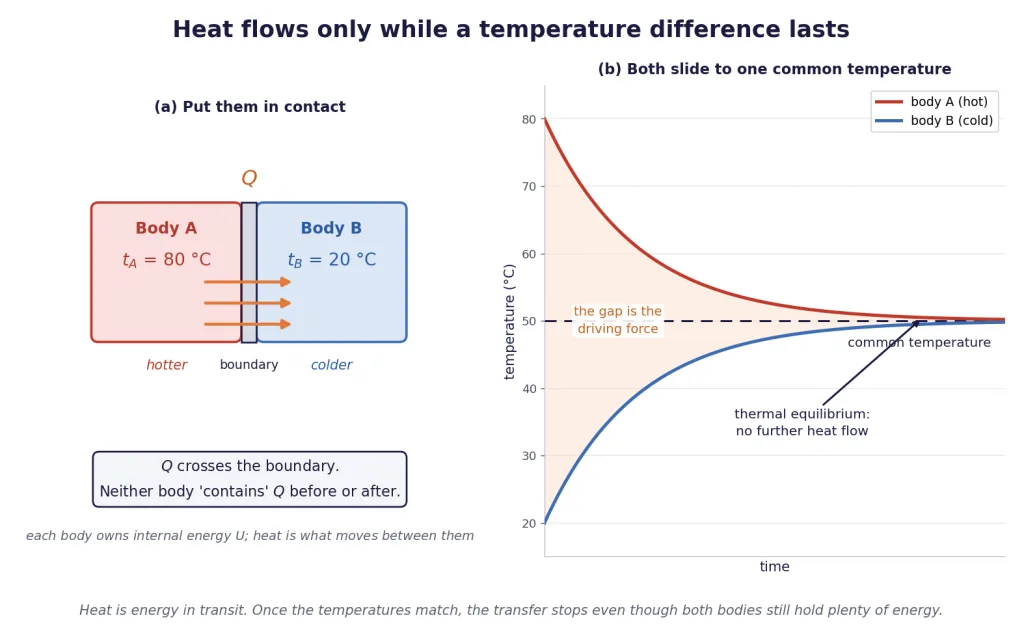
That "something" is heat, and the state the two bodies end up in is called thermal equilibrium. Both words are worth a proper definition, and they come next.
[Board Important] A very common one-mark question is "Is temperature a measure of the total energy of a body?" The answer is no — it is a measure of the degree of hotness, and it decides the direction of heat flow. The next block shows exactly how badly wrong the "total energy" answer can go.
Heat Is Energy in Transit
Here is the definition that the whole chapter hangs on, and it is worth learning word for word.
Key Point — heat:
Heat is energy transferred between two systems, or between a system and its surroundings, by virtue of a temperature difference alone. Its SI unit is the joule (J), because it is a form of energy.
The key phrase is energy in transit. Heat exists only while it is crossing a boundary. The instant the transfer stops, there is no heat anywhere — only energy sitting inside the bodies.
"This body contains a lot of heat" is a wrong sentence
This is the single most important correction in the section, so let us be blunt about it.
A body does not contain heat. A body contains internal energy, written : the total energy of all its molecules — their random kinetic energy of translation, rotation and vibration, plus the potential energy of the forces between them. Internal energy is a property the body owns, like its mass or its volume. You could in principle put a number on it without ever letting the body touch anything.
Heat is not like that. Heat is what crosses the boundary when the body is put in contact with something at a different temperature. Once it has crossed, it is no longer heat — it has become part of the internal energy of the body that received it.
Think of it this way. Rain is water in transit through the air. A lake contains water; it does not contain rain. Asking "how much rain is in this lake?" is not a hard question, it is a malformed question. "How much heat does this body contain?" is malformed in exactly the same way.
Key Point — the three-word test:
- Correct: "600 J of heat flowed into the water."
- Correct: "The internal energy of the water increased by 600 J."
- Wrong: "The water now contains 600 J of heat."
If the sentence has heat sitting still, it is wrong. Heat only ever moves.
The spark and the bucket
Now the demonstration that shows why temperature and internal energy must be kept apart.
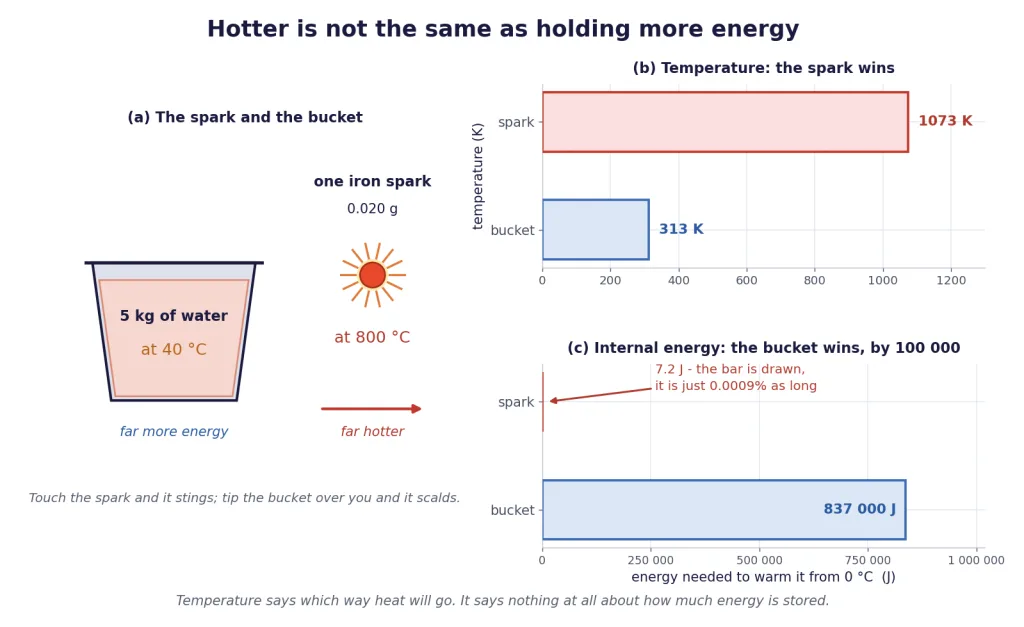
A grinding wheel throws off a spark: a fleck of iron of mass about 0.020 g, glowing at around 800°C. Beside it stands a bucket holding 5.0 kg of water at 40°C.
Which is hotter? The spark, and it is not close. The spark is at 1073 K, the water at 313 K.
Which holds more internal energy? Take the energy each would have to give up to cool to 0°C, using 450 J/(kg K) for iron and 4186 J/(kg K) for water.
- Spark: J. About what it takes to lift a 250 g apple three metres.
- Bucket: J. Enough to run a 100 W bulb for well over two hours.
The bucket holds about 116 000 times as much energy as the spark, and yet the spark is nearly three and a half times hotter on the absolute scale. The spark lands on your arm and stings for an instant; the bucket tipped over you would put you in hospital.
Key Point: A high temperature does not mean a lot of energy, and a lot of energy does not mean a high temperature. Temperature tells you the direction heat will flow. Internal energy tells you how much there is to give.
And notice which way heat would actually go if the spark landed in the bucket: from the spark into the water, from the tiny store to the enormous one, because heat obeys the temperature difference and takes no interest at all in who has more.
[NEET Important] The classic version of this asks you to compare an iceberg and a cup of hot coffee. The iceberg has vastly more internal energy; the coffee is at the far higher temperature; and if you could put them in contact, heat would flow from the coffee to the iceberg. All three statements are true together, and saying so is the full-mark answer.
Thermal Equilibrium, Walls, and the Zeroth Law
Thermal equilibrium
Key Point — thermal equilibrium:
Two systems are in thermal equilibrium when, being free to exchange heat, no net heat flows between them. Experiment says this happens exactly when they are at the same temperature."No net flow" is deliberate. Energy is still being swapped both ways at the molecular level; the two flows have simply become equal and opposite.
The wall matters as much as the bodies
Whether two systems can reach equilibrium at all depends on what separates them.
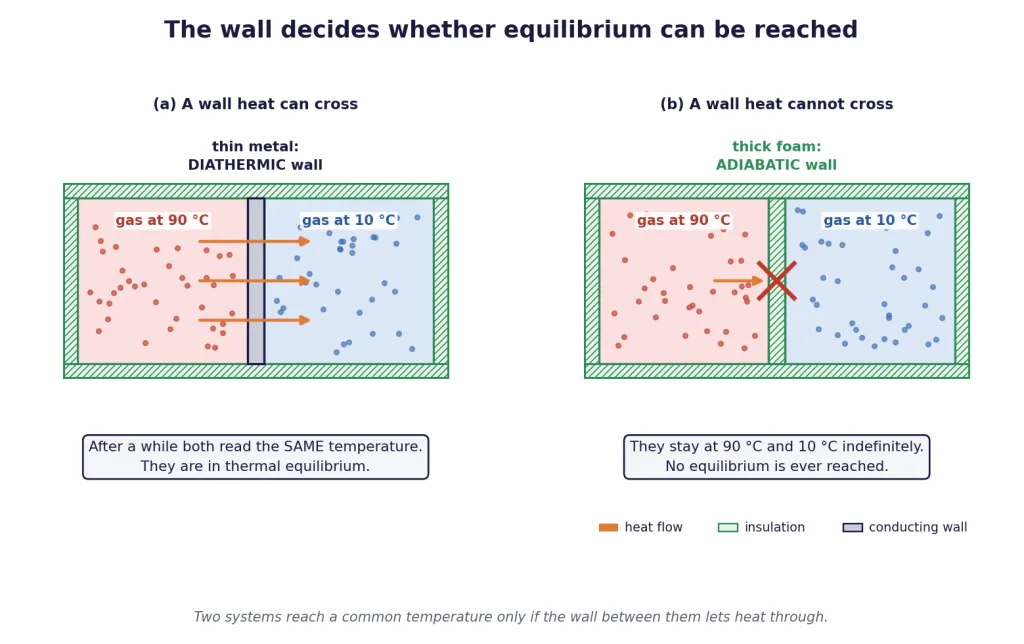
Key Point — the two kinds of wall:
- A diathermic wall lets heat pass through it. Two systems separated by one will always drift to a common temperature and stay there. A thin metal partition, the wall of a copper vessel and the glass of a window are all diathermic.
- An adiabatic wall does not let heat pass. Two systems separated by one keep their own temperatures indefinitely. Thick foam, the double vacuum wall of a thermos flask and a well-lagged pipe are all, to a good approximation, adiabatic.
"Diathermic" is from Greek for through-heat; "adiabatic" for not-passable.
No real wall is perfectly adiabatic — a thermos flask keeps tea hot for hours, not for ever. When a problem says "the vessel is perfectly insulated", it is telling you to treat the outer wall as adiabatic so that no heat is lost to the room. Section 6 leans on this every time it sets up a calorimetry problem.
[JEE Tip] Read the wall before you read the numbers. If the outer boundary is adiabatic, the total energy of everything inside is conserved and you can write "heat lost by the hot part = heat gained by the cold part". If it is diathermic, the surroundings are in the problem too and that equation is false.
The zeroth law of thermodynamics
Now the piece of logic that makes measuring temperature possible at all.
Take three bodies , and . Put in contact with through a diathermic wall and wait: they reach thermal equilibrium. Separate them. Now put in contact with the same and wait: they too reach thermal equilibrium.
Now bring and together, having never allowed them to touch before. What happens?
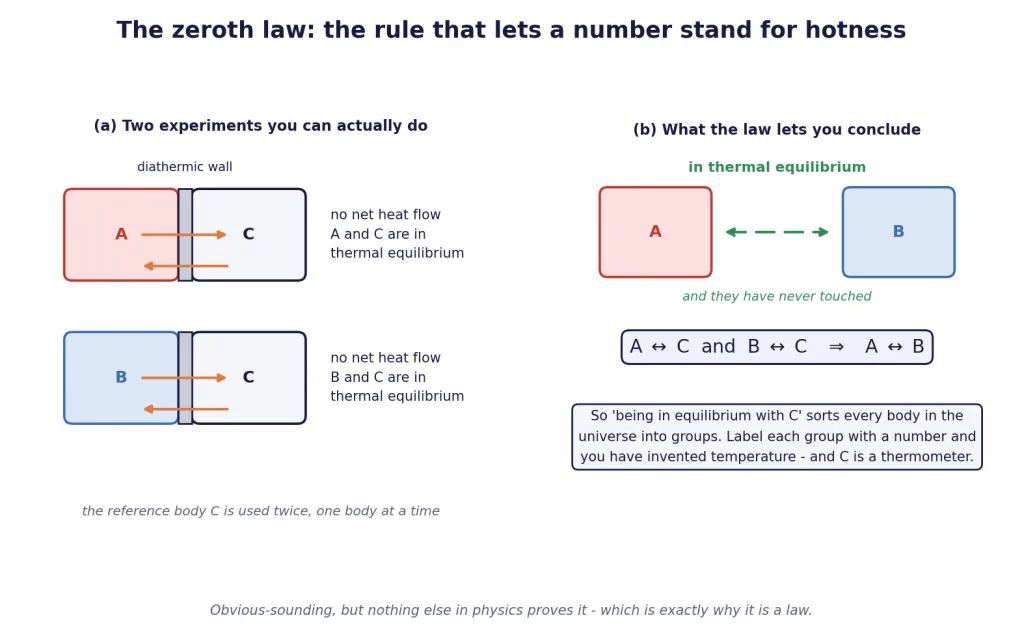
Key Point — the zeroth law of thermodynamics:
If two systems and are each separately in thermal equilibrium with a third system , then and are in thermal equilibrium with each other.Nothing flows between and when they meet.
Why on earth is that a law?
Students meet the zeroth law, shrug, and move on, because it sounds like something you could have guessed. That reaction is worth arguing with, because the law is doing real work.
First: it is an experimental fact, not a piece of logic. Being in thermal equilibrium is a relation between bodies, and most relations in the world are not transitive. " is a friend of " and " is a friend of " tells you nothing whatever about and . There is no mathematics that forces thermal equilibrium to behave better than friendship. That it does is something nature grants us, and we discovered it by trying.
Second: it is what makes temperature a meaningful quantity. The law says that "being in thermal equilibrium with" sorts every body in the universe into groups, with every member of a group in equilibrium with every other member and with nothing outside it. Give each group a number, and that number is exactly what we mean by temperature. Without the zeroth law the groups would overlap and no single number could describe hotness at all.
Third: it is what makes a thermometer possible. A thermometer is nothing but the body , carried about and used over and over. When you press a thermometer against a patient and then against a cup of water and get the same reading, the zeroth law is what entitles you to say the patient and the water are at the same temperature — even though you never put them in contact.
Key Point: The zeroth law is the licence to measure temperature by comparison with a standard body instead of by direct contact. Every thermometer ever made runs on it.
It was named "zeroth" because it was recognised as fundamental only after the first and second laws were already famous, and it clearly had to come before them.
[Board Important] The standard three-mark question is: state the zeroth law and explain its significance. State it with three named systems, then give the significance in one sentence: it establishes temperature as a measurable property and justifies the use of a thermometer. Both halves carry marks.
The Joule, the Calorie, and the Mechanical Equivalent of Heat
Heat is energy, so its unit is the unit of energy: the joule. But heat was studied for a century and a half before anyone realised it was energy, and the unit invented back then is still in daily use — which is why every student needs both.
Key Point — the units of heat:
- SI unit: the joule (J).
- The calorie (cal) is the heat needed to raise the temperature of 1 g of water by 1°C.
- The kilocalorie (kcal) is 1000 cal, so 1 kcal = 4186 J. It is the heat needed to warm 1 kg of water by 1°C.
- The Calorie with a capital C printed on food packets is the kilocalorie. A biscuit listing "60 Calories" carries about 251 000 J.
You will meet 4.186 J/cal, 4.18 J/cal and 4.2 J/cal in different places. They are the same number to different precision. Pick one at the start of a problem and use it throughout — mixing them mid-solution is a real source of small errors.
The mechanical equivalent of heat
For most of the eighteenth century heat was thought to be a fluid, "caloric", that flowed out of hot bodies into cold ones and was conserved. It was a good theory. It made correct predictions about mixtures. It was also completely wrong, and the thing that killed it was a boring observation: you can make a body hotter by doing mechanical work on it, without any hotter body anywhere in sight.
Rub your palms together and they warm up. Bore a cannon barrel with a blunt drill and the shavings glow. Where is the caloric coming from? The metal is not cooling down; nothing is cooling down. Work is going in, and hotness is coming out.
James Prescott Joule settled it in the 1840s. He let falling weights turn a paddle wheel inside a sealed, insulated vessel of water, and measured two things: the mechanical work done by the falling weights, and the temperature rise of the water. The result was always the same ratio:
Key Point — the mechanical equivalent of heat: where is the work done in joules, is the equivalent heat in calories, and is the mechanical equivalent of heat. It says that mechanical work and heat are two routes to the same destination: 4.186 J of work always produces the same effect as 1 cal of heat.
Since we now measure heat in joules as well, has quietly become a conversion factor between two units of the same quantity — which is exactly the point Joule was making.
This is where this chapter joins on to the work-energy chapter you have already done. Friction, braking, hammering, stirring, drilling: all of them convert ordered mechanical energy into the disordered internal energy of the bodies involved. Nothing is lost. It is simply no longer available as neat, organised motion.
[JEE Tip] Whenever a problem says "assume all the kinetic energy is converted into heat" or "40% of the work goes into the block", it is asking you to use exactly this idea: set the mechanical energy equal to for the body that gets hot. Section 5 gives its proper name and its proper values; here just note that the energy bookkeeping is the same bookkeeping you already know.
Notation for This Chapter
This chapter has the worst symbol collisions you will meet all year. means two different things in two different sections; three different quantities all want to be called ; and is claimed by both thermal expansion and radiation.
The symbols used throughout:
| Symbol | Meaning | Unit | Also written |
|---|---|---|---|
| absolute temperature — ALWAYS in kelvin | K | — | |
| or | Celsius temperature | °C | |
| heat (energy in transit) | J | ||
| internal energy of a body | J | , | |
| (bare) | a length | m | , |
| latent heat of fusion | J/kg | a bare | |
| latent heat of vaporisation | J/kg | a bare | |
| coefficient of linear expansion | K | ||
| coefficient of areal (superficial) expansion | K | , sometimes | |
| coefficient of volume expansion | K | , sometimes | |
| specific heat capacity | J/(kg K) | ||
| molar specific heat capacity | J/(mol K) | , | |
| heat capacity of a whole body | J/K | ||
| thermal conductivity | W/(m K) | , | |
| the cooling constant in Newton's law | s | ||
| thermal resistance | K/W | ||
| absorptive power (absorptivity) | none | , | |
| emissivity | none | , | |
| the Stefan-Boltzmann constant | W/(m K) | — | |
| Wien's displacement constant | m K | — |
The five that actually cost marks
1. is kelvin. or is Celsius. Always.
This is the one. Every fourth-power law, every ratio of temperatures, every gas-law calculation in this chapter needs the absolute temperature, and putting a Celsius number into one of them is the commonest wrong answer in the entire chapter.
Key Point — the kelvin rule:
In any expression where temperature appears as a ratio, a product or a power — , , , — the temperature must be in kelvin.
In any expression where only a difference appears — , , — kelvin and Celsius give the same number, because the two scales have the same degree size.
State the unit at every substitution. Writing " K" costs you two characters and saves you the question.
Here is that rule doing its job. A body is warmed from 27°C to 77°C.
- The rise is 50°C, and also 50 K. Both are right; they are the same interval.
- The ratio of the absolute temperatures is , not . The Celsius answer is wrong by a factor of two and a half.
2. with a subscript is latent heat; a bare is a length. So and for fusion and vaporisation, and a plain for the length of a rod or the thickness of a slab.
3. , and are three different quantities. Specific heat capacity is per kilogram; molar specific heat is per mole; heat capacity belongs to a whole named object, so .
4. is thermal conductivity; lowercase is reserved for the cooling constant in Newton's law of cooling. Conductivity is also written or , so check which one a formula sheet means before you trust it. Capital and lowercase are two different quantities with two different units.
5. In radiation, absorptive power is , never . Absorptivity is also written or , but here belongs to linear expansion and nothing else, so absorptivity gets and emissivity gets . And is always the Stefan-Boltzmann constant.
One more that catches people out: does double duty. In the conduction sections is thermal resistance, measured in K/W. In the one place where molar specific heats appear, is the universal gas constant, 8.31 J/(mol K). They never appear in the same equation, but say which one you mean when you write it down.
[Board Important] Marks are lost for writing where was meant and for quoting a specific heat with the units of a molar specific heat. Write the symbol, then write its unit next to it, every single time.
Pulling It Together
Everything in this section, on one page
| Idea | The precise statement | The thing people get wrong |
|---|---|---|
| Temperature | the degree of hotness; it fixes the direction of heat flow | thinking it measures total energy |
| Heat | energy in transit because of a temperature difference | saying a body "contains heat" |
| Internal energy | the total random molecular energy a body owns | confusing it with heat |
| Thermal equilibrium | no net heat flow; equal temperatures | thinking nothing at all is exchanged |
| Diathermic wall | lets heat through, so equilibrium is reached | mixing it up with adiabatic |
| Adiabatic wall | blocks heat, so the two temperatures stay apart | assuming any container is adiabatic |
| Zeroth law | with and with with | calling it obvious and missing its point |
| Units | cal J; kcal J | forgetting the food Calorie is a kcal |
| Mechanical equivalent | , with J/cal | treating as a physical constant of nature |
| The kelvin rule | ratios and powers of need kelvin | substituting Celsius into a ratio |
The six traps in this section
Trap 1 — "the body contains 500 J of heat". It contains internal energy. Heat is what crossed the boundary. Examiners mark this phrasing wrong even when the arithmetic is right.
Trap 2 — assuming hotter means more energy. The spark is hotter than the bucket and holds a hundred-thousandth of its energy. When a question compares two bodies, ask which comparison it wants: temperature or energy.
Trap 3 — putting Celsius into a ratio. needs kelvin. A difference does not care. Learn the two cases as one rule.
Trap 4 — treating the zeroth law as a definition. It is an experimental law about the transitivity of thermal equilibrium, and it is what allows temperature to be defined at all. Say that, not "it is obvious".
Trap 5 — the food Calorie. A packet reading 250 Calories means 250 kilocalories, which is about J. Answering 1047 J is out by a factor of a thousand.
Trap 6 — forgetting that heat can be made from work. Braking, friction, stirring and hammering all raise internal energy with no hotter body anywhere. If a problem gives you a speed and asks for a temperature rise, that is what it is testing.
The habit that saves marks
Before you write a final answer anywhere in this chapter, run these three checks.
- Which quantity is the question about — heat, internal energy or temperature? Circle the word in the question. Half the conceptual marks in this chapter are lost by answering a different question from the one asked.
- Is every temperature in the unit that expression needs? Difference: either scale. Ratio, product or power: kelvin, and write the K.
- Does the size feel right? Warming a kilogram of water by one degree takes about 4200 J. A tenth of that or a thousand times that should make you look again at the arithmetic.
[NEET Important] The one-mark recall questions from this section are always the same four: define heat, define temperature, state the zeroth law, and give the value of 1 cal in joules. Have all four ready as single sentences.
Solved Examples
Constants used throughout, unless a problem states otherwise: m/s, 1 cal J, specific heat capacity of water 4186 J/(kg K), of iron and steel 450 J/(kg K), of lead 128 J/(kg K).
Example 1: Reading the back of a biscuit packet
A packet of biscuits states an energy content of 250 Calories (with a capital C). (a) Express this in joules. (b) A student of mass 60 kg wants to burn it off by climbing stairs. Ignoring all inefficiency, how high would they have to climb?
Solution:
The capital C is the trap. The Calorie on a food label is the kilocalorie, so 250 Calories means 250 kcal:
(b) Equate that to the gain in gravitational potential energy. For a climb of height ,
Solve for , with kg and m/s:
Feel the size of that. Eighteen hundred metres of vertical climb is about six times the height of the Qutub Minar stacked on itself, for one packet of biscuits. The human body is not very efficient, so the real climb would be shorter than this — but not by as much as you would like.
Final Answer: (a) J; (b) about 1780 m.
Takeaway: The food Calorie is a kilocalorie. Missing that costs you a clean factor of a thousand, and it is the single most common slip in this type of question.
Example 2: The spark and the bucket, in numbers
A spark of iron of mass 0.020 g flies off a grinding wheel at 800°C. A bucket holds 5.0 kg of water at 40°C. Take the specific heat capacity of iron as 450 J/(kg K) and of water as 4186 J/(kg K). (a) Compare their temperatures on the absolute scale. (b) Compare the energy each would give up in cooling to 0°C. (c) If the spark landed in the bucket, which way would heat flow?
Solution:
(a) Convert both temperatures to kelvin, because a ratio of temperatures is being asked for:
(b) The energy released by the spark, with g kg:
The energy released by the bucket:
The ratio:
(c) Heat flows from higher temperature to lower, and nothing else enters into it. So heat flows from the spark into the water, even though the water holds over a hundred thousand times as much energy.
Final Answer: (a) the spark is 3.43 times hotter on the absolute scale; (b) the bucket holds about times as much energy; (c) from the spark to the water.
Takeaway: Temperature sets the direction; internal energy sets the amount. They are independent, and a question that mixes them is testing whether you know that.
Example 3: Which way does the heat go?
Body is 1.0 kg of water at 30°C. Body is 0.10 kg of water at 60°C. They are placed in contact through a diathermic wall, with the pair insulated from the room. (a) Which contains more internal energy, measured from 0°C? (b) Which way does heat flow, and why?
Solution:
(a) Internal energy above 0°C for each, using 4186 J/(kg K): So holds five times as much energy as .
(b) But heat flows from to , because is at the higher temperature. The energy stored is irrelevant to the direction.
What stops the flow? It continues until and are at a common temperature, at which point they are in thermal equilibrium and the net flow becomes zero. Working out what that common temperature is takes one more idea — the heat lost by one equals the heat gained by the other — and that is exactly what Section 6 sets up.
Final Answer: (a) , with J against J; (b) from to , because is hotter.
Takeaway: "More energy" and "hotter" can point in opposite directions, and only "hotter" decides which way heat moves. Answer the direction from the temperatures alone, every time.
Example 4: Joule's paddle wheel
A mass of 10 kg falls through 5.0 m, turning a paddle wheel immersed in 0.50 kg of water inside a well-insulated vessel. The experiment is repeated 20 times. Assuming all the work done by the falling mass goes into the water, find the rise in its temperature. Take m/s and the specific heat capacity of water as 4186 J/(kg K).
Solution:
Work done in one fall:
Total work over 20 falls:
All of it appears as internal energy of the water, and the vessel is insulated, so
Solve for the rise:
Note the unit. This is a temperature rise, so 4.68 K and 4.68°C are the same statement. Either is a correct answer.
Final Answer: The water warms by about 4.7 K, that is 4.7°C.
Takeaway: This is Joule's experiment, and it is the death certificate of the caloric theory. No hotter body was involved anywhere; work alone made the water warmer, which a conserved heat-fluid could never explain.
Example 5: Getting the mechanical equivalent of heat from one measurement
A stirrer driven by an electric motor does 2093 J of work on 100 g of water in an insulated flask. (a) Find the temperature rise. (b) Express the same energy in calories, given that the specific heat capacity of water is 1 cal/(g K). (c) Hence find the mechanical equivalent of heat.
Solution:
(a) In SI units, with kg and J/(kg K):
(b) Now do the same sum in the older units. In calorie units, water has cal/(g K) by the very definition of the calorie, and g:
(c) The same physical effect, described two ways. It took 2093 J of work, or equivalently 500 cal of heat, to produce it. So
What the number means. is not a constant of nature like or ; it is a conversion factor between two units of energy that were historically invented separately. Measuring it was the experiment that proved heat is energy.
Final Answer: (a) 5.00 K; (b) 500 cal; (c) J/cal.
Takeaway: The whole content of "the mechanical equivalent of heat" is that the joule and the calorie measure the same thing. Once you accept that, becomes a unit conversion and nothing more.
Example 6: A bullet stopped by a wall
A lead bullet of mass 10 g travelling at 200 m/s strikes a wall and stops. Half the kinetic energy is retained by the bullet as internal energy. The specific heat capacity of lead is 128 J/(kg K). Find the rise in temperature of the bullet.
Solution:
Kinetic energy just before impact:
Half stays in the bullet:
Convert that to a temperature rise, using with kg and J/(kg K):
Sanity check. Lead has a low specific heat capacity, so it heats up easily — which is exactly why lead was chosen for this classic problem, and why lead bullets sometimes melt on impact at higher speeds. The melting point of lead is 328°C, so a bullet already warm at 250°C would be in real trouble here.
Final Answer: The bullet warms by about 78 K.
Takeaway: Read the fraction carefully. "Half the kinetic energy is retained by the bullet" gives 78 K; "all of it is retained" would give 156 K; "half is retained by the wall" means the other half is in the bullet and gives 78 K again. The physics is one line — the marks are in reading the sentence.
Example 7: An immersion heater
A 1.5 kW immersion heater is switched on for 4.0 minutes in a bucket containing 2.0 kg of water. Assuming no losses, find (a) the heat supplied in joules, (b) the same heat in kilocalories and (c) the temperature rise of the water.
Solution:
(a) Energy is power multiplied by time, with the time in seconds:
(b) Convert to kilocalories, using 1 kcal = 4186 J:
(c) The temperature rise:
Is that believable? Water starting at 25°C would end at 68°C — hot but not boiling. Four minutes of a 1.5 kW heater on two litres is about right, which is why a kettle of that power boils a litre in something like two minutes.
Final Answer: (a) J; (b) 86 kcal; (c) a rise of 43 K.
Takeaway: Watts are joules per second, so the time must be in seconds. Leaving 4.0 minutes as "4" gives an answer sixty times too small, and it is the most common arithmetic slip in this type.
Example 8: The same interval, two different scales
A metal block is warmed from 27°C to 77°C. (a) What is the rise in temperature, in °C and in K? (b) What are the initial and final absolute temperatures? (c) What is the ratio of the final to the initial absolute temperature, and what would you get if you carelessly used the Celsius numbers?
Solution:
(a) The rise: Since one kelvin and one Celsius degree are the same size, the rise is also 50 K. A temperature difference has the same number on both scales.
(b) The absolute temperatures, using : Their difference is K, confirming part (a).
(c) The ratio, done correctly:
The ratio, done carelessly: which is wrong by a factor of about two and a half. There is no physical quantity anywhere in this chapter equal to 2.85 here.
Final Answer: (a) 50°C, which is 50 K; (b) 300.15 K and 350.15 K; (c) 1.17, not 2.85.
Takeaway: A difference does not care which scale you use; a ratio cares enormously. Write the K next to every temperature you substitute and this error becomes impossible to make.
Example 9: Where does the car's energy go?
A car of mass 1000 kg travelling at 20 m/s is brought to rest by its brakes. (a) How much energy has to be got rid of? (b) If 40% of it ends up in the four steel brake discs, of total mass 8.0 kg and specific heat capacity 450 J/(kg K), find their temperature rise.
Solution:
(a) The kinetic energy that must be disposed of:
(b) The share that reaches the discs:
The temperature rise:
Where did the rest go? Into the tyres, the road surface, the air dragged along behind the car and the brake fluid. None of it vanished. All of it turned from the ordered kinetic energy of a moving car into the disordered internal energy of a great many things — and once it is disordered, you cannot get it back to drive the car again.
Final Answer: (a) J; (b) the discs warm by about 22 K.
Takeaway: Braking is a machine for converting mechanical energy into internal energy. This is why the brakes of a lorry coming down a hill glow, and why racing cars need brakes made of materials that survive several hundred degrees.
Example 10: Sorting the sentences
Which of the following statements are correct, and correct the ones that are not? (a) "The hot coffee contains 5000 J of heat." (b) "5000 J of heat flowed from the coffee to the cup." (c) "The internal energy of the cup rose by 5000 J." (d) "Since the iceberg has more internal energy than the coffee, heat will flow from the iceberg to the coffee."
Solution:
(a) Wrong. A body does not contain heat. Corrected: "the coffee's internal energy is 5000 J greater than it would be at room temperature."
(b) Correct. Heat is named as something that flowed, across a boundary, and a direction is given. This is exactly how the word should be used.
(c) Correct. Internal energy is a property that a body owns, so it can rise and fall, and saying so is proper physics.
(d) Wrong. The direction of heat flow is decided by temperature, not by how much internal energy each body holds. The coffee is hotter, so heat flows from the coffee to the iceberg. Corrected: "although the iceberg has far more internal energy, heat flows from the hotter coffee to the colder iceberg."
Final Answer: (b) and (c) are correct; (a) and (d) are wrong, for the two reasons above.
Takeaway: Two rules cover every sentence of this kind: heat only ever moves, and only temperature decides which way. Test any statement against those two and you will never mark one wrongly.
Example 11: Reading the walls of a problem
Classify each of the following boundaries as approximately diathermic or approximately adiabatic, and say what follows. (a) The thin copper wall of a calorimeter, between the water inside and the metal block dropped into it. (b) The double vacuum wall of a thermos flask. (c) The outer wall of a "perfectly insulated container" in an examination question. (d) A closed glass window between a warm room and a cold night.
Solution:
(a) Diathermic. Copper conducts well, so heat crosses freely and the block and the water reach a common temperature quickly. That is the entire point of building a calorimeter out of a good conductor.
(b) Adiabatic, to a good approximation. The vacuum blocks conduction and convection and the silvering blocks most radiation. Not perfect — tea in a flask does cool over a day — but for a one-hour experiment, adiabatic.
(c) Adiabatic, by instruction. The phrase is a signal from the examiner: no heat escapes to the room, so all the energy stays inside and you may write "heat lost by the hot bodies = heat gained by the cold bodies".
(d) Diathermic. Glass conducts, which is why a single-glazed room is expensive to heat and why double glazing puts a layer of trapped gas in the way to make the boundary more nearly adiabatic.
Final Answer: (a) diathermic; (b) adiabatic; (c) adiabatic; (d) diathermic.
Takeaway: "Perfectly insulated" is not scene-setting, it is data. It tells you that the energy bookkeeping closes inside the container, which is the assumption every calorimetry calculation rests on.
Example 12: Putting the zeroth law to work
A laboratory has three water baths, , and , and one thermometer . The thermometer is placed in and left until its reading stops changing; it then reads a steady value. It is dried, placed in , and settles at the same reading. It is then placed in and settles at a higher reading. (a) What can you say about and ? (b) About and ? (c) Which law of thermodynamics did you use, and what would go wrong without it?
Solution:
(a) and are in thermal equilibrium with each other. The thermometer came to equilibrium with , and separately with , at the same reading. By the zeroth law, and are therefore in equilibrium with each other, and are at the same temperature. Connect them with a copper pipe and no net heat would flow.
(b) is hotter than . Since settled higher in than in , they are not in equilibrium. Put and in contact and heat would flow from to .
(c) This is the zeroth law of thermodynamics, used in exactly the form it was stated in: two bodies each in equilibrium with a third are in equilibrium with each other.
What would go wrong without it? Everything. If thermal equilibrium were not transitive, then two baths that both matched the thermometer might still exchange heat with each other, and the thermometer's reading would tell you nothing about any body but itself. No thermometer anywhere would mean anything.
Final Answer: (a) they are at the same temperature; (b) is hotter, and heat would flow from to ; (c) the zeroth law, without which no thermometer reading could be transferred from one body to another.
Takeaway: Every time you use a thermometer twice and compare the readings, you are using the zeroth law. That is what makes it a law worth naming rather than a remark worth skipping.