
Three Questions One Number Answers
The equilibrium constant is measured once, at one temperature, for one balanced equation. From that single number three practical things follow.
- How far the reaction goes before it stalls — the extent.
- Which way a particular mixture will move — the direction.
- What the concentrations will be when the movement stops — the equilibrium composition.
Four features of carry the whole of what follows.
- The expression applies only when the concentrations have stopped changing. Substituting concentrations measured halfway through gives a number, but that number is not .
- The value does not depend on the initial concentrations. Starting with reactant or reactant, the same comes out.
- The value depends on temperature, and on nothing else. One balanced equation at one temperature has one value of .
- Reversing the equation inverts the constant, and multiplying the equation through by raises the constant to the power .
Feature 2 is what makes the third application possible at all. Because is fixed, an unknown equilibrium composition can be pulled out of a known starting composition by algebra alone.
Key Point: describes the destination of a reaction, never the journey. It fixes where the system ends up and says nothing about how long it takes to get there.
The Magnitude of K Fixes the Extent
Products sit in the numerator of the equilibrium constant and reactants in the denominator, so a large means large product concentrations against small reactant concentrations, and a small the reverse. The number is a ratio, so the useful comparison is with and the useful scale is logarithmic. Three bands cover every case seen at this level.
| Magnitude of | Equilibrium mixture | Named example |
|---|---|---|
| products predominate; the reaction runs nearly to completion | , at | |
| appreciable amounts of both reactants and products | , at | |
| reactants predominate; the reaction barely proceeds | , at |
More named values worth carrying, because questions quote them directly.
- , at — top band.
- , at — top band, and smaller than the chlorine value, matching the weaker bond.
- , at — middle band, just inside it, which is why a sealed tube of this mixture is visibly brown yet still holds plenty of colourless .
- , at — bottom band, and the exact inverse partner of the first entry in the table.
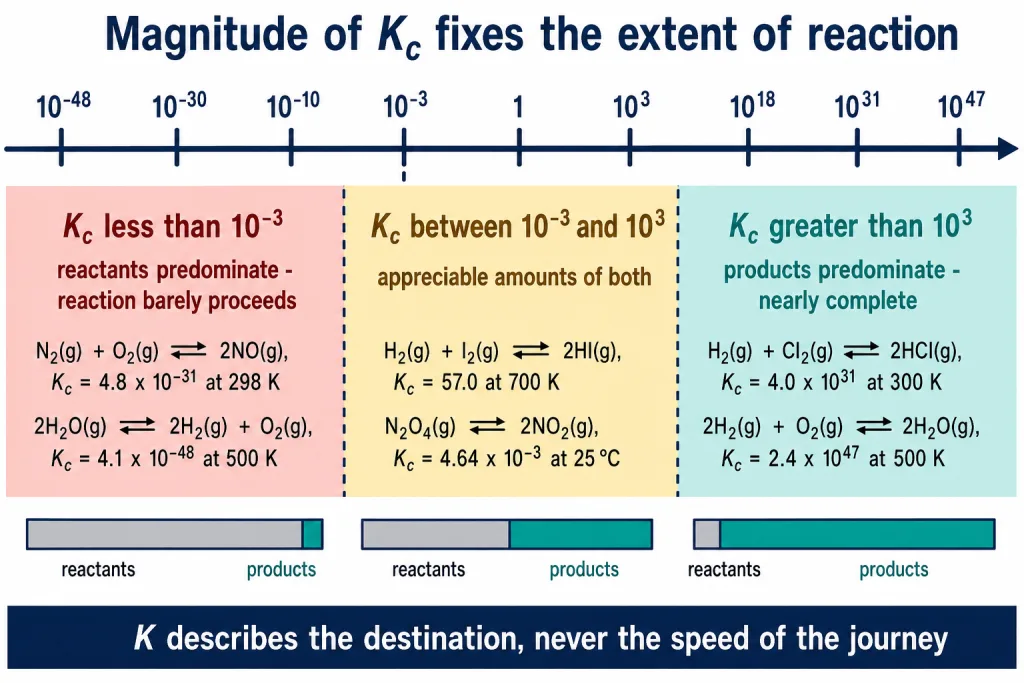
That last pair shows the bands belong to the equation, not to the chemicals. Water synthesis sits at and water decomposition at ; same chemistry, opposite directions, reciprocal constants.
[NEET] The boundaries and are conventions, not laws. A mixture with inside that window can be pushed either way by ordinary changes of concentration or pressure; one outside it cannot.
K Is Silent About Rate
A mixture of hydrogen and oxygen in a flask has at . Equilibrium lies so far towards water that the reactants are meant to vanish. The flask can nevertheless stand on a bench for years with no measurable change. One spark, and the same mixture explodes. Nothing about changed between the bench and the spark; what changed was the rate.
Key Point: A large guarantees that the products are favoured at equilibrium. It does not guarantee that equilibrium will be reached in a useful time. Extent and rate are separate questions with separate answers.
The separation runs both ways.
- Large , slow reaction. Diamond is thermodynamically unstable with respect to graphite at room temperature, yet the conversion takes geological time. Hydrogen and oxygen behave the same way. The barrier to starting is high, so the system sits frozen far from equilibrium.
- Small , fast reaction. Nitric oxide formation from nitrogen and oxygen has at , yet inside a car engine at equilibrium is reached in milliseconds — and at engine temperature itself is far larger, which is why exhaust gases carry at all.
A catalyst belongs to the rate side of this divide. It lowers the barrier for the forward and the reverse reaction by the same amount, so both rates rise together and the ratio at which they balance is untouched. The mixture reaches the same equilibrium composition sooner.
[JEE Main] A question that supplies a large and then asks whether the reaction "will occur rapidly" is testing exactly this. Any option that converts a magnitude of into a statement about speed is wrong on principle, whatever the numbers are.
The Reaction Quotient Q
A mixture that is not at equilibrium still has concentrations, and those concentrations can still be substituted into the equilibrium expression. The number that comes out is the reaction quotient, written .
Key Point (Definition): For the general reaction , the reaction quotient is built from the concentrations present at an arbitrary time , which need not be equilibrium values.
The algebraic form of is identical to that of — same species, same powers, same numerator and denominator. Only the numbers substituted are different. The subscript is a reminder that the concentrations were measured at some moment during the reaction, not necessarily after it settled.
Every convention that applies to applies unchanged to . Pure solids and pure liquids are left out. Partial pressures give , molar concentrations give , and the two are related by exactly as and are.
Starting from pure reactants, begins at zero, climbs as products build and reactants are consumed, and stops on reaching . Starting from pure products instead, begins infinitely large and falls to the same . This is the algebraic statement of the fact that equilibrium can be approached from either side.
At equilibrium and are the same number. That is the only difference between them, and it is the whole basis of the direction rule.
The Direction Rule
Comparing with says which way a mixture must move to reach equilibrium, because has to end up equal to .
- — the numerator is too small. Products must be made. The net reaction goes forward, left to right.
- — the numerator is too large. Products must be consumed. The net reaction goes backward, right to left.
- — nothing needs to change. The mixture is already at equilibrium; there is no net reaction.
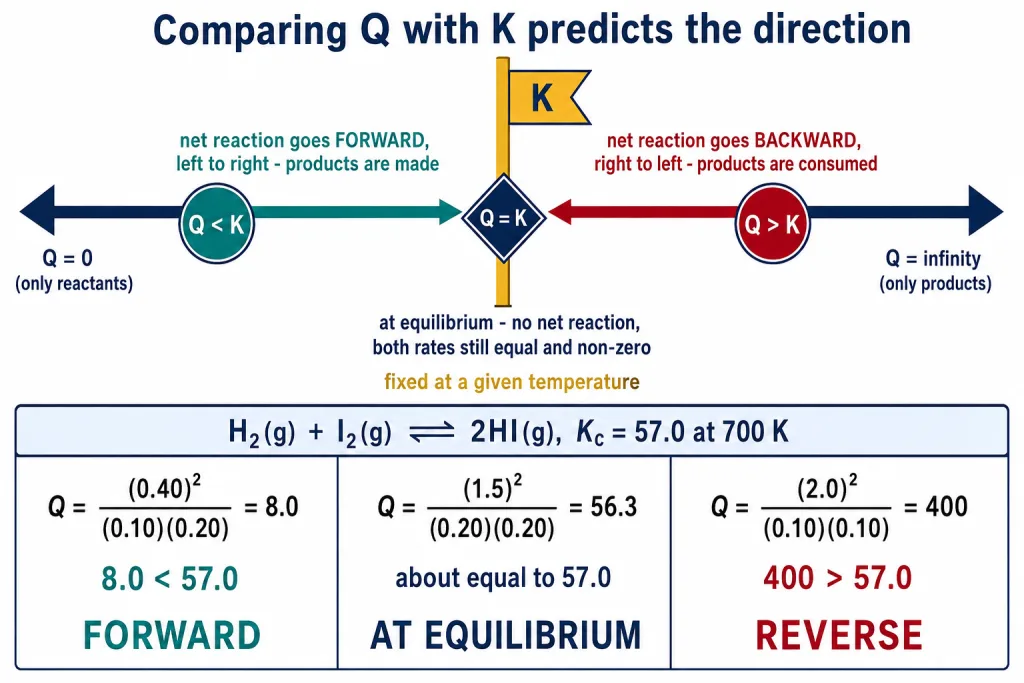
On a number line, is a fixed post and a marker sliding towards it. The direction of the slide is the direction of the reaction; the arrow always points from towards .
A worked judgement. For , at . A vessel at that temperature is found to contain , and .
is less than , so more has to form, and rises from until it reaches . Nothing else was needed: no knowledge of how the mixture was prepared, no initial concentrations, no time. A single snapshot of the composition decides the direction.
[JEE/NEET] The word "net" carries weight. When both reactions still run at full speed; they simply run at equal speeds, so nothing changes on the outside. Describing an equilibrium mixture as one where "the reaction has stopped" is wrong even though the concentrations are constant.
Reading Q Without a Calculator
Several standard situations can be settled by inspection.
A mixture of reactants only. Every product concentration is zero, so . Since is always positive, and the reaction must go forward. Any reaction started from pure reactants goes forward at first, whatever its .
A mixture of products only. The denominator is zero, so is infinite, , and the reaction must run in reverse. Pure in a hot vessel decomposes; pure dissociates.
Something added to a mixture already at equilibrium. Adding a product raises the numerator, so jumps above and the system moves backward. Adding a reactant raises the denominator, so falls below and the system moves forward. Le Chatelier's principle arrives here as arithmetic rather than as a slogan.
The volume changed. Concentration is , so halving the volume doubles every concentration, and whether rises or falls depends on how many concentration terms sit upstairs and downstairs. For starting from equilibrium, doubling the volume halves every concentration and
is now half of , so the reaction goes forward and more dissociates. Expansion favours the side with more gas molecules, and the factor is where that rule comes from.
A catalyst added. No concentration changes, so neither nor moves. There is no shift at all — only a faster arrival.
Temperature changed. The one case where itself moves. stays put, shifts, and the mixture is suddenly off equilibrium through no fault of its own composition.
The ICE Method
Knowing the initial concentrations and , the equilibrium concentrations follow from a fixed five-step routine. The table at its centre has one row for Initial, one for Change and one for Equilibrium, which is where the name comes from.
Step 1. Write the balanced equation. Every power in the equilibrium expression and every coefficient in the change row is read off it, so an unbalanced equation ruins everything that follows.
Step 2. Build the table beneath the equation, one column per species.
- Initial — the concentrations before any reaction, in . Convert moles to molarity here, not later.
- Change — define as the amount of one chosen species that reacts, then write every other change as a multiple of in the stoichiometric ratio. Reactants get , products get .
- Equilibrium — the sum of the two rows above it.
Step 3. Substitute the equilibrium row into the expression for and solve for . If a quadratic appears, keep only the root that makes chemical sense: a root that makes any equilibrium concentration negative, or that consumes more of a reactant than was present, is discarded.
Step 4. Put back into the equilibrium row to get every concentration.
Step 5. Substitute those concentrations into the expression for and confirm that the original value comes back.
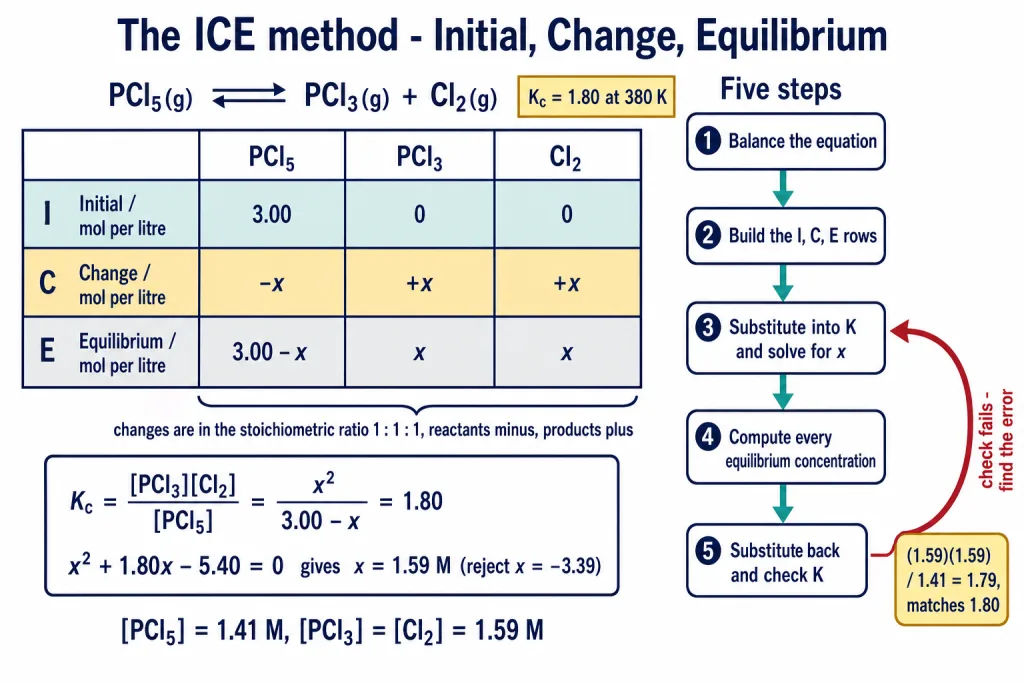
The stoichiometric ratio in the change row is where most marks are lost. For the changes are , and , never , , . For they are , and if is defined as the oxygen formed.
The coefficients that become powers in are the same coefficients that become multipliers in the change row, which gives a free cross-check: if a species carries a power of in , its change must carry a factor of .
One warning about the last column. When the change is , the equilibrium concentration is , so a measured product concentration must be halved before it becomes . Confusing with a concentration wrecks every line that follows it.
When x Can Be Neglected
The equation is a quadratic. When is very small, hardly any reactant is consumed, so is tiny beside and writing turns the quadratic into a one-line square root. The saving is real, and so is the risk of using it where it does not hold.
Key Point: Neglect only after testing it. Solve with the approximation, then evaluate . If that is less than about per cent, keep the answer. If it is more, throw the answer away and solve the quadratic properly.
A ratio such as is sometimes offered as a pre-test before any arithmetic, but there is no single threshold, because the number shifts with the shape of the expression. For the per cent limit corresponds to above about ; for , where the factor from the squared makes smaller, the same limit corresponds to above only about . Treat any such ratio as a rough signal and nothing more: the reliable check is the per cent test applied to after solving. Dilution and a large both push towards failure, because both raise the fraction of reactant that reacts.
The same reaction can fall on either side of the test depending on the starting concentration. Take with at , whose ICE equation is
Starting from , the approximation gives , so , which is per cent of . That passes.
Starting from , the same approximation gives , so , which is per cent of . That fails badly, and the honest quadratic gives instead — a difference of per cent in and over per cent in .
Diluting a dissociation equilibrium increases the fraction that dissociates. The same , the same reaction, a smaller starting concentration, and the shortcut that worked at collapses at .
[JEE Main] Examiners choose the initial concentration deliberately. A problem in which the approximation is legitimate and one in which it is not look identical on the page; only the test tells them apart. Perform the test in writing, every time.
The Substitute-Back Check
Step 5 costs about twenty seconds and catches almost every error the previous four steps can produce. Take the equilibrium concentrations that came out, put them into the expression for , and compute. A wrong power, a dropped factor of , a sign error in the change row, a mis-solved quadratic, a root that should have been rejected — each produces a number that fails to reproduce , and the failure is visible immediately.
Three further checks take no time at all.
- No negative concentrations. A concentration below zero means the wrong root was kept.
- No reactant consumed beyond what was there. With , a root is unphysical.
- The answer must sit in the right band. A reaction with cannot end up with more product than reactant.
Agreement to two significant figures is normally enough. Small disagreements are expected when the small- approximation was used, and the size of the disagreement is itself the verdict on whether the approximation was allowed.
Question 1: Placing three reactions in their bands
At the temperatures shown, has , has , and has . Describe the equilibrium mixture in each case.
Answer:
I compare each value with the boundaries and .
is far above , so products dominate and the reaction is effectively complete, with only a vanishing trace of and left.
lies inside to , so the mixture holds appreciable amounts of everything. Hydrogen iodide predominates because is above , but measurable and remain.
is far below , so reactants dominate. Air at room temperature holds nitrogen and oxygen side by side with essentially no nitric oxide.
Ans: Nearly complete conversion; both reactants and products present in appreciable amounts; almost no reaction. Watch out: These bands compare with on a logarithmic scale. A value of is "middle band" even though it is much bigger than , because is comfortably below .
Question 2: A favourable constant and an unreactive flask
A sealed flask holds hydrogen and oxygen at , for which . No water is detected after a month. Explain, and state what the value of does predict.
Answer:
The equilibrium constant fixes the ratio of concentrations once equilibrium is reached. It says nothing about the rate at which that state is approached.
The barrier to breaking the and bonds is high, so at almost no collision carries enough energy and the mixture stays frozen far from equilibrium. A spark or a platinum catalyst opens a faster route, and the same mixture then reacts explosively to the composition demands.
Ans: predicts only that, at equilibrium, the products are overwhelmingly favoured; the absence of reaction is a kinetic matter and is entirely consistent with a large . Watch out: A large never implies a fast reaction, and a small never implies a slow one.
Question 3: Direction for a hydrogen iodide mixture
For , at . A vessel at contains , and . In which direction does the reaction proceed?
Answer:
I write in exactly the form of and put in the measured values.
, so the numerator is too small and must grow.
Ans: Forward, left to right; and react to make more until rises to . Watch out: The square on is compulsory. Leaving it off gives , still below , so the direction happens to survive — but the same slip in a question where lies between the two values reverses the answer.
Question 4: Direction for a mixture with equal concentrations
for is . At a given moment . Which way does the reaction go?
Answer:
The three concentrations are equal, so the ratio collapses to whatever their common value is. Comparing, .
Ans: Reverse; and combine to reform until falls to . Watch out: The power on is what makes come out as exactly here. Writing unsquared gives , which is below and would point the reaction the wrong way.
Question 5: Direction from partial pressures
For , at . A reactor at holds , and . Is ammonia being formed or decomposed?
Answer:
takes the same form as , with the coefficient appearing as a cube.
is smaller than .
Ans: , so the net reaction runs forward and ammonia is being formed. Watch out: Forgetting the cube on hydrogen gives , which is far above and reverses the predicted direction.
Question 6: Kc from one measured equilibrium concentration
each of and are placed in a vessel at . At equilibrium . Find .
Answer:
| Initial / | |||||
| Change / | |||||
| Equilibrium / |
The measured value fixes : , so .
Ans: , dimensionless since . Watch out: The change is , so is half the measured . Setting leaves , which is impossible and should be spotted at once.
Question 7: A change row that is not one to one
of is heated in a flask. At equilibrium . Find for .
Answer:
I define as the oxygen formed, so the changes follow the coefficients .
| Initial / | |||||
| Change / | |||||
| Equilibrium / |
From the measurement, , so .
Ans: . Watch out: The sulphur dioxide formed is , twice the oxygen. Taking the two as equal gives , a factor of four low.
Question 8: A quadratic that becomes a square root
and are mixed at , where for . Find all three equilibrium concentrations.
Answer:
| Initial / | |||||
| Change / | |||||
| Equilibrium / |
Both sides are perfect squares, so I take the square root rather than expanding.
Checking: , which reproduces .
Ans: , . Watch out: The square root of both sides is legitimate only because the numerator and denominator are each a perfect square, which happens here because the two reactants started equal. With unequal starting concentrations the quadratic must be expanded.
Question 9: A genuine quadratic
of is kept in a closed vessel at and allowed to reach equilibrium. Calculate the composition of the mixture. .
Answer:
| Initial / | |||||
| Change / | |||||
| Equilibrium / |
The negative root would make and negative, and would push up to , more than was ever put in, so I keep .
Checking: , which agrees with .
Ans: , . Watch out: Neglecting here would give , so — which is per cent of and fails the test outright. With of order the approximation is never available.
Question 10: A case where x may be neglected
of is placed in a flask at , where for . Find the equilibrium concentrations, using the small- approximation if it is justified.
Answer:
| Initial / | |||
| Change / | |||
| Equilibrium / |
Taking ,
Testing: per cent, under per cent, so the approximation stands.
Checking: , about per cent above — the expected small error from neglecting , and well inside two-figure agreement.
Ans: and ; the approximation is justified at per cent. Watch out: The factor from squaring is easy to lose. Writing instead gives and doubles the answer for to .
Question 11: The same reaction, where x may not be neglected
Repeat the previous calculation with of in the same flask at .
Answer:
The table is unchanged except that .
Trying the approximation: , giving . Testing, per cent, which fails outright, so the answer is discarded and the quadratic solved.
Checking: , exactly .
The rejected approximate answer gives and , for which the substitute-back check returns — over per cent above . The check alone would have condemned it.
Ans: , ; the approximation is not permitted at this dilution. Watch out: The fraction dissociated rose from per cent at to per cent at . Dilution always favours the side with more particles, which is why the shortcut fails in dilute solution.
Question 12: From a mass and a total pressure
of was placed in a reaction vessel at and allowed to reach equilibrium for . The total pressure at equilibrium was . Calculate the equilibrium partial pressures, and . Take .
Answer:
The molar mass of is , so , and the initial pressure follows from .
Now the ICE table in pressures.
| Initial / bar | |||
| Change / bar | |||
| Equilibrium / bar |
The total pressure supplies the missing equation.
With ,
Checking the partial pressures: , the measured total.
Ans: , , , . Watch out: The rise in total pressure equals , not , because one mole of gas is destroyed for every two made. Setting gives and a badly wrong of about .
What Goes Wrong
- Reading as a rate. A large says the products win at equilibrium, not that they arrive quickly.
- Comparing with instead of with . A value of above means nothing on its own.
- Dropping a power in . and must carry identical exponents.
- A change row that ignores stoichiometry. Equal changes for unequal coefficients is the commonest ICE error.
- Mixing up with a concentration. When the change is , the equilibrium concentration is , not .
- Keeping the wrong root. A root giving a negative concentration, or consuming more reactant than was supplied, is rejected without comment.
- Neglecting without testing it. The test is , one division.
- Changing when the volume or the amount changes. Only temperature moves ; everything else moves .
- Skipping the check. Substituting back into takes seconds and detects every error above.
Key Point: Extent comes from the magnitude of , direction comes from comparing with , and composition comes from an ICE table solved against and then verified by substituting back.