Homogeneous Equilibria and the Relation Between Kp and Kc
One Phase, One Set of Rules
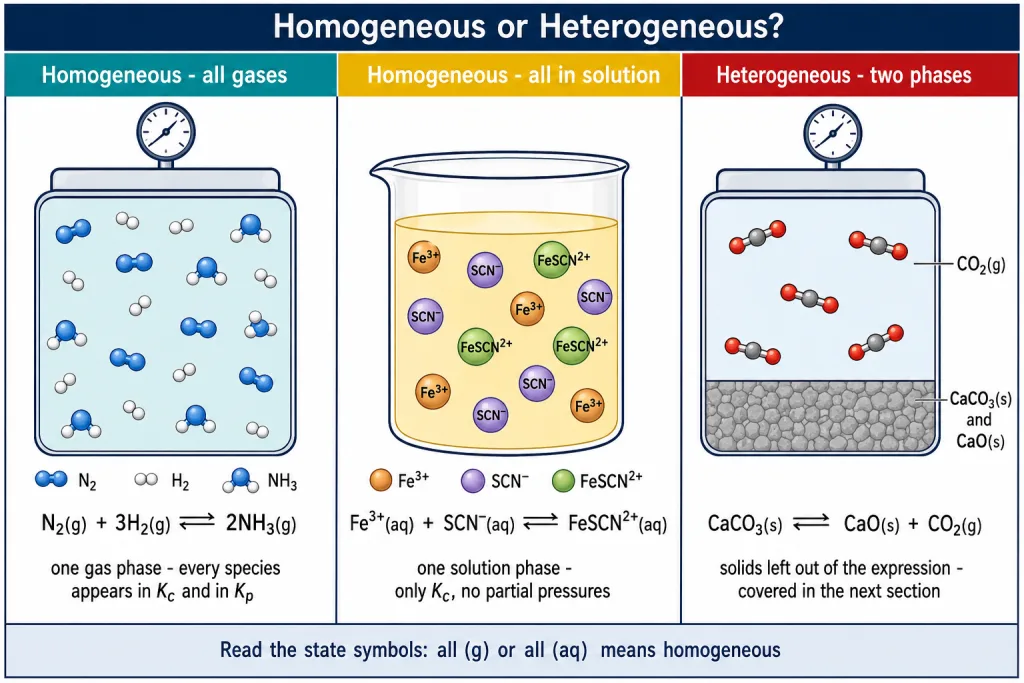
An equilibrium is homogeneous when every reactant and every product sits in the same phase. Nothing is a solid while something else is a gas; nothing is a liquid while something else is dissolved. One phase, throughout.
Key Point (Definition): In a homogeneous equilibrium all the reacting species — reactants and products alike — are present in a single phase, either all gaseous or all in the same solution.
Two families of homogeneous equilibria turn up again and again.
All species gaseous
The synthesis of ammonia is the standard example:
N2(g)+3H2(g)⇌2NH3(g)
Nitrogen, hydrogen and ammonia are all gases at the temperature of the reaction, so the mixture is a single gas phase filling the vessel uniformly. The same is true of
H2(g)+I2(g)⇌2HI(g)
2SO2(g)+O2(g)⇌2SO3(g)
PCl5(g)⇌PCl3(g)+Cl2(g)
N2O4(g)⇌2NO2(g)
Each of these can be handled with concentrations, and each can equally well be handled with pressures. That second option is what this section is about.
All species in one solution
Homogeneous does not mean gaseous. A reaction in which everything is dissolved in the same solvent is equally homogeneous. The hydrolysis of ethyl acetate is written
and the formation of the blood-red thiocyanato complex of iron is
Fe3+(aq)+SCN−(aq)⇌[Fe(SCN)]2+(aq)
Every species here is in the aqueous solution phase. For such equilibria only Kc makes sense, because dissolved species have concentrations but no partial pressures of their own. Nothing in this section about Kp applies to them.
What homogeneous buys you
The reason the distinction matters is a practical one. In a homogeneous equilibrium every species that appears in the balanced equation also appears in the equilibrium constant expression. Nothing gets left out. The moment a pure solid or a pure liquid enters the equation the system becomes heterogeneous, and those species drop out of the expression — a separate rule dealt with in the next section.
So for
aA+bB⇌cC+dD
with all four species in one phase,
Kc=[A]a[B]b[C]c[D]d
and no term is missing.
[NEET] A one-line test for homogeneous: read the state symbols. If they are all (g), or all (aq), the equilibrium is homogeneous. A single (s), or an (l) present as a separate pure phase, makes it heterogeneous — with one exception, the solvent. The H2O(l) written in the ethyl acetate hydrolysis above is the medium the reaction is run in and not a second phase, so that equilibrium is homogeneous even though an (l) appears in the equation.
Why Gases Prefer Pressure
A gas mixture at equilibrium can be described in two equivalent ways. You can quote the molar concentration of each gas, [A]=nA/V in molL−1. Or you can quote the partial pressure of each gas.
Key Point (Definition): The partial pressure of a gas in a mixture is the pressure that gas alone would exert if it occupied the whole container at the same temperature. The total pressure is the sum of the partial pressures (Dalton's law), and pi=xiPtotal where xi is the mole fraction of that gas.
Pressure wins on convenience for three reasons.
It is what the instrument reads. A pressure gauge on a reaction vessel gives the total pressure directly. Getting concentrations instead would mean withdrawing a sample, analysing it and dividing by the volume — slower and less accurate.
Composition follows from pressure without extra measurement. If a gas mixture is 40% by volume of one component, that component's mole fraction is 0.40, and its partial pressure is 0.40×Ptotal. Volume percentage, mole percentage and pressure percentage are the same number for ideal gases.
Standard states for gases are defined in pressure. The standard state of a gas is a pressure of exactly 1 bar. Thermodynamic quantities such as ΔG∘ are tabulated against that reference, so an equilibrium constant already written in pressures links straight to thermodynamics.
Writing Kp
The recipe is identical to the one for Kc; only the quantity substituted changes. Products over reactants, each raised to its stoichiometric coefficient, with partial pressures in place of concentrations.
For H2(g)+I2(g)⇌2HI(g):
Kp=(pH2)(pI2)(pHI)2
For N2(g)+3H2(g)⇌2NH3(g):
Kp=(pN2)(pH2)3(pNH3)2
For 2SO2(g)+O2(g)⇌2SO3(g):
Kp=(pSO2)2(pO2)(pSO3)2
Key Point:Kp is the equilibrium constant written with equilibrium partial pressures of the gaseous species, each raised to its stoichiometric coefficient, products in the numerator.
Both constants describe the same equilibrium at the same temperature, so they must be connected. The connection is the ideal gas equation.
Deriving Kp=Kc(RT)Δn
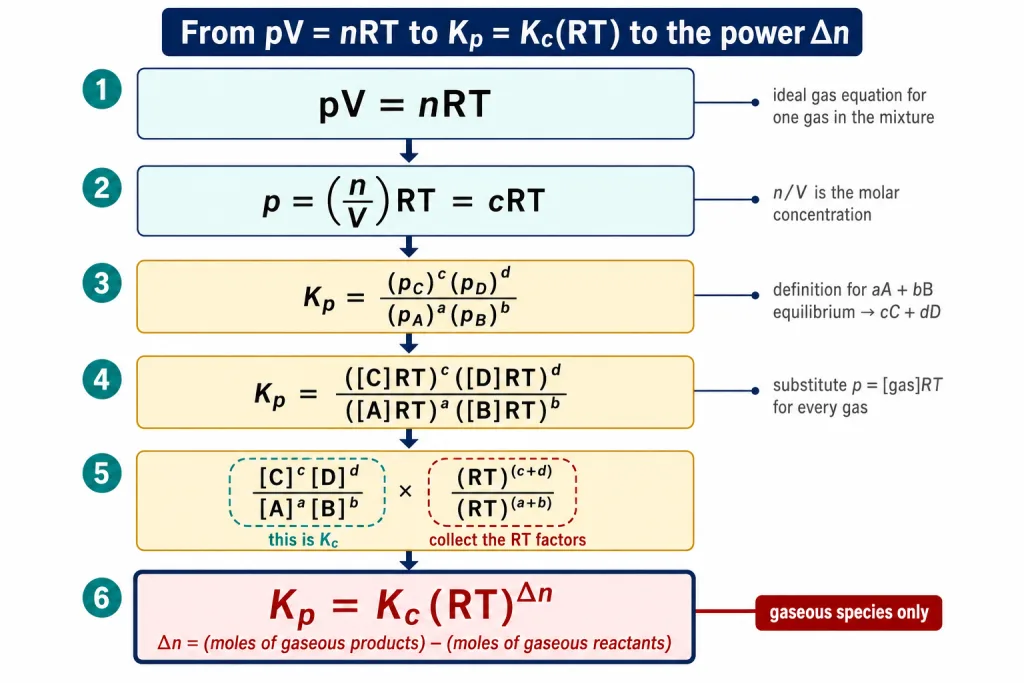
The whole derivation rests on one substitution. Start from the ideal gas equation for a single gas in the mixture:
pV=nRT
Divide both sides by V:
p=VnRT
The ratio n/V is moles per unit volume, which is exactly molar concentration. Writing c for it,
p=cRT
or, for a species A in the mixture,
pA=[A]RT
At a fixed temperature RT is a constant, so the partial pressure of each gas is directly proportional to its molar concentration: p∝[gas].
The general case, step by step
Take the general homogeneous gaseous equilibrium
aA(g)+bB(g)⇌cC(g)+dD(g)
Step 1. Write Kp from the definition:
Kp=(pA)a(pB)b(pC)c(pD)d
Step 2. Replace every partial pressure by pi=[i]RT:
Kp=([A]RT)a([B]RT)b([C]RT)c([D]RT)d
Step 3. Expand each bracket. A product raised to a power is the product of the powers, so ([C]RT)c=[C]c(RT)c:
Kp=[A]a(RT)a⋅[B]b(RT)b[C]c(RT)c⋅[D]d(RT)d
Step 4. Collect the concentration terms in one fraction and the RT terms in another:
Kp=[A]a[B]b[C]c[D]d×(RT)a+b(RT)c+d
Step 5. The first fraction is Kc. The second collapses by the law of indices, xm/xn=xm−n:
Kp=Kc×(RT)(c+d)−(a+b)
Step 6. Name the exponent. Writing Δn for (c+d)−(a+b),
Kp=Kc(RT)Δn
Key Point:Kp=Kc(RT)Δn, where Δn= (total number of moles of gaseous products) − (total number of moles of gaseous reactants), read off the balanced equation.
A worked check on the formula
Apply it to H2(g)+I2(g)⇌2HI(g) from scratch instead of quoting the result:
Everything the relation can do is decided by the sign of one small integer.
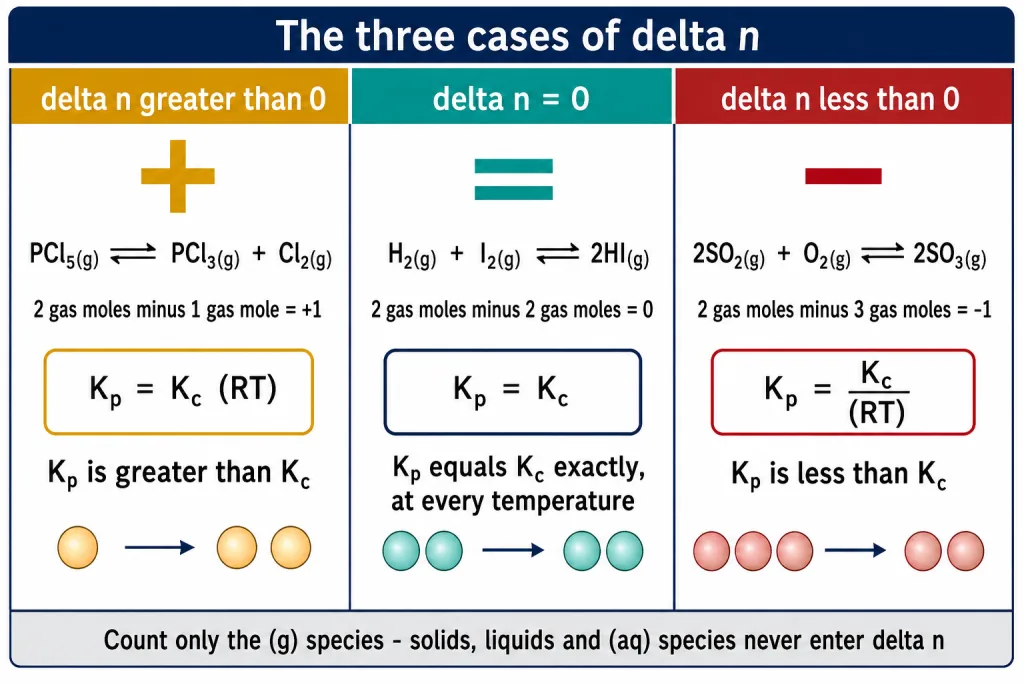
Case 1: Δn>0 — more gas moles on the right
PCl5(g)⇌PCl3(g)+Cl2(g),Δn=2−1=+1
Kp=Kc(RT)+1=Kc(RT)
At any ordinary temperature RT is a large number — at 500 K it is 0.0831×500=41.6 — so Kp comes out larger than Kc, here by a factor of about 42.
Another with Δn=+1: N2O4(g)⇌2NO2(g), since 2−1=+1.
Case 2: Δn<0 — more gas moles on the left
2SO2(g)+O2(g)⇌2SO3(g),Δn=2−3=−1
Kp=Kc(RT)−1=RTKc
Now Kp is smaller than Kc, divided by that same large factor.
The strongest common example is ammonia synthesis, N2(g)+3H2(g)⇌2NH3(g), with Δn=2−4=−2 and
Kp=(RT)2Kc
At 500 K that divides by 41.62≈1730.
Case 3: Δn=0 — the numbers are equal
H2(g)+I2(g)⇌2HI(g),Δn=2−2=0
Kp=Kc(RT)0=Kc×1=Kc
Key Point:Kp=Kcexactly when Δn=0, and only then. This holds at every temperature, because (RT)0=1 whatever T may be.
Other equilibria with Δn=0:
CO(g)+H2O(g)⇌CO2(g)+H2(g),Δn=2−2=0
N2(g)+O2(g)⇌2NO(g),Δn=2−2=0
2HI(g)⇌H2(g)+I2(g),Δn=2−2=0
The three cases side by side
Δn
Meaning
Relation
Size comparison
Named example
+1
one extra mole of gas formed
Kp=Kc(RT)
Kp>Kc
PCl5⇌PCl3+Cl2
+2
two extra moles of gas formed
Kp=Kc(RT)2
Kp≫Kc
NH4HS(s)⇌NH3(g)+H2S(g)
0
gas moles unchanged
Kp=Kc
equal
H2+I2⇌2HI
−1
one mole of gas consumed
Kp=Kc/(RT)
Kp<Kc
2SO2+O2⇌2SO3
−2
two moles of gas consumed
Kp=Kc/(RT)2
Kp≪Kc
N2+3H2⇌2NH3
[JEE Main] A question that gives Kc and asks for Kp without giving T is answerable only if Δn=0. Check Δn before hunting for a missing temperature.
Δn Counts Gases and Nothing Else
This is where the marks go.
Key Point:Δn in Kp=Kc(RT)Δn is the change in the number of moles of gaseous species only. Solids, pure liquids and dissolved species contribute zero, on both sides.
The reason follows from the derivation. The factors of RT appeared because each gaseous partial pressure was replaced by [i]RT. A solid or a pure liquid never entered the equilibrium expression at all, so it never contributed an RT, so it cannot contribute to the exponent.
The error to avoid
The commonest mistake is to count every species in the balanced equation — the total change in moles — instead of only the gaseous ones. Three reactions expose the difference immediately.
C(s)+CO2(g)⇌2CO(g)
Total moles: 2 on the right, 2 on the left, so a total change of 0. Gaseous moles: 2 on the right, 1 on the left, so Δn=2−1=+1. The correct relation is Kp=Kc(RT), and a student who used the total change would have written Kp=Kc and lost the whole answer.
NH4HS(s)⇌NH3(g)+H2S(g)
Total change: 2−1=+1. Gaseous change: 2−0=+2. So Kp=Kc(RT)2, not Kc(RT).
Fe2O3(s)+3CO(g)⇌2Fe(s)+3CO2(g)
Total change: 5−4=+1. Gaseous change: 3−3=0. So Kp=Kc exactly, at every temperature, even though the equation looks lopsided.
The habit that prevents it
Before touching the formula, rewrite the equation with the non-gaseous species struck out of the count:
List the coefficients of the (g) species on the product side and add them.
List the coefficients of the (g) species on the reactant side and add them.
Subtract: products minus reactants. That number, and only that number, is Δn.
(aq) species are counted the same way as solids — that is, not at all. A species dissolved in water has no partial pressure, so it contributes no RT.
[JEE/NEET] In a heterogeneous equilibrium, the solid and liquid species are absent from the Kp expression and absent from Δn. Both omissions are the same omission.
Units, R and the Standard-State Convention
Choosing R to match the pressure unit
The value of R substituted into (RT)Δn must carry the same pressure unit that Kp is expressed in. Two combinations are in common use.
Pressure unit for Kp
Value of R to use
Units of R
bar
0.0831
LbarK−1mol−1
atm
0.0821
LatmK−1mol−1
Concentrations are in molL−1 in both cases, and T is always in kelvin.
This section uses R=0.0831LbarK−1mol−1 and expresses every Kp in bar, because the standard state for pressure is defined as exactly 1 bar. Where a problem quotes Kp in atm, R=0.0821LatmK−1mol−1 is used instead so that the units agree. Mixing them — a Kp in atm with R=0.0831 — produces a wrong number by a factor of about 1.2% per power of Δn, which is enough to miss a printed option.
Useful conversions: 1bar=105Pa, and 1atm=1.013bar=1.013×10⁵Pa.
Units of Kc and Kp
Substituting concentrations in molL−1 and pressures in bar leaves the constant with units unless the powers on top and bottom cancel:
units of Kc are (molL−1)Δn
units of Kp are (bar)Δn
Worked through for three reactions:
Reaction
Δn
Units of Kc
Units of Kp
H2+I2⇌2HI
0
none
none
N2O4⇌2NO2
+1
molL−1
bar
N2+3H2⇌2NH3
−2
mol−2L2
bar−2
The same Δn that sets the power of RT sets the units — one fact doing two jobs.
Why the constants are strictly dimensionless
Each concentration is properly divided by the standard concentration c∘=1molL−1, and each pressure by the standard pressure p∘=1bar. A pressure of 4 bar becomes 4bar/1bar=4, a pure number. Every term entering the expression is then a ratio, and Kp and Kc come out dimensionless.
The numerical values are still different whenever Δn=0, because the two standard states are different. Being dimensionless does not make them equal.
Key Point: Written against standard states, both Kp and Kc are dimensionless. In routine numerical work the units (bar)Δn and (molL−1)Δn are still quoted, and quoting them is accepted.
[Board] State the temperature and the pressure unit whenever a Kp value is written down. A bare number with neither is incomplete.
Worked Questions
Question 1: Reading Δn off four equations
State Δn for each: (i) 2NOCl(g)⇌2NO(g)+Cl2(g), (ii) CaCO3(s)⇌CaO(s)+CO2(g), (iii) C(s)+CO2(g)⇌2CO(g), (iv) Fe2O3(s)+3CO(g)⇌2Fe(s)+3CO2(g).
Answer:
I count only the species carrying (g).
(i) Gaseous products 2+1=3; gaseous reactants 2. So Δn=3−2=+1.
(ii) Gaseous products 1 (the CO2); gaseous reactants 0, since CaCO3 is a solid. So Δn=1−0=+1.
(iii) Gaseous products 2; gaseous reactants 1, because the graphite does not count. So Δn=2−1=+1.
(iv) Gaseous products 3; gaseous reactants 3. So Δn=3−3=0, and Kp=Kc for this one.
Ans: (i) +1, (ii) +1, (iii) +1, (iv) 0Watch out: In (iii) the total number of moles does not change at all, and in (iv) the total goes up by one. Both totals are irrelevant.
Question 2: Kc to Kp for nitrosyl chloride
For 2NOCl(g)⇌2NO(g)+Cl2(g), Kc=3.75×10⁻⁶ at 1069 K. Calculate Kp.
Answer:
First I find Δn. Gaseous products =2+1=3, gaseous reactants =2, so Δn=+1.
The relation is Kp=Kc(RT)Δn=Kc(RT)1.
With R=0.0831LbarK−1mol−1 and T=1069K:
RT=0.0831×1069=88.83
Kp=3.75×10−6×88.83=3.33×10⁻⁴
Ans:Kp=3.33×10⁻⁴barWatch out:Δn is +1, so RT multiplies. Dividing by 88.83 instead gives 4.2×10⁻⁸, which is the answer to the reverse conversion.
Question 3: Kp to Kc for the contact process
At 450 K, Kp=2.0×10¹⁰bar−1 for 2SO2(g)+O2(g)⇌2SO3(g). Find Kc.
Answer:
Gaseous products =2, gaseous reactants =2+1=3, so Δn=2−3=−1.
Kp=Kc(RT)−1⇒Kc=Kp×RT
RT=0.0831×450=37.40
Kc=2.0×1010×37.40=7.48×10¹¹
Ans:Kc=7.48×10¹¹Lmol−1Watch out: The unit bar−1 printed with Kp is itself a check: (bar)Δn with Δn=−1. If your Δn disagrees with the printed unit, one of them is wrong.
Question 4: A carbonate with a solid on each side
Kp=167kPa at 1073 K for CaCO3(s)⇌CaO(s)+CO2(g). Calculate Kc.
Answer:
The unit on Kp decides everything here. Both solids drop out, so Kp is simply pCO2, and the figure 167 is in kilopascals — that is 1.67bar, sitting sensibly beside the 2.0×10⁵Pa measured for this equilibrium near 1100 K. Read as 167 bar it would be absurd. So I take R in the matching unit, R=8.31LkPaK−1mol−1.
Only CO2 is a gas, so Δn=1−0=+1.
RT=8.31×1073=8916
Kc=(RT)ΔnKp=8916167=1.87×10⁻²
Ans:Kc=1.87×10⁻²molL−1Watch out: Both solids are absent from the Kp expression and absent from Δn. The other trap is the unit: pairing a Kp of 167 kPa with R=0.0831LbarK−1mol−1 gives 1.87, a hundred times too large, because R and the pressure unit no longer agree.
Question 5: Phosphorus pentachloride, Kc to Kp
For PCl5(g)⇌PCl3(g)+Cl2(g), Kc=8.3×10⁻³ at 473 K. Find Kp.
Answer:
Δn=2−1=+1.
RT=0.0831×473=39.31
Kp=Kc(RT)=8.3×10−3×39.31=0.326
Ans:Kp=0.326bar
Question 6: Iodine vapour partly dissociated
At a total pressure of 105Pa, iodine vapour at equilibrium contains 40% by volume of I atoms. Calculate Kp for I2(g)⇌2I(g).
Answer:
A total pressure of 105Pa is 1bar.
For ideal gases, percentage by volume equals mole percentage, so the mole fraction of I atoms is 0.40 and that of I2 is 0.60.
Using pi=xiPtotal:
pI=0.40×1=0.40bar,pI2=0.60×1=0.60bar
Kp=pI2(pI)2=0.60(0.40)2=0.600.16=0.267
Ans:Kp=0.267barWatch out: The coefficient 2 in 2I becomes a square, not a multiplier. Writing 2×0.40/0.60 gives 1.33, a wrong answer produced by a very common slip.
Question 7: Hydrogen iodide decomposing, and why R never appears
A sample of HI(g) is placed in a flask at a pressure of 0.2 atm. At equilibrium the partial pressure of HI is 0.04 atm. Find Kp for 2HI(g)⇌H2(g)+I2(g), and state Kc.
Answer:
The pressure of HI falls from 0.2 atm to 0.04 atm, so 0.16 atm of HI has reacted.
From the stoichiometry, 2 mol HI give 1 mol H2 and 1 mol I2. So the pressure of each product formed is 0.16/2=0.08atm.
Here Δn=2−2=0, so Kp=Kc(RT)0=Kc. No value of R and no temperature are needed.
Ans:Kp=4.0 and Kc=4.0, both dimensionless
Watch out: The 0.16 atm consumed is halved to get each product pressure. Using 0.16 for H2 and I2 gives 16, four times too large.
Question 8: Working in atmospheres
Kp=0.04atm at 899 K for C2H6(g)⇌C2H4(g)+H2(g). Calculate Kc at this temperature.
Answer:
Kp is quoted in atm, so I use R=0.0821LatmK−1mol−1 to keep the units consistent.
Δn=2−1=+1.
Kc=RTKp=0.0821×8990.04
RT=0.0821×899=73.81
Kc=73.810.04=5.42×10⁻⁴
Ans:Kc=5.42×10⁻⁴molL−1Watch out: Using R=0.0831 with a Kp in atm gives 5.35×10⁻⁴ — close enough to look right and wrong enough to miss the printed option.
Question 9: The ratio Kp/Kc for ammonia synthesis
For N2(g)+3H2(g)⇌2NH3(g) at 500 K, find the ratio Kp/Kc.
Answer:
Δn=2−4=−2, so
KcKp=(RT)Δn=(RT)−2=(RT)21
RT=0.0831×500=41.55
(RT)2=1726.4
KcKp=1726.41=5.79×10⁻⁴
Ans:Kp/Kc=5.79×10−4, so Kp is about 1700 times smaller than KcWatch out:Δn is −2, not −1. Using −1 gives 2.41×10⁻².
Question 10: When the answer needs no temperature
For which of these can Kp be found from Kc without knowing T? (i) CO(g)+H2O(g)⇌CO2(g)+H2(g), (ii) 2NO2(g)⇌N2O4(g), (iii) Fe2O3(s)+3CO(g)⇌2Fe(s)+3CO2(g).
Answer:
I check Δn in each case.
(i) 2−2=0, so Kp=Kc. No temperature needed.
(ii) 1−2=−1, so Kp=Kc/(RT). Temperature needed.
(iii) Gaseous only: 3−3=0, so Kp=Kc. No temperature needed, even though solids appear in the equation.
Ans: (i) and (iii)
Watch out: In (iii), counting all species gives a total change of +1 and the false conclusion that T is required.
Question 11: Building Kp from a starting pressure
A vessel at 400∘C is charged with an equimolar mixture of CO and steam at pCO=pH2O=4.0bar. For CO(g)+H2O(g)⇌CO2(g)+H2(g), Kp=10.1. Find the equilibrium partial pressure of H2.
Answer:
Let x bar of CO react. Then x bar of steam also reacts, and x bar each of CO2 and H2 form.
At equilibrium: pCO=pH2O=(4.0−x), and pCO2=pH2=x.
Kp=(4.0−x)(4.0−x)x⋅x=(4.0−x)2x2=10.1
Both sides are perfect squares, so I take the square root:
4.0−xx=10.1=3.178
x=3.178(4.0−x)=12.71−3.178x
4.178x=12.71⇒x=3.04
Ans:pH2=3.04barWatch out:Δn=0 here, so no conversion between Kp and Kc is involved at any stage. Taking the square root turns a quadratic into one line.
Question 12: Same reaction, opposite direction
Kp for N2O4(g)⇌2NO2(g) is 0.115bar at 298 K. Find Kc for this reaction, and then Kc for 2NO2(g)⇌N2O4(g).
Answer:
For the forward equation as written, Δn=2−1=+1.
RT=0.0831×298=24.76
Kc=RTKp=24.760.115=4.64×10⁻³
Reversing an equation inverts its equilibrium constant:
Kc′=4.64×10−31=215
Ans:Kc=4.64×10⁻³molL−1 for the dissociation, the value quoted for this equilibrium at 298 K throughout the chapter; Kc′=215Lmol−1 for the dimerisation
Watch out: Convert first, invert second — or invert first and convert with Δn=−1. Both routes agree; mixing the sign of Δn with the inversion does not.
Fixing the Section in Place
The chain of reasoning in six lines
All species in one phase ⇒ homogeneous equilibrium, nothing dropped from the expression.
For gases, partial pressure is the natural variable: it is measured directly and defines the standard state.
pV=nRT gives p=(n/V)RT=cRT for each gas separately.
Substituting pi=[i]RT into Kp pulls out a factor (RT) for every mole of gas in the equation.
The factors collect into (RT)Δn, giving Kp=Kc(RT)Δn.
Counting non-gaseous species in Δn.C(s)+CO2(g)⇌2CO(g) has Δn=+1, not 0. Strike out the solids and liquids before counting.
Getting the sign backwards.Kp=Kc(RT)Δn means multiply by (RT)Δn when going from Kc to Kp, and divide by it when going the other way. A quick sanity check: for Δn>0, Kp must be the bigger number.
Mismatching R with the pressure unit. Bar goes with 0.0831, atm goes with 0.0821. Choose R after looking at the unit printed on Kp.
Forgetting the stoichiometric powers inside the pressure expression.Kp for I2⇌2I is (pI)2/pI2, never 2pI/pI2.
Formula card
pi=[i]RTpi=xiPtotalPtotal=∑pi
Kp=Kc(RT)Δn,Δn=(moles of gaseous products)−(moles of gaseous reactants)
R=0.0831LbarK−1mol−1 with Kp in bar;R=0.0821LatmK−1mol−1 with Kp in atm
Units: Kc in (molL−1)Δn,Kp in (bar)Δn
Δn=0⟺Kp=Kc
Ready to test your knowledge?
Take a quick interactive quiz on this topic —
free, works without login.