
The Equilibrium Inside a Saturated Solution
Shake solid barium sulphate with water and very little of it dissolves. What dissolves does not just sit there. Ions break away from the crystal surface and move into the solution, and ions already in the solution collide with the surface and lock back into the lattice. Once the rate of dissolution equals the rate of crystallisation, the amount of dissolved salt stops changing and the solution is saturated:
This is a heterogeneous equilibrium — a solid in contact with a solution — and it is dynamic. Undissolved solid must be present for the equilibrium to exist at all. Without it there is nothing for the ions to crystallise back onto, and the solution is simply unsaturated.
Writing the equilibrium constant in the ordinary way gives
The denominator is where the solid drops out. A pure solid has a fixed density and a fixed molar mass, so the number of moles per litre of its own volume is a constant of the substance. Grinding the crystal or adding a second spoonful does not change it. Its activity is taken as 1. Multiplying both sides by that constant absorbs it into :
Key Point (Definition): The solubility product of a sparingly soluble salt is the product of the molar concentrations of its ions in a saturated solution, each concentration raised to the power of its coefficient in the dissociation equation. The undissolved solid never appears in the expression.
Two consequences follow immediately. Adding more solid to a saturated solution changes nothing, because the solid is not in the expression. And depends only on temperature, exactly like every other equilibrium constant in this chapter.
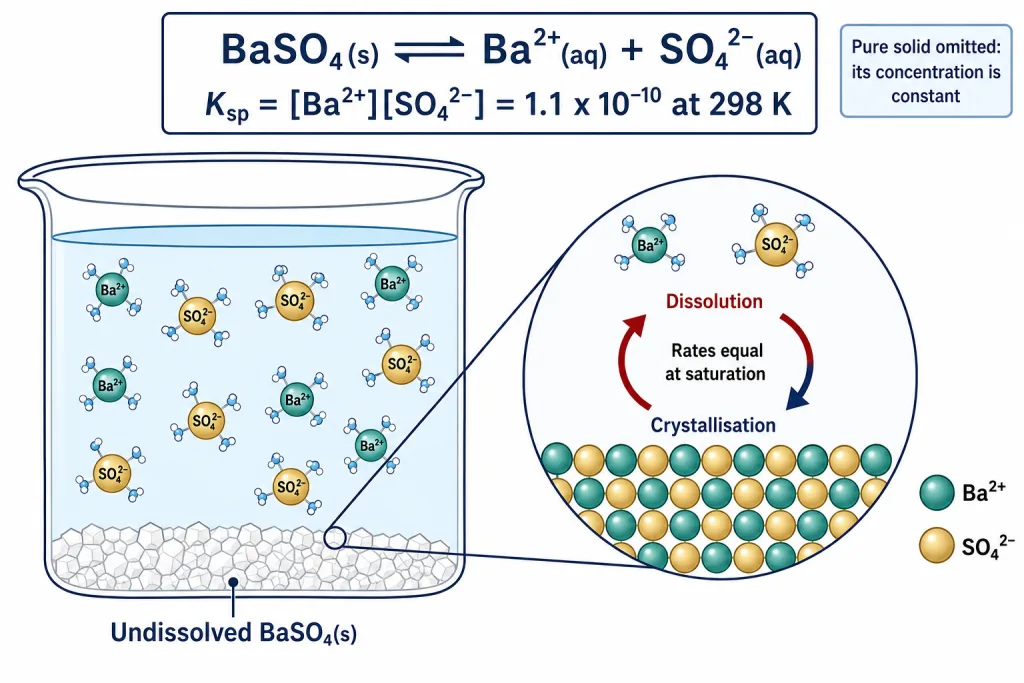
[Board] The one-line reason the solid is omitted: the concentration of a pure solid is constant, so it is merged into the equilibrium constant.
The General Expression for a Salt
Take a salt that dissolves to give cations and anions :
Let be the molar solubility — the number of moles of the salt that dissolve in one litre of the saturated solution. The stoichiometry does the rest of the work.
Step 1. Every formula unit that dissolves releases cations and anions. Dissolving mol of salt per litre therefore produces
Step 2. Put these into the solubility product expression, with each ion raised to its own coefficient:
Step 3. Separate the numbers from the solubility:
Step 4. Invert it to get solubility from a measured constant:
Each ion picks up its coefficient twice over, and both times for a different reason. Once as a multiplier, because that many ions are released per formula unit. Once as a power, because the equilibrium constant raises every concentration to its stoichiometric coefficient. Dropping either one is the most common error in this whole topic.
A worked case from the extreme end: zirconium phosphate, , gives cations of charge and anions of charge , so and , and
The numerical factor is not decoration. For a salt it equals 1 and can be ignored; for anything else it changes the answer by orders of magnitude.
The Four Formula Types Worth Memorising
Almost every salt asked about belongs to one of four patterns. The factor and the power on are fixed by the formula alone.
| Formula type | Typical salt | Ions per unit | in terms of | from |
|---|---|---|---|---|
| , , | , | |||
| or | , , | , | ||
| or | , | , | ||
| or | , | , |
The factor 4 comes from , the 27 from , and the 108 from . A salt and a salt share the same factor because does not care which ion carries which number.
Running the table forwards. Ferric hydroxide has at 298 K. It is an salt, so
Running it backwards. Silver chromate dissolves to the extent of at 298 K. Its molar mass is , so . It is an salt, so
Solubility quoted in grams per litre must always be converted to moles per litre before it touches a expression.
[JEE Main] Fixing the four factors — 1, 4, 27, 108 — and the four powers — 2, 3, 4, 5 — converts most solubility questions into arithmetic.
A Smaller Does Not Always Mean a Smaller Solubility
Two salts, both silver salts, both sparingly soluble:
Silver chromate has a solubility product roughly 160 times smaller. The trap is to conclude that it is the less soluble salt. Work out both solubilities instead.
Silver chloride is an salt:
Silver chromate is an salt, because one formula unit releases two silver ions:
Silver chromate is about five times more soluble than silver chloride while having the smaller . The reason is structural, not numerical: for the chromate is a product of three concentration terms, , so a given is reached at a much larger than it would be for a two-term product.
Key Point: values may be compared directly to rank solubility only when the salts have the same formula type. Across different types the constants have different dimensions and different powers of in them, and the comparison is meaningless until each has been converted to a molar solubility.
, and may safely be ranked by alone: all three are salts, so the largest belongs to the most soluble. against , or against , may not.
[JEE/NEET] Any question that puts two salts of different formula types side by side and asks which is more soluble is testing exactly this point. Convert first, compare second.
How Soluble Is Soluble
Solubility varies over an enormous range. Calcium chloride is so soluble that it pulls water vapour out of the air; lithium fluoride dissolves so little that it is casually called insoluble. Two enthalpies decide the outcome. The lattice enthalpy holds the ions together in the crystal and opposes dissolution. The hydration enthalpy released when water molecules surround the separated ions pays that cost back. A salt dissolves appreciably when hydration enthalpy is large enough to overcome lattice enthalpy. In a non-polar solvent hydration energy is tiny, which is why ionic salts do not dissolve in benzene or carbon tetrachloride.
Salts are grouped by measured solubility at 298 K:
| Category | Description | Molar solubility | Rough for an salt |
|---|---|---|---|
| I | Soluble | above | |
| II | Slightly soluble | to | |
| III | Sparingly soluble | below |
The column applies to salts only, for the reason given in the previous block. For a salt the same solubility boundary of corresponds to , not .
Salts genuinely called sparingly soluble sit far below the boundary. is at , at , at , and at about . Solubility products are only quoted for category III salts, because for a genuinely soluble salt the ions interact strongly with one another and concentrations no longer behave like activities.
Key Point: is defined for sparingly soluble salts. Writing a solubility product for or and treating molarities as activities is not valid.
Predicting Precipitation: Against
Mix two solutions and the ions meet at concentrations that have nothing to do with equilibrium. The ionic product is built exactly like — the same ions, the same powers — but from whatever concentrations are actually present at that instant. Comparing it with answers the question of whether a precipitate appears.
| Condition | State of the solution | What happens |
|---|---|---|
| Unsaturated | No precipitate. More solid would dissolve if it were available. | |
| Exactly saturated | No precipitate, but the solution is on the point of forming one. | |
| Supersaturated | Precipitation, until enough salt has come out to bring back down to . |
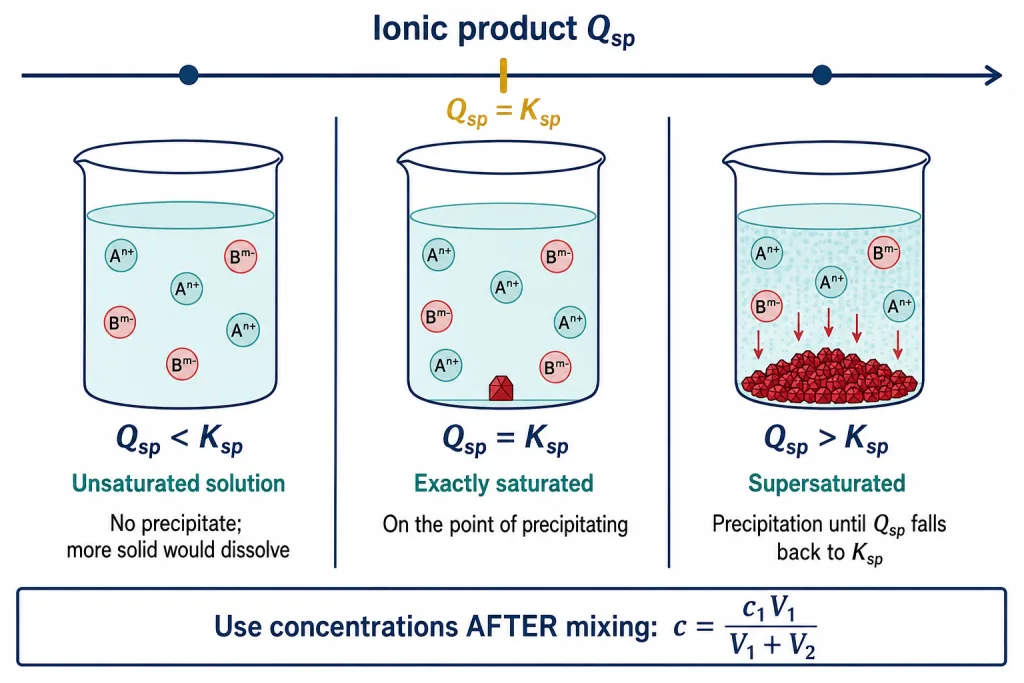
This is the same against test used for gas-phase equilibria, applied to a dissolution equilibrium. drives the equilibrium backwards, and backwards here means towards solid salt.
The dilution step that everyone forgets. When two solutions are mixed, each solute is diluted by the other. The concentrations that go into are the concentrations after mixing, never the concentrations on the bottles. For a solute of concentration and volume mixed with a second solution of volume :
Equal volumes halve every concentration. Using the label concentrations instead inflates and can turn a clear solution into a predicted precipitate. For an salt made from equal volumes, the error is a factor of .
Key Point: is calculated from the concentrations present in the mixed solution. Dilute first, then multiply, then compare with .
[NEET] Order of work in every mixing problem: moles of each ion, total volume, concentration of each ion, , comparison.
The Common Ion Effect on Solubility
A saturated solution of silver chloride sits at
Add sodium chloride. Chloride ion is a product of this equilibrium, so jumps above the instant the salt dissolves. The system responds by precipitating silver chloride until has fallen back to . Less silver chloride remains in solution than before, so its solubility has been reduced.
Key Point: The solubility of a sparingly soluble salt is decreased by the presence of a common ion in the solution. itself does not change — only the position of the equilibrium, and with it the molar solubility.
Setting the calculation up takes one line of care. In sodium chloride, with the new molar solubility of :
is going to come out around , utterly negligible beside , so and
In pure water the solubility was . The common ion has cut it by a factor of about .
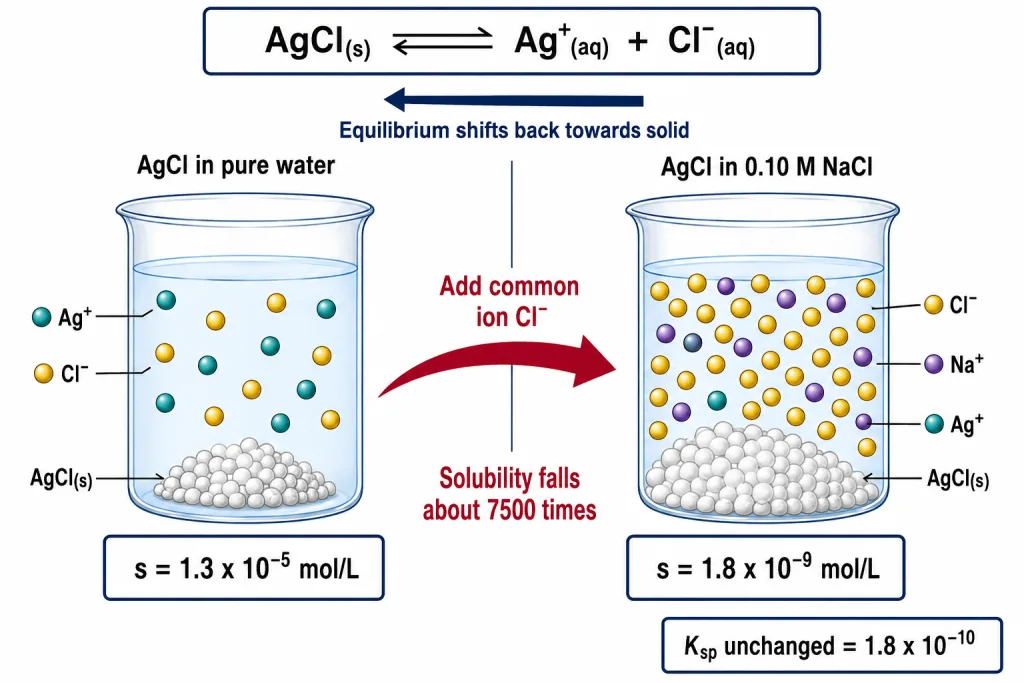
Three points of technique. The common ion contributed by the sparingly soluble salt itself is always dropped against the added concentration, and the approximation is safe precisely because is tiny. The ion supplied by the strong electrolyte enters the expression at full strength, raised to its stoichiometric power — for in the hydroxide term is , not . And a common ion supplied to a salt through its doubly-stoichiometric ion suppresses solubility far more sharply, because that concentration is squared.
The reverse also holds. Remove one of the ions from the solution — by protonating it, by complexing it — and falls below , so more solid dissolves. Salts of weak acids, such as phosphates, carbonates and sulphides, therefore become more soluble as the pH is lowered, because takes the anion out of circulation as the undissociated weak acid.
Selective Precipitation and Where This Is Used
If two cations in the same solution form salts of very different with one added anion, they can be separated by adding that anion slowly. The salt with the smaller solubility product reaches first and precipitates while the other stays dissolved. This is selective precipitation.
A solution in both and makes the point. Chloride is added drop by drop. Silver chloride needs only
while lead chloride, with , needs
Silver is essentially completely removed long before lead begins to precipitate. The same reasoning is behind the sulphide groups of qualitative analysis: passing through an acidified solution keeps very low, which is enough to precipitate but not ; making the solution alkaline raises and brings the zinc down in the next group.
The common ion effect is put to work in the same way. In gravimetric estimation an excess of the precipitating reagent is added so that the ion being weighed is driven almost entirely into the solid — silver as , ferric ion as hydrated , barium as . Passing gas through saturated brine precipitates very pure sodium chloride, leaving soluble sulphate impurities behind in the liquid.
Question 1: Solubility of barium sulphate from its
of is at 298 K. Find its molar solubility and the concentration of each ion.
Answer:
First I write the dissolution equation. .
One formula unit gives one cation and one anion, so with molar solubility both ions are at .
Ans: ;
Question 2: Solubility of calcium fluoride
of is . Find its molar solubility and the fluoride ion concentration in the saturated solution.
Answer:
.
Each formula unit releases one calcium ion and two fluoride ions, so and .
The fluoride concentration is twice this, .
Ans: ; Watch out: The 2 in must be both multiplied in and squared. Using gives and a wrong solubility of ; using gives .
Question 3: from a solubility in grams per litre
The solubility of at 298 K is . Calculate its solubility product. Molar mass of .
Answer:
First I convert to molar solubility.
, an salt, so .
Ans: Watch out: Feeding straight into without dividing by the molar mass gives roughly , an impossible solubility product for a sparingly soluble salt.
Question 4: A salt of the type
Calculate the solubility of in pure water, given , assuming neither ion reacts with water.
Answer:
, so and .
Taking the fifth root, .
Ans:
Question 5: Which salt is more soluble
values are for and for . Which is more soluble in water?
Answer:
The two salts are of different formula types, so I convert both constants to solubilities.
For , with solubility :
For , with solubility :
Nickel hydroxide is about a thousand times more soluble. It happens also to carry the larger , but that fact could not have been used to reach the answer: the two salts are of different formula types, so their constants are built from different numbers of concentration terms and a larger carries no promise of a larger solubility. Only the two values of settle the comparison.
Ans: is more soluble ( against ) Watch out: For salts of different stoichiometry the larger does not imply the larger molar solubility — and run the other way, the smaller belonging to the more soluble salt. That is exactly why the comparison has to go through and never through .
Question 6: Will copper iodate precipitate
Equal volumes of sodium iodate and copper(II) chlorate are mixed. of is . Does a precipitate form?
Answer:
Equal volumes are mixed, so the total volume is double and every concentration is halved.
The salt is , so the iodate term is squared:
is smaller than , so the solution is unsaturated.
Ans: No precipitate forms Watch out: Forgetting to square the iodate term gives , which is larger than and reverses the conclusion.
Question 7: A mixing problem where dilution decides the answer
Equal volumes of and are mixed. of is . Will calcium sulphate precipitate?
Answer:
Each solution is diluted to half its concentration on mixing.
, so the mixture is unsaturated and stays clear.
Ans: No precipitate; Watch out: Skipping the dilution and using for both ions gives , larger than , and predicts a precipitate that does not appear. Dilution changes the answer here, not just the number.
Question 8: Unequal volumes mixed
of is added to of . of is . Will silver chloride precipitate?
Answer:
Total volume after mixing is . I scale each concentration by its own dilution factor.
exceeds by more than five hundred times.
Ans: Silver chloride precipitates, since Watch out: Each solution has its own dilution factor when the volumes differ. Halving both, as though the volumes were equal, gives for the product and misrepresents the mixture even though the conclusion survives here.
Question 9: The largest concentration that will not precipitate
Equimolar solutions of and are mixed in equal volumes. What is the maximum concentration of each solution for which no precipitates? of .
Answer:
Let each solution be molar before mixing. Equal volumes halve both, so after mixing .
No precipitation requires :
Ans: Each solution may be at most Watch out: The answer is the concentration before mixing. Stopping at reports the concentration in the mixture and misses the factor of 2.
Question 10: Silver chloride in sodium chloride solution
Calculate the solubility of in and compare it with the solubility in pure water. .
Answer:
In pure water, .
In , let the solubility be . Silver comes only from the dissolving , while chloride comes from two sources.
The approximation is safe because will turn out near .
Ans: , about times smaller than in pure water Watch out: The solubility is , not . Chloride is dominated by the sodium chloride and says nothing about how much silver chloride dissolved.
Question 11: Nickel hydroxide in sodium hydroxide
Calculate the molar solubility of in . of .
Answer:
.
Dissolving mol per litre gives mol of and mol of , but the solution already holds hydroxide from the sodium hydroxide.
is very small, so and .
In pure water the solubility was , so the common ion has cut it by about times.
Ans: Watch out: The hydroxide term is squared. Writing gives , ten times too small.
Question 12: How much water dissolves one gram of calcium sulphate
What is the minimum volume of water needed to dissolve of at 298 K? , molar mass .
Answer:
Calcium sulphate is an salt, so its molar solubility is
One gram is . One litre of water holds only , so
Ans: About of water Watch out: The minimum volume is the volume that is exactly saturated. Any smaller volume leaves undissolved solid at the bottom.
What Goes Wrong in This Topic
A short list, in the order the errors actually appear in answer scripts.
The solid is written into the expression. It never appears; its concentration is constant and has been absorbed into the constant.
The stoichiometric number is used once instead of twice. For the fluoride term is : multiplied in because two ions are released, squared because the coefficient is 2.
Two values of different formula types are compared directly. has a smaller than and a larger solubility. Convert to before ranking.
Dilution on mixing is skipped. Every concentration entering must be recomputed for the final total volume.
Solubility in is used without converting to .
The solubility in a common-ion problem is read off the wrong ion. Solubility equals the concentration of the ion that comes only from the sparingly soluble salt, divided by its coefficient.
is treated as temperature-independent. It is an equilibrium constant, and it changes with temperature like any other; most salts dissolve endothermically, so usually rises on heating.
[Board] Two statements worth having ready in exact words: is the product of the molar concentrations of the ions in a saturated solution, each raised to its stoichiometric coefficient; precipitation occurs when the ionic product exceeds the solubility product.