
What the Principle Says, and What It Cannot Do
An equilibrium mixture left alone keeps its composition for ever. Disturb it — pour in more of something, squeeze the vessel, warm it — and the composition moves. It moves in a direction that can be predicted without any calculation at all.
Key Point (Definition): Le Chatelier's principle. If a system at equilibrium is subjected to a change in concentration, pressure, volume or temperature, the position of equilibrium shifts in the direction that partly counteracts the imposed change.
The word partly carries weight. A shift never cancels the disturbance. Add hydrogen to an equilibrium mixture and some of it is used up, but the final hydrogen concentration still sits above where it started. The system pushes back; it does not undo.
The principle is a summary, not a mechanism. The mechanism sits one level down, in the comparison of the reaction quotient with the equilibrium constant.
A mixture at equilibrium has sitting exactly on . Any disturbance that breaks that equality starts a net reaction, and the direction of the net reaction is fixed by which of the two numbers is now larger. Every prediction in this section reduces to that single comparison, and working it out that way is far safer than reciting a rule.
There are only two ways to break the equality . Either is moved while stays put, or is moved while stays put.
Concentration changes, volume changes, pressure changes and the addition of an inert gas all belong to the first kind, in that none of them can touch . Most of them do rearrange the numbers inside the quotient, but one does not: argon pumped into a rigid vessel leaves the amount and the volume of every reacting species exactly as they were, so every concentration and every partial pressure in is untouched and no shift follows at all. That case is worked out in full further on. The constant they are compared against stays put in every one of these cases, because at a fixed temperature is fixed by thermodynamics through , and depends on temperature alone.
Temperature belongs to the second kind, and it is the only member of that class. Heating or cooling changes the value of itself. The mixture then has to move until its quotient catches up with the new constant.
Key Point: At a fixed temperature the equilibrium constant is fixed. Concentration, volume, pressure and inert gas shift the position of equilibrium without altering . Only a temperature change alters .
A catalyst is a third case and stands apart from both. It moves neither nor , so it produces no shift whatever.
[JEE/NEET] A question that asks "which of these changes the value of the equilibrium constant" has exactly one acceptable answer at the Class 11 level: a change of temperature. Pressure, volume, concentration, inert gas and catalyst are all distractors.
Changing a Concentration
Take the hydrogen iodide equilibrium at a fixed temperature.
Inject extra hydrogen into the vessel. The denominator of grows at once while the numerator has not had time to change, so drops below . A net forward reaction follows: hydrogen and iodine are consumed, hydrogen iodide builds up, and the quotient climbs back to . The system has swallowed part of the added hydrogen, which is exactly what the principle predicts in words.
Removing a species works the same way in reverse. Take hydrogen out and the denominator shrinks, rises above , and the reverse reaction runs to put some hydrogen back.
The two statements worth carrying are these.
- The stress of an added reactant or product is relieved by net reaction in the direction that consumes the added substance.
- The stress of a removed reactant or product is relieved by net reaction in the direction that replenishes the removed substance.
A detail that is examined more often than it is taught: after adding hydrogen and letting the system settle, the new equilibrium concentration of hydrogen is lower than it was immediately after the injection, but still higher than in the original mixture. Partial counteraction, never full.
Continuous removal of a product is the industrial version of this idea. Keep taking a product out and is held permanently below , so the forward reaction never stops. Ammonia is liquefied and drawn off from the Haber plant for this reason. In a lime kiln the carbon dioxide from
is swept away continuously, and the decomposition, which would otherwise stall at a modest pressure of carbon dioxide, runs essentially to completion.
Adding or removing a pure solid or a pure liquid changes nothing. Neither appears in , so neither can move it. Tipping more calcium carbonate into the kiln at constant temperature and volume leaves the carbon dioxide pressure exactly where it was.
[NEET] Adding a common ion to an ionic equilibrium is nothing more than this same concentration effect wearing a different name; it reappears in the section on the common ion effect.
Two Colour Experiments You Can Watch
Iron(III) and thiocyanate
Iron(III) is pale yellow, thiocyanate is colourless, and the complex is deep blood red. Two drops of potassium thiocyanate added to of iron(III) nitrate give a red colour that deepens and then holds steady once equilibrium is reached. The intensity of that red is a direct meter reading of .
Four separate additions, four predictions.
- More potassium thiocyanate. rises, falls below , forward shift, red deepens.
- More iron(III) nitrate. Same reasoning on the other reactant, red deepens.
- Oxalic acid. Oxalate ties up iron(III) as the stable complex , so free is removed. rises above , the complex dissociates to replenish , and the red fades.
- Mercury(II) chloride. removes thiocyanate as . Same outcome, red fades.
The last two are the instructive ones. Nothing was removed with a pipette; a reagent simply locked one reactant away in a different compound, and the equilibrium responded as though it had been drained.
Chromate and dichromate
Chromate is yellow, dichromate is orange. Here the species being adjusted is the hydrogen ion.
Add a few drops of dilute sulphuric acid to a yellow chromate solution: rises, drops below , the forward reaction runs and the solution turns orange. Add sodium hydroxide to an orange dichromate solution: hydroxide neutralises and removes it, climbs above , the reverse reaction runs and the yellow returns. The colour can be driven back and forth as often as the acid and alkali are alternated.
Water is a pure liquid and the solvent, so it stays out of altogether.
The square on is why this equilibrium is so sensitive to acid: a tenfold rise in hydrogen ion concentration divides by one hundred.
Changing Pressure or Volume
A pressure change matters only when gases are involved, and only when the two sides of the equation carry different numbers of gaseous moles. Solids and liquids are close to incompressible, so squeezing them changes neither their volume nor anything that enters .
The cleanest way to handle compression is to write down what it does to every concentration and let the algebra decide. Halving the volume of a fixed amount of gas doubles every molar concentration and doubles every partial pressure.
Take the methanation equilibrium, four gaseous moles on the left and two on the right.
Halve the volume. Replace every concentration by twice its equilibrium value.
, so the net reaction runs forward — towards the side with fewer gaseous moles, which is the side that relieves the pressure.
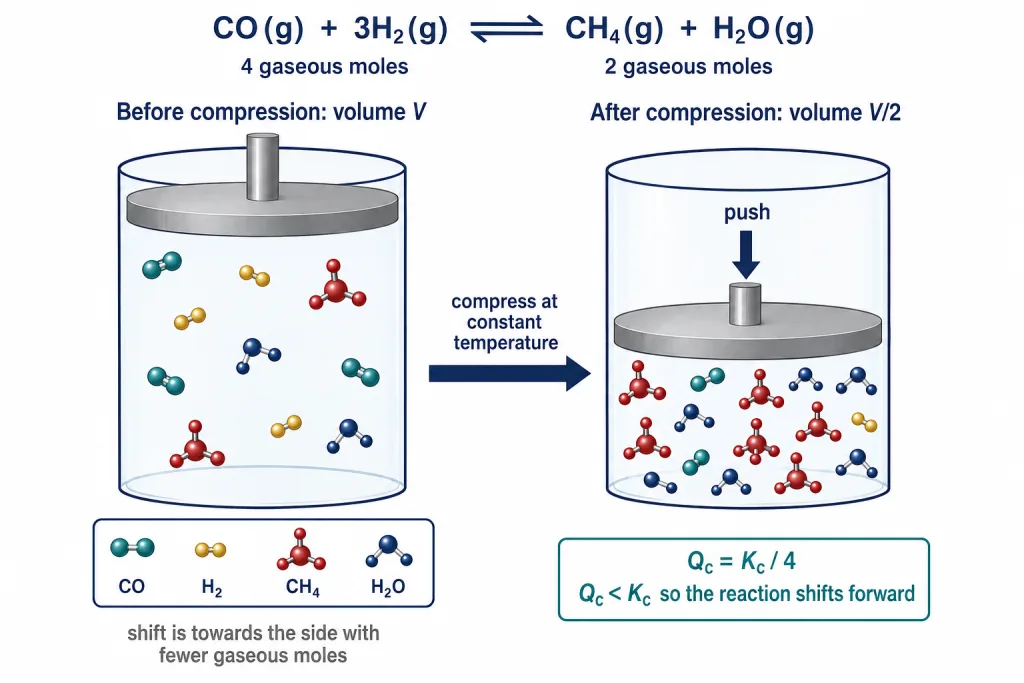
The general result is worth memorising as algebra rather than as a slogan. If every concentration is multiplied by a factor , every term in picks up that factor raised to its own power, and the powers combine to give
Compression means ; expansion means . Three cases follow immediately.
- : compression makes , so and the shift is forward. Fewer moles on the right, and the reaction moves right.
- : compression makes , so and the shift is backward. Fewer moles on the left, and the reaction moves left.
- : , so exactly. No shift at any pressure.
Key Point: Compressing a gaseous equilibrium shifts it towards the side with fewer gaseous moles; expanding it shifts it towards the side with more. When the position of equilibrium is completely indifferent to pressure.
Two worked instances. For the carbon is a solid and does not count, so ; raising the pressure drives the reaction backwards, towards carbon dioxide. For , ; the mixture can be squeezed to any pressure and the fraction converted to hydrogen iodide will not budge.
[JEE Main] The same factor governs and , because partial pressures scale exactly as concentrations do at constant temperature. Counting correctly — solids and liquids excluded — is where most of the marks are won.
Adding an Inert Gas
An inert gas is one that takes no part in the reaction: argon, helium, neon, or nitrogen in a reaction that does not involve nitrogen. Adding it produces two completely different outcomes depending on what is held constant, and the difference is a standing exam trap.
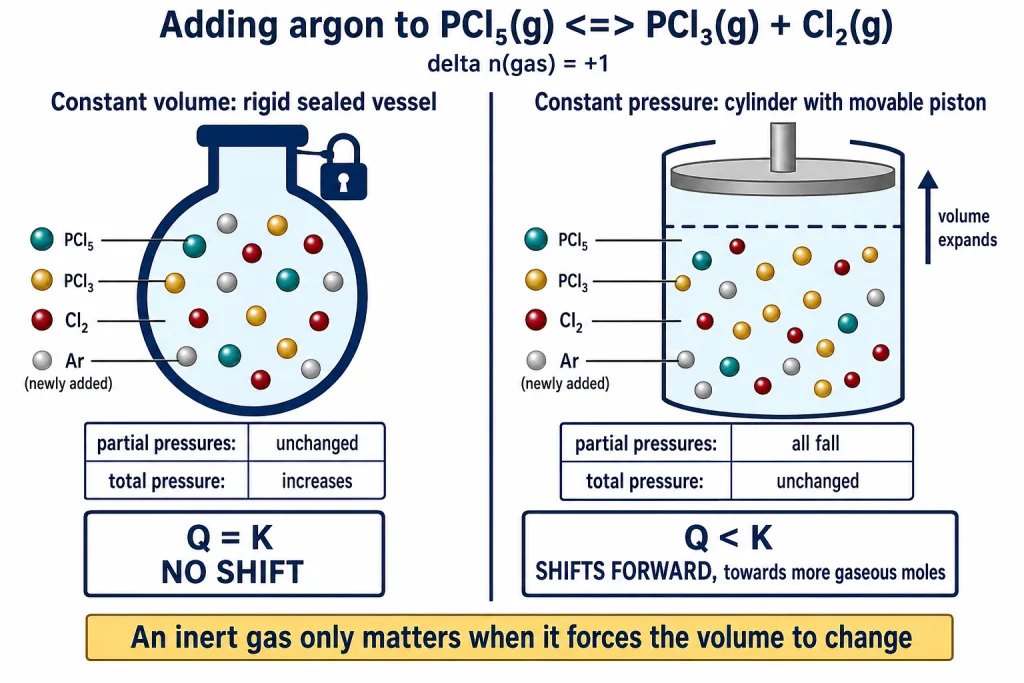
At constant volume: nothing happens
The vessel is rigid. Argon is pumped in. Every reacting species still occupies the same volume in the same amount, so every molar concentration is unchanged, and by every partial pressure is unchanged too.
is built entirely out of those concentrations or those partial pressures. Nothing inside it has moved, so still equals , and no net reaction occurs.
Key Point: Adding an inert gas at constant volume changes the total pressure but not a single partial pressure or concentration. is untouched and there is no shift, whatever may be.
The total pressure does rise, which is what tempts students into predicting a shift. Total pressure appears nowhere in . Only the partial pressures of the reacting species do, and argon has left every one of them exactly where it was.
At constant pressure: dilution
Now the vessel has a movable piston, or the reaction runs in a stream held at fixed total pressure. Adding argon at fixed total pressure forces the volume to expand, because the argon claims a share of the pressure and the reacting gases must give some up.
Expansion spreads the reacting molecules over a larger volume, so every concentration and every partial pressure of a reacting species falls by the same factor . That is precisely the situation analysed in the previous block.
- : , so and the reaction shifts forward, towards the side with more gaseous moles.
- : , so and the reaction shifts backward, again towards the side with more gaseous moles.
- : no shift.
Key Point: Adding an inert gas at constant pressure acts exactly like a dilution and shifts the equilibrium towards the side with the greater number of gaseous moles. At constant volume it does nothing at all.
Phosphorus pentachloride makes the contrast concrete. For , . Add argon to a sealed rigid bulb and the degree of dissociation does not change by a hair. Add the same argon to a cylinder under a weighted piston and the pentachloride dissociates further.
[JEE/NEET] Read the stem for the words "rigid vessel", "sealed container" or "constant volume" before answering anything about an inert gas. Those words alone settle the question.
Changing the Temperature
Temperature is the odd one out. A change in temperature does not merely disturb ; it changes itself, and the mixture then has to reorganise until the quotient matches the new constant.
The direction is set by the sign of for the forward reaction.
- Forward reaction exothermic ( negative): decreases as the temperature rises.
- Forward reaction endothermic ( positive): increases as the temperature rises.
A single sentence covers both: heating shifts an equilibrium in the endothermic direction, cooling shifts it in the exothermic direction. Treating heat as though it were a reagent — a product for an exothermic reaction, a reactant for an endothermic one — reproduces the same answers, and adding heat then pushes the equilibrium away from the side heat is written on.
Key Point: Raising the temperature always favours the endothermic direction. An exothermic forward reaction is therefore disfavoured by heating: both its yield and its equilibrium constant fall.
The dimerisation of nitrogen dioxide
Nitrogen dioxide is deep brown, dinitrogen tetraoxide is colourless, so the colour of the mixture reports its composition. Two sealed tubes of the gas are matched for colour in a beaker of water at room temperature, then one is moved into a freezing mixture and the other into water at .
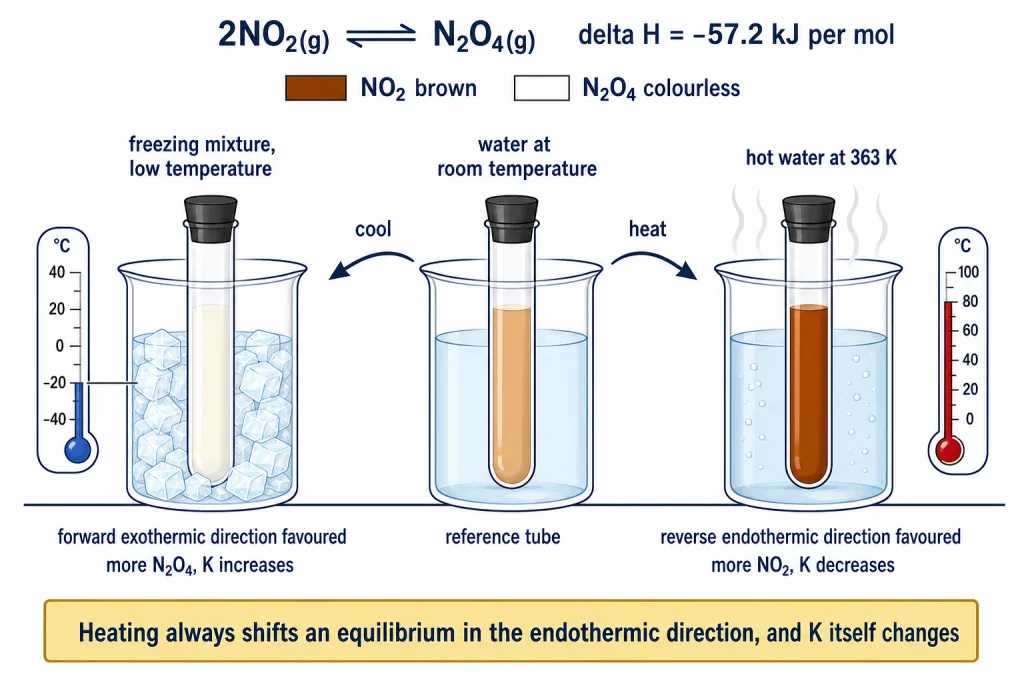
The cold tube pales. Cooling favours the exothermic forward direction, more of the colourless dimer forms, and has risen. The hot tube darkens. Heating favours the endothermic reverse direction, the dimer breaks up into brown , and has fallen. Both tubes contain the same amount of matter as before; only the distribution between the two forms has changed.
The cobalt chloride colour change
The hexaaqua ion is pink and the tetrachloro ion is blue. The forward reaction is endothermic. A solution containing both, sitting blue at room temperature, turns pink when the tube is stood in a freezing mixture, because cooling drives the equilibrium in the exothermic reverse direction. Warm it again and the blue comes back.
The two experiments cut in opposite directions, which is the point of running both. Cooling pales the nitrogen dioxide tube and pinkens the cobalt tube, and in each case the shift is towards the exothermic side of that particular equation.
[Board] Every temperature question is answered in two steps: read the sign of , then place heat on the correct side of the arrow. State both the direction of the shift and what happens to , since the marks are usually split between them.
Adding a Catalyst
A catalyst provides a new pathway from reactants to products with a lower activation energy. The pathway is shared: the forward and reverse reactions pass through the same transition state, so the catalyst lowers the activation energy of both by exactly the same amount.
Lowering by the same amount in both directions multiplies both rate constants by the same factor. Their ratio, which is the equilibrium constant, is unchanged.
Key Point: A catalyst does not shift the position of equilibrium and does not change . It shortens the time taken to reach equilibrium, and nothing else.
A catalyst appears neither in the balanced equation nor in the equilibrium constant expression, which is another way of seeing that it cannot alter either. The composition of the final mixture is identical with and without it; only the wait is shorter.
The practical value of this is large. Where a reaction has a favourable but a forbidding activation energy, a catalyst turns a thermodynamically possible reaction into a commercially usable one without costing any yield. Both industrial processes in the next block depend on exactly that.
The limitation is equally sharp. If is extremely small, the equilibrium mixture contains almost no product, and a catalyst will deliver that disappointing mixture faster. No catalyst can rescue a reaction that thermodynamics has already ruled out.
[NEET] A catalyst changes the rate, the time to equilibrium and the activation energy. It does not change , , or the equilibrium yield.
Two Industrial Compromises
The Haber process
Four gaseous moles become two, so , and the forward reaction is exothermic. Le Chatelier gives the ideal conditions for yield without hesitation: high pressure and low temperature.
High pressure is straightforward and is used. Compression drives the equilibrium towards the smaller number of moles, and the plant runs at around . The limit is engineering and cost, not chemistry — vessels and compressors for very high pressure are expensive.
Low temperature is where the conflict lies. Cooling raises and would raise the yield, but it also collapses the rate. At the equilibrium constant is enormous and the mixture would sit almost unreacted for years, because the nitrogen triple bond will not break at a useful speed. A high yield reached after a decade is worth nothing.
The resolution has two parts. An iron catalyst raises the rate at a temperature where the yield is still tolerable, and the operating temperature is pushed up to roughly , near degrees Celsius, deliberately sacrificing equilibrium yield to buy rate. Ammonia is then liquefied and removed continuously, holding below so the unconverted gas, recycled through the converter, keeps reacting.
Key Point: The Haber conditions — about , about , iron catalyst, continuous removal of ammonia — are a compromise. The temperature is higher than equilibrium alone would want, because a catalyst can fix a slow rate but nothing can fix a rate that is slow at low temperature and a yield that is poor at high temperature at the same time.
The Contact process
The forward reaction is exothermic and , so once again high pressure and low temperature favour the yield. The arithmetic of the compromise is different, though, because is already astronomically large.
With near the equilibrium conversion at ordinary pressure is essentially complete, so there is no point paying for high pressure. The plant runs near , just enough to move gas through the converter.
The problem is entirely one of rate: the oxidation of sulphur dioxide is desperately slow at low temperature. Vanadium(V) oxide, , or platinum is used as catalyst, and the temperature is held near . Raising the temperature costs some yield, since the reaction is exothermic, but with so large the loss is affordable and the gain in rate is not.
The contrast between the two plants is the useful lesson. Both reactions are exothermic with negative , so Le Chatelier prescribes the same conditions for both. Haber pays for very high pressure because its is small; the Contact process does not, because its is huge. The principle tells you the direction; the size of tells you whether the direction is worth paying for.
Question 1: Compression of the nitrogen dioxide equilibrium
At , for . An equilibrium mixture has . The volume is suddenly halved at constant temperature. Find immediately after compression and state the direction of the shift.
Answer:
First I find the equilibrium concentration of .
Halving the volume doubles both concentrations, to and .
This is exactly , as the formula predicts with and . Since , the net reaction runs backwards, towards — the side with fewer gaseous moles.
Ans: ; the equilibrium shifts backwards, towards Watch out: Doubling the numerator but forgetting that the denominator also doubles gives and still points backwards, so the wrong method survives the direction check. Only the value exposes it.
Question 2: Inert gas in a rigid vessel and under a piston
is at equilibrium. Argon is added (a) to a sealed rigid vessel and (b) to a cylinder fitted with a frictionless piston at constant total pressure, doubling the volume. Predict each outcome.
Answer:
For (a) the volume is fixed, so the moles and volume of every reacting species are unchanged, and so is every concentration. is built only from , and , none of which has moved. still equals and nothing happens, even though the total pressure has risen.
For (b) the volume doubles, so every reacting concentration falls to half its old value, giving . Here .
, so the reaction moves forward and more dissociates.
Ans: (a) no shift; (b) forward shift, the degree of dissociation increases Watch out: The total pressure rises in case (a) and stays constant in case (b), which is the reverse of what most students assume when they see the word "inert gas". Total pressure is not what is made of.
Question 3: Reading the sign of from two values of
For a gaseous reaction at and at . Is the forward reaction exothermic or endothermic? What happens to the yield of product if the mixture is cooled?
Answer:
has grown by a factor of about when the temperature was raised. An equilibrium constant that increases with temperature belongs to an endothermic forward reaction.
Cooling therefore lowers and shifts the equilibrium in the exothermic direction, which here is the reverse direction. The yield of product falls.
Ans: the forward reaction is endothermic; cooling lowers and lowers the yield of product
Question 4: Adding a reactant, worked numerically
At , for . An equilibrium mixture has . Enough hydrogen is injected at constant volume to raise instantly to . Which way does the reaction go?
Answer:
First I find the equilibrium concentration of .
Immediately after the injection, and have not changed.
is half of , so and the reaction moves forward, consuming part of the added hydrogen.
Ans: ; net forward reaction Watch out: The final equilibrium lands between and . It never returns all the way to ; the system counteracts the addition only in part.
Question 5: A reaction with
Predict the effect on the equilibrium yield of in of (a) trebling the total pressure by compression, (b) adding argon at constant volume, (c) adding argon at constant pressure.
Answer:
I count the gaseous moles: two on the left, two on the right, so .
For (a) compression multiplies every concentration by , and . No shift.
For (b) an inert gas at constant volume leaves every concentration alone, so . No shift.
For (c) an inert gas at constant pressure expands the vessel and multiplies every concentration by some , but again. No shift.
Ans: none of the three changes the yield of Watch out: All three answers come from the same exponent being zero. A reaction with is completely indifferent to pressure, volume and inert gas; only temperature can move it.
Question 6: The conditions of the Haber process
For , . State and justify the effect on the equilibrium yield of ammonia of (a) increasing the pressure, (b) increasing the temperature, (c) adding an iron catalyst, (d) removing ammonia as it forms.
Answer:
(a) . Compression makes , so the reaction moves forward. The yield rises.
(b) The forward reaction is exothermic, so heating shifts the equilibrium in the endothermic reverse direction. falls and the yield falls.
(c) The catalyst multiplies the forward and reverse rate constants by the same factor, so is unchanged. The yield is unchanged; only the time to reach equilibrium is shorter.
(d) Removing ammonia lowers the numerator of , holding , so the forward reaction continues. More ammonia is produced overall.
Ans: (a) yield rises; (b) yield falls; (c) yield unchanged, equilibrium reached sooner; (d) more ammonia obtained Watch out: The plant nevertheless runs near , which part (b) says is bad for yield. The high temperature is bought deliberately, to make the rate usable; the catalyst alone cannot do enough at low temperature.
Question 7: Why the Contact process does not use high pressure
For , at and the forward reaction is exothermic. Le Chatelier predicts that high pressure raises the yield, yet the plant operates near . Explain, and find if the pressure is trebled by compression.
Answer:
, so compression by a factor gives
, so compression does shift the reaction forward. The prediction is correct.
It is simply not worth acting on. With the equilibrium conversion of to is already very close to complete at low pressure, so high pressure would buy a negligible improvement at large cost in plant. The real obstacle is rate, which is why is used as catalyst at about .
Ans: compression shifts the equilibrium forward with , but the conversion is already near-complete at , so high pressure is not economically justified Watch out: A large says nothing about speed. A reaction with can still be too slow to observe, and that is exactly the case here.
The Whole Section in One Table
Every entry below was derived from against , and can be re-derived that way in a few seconds if the table is forgotten.
| Change imposed on the system | Direction in which the position shifts | Effect on |
|---|---|---|
| Add a reactant | Forward, consuming the added reactant | None |
| Remove a reactant | Backward, replenishing it | None |
| Add a product | Backward | None |
| Remove a product continuously | Forward, and it keeps going | None |
| Add or remove a pure solid or pure liquid | No shift | None |
| Increase pressure by compression | Towards fewer gaseous moles; no shift if | None |
| Decrease pressure by expansion | Towards more gaseous moles; no shift if | None |
| Add inert gas at constant volume | No shift, whatever is | None |
| Add inert gas at constant pressure | Towards more gaseous moles; no shift if | None |
| Raise the temperature | In the endothermic direction | Rises if forward is endothermic, falls if exothermic |
| Lower the temperature | In the exothermic direction | Falls if forward is endothermic, rises if exothermic |
| Add a catalyst | No shift | None |
Three habits keep this reliable under exam pressure. Count from gases only, with solids and liquids struck out. Check whether the stem fixes the volume or the pressure before answering anything about an inert gas. And treat the temperature row as the only one where the right-hand column is not blank.