
Reversible and Irreversible Reactions
Some reactions run one way and stop there. Burn a magnesium ribbon in air and you get white magnesium oxide; the ash never turns back into shiny metal and oxygen. Reactions like these are called irreversible under the conditions used.
Other reactions refuse to finish. Seal dinitrogen and dihydrogen in a hot vessel over an iron catalyst and ammonia appears — but analysis always finds unreacted dinitrogen and dihydrogen still there. Seal pure ammonia in the same vessel at the same temperature and it breaks down — but analysis always finds ammonia still present. Both changes happen at once, and neither wins outright.
Key Point (Definition): A reversible reaction is one in which the products, as soon as they are formed, react together under the same conditions to give back the reactants. In a closed vessel such a reaction never goes to completion: the final mixture contains every reactant and every product.
The double half-arrow
A single arrow claims that the change goes one way only:
A pair of half-arrows, one pointing each way, claims something quite different:
The upper half-arrow is the forward reaction, reading left to right; the lower half-arrow is the reverse (or backward) reaction, reading right to left. Both run at the same instant, in the same vessel, at the same temperature. The symbol is not shorthand for "this reaction can be reversed if you change the conditions". It says the two directions go on simultaneously and under identical conditions.
The words "reactant" and "product" therefore become a matter of which side you happened to write first. Above, ammonia is the product; write the same chemistry as and ammonia is the reactant. The system in the vessel is the same either way.
Reversibility depends on the vessel
Calcium carbonate decomposing on heating is the standard illustration:
Heat limestone in an open kiln and the carbon dioxide walks away into the atmosphere. It never comes back to meet the quicklime, the reverse reaction has nothing to work with, and the decomposition goes to completion. The reaction looks irreversible.
Heat the same limestone in a closed vessel and the carbon dioxide is trapped. As its pressure builds it starts recombining with calcium oxide, the decomposition slows and never finishes, and a fixed pressure of carbon dioxide sits above the two solids.
Key Point: Whether a reaction appears irreversible often depends on whether a product is allowed to escape. Equilibrium can only be studied in a closed system — one that exchanges energy with the surroundings but not matter.
[Board] A common one-mark question asks for one example each of a reversible and an irreversible change with a reason. The reason must mention the closed vessel, not just the arrow used.
How a Chemical System Reaches Equilibrium
Take the general reversible reaction
and load the vessel with A and B only. At the instant of mixing there is no C and no D at all.
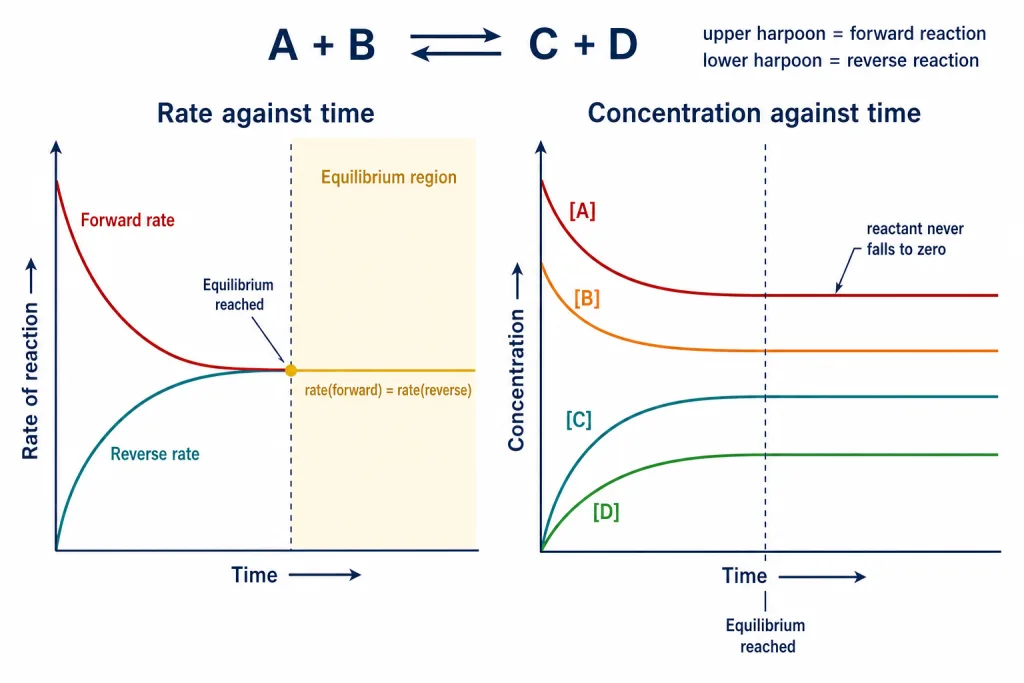
At the start. The concentrations of A and B are at their highest, so collisions between them are as frequent as they will ever be and the forward rate is at its maximum. The reverse rate is exactly zero, because there is nothing on the right-hand side to react.
As time passes. and fall and the forward rate falls with them, while and rise and the reverse rate climbs from zero. One curve is coming down; the other is going up.
The meeting point. A falling curve and a rising curve must meet. At that moment
Every molecule of C destroyed by the reverse reaction is replaced by one made in the forward reaction, so the concentrations stop changing. This is chemical equilibrium.
Key Point (Definition): Chemical equilibrium is the state of a reversible reaction in a closed system at which the rate of the forward reaction equals the rate of the reverse reaction, so that the concentrations of all reactants and products remain constant with time. The mixture present at this state is called the equilibrium mixture.
Reading the two kinds of graph
Two graphs get drawn for the same experiment and they are easy to confuse. A rate-against-time graph shows one curve sagging from a high value, another rising from zero, and the two merging into a single horizontal line; the merging is the point of the picture. A concentration-against-time graph shows and falling and flattening while and rise and flatten, all four at the same instant, because the stoichiometry ties them together.
No reactant curve reaches zero. Some A and some B are always left over, which is the signature of a reversible reaction in a closed vessel.
How quickly equilibrium arrives depends on temperature, surface area and the presence of a catalyst. None of that affects where the system settles, only how long the journey takes.
[JEE Main] Questions often show a rate-against-time sketch and ask at which labelled point equilibrium is first attained. The answer is the point where the two curves first coincide, not the point where either curve first looks flat.
The Haber Synthesis as the Worked Case
The industrial synthesis of ammonia is the reaction on which the dynamic picture was first nailed down experimentally.
Haber charged a vessel with known amounts of dinitrogen and dihydrogen, held it at high temperature and pressure, and at regular intervals measured how much ammonia had formed. He also measured the dinitrogen and dihydrogen that had not reacted, which is the part that matters here.
What the measurements showed
For the first stretch of the run ammonia climbed steeply while dinitrogen and dihydrogen fell. Then the climb slowed. Then all three measurements went flat and stayed flat for as long as the experiment continued.
The flat portion carries two pieces of information, and students routinely take only the first.
- The composition of the mixture is no longer changing. The reaction has reached equilibrium.
- Some of the reactants are still present. The dinitrogen and dihydrogen readings did not go to zero; they went to a constant non-zero value.
If the forward reaction were running unopposed, that leftover dinitrogen and dihydrogen would keep being converted and the ammonia reading would keep rising. It does not rise. Something must be undoing the forward reaction at exactly the rate the forward reaction is doing it.
Stoichiometry ties the three curves together
The three concentration curves are not independent. For every mol of ammonia formed, exactly mol of dinitrogen and mol of dihydrogen disappear:
The dihydrogen curve therefore falls three times as steeply as the dinitrogen curve, the ammonia curve rises twice as steeply as the dinitrogen curve falls, and all three must flatten at the same instant. A sketch in which the ammonia curve flattens before the dihydrogen curve is chemically impossible.
Limestone in a closed vessel
The same story runs with a solid decomposing into a solid and a gas:
Put calcium carbonate in an evacuated closed vessel and heat it to . Carbon dioxide pressure starts at zero and climbs. As it climbs, carbon dioxide molecules strike the calcium oxide surface more often and the reverse reaction speeds up, so the pressure climbs more slowly and then stops climbing. Experimentally it settles at and stays there.
Two facts about this system come back in the section on heterogeneous equilibria.
- The final pressure does not depend on how much limestone you started with, and adding more limestone or more quicklime does not change it. A solid has a fixed density; piling up more of it does not make its "concentration" larger.
- Both solids must be present for the equilibrium to exist.
Key Point: In the Haber vessel and in the limestone vessel alike, the constancy of the readings tells you the rates have become equal. It never tells you the reaction has stopped, and it never tells you the reactants are used up.
Equilibrium Can Be Reached from Either Side
A single equilibrium state can be approached from two opposite directions, and the mixture you end up with is the same.
The hydrogen-iodine system
Iodine vapour is deep purple; hydrogen and hydrogen iodide are colourless. The colour of the vessel is a direct read-out of , which makes this system easy to follow.
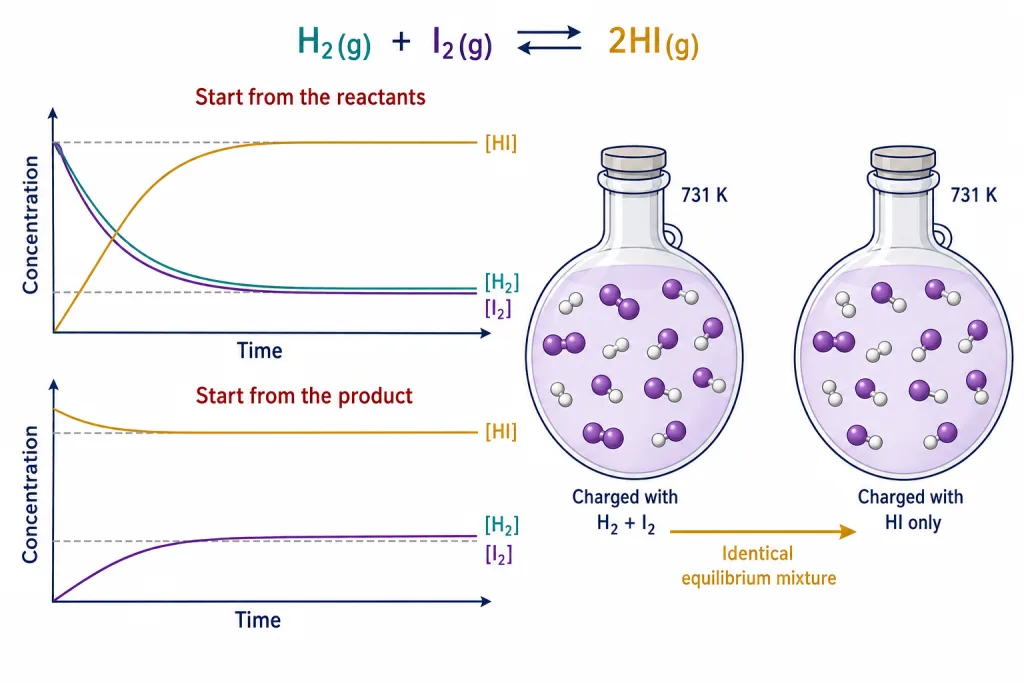
Run 1 — start from the reactants. Seal equal concentrations of dihydrogen and iodine vapour at . The purple colour fades as iodine is consumed, then stops fading. and fall and level off; rises from zero and levels off.
Run 2 — start from the product. Seal pure hydrogen iodide in an identical vessel at the same temperature. Purple colour appears, deepens, then stops deepening. falls and levels off; and rise from zero and level off.
Both runs end in a mixture of all three gases. If the vessel holds the same number of hydrogen atoms and the same number of iodine atoms in the two runs, the two final mixtures are identical — same concentrations, same colour, same pressure.
Why the atom count is the condition
Two vessels reach the same equilibrium mixture only when they contain the same number of atoms of each element in the same volume. Starting with each of and in one litre puts of H atoms and of I atoms in the vessel; starting with of in one litre puts in the same of each. Those two experiments converge on the same final state. Starting with of would supply only half as many atoms, and the final mixture would be different.
The same holds for ammonia
Charge one vessel with mol dinitrogen and mol dihydrogen and a second identical vessel with mol ammonia. Both contain mol of N atoms and mol of H atoms, and at the same temperature both arrive at the same equilibrium composition — one by building ammonia up, the other by tearing it down. An equilibrium state carries no memory of the route by which it was reached.
Key Point: The equilibrium composition is fixed by the temperature and by the total amount of each element present in the vessel. It does not depend on whether you started from the left-hand side or the right-hand side of the equation.
[NEET] A frequent statement to judge: "An equilibrium mixture obtained by decomposing HI differs from one obtained by combining H2 and I2." False, provided the atom counts and the temperature match.
The Evidence That Equilibrium Is Dynamic
Everything so far is consistent with two rival pictures.
Picture A (static). The reaction ran for a while and then stopped dead. The readings are constant because there is no activity.
Picture B (dynamic). Both reactions are still running at full speed, at equal rates. The readings are constant because the two rates cancel.
From the outside the two look identical. Concentration, pressure and colour cannot tell them apart. To decide between them, you have to label the atoms and see whether they move.
The deuterium exchange experiment
Deuterium, or , is the heavy isotope of hydrogen. It reacts chemically just like ordinary hydrogen but has twice the mass, so a mass spectrometer separates (mass 2), (mass 3) and (mass 4) cleanly.
The simple version. Pass a mixture of pure and pure over a heated platinum or nickel catalyst:
Analyse the gas afterwards and is there, although none was put in. An H atom and a D atom can end up bonded to each other only if an bond and a bond break and new bonds form. Molecules are being taken apart and rebuilt continuously.
The ammonia version
The experiment Haber's system provides is more striking, because it uses two mixtures already at equilibrium.
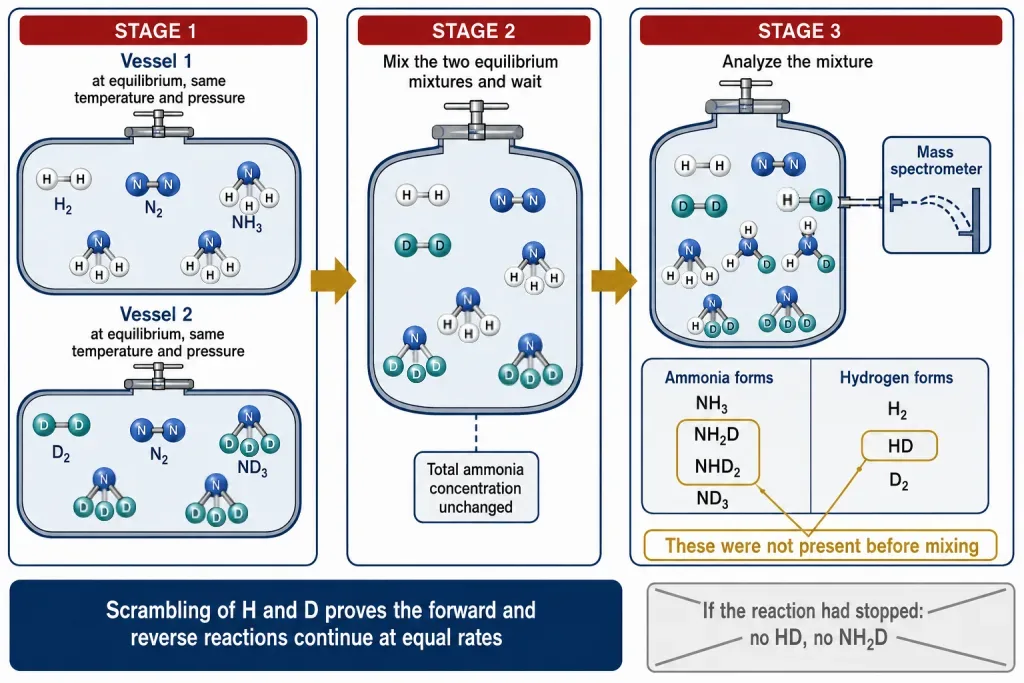
- Run the synthesis in one vessel with ordinary dihydrogen. At equilibrium it contains , and .
- Run the identical synthesis in a second vessel at the same temperature and partial pressures, but with in place of . It reaches equilibrium with exactly the same composition, except that the species are , and .
- Mix the two equilibrium mixtures and leave them alone.
Now analyse. The amount of ammonia is unchanged — a chemical analysis of "total ammonia" gives the same answer before and after. Nothing appears to have happened.
Feed the same sample to a mass spectrometer and the picture changes completely. Present in the vessel are
The hydrogen and deuterium atoms have been thoroughly scrambled across every molecule that can hold them. Mixed species such as and did not exist in either vessel beforehand.
Why this settles the argument
For an H atom that started inside an molecule to finish up inside an molecule, that ammonia molecule must have decomposed and been rebuilt. Bonds break and re-form only if the forward and reverse reactions are still running.
Under Picture A, mixing the two mixtures would change nothing: would stay , would stay , and no or could appear. The mass spectrometer says otherwise.
Key Point: The isotope-scrambling experiment shows that at equilibrium the forward and reverse reactions continue at equal rates, with no net change in composition. Equilibrium is dynamic, not static. The reaction does not stop.
[JEE/NEET] The single most repeated trap on this topic is the claim that "at equilibrium the reaction stops" or "at equilibrium the rates of the forward and reverse reactions become zero". Both are wrong. The correct statement is that the two rates become equal, and both are non-zero.
Labelled Atoms and a Classroom Model
Isotopic labelling is the general tool. Radioactive isotopes make it even easier, because a counter detects them at trace levels.
Radioactive iodine in the hydrogen-iodide system
Let reach equilibrium in a sealed vessel; the colour has stopped changing, so the concentrations are constant. Now introduce a trace of iodine vapour made from radioactive , in a quantity too small to disturb the concentrations measurably.
Wait, then separate the hydrogen iodide from the unreacted iodine and count each fraction. The radioactivity is found in both. Labelled iodine atoms have moved out of and into , and never changed while this was happening. A static equilibrium would have kept every radioactive atom locked inside for ever.
The radioactive sugar experiment
The physical analogue runs the same argument. Drop a little radioactive sugar into a saturated solution of ordinary sugar in contact with undissolved crystals. After a while, radioactivity turns up in the solid crystals as well as in the solution, and the ratio of radioactive to non-radioactive molecules in the solution rises to a constant value. The amount of dissolved sugar never changed; dissolution and crystallisation are both still running.
The two-cylinder activity
A model that needs no isotopes. Half-fill one measuring cylinder with water coloured by a crystal of potassium permanganate and leave a second cylinder empty. Using one glass tube for each, transfer liquid from 1 to 2 and from 2 to 1, over and over.
Cylinder 1 is the reactant and cylinder 2 the product. At first the transfer out of cylinder 1 is large and the transfer out of the empty cylinder 2 is nil; as liquid builds up in cylinder 2 the return transfer grows, and eventually the two levels stop changing.
Two things about the model deserve attention.
- The levels become constant, not equal. Use tubes of different diameters and the two final levels are different. Constancy is what equilibrium demands; equality of concentrations is not.
- The transferring never stopped. It carried on at the same pace after the levels froze. That is precisely the dynamic character the isotope experiments prove for real reactions.
Key Point: Radioactive and isotopic labels are the experimental proof of dynamic equilibrium; the two-cylinder transfer is only an analogy for it. Both make the same point — constant readings are produced by two opposing processes running at equal rates, not by inactivity.
What Is Constant and What Is Not
The whole topic can be compressed into one table, and most errors in this section come from confusing the two columns.
| Constant at equilibrium | Not constant, and never becomes zero |
|---|---|
| Concentration of every reactant and every product | The forward reaction rate itself, which continues |
| Total pressure of the system (at fixed and ) | The reverse reaction rate, which continues |
| Colour, refractive index, density of the mixture | The identity of the atoms inside a given molecule |
| Number of moles of each species | The number of collisions per second between molecules |
| All other measurable macroscopic properties | The exchange of atoms between reactant and product molecules |
The left-hand column is what an instrument outside the vessel reports. The right-hand column is what a mass spectrometer or a radiation counter reports about the individual molecules.
The conditions
- Closed system. No matter enters or leaves; energy may be exchanged.
- Constant temperature. A changed temperature gives a different equilibrium composition.
- Both directions possible. The reaction must be reversible under those conditions.
- Enough time. Reaching equilibrium takes as long as it takes.
The statements to get right
Three formulations are correct and interchangeable: the forward rate equals the reverse rate; the concentrations of all species remain constant with time; all measurable properties remain constant with time.
Three are wrong, and each turns up in exams:
- "The reaction stops." It does not. Only the net change stops.
- "The concentrations of reactants and products become equal." They become constant. They are almost never equal.
- "The rates of the forward and reverse reactions become zero." They become equal, and both are non-zero.
Key Point: At equilibrium there is no net change, which is not the same as no change. The macroscopic properties freeze; the molecular activity does not.
Equilibrium is a state the system runs to on its own. Leave a reversible reaction in a closed vessel at fixed temperature for long enough and it will find that state, from whichever side it starts.
Worked Questions
Question 1: Reading the double half-arrow
State what the symbol in tells you that a single arrow would not.
Answer:
A single arrow would say that sulphur dioxide and oxygen turn into sulphur trioxide and nothing else happens.
The double half-arrow says two things happen at once, in the same vessel, at the same temperature: sulphur dioxide and oxygen combine to give sulphur trioxide, and sulphur trioxide breaks up to give them back.
So the reaction cannot go to completion in a closed vessel. The final mixture holds all three gases.
Ans: The forward and reverse reactions proceed simultaneously under the same conditions, so the reaction is reversible and the mixture at equilibrium contains , and together. Watch out: The symbol does not mean "this reaction can be reversed by changing the conditions". Both directions run under one single set of conditions.
Question 2: Why an open kiln looks irreversible
Calcium carbonate is heated in an open kiln and decomposes completely, yet the same reaction in a closed vessel stops part-way. Explain.
Answer:
The reaction is .
In the open kiln the carbon dioxide diffuses away as fast as it is made, so it is not available to react with calcium oxide and the reverse reaction never runs. Only the forward reaction operates, until no calcium carbonate is left.
In the closed vessel the carbon dioxide is trapped, its pressure rises, and the reverse reaction speeds up. When the reverse rate matches the forward rate, the composition freezes with all three substances present.
Ans: Escape of in the open kiln prevents the reverse reaction, so the decomposition goes to completion; in a closed vessel the trapped allows the reverse reaction and equilibrium is established. Watch out: "Reversible" and "irreversible" are not fixed labels. The same chemistry behaves either way depending on whether a product can leave.
Question 3: Rates at the start of a run
A vessel is charged with and only. State the value of the forward rate and of the reverse rate at , and describe how each changes up to equilibrium.
Answer:
At the concentrations of and are at their maximum, so the forward rate is at its maximum. There is no ammonia in the vessel, so the reverse rate is exactly zero.
As the run proceeds and fall and the forward rate falls with them, while rises from zero and the reverse rate rises with it. The falling curve and the rising curve meet, and at that instant the concentrations stop changing.
Ans: Forward rate is maximum and reverse rate is zero at ; the forward rate then decreases and the reverse rate increases until the two become equal at equilibrium. Watch out: Both rates are non-zero at equilibrium. They meet at some common non-zero value, they do not fall to zero.
Question 4: Equilibrium concentrations from one measurement
of and of are sealed in a vessel at . At equilibrium the concentration of is found to be . Find the equilibrium concentrations of and .
Answer:
The equation is , and since the volume is , moles and molarity have the same numerical value.
Two moles of are formed for each mole of used, so the used is half the formed. The measured value carried to four figures is , and keeping that extra figure through the division is what makes the third figure of the answer trustworthy:
The coefficients of and are both , so the same amount of is used.
A quick check on the three figures together: , which is the accepted constant for this equilibrium at .
Ans: Watch out: Subtracting straight from gives a negative concentration, which is the signal that the factor of from the stoichiometry has been dropped.
Question 5: The same mixture from the other side
For the vessel in Question 4, what starting amount of pure in a vessel at would give exactly the same equilibrium mixture? Verify the final concentrations.
Answer:
First I count atoms in the original vessel: of carries of H atoms and of carries of I atoms. Each molecule carries one of each, so of supplies the same atoms in the same volume.
Now I check the equilibrium reached from that side. Let mol of decompose per litre, giving of and of . Matching Question 4 gives , so , leaving exactly as before.
Ans: of in ; the mixture settles at , . Watch out: Starting with of instead supplies only half the atoms, and gives a different equilibrium mixture.
Question 6: Leftover reactants in the Haber vessel
of and of are placed in a vessel. At equilibrium of is present. Find the amounts of and remaining, and the percentage of converted.
Answer:
For every mol of ammonia formed in , mol of and mol of are consumed.
So left and left , and the conversion of is .
Ans: and remain; of the dinitrogen is converted. Watch out: Subtracting from to get uses the ammonia figure directly and ignores the coefficient on dihydrogen.
Question 7: What the deuterium experiment proves
Two equilibrium mixtures at the same temperature and pressure — one of , , and the other of , , — are mixed and left. List what a mass spectrometer finds afterwards, and state what would be found if equilibrium were static.
Answer:
An ordinary chemical analysis reports the total ammonia to be exactly what it was before mixing, so nothing appears to have happened.
The mass spectrometer separates species by mass and so distinguishes the isotopic forms. It finds , , and , together with , and . The mixed species were in neither vessel before mixing; to put an H and a D on the same nitrogen atom, an ammonia molecule must break apart and be rebuilt from a pool containing both isotopes.
If equilibrium were static, no bonds would break, and neither nor any mixed ammonia could appear.
Ans: All four ammonia forms , , , and all three hydrogen forms , , are present; a static equilibrium would have shown only the original four species. Watch out: The total ammonia concentration is unchanged throughout. The scrambling is invisible to any measurement that cannot see isotopes.
Question 8: Radioactive iodine at equilibrium
A trace of iodine vapour enriched in radioactive is injected into a vessel in which has already reached equilibrium. Predict the observation and give its interpretation.
Answer:
The trace is far too small to disturb the concentrations, so the colour and the pressure do not change.
After some time I separate the hydrogen iodide from the unreacted iodine and count each fraction. Radioactivity is found in both. A radioactive iodine atom can get into an molecule only if an molecule reacts, and since did not change while this happened, the reverse reaction must have been converting back at exactly the same rate.
Ans: Radioactivity appears in both and although no concentration changes, showing that the forward and reverse reactions continue at equal rates. Watch out: A static equilibrium would leave every radioactive atom locked inside . The appearance of the label in is the whole result.
Question 9: Judging four statements
Which of these statements about a system at chemical equilibrium are correct?
(i) The reaction has stopped. (ii) The concentrations of reactants and products are equal. (iii) The rates of the forward and reverse reactions are equal. (iv) Equilibrium can be reached only by starting from the reactants.
Answer:
(i) Wrong. Only the net change stops; both reactions carry on at equal rates, as the isotope experiments show.
(ii) Wrong. The concentrations become constant, not equal. In the ammonia system the three concentrations are all different.
(iii) Correct. This is the defining condition of equilibrium.
(iv) Wrong. The same mixture is reached from the product side, provided the temperature and the total atoms of each element match.
Ans: Only (iii) is correct. Watch out: The confusion between "constant" and "equal" in statement (ii) is the commonest error on this topic.
Question 10: Limestone in a sealed tube
Calcium carbonate is heated at in a sealed evacuated vessel until the carbon dioxide pressure becomes constant at . Predict what happens to that pressure if (a) more calcium carbonate is added, (b) some calcium oxide is removed but some remains, (c) the vessel is opened to the atmosphere.
Answer:
(a) Nothing. A solid has a fixed density, so adding more of it does not increase any concentration and the pressure stays at .
(b) Nothing, as long as some calcium oxide is still there, by the same argument.
(c) The carbon dioxide escapes, the reverse reaction loses its supply of gas, and the calcium carbonate decomposes completely.
Ans: (a) unchanged, (b) unchanged, (c) the pressure falls to atmospheric and the decomposition goes to completion. Watch out: Both solids must be present for the equilibrium to exist at all. Removing all the calcium oxide, or all the calcium carbonate, destroys the equilibrium rather than shifting it.
Question 11: The two-cylinder analogy
In the coloured-water transfer activity, tubes of different diameters are used. At the end the levels are constant but unequal. What does this show?
Answer:
The level in each cylinder plays the role of a concentration, and the tube diameters set how fast liquid moves each way. The levels stop changing when the volume carried from cylinder 1 to cylinder 2 equals the volume carried back, and with unequal tubes that balance is struck at unequal levels. Transferring carries on afterwards.
Ans: Equilibrium requires concentrations to become constant, not equal, and it is maintained by two opposing processes that continue to run. Watch out: The model is an analogy, not evidence. The proof of dynamic equilibrium comes from isotope and radioactive-tracer studies.