
Two Phases in the Same Vessel
An equilibrium is heterogeneous when the reacting species are not all in the same phase. A solid sits at the bottom of the flask while a gas fills the space above it. A liquid coats the walls while its vapour presses on the lid. A lump of metal sits in a solution that is eating into it. Wherever a boundary can be drawn inside the reaction mixture, with different states of matter on the two sides of it, the equilibrium is heterogeneous.
Key Point (Definition): A heterogeneous equilibrium is one in which the reactants and products are present in more than one phase. At least one species is in a phase different from the rest.
The test is mechanical: read the state symbols in the balanced equation. If they are not all the same, the equilibrium is heterogeneous.
Two solids and a gas — three phases, because two different solids never merge into a single phase and the gas is a third phase on top of them.
A liquid and its vapour. The physical equilibria of the first section of this chapter are all heterogeneous.
Solid nickel with two gases. This is the Mond process, used to purify nickel: the metal is dissolved into the gas phase as a volatile carbonyl at one temperature and dumped back out as pure metal at another.
Two solids and two gases.
A solid precipitate in contact with the solution that made it. Every solubility equilibrium in the last part of this chapter is of this kind.
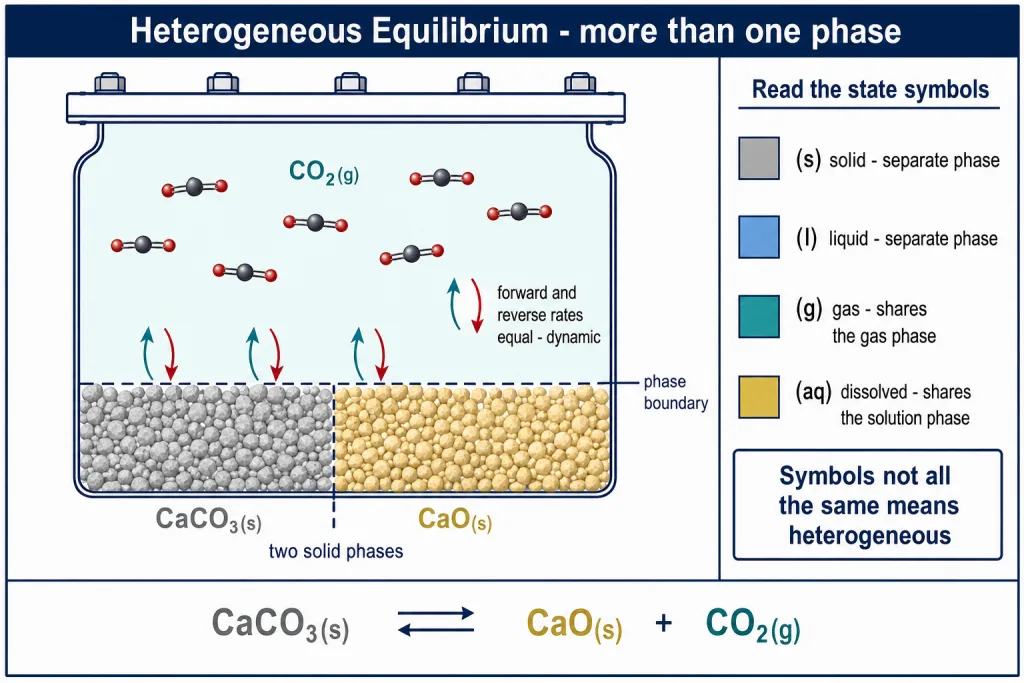
[NEET] The state symbols are the whole question. A species written or is a separate phase; a species written or shares its phase with everything else carrying the same symbol. Two different solids do not merge into one phase, and a solid in contact with a solution is never homogeneous.
A heterogeneous equilibrium is still dynamic. Carbon dioxide molecules keep leaving the surface of the carbonate and keep striking the oxide and being reabsorbed. What has stopped is the net change, not the traffic.
Why Pure Solids and Pure Liquids Drop Out
Write the law of mass action for the carbonate decomposition exactly as the balanced equation dictates:
Now look hard at the two solid terms. What does the molar concentration of a solid actually mean? Concentration is moles per litre, and for a pure solid that ratio is fixed by the substance itself:
Density divided by molar mass. Calcium carbonate has and , so — and it is for one gram of the powder, for one kilogram of it, and for a marble block. Doubling the amount doubles the moles and doubles the volume the solid occupies. The ratio does not move.
Key Point: The molar concentration of a pure solid or a pure liquid is a fixed property of the substance, equal to its density divided by its molar mass. It does not change as the reaction proceeds, so it is a constant and is absorbed into the equilibrium constant.
That is the entire reason. It is not a convention and not a shortcut. A quantity that never changes cannot carry information about the position of equilibrium, so it is multiplied into where it belongs. Rearrange:
The left side is a constant multiplied by a ratio of two constants, which is simply another constant. Call it and drop the prime once everybody agrees to omit solids from the start:
The same argument runs for a pure liquid. Water as a pure liquid has and , giving , unchanged whether the flask holds or a litre.
Contrast this with and . A gas expands to fill whatever volume it is given, so its concentration depends on how much of it there is in that volume. A dissolved species is spread through a solvent whose volume is set independently, so its concentration depends on how much has dissolved. Both vary as the reaction proceeds. Both stay in the expression.
The modern justification uses activity. Every term in a rigorous equilibrium constant is an activity — a concentration or pressure measured against a chosen standard state. For a pure solid or a pure liquid the standard state is the pure substance, so its activity is exactly , and multiplying or dividing by changes nothing. The Class 11 rule and the thermodynamic rule are the same rule.
[Board] "Explain why pure liquids and solids can be ignored while writing the equilibrium constant expression" is a standard two-mark question. The answer must contain the reason, not just the rule: their molar concentration equals density over molar mass, a constant independent of the amount present, so it is merged into .
Calcium Carbonate in a Closed Vessel
Heat limestone in a sealed container and it begins to decompose:
Carbon dioxide builds up in the space above the solid. As its pressure rises, the reverse reaction — quicklime reabsorbing the gas — speeds up. At some pressure the two rates match and the gas pressure stops climbing. Both solids are still there, and the gas above them has a definite pressure that will not change as long as the temperature is held.
With the solids omitted, the constant in concentration terms is
and in pressure terms it is the simplest equilibrium constant in the whole chapter:
One term. Nothing in the denominator, nothing multiplying it.
Experiment supplies the number. At the pressure of carbon dioxide in equilibrium with and is . Taking the standard state of a gas as (that is, ),
a dimensionless number. Quoted with units instead, .
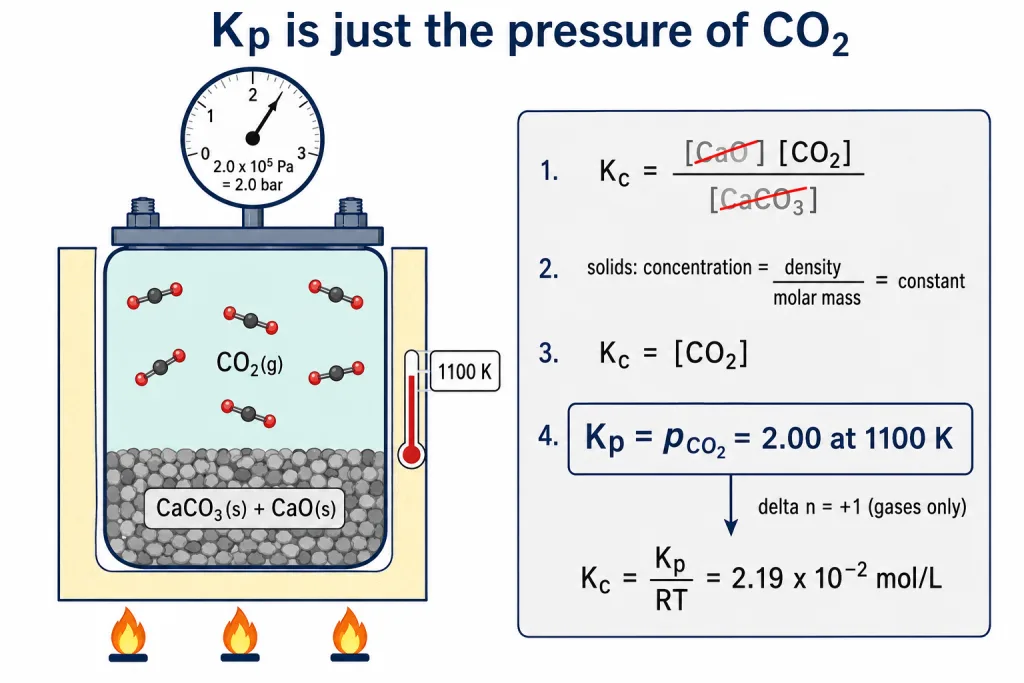
The corresponding follows from . Only gaseous species are counted in , so here :
using .
Key Point: Solids and liquids are excluded from as well as from the expression. counts moles of gaseous products minus moles of gaseous reactants.
Two more decompositions behave identically. Sodium bicarbonate on heating in a closed vessel gives
and a hydrated salt losing water of crystallisation gives
The water here is a vapour, and vapour is never omitted.
The Pressure Does Not Care How Much Solid There Is
has a consequence that catches students every time. The equilibrium constant depends only on temperature. The pressure of carbon dioxide is the equilibrium constant. So the carbon dioxide pressure above decomposing limestone depends only on temperature — and on nothing else at all.
Key Point: For , the equilibrium pressure of at a given temperature is fixed. It is the same above a gram of limestone as above a kilogram, and the same whether the quicklime present is a trace or a heap.
Work through what that means.
Add more limestone. Nothing happens to the pressure. More solid means more surface, so the forward reaction runs faster — but the reverse reaction speeds up in the same proportion, and was never in the expression to begin with. The gauge reads exactly what it read before.
Scrape out some quicklime. Again nothing, for the same reason.
Double the volume of the vessel at constant temperature. The pressure drops instantly to half, so the system is no longer at equilibrium and more carbonate decomposes. It keeps decomposing until the pressure is back to . The final pressure is identical; what has changed is that twice as many moles of now occupy twice the volume. The system has restored the only quantity it controls.
Raise the temperature. The pressure rises, because decomposition is endothermic and itself is a function of temperature. This is the one change that moves the reading.
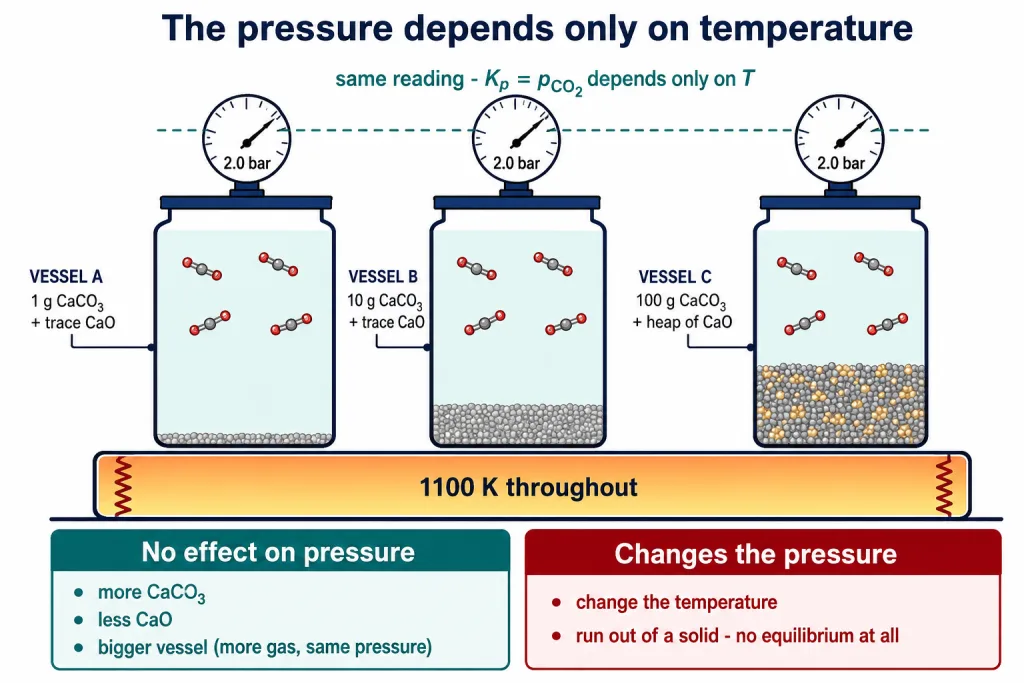
There is one condition, and it is the condition students forget. Some of every solid must actually be present at equilibrium. However small the amount, it must be there. If the vessel is so large, or the carbonate charge so small, that all of it decomposes before the pressure reaches , then there is no equilibrium at all — the final pressure is whatever the fully decomposed sample produced, and it is less than . The same happens in reverse: pump carbon dioxide onto quicklime until every last bit of has been converted, and the pressure can then be pushed above freely, because the buffering solid is gone.
[JEE Main] A favourite trap: " of is heated in a vessel at ; what is the pressure?" Before answering , check that can supply that much gas. is , which at in would exert if it all decomposed. That comfortably exceeds , so solid survives and the answer is . Had the charge been , the maximum obtainable pressure would be and the carbonate would vanish completely.
Steam over Hot Iron, and Other Solid-Gas Exchanges
Pass steam over iron heated to redness and the metal is oxidised while hydrogen comes off:
Both solids leave the expression. Both gases stay, each raised to its coefficient:
Counting gases only, , so and both are dimensionless. The reaction is the classic laboratory demonstration of a reversible reaction: send steam over the iron and hydrogen is produced; send hydrogen over the oxide instead and steam comes back.
This is the general pattern of a large family — a solid reacts with a gas to give another solid and another gas. The two solids vanish from the expression and what is left is a ratio of the two gases.
This is a step in the blast furnace, and at . The constant is a bare pressure ratio, so it is dimensionless, and its small value says that carbon monoxide is the more abundant gas in the equilibrium mixture.
Carbon dioxide passed over red-hot coke gives carbon monoxide. Here , so carries units of pressure and . Its value is at .
Solid nickel disappears from the expression even though it is the species being purified. Here .
Two metals, both pure solids, both omitted. The two ions are dissolved, so both stay, and the silver ion term is squared.
[JEE/NEET] Write the full expression first, coefficients and all, then strike out the and terms. Striking them out before writing the powers is how a stoichiometric exponent goes missing on a gaseous term.
One Solid Decomposing into Gases Only
A different shape of problem arises when a single solid decomposes and every product is a gas. Ammonium chloride sublimes with dissociation:
The solid is the only reactant and it is omitted, so is a bare product of pressures with units of .
The useful feature is that the two gases are produced in a fixed ratio from nothing else. Starting with pure solid in an evacuated vessel, every molecule is accompanied by one molecule, so the two partial pressures are equal. If the total pressure at equilibrium is ,
Ammonium hydrogen sulphide behaves the same way:
Ammonium carbamate splits three ways instead of two:
Three moles of gas come out of the solid, two of them ammonia. The mole fractions in the gas phase are therefore and , fixed by the equation and independent of how far the decomposition has gone:
Key Point: When a single pure solid decomposes into gases and nothing else is added, the partial pressures are in the ratio of the stoichiometric coefficients. Each partial pressure is that mole fraction times the total pressure , and comes out as a pure number times a power of .
The reasoning breaks the moment extra gas is introduced from outside. Add ammonia to the ammonium chloride vessel and the two pressures are no longer equal, so no longer holds — but still does, and the ammonia added suppresses the dissociation. That is the common ion effect, in gas-phase clothing.
[JEE Main] Note which relation is being quoted. for the two-gas case and for the carbamate case are derived results that assume a pure solid starting in a vacuum. The defining expression, the product of partial pressures, is always true.
Water, and the Two Traps Around It
Water is where the omission rule is most often applied wrongly, because water appears in equilibria in three different roles.
Water as a pure liquid, or as the solvent — omitted. In the hydrolysis of an ester in dilute aqueous solution,
Water is present in enormous excess as the solvent at , and the tiny fraction consumed by the reaction leaves that figure unchanged. It behaves as a constant and is folded into . Every ionisation constant in the second half of this chapter — , , — is built on exactly this omission.
Water as a gas — never omitted. In the water gas shift reaction,
steam is a gas like any other. Its partial pressure varies with the extent of reaction and it belongs in the expression. The same holds in and in every hydrate decomposition.
Key Point: as a pure liquid or as the solvent is left out. is a gas and is always kept. The state symbol decides, not the formula.
A dissolved species is never omitted, whatever it is. The reaction of silver oxide with nitric acid runs in solution:
Solid silver oxide goes, liquid water goes, and the two aqueous species stay with their coefficients as powers. A student who reasons "silver nitrate is a salt, so it must be solid" has misread the state symbol; dissolved salts are , and always counts.
Three points that follow from all of this:
- A solid dissolved in a solvent is not a pure solid. varies and appears; is constant and does not.
- A liquid that is one component of a liquid mixture is not a pure liquid. The omission rule needs the liquid to be essentially pure, which for a solvent in dilute solution is close enough.
- Omitting a species from the expression does not mean it takes no part. The carbonate is doing all the work in the limestone equilibrium; it simply carries no variable concentration to report.
The Expressions Side by Side
Every row below has the solids and pure liquids struck out. Compare each expression against its equation and check what is missing.
| Balanced equation | (gases only) | ||
|---|---|---|---|
| not defined | no gases | ||
| not defined | no gases |
Two habits are worth reading off the table. First, whenever the constant is dimensionless and numerically. Second, an equilibrium with no gaseous species at all has no — pressure is not the variable such a system runs on.
Question 1: Expressions for steam over iron
Write and for and state the relation between them.
Answer:
First I write every species in, with its coefficient as a power. Then I remove the two solids, and , because their concentrations are fixed and are absorbed into the constant.
Now I count gaseous moles: on the product side and on the reactant side, so .
Ans: , , and , both dimensionless. Watch out: The exponent belongs to both gases. Dropping it on the steam term because the solids were struck out first is the commonest slip here.
Question 2: The reason, not the rule
Explain why pure liquids and solids can be ignored while writing an equilibrium constant expression.
Answer:
The molar concentration of a pure solid or pure liquid is its number of moles divided by its own volume, which equals its density divided by its molar mass:
Density and molar mass are both properties of the substance. Taking more of the solid raises and in the same proportion, so the ratio is unchanged. The concentration therefore stays constant while the reaction proceeds and cannot influence the position of equilibrium. Being constant, it is multiplied into the equilibrium constant, producing a new constant with the solid and liquid terms already inside it.
Ans: Their molar concentration is fixed at , independent of the amount present, so it is a constant and is merged into ; equivalently, the activity of a pure solid or pure liquid is .
Question 3: Kp and Kc for limestone
At the pressure of in equilibrium with and is . Find and . Take .
Answer:
Only the gas appears, so . Measured against the standard pressure ,
With units this is . For I use with , counting only the gas:
Ans: (that is, ); . Watch out: is , not . Counting the two solids as though they contributed to gives the wrong power of .
Question 4: Does more solid raise the pressure
A sealed vessel at contains , and at equilibrium. A further of is added. What happens to the pressure of ?
Answer:
The equilibrium constant is , and depends only on temperature. The temperature has not changed, so cannot change. Adding solid gives the system more surface area, so equilibrium is regained faster, but the amount of a pure solid never appears in the expression and so has no say in where equilibrium sits.
Ans: No change; the pressure stays at .
Question 5: Expanding the vessel
The same equilibrium mixture, with plenty of both solids present, is transferred to a vessel of twice the volume at the same temperature. Compare the final pressure and the final number of moles of with the original values.
Answer:
Doubling the volume immediately halves the pressure of the gas, so falls below and the forward reaction runs. More carbonate decomposes and gas is released until is back to .
The final pressure is the same as before. Since and and are unchanged while has doubled, the moles of have doubled.
Ans: Pressure unchanged at ; moles of doubled. Watch out: This works only while some carbonate is left. If the charge runs out during the expansion, the pressure ends below and the system is not at equilibrium.
Question 6: Ammonium chloride from total pressure
Solid is heated in an evacuated vessel and dissociates as . The total pressure at equilibrium is . Calculate .
Answer:
The solid is omitted, so .
Both gases come only from the solid, and the equation makes them in a ratio, so their partial pressures are equal. Each is half the total:
Ans: . Watch out: Using the total pressure for each gas gives . Half the total goes to each.
Question 7: Ammonium carbamate
Ammonium carbamate decomposes as . Starting from the pure solid in a vacuum, the total equilibrium pressure is . Find , and obtain the general relation between and the total pressure .
Answer:
Three moles of gas leave the solid for every mole that decomposes, two of them ammonia. The mole fractions are therefore ammonia and carbon dioxide, whatever the extent of decomposition.
Putting :
Ans: ; at , . Watch out: Forgetting to square the in gives and an answer of .
Question 8: Carbon dioxide over hot coke
for is at . Initially , , and pure graphite is present. Calculate the equilibrium partial pressures.
Answer:
Graphite is a pure solid and is left out. Let be the fall in the pressure of . Every mole of that reacts makes two of , so rises by .
At equilibrium: bar, bar.
I reject the negative root. So and .
Checking: , close enough to after rounding.
Ans: , . Watch out: Putting graphite into the denominator, or writing instead of , both wreck the quadratic.
Question 9: Iron(II) oxide reduced by carbon monoxide
For , at . A vessel is charged with and . Find the equilibrium partial pressures.
Answer:
Both solids are omitted, leaving . First I check the direction:
, so the reaction runs backwards. Carbon dioxide is consumed and carbon monoxide is made. Let be the fall in ; then rises by .
Ans: , . Watch out: Assuming the forward direction without testing against gives a negative and a pair of impossible pressures.
Question 10: Which water counts
Write for each and say in one phrase why water is treated as it is.
(a)
(b)
Answer:
In (a) water is a gas, so its partial pressure and concentration both vary with the extent of reaction. It stays in.
In (b) water is a pure liquid, at a fixed , and silver oxide is a pure solid. Both go. The two aqueous species remain, each raised to its coefficient.
Ans: (a) water kept, because is a gas; (b) water and dropped, because both are pure phases. Watch out: is dissolved, not solid. Dropping it because it is a salt loses the whole numerator.
Question 11: Pressure change and heterogeneous equilibria
Does the number of moles of product increase, decrease or stay the same when each equilibrium is subjected to a decrease in pressure produced by increasing the volume?
(a)
(b)
Answer:
Only gaseous moles matter, because only gases respond to a volume change.
In (a) there is mole of gas on the left and none on the right. Lowering the pressure shifts the system towards the side with more gas, which is the reactant side. Carbonate decomposes, so the moles of product fall.
In (b) there are moles of gas on each side, so . Neither side is favoured and nothing shifts.
Ans: (a) decreases; (b) stays the same. Watch out: Counting the solids into the mole balance makes (b) look as though it has moles on the left and on the right, and produces the wrong prediction.
Question 12: When the solid runs out
of is sealed in an evacuated vessel and heated to , where . What is the final pressure of ?
Answer:
I first find the largest pressure this sample could produce if all of it decomposed. of is , giving of .
That is below , so the carbonate is entirely used up before the equilibrium pressure can be reached. No solid carbonate survives, so no equilibrium is established and does not apply.
Ans: , with all the carbonate decomposed and no equilibrium set up. Watch out: Quoting automatically is the error being tested. The rule "pressure depends only on temperature" holds only while some of each solid is still present.
What Goes Wrong
- Solids left in the expression. is not wrong so much as unfinished; the constant terms have to be absorbed, leaving .
- Solids counted in . For , , not and not .
- Vapour treated as a liquid. is kept, always. Only goes.
- Aqueous species dropped. concentrations vary and always appear, including those of dissolved salts.
- Powers lost. Removing the solids does not remove the coefficients of the surviving species; still contributes a fourth power.
- "More solid, more product." The amount of a pure solid changes the rate, never the equilibrium position.
- Forgetting that the solid must be present. If a solid is completely consumed the equilibrium no longer exists, and the constant stops describing the system.
Key Point: Read the state symbols, write the full expression with all the coefficients, then delete every and every pure . Whatever remains, gases and aqueous species with their stoichiometric powers, is the equilibrium constant.