JEE Corner — Simultaneous Equilibria, Degree of Dissociation and Advanced Ionic Equilibrium
Reading Dissociation off a Density Measurement
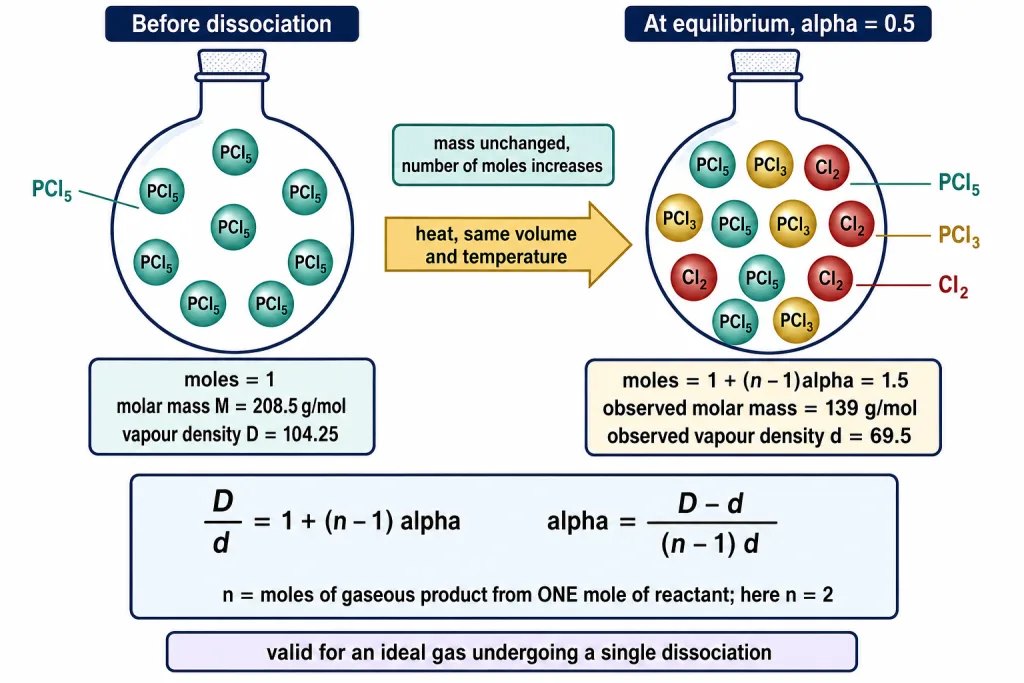
A gas that dissociates in a closed vessel keeps its mass and gains molecules. Two moles of NO2 weigh exactly what the one mole of N2O4 they came from weighed, but they occupy twice the volume at the same temperature and pressure. Anything that measures mass per mole therefore falls as dissociation proceeds, and measuring how far it has fallen measures the degree of dissociation.
Key Point (Definition): The degree of dissociationα is the fraction of the reactant originally taken that has dissociated when equilibrium is reached. It runs from 0 to 1; multiplied by 100 it is the percentage dissociation.
The quantity actually measured in the laboratory is the vapour density.
Key Point (Definition): The vapour density of a gas is the mass of a given volume of that gas divided by the mass of the same volume of hydrogen, both measured at the same temperature and pressure. For an ideal gas this equals M/2, where M is the molar mass in gmol−1.
Two symbols are used throughout, and mixing them up is the commonest error in the topic. D is the theoretical vapour density, calculated from the formula of the undissociated substance. d is the observed vapour density, measured on the equilibrium mixture. Dissociation makes d smaller than D.
The derivation
Write the dissociation so that one mole of reactant appears on the left, and let it produce n moles of gaseous product in total:
A(g)⇌nB(g)
Step 1. Start with 1 mol of A and let a fraction α of it dissociate. At equilibrium there is (1−α) mol of A left and nα mol of product formed.
Step 2. Add the moles present at equilibrium:
ntotal=(1−α)+nα=1+(n−1)α
Step 3. Mass is conserved. The mass of the sample equals moles multiplied by molar mass, both before and after:
1×Mtheoretical=[1+(n−1)α]×Mobserved
Step 4. Divide, and replace each molar mass by twice its vapour density, since the factor 2 cancels:
The ratio D/d is the gas-phase counterpart of the van't Hoff factor: it is the number of particles now present for every particle originally taken, i=1+(n−1)α.
What n actually counts
n is the number of moles of gaseous product formed from one mole of the reactant. The equation must be rewritten with a coefficient of 1 on the reactant before n is read off, even if fractions appear on the right.
Dissociation, written per mole of reactant
n
α in terms of D and d
PCl5(g)⇌PCl3(g)+Cl2(g)
2
(D−d)/d
N2O4(g)⇌2NO2(g)
2
(D−d)/d
NH4Cl(g)⇌NH3(g)+HCl(g)
2
(D−d)/d
NH3(g)⇌21N2(g)+23H2(g)
2
(D−d)/d
SO3(g)⇌SO2(g)+21O2(g)
1.5
2(D−d)/d
N2O5(g)⇌2NO2(g)+21O2(g)
2.5
(D−d)/1.5d
For the first four the formula collapses to the memorable α=(D−d)/d, which is why so many students apply it everywhere. It is only correct when n=2.
The pressure version of the same result
Nothing in the derivation depends on density as such — only on the mole number changing at constant mass. If the pure reactant would exert a pressure p0 in the vessel at that temperature, and the equilibrium mixture exerts P, then at constant volume and temperature pressure is proportional to moles:
p0P=1+(n−1)α
An observed total pressure and a calculated undissociated pressure give α exactly as a pair of densities do.
The conditions attached to the formula
Every step above used an assumption, and each one is a place where a question can be set.
Ideal gas behaviour.D=M/2 and P∝n both come from pV=nRT. Near condensation, or at high pressure, the relation drifts.
One dissociation only. If the product dissociates further, or two reactions run at once, the single n in the formula no longer describes the mixture.
The sample must be entirely in the gas phase. A solid or liquid residue holds back mass that the calculation assumes is in the vapour.
D must come from the formula mass of the undissociated species, and d must be measured at the same temperature and pressure.
The vapour must not associate. If d comes out greater than D, molecules are combining rather than splitting — acetic acid vapour dimerising through hydrogen bonds is the standard case — and a different relation applies. The sign of D−d tells which process is happening before any arithmetic is done.
Reading α back out of a measurement
Four different measurements all lead to the same α, and a question may supply any one of them.
Measurement given
Relation used
Theoretical and observed vapour density
α=(n−1)dD−d
Theoretical and observed molar mass
α=(n−1)MobsMth−Mobs
Undissociated and observed pressure, constant V and T
α=(n−1)p0P−p0
Initial and final total moles, constant V and T
α=(n−1)ninitialnfinal−ninitial
All four are the single statement 1+(n−1)α = (particles now)/(particles taken), read through whichever property was measured. They differ in two places, not one. First the numerator: density and molar mass fall on dissociation while pressure and mole number rise, so the subtraction is written the other way round in the lower two rows. Second the denominator: it is always whichever quantity sits below the line in that ratio, which is the observed density or molar mass in the upper two rows but the initial pressure or mole number in the lower two.
[JEE Main] A question that gives a vapour density and asks for Kp is really two questions joined: get α from the densities, then feed α into the Kp expression of the next block.
Kp in Terms of α and Total Pressure
Once α is known, the equilibrium constant follows without ever converting to concentrations. The route is always the same: moles at equilibrium, then mole fractions, then partial pressures as mole fraction multiplied by total pressure P, then substitution.
Case 1: A(g)⇌2B(g)
This covers N2O4⇌2NO2, Cl2⇌2Cl and I2⇌2I — every case in which one mole of reactant splits into two moles of the same product. PCl5 does not belong here: its two products are different species, and it follows Case 2 below.
Step 1. Start with 1 mol of A; at equilibrium, A=1−α, B=2α, total =1+α.
Step 2. Mole fractions are each species divided by the total:
xA=1+α1−αxB=1+α2α
Step 3. Partial pressure is mole fraction multiplied by the total pressure P:
pA=1+α(1−α)PpB=1+α2αP
Step 4. Substitute into Kp=pB2/pA:
Kp=1+α(1−α)P(1+α2αP)2=(1+α)24α2P2×(1−α)P1+α
Step 5. Cancel one factor of (1+α) and one of P, and use (1+α)(1−α)=1−α2:
Kp=1−α24α2P
Step 6. Inverting for α: cross-multiplying gives Kp−Kpα2=4α2P, so
α=Kp+4PKp
Case 2: A(g)⇌B(g)+C(g)
This is the PCl5⇌PCl3+Cl2 pattern, and also NH4Cl vapour and COCl2. The total is again 1+α, but the two products each carry a coefficient of 1:
The only difference from Case 1 is the factor 4, and it comes from squaring the coefficient 2 in 2B. Dropping it is the single most common slip in this calculation.
The standard cases collected
Equilibrium
Total moles
Kp
α
Kc (volume V, 1 mol taken)
A⇌2B
1+α
1−α24α2P
Kp+4PKp
(1−α)V4α2
A⇌B+C
1+α
1−α2α2P
Kp+PKp
(1−α)Vα2
A⇌3B
1+2α
(1−α)(1+2α)227α3P2
solved numerically
(1−α)V227α3
2A⇌B+C
1 (unchanged)
4(1−α)2α2
independent of P
same as Kp
The last row is worth a moment. When the number of gaseous moles does not change, P cancels out of the expression entirely, and α is fixed by temperature alone. H2+I2⇌2HI and the dissociation of HI behave this way, which is why a vapour-density measurement on them shows nothing at all — d equals D however far the reaction has gone.
How α responds to pressure
Take Kp=4α2P/(1−α2) and hold the temperature fixed, so Kp is a constant. Raising P must be paid for by lowering α2/(1−α2), which means lowering α. Compression suppresses dissociation whenever the dissociation increases the gaseous mole number, which is exactly what Le Chatelier's principle predicts, now with a number attached.
When α is small, 1−α2≈1 and
α≈4PKp(Case 1)α≈PKp(Case 2)
so α falls off as P−1/2. Quadrupling the pressure roughly halves the degree of dissociation. That approximation needs α small — below about 0.1 it is good to a few per cent, and at α=0.5 it is useless.
Adding an inert gas at constant volume changes neither the partial pressures nor α: the extra gas raises the total pressure but every pi stays where it was. Adding an inert gas at constant total pressure forces the volume up, dilutes every reacting species, and pushes dissociation forward exactly as a genuine pressure reduction would.
[JEE Main] Recognise the pattern by counting the moles on the right of the equation written for one mole of reactant. Two moles gives the 1+α denominator; the factor 4 appears only when both moles are the same species.
Simultaneous and Coupled Equilibria
Two equilibria that share a species cannot be solved separately. The shared species has one concentration in the vessel, and both equilibrium expressions must be satisfied by that single value at the same time.
The combination rule
If a third equation is obtained by adding two others, its equilibrium constant is the product of theirs at the same temperature:
Reaction 3=Reaction 1+Reaction 2⟹K3=K1×K2
The reason is mechanical: writing the two expressions and multiplying them cancels the concentration of every species that appears as a product in one and a reactant in the other. Two consequences are used constantly.
Rearranged, this is the master equation of qualitative analysis:
[S2−]=[H+]2Ka1Ka2[H2S]
The sulphide concentration is controlled by the square of the hydrogen ion concentration. Saturating a solution with H2S holds [H2S] near 0.1M; the acidity then sets [S2−] anywhere over about six orders of magnitude. In 0.1M HCl the sulphide ion concentration is only about 1.0×10⁻¹⁹M, while in 0.1MH2S alone it is near 1.2×10⁻¹³M.
Dissolution helped by complex formation. Silver chloride dissolves in ammonia because two equilibria are added:
A net constant of 10−3 is small but workable, so ammonia dissolves silver chloride. For silver iodide, Ksp=8.3×10⁻¹⁷ gives a net constant near 1.3×10⁻⁹, and ammonia leaves it untouched. The complexing agent removes Ag+, the shared species, and the solid dissolves to replace it.
Two solids sharing a gas
The classic gas-phase case has two solids decomposing in the same vessel, each giving a different gas plus a common one:
A(s)⇌B(g)+C(g),Kp1D(s)⇌E(g)+C(g),Kp2
Let pB=x and pE=y. Every molecule of C came from one solid or the other, so pC=x+y. The two constants read
Kp1=x(x+y)Kp2=y(x+y)
Adding them gives Kp1+Kp2=(x+y)2, so
pC=Kp1+Kp2x=pCKp1y=pCKp2
Ptotal=x+y+pC=2Kp1+Kp2
The result holds only for this shape — both solids giving two gaseous moles, one of them common, and both solids still present at equilibrium. If either solid runs out, its equilibrium no longer exists and the expression fails.
What sharing does to the shared species
The shared species ends up at a higher concentration than either equilibrium alone would give, and every species that is not shared ends up lower. Solid A alone would give pC=Kp1; with D present as well, pC=Kp1+Kp2, which is larger. Since Kp1=xpC is fixed, a larger pC forces a smaller x.
Key Point: Any second source of a shared species pushes the first equilibrium backwards. The common ion effect in solution, the suppression of PCl5 dissociation by added chlorine, and the suppression of H2S release by added ammonia are one principle wearing three costumes.
The gas-phase version is worth writing out. Heating PCl5 with extra Cl2 already present changes the mole table: starting from 1 mol PCl5 and b mol Cl2, at equilibrium there are (1−α), α and (b+α) moles with a total of (1+b+α), and
Kp=(1−α)(1+b+α)α(b+α)P
Setting b=0 recovers α2P/(1−α2). For any b>0 the same Kp and P give a smaller α.
Water as the universal shared species
In every aqueous problem, H3O+ and OH− are shared between the solute's equilibrium and water's own autoionisation. The two are linked by Kw=[H3O+][OH−], which is 1.0×10⁻¹⁴ at 298 K and changes with temperature. Most of the time the solute swamps water and the coupling is ignored. When the solution is very dilute, or the acid very weak, it cannot be — which is the subject of the next block.
The Exact Treatment of a Weak Acid
The working formula [H3O+]=Kac is an approximation, and knowing when it fails is worth more marks than knowing the formula.
Where the approximation enters
For a monoprotic weak acid HA at initial concentration c, with x the amount ionised per litre:
HA+H2O⇌H3O++A−Ka=c−xx2
Replacing c−x by c gives x=Kac. The exact statement is a quadratic:
x2+Kax−Kac=0x=2−Ka+Ka2+4Kac
The negative root is discarded because a concentration cannot be negative. In terms of the degree of ionisation α=x/c, the same equation is Ostwald's dilution law without any approximation:
Ka=1−αcα2α=2c−Ka+Ka2+4Kac
and the familiar α=Ka/c is what is left when 1−α is set to 1.
The c/Ka≥400 test
The usual working rule is that the approximation is acceptable while α≤0.05, a 5% ionisation. Turning that into a test on the data:
Step 1. Accept the approximate α≈Ka/c for the purpose of the test itself.
Step 2. Impose α≤0.05, so Ka/c≤0.0025.
Step 3. Invert: c/Ka≥400.
Key Point: Compute c/Ka before anything else. If it is at least 400, use [H3O+]=Kac. If it is smaller, solve the quadratic — the approximation will overstate [H3O+].
The approximation always errs the same way. The exact x satisfies x=Ka(c−x), which is smaller than Kac, so the approximate answer is always too high and the approximate pH always too low. The size of the error:
c/Ka
Exact α
Approximate α
Error in [H3O+]
Error in pH
10000
0.00995
0.01000
+0.5%
0.002
400
0.0488
0.0500
+2.5%
0.011
100
0.0951
0.1000
+5.1%
0.022
10
0.270
0.316
+17%
0.069
1
0.618
1.000
+62%
0.21
At c/Ka=400 the pH is wrong in the second decimal place, by 0.011, which no examination cares about. At c/Ka=1 the approximation predicts complete ionisation of a weak acid, which is nonsense. The rule is a boundary between harmless and harmful, not between right and wrong.
Bringing water into the calculation
Two exact conditions govern the solution. Charge balance says the positive and negative charges must sum to zero:
[H3O+]=[A−]+[OH−]
Mass balance says all the acid taken is somewhere:
c=[HA]+[A−]
The [OH−] term is what the ordinary treatment throws away. Keeping it, and writing [A−]=Ka[HA]/[H3O+] and [OH−]=Kw/[H3O+]:
[H3O+]=[H3O+]Ka[HA]+[H3O+]Kw
Multiplying through by [H3O+] and, where ionisation is slight, putting [HA]≈c:
[H3O+]=Kac+Kw
That one extra term is all that is usually needed. Solving the two balances without any approximation gives a cubic,
[H3O+]3+Ka[H3O+]2−(Kac+Kw)[H3O+]−KaKw=0
which is beyond what is ever required, but its existence is the reason the simpler forms are called approximations.
When water matters. Compare Kac with Kw. Water contributes about 1% when Kac≈104Kw, and dominates when Kac<Kw. Two situations trigger it: an extremely weak acid such as HCN or phenol, and an extremely dilute solution of any acid. A 10−5M solution of HCN has Kac=4.9×10⁻¹⁵, smaller than Kw; ignoring water gives pH=7.15 for an acid, which cannot be right.
The strong-acid version of the same correction, for an acid of concentration Ca that ionises completely, is
[H3O+]=2Ca+Ca2+4Kw
For 10−8M HCl this returns 1.05×10⁻⁷M and pH=6.98, slightly acidic, rather than the impossible pH=8 from the naive calculation. Adding acid to water can never take the pH above the neutral value.
The temperature caveat
Kw rises with temperature because the autoionisation of water is endothermic. At 298 K it is 1.0×10⁻¹⁴, giving a neutral pH of exactly 7.00 and pH+pOH=14. At 310 K, body temperature, Kw is 2.7×10⁻¹⁴, so neutral water has pH=6.78 and pH+pOH=pKw=13.57. The water is still exactly neutral — [H3O+]=[OH−] — and its pH is not 7. Every statement in this chapter that attaches a number to neutrality carries "at 298 K" with it.
Buffer Capacity
A buffer resists pH change, but not without limit. Buffer capacity puts a number on the resistance.
Key Point (Definition): The buffer capacityβ is the number of moles of strong acid or strong base that must be added to one litre of the buffer to change its pH by one unit. Formally β=dnb/d(pH), where nb is moles of strong base added per litre. It is always positive, since adding base raises the pH and adding acid lowers it.
The expression and where its maximum lies
For a buffer made from a weak acid and its conjugate base with total concentration C=[HA]+[A−], differentiating the mass and charge balances gives
β=2.303([H3O+]+[OH−]+C(Ka+[H3O+])2Ka[H3O+])
The first two terms are water's own contribution; they are negligible between about pH 2 and pH 12 and take over outside that range, which is why a strong acid at pH 1 is itself an excellent buffer. The third term is the buffer's own.
Finding where it peaks takes one substitution. Put r=[H3O+]/Ka, so the buffer term becomes
C(1+r)2r
Step 1. Differentiate with respect to r:
drd[(1+r)2r]=(1+r)4(1+r)2−2r(1+r)=(1+r)31−r
Step 2. Set the derivative to zero: r=1.
Step 3.r=1 means [H3O+]=Ka, that is pH=pKa.
Step 4. Substituting r=1 gives the peak value C/4, so
βmax=42.303C=0.576C
Key Point: Buffer capacity is greatest when pH=pKa, where the salt-to-acid ratio is 1:1, and it is directly proportional to the total buffer concentration.
Why the 1:1 mixture is the strongest
The Henderson-Hasselbalch equation, pH=pKa+log[acid][salt], says the pH tracks the logarithm of a ratio. Adding base converts acid into salt: it subtracts from the denominator and adds the same amount to the numerator. A ratio near 1 is the least sensitive place on that logarithmic curve, because both quantities are large and the fractional change in each is small.
Numbers make it concrete. Take one litre of buffer with C=1.0M and pKa=4.76, and add 0.05 mol of NaOH.
Starting mixture
Starting pH
Final ratio
Final pH
ΔpH
β from this addition
0.50 acid, 0.50 salt
4.76
0.55/0.45
4.85
0.087
0.57
0.70 acid, 0.30 salt
4.39
0.35/0.65
4.49
0.10
0.50
0.90 acid, 0.10 salt
3.81
0.15/0.85
4.01
0.20
0.25
The lopsided buffer shifts more than twice as far for the same addition. The last column is an average capacity over the interval rather than the instantaneous β at the starting pH, and the two need not agree, because β itself changes as the base goes in. For the two lopsided mixtures β is climbing towards its peak as acid is converted, so the average comes out above the starting value — 0.50 against 0.48, and 0.25 against 0.21. The 1:1 mixture starts at the peak, so its β can only fall, and its average 0.57 sits just below the starting 0.576.
The useful range
At pH=pKa±1 the ratio is 10:1 or 1:10, and r/(1+r)2 has fallen from 0.25 to 10/121=0.083 — almost exactly one third of the maximum. Beyond that the buffer is running out of one component and the capacity collapses. The working range of a buffer is pKa±1, and an acid is chosen for a target pH by finding one whose pKa is within a unit of it.
Dilution: the trap
Diluting a buffer tenfold does not change [salt]/[acid], so the Henderson-Hasselbalch equation returns the same pH. The capacity, being proportional to C, falls to one tenth. A diluted buffer holds the same pH and defends it ten times more weakly. The pH-unchanged result also has a limit of its own: once the components fall to around 10−6M, the water terms and the neglected ±[H3O+] corrections in the mass balance matter, and the pH drifts towards 7.
Buffer capacity is also raised by having both components present in bulk rather than by any special ratio. A 0.01M acetate buffer at pH=4.76 is destroyed by 0.006 mol of acid per litre; a 1.0M buffer at the same pH absorbs a hundred times as much for the same pH shift.
Choosing the acid for a target pH
Since the capacity peaks at pH=pKa and stays usable within a unit of it, designing a buffer starts by picking a conjugate pair whose pKa brackets the required pH, and only then adjusting the ratio.
Buffer pair
pKa at 298 K
Best working range
HCOOH/HCOO−
3.74
2.74−4.74
CH3COOH/CH3COO−
4.76
3.76−5.76
H2CO3/HCO3−
6.35
5.35−7.35
H2PO4−/HPO42−
7.21
6.21−8.21
NH4+/NH3
9.25
8.25−10.25
HCO3−/CO32−
10.33
9.3−11.3
A basic buffer is handled with the same table by converting: an ammonia buffer has pKb=4.75 for the base, and the pKa of its conjugate acid NH4+ is 14−4.75=9.25 at 298 K. Blood is held near pH7.4 by the carbonic acid pair even though pKa is 6.35, a full unit away, because the lungs and kidneys continuously restock both components — a working reminder that the ±1 rule describes a closed beaker, not an open system.
[JEE Main] Questions phrase this as "which buffer resists change best". Rank first by how close the pH is to pKa, then by total concentration. Both matter, and a highly concentrated buffer two pH units from its pKa can still lose to a dilute one sitting exactly on it.
Titration Curves and the Choice of Indicator
A titration curve plots the pH of the flask against the volume of titrant added. Its shape is fixed by which of the two reagents is strong and which is weak, and the shape decides which indicator can be used.
Strong acid against strong base
Take 25.0mL of 0.10M HCl titrated with 0.10M NaOH. The pH is set entirely by whichever reagent is in excess, since neither ion of the salt formed reacts with water.
NaOH added / mL
Species in excess
pH
0.0
0.10MH3O+
1.00
24.0
H3O+, 2.0×10⁻³M
2.69
24.9
H3O+, 2.0×10⁻⁴M
3.70
25.0
neither; NaCl solution
7.00
25.1
OH−, 2.0×10⁻⁴M
10.30
50.0
OH−, 3.3×10⁻²M
12.52
Between 24.9 and 25.1mL — about four drops — the pH climbs from 3.70 to 10.30. The equivalence pH is 7.00at 298 K, because Na+ and Cl− are the ions of a strong base and a strong acid and neither hydrolyses. At another temperature the neutral pH is not 7 and neither is the equivalence point.
Weak acid against strong base
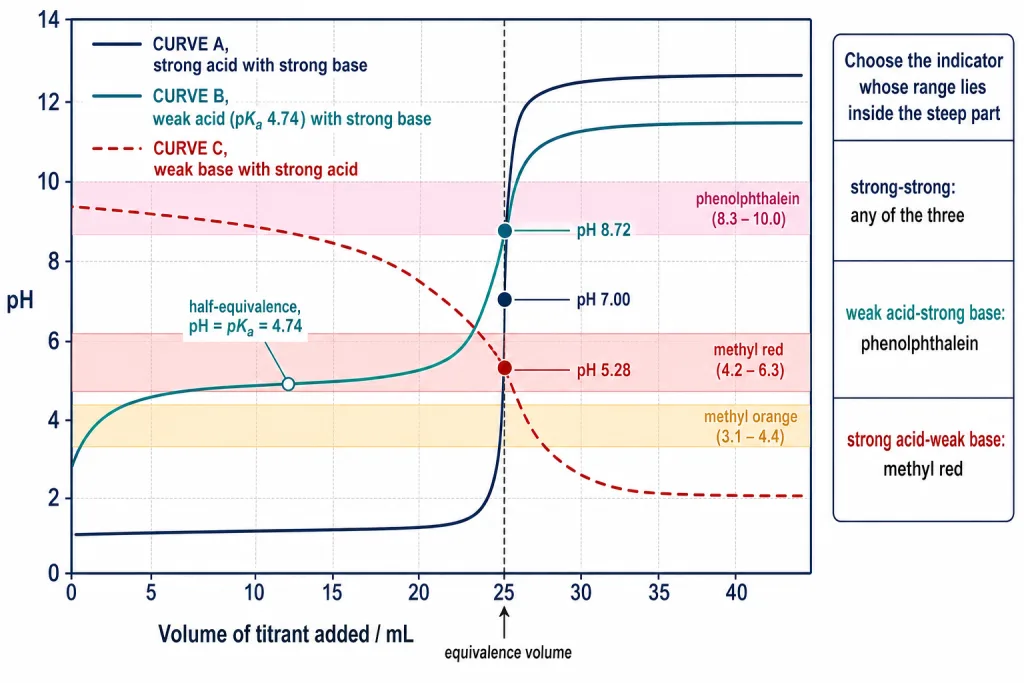
Take 25.0mL of 0.10MCH3COOH (Ka=1.74×10⁻⁵, pKa=4.76) with 0.10M NaOH. Four regions follow one another.
Before any base. A weak acid on its own: [H3O+]=Kac=1.32×10⁻³, pH=2.88. The curve starts far higher than the strong acid's 1.00.
The buffer region. Between the first drop and the equivalence point the flask holds acid and its conjugate base together, and the pH follows the Henderson-Hasselbalch equation. The curve is at its flattest here.
The half-equivalence point, at 12.5mL. Exactly half the acid has been converted, so [salt]=[acid], the logarithm vanishes and pH=pKa=4.76. This is the standard experimental route to pKa — no concentrations need to be known, only the volume at which half the equivalence volume has been delivered.
The equivalence point, at 25.0mL. Every acid molecule has become acetate, at 0.05M in the doubled volume. Acetate is a Bronsted base with Kb=Kw/Ka=5.7×10−10, so [OH−]=Kbc=5.34×10⁻⁶ and pH=8.73. The equivalence pH is above 7 and it is not the point where pH equals 7.
Measured over the same 24.9 to 25.1mL window used for the strong acid, the jump runs from 7.1 to 10.3 — shorter than for the strong-strong case and displaced upwards.
Strong acid against weak base
Take 25.0mL of 0.10MNH3 (Kb=1.77×10⁻⁵, pKb=4.75) with 0.10M HCl. The mirror image: the curve starts at pH=11.12, the half-equivalence point has pOH=pKb so pH=9.25, and at equivalence the flask holds 0.05MNH4+, an acid with Ka=Kw/Kb=5.6×10−10. Then [H3O+]=5.29×10⁻⁶ and pH=5.28, below 7. Over the same 24.9 to 25.1mL window the jump runs down from 6.9 to 3.7.
Titration
pH at start
pH at half-equivalence
pH at equivalence (298 K)
Jump from 24.9 to 25.1mL
Strong acid, strong base
1.00
no special value
7.00
3.7 to 10.3
Weak acid, strong base
2.88
pKa=4.76
above 7, 8.73
7.1 to 10.3
Strong acid, weak base
11.12
14−pKb=9.25
below 7, 5.28
6.9 to 3.7
Weak acid, weak base
intermediate
—
near 7 if Ka≈Kb
no sharp jump
The weak-weak titration has no usable indicator end point at all, because there is no steep region for a colour change to sit in; conductometric titration is used instead.
How an indicator works
An acid-base indicator is itself a weak acid whose two forms differ in colour:
The eye stops seeing one colour when the other form reaches roughly a tenth of it, so the visible transition spans the ratios 1:10 to 10:1, that is pKIn±1. Only a very small amount of indicator is added, so it does not consume a measurable quantity of the titrant.
Indicator
pH range
Colour in acid
Colour in base
pKIn
Thymol blue (first change)
1.2−2.8
red
yellow
≈1.7
Methyl orange
3.1−4.4
red
yellow
≈3.7
Bromophenol blue
3.0−4.6
yellow
blue
≈4.0
Methyl red
4.2−6.3
red
yellow
≈5.1
Bromothymol blue
6.0−7.6
yellow
blue
≈7.0
Phenol red
6.8−8.4
yellow
red
≈7.9
Phenolphthalein
8.3−10.0
colourless
pink
≈9.1
Thymolphthalein
9.3−10.5
colourless
blue
≈9.9
Alizarin yellow R
10.1−12.0
yellow
red
≈11.0
Key Point: Choose an indicator whose transition range lies wholly inside the steep part of the curve, so that the colour changes within one drop of the equivalence point. It is the position of the range, not a match with pH 7, that decides.
Applying that rule to the three cases: strong against strong takes methyl red or phenolphthalein outright, both ranges lying wholly inside 3.7 to 10.3, and methyl orange serves in practice as well — its range opens at 3.1, a shade below the foot of the jump, but its change to yellow is complete by 4.4, comfortably inside the steep region. Weak acid against strong base needs phenolphthalein or thymolphthalein; methyl orange would have finished its change to yellow by about 8mL, less than a third of the way to the equivalence point. Strong acid against weak base needs methyl red or methyl orange; phenolphthalein would lose its pink long before the equivalence point and report far too little acid.
Selective Precipitation
When one reagent can precipitate two or more ions in the same solution, the ion whose salt needs the smallest concentration of the added ion comes down first. Adding the reagent slowly separates them.
Setting the threshold
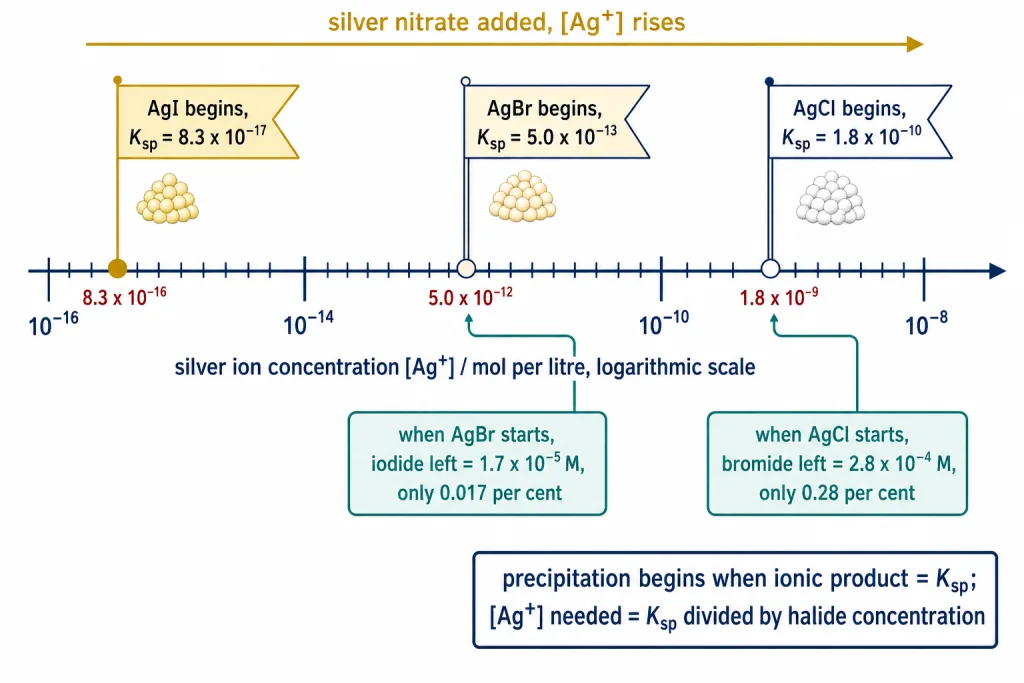
Precipitation begins the instant the ionic product reaches Ksp. For a 1:1 salt AgX in a solution already containing X−,
[Ag+]start=[X−]Ksp(AgX)
Below this the solution is unsaturated and nothing appears; at it the solution is exactly saturated; above it solid separates until the product falls back to Ksp.
Take a litre holding 0.10M each of Cl−, Br− and I−, with silver nitrate solution added drop by drop.
Salt
Ksp at 298 K
[Ag+] needed with the halide at 0.10M
Order
AgI
8.3×10⁻¹⁷
8.3×10⁻¹⁶M
first
AgBr
5.0×10⁻¹³
5.0×10⁻¹²M
second
AgCl
1.8×10⁻¹⁰
1.8×10⁻⁹M
third
How clean the separation is
The useful question is not which comes first but how much of the first ion is still in solution when the second starts. Silver bromide begins when [Ag+]=5.0×10⁻¹²M. At that instant the iodide left over is fixed by the silver iodide equilibrium:
That is 0.017% of the original 0.10M: over 99.98% of the iodide is already in the precipitate before any bromide is touched. Repeating the calculation at the moment silver chloride starts, [Ag+]=1.8×10⁻⁹M leaves [Br−]=2.8×10⁻⁴M, or 0.28% of the bromide.
Key Point: For two salts of the same formula type sharing a common ion, the separation is essentially complete when their solubility products differ by a factor of about 103 or more. A smaller gap leaves the two precipitating together over much of the addition.
The comparison that must be made with care
Ranking salts by Ksp alone works only when they are of the same formula type. Silver chromate has Ksp=1.1×10⁻¹², smaller than silver chloride's 1.8×10⁻¹⁰, yet it is the more soluble salt: s(Ag2CrO4)=(Ksp/4)1/3=6.5×10−5M against s(AgCl)=Ksp=1.3×10⁻⁵M. The chromate releases two silver ions per formula unit and its Ksp carries a squared term, so the numbers are not on the same footing.
The safe procedure is always to compute the concentration of the added ion at which each salt starts. With [Cl−]=[CrO42−]=0.10M:
Silver chloride needs a thousand times less silver, so all the chloride precipitates before the first red speck of silver chromate appears. That is exactly the basis of Mohr's method, in which chromate is the indicator for a chloride titration.
Controlling an ion instead of adding it
Sulphide separations do not add sulphide directly; they control it through acidity, using the coupled equilibrium of the earlier block:
[S2−]=[H+]2Ka1Ka2[H2S]
In a solution saturated with H2S and made 0.1M in HCl, [S2−] sits near 1.0×10⁻¹⁹M. With a metal ion at around 10−2M the ionic product is near 10−21, which exceeds Ksp for CuS (8×10−37), CdS (8×10⁻²⁷) and ZnS (1.6×10⁻²⁴) but not for FeS (6.3×10⁻¹⁸) or MnS (2.5×10⁻¹³). Raising the acid to 0.3M divides [S2−] by nine, to about 1.1×10⁻²⁰M, which pulls the ionic product down to about 10−22 — still above Ksp for ZnS, so zinc does not return to solution on these numbers. What the extra acid buys is margin: it pushes the borderline sulphides closer to their saturation point while leaving the very insoluble ones untouched. Setting the sulphide groups of qualitative analysis apart is done the same way, by choosing the acidity rather than by adding sulphide, and the zinc group is held back not by more acid but by precipitating it separately from an alkaline medium, where [S2−] is orders of magnitude higher. The same hydroxide-based logic separates Fe3+ from Mg2+: a buffered pH near 5 precipitates Fe(OH)3 (Ksp=1.0×10−38) completely while leaving Mg(OH)2 (Ksp=8.9×10⁻¹²) untouched.
[JEE/NEET] Every one of these problems reduces to a single sentence: compute the ionic product with the concentrations actually present after mixing, and compare it with Ksp. Dilution on mixing is the step most often skipped.
Question 1: Degree of dissociation of PCl5 from vapour density
The vapour density of phosphorus pentachloride at 523K and a total pressure of 2.0bar is found to be 69.5. Calculate the degree of dissociation, Kp and Kc for PCl5(g)⇌PCl3(g)+Cl2(g). Take P=31, Cl=35.5 and R=0.0831LbarK−1mol−1.
Answer:
First I find the theoretical vapour density from the formula. The molar mass of PCl5 is 31+5(35.5)=208.5gmol−1, so D=208.5/2=104.25.
One mole of PCl5 gives one mole of PCl3 and one of Cl2, so n=2 and n−1=1.
α=(n−1)dD−d=1×69.5104.25−69.5=69.534.75=0.50
Half the pentachloride has dissociated. For Kp I use the A⇌B+C result with P=2.0bar:
Ans:α=0.50 (50% dissociated), Kp=0.67bar, Kc=1.5×10⁻²molL−1Watch out:D is the vapour density, 104.25, not the molar mass 208.5. Using 208.5 in place of D returns α=2.0, which is impossible since α cannot exceed 1 — a useful check on the arithmetic.
Question 2: N2O4 from an observed molar mass
The observed molar mass of an equilibrium mixture of N2O4 and NO2 at 1.0bar is 80.0gmol−1. Find the degree of dissociation of N2O4 and Kp at this temperature. Take N=14, O=16.
Answer:
The theoretical molar mass of N2O4 is 2(14)+4(16)=92.0gmol−1.
The reaction N2O4(g)⇌2NO2(g) gives two moles of gas from one, so n=2.
Ans:α=0.15 (15% dissociated), Kp=0.092barWatch out: The factor 4 comes from squaring the coefficient 2 in 2NO2. Leaving it out gives 0.023bar, exactly a quarter of the right value, and it is the commonest error in the whole topic.
Question 3: Ammonium chloride vapour
The vapour above solid ammonium chloride heated to 673K has an observed vapour density of 14.5. Assuming the vapour is entirely NH3, HCl and undissociated NH4Cl, find the percentage dissociation. Take N=14, H=1, Cl=35.5.
Answer:
The formula mass of NH4Cl is 14+4+35.5=53.5gmol−1, so the theoretical vapour density is D=53.5/2=26.75.
The dissociation NH4Cl(g)⇌NH3(g)+HCl(g) produces two moles from one, so n=2.
α=(n−1)dD−d=14.526.75−14.5=14.512.25=0.845
Multiplying by 100 gives the percentage.
The observed molar mass is 2×14.5=29.0gmol−1, which is close to that of air. A vapour that appears to weigh about as much as air, from a compound of formula mass 53.5, signals extensive dissociation before any calculation is done.
Ans:84.5% dissociated
Watch out: The measured density falling below the formula value is what defines dissociation here. If a measured d ever comes out aboveD, the vapour is associating, not dissociating, and this formula does not apply.
Question 4: How the degree of dissociation follows the pressure
For N2O4(g)⇌2NO2(g), Kp=0.15bar at a certain temperature. Calculate the degree of dissociation at a total pressure of 1.0bar and at 10.0bar, and comment on the ratio.
Answer:
I start from Kp=4α2P/(1−α2) and make α the subject. Cross-multiplying, Kp(1−α2)=4α2P, so Kp=α2(Kp+4P) and
α=Kp+4PKp
At P=1.0bar:
α=0.15+4.00.15=4.150.15=0.0361=0.19
At P=10.0bar:
α=0.15+40.00.15=40.150.15=0.00374=0.061
Ten times the pressure gives about one third the dissociation. Since α is small in both cases, Kp≈4α2P, so α varies as P−1/2 and the predicted ratio is 10=3.16. The computed ratio is 0.19/0.061=3.11, close because the α2 correction in the denominator is tiny at these values.
Compression forces the equilibrium towards the side with fewer gaseous moles, which is the undissociated N2O4, so α falls. Kp itself does not move; only temperature changes it.
Ans:α=0.19 at 1.0bar and α=0.061 at 10.0barWatch out: A falling α is not a falling Kp. Pressure redistributes the mixture at constant Kp; only a temperature change alters the constant.
Question 5: Dissociation suppressed by a product already present
One mole of PCl5 is heated with one mole of Cl2 in a vessel until equilibrium is reached at a total pressure of 2.0bar, at the temperature where Kp=2/3bar. Find the degree of dissociation of PCl5 and compare it with the value obtained when no chlorine is added.
Answer:
I build the mole table first. Starting from 1 mol PCl5 and 1 mol Cl2, with α mol of the pentachloride dissociating:
PCl5=1−αPCl3=αCl2=1+αtotal=2+α
The chlorine already present adds to the chlorine produced, which is why its count is 1+α and the total is 2+α rather than 1+α.
Each partial pressure is the mole fraction multiplied by P=2.0bar:
Kp=pPCl5pPCl3pCl2=(1−α)(2+α)α(1+α)P
Substituting Kp=2/3 and P=2:
32=(1−α)(2+α)2α(1+α)⟹(1−α)(2+α)=3α(1+α)
Expanding both sides, 2−α−α2=3α+3α2, which rearranges to
4α2+4α−2=0⟹2α2+2α−1=0
α=4−2+4+8=4−2+3.464=0.366
Without added chlorine the same Kp and P give α=Kp/(Kp+P)=0.667/2.667=0.50.
Ans:α=0.366 with the added chlorine, against 0.50 without it
Watch out: The chlorine changes both the numerator and the total mole count, so the 1+α denominator of the simple case becomes 2+α. Using the plain α2P/(1−α2) formula here quietly assumes there is no added chlorine at all.
Question 6: Two solids releasing a common gas
Solid NH4HS and solid NH4Cl are both placed in an evacuated vessel and allowed to reach equilibrium at a temperature where
Both solids remain in excess. Find the partial pressure of each gas and the total pressure, and compare with the pressures each solid would give on its own.
Answer:
Ammonia is shared, so there is only one pNH3 in the vessel and it must satisfy both expressions.
I let pH2S=x and pHCl=y. Every ammonia molecule came from one solid or the other, one for each molecule of the partner gas, so
Alone, NH4HS would give pNH3=pH2S=0.090=0.30bar, and NH4Cl alone would give 0.40bar of each gas. Together, the shared ammonia rises to 0.50bar while hydrogen sulphide is pushed down from 0.30 to 0.18bar and hydrogen chloride from 0.40 to 0.32bar.
Ans:pNH3=0.50bar, pH2S=0.18bar, pHCl=0.32bar, Ptotal=1.00barWatch out: The two equilibria cannot be solved one at a time. Treating them separately and adding the four pressures gives 1.40bar, which satisfies neither constant.
Question 7: Sulphide concentration controlled by acid
A solution 0.1M in HCl and saturated with H2S contains sulphide ion at 1.0×10⁻¹⁹M. Ten millilitres of this solution is added to 5mL of 0.04M solutions of FeSO4, MnCl2, ZnCl2 and CdCl2 in turn. In which will a sulphide precipitate? Take Ksp as 6.3×10⁻¹⁸ (FeS), 2.5×10⁻¹³ (MnS), 1.6×10⁻²⁴ (ZnS) and 8.0×10⁻²⁷ (CdS).
Answer:
Mixing dilutes both solutions, and the dilution must be done before any comparison. The total volume is 10+5=15mL.
[S2−]=1.0×10−19×1510=6.7×10⁻²⁰M
[M2+]=0.04×155=1.3×10⁻²M
The ionic product is the same for all four, because every one of these salts is MS and each solution has the same metal ion concentration:
Qsp=[M2+][S2−]=(1.3×10⁻²)(6.7×10⁻²⁰)=8.9×10⁻²²
Now I compare this single number with each Ksp. Precipitation happens when Qsp>Ksp.
Salt
Ksp
Qsp against Ksp
Result
FeS
6.3×10⁻¹⁸
Qsp smaller
no precipitate
MnS
2.5×10⁻¹³
Qsp smaller
no precipitate
ZnS
1.6×10⁻²⁴
Qsp larger
precipitates
CdS
8.0×10⁻²⁷
Qsp larger
precipitates
Ans:ZnS and CdS precipitate; FeS and MnS do not
Watch out: Skipping the dilution multiplies the ionic product by about 4.5 — it gives (1.0×10⁻¹⁹)(0.04)=4.0×10⁻²¹ against the correct 8.9×10⁻²² — which does not change the verdict here but does in problems where a value sits close to Ksp. Raising the HCl to 0.3M would divide [S2−] by nine, since [S2−] goes as 1/[H+]2, taking the ionic product to about 9.9×10⁻²³; that is still well above Ksp(ZnS), so zinc comes down even then, and separating it from cadmium needs a different medium rather than more acid.
Question 8: When the small-x approximation must be abandoned
Calculate the degree of ionisation and the pH of 0.020M hydrofluoric acid, for which Ka=3.5×10⁻⁴, first with the usual approximation and then exactly. Comment on the difference.
Answer:
I apply the validity test before choosing a method.
Kac=3.5×10−40.020=57
This is far below 400, so the approximation is not safe here and the quadratic must be solved.
The approximate route, for comparison.[H3O+]=Kac=(3.5×10⁻⁴)(0.020)=7.0×10−6=2.65×10⁻³M, giving pH=2.58 and α=0.132.
The exact route. With x=[H3O+] at equilibrium and (c−x) left as it is:
Ka=c−xx2⟹x2+Kax−Kac=0
x2+(3.5×10⁻⁴)x−7.0×10−6=0
The discriminant is (3.5×10⁻⁴)2+4(7.0×10⁻⁶)=1.23×10⁻⁷+2.80×10−5=2.81×10⁻⁵, whose square root is 5.30×10⁻³. Taking the positive root,
x=2−3.5×10⁻⁴+5.30×10−3=2.48×10⁻³M
α=0.0202.48×10−3=0.124pH=−log(2.48×10⁻³)=2.61
The approximation overstates [H3O+] by about 7% and understates the pH by 0.03. It always errs in this direction, because replacing (c−x) by c pretends more acid is available than there is.
Ans: exact α=0.124 and pH=2.61; the approximation gives α=0.132 and pH=2.58Watch out: For 1.0×10⁻³M chloroacetic acid, Ka=1.35×10⁻³, the same approximation returns [H3O+]=1.16×10⁻³M — more hydrogen ion than the acid taken. The quadratic gives 6.75×10⁻⁴M and pH=3.17. Whenever c/Ka is near 1 the approximation does not merely lose accuracy, it produces impossible numbers.
Question 9: When water's own ionisation cannot be ignored
(a) Calculate the pH of 1.0×10⁻⁵M HCN, Ka=4.9×10⁻¹⁰. (b) Calculate the pH of 1.0×10⁻⁸M HCl. Take Kw=1.0×10⁻¹⁴ at 298 K.
Answer:
(a) I first check how much acid the solute can supply against what water supplies. The product Kac=(4.9×10⁻¹⁰)(1.0×10⁻⁵)=4.9×10⁻¹⁵, which is smaller than Kw=1.0×10⁻¹⁴. Water is the larger source, so it must be kept.
Charge balance gives [H3O+]=[CN−]+[OH−]. Substituting [CN−]=Kac/[H3O+] (the acid is barely ionised, so [HCN]≈c) and [OH−]=Kw/[H3O+], then multiplying through by [H3O+]:
Dropping the Kw term would give 4.9×10−15=7.0×10⁻⁸ and pH=7.15 — an acidic solution reported as basic.
(b) Hydrochloric acid ionises completely, so it supplies 1.0×10⁻⁸M of hydrogen ion, one hundredth of what pure water already holds. The exact result comes from the same charge balance with Ca the acid concentration:
Ans: (a) pH=6.91; (b) pH=6.98Watch out: The naive answer to (b) is pH=8, which claims that adding acid to water made it basic. Adding any acid can only push the pH below the neutral value, which is 7.00 at 298 K and different at other temperatures.
Question 10: Measuring a buffer's capacity
One litre of buffer contains 0.50mol of CH3COOH and 0.50mol of CH3COONa; Ka=1.74×10⁻⁵, so pKa=4.76. (a) Find the pH. (b) Find the pH after adding 0.050mol of solid NaOH, and the buffer capacity this implies. (c) Compare with the theoretical maximum. (d) State what happens if the same 0.050mol is added to one litre of the buffer after a tenfold dilution.
Answer:
(a) The salt and acid are equal, so the logarithmic term vanishes:
pH=pKa+log[acid][salt]=4.76+log1=4.76
(b) Hydroxide converts acid into its conjugate base mole for mole. Acid falls to 0.45mol, salt rises to 0.55mol:
β=ΔpHmoles of base added per litre=0.0870.050=0.57molL−1per pH unit
(c) The total buffer concentration is C=0.50+0.50=1.0M, and the buffer is sitting exactly at pH=pKa, so it is at its most resistant:
βmax=0.576C=0.576molL−1per pH unit
The measured 0.57 matches, the small shortfall arising because the addition is finite while βmax is defined for an infinitesimal one.
(d) After a tenfold dilution each component is 0.050M, so one litre holds 0.050mol of each. The ratio is unchanged and the pH is still 4.76, but βmax has fallen to 0.0576. Adding 0.050mol of NaOH now consumes every last mole of acetic acid, leaving a plain 0.050M sodium acetate solution at about pH=8.7. The buffer has not resisted, it has been destroyed.
Ans: (a) 4.76; (b) 4.85, β=0.57; (c) βmax=0.576, in agreement; (d) same pH, one tenth the capacity, and the addition wipes the buffer out
Watch out: Dilution leaves the pH alone and cuts the capacity in proportion. A question that dilutes a buffer and asks for the new pH is testing whether the ratio was seen to be unchanged.
Question 11: Building a weak-acid titration curve
25.0mL of 0.100MCH3COOH (Ka=1.74×10⁻⁵) is titrated with 0.100M NaOH. Find the pH after adding 0, 12.5, 24.0, 25.0 and 26.0mL of the base, and choose a suitable indicator. Work at 298 K.
Answer:
The acid taken is 25.0×0.100=2.50mmol, so the equivalence volume is 25.0mL.
At 0mL. A weak acid alone. Here c/Ka=0.100/(1.74×10−5)=5.7×103, comfortably above 400, so the approximation is safe:
[H3O+]=Kac=1.74×10−6=1.32×10⁻³MpH=2.88
At 12.5mL. Half the acid (1.25mmol) is neutralised, leaving 1.25mmol each of acid and acetate. Equal amounts in the same solution means an equal ratio:
pH=pKa=4.76
At 24.0mL. Base added =2.40mmol, so acid left =0.10mmol and acetate formed =2.40mmol. Both sit in the same volume, so their ratio is the ratio of the millimoles:
pH=4.76+log0.102.40=4.76+1.38=6.14
At 25.0mL (equivalence). All the acid has become acetate: 2.50mmol in 50.0mL, that is 0.0500M. Acetate hydrolyses as a base with
Kb=KaKw=1.74×10−51.0×10−14=5.7×10⁻¹⁰
[OH−]=Kbc=(5.7×10⁻¹⁰)(0.0500)=5.34×10⁻⁶M
pOH=5.27pH=14.00−5.27=8.73
At 26.0mL. Excess NaOH =0.10mmol in 51.0mL=1.96×10⁻³M. Strong base swamps the acetate:
pOH=−log(1.96×10⁻³)=2.71pH=11.29
The steep region therefore runs from 6.14 at 24.0mL to 11.29 at 26.0mL, and within the four drops from 24.9 to 25.1mL it climbs from 7.1 to 10.3. Phenolphthalein, changing between 8.3 and 10.0, lies entirely inside it.
Ans:pH=2.88,4.76,6.14,8.73,11.29; use phenolphthalein
Watch out: The equivalence point is at pH=8.73, not 7. Methyl orange, with its range 3.1 to 4.4, would have completed its change to yellow by about 8mL — less than a third of the way to the equivalence point.
Question 12: Separating three halides with one reagent
A litre of solution is 0.10M in each of Cl−, Br− and I−. Silver nitrate solution is added drop by drop, the volume change being negligible. Give the order of precipitation, the silver ion concentration at which each salt begins, and the fraction of iodide still in solution when silver bromide starts. Take Ksp as 1.8×10⁻¹⁰ (AgCl), 5.0×10⁻¹³ (AgBr) and 8.3×10⁻¹⁷ (AgI).
Answer:
Each salt is AgX, so precipitation begins when [Ag+][X−] reaches its Ksp. With every halide at 0.10M:
[Ag+]AgI=0.108.3×10−17=8.3×10⁻¹⁶M
[Ag+]AgBr=0.105.0×10−13=5.0×10⁻¹²M
[Ag+]AgCl=0.101.8×10−10=1.8×10⁻⁹M
The smallest requirement is met first, so iodide precipitates, then bromide, then chloride.
Silver bromide starts the moment [Ag+] reaches 5.0×10⁻¹²M. At that instant the solid silver iodide already present fixes the remaining iodide:
As a fraction of the original 0.10M that is 1.7×10⁻⁴, or 0.017%. More than 99.98% of the iodide is in the precipitate before a single crystal of silver bromide appears, so the separation is effectively complete.
Repeating the step at the start of silver chloride, [Br−]=5.0×10⁻¹³/1.8×10−9=2.8×10−4M, leaving 0.28% of the bromide — a good separation, though not as clean, because the solubility products of AgBr and AgCl differ by a smaller factor than those of AgI and AgBr.
Ans: iodide first at 8.3×10⁻¹⁶M, bromide at 5.0×10⁻¹²M, chloride at 1.8×10⁻⁹M; 0.017% of the iodide remains when bromide begins
Watch out: Comparing Ksp values directly is only valid because all three salts have the same 1:1 formula. Against a salt such as Ag2CrO4, whose Ksp contains [Ag+]2, the required silver concentration must be computed before any ranking is attempted.
Ready to test your knowledge?
Take a quick interactive quiz on this topic —
free, works without login.