
The Question an Equilibrium Constant Answers
A mixture of reactants and products that has reached equilibrium is called an equilibrium mixture. Its composition stops changing, but the composition it settles at is not fixed by nature alone — it depends on how much of each substance was put into the vessel to begin with.
Take the same reversible reaction and run it three times with different starting amounts. Three different equilibrium mixtures come out. So the individual equilibrium concentrations are of no use as a fingerprint of the reaction; they change from run to run.
What chemists wanted was a combination of those concentrations that comes out the same every time, whatever the starting mixture, so long as the temperature is unchanged. Such a number would be a property of the reaction rather than of the particular experiment.
Two Norwegian chemists, Cato Maximillian Guldberg and Peter Waage, found that combination in 1864. For a general reversible reaction
they proposed that the equilibrium concentrations always satisfy
is the equilibrium constant and the right-hand side is the equilibrium constant expression. The subscript says that the expression is written in concentrations, in .
Why it is called the law of mass action
In the chemistry of the 1860s, concentration went by the name active mass. Guldberg and Waage's relation was a statement about active masses, and the name law of mass action has stuck to it ever since. The name is historical; the content is about concentration.
Key Point (Definition): The equilibrium mixture is the mixture of reactants and products present when a reversible reaction has reached equilibrium. Its individual concentrations depend on what was taken initially; the equilibrium constant built from them does not.
The square brackets
means the molar concentration of A. Inside an equilibrium constant expression, every square bracket is understood to be an equilibrium concentration, even though the subscript "eq" is almost never written. Concentrations measured at some random moment before equilibrium do not belong in a expression at all.
Phase labels , , are usually dropped inside the brackets to save clutter. They still matter — Section 5 shows that pure solids and pure liquids are left out of the expression altogether — but the labels themselves are not written in the fraction.
[JEE/NEET] Every value of carries a temperature with it. Quoting without a temperature is like quoting a density without saying of what.
The Hydrogen-Iodine Experiments
The cleanest evidence for the law comes from the reaction of dihydrogen with iodine vapour in a sealed vessel at :
Iodine vapour is purple and hydrogen iodide is colourless, so the colour of the vessel tracks the amount of iodine left. When the purple stops fading, equilibrium has arrived.
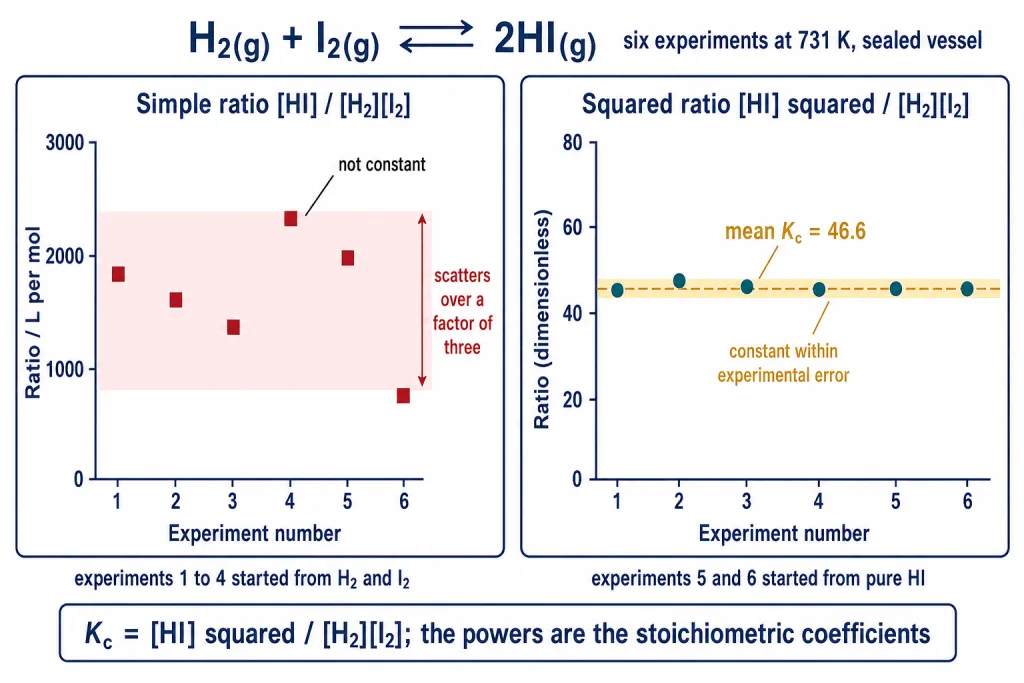
Six experiments were run at the same temperature. The first four started with dihydrogen and iodine only, in various proportions. The last two started with pure hydrogen iodide, so that equilibrium had to be reached from the opposite side.
All concentrations below are in units of .
| Expt | ||||||
|---|---|---|---|---|---|---|
| 1 | 2.40 | 1.38 | 0 | 1.14 | 0.120 | 2.52 |
| 2 | 2.40 | 1.68 | 0 | 0.920 | 0.200 | 2.96 |
| 3 | 2.44 | 1.98 | 0 | 0.770 | 0.310 | 3.34 |
| 4 | 1.20 | 1.40 | 0 | 0.208 | 0.408 | 1.98 |
| 5 | 0 | 0 | 3.04 | 0.345 | 0.345 | 2.35 |
| 6 | 0 | 0 | 7.58 | 0.860 | 0.860 | 5.86 |
Two things fall straight out of the numbers. In experiments 1 to 4, the moles of dihydrogen consumed equal the moles of iodine consumed and equal half the moles of hydrogen iodide formed — exactly what the balanced equation demands. In experiments 5 and 6, which started from pure hydrogen iodide, the two products come out equal: .
Trying the obvious combination first
The simplest combination anyone would try puts the product on top and the two reactants underneath, each to the first power:
Feeding the six equilibrium rows into it gives nothing like a constant.
| Expt | ||
|---|---|---|
| 1 | 1842 | 46.4 |
| 2 | 1609 | 47.6 |
| 3 | 1399 | 46.7 |
| 4 | 2333 | 46.2 |
| 5 | 1974 | 46.4 |
| 6 | 792 | 46.4 |
The first column wanders over a factor of three, from 792 to 2333. It is a property of the experiment, not of the reaction.
The second column, which squares the hydrogen iodide term, sits between 46.2 and 47.6 across six wildly different starting mixtures — including two that approached equilibrium from the opposite direction. The mean value is about , and the spread is no bigger than the experimental error in measuring the concentrations. The figure conventionally quoted for this equilibrium, and the one used everywhere in this chapter, is — the value returned by three of the six runs, including both of those that started from pure hydrogen iodide — so the small difference from the mean is a matter of convention, not of chemistry.
What the square was doing there
The power 2 on is not a fitting parameter that happened to work. It is the coefficient of in the balanced equation . The powers on and are 1, and those are their coefficients too.
Repeat the exercise on any other reversible reaction and the same pattern appears: the combination that stays constant is the one in which every concentration is raised to its own stoichiometric coefficient. So for this reaction
[Board] The experimental point worth remembering is that experiments 5 and 6 started from pure and still landed on the same constant. A relation that survives approach from both directions is a genuine property of the equilibrium state.
The Law of Chemical Equilibrium
Generalising the hydrogen-iodine result to any balanced reversible reaction
gives the central equation of this chapter:
Key Point (Definition): Law of Chemical Equilibrium (Equilibrium Law). At a given temperature, the product of the equilibrium concentrations of the products, each raised to its stoichiometric coefficient in the balanced equation, divided by the product of the equilibrium concentrations of the reactants, each raised to its stoichiometric coefficient, has a constant value.
Three separate claims are packed into that sentence, and each one is tested in exams.
The products go on top. Numerator for the right-hand side of the equation as written, denominator for the left-hand side. Flip the fraction and you have written the constant for the reverse reaction, which is a different number.
The powers are the coefficients. Not the number of atoms, not the number of bonds, not the order of the reaction. The coefficient that sits in front of C in the balanced equation becomes the exponent on .
The equation must be balanced first. An unbalanced equation has no defensible coefficients, so it has no defensible . Balance, then write.
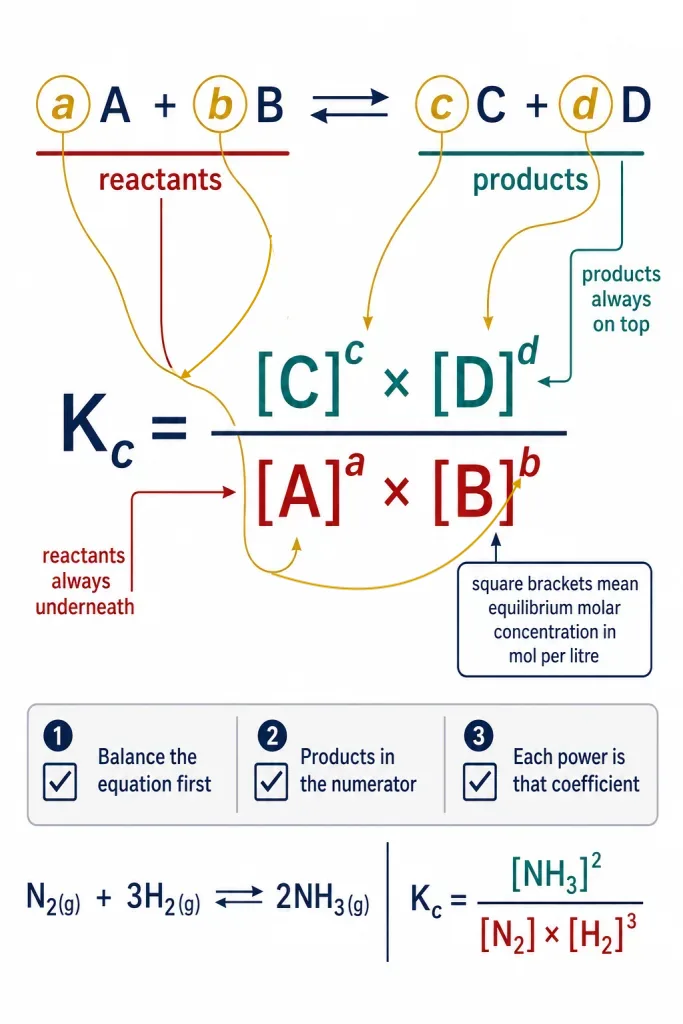
Reading the general expression on real reactions
A coefficient of 1 gives a power of 1, which is never written.
What the law does not say
The equilibrium law is an experimental result about the equilibrium state. It is not a rate law. The exponents in a rate law come from the mechanism and have to be measured; the exponents in come from the balanced equation and can be written down by inspection. A reaction whose rate law is first order in and half order in would still have in its .
[JEE Main] A favourite trap is to hand you a rate law and ask for , or to hand you the equation and ask for the rate law. The coefficients feed the equilibrium constant; only experiment feeds the rate law.
Writing the Expression: the Three Checks
Every expression you will ever write survives three checks. Run them in order.
Check 1 — is the equation balanced? Count each element, then count the charge if ions are involved. For , the charge on the left is and on the right is . Balanced.
Check 2 — are the products on top? The side written on the right of the is the numerator, no matter which side you privately think of as "the products".
Check 3 — is every power the coefficient of that species? Read the coefficients straight off the equation and copy them up as exponents.
The same chemistry, two equations, two constants
Consider the hydrogen-iodine system written two ways at :
Same vessel, same molecules, same equilibrium mixture, same temperature — and two different numbers, because the two equations are two different bookkeeping choices. Neither is more correct than the other.
Key Point: A value of is meaningless without the balanced equation it belongs to. Always quote the equation alongside the number.
Fractional coefficients are allowed
is a legitimate balanced equation. Half a molecule is meaningless, but half a mole is not, and equilibrium constants are written on the mole scale. Fractional coefficients become fractional exponents, and fractional exponents are square roots and cube roots.
Concentrations, not moles
The brackets hold concentrations in , never mole numbers. If a problem gives you moles, divide by the volume of the vessel before anything else. Skipping that division is the single most common arithmetic slip in this chapter, and it damages the answer by a factor of — which is why a reaction with equal numbers of moles on both sides sometimes forgives the mistake and a reaction like never does.
The Units of , and Why It Is Usually a Bare Number
Work out the dimensions of from the expression itself. Each bracket carries units of , so
where is the total stoichiometric coefficient of the products minus that of the reactants.
| Reaction | Units of | |
|---|---|---|
| none | ||
So the units are not fixed — they change from reaction to reaction, and they vanish whenever the coefficients balance out.
Why tables print without units
Strictly, the quantity that belongs inside an equilibrium constant is not the concentration itself but the activity: the concentration divided by a chosen standard concentration, .
Dividing a concentration in by leaves the number unchanged but strips the units. Every bracket in the expression becomes a pure ratio, and the constant built from pure ratios is itself a pure number.
The same argument runs for gases with the standard pressure , which is why is also quoted without units.
Key Point: is dimensionless because each concentration (or pressure) is divided by its standard-state value of (or ). The numerical value is unaffected; only the units disappear. A thermodynamically dimensionless is what makes legal, since you cannot take the logarithm of a quantity with units.
[Board] Board papers sometimes ask for the units of for a stated reaction. Give worked out for that reaction, and add the one-line remark that is treated as dimensionless when activities are used. Both halves earn marks.
What the Magnitude of Tells You
has products in the numerator and reactants in the denominator. A large therefore means the numerator dominates: at equilibrium there is far more product than reactant. A small means the reverse.
That single observation is enough to sort every reaction into three bands.
| Magnitude of | Composition of the equilibrium mixture | Extent of reaction | Examples |
|---|---|---|---|
| products predominate; very little reactant left | proceeds nearly to completion | at , ; at , ; at , | |
| appreciable amounts of both reactants and products | proceeds part of the way | at , ; at , | |
| reactants predominate; very little product forms | barely proceeds | at , ; at , |
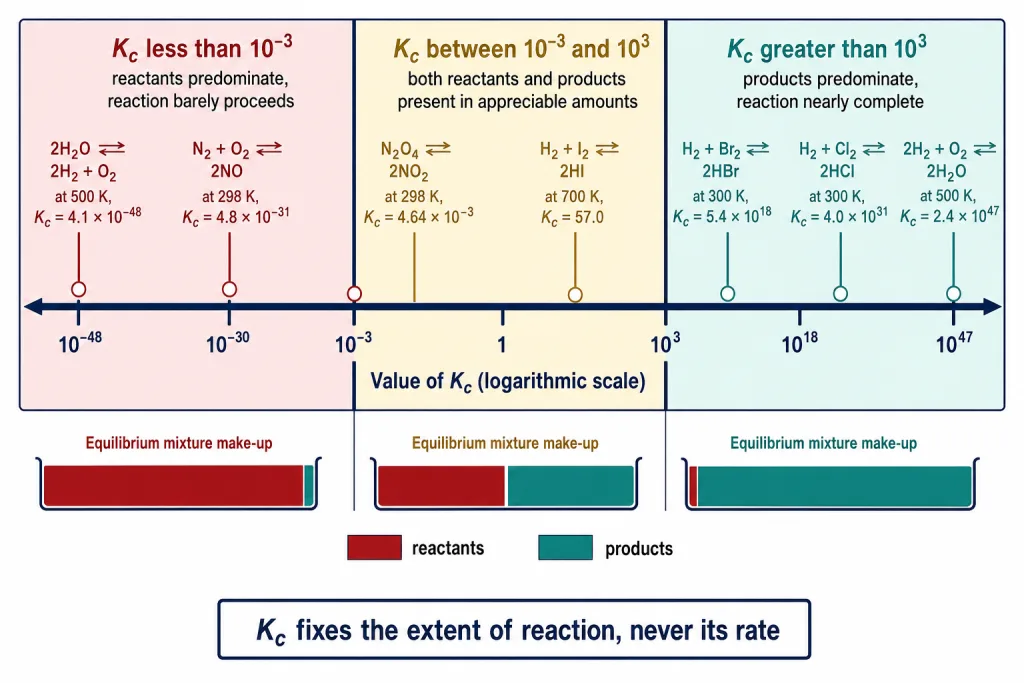
The boundaries and are conventions, not laws of nature. A reaction with is not qualitatively different from one with . The bands are a way of reading a number at a glance.
The pair of reactions that explains the atmosphere
and have shared the atmosphere for billions of years without turning into nitric oxide, and at says why: the equilibrium mixture is essentially pure nitrogen and oxygen. Raise the temperature to the inside of a car engine and rises by many orders of magnitude, which is where the oxides of nitrogen in exhaust gas come from.
The limit of what can tell you
A large says where the equilibrium lies. It says nothing whatever about how long the mixture takes to get there.
has , one of the largest equilibrium constants in ordinary chemistry, yet a sealed flask of the two gases at room temperature will sit unchanged for years. The equilibrium position is overwhelmingly on the water side; the rate of getting there is negligible until a spark supplies the activation energy.
Key Point: is a thermodynamic quantity and fixes only the extent of reaction. Rate is a kinetic quantity fixed by activation energy. A huge with a huge activation energy gives a reaction that will go far but has not yet started.
[NEET] The statement "a reaction with a large is a fast reaction" is false, and it appears as a distractor almost every year.
Manipulating Equilibria: Three Rules
Equations get rewritten — reversed, halved, doubled, added together. Each rewriting changes in a way that follows straight from the algebra of the expression.
Rule 1 — reversing a reaction inverts
For at ,
Write the same chemistry backwards, . The products of the new equation are the reactants of the old, so the fraction turns over:
Nothing physical has happened. The same vessel holds the same equilibrium mixture; only the direction in which the equation was typed has changed.
Rule 2 — multiplying the equation by raises to the power
Multiply every coefficient in by :
Every exponent in the expression is multiplied by as well:
Two cases worth having at your fingertips. With :
With :
Halving the equation takes the square root of ; it does not halve . That confusion is the most expensive mistake in this section.
Rule 3 — adding two equilibria multiplies their constants
Suppose two equilibria, at the same temperature, share a species:
Add the two equations. appears once on the right and once on the left, so it cancels:
Multiply the two expressions and the shared cancels in exactly the same way:
The cancellation of the species in the equations mirrors the cancellation of the brackets in the fractions, which is the whole reason the rule works. With and at ,
Subtracting one equation from another divides the constants, since subtraction is addition of the reversed equation.
The rules in one table
| Operation on the equation | Effect on |
|---|---|
| reverse it: | |
| multiply through by | |
| halve it | |
| add two equations | |
| subtract one from another |
Logarithms make the pattern obvious: reversing changes the sign of , scaling by multiplies by , and adding equations adds their values.
Key Point: Addition and subtraction of equations become multiplication and division of . Multiplication of an equation becomes exponentiation of . Never add or multiply values themselves.
[JEE Main] Multi-step questions usually combine two rules: reverse one equation and halve it, so becomes . Do the operations one at a time and write the intermediate constant down.
Worked Questions
Question 1: Writing the expression from a balanced equation
Write the equilibrium constant expression for
Answer:
First I check the equation is balanced. Nitrogen: 4 on each side. Hydrogen: 12 on each side. Oxygen: 10 on the left, on the right. Balanced.
The right-hand side goes in the numerator, the left-hand side in the denominator.
Each power is that species' coefficient: 4 for , 6 for , 4 for , 5 for .
Ans: Watch out: Water is a gas here, so it stays in the expression. Liquid water in an aqueous equilibrium would be left out.
Question 2: from equilibrium concentrations
At the equilibrium concentrations for are , and . Calculate .
Answer:
I write the expression first.
Then I substitute.
Ans: (dimensionless, since ) Watch out: Dropping the square on gives , which is off by a factor of 357.
Question 3: for the synthesis of ammonia
At the equilibrium concentrations for are , and . Find and its units.
Answer:
The numerator is .
The denominator is .
For the units, , so the units are .
Ans: Watch out: The cube on is the coefficient 3, not the number of hydrogen atoms. Forgetting it gives instead of .
Question 4: Reversing the equation
For , at . Find for at the same temperature.
Answer:
Reversing an equation turns the equilibrium constant expression upside down, so the new constant is the reciprocal of the old one.
Ans: Watch out: A reversed reaction never gets a negative . Equilibrium constants are ratios of concentrations and are always positive.
Question 5: Halving the equation
Using for at , find for
Answer:
Every coefficient has been multiplied by , so the constant is raised to the power .
Ans: Watch out: Halving the equation takes the square root, not half the value. Halving to is the standard error here.
Question 6: Doubling the equation
for is at . Find for .
Answer:
Here , so the constant is squared.
Ans:
Question 7: A reversal and a scaling together
At a certain temperature for . Find for
Answer:
I take the two operations one at a time.
Step one: reverse the given equation to get . The constant becomes
Step two: halve that equation to get the target. The constant is raised to the power .
Ans: Watch out: The order of the two steps does not matter — and are the same number — but doing both in one line invites an error. Write the intermediate value down.
Question 8: Adding two equilibria
At : Find for .
Answer:
I add the two equations. On the left I get and on the right .
appears on both sides and cancels, leaving , which is the target.
Adding equations multiplies the constants.
Ans: Watch out: Adding the two values gives , essentially alone, because is negligible beside it. That answer looks plausible and is wrong.
Question 9: Units and the dimensionless convention
State the units of for and for , and explain why data tables print both constants without units.
Answer:
The units are .
For the phosphorus pentachloride equilibrium, , giving .
For the nitric oxide equilibrium, , giving .
Tables print bare numbers because each concentration is divided by the standard concentration before it enters the expression. The numerical value is unchanged and the units cancel.
Ans: and respectively; both are quoted as pure numbers once activities are used.
Question 10: Reading the magnitude
Three reactions have , and at the stated temperatures. Describe the equilibrium mixture in each case, and say which of the three is the fastest.
Answer:
is far above , so products predominate and the reaction goes nearly to completion. Reactant is present but in vanishing amounts.
lies inside the band to , so reactants and products are both present in appreciable amounts.
is far below , so reactants predominate and almost no product forms.
Ans: Products predominate; both present appreciably; reactants predominate. The question of which is fastest cannot be answered, because carries no information about rate. Watch out: The equilibrium constant is thermodynamic. Ranking reactions by speed from their values is the trap the question is built around.
Question 11: Two forms of one equation
A student measures for and a classmate measures for the same equilibrium mixture. Both are correct. Explain.
Answer:
The two are working from different balanced equations for the same chemistry.
The classmate has written , whose expression is .
The student has halved every coefficient, so the expression becomes , which is the square root of the first.
, so the two numbers describe one equilibrium mixture.
Ans: Halving the equation takes the square root of ; both values are correct for the equations they belong to. Watch out: A value of quoted without its balanced equation is unusable. Always write the equation beside the number.