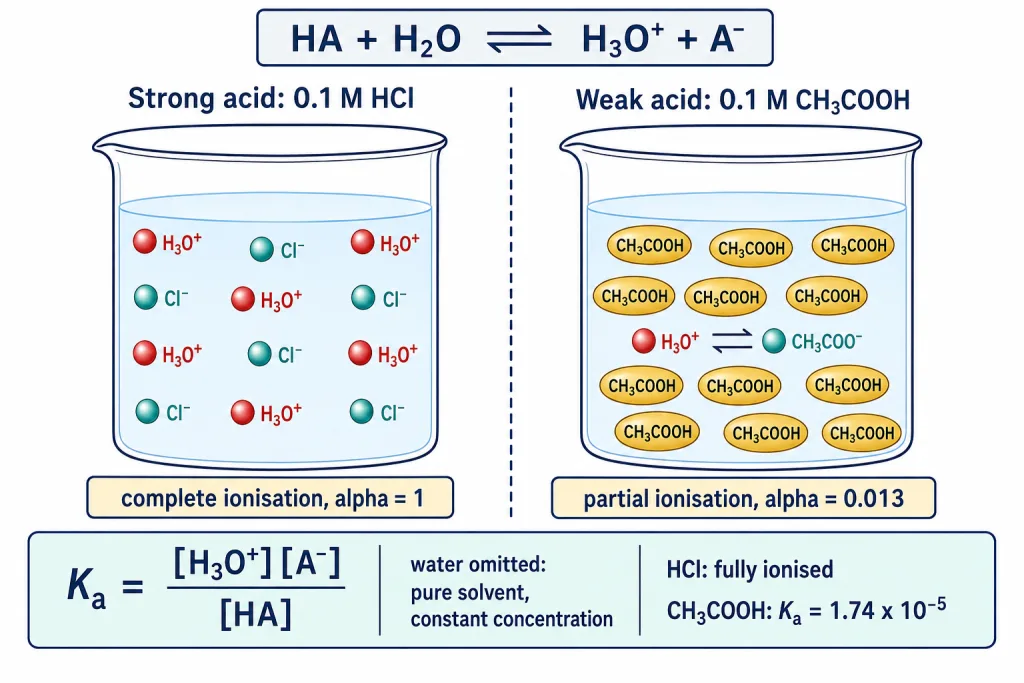
Dissolve 0.1mol of HCl in a litre of water and no HCl molecules survive. Dissolve 0.1mol of acetic acid and almost all of it survives: about thirteen molecules in a thousand have given up a proton, since α=0.0132 at this concentration, and the hydronium concentration is about seventy-five times smaller.
The difference is one of position, not of kind. A weak acid in water reaches a genuine equilibrium — proton transfer forward, proton transfer back, both continuing, concentrations steady. Writing the acid as HA:
HA(aq)+H2O(l)⇌H3O+(aq)+A−(aq)
Water is the base; it accepts the proton and becomes hydronium. The species A− is the conjugate base of HA, and it is the reason the reverse arrow matters: A− is strong enough as a base to take the proton back from H3O+, so the reaction settles part-way instead of running to completion.
The equilibrium constant for that proton transfer, written the way any equilibrium constant is written, would be
K=[HA][H2O][H3O+][A−]
Water is the solvent, present at about 55.5molL−1. Ionising a few millimoles of acid changes that number in the fourth decimal place at best, and a quantity that does not change belongs on the same side as the constant, so [H2O] is absorbed into K.
Key Point (Definition): The ionisation constant (or acid dissociation constant) of a weak acid HA is
Ka=[HA][H3O+][A−]
where every concentration is the equilibrium concentration in molL−1. Water does not appear.
Three properties of Ka decide how it is used.
It is fixed at a fixed temperature. Diluting the solution does not change Ka; adding a common ion does not change Ka; only heating or cooling does.
It is a pure number. Each concentration is understood to be divided by the standard-state concentration of 1M, so the units cancel. Quoting Ka for acetic acid as 1.74×10⁻⁵M is a habit, not a requirement.
Its size measures acid strength directly. A large Ka puts the equilibrium to the right and means a large hydronium concentration for a given amount of acid dissolved.
larger Ka⟹stronger acid
The shorthand HA⇌H++A− with Ka=[H+][A−]/[HA] gives identical numbers, because a bare proton in water is a hydronium ion. Write the full version whenever a question asks for the equilibrium; the short version is a calculation device.
[Board] A question asking for the expression for the ionisation constant wants the water-free ratio. Including [H2O] in the denominator loses the mark.
pKa Turns a Range of Eight Powers into a Range of Eight Units
Ionisation constants run from about 10−2 down to about 10−10. Comparing numbers across eight decades is awkward, so the same logarithmic operator used for [H3O+] is applied to Ka.
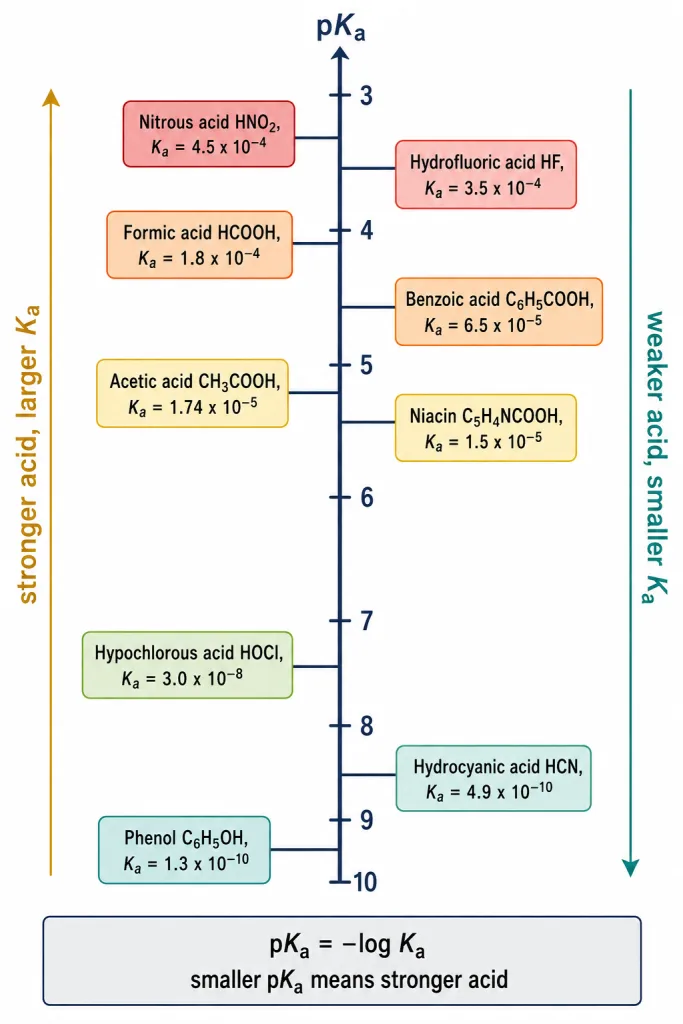
Key Point (Definition):pKa=−logKa and pKb=−logKb.
The minus sign flips the direction of the comparison, and that is where marks are lost.
smaller pKa⟹larger Ka⟹stronger acid
A drop of one unit in pKa is a factor of ten in Ka. Nitrous acid at 3.35 is about twenty-six times stronger than acetic acid at 4.76, and about 106 times stronger than hydrocyanic acid at 9.31.
The constants worth carrying in memory, at 298 K:
Acid
Formula
Ka
pKa
Nitrous acid
HNO2
4.5×10⁻⁴
3.35
Hydrofluoric acid
HF
3.5×10⁻⁴
3.46
Formic acid
HCOOH
1.8×10⁻⁴
3.74
Benzoic acid
C6H5COOH
6.5×10⁻⁵
4.19
Acetic acid
CH3COOH
1.74×10⁻⁵
4.76
Niacin
C5H4NCOOH
1.5×10⁻⁵
4.82
Hypochlorous acid
HOCl
3.0×10⁻⁸
7.52
Hydrocyanic acid
HCN
4.9×10⁻¹⁰
9.31
Phenol
C6H5OH
1.3×10⁻¹⁰
9.89
Three features of this table do real work in problems.
The strongest entries are all around 10−4, and pKa separates them where the powers of ten do not. Formic acid beats acetic acid by a full unit, and benzoic acid also sits above acetic acid because the ring stabilises the conjugate base.
Hypochlorous acid, hydrocyanic acid and phenol are all extremely weak. A 0.1M solution of HCN has a pH near 5, not far from neutral, and yet the acid is present at a tenth molar.
The ordering by Ka and the ordering by pKa are exact reverses. Any question that hands you pKa values and asks for the strongest acid wants the smallest number.
Converting between the two forms needs nothing beyond a log table. Acetic acid: Ka=1.74×10⁻⁵, so pKa=5−log(1.74)=4.76. Backwards: Ka=10−4.76=100.24×10−5=1.74×10⁻⁵. Split the number into mantissa and power of ten before touching the logarithm and the arithmetic never goes wrong.
Weak Bases, Kb and pKb
A weak base is the same argument with the role of water reversed. The base B takes a proton from water and leaves hydroxide behind:
B(aq)+H2O(l)⇌BH+(aq)+OH−(aq)
Kb=[B][BH+][OH−]
Water is the acid here, and it is again omitted as the pure solvent. The constant Kb is the base ionisation constant, and a larger Kb means a stronger base, exactly as a larger Ka means a stronger acid.
Some bases are written as hydroxides that ionise rather than as proton acceptors:
MOH(aq)⇌M+(aq)+OH−(aq),Kb=[MOH][M+][OH−]
Ammonia is quoted both ways, and the constant is the same 1.77×10⁻⁵ either way.
Base
Formula
Kb
pKb
Dimethylamine
(CH3)2NH
5.4×10⁻⁴
3.27
Methylamine
CH3NH2
4.4×10⁻⁴
3.36
Triethylamine
(C2H5)3N
6.45×10⁻⁵
4.19
Ammonia
NH3
1.77×10⁻⁵
4.75
Quinine
plant alkaloid
1.10×10⁻⁶
5.96
Pyridine
C5H5N
1.77×10⁻⁹
8.75
Aniline
C6H5NH2
4.27×10⁻¹⁰
9.37
Urea
CO(NH2)2
1.3×10⁻¹⁴
13.89
The amines dominate the list. They are ammonia with one or more hydrogens replaced by carbon groups, and the nitrogen lone pair is what accepts the proton. Alkyl groups push electron density towards that lone pair and make the base stronger, which is why methylamine and dimethylamine outrank ammonia.
Aniline and pyridine sit four to five orders of magnitude below ammonia, but for two different reasons. In aniline the nitrogen lone pair is conjugated with the ring: it is delocalised into the π system and is much less available to a proton, which is why aniline is roughly forty thousand times weaker a base than ammonia. Pyridine's lone pair is not delocalised at all — it lies in an sp2 orbital in the plane of the ring, at right angles to the π system — and its weakness comes instead from the high s character of that orbital, which holds the pair closer to the nitrogen nucleus and makes it less willing to be shared with a proton. Urea at 1.3×10⁻¹⁴ is barely a base at all.
A weak base calculation runs on hydroxide, so it has one extra step at the end. Find [OH−] from Kb, take pOH=−log[OH−], then pH=14.00−pOH at 298 K. Skipping that conversion turns a pH of 11 into a pH of 3, the single most common error in this part of the chapter.
[NEET] Given pKb, the fastest route to pH is pOH=21(pKb−logc) followed by pH=14−pOH.
The Degree of Ionisation
Ka tells you about the acid. It says nothing on its own about how much of a particular solution has ionised, because that depends on the concentration as well. The quantity that answers the second question is the degree of ionisation.
Key Point (Definition): The degree of ionisationα is the fraction of the dissolved acid or base that has ionised at equilibrium:
α=moles taken initiallymoles ionised
It is a pure fraction between 0 and 1. Multiplied by 100 it is the percent ionisation or percent dissociation.
For an acid HA taken at initial concentration c, the amounts follow directly.
HA
+H2O
⇌
H3O+
+A−
Initial (M)
c
—
0
0
Change (M)
−cα
—
+cα
+cα
Equilibrium (M)
c−cα=c(1−α)
—
cα
cα
Two readings come out of the bottom row and both get used constantly.
[H3O+]=cαandα=c[H3O+]
The second form is how α is measured: take the pH of a solution of known concentration, convert to [H3O+], divide by c. No assumption has been made anywhere.
Percent dissociation is the same number in different clothes:
A 0.08M solution of hypochlorous acid produces [H3O+]=1.41×10⁻³M — the figure that follows from the Ka=2.5×10⁻⁵ used in this standard problem, rather than from the tabulated 3.0×10⁻⁸ — so α=1.41×10⁻³/0.08=0.0176, which is 1.76 per cent dissociated.
For a base the table is identical with OH− in place of H3O+: [OH−]=cα and [B]=c(1−α).
Two warnings before the next step.
α is not a property of the acid. Acetic acid has one Ka at 298 K but a different α at every concentration. A question that asks for the degree of ionisation of acetic acid without giving a concentration is incomplete.
α has no units and cannot exceed 1. An answer of α=3.2 or α=140 per cent means an algebra error, usually a forgotten square root.
Ostwald's Dilution Law
Substituting the equilibrium row into the expression for Ka connects the constant of the acid to the fraction ionised in this particular solution.
Ka=[HA][H3O+][A−]=c(1−α)(cα)(cα)=c(1−α)c2α2
One factor of c cancels between numerator and denominator.
Key Point:Ostwald's dilution law. For a weak monobasic acid of ionisation constant Ka at initial concentration c,
Ka=1−αcα2
and for a weak monoacidic base,
Kb=1−αcα2
The law is exact. No approximation has entered — only the balanced stoichiometry and the definition of α. It is a quadratic in α:
cα2+Kaα−Ka=0,α=2c−Ka+Ka2+4Kac
The other root is negative and is discarded: a fraction of the acid that has ionised cannot be less than zero.
Three consequences follow from the shape of the expression, before any numbers are put in.
α rises when c falls. The product cα2 must stay fixed at Ka(1−α), so shrinking c forces α up. This is Le Chatelier's principle applied to a reaction that produces more solute particles than it consumes.
α rises when Ka rises. A stronger acid ionises further at the same concentration.
α→1 as c→0. At infinite dilution every weak electrolyte is completely ionised, which is why α is sometimes obtained as the ratio Λm/Λm∞ of molar conductivities.
The same algebra for a weak base with [OH−]=cα gives Kb=cα2/(1−α) unchanged, so everything proved for acids transfers directly; only the final conversion from pOH to pH differs.
The Square-Root Shortcut
Solving a quadratic for every weak acid problem is slow, and for most of them unnecessary, because α is tiny and 1−α is barely distinguishable from 1.
For acetic acid at 0.1M, α is about 0.013. Then 1−α=0.987, and treating it as 1 changes the answer by about one per cent — far less than the uncertainty in the tabulated Ka.
Setting 1−α≈1 collapses the law:
Ka≈cα2⟹α=cKa
Multiplying by c gives the hydronium concentration:
[H3O+]=cα=ccKa=Kac
Key Point: For a weak monobasic acid with small α,
α=cKa,[H3O+]=Kac,pH=21(pKa−logc)
and for a weak monoacidic base,
α=cKb,[OH−]=Kbc,pOH=21(pKb−logc)
The pH form is worth deriving once so it is never misremembered. Take logarithms of [H3O+]=Kac=(Kac)1/2:
log[H3O+]=21logKa+21logc
Multiply through by −1:
pH=21pKa−21logc=21(pKa−logc)
For the usual solutions c<1, so logc is negative and the formula adds to 21pKa. For 0.01M acetic acid, pH=21(4.76+2)=3.38.
Two facts about the shortcut are tested without any computing at all.
[H3O+] goes as the square root of the concentration, not as the concentration. Diluting a weak acid ten-fold divides [H3O+] by 10=3.16, so the pH rises by 0.5, not by 1. For a strong acid the same dilution raises the pH by a full unit.
α goes as the inverse square root of concentration, so a hundred-fold dilution multiplies α by 10.
When the Shortcut Breaks
The approximation replaced 1−α by 1. That is safe while α is small, and unsafe when it is not.
Key Point: The approximation α=Ka/c is acceptable when α comes out below about 0.05 (5 per cent), equivalently when
Kac>400
Outside that range the quadratic cα2+Kaα−Ka=0 must be solved.
The two conditions are one condition. If α=Ka/c=0.05 then Ka/c=0.0025 and c/Ka=400. Checking c/Ka takes one division and is done before any square root, so it tells you in advance whether the shortcut is allowed.
The error grows quickly once the ratio drops.
c/Ka
Exact α
Approximate α
Error in α
Error in pH
400
4.88 %
5.00 %
2.5 %
0.01
100
9.51 %
10.00 %
5.1 %
0.02
57.1
12.38 %
13.23 %
6.8 %
0.03
10
27.02 %
31.62 %
17.1 %
0.07
4
39.04 %
50.00 %
28.1 %
0.11
The approximate value is always too large. Dropping α from the denominator makes the denominator bigger than it should be, which makes the calculated α bigger than it should be.
pH is far more forgiving than α, because the logarithm compresses everything. Even a 28 per cent error in α moves the pH by only 0.11 units. A question asking for pH to two decimals will usually forgive the shortcut; one asking for the degree of ionisation will not.
A case where it fails. Hydrofluoric acid, Ka=3.5×10⁻⁴, at c=0.02M. The check first: c/Ka=57.1, well under 400, so the shortcut is not allowed.
Shortcut anyway, to see the damage: α=0.0175=0.1323, so 13.23 per cent, and [H3O+]=2.65×10⁻³M, pH=2.58.
Exact treatment, from Ostwald's law without simplification:
So α=0.124, that is 12.4 per cent, and [H3O+]=0.02×0.1238=2.48×10⁻³M, giving pH=2.61.
The two degrees of ionisation differ by 6.8 per cent — enough to change a reported value from 12 to 13 per cent. The two pH values differ by 0.03, which no marking scheme would notice. That asymmetry is the practical rule: check c/Ka, and if it is small, solve the quadratic whenever the answer wanted is α itself.
[JEE Main] Very dilute solutions of very weak acids break a second assumption. When Kac comes out near 10−7M, the hydronium supplied by water is no longer negligible and even the quadratic above is insufficient.
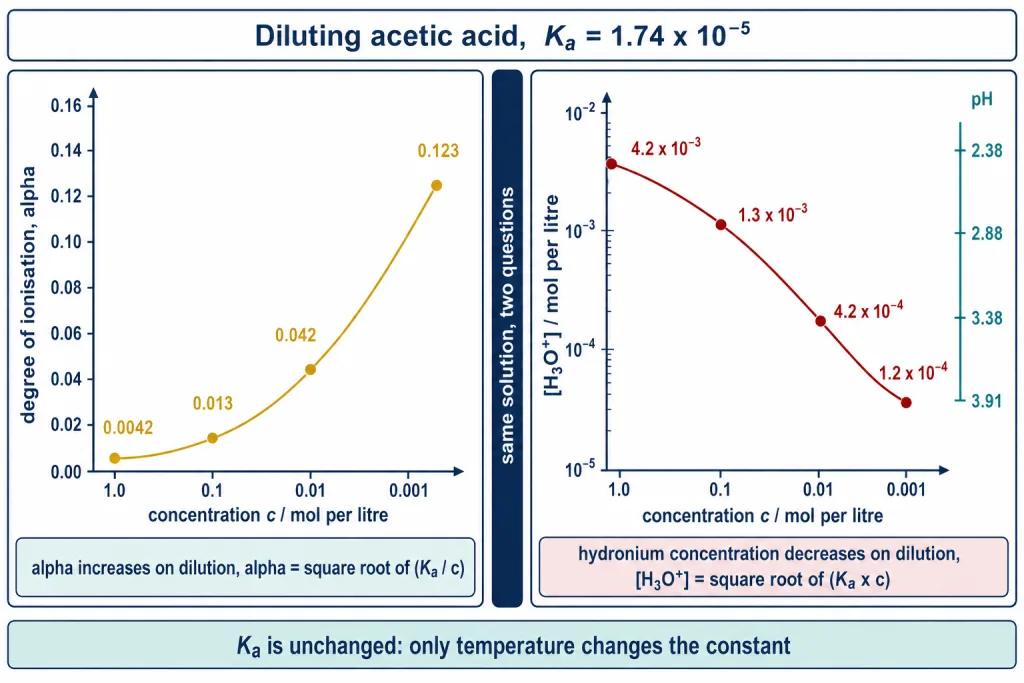
Dilution Pulls the Two Quantities in Opposite Directions
The pair of results α=Ka/c and [H3O+]=Kac contain a contradiction that is only apparent. One rises on dilution, the other falls.
α∝c1[H3O+]∝c
Acetic acid, Ka=1.74×10⁻⁵, makes it concrete.
c (M)
α
Percent ionised
[H3O+] (M)
pH
1.0
0.00417
0.42 %
4.17×10⁻³
2.38
0.1
0.0132
1.32 %
1.32×10⁻³
2.88
0.01
0.0417
4.17 %
4.17×10⁻⁴
3.38
0.001
0.123
12.3 %
1.24×10⁻⁴
3.91
A thousand-fold dilution raises the fraction ionised from under half a per cent to over twelve per cent, and cuts [H3O+] by a factor of about thirty-four. Both are true because α is a fraction and [H3O+] is an amount. A larger fraction of a much smaller total is still a smaller total.
The mechanism is Le Chatelier. Ionisation converts one dissolved particle into two, so adding water shifts the system towards the side with more particles and more HA ionises. It shifts forward, but not far enough to keep [H3O+] where it was, because the added water has diluted the ions too.
The last row carries its own warning. At 0.001M, α has passed 5 per cent, so the shortcut is no longer clean: Ka/c gives 0.132 where the quadratic gives 0.123, and the pH shifts from 3.88 to 3.91. Only that last row has been solved from the quadratic; the three rows above it come from the shortcut, which is accurate to better than one per cent there.
Key Point: On dilution of a weak acid: α increases, [H3O+] decreases, pH increases, and Ka does not change.
Adding "Ka does not change" is not padding. A common wrong answer holds that the ionisation constant increases on dilution because more ionisation has occurred. What changed was the position of the equilibrium, not the constant.
[NEET] For a strong acid, dilution by a factor of ten raises the pH by exactly 1 until the solution approaches 10−6M. For a weak acid the same dilution raises it by only 0.5.
Question 1: Degree of ionisation of hydrofluoric acid
The ionisation constant of HF is 3.5×10⁻⁴. Calculate the degree of dissociation of HF in its 0.02M solution, the concentrations of H3O+, F− and HF, and the pH.
Answer:
Two proton transfers are possible: HF with water, Ka=3.5×10⁻⁴, and water with itself, Kw=1.0×10⁻¹⁴. Since Ka≫Kw the first is the principal reaction.
HF+H2O⇌H3O++F−
Equilibrium concentrations are 0.02(1−α), 0.02α and 0.02α.
Ka=0.02(1−α)(0.02α)2=1−α0.02α2=3.5×10⁻⁴
I check whether the shortcut is allowed: c/Ka=0.02/(3.5×10−4)=57.1, which is below 400, so I solve the quadratic.
α2+1.75×10⁻²α−1.75×10−2=0
α=2−0.0175+0.000306+0.07=2−0.0175+0.2652=0.124
The negative root −0.141 is rejected.
[H3O+]=[F−]=cα=0.02×0.1238=2.48×10⁻³M
[HF]=c(1−α)=0.02×0.876=1.75×10⁻²M
pH=−log(2.48×10⁻³)=2.61
Ans:α=0.124; [H3O+]=[F−]=2.48×10⁻³M; [HF]=1.75×10⁻²M; pH=2.61Watch out: The shortcut gives α=0.132, about 7 per cent too high. Its pH, 2.58, is close enough to pass; its degree of ionisation is not.
Question 2: pH and percent dissociation of hypochlorous acid
Calculate the pH of a 0.08M solution of HOCl, ionisation constant 2.5×10⁻⁵, and its percent dissociation.
Answer:
HOCl(aq)+H2O(l)⇌H3O+(aq)+ClO−(aq)
The constant quoted here is the 2.5×10⁻⁵ used in this standard problem, not the 3.0×10⁻⁸ listed for HOCl in the table earlier; I work with the value the question supplies.
The ratio first: c/Ka=0.08/(2.5×10−5)=3200, comfortably above 400, so the shortcut is safe.
Writing x for [H3O+] at equilibrium, with 0.08−x≈0.08:
0.08x2=2.5×10−5
x2=2.0×10⁻⁶, so x=1.41×10⁻³M
pH=−log(1.41×10⁻³)=2.85
Percent dissociation =0.081.41×10−3×100=1.76 per cent
Ans:pH=2.85; percent dissociation =1.76 per cent
Question 3: Ka from a measured pH
The pH of a 0.1M solution of a monobasic acid is 4.50. Find [H+], [A−] and [HA] at equilibrium, and the values of Ka and pKa.
Answer:
From the pH:
[H+]=10−4.50=100.50×10−5=3.16×10⁻⁵M
The acid gives one H+ and one A− together, so [A−]=3.16×10⁻⁵M. That is negligible against 0.1M, so [HA]≈0.1M.
Ka=0.1(3.16×10⁻⁵)2=0.11.0×10−9=1.0×10⁻⁸
pKa=−log(10−8)=8
Ans:[H+]=[A−]=3.16×10⁻⁵M; [HA]=0.1M; Ka=1.0×10⁻⁸; pKa=8Watch out:10−4.50 is not 4.5×10⁻⁵. Split the exponent as 100.50×10⁻⁵ and take the antilog of the positive part.
Question 4: Degree of ionisation and pH of ammonia
Determine the degree of ionisation and the pH of a 0.05M solution of ammonia, Kb=1.77×10⁻⁵. Also find Ka for the ammonium ion.
Answer:
NH3+H2O⇌NH4++OH−
Here c/Kb=0.05/(1.77×10−5)=2825, far above 400, so I drop α against 1 in Ostwald's law.
α=0.051.77×10−5=3.54×10−4=0.0188
[OH−]=cα=0.05×0.0188=9.4×10⁻⁴M
[H+]=9.4×10−41.0×10−14=1.06×10⁻¹¹M
pH=−log(1.06×10⁻¹¹)=10.97
For the conjugate acid, Ka=Kw/Kb=(1.0×10−14)/(1.77×10−5)=5.6×10−10.
Ans:α=0.0188 (1.88 per cent); pH=10.97; Ka(NH4+)=5.6×10⁻¹⁰Watch out:−log(9.4×10⁻⁴)=3.03 is the pOH. Reporting it turns a solution of ammonia into an acid.
Question 5: Kb and pKb from a measured pH
The pH of a 0.004M hydrazine solution is 9.7. Calculate its ionisation constant Kb and pKb.
Answer:
NH2NH2+H2O⇌NH2NH3++OH−
I go from pH to hydronium, then to hydroxide.
[H+]=10−9.7=2.0×10⁻¹⁰M
[OH−]=2.0×10−101.0×10−14=5.0×10⁻⁵M
The hydrazinium ion is produced in equal amount, and both are far below 0.004M, so the undissociated base is still 0.004M.
Kb=0.004(5.0×10⁻⁵)2=0.0042.5×10−9=6.3×10⁻⁷
pKb=−log(6.3×10⁻⁷)=6.20
Ans:Kb=6.3×10⁻⁷; pKb=6.20Watch out: Using [H+] in place of [OH−] gives about 10−17, a value no base could have. Kb is built from the hydroxide side.
Question 6: Degree of ionisation from pKa
Calculate the degree of ionisation of 0.05M acetic acid if its pKa is 4.76.
Answer:
First I convert pKa to Ka.
Ka=10−4.76=100.24×10−5=1.74×10⁻⁵
Check: c/Ka=0.05/(1.74×10−5)=2874, above 400.
α=0.051.74×10−5=3.48×10−4=1.87×10⁻²
Ans:α=1.87×10⁻², that is 1.87 per cent
Watch out: Using pKa in place of Ka gives 4.76/0.05=9.8. Any α above 1 signals that the conversion was skipped.
Question 7: pKa from a large degree of ionisation
The degree of ionisation of a 0.1M bromoacetic acid solution is 0.132. Calculate the pH of the solution and the pKa of the acid.
Answer:
[H3O+]=cα=0.1×0.132=1.32×10⁻²M
pH=−log(1.32×10⁻²)=1.88
For Ka, α is 13.2 per cent, well over the 5 per cent limit, so I keep the (1−α) term.
Ans:pH=1.88; Ka=2.01×10⁻³; pKa=2.70Watch out: Dropping (1−α) gives Ka=1.74×10⁻³ and pKa=2.76. The pH is unaffected because it comes from cα directly.
Question 8: pH of a very weak base
Calculate the degree of ionisation and the pH of 0.01M aniline, Kb=4.27×10⁻¹⁰.
Answer:
C6H5NH2+H2O⇌C6H5NH3++OH−
α=0.014.27×10−10=4.27×10−8=2.07×10⁻⁴
[OH−]=cα=0.01×2.07×10−4=2.07×10⁻⁶M
pOH=−log(2.07×10⁻⁶)=5.68
pH=14.00−5.68=8.32
Ans:α=2.07×10⁻⁴; pH=8.32Watch out: A pH of 8.32 is only just alkaline, and that is correct — aniline is roughly forty thousand times weaker a base than ammonia.
Question 9: Comparing the shortcut with the quadratic
Chloroacetic acid has Ka=1.35×10⁻³. For a 0.01M solution, find α and the pH both by the approximation and exactly, and state the error.
Answer:
The check: c/Ka=0.01/(1.35×10−3)=7.4, far below 400.
By the shortcut: α=1.35×10⁻³/0.01=0.135=0.367, and [H3O+]=3.67×10⁻³M, pH=2.43.
Exactly, from 1−α0.01α2=1.35×10⁻³:
α2+0.135α−0.135=0
α=2−0.135+0.0182+0.54=2−0.135+0.7471=0.306
[H3O+]=0.01×0.306=3.06×10⁻³M, pH=2.51.
The approximate α is too large by (0.367−0.306)/0.306=20 per cent. The pH is wrong by 0.08 units.
Ans: Exact α=0.306, pH=2.51; the approximation gives 0.367 and 2.43, an error of 20 per cent in α and 0.08 in pH
Watch out: The approximate answer is always the larger one. A calculated α above 0.05 is an overestimate, and the quadratic is the fix.
Question 10: pH straight from the formula
Calculate the pH of 0.01M acetic acid, pKa=4.76.
Answer:
pH=21(pKa−logc), and log(0.01)=−2.
pH=21(4.76+2)=3.38
Ans:pH=3.38Watch out: The formula subtracts logc, it does not add it. With c<1, logc is negative, so subtracting raises the pH. Adding gives 1.38, a value stronger than the same concentration of HCl.
Question 11: Ka from percent ionisation
A 0.1M solution of a weak monobasic acid is 1.32 per cent ionised at 298 K. Calculate Ka, pKa and the pH.
Answer:
α=0.0132
[H3O+]=cα=0.1×0.0132=1.32×10⁻³M
pH=−log(1.32×10⁻³)=2.88
α is under 5 per cent, so Ka≈cα2=0.1×(0.0132)2=1.74×10⁻⁵. Keeping the (1−α) term gives 1.77×10⁻⁵, a difference of about one per cent.
pKa=−log(1.74×10⁻⁵)=4.76
Ans:Ka=1.74×10⁻⁵; pKa=4.76; pH=2.88Watch out: Percent ionisation must be divided by 100 first. Using 1.32 for 0.0132 gives Ka=0.17, a strong acid.
Question 12: Effect of dilution
A 0.1M solution of acetic acid is diluted a hundred-fold. State what happens to Ka, α, [H3O+] and the pH.
Answer:
Ka depends only on temperature, so it stays at 1.74×10⁻⁵.
α=Ka/c, and c has fallen by 100, so α rises by 100=10: from 0.0132 to about 0.13.
[H3O+]=Kac, so the hydronium concentration falls by 10: from 1.32×10⁻³M to about 1.3×10⁻⁴M, and the pH rises by 1 unit.
At the final concentration α has crossed 5 per cent, so the exact values are α=0.123, [H3O+]=1.24×10⁻⁴M and pH=3.91.
Ans:Ka unchanged; α up ten-fold to about 0.12; [H3O+] down ten-fold to 1.24×10⁻⁴M; pH up by about 1 unit to 3.91Watch out: "More ionisation" and "more acidic" are different claims. The fraction ionised went up; the hydronium concentration went down.
What to Carry Forward
Every result here comes from one equilibrium and one definition.
Quantity
Expression
Condition
Ka
[HA][H3O+][A−]
any weak acid; water omitted
Kb
[B][BH+][OH−]
any weak base; water omitted
pKa, pKb
−logKa, −logKb
always; smaller means stronger
α
[H3O+]/c
always; exact
Ostwald's law
Ka=1−αcα2
always; exact
α=Ka/c
only when α<0.05, i.e. c/Ka>400
[H3O+]=Kac
same condition
pH=21(pKa−logc)
same condition
pOH=21(pKb−logc)
same condition, weak base
Five errors account for almost all the lost marks.
Reading pKa the wrong way and calling the acid with the larger pKa the stronger one.
Using pKa where Ka belongs, which produces a degree of ionisation greater than 1.
Applying α=Ka/c without checking c/Ka, and reporting 37 per cent where the true value is 31.
Forgetting the pOH to pH conversion for a base, so 10.97 is reported as 3.03.
Confusing α with [H3O+] on dilution, or claiming Ka itself rises. The fraction rises, the concentration falls, and the constant does neither.
The next section takes Ka and Kb for a conjugate pair and shows that their product is Kw, and extends the treatment to acids that can lose more than one proton.
Ready to test your knowledge?
Take a quick interactive quiz on this topic —
free, works without login.