Sodium acetate is a strong electrolyte. It does not sit at an equilibrium at all; in water it comes apart completely:
CH3COONa(aq)→Na+(aq)+CH3COO−(aq)
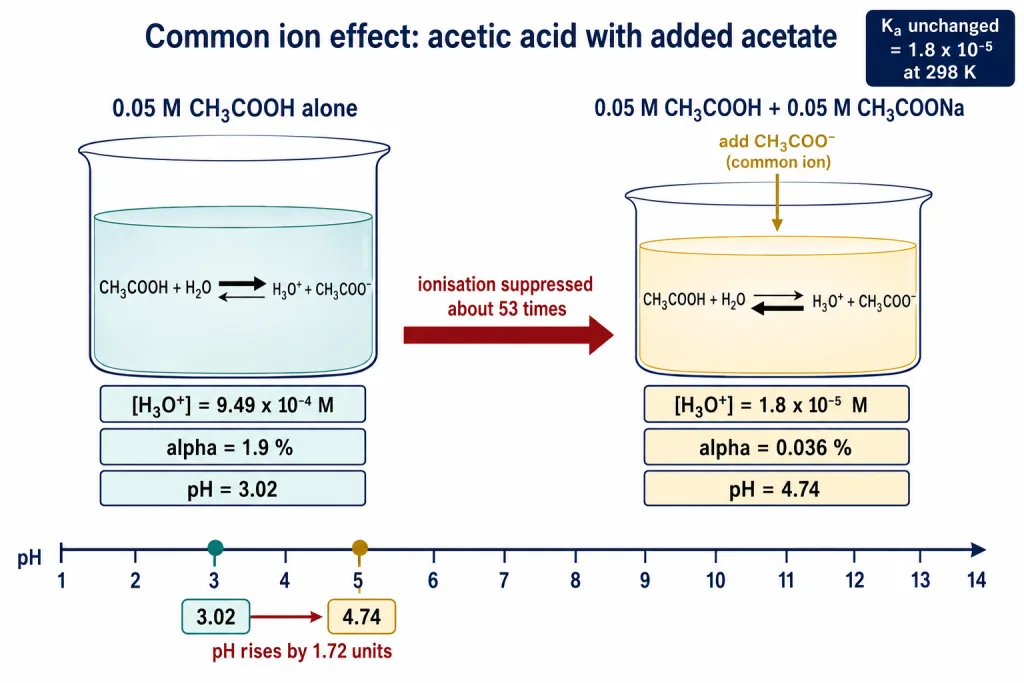
Dissolve sodium acetate in the acetic acid solution and the beaker suddenly holds a large stock of acetate ion, a product of the first equilibrium. Acetate is the common ion. Two readings of what follows, and both give the same answer.
Le Chatelier's reading. The concentration of a product has been raised. The system shifts in the direction that consumes that product, which is the reverse direction. Acetate ions pick up hydronium ions, undissociated acetic acid is rebuilt, and [H3O+] drops. The acid ionises less than it did.
The Q reading. Before the salt is added the mixture is at equilibrium, so Q=Ka. The moment acetate is dumped in, the numerator of
Q=[CH3COOH][H3O+][CH3COO−]
jumps while the denominator is untouched. Now Q>Ka, and a system with Q above K runs backwards until Q falls back to Ka. It falls back by destroying H3O+.
The same suppression happens from the other side. Add hydrochloric acid to acetic acid and the added H3O+ is the common ion; the equilibrium again moves left and the acetic acid ionises less.
Key Point (Definition): The common ion effect is the suppression of the ionisation of a weak electrolyte caused by adding a strong electrolyte that supplies an ion already present in the ionisation equilibrium. It is Le Chatelier's principle applied to an ionic equilibrium.
Ka is a constant at fixed temperature and adding a salt does not change it. What changes is the position of the equilibrium, and with it the degree of ionisation α and the pH. A common ion never alters Ka, Kb or Kw.
[JEE/NEET] A common ion always pushes the weak electrolyte back towards its undissociated form. There is no case in which it increases ionisation.
How Large the Suppression Is
Take 0.05M acetic acid, Ka=1.74×10⁻⁵ at 298K.
On its own, Ostwald's dilution law gives
[H3O+]=Kac=1.74×10−5×0.05=9.33×10⁻⁴M,pH=3.03
α=0.059.33×10−4=1.87×10−2=1.9%
Now make the same solution 0.05M in sodium acetate as well. Set up the equilibrium with x as the amount of acid that ionises:
CH3COOH
H3O+
CH3COO−
Initial (M)
0.05
0
0.05
Change (M)
−x
+x
+x
Equilibrium (M)
0.05−x
x
0.05+x
Ka=0.05−xx(0.05+x)
The acid was already barely ionised, and the added acetate makes it ionise even less, so x≪0.05 and both 0.05+x and 0.05−x collapse to 0.05:
The degree of ionisation has fallen from 1.9% to 0.035%, a factor of about 54. The pH has climbed by 1.73 units, from 3.03 to 4.76.
The same arithmetic works for a weak base. Ammonia, Kb=1.77×10⁻⁵:
NH3(aq)+H2O(l)⇌NH4+(aq)+OH−(aq)
Ammonium chloride is fully ionised and floods the solution with NH4+, the common ion. In 0.10M ammonia alone, [OH−]=1.77×10−5×0.10=1.33×10⁻³M and pH=11.12. Make it 0.10M in NH4Cl and the same cancellation leaves [OH−]=Kb=1.77×10⁻⁵M, so pOH=4.75 and pH=9.25. The base is suppressed 75-fold and the pH drops by 1.87 units.
Two structural facts fall out of these calculations, and both matter later:
When the weak electrolyte and its salt are at equal concentrations, [H3O+]=Ka exactly, so pH=pKa. The acetic acid case landed on 4.76 for that reason.
A weak acid together with a large stock of its conjugate base behaves quite unlike the acid alone. That mixture is a buffer.
Which Ions React with Water
A salt is what an acid and a base leave behind after neutralisation. Dissolve it and it ionises completely; the question is what those ions then do to the water around them. Some simply become hydrated and stop there. Others attack water, taking a proton from it or handing one to it, and leave an excess of H3O+ or OH− behind. That second process is hydrolysis.
Key Point (Definition):Salt hydrolysis is the reaction of the cation or the anion of a salt with water to regenerate the parent weak acid or weak base, producing an excess of OH− or H3O+ and shifting the pH away from 7.
Deciding which ion hydrolyses needs only one rule, and it is the conjugate rule from the previous section.
Anions. An anion hydrolyses if it is the conjugate base of a weak acid, because a weak acid has a conjugate base strong enough to pull a proton out of water. CH3COO−, CN−, F−, NO2− and CO32− all hydrolyse. Cl−, Br−, I−, NO3− and ClO4− come from strong acids; their conjugate bases are so feeble that they do nothing but get hydrated.
Cations. A cation hydrolyses if it is the conjugate acid of a weak base. NH4+ and the anilinium and pyridinium ions do so. The cations of strong bases, Na+, K+, Ca2+ and Ba2+, are hydrated but never hydrolysed. Small highly charged metal ions such as Al3+ and Fe3+ are a separate case: their hydrated forms are acidic in their own right.
Read that rule backwards and it gives a fast prediction: the stronger partner wins. A salt of a strong acid and a weak base is acidic; a salt of a weak acid and a strong base is basic; a salt of two strong partners is neutral.
[Board] A one-line justification is expected with the prediction: name the ion that hydrolyses and write its equation with water.
The Four Combinations
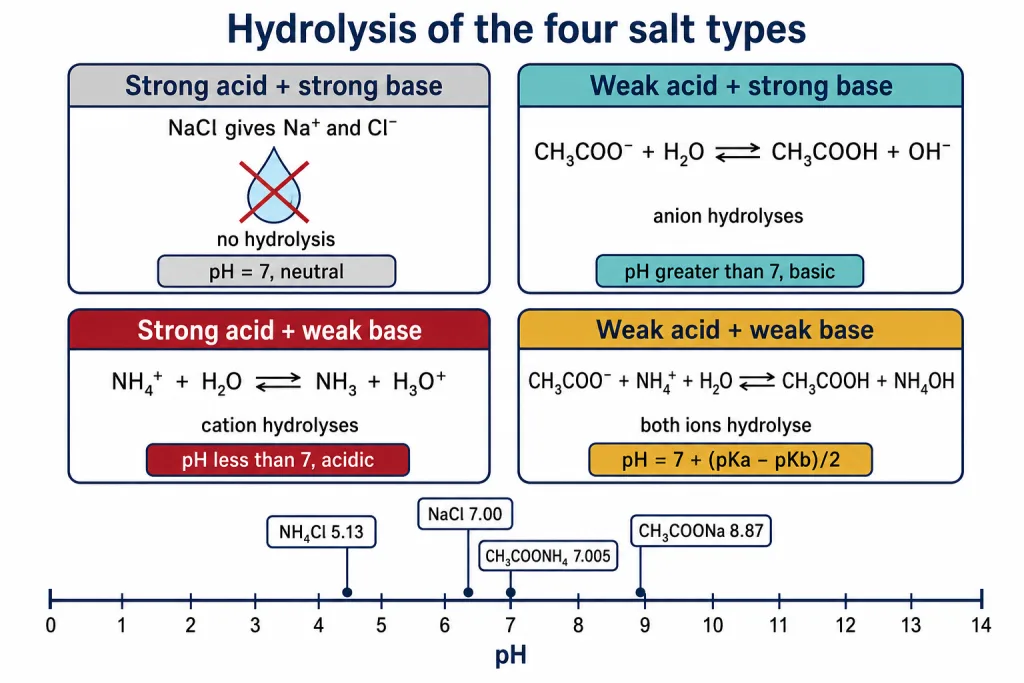
1. Strong acid with strong base — NaCl, KBr, KNO3
NaCl(aq)→Na+(aq)+Cl−(aq)
Na+ comes from NaOH and Cl− comes from HCl. Neither reacts with water. Only the water equilibrium is left, and the solution is neutral: pH=7 at 298K.
2. Weak acid with strong base — CH3COONa, NaCN, KF, NaNO2
CH3COONa(aq)→CH3COO−(aq)+Na+(aq)
CH3COO−(aq)+H2O(l)⇌CH3COOH(aq)+OH−(aq)
Acetic acid, Ka=1.74×10⁻⁵, is weak, so the acetic acid formed stays largely unionised and the liberated OH− is not mopped up. The solution is basic, pH>7. This is anionic hydrolysis.
3. Strong acid with weak base — NH4Cl, NH4NO3, (NH4)2SO4
NH4Cl(aq)→NH4+(aq)+Cl−(aq)
NH4+(aq)+H2O(l)⇌NH3(aq)+H3O+(aq)
Ammonia, Kb=1.77×10⁻⁵, is weak and holds the proton loosely enough that the reaction proceeds measurably, leaving excess H3O+. The solution is acidic, pH<7. This is cationic hydrolysis.
4. Weak acid with weak base — CH3COONH4, NH4CN, HCOONH4
Both ions hydrolyse at once, one making OH− and the other making H3O+. The result is a tug of war, and the winner is whichever parent is weaker. Hydrolysis here is extensive, and the pH sits close to 7 but on the side of the stronger parent.
Salt type
Example
Ion that hydrolyses
Nature
pH at 298 K
Strong acid + strong base
NaCl
neither
neutral
=7
Weak acid + strong base
CH3COONa
anion, CH3COO−
basic
>7
Strong acid + weak base
NH4Cl
cation, NH4+
acidic
<7
Weak acid + weak base
CH3COONH4
both ions
depends on Ka vs Kb
near 7
The Hydrolysis Constant and the pH Formulae
Hydrolysis is an equilibrium, so it has a constant. For the acetate ion:
A−(aq)+H2O(l)⇌HA(aq)+OH−(aq)Kh=[A−][HA][OH−]
That expression is exactly Kb of the anion, so the conjugate relation gives it immediately:
Kh=KaKw
Multiply top and bottom by [H3O+] to see it directly: [A−][HA][OH−]×[H3O+][H3O+]=KaKw. For cationic hydrolysis the mirror result is Kh=Kw/Kb, and for a salt of a weak acid with a weak base Kh=Kw/(KaKb).
A weaker parent acid means a smaller Ka and a larger Kh: the weaker the acid, the more its salt hydrolyses.
Deriving the pH of a salt of a weak acid and a strong base. Let the salt concentration be c and the degree of hydrolysis be h.
A−
HA
OH−
Initial (M)
c
0
0
Equilibrium (M)
c(1−h)
ch
ch
Kh=c(1−h)(ch)(ch)=1−hch2≈ch2(h≪1)
h=cKh=KacKw
[OH−]=ch=Khc=KaKwc
[H3O+]=[OH−]Kw=cKwKa
Take −log of both sides:
pH=21pKw+21pKa+21logc
pH=7+21(pKa+logc)at 298K
Because logc is negative below 1M, dilution lowers the pH of such a salt towards 7.
The identical derivation on NH4++H2O⇌NH3+H3O+, with Kh=Kw/Kb, gives
pH=7−21(pKb+logc)at 298K
For a salt of a weak acid with a weak base both ions hydrolyse, the concentration terms cancel between them, and the result carries no c at all:
pH=7+21(pKa−pKb)at 298K
Key Point: For CH3COONH4 with pKa=4.76 and pKb=4.75, pH=7+21(0.01)=7.005. The pH of a weak-acid-weak-base salt does not change on dilution, because concentration never enters the formula. The solution is basic if pKa>pKb (acid weaker than base) and acidic if pKa<pKb.
[JEE Main] The three formulae differ only in signs and in which p-value appears. The safe route in an examination is to write the hydrolysis equation first, decide from it whether the solution must be acidic or basic, and only then substitute; a formula that contradicts the equation has been misremembered.
Buffer Solutions and How They Absorb Acid or Base
Add a little hydrochloric acid to a litre of pure water and the pH crashes by several units. Do the same to blood and the pH moves by a hundredth of a unit. Blood is buffered.
Key Point (Definition): A buffer solution resists change in pH when a small amount of acid or alkali is added to it, and on moderate dilution. It contains a weak acid together with its conjugate base, or a weak base together with its conjugate acid, both in appreciable concentration.
Two kinds are made in the laboratory.
Acidic buffer: a weak acid plus its salt with a strong base. CH3COOH with CH3COONa buffers around pH 4.76.
Basic buffer: a weak base plus its salt with a strong acid. NH3 with NH4Cl buffers around pH 9.25.
The mechanism is a stockpile of two species that neutralise opposite intruders. In an acetate buffer, the salt supplies plenty of CH3COO− and the acid supplies plenty of CH3COOH.
Added acid meets the acetate ion:
CH3COO−(aq)+H3O+(aq)→CH3COOH(aq)+H2O(l)
The invading H3O+ is converted into unionised acetic acid, a weak acid that barely releases it again.
Added base meets the acetic acid:
CH3COOH(aq)+OH−(aq)→CH3COO−(aq)+H2O(l)
The invading OH− is turned into water and acetate.
Either way the intruder is removed and only the ratio of salt to acid shifts. Since the pH depends on that ratio through a logarithm, a shift of ten or twenty per cent moves the pH by a few hundredths of a unit.
For a basic buffer the same two reactions run on the ammonia pair:
NH3(aq)+H3O+(aq)→NH4+(aq)+H2O(l)
NH4+(aq)+OH−(aq)→NH3(aq)+H2O(l)
Buffer capacity is set by how many moles of each partner are present. Once the added acid has consumed all the acetate, the next drop behaves as it would in plain water. A buffer made from 0.5M solutions absorbs five times as much acid as one made from 0.1M solutions at the same pH.
A mixture of a strong acid and its salt, such as HCl with NaCl, is not a buffer. Cl− is too weak a base to accept a proton, so there is nothing to absorb added acid.
The Henderson-Hasselbalch Equation
Write the ionisation of the weak acid of the buffer:
Multiply throughout by −1, which turns log[H3O+] into −pH and logKa into −pKa, and inverts the fraction inside the last logarithm:
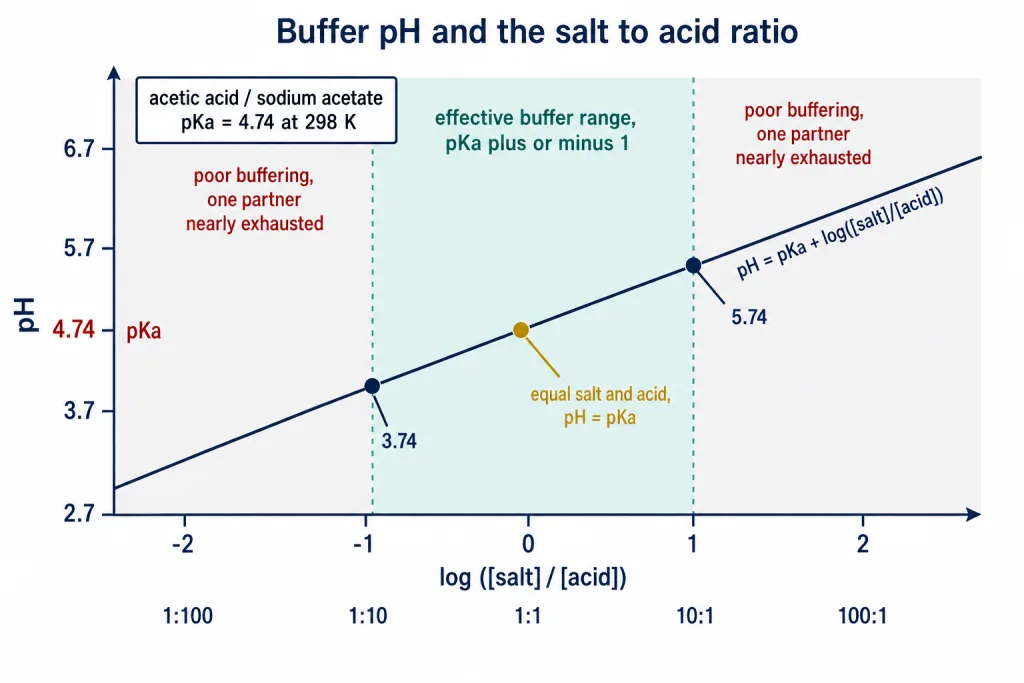
pH=pKa+log[HA][A−]
Two approximations turn this into a working formula. The acid is weak and its ionisation is further suppressed by the common ion, so [HA] is essentially the concentration of acid weighed out. Almost all the A− comes from the fully ionised salt, so [A−] is essentially the concentration of salt weighed out.
pH=pKa+log[acid][salt]
That is the Henderson-Hasselbalch equation. Three consequences follow at once.
Equimolar means pH=pKa. When [salt]=[acid] the ratio is 1, log1=0, and the pH equals the pKa of the acid. An equimolar acetic acid-sodium acetate buffer sits at 4.76.
Dilution does not change the pH. Adding water divides salt and acid by the same factor, so the ratio, and with it the pH, is unchanged. Buffer capacity does fall, because both stocks shrink.
The useful range is pKa±1. A ratio of 10:1 gives pH=pKa+1, and 1:10 gives pH=pKa−1. Outside that window one partner is so depleted that it can no longer soak up an intruder, and the buffering collapses.
For a basic buffer the same derivation applied to Kb gives
pOH=pKb+log[base][salt]
and the pH follows from pH+pOH=14 at 298K. Substituting pKa+pKb=pKw converts it into the acid form written for the conjugate pair:
pH=pKa+log[conjugate acid][base]
where pKa now belongs to the cation. For the ammonia system that pKa is 9.25, so an equimolar NH3-NH4Cl mixture sits at pH 9.25.
[JEE Main] The logarithm holds a ratio, so any unit cancels: moles, millimoles or molarity may be used, provided both partners are in the same volume and the same unit.
Designing a Buffer of a Required pH
The design problem is stated as: make one litre of buffer at a stated pH. The Henderson-Hasselbalch equation turns that into two decisions.
Step 1 — choose the acid. Pick a weak acid whose pKa lies within one unit of the target pH, and as close to it as possible. The ratio then stays between 1:10 and 10:1, where the buffer has real capacity. A target of pH 4.5 points to acetic acid, pKa=4.76. A target of pH 7.2 points to the dihydrogenphosphate ion, pKa=7.21. A target of pH 9.2 points to the ammonium ion, pKa=9.25, so a base-plus-salt mixture is used.
A target above the pKa needs more salt than acid; a target below it needs more acid than salt.
Step 3 — set the absolute concentrations. The ratio fixes the pH; the concentrations fix the capacity, and totals of 0.1 to 1M are typical.
A buffer can also be made without weighing out any salt, by partial neutralisation. Add strong base amounting to less than one equivalent of the weak acid and it converts part of the acid into its salt in the same beaker. Half-neutralisation converts exactly half, making salt and acid equal, so the pH is pKa. This is why the half-way point of a weak-acid titration is a buffer and why the titration curve is flattest there.
Some pKa values worth carrying:
Acid system
pKa at 298 K
Buffer range
HCOOH / HCOO−
3.74
2.74 to 4.74
CH3COOH / CH3COO−
4.76
3.76 to 5.76
H2CO3 / HCO3−
6.35
5.35 to 7.35
H2PO4− / HPO42−
7.21
6.21 to 8.21
NH4+ / NH3
9.25
8.25 to 10.25
[Board] A design answer must name the pair, quote the pKa, show the ratio calculation and state the concentrations chosen.
The Buffer That Keeps Blood at 7.4
Human blood plasma is held between pH 7.35 and 7.45. Enzymes lose their shape and their activity outside that band. A drop below 7.35 is acidosis; a rise above 7.45 is alkalosis. Both are medical emergencies at a fraction of a pH unit.
The main defence is the carbonic acid-hydrogencarbonate pair. Carbon dioxide from respiring tissue dissolves and hydrates:
CO2(g)⇌CO2(aq)CO2(aq)+H2O(l)⇌H2CO3(aq)
H2CO3(aq)+H2O(l)⇌H3O+(aq)+HCO3−(aq)
Acid produced by metabolism is absorbed by the hydrogencarbonate ion, and any base is absorbed by carbonic acid:
HCO3−(aq)+H3O+(aq)→H2CO3(aq)+H2O(l)
H2CO3(aq)+OH−(aq)→HCO3−(aq)+H2O(l)
The acid of the pair is carbonic acid itself, pKa1=6.35, the value already listed in the table above. The Henderson-Hasselbalch equation then reads
pH=6.35+log[H2CO3][HCO3−]
and pH 7.4 requires log of the ratio to be 7.4−6.35=1.05, that is a ratio of 101.05≈11. Blood accordingly keeps its hydrogencarbonate stock roughly eleven times its carbonic acid, well over on the base side.
An 11:1 ratio is outside the pKa±1 window, and a sealed bottle of this mixture would be a poor buffer. Blood escapes the limit because the system is open at both ends. The lungs blow off CO2, adjusting the denominator within seconds by changing the breathing rate; the kidneys retain or excrete HCO3−, adjusting the numerator over hours. Both stocks are under active control, so blood absorbs far more acid than the equation alone would predict, and the lopsided ratio is deliberate: metabolism produces acid, so the reserve is kept on the base side.
The dihydrogenphosphate-hydrogenphosphate pair, pKa=7.21, does the same job inside cells and in urine.
Key Point: Blood is buffered at pH 7.4 by H2CO3 and HCO3− in a ratio near 11:1, with the lungs controlling CO2 and the kidneys controlling HCO3−. Holding the breath raises dissolved CO2 and lowers blood pH; hyperventilation strips CO2 out and raises it.
Question 1: How far a common ion suppresses ionisation
For 0.05M acetic acid, Ka=1.74×10⁻⁵, find the degree of ionisation and the pH. Repeat for the same acid made 0.05M in sodium acetate.
Answer:
Without the salt I use Ostwald's dilution law.
α=Ka/c=1.74×10−5/0.05=3.48×10−4=1.87×10−2
[H3O+]=cα=0.05×1.87×10−2=9.35×10⁻⁴M, so pH=3.03.
With the salt, acetate starts at 0.05M. Letting x be the acid that ionises, and using x≪0.05 on both sides,
Ka=0.05−xx(0.05+x)≈0.05x×0.05=x
So [H3O+]=1.74×10⁻⁵M and pH=4.76.
α=1.74×10⁻⁵/0.05=3.48×10−4
Ans: Alone, α=1.9% and pH=3.03; with acetate, α=0.035% and pH=4.76. Ionisation is suppressed about 54 times and the pH rises by 1.73 units.
Watch out: Ostwald's law cannot be used on the second solution. It assumes the only source of the anion is the acid itself, which is exactly what the added salt destroys.
Question 2: A common ion supplied by a strong acid
The ionisation constant of propanoic acid is 1.32×10⁻⁵. Find its degree of ionisation in a 0.05M solution and the pH. What is the degree of ionisation if the solution is also 0.01M in HCl?
Answer:
Alone: α=1.32×10⁻⁵/0.05=2.64×10−4=1.62×10−2.
[H3O+]=0.05×1.62×10−2=8.12×10⁻⁴M, so pH=3.09.
With HCl present, the hydronium ion is the common ion. Hydrochloric acid is strong and fully ionised, and the propanoic acid contributes almost nothing beside it, so [H3O+]=0.01M.
Ka=[HA][H3O+][A−]=0.050.01×0.05α=0.01α
α=0.011.32×10−5=1.32×10⁻³
Ans:α=1.62×10⁻² and pH=3.09 alone; α=1.32×10⁻³ in 0.01MHCl, a suppression of about 12 times.
Question 3: Ammonia with ammonium chloride
Calculate the pH of 0.10M ammonia, Kb=1.77×10⁻⁵, and the pH after enough NH4Cl is dissolved in it to make the solution 0.10M in ammonium ion.
Answer:
Alone: [OH−]=Kbc=1.77×10−5×0.10=1.33×10⁻³M.
pOH=−log(1.33×10⁻³)=2.88, so pH=14.00−2.88=11.12.
With the salt, [NH4+]=0.10M and [NH3]=0.10M to a good approximation.
Kb=[NH3][NH4+][OH−]=0.100.10×[OH−], so [OH−]=Kb=1.77×10⁻⁵M.
pOH=4.75 and pH=9.25.
Ans:pH=11.12 alone; pH=9.25 with the common ion.
Watch out: For a base, the equimolar mixture gives pOH=pKb, not pH=pKb. Stopping at 4.75 and calling it the pH is the standard slip.
Question 4: pH and degree of hydrolysis of sodium nitrite
The ionisation constant of nitrous acid is 4.5×10⁻⁴. Calculate the pH of 0.04M sodium nitrite and its degree of hydrolysis.
Answer:
NaNO2 is a salt of a weak acid with a strong base, so the nitrite ion hydrolyses:
NO2−(aq)+H2O(l)⇌HNO2(aq)+OH−(aq)
Kh=KaKw=4.5×10−41.0×10−14=2.22×10⁻¹¹
h=Kh/c=2.22×10−11/0.04=5.56×10−10=2.36×10−5
[OH−]=ch=0.04×2.36×10−5=9.43×10⁻⁷M
pOH=6.03, so pH=7.97.
The formula route agrees: pKa=3.35, and pH=7+21(3.35−1.40)=7.97.
Ans:pH=7.97; h=2.4×10⁻⁵, that is 0.0024%.
Question 5: An acid and its salt at the same concentration
The ionisation constant of chloroacetic acid is 1.35×10⁻³. Find the pH of a 0.1M solution of the acid and of a 0.1M solution of its sodium salt.
Answer:
The acid first, with the usual check: c/Ka=0.1/(1.35×10−3)=74, far below the threshold of 400, so α comes out well above 5 per cent and the square-root form is not allowed. I solve the quadratic.
The salt hydrolyses through its anion. pKa=−log(1.35×10⁻³)=2.87.
pH=7+21(pKa+logc)=7+21(2.87−1.00)=7+0.94=7.94
Ans: Acid, pH=1.96; salt, pH=7.94.
Watch out: The shortcut Kac=1.16×10⁻²M would have given 1.94; with c/Ka=74 it was never available, and the quadratic is what the chapter's own test demands. Chloroacetic acid is also strong enough that its salt hydrolyses only slightly, which is why 7.94 sits nearer 7 than the 8.88 given by 0.1M sodium acetate.
Question 6: A salt of a weak acid and a weak base
Given pKa(CH3COOH)=4.76, pKa(HCOOH)=3.74 and pKb(NH4OH)=4.75, find the pH of ammonium acetate solution and of ammonium formate solution.
Answer:
Both ions hydrolyse, so concentration drops out and
Ammonium formate: pH=7+21(3.74−4.75)=7−0.505=6.50 to two decimals.
Formic acid is the stronger of the two parents, so its salt with a weak base is acidic.
Ans: Ammonium acetate, pH=7.005 (very nearly neutral); ammonium formate, pH=6.50 (acidic).
Watch out: No concentration is given, and none is needed for this salt type.
Question 7: Working backwards to the base constant of pyridine
A 0.02M solution of pyridinium hydrochloride is found to have [H3O+]=3.36×10⁻⁴M. Calculate the ionisation constant of pyridine, and the pH of the solution.
Answer:
The salt comes from a strong acid and the weak base pyridine, so the pyridinium cation hydrolyses:
C5H5NH+(aq)+H2O(l)⇌C5H5N(aq)+H3O+(aq)
pH=−log(3.36×10⁻⁴)=3.47
h=0.023.36×10−4=1.68×10⁻²
Kh=ch2=0.02×(1.68×10−2)2=5.64×10⁻⁶
Kh=KbKw, so Kb=5.64×10−61.0×10−14=1.77×10⁻⁹.
Ans:Kb(pyridine)=1.77×10⁻⁹; pH=3.47Watch out:Kh here is Kw/Kb because the cation is hydrolysing. Dividing by Ka instead inverts the whole calculation.
Question 8: What a buffer actually saves you from
One litre of solution contains 0.10mol acetic acid and 0.10mol sodium acetate, pKa=4.76. Find the pH, and the pH after adding 0.010mol of HCl and, separately, 0.010mol of NaOH. Compare with adding the same acid to a litre of pure water.
Answer:
Initially the ratio is 1, so pH=pKa=4.76.
Added H3O+ converts acetate into acetic acid, mole for mole: salt 0.10−0.010=0.090mol, acid 0.10+0.010=0.110mol.
pH=4.76+log0.1100.090=4.76−0.09=4.67
Added OH− converts acid into acetate: salt 0.110, acid 0.090.
pH=4.76+log0.0900.110=4.76+0.09=4.85
In pure water, 0.010mol of HCl per litre gives [H3O+]=0.010M and pH=2.00.
Ans: Buffer moves from 4.76 to 4.67 or 4.85, a change of 0.09; water moves from 7.00 to 2.00, a change of 5.00.
Question 9: A buffer made by partial neutralisation
50.0mL of 0.10M ammonia is treated with 25.0mL of 0.10MHCl. Calculate the pH of the mixture. Kb=1.77×10⁻⁵.
The acid is limiting. It consumes 2.5mmol of ammonia and produces 2.5mmol of NH4+, leaving 2.5mmol of ammonia. Total volume is 75.0mL, so each is 0.033M.
Base and its conjugate acid are present in equal amounts, so
[OH−]=Kb×[NH4+][NH3]=1.77×10⁻⁵M
[H3O+]=1.77×10−51.0×10−14=5.6×10⁻¹⁰M, so pH=9.25.
Ans:pH=9.25Watch out: This is the half-neutralisation point, so the pH is fixed by pKa of NH4+ alone and the dilution to 75mL cancels in the ratio.
Question 10: Designing a buffer to order
How much sodium acetate must be dissolved in one litre of 0.10M acetic acid to give a buffer of pH 4.30? Take pKa=4.76 and M(CH3COONa)=82gmol−1. Assume no volume change.
Answer:
4.30 lies within one unit of 4.76, so acetic acid is a sound choice.
log[acid][salt]=pH−pKa=4.30−4.76=−0.46
[acid][salt]=10−0.46=0.347
[salt]=0.347×0.10=0.0347M
Mass =0.0347×82=2.85g.
Ans: About 2.8g of sodium acetate per litre.
Watch out: The target is below the pKa, so the answer must contain less salt than acid. A ratio greater than 1 here means the subtraction was done the wrong way round.
Question 11: The bicarbonate ratio in blood
Blood plasma is buffered by the H2CO3-HCO3− pair, pKa1=6.35. Find the ratio needed for pH 7.4, and the pH that results if illness halves that ratio.
Answer:
log[H2CO3][HCO3−]=pH−pKa1=7.4−6.35=1.05
[H2CO3][HCO3−]=101.05=11.2
Halved, the ratio is 5.6, and pH=6.35+log5.6=6.35+0.75=7.10.
Ans: A ratio near 11:1 holds blood at 7.4; halving it to about 5.6:1 drops the pH to 7.10, which is severe acidosis.
Watch out: A drop of 0.3 in pH looks small and is a doubling of [H3O+].
Traps Collected in One Place
A common ion never changes Ka. It changes α and the pH. Any answer claiming that adding sodium acetate lowered Ka of acetic acid is wrong on definition.
Ostwald's dilution law dies the moment a common ion appears.α=Ka/c assumes the acid is the only source of its anion. With salt present, go back to the Ka expression and cancel.
Match the formula to the equation. Salt of weak acid and strong base is basic and takes pH=7+21(pKa+logc); salt of strong acid and weak base is acidic and takes pH=7−21(pKb+logc). Writing the hydrolysis equation first tells you which side of 7 the answer must land on.
Concentration is absent only for the weak-weak salt.pH=7+21(pKa−pKb) holds at any dilution.
pKb gives pOH, not pH. In a basic buffer, pOH=pKb+log([salt]/[base]), and 14 minus that is the pH at 298K.
A strong acid and its salt is not a buffer.HCl with NaCl has no weak conjugate pair, so nothing absorbs added acid.
Dilution moves buffer capacity, not buffer pH. The ratio in the logarithm survives dilution; the stock of each partner does not.
Ready to test your knowledge?
Take a quick interactive quiz on this topic —
free, works without login.