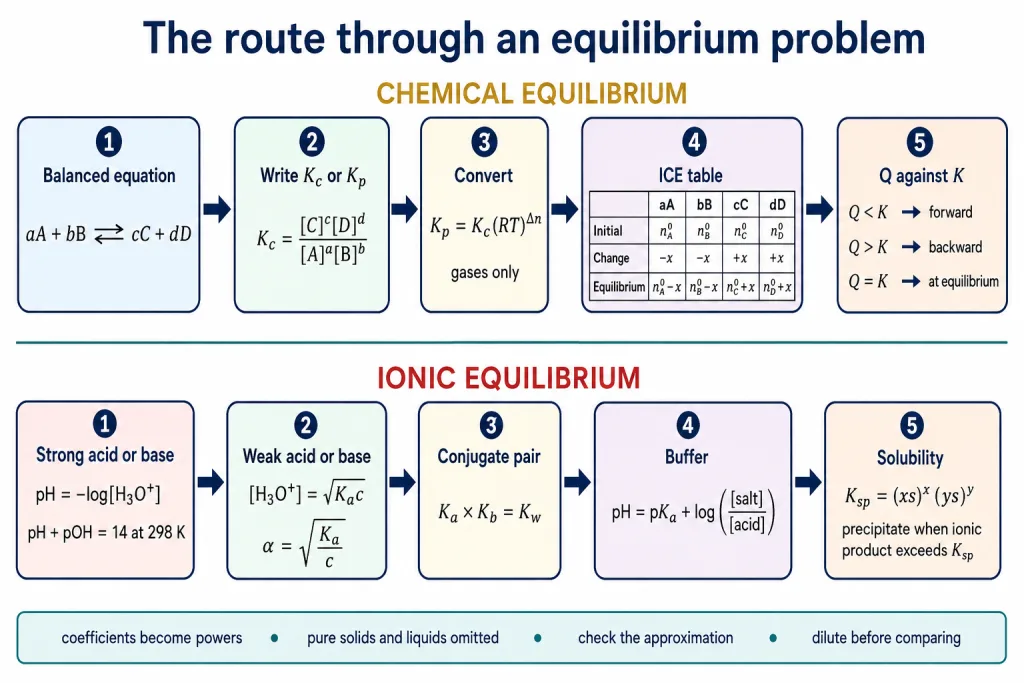
The theory is finished. What follows is one long problem set — forty questions worked out in full, arranged from the simplest to the hardest. Between them they cover the in-text problems and the end-of-chapter exercises that boards, JEE Main and NEET keep recycling, in the same order the chapter builds them: equilibrium expressions first, then the manipulation and conversion of K, then ICE tables, then Q, ΔG∘ and Le Chatelier, and finally the whole of ionic equilibrium from the pH of a strong acid to the prediction of a precipitate.
Work each question yourself before reading the answer. The working is written the way it should appear on an answer sheet: equation, expression, substitution, result.
The working method
Write the balanced equation before anything else. Every power in the equilibrium expression comes from a coefficient in that equation, and a wrong coefficient poisons everything downstream.
Decide whether the question is asking for Kc or Kp, and note the units the data arrive in. Concentrations in molL−1 go into Kc; partial pressures in bar or atm go into Kp.
Build an ICE table whenever initial amounts are given and equilibrium amounts are not. Moles must be converted to concentrations by dividing by the volume before they enter Kc.
Substitute, then look at the algebra. A perfect square on both sides lets you take a square root and avoid the quadratic entirely. A very small K lets you drop x against the initial concentration — but only after checking that x is under about five per cent of it.
Convert between Kp and Kc only at the end, using Kp=Kc(RT)Δn with Δn counted over gaseous species alone.
Finish by looking at the number. A negative concentration, a degree of dissociation above 1, or a pH of −3 for a dilute acid means an algebra slip, not a chemical discovery.
The errors that cost the most marks in this chapter
Error
Where it bites
The fix
Stoichiometric coefficients not carried into the powers
Kc and Kp expressions, and every ICE substitution
Each coefficient becomes an exponent. A 2 in front of a species means that term is squared, in the expression and in the change row alike
Pure solids and pure liquids left in the expression
Heterogeneous equilibria, Ksp, ester hydrolysis in dilute aqueous solution
Only gases and dissolved species appear. A pure solid or pure liquid has activity 1 and is absorbed into K
Δn counted over all species
Kp to Kc conversion
Δn counts gaseous moles only, products minus reactants. Solids and liquids contribute nothing
The approximation used without testing it
Weak acid and weak base pH, ICE tables with small K
Drop x only if it comes out below about five per cent of the initial concentration. Otherwise solve the quadratic
pOH written down as the answer to a pH question
Strong bases, weak bases, salts of weak acids
Any route that ends in [OH−] needs one more line: pH=14−pOH at 298 K
Dilution ignored when two solutions are mixed
Precipitation prediction, buffers made by partial neutralisation
Recompute every concentration in the total volume first, then compare the ionic product with Ksp
Inert gas assumed to shift the equilibrium
Le Chatelier questions
Added at constant volume it changes nothing at all. Only at constant pressure does it act as a dilution
[JEE/NEET] The single most productive habit in this chapter is writing Δn and the ICE row before touching the calculator.
Question 1: Writing the equilibrium constant expression
Write the expression for Kc for each of the following.
(i) 2NOCl(g)⇌2NO(g)+Cl2(g)
(ii) 2Cu(NO3)2(s)⇌2CuO(s)+4NO2(g)+O2(g)
(iii) CH3COOC2H5(aq)+H2O(l)⇌CH3COOH(aq)+C2H5OH(aq)
(iv) Fe3+(aq)+3OH−(aq)⇌Fe(OH)3(s)
(v) I2(s)+5F2⇌2IF5
Answer:
The rule is the same every time. Products over reactants, each concentration raised to its coefficient, and every pure solid or pure liquid dropped.
(i) All three are gases, nothing drops out.
Kc=[NOCl]2[NO]2[Cl2]
(ii) Both Cu(NO3)2 and CuO are pure solids. Only the two gases survive, and the denominator becomes 1.
Kc=[NO2]4[O2]
(iii) Water here is the solvent, present in vast excess, so its concentration is effectively constant and it is absorbed into Kc.
Kc=[CH3COOC2H5][CH3COOH][C2H5OH]
(iv) Fe(OH)3 is a solid, so the numerator is 1.
Kc=[Fe3+][OH−]31
(v) Solid iodine drops out.
Kc=[F2]5[IF5]2
Two things are worth noticing across the set. The reaction quotient Qc has exactly the same algebraic form in every case — the only difference is that the concentrations put into Qc need not be equilibrium values. And the units follow from the powers: in (i) the numerator carries three concentration terms against two in the denominator, so Kc has units of molL−1, while in (ii), with nothing in the denominator, the units are mol5L−5. Only when the total power above and below match does Kc come out dimensionless.
Ans: As written above in (i) to (v)
Watch out: In (iii) water is omitted only because it is the solvent. If the same esterification is run in the liquid phase with no solvent, water is a genuine reagent and must appear in the expression.
Question 2: Kc from equilibrium concentrations
(a) Find Kc for 2SO2(g)+O2(g)⇌2SO3(g) when the equilibrium concentrations are [SO2]=0.60M, [O2]=0.82M and [SO3]=1.90M.
(b) At 500 K the equilibrium concentrations for ammonia synthesis are [N2]=1.5×10⁻²M, [H2]=3.0×10⁻²M and [NH3]=1.2×10⁻²M. Find Kc.
Answer:
(a) The equation is already balanced, so I write the expression and substitute.
Both constants are comfortably above 1, so in both systems the products dominate the equilibrium mixture. That is all the magnitude of K tells you. It says nothing about how fast either mixture got there — sulphur dioxide oxidation needs a vanadium catalyst and ammonia synthesis needs iron at 700 K, and neither fact appears anywhere in Kc.
Ans: (a) Kc=12.23 (b) Kc=3.56×10²Watch out: In (b) the hydrogen term is cubed. Cubing 3.0×10⁻² gives 2.7×10⁻⁵, not 9.0×10⁻⁴; using the square instead returns 10.7, an answer smaller than Kc by a factor of 33.
Question 3: Two more constants, and one reversal
(a) At 800 K a sealed vessel holds [N2]=3.0×10⁻³M, [O2]=4.2×10⁻³M and [NO]=2.8×10⁻³M at equilibrium. Find Kc for N2(g)+O2(g)⇌2NO(g), and for the reverse reaction.
(b) At 500 K, [PCl3]=1.59M, [Cl2]=1.59M and [PCl5]=1.41M. Find Kc for PCl5(g)⇌PCl3(g)+Cl2(g).
The equal concentrations of PCl3 and Cl2 in (b) are not a coincidence. They are produced in a 1:1 ratio from a vessel that started with PCl5 alone, so they must stay equal all the way to equilibrium. Spotting that saves a line of algebra in the ICE problems later on, and it is also a quick check that the data in a question are self-consistent.
Ans: (a) Kc=0.622; reverse Kc′=1.61 (b) Kc=1.79molL−1Watch out:Kc in (a) is close to 1, which says reactants and products are present in comparable amounts — it does not mean the reaction has barely happened.
Question 4: Manipulating an equilibrium constant
(a) For NO(g)+O3(g)⇌NO2(g)+O2(g), Kc=6.3×10¹⁴ at 1000 K. What is Kc for the reverse reaction?
(b) For N2(g)+3H2(g)⇌2NH3(g), Kc=3.56×10² at 500 K. Find Kc for 21N2(g)+23H2(g)⇌NH3(g) and for 2NH3(g)⇌N2(g)+3H2(g).
(c) Given A⇌B with K1=4.0 and B⇌C with K2=2.5, find K for A⇌C.
Answer:
Three rules cover all of this. Reversing an equation inverts K. Multiplying an equation by n raises K to the power n. Adding two equations multiplies their constants.
(a) Both directions are elementary bimolecular steps, but that does not matter for the arithmetic.
Kc′=6.3×10141=1.6×10⁻¹⁵
(b) Halving the equation means raising Kc to the power 21.
Kc′=(3.56×10²)1/2=18.9
Reversing the original equation inverts it.
Kc′′=3.56×1021=2.81×10⁻³
(c) Adding the two steps gives A⇌C, so the constants multiply.
K=K1×K2=4.0×2.5=10
The reason the constants multiply is visible in the expressions themselves. K1=[B]/[A] and K2=[C]/[B], so their product is [C]/[A], which is exactly K for the overall change. The same cancellation is what makes Ka×Kb=Kw work for a conjugate pair later in the chapter, and what lets a coupled biochemical reaction with an unfavourable K be dragged forward by a second step with a large one.
Ans: (a) 1.6×10⁻¹⁵ (b) 18.9 and 2.81×10⁻³ (c) K=10Watch out: Halving the equation takes the square root, not half the value. Writing 3.56×10²/2=178 is the commonest slip here.
Question 5: Kp from Kc
For 2NOCl(g)⇌2NO(g)+Cl2(g), Kc=3.75×10⁻⁶ at 1069 K. Calculate Kp.
Answer:
I use Kp=Kc(RT)Δn with R=0.0831LbarK−1mol−1, so Kp comes out in bar.
Gaseous moles: products 2+1=3, reactants 2. So Δn=3−2=1.
RT=0.0831×1069=88.83Lbarmol−1
Kp=(3.75×10⁻⁶)(88.83)1=3.33×10⁻⁴bar
A word on the gas constant. Using R=0.0831LbarK−1mol−1 delivers Kp in bar, which is the standard state for pressure. If a question gives pressures in atmospheres, switch to R=0.0821LatmK−1mol−1 and the answer comes out in atm. The two differ by less than 2%, so the numbers look similar, but mixing them within one calculation is untidy and the units in the final answer will be wrong.
Ans:Kp=3.33×10⁻⁴barWatch out:Δn here is +1, so Kp>Kc. Using Δn=−1 by counting reactants minus products gives 4.2×10⁻⁸, wrong by four orders of magnitude.
Question 6: Kc from Kp, including a negative Δn
Find Kc for each equilibrium from the given Kp. Take R=0.0831LbarK−1mol−1.
(i) 2NOCl(g)⇌2NO(g)+Cl2(g), Kp=1.8×10⁻² at 500 K
(ii) CaCO3(s)⇌CaO(s)+CO2(g), Kp=167kPa at 1073 K
(iii) 2SO2(g)+O2(g)⇌2SO3(g), Kp=2.0×10¹⁰bar−1 at 450 K
Answer:
Rearranging, Kc=Kp(RT)−Δn.
(i) Δn=3−2=1, RT=0.0831×500=41.55.
Kc=41.551.8×10−2=4.33×10⁻⁴
(ii) The two solids contribute nothing to Δn. Gaseous products 1, gaseous reactants 0, so Δn=1 and RT=0.0831×1073=89.17. The constant is supplied in kilopascals, so it goes into bar first to match R: Kp=167kPa=1.67bar, which is the equilibrium pressure of CO2 over the solid and sits sensibly below the 2bar measured near 1100 K.
Kc=89.171.67=1.87×10⁻²molL−1
Dropping the unit and feeding a bare 167 into the same division returns 1.87molL−1, which is the figure printed wherever the constant is read as bar. Writing the unit down is what keeps the two versions from looking like a contradiction.
(iii) Gaseous products 2, gaseous reactants 3, so Δn=−1 and RT=0.0831×450=37.40.
Kc=Kp(RT)+1=(2.0×10¹⁰)(37.40)=7.48×10¹¹
The sign of Δn decides everything here, so it is worth reading off the pattern. When Δn>0, Kp exceeds Kc; when Δn<0, Kp is the smaller of the two; and when Δn=0 the two are numerically equal and both dimensionless. That last case covers H2+I2⇌2HI and the water gas shift reaction, which is why those two appear so often in questions that give a single constant without saying which it is.
Ans: (i) 4.33×10⁻⁴ (ii) 1.87×10⁻²molL−1 (iii) 7.48×10¹¹Watch out: In (ii) the temptation is to set Δn=0 because there is one species on each side. Only gases are counted, and calcium carbonate and calcium oxide are solids, so Δn=+1.
Question 7: Kp from percentage composition by volume
At a certain temperature and a total pressure of 105Pa, iodine vapour contains 40% by volume of I atoms. Calculate Kp for I2(g)⇌2I(g).
Answer:
For a gas mixture, percentage by volume is percentage by mole, so the mole fractions are 0.40 for I and 0.60 for I2.
The total pressure is 105Pa=1bar. Partial pressure is mole fraction times total pressure:
pI=0.40×1=0.40barpI2=0.60×1=0.60bar
Kp=pI2(pI)2=0.60(0.40)2=0.600.16=0.267bar
The same data give the degree of dissociation. If one mole of I2 dissociates to the extent α, the mixture contains (1−α) of I2 and 2α of I, a total of (1+α). Setting the I mole fraction equal to 0.40:
1+α2α=0.40⇒2α=0.40+0.40α⇒α=0.25
So a quarter of the iodine molecules have split. This is the same bridge between composition and α that vapour density questions use.
Ans:Kp=0.267bar (equivalently 2.67×10⁴Pa); α=0.25Watch out: The 40% belongs to the atoms I, not to I2. Swapping them gives 0.90bar.
Question 8: Kp from an initial and an equilibrium pressure
A sample of HI(g) is placed in a flask at a pressure of 0.2atm. At equilibrium the partial pressure of HI(g) is 0.04atm. Find Kp for 2HI(g)⇌H2(g)+I2(g).
Answer:
I set up the pressure ICE table. Let 2p be the fall in pHI.
2HI
H2
I2
Initial (atm)
0.20
0
0
Change (atm)
−2p
+p
+p
Equilibrium (atm)
0.20−2p
p
p
The equilibrium pressure of HI is given as 0.04atm, so 0.20−2p=0.04, giving 2p=0.16 and p=0.08atm.
Kp is dimensionless here because Δn=0, which also means Kc=Kp=4.0 without any conversion.
A check on the total pressure. At equilibrium it is 0.04+0.08+0.08=0.20atm, exactly what was there at the start — as it must be, since two moles of gas become two moles of gas. If the arithmetic had produced any other total, something in the change row would be wrong.
Ans:Kp=Kc=4.0Watch out: The decrease in HI pressure is 0.16atm, but only half of it, 0.08atm, appears as H2. Setting pH2=0.16 gives Kp=16.
Question 9: A heterogeneous equilibrium from a mass percentage
At 1127 K and 1 atm, a gaseous mixture of CO and CO2 in equilibrium with solid carbon contains 90.55% CO by mass. Calculate Kc for C(s)+CO2(g)⇌2CO(g).
Answer:
Mass percentages have to become mole fractions before they can become partial pressures. I take 100 g of the gas mixture.
nCO=2890.55=3.234molnCO2=449.45=0.2148mol
Total =3.449mol, so the mole fractions are 0.9377 and 0.0623.
At a total pressure of 1 atm, pCO=0.9377atm and pCO2=0.0623atm. Solid carbon does not appear.
The result makes physical sense. At 1127 K the Boudouard equilibrium lies well over towards carbon monoxide, which is why a hot bed of coke reduces carbon dioxide so effectively — the basis of the blast furnace.
Ans:Kp=14.1atm, Kc=0.153molL−1Watch out: Treating 90.55% as a mole percentage skips the division by molar mass and gives pCO=0.9055, Kp=8.68 and Kc=0.094.
Question 10: Reading the balanced equation off the expression
The equilibrium constant expression for a gas reaction is
Kc=[NO]4[H2O]6[NH3]4[O2]5
Write the balanced chemical equation.
Answer:
Everything in the numerator is a product, everything in the denominator a reactant, and every power is a coefficient. Reading straight off:
4NO(g)+6H2O(g)⇌4NH3(g)+5O2(g)
Checking the atom balance. Nitrogen: 4 on each side. Oxygen: 4+6=10 on the left, 5×2=10 on the right. Hydrogen: 6×2=12 on the left, 4×3=12 on the right. It balances.
The corresponding pressure form follows the same reading:
Kp=(pNO)4(pH2O)6(pNH3)4(pO2)5
with Δn=9−10=−1.
Ans:4NO(g)+6H2O(g)⇌4NH3(g)+5O2(g)Watch out: Writing the ammonia oxidation the usual way round, with NH3 and O2 as reactants, gives the reciprocal of the constant asked for.
Question 11: An ICE table that solves as a perfect square
Kc=4.24 at 800 K for CO(g)+H2O(g)⇌CO2(g)+H2(g). If only CO and H2O are present initially, each at 0.10M, find all four equilibrium concentrations.
Answer:
Let x be the concentration of CO2 formed. The stoichiometry is one-to-one throughout.
CO
H2O
CO2
H2
Initial (M)
0.10
0.10
0
0
Change (M)
−x
−x
+x
+x
Equilibrium (M)
0.10−x
0.10−x
x
x
Kc=(0.10−x)2x2=4.24
Both sides are perfect squares, so I take the square root rather than expanding.
0.10−xx=4.24=2.059
x=0.2059−2.059x⇒3.059x=0.2059⇒x=0.067
The last step of any ICE problem is to substitute back:
(0.033)2(0.067)2=1.09×10−34.49×10−3=4.12
which recovers 4.24 to within rounding. That check costs one line and catches almost every arithmetic slip.
Ans:[CO2]=[H2]=0.067M; [CO]=[H2O]=0.033MWatch out: Expanding into 3.24x2−0.848x+0.0424=0 gives roots 0.067 and 0.194. The second is impossible — it would require more CO to react than was present — so it is rejected. Taking the square root avoids the trap entirely.
Question 12: Kc from a percentage reacted
One mole of H2O and one mole of CO are taken in a 10 L vessel and heated to 725 K. At equilibrium 40% of the water by mass has reacted according to H2O(g)+CO(g)⇌H2(g)+CO2(g). Calculate the equilibrium constant.
Answer:
Moles first become concentrations. One mole in 10 L is 0.10M, for both reactants.
Two details in the wording deserve attention. "40% of water by mass" is the same as 40% by moles, because all the water in the vessel has the same molar mass — percentages by mass and by mole only diverge when different substances are being compared. And the vessel is 10 L, not 1 L, so the moles had to be converted before the ICE table was built, even though the volume happens to cancel in this particular expression.
Ans:Kc=Kp=0.44Watch out: Because Δn=0 the volume cancels, so using moles instead of concentrations happens to give the same answer here. That coincidence does not survive to any reaction with Δn=0, so build the habit of dividing by the volume.
Question 13: An ICE table needing the quadratic formula
3.00mol of PCl5 kept in a 1 L closed vessel is allowed to reach equilibrium at 380 K, where Kc=1.80. Calculate the composition of the mixture at equilibrium.
Answer:
The volume is 1 L, so moles and molarities are numerically equal. Let x be the molarity of PCl5 that dissociates.
PCl5
PCl3
Cl2
Initial (M)
3.00
0
0
Equilibrium (M)
3.00−x
x
x
Kc=3.00−xx2=1.80
Kc is not small compared with the initial concentration, so the approximation is not available and I solve properly.
Substituting back, (1.59)2/1.41=2.528/1.41=1.79, which is Kc to two decimal places. The degree of dissociation follows immediately as α=1.59/3.00=0.53, so slightly over half the phosphorus pentachloride has broken up at 380 K.
Ans:[PCl5]=1.41M; [PCl3]=[Cl2]=1.59M; α=0.53Watch out: Dropping x against 3.00 here gives x=5.40=2.32M, which is 77% of the initial concentration. The approximation is only safe when the answer it produces is small — always test it afterwards.
Question 14: Equilibrium concentrations for a 2A⇌B+C system
What is the equilibrium concentration of each substance when the initial concentration of ICl was 0.78M? 2ICl(g)⇌I2(g)+Cl2(g), Kc=0.14.
Answer:
Let x be the concentration of I2 formed. Two ICl are consumed for each I2, so ICl falls by 2x.
2ICl
I2
Cl2
Initial (M)
0.78
0
0
Equilibrium (M)
0.78−2x
x
x
Kc=(0.78−2x)2x2=0.14
Perfect squares again, so I take the root.
0.78−2xx=0.14=0.374
x=0.2918−0.748x⇒1.748x=0.2918⇒x=0.167
Then [ICl]=0.78−2(0.167)=0.78−0.334=0.446M.
Substituting back gives (0.167)2/(0.446)2=0.0279/0.199=0.140, which is Kc exactly. A second check is available too: iodine and chlorine atoms must be conserved, and 0.446+2(0.167)=0.78 accounts for all the ICl originally present.
Ans:[ICl]=0.446M; [I2]=[Cl2]=0.167MWatch out: The change row for ICl is −2x, not −x. Using −x gives x=0.212 and an ICl concentration of 0.568M.
Question 15: A heterogeneous equilibrium with a quadratic
Kp=3.0 at 1000 K for CO2(g)+C(s)⇌2CO(g). If initially pCO2=0.48bar, pCO=0, and pure graphite is present, calculate the equilibrium partial pressures.
Answer:
Graphite is a pure solid and stays out of the expression. Let x be the fall in pCO2; then pCO rises by 2x.
CO2
CO
Initial (bar)
0.48
0
Equilibrium (bar)
0.48−x
2x
Kp=pCO2(pCO)2=0.48−x(2x)2=3.0
4x2=1.44−3x⇒4x2+3x−1.44=0
x=8−3±9+4(4)(1.44)=8−3±32.04=8−3+5.66=0.33
Checking: (0.66)2/0.15=0.4356/0.15=2.9, close enough to 3.0 given the rounding of x. Notice also that the total pressure has risen from 0.48 to 0.81bar, as it should when one mole of gas becomes two.
Ans:pCO=0.66bar; pCO2=0.15barWatch out: Solid carbon must be present for the equilibrium to exist, but its amount never enters the calculation. Putting a concentration for graphite into the denominator is the standard heterogeneous-equilibrium error.
Question 16: When the small-x approximation is justified
A mixture of 0.482molN2 and 0.933molO2 is placed in a 10 L vessel and allowed to form N2O at a temperature where Kc=2.0×10−37. Determine the composition of the equilibrium mixture.
2N2(g)+O2(g)⇌2N2O(g)
Answer:
Initial concentrations: [N2]=0.482/10=0.0482M and [O2]=0.933/10=0.0933M.
Kc is 10−37, so almost nothing reacts. Let 2x be the N2O formed; x will be utterly negligible beside the initial concentrations, so I take them as unchanged.
The check is immediate: 6.6×10⁻²¹ against 0.0482 is about 10−17 per cent, so treating the reactants as unchanged was more than safe.
A constant of this size is what makes the atmosphere possible. Nitrogen and oxygen sit together in air at room temperature without reacting to any measurable extent, and Kc=2.0×10−37 says the equilibrium position itself forbids it, quite apart from how slow the reaction is. Only the enormous temperatures inside an engine cylinder or a lightning channel raise K enough for nitrogen oxides to form in quantity.
Ans:[N2]=0.0482M, [O2]=0.0933M, [N2O]=6.6×10⁻²¹MWatch out: The nitrogen term is squared. Leaving it as 0.0482 instead of (0.0482)2 gives 3.0×10⁻²⁰M.
Question 17: Which way will the mixture move
(a) A mixture of 1.57molN2, 1.92molH2 and 8.13molNH3 is put into a 20 L vessel at 500 K, where Kc=1.7×10² for N2(g)+3H2(g)⇌2NH3(g). Is the mixture at equilibrium? If not, which way does it go?
(b) At 500 K, Kc=0.061 for the same reaction. A mixture contains 3.0MN2, 2.0MH2 and 0.5MNH3. Same question.
Answer:
The tool is the reaction quotient Qc, built exactly like Kc but from whatever concentrations happen to be present.
Qc=2.38×10³ is far larger than Kc=1.7×10². Too much product is present, so the net reaction runs backwards, decomposing ammonia into nitrogen and hydrogen.
(b)
Qc=(3.0)(2.0)3(0.5)2=240.25=0.0104
Qc=0.0104 is smaller than Kc=0.061, so the net reaction runs forwards, making more ammonia.
The whole comparison can be done in pressures instead, using Qp against Kp, and the verdict is identical. What must never be done is compare a Qc with a Kp, or a Q built from moles with a K built from concentrations — the numbers are then in different currencies and the direction they suggest is meaningless.
Ans: (a) Not at equilibrium; Qc>Kc, so it goes in the reverse direction (b) Not at equilibrium; Qc<Kc, so it goes forward
Watch out: Moles must be divided by the 20 L before Qc is built. Feeding the raw moles into (a) gives Qc=(8.13)2/[(1.57)(1.92)3]=5.95, which would suggest the forward direction — the exact opposite of the truth.
Question 18: ΔG∘ and the equilibrium constant
Calculate (a) ΔrG∘ and (b) the equilibrium constant for the formation of NO2 from NO and O2 at 298 K.
NO(g)+21O2(g)⇌NO2(g)
Given ΔfG∘(NO2)=52.0kJmol−1, ΔfG∘(NO)=87.0kJmol−1, ΔfG∘(O2)=0.
Answer:
(a) Standard Gibbs energy of reaction is products minus reactants, each weighted by its coefficient. Oxygen is an element in its standard state, so it contributes nothing.
ΔrG∘=52.0−(87.0+21(0))=−35.0kJmol−1
(b) At equilibrium ΔG=0 and Q=K, so ΔrG∘=−RTlnK.
lnK=−RTΔrG∘=8.314×29835000=2477.635000=14.13
K=e14.13=1.4×10⁶
A negative ΔrG∘ and a K far above 1 say the same thing: at 298 K the equilibrium lies well over towards NO2.
The distinction between ΔG and ΔG∘ is worth holding on to. ΔG∘ is a fixed property of the reaction at a given temperature and is tied to K alone. ΔG describes the mixture actually in front of you, through ΔG=ΔG∘+RTlnQ, and it changes continuously as the reaction proceeds. At equilibrium Q=K, the two terms cancel, and ΔG becomes zero — the reaction has no remaining driving force in either direction, even though molecules are still turning over.
Ans: (a) ΔrG∘=−35.0kJmol−1 (b) K=1.4×10⁶Watch out:ΔrG∘ must be in joules before dividing by R in JK−1mol−1. Using 35 instead of 35000 gives lnK=0.0141 and K=1.01.
Question 19: Both directions between K and ΔG∘
(a) ΔG∘ for the phosphorylation of glucose in glycolysis is 13.8kJmol−1. Find Kc at 298 K.
(b) For the hydrolysis of sucrose, sucrose+H2O⇌glucose+fructose, Kc=2×10¹³ at 300 K. Find ΔG∘.
ΔG∘ is positive and Kc is well below 1, so left to itself this step barely proceeds. In the cell it is driven by coupling to ATP hydrolysis.
(b)
lnKc=ln(2×10¹³)=30.63
ΔG∘=−RTlnKc=−(8.314)(300)(30.63)=−7.64×10⁴Jmol−1
A large negative ΔG∘ and Kc=2×10¹³ mean that sucrose in water is thermodynamically almost entirely converted to glucose and fructose. Yet a sugar solution sits on the shelf unchanged for months, because without acid or the enzyme invertase the reaction has no accessible pathway. K and ΔG∘ fix where the system is heading, never how long it takes to arrive.
Ans: (a) Kc=3.81×10⁻³ (b) ΔG∘=−76.4kJmol−1Watch out: The natural logarithm is required, not log10. Using log10(2×10¹³)=13.30 in (b) gives −33.2kJmol−1, short by a factor of 2.303.
Question 20: Le Chatelier and a change of pressure
(a) Does the number of moles of products increase, decrease or stay the same when the pressure on each equilibrium is decreased by increasing the volume?
(i) PCl5(g)⇌PCl3(g)+Cl2(g)
(ii) CaO(s)+CO2(g)⇌CaCO3(s)
(iii) 3Fe(s)+4H2O(g)⇌Fe3O4(s)+4H2(g)
(b) Which of these are affected by an increase in pressure, and in which direction do they shift?
One rule settles all of it. Count gaseous moles on each side. Raising the pressure pushes the system towards the side with fewer gaseous moles; lowering it pushes towards the side with more. Solids and liquids are not counted.
(a) (i) 1 gaseous mole on the left, 2 on the right. Lowering the pressure favours the right, so the moles of product increase.
(ii) 1 gaseous mole on the left, 0 on the right. Lowering the pressure favours the left, so CaCO3decreases.
(iii) 4 gaseous moles on each side, Δn=0. Pressure has no effect, so the amounts stay the same.
(b) I list gaseous moles as left → right.
Reaction
Gaseous moles
Effect of raising pressure
(i) COCl2 decomposition
1→2
Shifts backward
(ii) CH4+2S2
3→3
No shift
(iii) CO2+C(s)
1→2
Shifts backward
(iv) 2H2+CO
3→1
Shifts forward
(v) CaCO3 decomposition
0→1
Shifts backward
(vi) Ammonia oxidation
9→10
Shifts backward
The mechanism behind the rule is worth stating once. Compressing the vessel raises every partial pressure by the same factor, but the expression for Qp raises them to different total powers above and below the line, so Qp moves away from Kp whenever Δn=0. The system then shifts to bring Qp back. When Δn=0 the factor cancels top and bottom, Qp never moves, and compression does nothing at all.
Ans: (a) (i) increase, (ii) decrease, (iii) unchanged. (b) All except (ii) are affected; (iv) shifts forward, the rest shift backward
Watch out: In (b)(iii) and (v) the solid must be ignored when counting. Counting carbon or calcium carbonate makes both look like Δn=0 and unaffected, which is wrong.
Question 21: Temperature, catalyst and the inert gas trap
(a) For the endothermic reaction CH4(g)+H2O(g)⇌CO(g)+3H2(g), write Kp, and say how Kp and the equilibrium composition respond to (i) an increase in pressure, (ii) an increase in temperature, (iii) a catalyst.
(b) For PCl5(g)⇌PCl3(g)+Cl2(g), Kc=8.3×10⁻³ at 473 K and ΔrH∘=+124.0kJmol−1. Write Kc, find Kc for the reverse reaction, and state the effect on Kc of adding more PCl5, raising the pressure, and raising the temperature.
(c) Argon is added to the PCl5 equilibrium, first at constant volume and then at constant pressure. What happens in each case?
Answer:
(a)
Kp=pCH4⋅pH2OpCO⋅(pH2)3
(i) Raising the pressure does not touch Kp, which depends only on temperature. Gaseous moles go 2→4, so the mixture shifts backward and the yield of CO and H2 falls.
(ii) The reaction is endothermic, so heat behaves like a reactant. Raising the temperature shifts it forward and, unlike pressure, genuinely increases Kp.
(iii) A catalyst changes neither Kp nor the composition. It lowers the activation energy of both directions equally, so equilibrium arrives sooner and at the same place.
(b)
Kc=[PCl5][PCl3][Cl2]
For the reverse reaction,
Kc′=8.3×10−31=1.2×10²
Adding more PCl5 shifts the position of equilibrium forward but leaves Kc untouched. Raising the pressure shifts it backward and again leaves Kc untouched. Raising the temperature is the only one of the three that changes Kc, and because ΔrH∘ is positive, Kc increases.
(c) At constant volume, argon changes the total pressure but not the volume and therefore not a single partial pressure or concentration. Q is unchanged, so nothing shifts. At constant pressure the vessel must expand to accommodate the argon; every partial pressure falls, exactly as in a dilution, and the equilibrium shifts towards the side with more gaseous moles — forward, towards PCl3 and Cl2.
The reason the constant-volume case is so often got wrong is that "increase the pressure" is read as a single instruction with a single answer. It is not. Raising the pressure by pushing the piston in compresses the reacting gases and shifts the equilibrium; raising it by pumping in an unreactive gas at fixed volume leaves every reacting species exactly where it was. Only the partial pressures matter, and only a volume change alters them.
Ans: (a) Kp unchanged by pressure and catalyst, increased by temperature; composition shifts backward on compression, forward on heating, unchanged by a catalyst. (b) Kc′=1.2×10²; only temperature changes Kc, and it raises it. (c) No shift at constant volume; forward shift at constant pressure
Watch out: Concentration and pressure changes move the position of equilibrium but never the value of K. Only temperature changes K.
Question 22: Degree of dissociation from a total pressure
13.8g of N2O4 was placed in a 1 L reaction vessel at 400 K and allowed to reach equilibrium, N2O4(g)⇌2NO2(g). The total pressure at equilibrium was 9.15bar. Calculate the partial pressures at equilibrium, Kp, Kc and the degree of dissociation. Take R=0.0831LbarK−1mol−1.
Answer:
First the initial pressure, from the ideal gas equation. The molar mass of N2O4 is 92gmol−1, so n=13.8/92=0.15mol.
The degree of dissociation is the fraction of N2O4 that has decomposed:
α=pinitialx=4.994.16=0.834
There is a shortcut worth knowing. For A⇌2B starting from pure A at pressure p0, the total pressure at equilibrium is p0(1+α). Here 9.15/4.99=1.834, giving α=0.834 in one line. The same relation read backwards is how a measured vapour density delivers α: the observed molar mass falls to M/(1+α) as one molecule becomes two.
Ans:pN2O4=0.83bar, pNO2=8.32bar, Kp=83.4bar, Kc=2.51molL−1, α=0.834Watch out: The rise in total pressure equals x, not 2x, because one mole of N2O4 is lost for every two moles of NO2 gained. Setting 9.15−4.99=2x gives α=0.42.
Question 23: Conjugate pairs and Lewis classification
(a) Write the conjugate bases of HF, H2SO4 and HCO3−.
(b) Write the conjugate acids of NH2−, NH3 and HCOO−.
(c) H2O, HCO3−, HSO4− and NH3 can each act as both a Bronsted acid and a Bronsted base. Give the conjugate acid and the conjugate base of each.
(d) Classify OH−, F−, H+ and BCl3 as Lewis acids or Lewis bases. Which of H2O, BF3, H+ and NH4+ are Lewis acids?
Answer:
(a) A conjugate base has one proton fewer and one unit more negative charge: F−, HSO4−, CO32−.
(b) A conjugate acid has one proton more: NH3, NH4+, HCOOH.
(c)
Species
Conjugate acid
Conjugate base
H2O
H3O+
OH−
HCO3−
H2CO3
CO32−
HSO4−
H2SO4
SO42−
NH3
NH4+
NH2−
(d) A Lewis base donates a lone pair; a Lewis acid accepts one. OH− and F− both carry lone pairs and are Lewis bases. H+ has an empty 1s orbital and accepts a pair, so it is a Lewis acid. BCl3 has an incomplete octet at boron and is a Lewis acid.
The species in (c) are amphiprotic: each can lose a proton to give its conjugate base or gain one to give its conjugate acid. Water is the standard example, acting as a base towards HCl and as an acid towards NH3, and this dual behaviour is exactly what makes the self-ionisation of water, and therefore Kw, possible.
Of the second set, BF3 and H+ are Lewis acids. H2O has two lone pairs and is a Lewis base. NH4+ is a Bronsted acid but not a Lewis acid — nitrogen already has a complete octet and all four positions used, so it has no room to accept an electron pair.
Ans: (a) F−, HSO4−, CO32− (b) NH3, NH4+, HCOOH (c) as tabulated (d) Lewis bases OH−, F−, H2O; Lewis acids H+, BCl3, BF3Watch out: A conjugate pair differs by exactly one proton. H2SO4 and SO42− differ by two, so they are not a conjugate pair.
Question 24: pH of strong acids and strong bases
(a) The hydrogen ion concentration in a soft drink is 3.8×10⁻³M. Find its pH.
(b) Assuming complete dissociation, find the pH of 0.003MHCl, 0.005MNaOH, 0.002MHBr and 0.002MKOH at 298 K.
(c) The pH of a sample of vinegar is 3.76. Find its hydrogen ion concentration.
Answer:
(a)
pH=−log(3.8×10⁻³)=−(log3.8−3)=3−0.58=2.42
(b) For a strong monobasic acid the acid concentration is the hydrogen ion concentration; for a strong monoacidic base it is the hydroxide concentration, and pH follows from pH=14−pOH at 298 K.
HCl: [H3O+]=3×10⁻³, pH=3−0.477=2.52.
NaOH: [OH−]=5×10⁻³, pOH=3−0.699=2.30, pH=11.70.
HBr: [H3O+]=2×10⁻³, pH=3−0.301=2.70.
KOH: [OH−]=2×10⁻³, pOH=2.70, pH=11.30.
(c)
[H3O+]=10−3.76=100.24×10−4=1.74×10⁻⁴M
Reading an antilogarithm of a negative number is where marks leak away in the exam hall. The trick is to split −3.76 into −4+0.24, take the antilog of the positive fraction and attach the power of ten. Writing 10−3.76 as −1.74×10⁻⁴, or as 1.74×10⁻³, are the two usual outcomes of skipping that split.
[NEET] Vinegar is roughly 5% acetic acid, and a pH near 3 for a solution that concentrated is itself the evidence that acetic acid is weak — a strong acid at the same concentration would sit near pH 0.
Ans: (a) 2.42 (b) 2.52, 11.70, 2.70, 11.30 (c) 1.74×10⁻⁴MWatch out: The two base answers stop halfway if pOH is reported as pH. Quoting 2.30 for 0.005MNaOH turns a strong base into a strong acid.
Question 25: pH from a weighed mass and from a dilution
Calculate the pH of:
(a) 2g of TlOH dissolved in water to give 2 L of solution
(b) 0.3g of Ca(OH)2 dissolved in water to give 500mL of solution
(c) 0.3g of NaOH dissolved in water to give 200mL of solution
(d) 1mL of 13.6MHCl diluted with water to give 1 L of solution
Answer:
(a) Molar mass of TlOH=204+17=221gmol−1.
c=22/221=4.52×10−3M
TlOH is monoacidic, so [OH−]=4.52×10⁻³, pOH=2.34 and pH=11.66.
(b) Molar mass of Ca(OH)2=74gmol−1.
c=0.50.3/74=8.11×10−3M
Each formula unit gives two hydroxide ions, so [OH−]=1.62×10⁻²M, pOH=1.79 and pH=12.21.
(c) Molar mass of NaOH=40gmol−1.
c=0.20.3/40=3.75×10−2M
pOH=−log(3.75×10⁻²)=1.43, so pH=12.57.
(d) Dilution conserves moles: M1V1=M2V2.
M2=100013.6×1=1.36×10⁻²M
pH=−log(1.36×10⁻²)=1.87
All four share one structure: get to moles, get to a concentration in the final volume, count the ionisable hydrogens or hydroxides per formula unit, then take the logarithm. Nothing about a weak electrolyte enters, because thallium hydroxide, calcium hydroxide, sodium hydroxide and hydrochloric acid are all treated here as completely dissociated.
Ans: (a) 11.66 (b) 12.21 (c) 12.57 (d) 1.87
Watch out: In (b) the factor of 2 for a diacidic base is the whole question. Using 8.11×10⁻³ as [OH−] gives a pH of 11.91 instead of 12.21.
Question 26: A very dilute acid, and neutral water at another temperature
(a) Calculate the pH of a 1.0×10⁻⁸M solution of HCl.
(b) The ionic product of water at 310 K is 2.7×10⁻¹⁴. What is the pH of neutral water at this temperature?
Answer:
(a) Writing pH=−log(10−8)=8 would make a solution of hydrochloric acid alkaline, which is nonsense. At this dilution the water's own ionisation supplies more hydrogen ion than the acid does, and both sources must be counted.
Let x=[OH−], all of it from water. Water contributes x of H3O+ as well, and the acid contributes 10−8.
So [OH−]=9.5×10⁻⁸M, pOH=7.02 and pH=6.98 — just on the acidic side of neutral, which is what a trace of acid should do.
(b) Neutral means [H3O+]=[OH−], so [H3O+]2=Kw.
[H3O+]=2.7×10−14=1.64×10⁻⁷M
pH=−log(1.64×10⁻⁷)=6.78
The water is still neutral. Its pH is below 7 only because Kw has risen with temperature. Self-ionisation is endothermic, so heating water shifts it forward, raises Kw, and lowers the pH of the neutral point. At 310 K, blood temperature, that neutral point is 6.78, and a fluid at pH 7.0 there is very slightly alkaline.
A rule of thumb for part (a): the water contribution only matters when the acid or base concentration is within about two orders of magnitude of 10−7M. At 10−3M the acid outsupplies water ten thousandfold and can be used alone; at 10−8M water dominates; at 10−6M the correction is small but real.
Ans: (a) pH=6.98 (b) pH=6.78, and the water is neutral
Watch out: Neutrality is [H3O+]=[OH−], not pH=7. The number 7 is specific to 298 K, where Kw=10−14.
Question 27: A weak acid solved without the approximation
The ionisation constant of HF is 3.5×10⁻⁴. Calculate the degree of dissociation of HF in its 0.02M solution, the concentration of H3O+, F− and HF, and the pH.
Answer:
Two proton transfers are possible, from HF and from water. Since Ka=3.5×10⁻⁴ vastly exceeds Kw=10−14, only the first matters.
The mass balance holds: 2.5×10⁻³+1.75×10−2=2.0×10⁻²M, the whole of the hydrogen fluoride originally dissolved, now split between ionised and unionised forms. That check is available in every weak electrolyte problem and takes one line.
Ans:α=0.124; [H3O+]=[F−]=2.5×10⁻³M; [HF]=1.75×10⁻²M; pH=2.61Watch out: The approximation α=Ka/c gives α=0.132 here, and 13.2% ionisation is above the five per cent limit, so the quadratic is the honest route. It happens to be close this time; at higher Ka or lower c it will not be.
Question 28: Ostwald's dilution law in action
(a) The ionisation constant of acetic acid is 1.74×10⁻⁵. Calculate its degree of dissociation in a 0.05M solution, the acetate ion concentration, and the pH.
(b) Calculate the pH of a 0.08M solution of hypochlorous acid, Ka=2.5×10⁻⁵, and its percentage dissociation.
Answer:
(a) For a weak acid at concentration c, Ka=cα2/(1−α). When α is small, 1−α≈1 and Ostwald's dilution law follows:
α=cKa=0.051.74×10−5=3.48×10−4=1.87×10⁻²
That is 1.87%, comfortably below five per cent, so the approximation stands.
[CH3COO−]=[H3O+]=cα=0.05×1.87×10−2=9.35×10⁻⁴M
pH=−log(9.35×10⁻⁴)=3.03
(b) Let x=[H3O+] in HOCl(aq)+H2O(l)⇌H3O+(aq)+ClO−(aq). The constant used is the 2.5×10⁻⁵ that this standard problem supplies, not the 3.0×10⁻⁸ tabulated for HOCl at 298 K.
Ka=0.08−xx2≈0.08x2=2.5×10−5
x2=2.0×10⁻⁶⇒x=1.41×10⁻³M
pH=−log(1.41×10⁻³)=2.85
percent dissociation=0.081.41×10−3×100=1.76%
Ostwald's law also predicts what dilution does. Since α=Ka/c, diluting a weak acid a hundredfold multiplies α by ten. The degree of ionisation rises, but [H3O+]=cα=Kac falls, so the solution becomes both more ionised and less acidic at the same time. Students who expect those two to move together lose marks on exactly this point.
Ans: (a) α=1.87×10⁻², [CH3COO−]=9.35×10⁻⁴M, pH=3.03 (b) pH=2.85, 1.76% dissociated
Watch out:α is a fraction, [H3O+] is cα. Substituting α itself into −log gives a pH of 1.73 in (a).
Question 29: Finding Ka from a measurement
(a) The pH of a 0.01M solution of an organic acid is 4.15. Calculate the concentration of the anion, the ionisation constant of the acid, and its pKa.
(b) The degree of ionisation of a 0.1M bromoacetic acid solution is 0.132. Calculate the pH and the pKa.
Answer:
(a) From the pH,
[H3O+]=10−4.15=7.08×10⁻⁵M
The acid is monoprotic and water's contribution is negligible, so [A−]=[H3O+]=7.08×10⁻⁵M.
The undissociated acid left is 0.01−7.08×10⁻⁵≈9.93×10⁻³M.
Comparing the two acids shows the scale in action. The organic acid of part (a) has pKa=6.30 and ionises about 0.7% at 0.01M; bromoacetic acid has pKa=2.70 and ionises 13.2% at ten times that concentration. A difference of 3.6 in pKa is a factor of about four thousand in Ka, and the electron-withdrawing bromine atom next to the carboxyl group is what buys it.
Ans: (a) [A−]=7.08×10⁻⁵M, Ka=5.05×10⁻⁷, pKa=6.30 (b) pH=1.88, pKa=2.70Watch out: In (b), dropping the (1−α) denominator gives Ka=1.74×10⁻³ and pKa=2.76. The approximation must be abandoned once α climbs past about 0.05.
Question 30: A weak base, and the Ka of its conjugate acid
Determine the degree of ionisation and the pH of a 0.05M ammonia solution, given Kb=1.77×10⁻⁵. Also calculate the ionisation constant of the conjugate acid of ammonia.
Answer:
NH3(aq)+H2O(l)⇌NH4+(aq)+OH−(aq)
With [OH−]=cα,
Kb=1−αcα2≈cα2
α=cKb=0.051.77×10−5=3.54×10−4=0.0188
[OH−]=cα=0.05×0.0188=9.4×10⁻⁴M
[H3O+]=[OH−]Kw=9.4×10−410−14=1.06×10⁻¹¹M
pH=−log(1.06×10⁻¹¹)=10.97
The conjugate acid of NH3 is NH4+, and for any conjugate pair Ka×Kb=Kw.
Ka(NH4+)=KbKw=1.77×10−510−14=5.6×10⁻¹⁰
A shorter route to the pH runs through pOH and never touches Kw twice:
pOH=−log(9.4×10⁻⁴)=3.03⇒pH=14−3.03=10.97
Same answer, one line fewer, and it removes the chance of dividing Kw by the wrong quantity. The Ka just calculated is the constant that governs the hydrolysis of any ammonium salt of a strong acid, which is why ammonium chloride solutions come out acidic.
Ans:α=0.0188, pH=10.97, Ka(NH4+)=5.6×10⁻¹⁰Watch out: A weak base calculation delivers [OH−] first. Feeding 9.4×10⁻⁴ straight into −log gives 3.03, which is the pOH, not the pH.
Question 31: Kb and pKb from a measured pH
(a) The pH of a 0.004M hydrazine solution is 9.7. Calculate its ionisation constant Kb and pKb.
(b) The pH of a 0.005M codeine solution is 9.95. Calculate its ionisation constant and pKb.
Answer:
(a) NH2NH2+H2O⇌NH2NH3++OH−.
[H3O+]=10−9.7=2.0×10⁻¹⁰M
[OH−]=2.0×10−1010−14=5.0×10⁻⁵M
The hydrazinium ion concentration equals the hydroxide concentration, and both are tiny beside 0.004M, so the undissociated base is essentially 0.004M.
Kb=0.004(5.0×10⁻⁵)2=4×10−32.5×10−9=6.3×10⁻⁷
pKb=−log(6.3×10⁻⁷)=6.20
(b) A quicker route for a base is through pOH. pOH=14−9.95=4.05, so
[OH−]=10−4.05=8.91×10⁻⁵M
Kb=0.005(8.91×10⁻⁵)2=5×10−37.94×10−9=1.59×10⁻⁶
pKb=−log(1.59×10⁻⁶)=5.80
Both parts run the same three steps: pH to [OH−], then Kb=[OH−]2/c, then pKb. The approximation [B]≈c is safe in each because the hydroxide produced is four to five orders of magnitude below the base concentration. Codeine, at Kb=1.59×10⁻⁶, is the stronger base of the two, which fits its behaviour as an alkaloid extracted from opium by treatment with acid and recovered by adding alkali.
Ans: (a) Kb=6.3×10⁻⁷, pKb=6.20 (b) Kb=1.59×10⁻⁶, pKb=5.80Watch out: The concentration in the denominator is that of the undissociated base, not the hydroxide. Dividing by [OH−] instead of by c in (b) returns 8.91×10⁻⁵, which is not a Kb at all.
Question 32: Ka×Kb=Kw for conjugate pairs
The ionisation constants of HF, HCOOH and HCN at 298 K are 3.5×10⁻⁴, 1.8×10⁻⁴ and 4.9×10⁻¹⁰. Calculate the ionisation constants of the corresponding conjugate bases.
Answer:
For any conjugate acid-base pair in water, Ka×Kb=Kw=1.0×10⁻¹⁴ at 298 K. So Kb=Kw/Ka.
F−, the conjugate base of HF:
Kb=3.5×10−41.0×10−14=2.9×10⁻¹¹
HCOO−, the conjugate base of HCOOH:
Kb=1.8×10−41.0×10−14=5.6×10⁻¹¹
CN−, the conjugate base of HCN:
Kb=4.9×10−101.0×10−14=2.0×10⁻⁵
The pattern is the point. HCN is the weakest of the three acids by nearly six orders of magnitude, and CN− is correspondingly the strongest of the three bases.
The same relation in logarithmic form is often faster:
pKa+pKb=pKw=14at 298K
For HCN, pKa=9.31, so pKb(CN−)=4.69, which is Kb=2.0×10⁻⁵ again. The 14 is not a universal constant — it is pKw at 298 K, and at any other temperature the sum changes with Kw.
Ans:Kb(F−)=2.9×10⁻¹¹; Kb(HCOO−)=5.6×10⁻¹¹; Kb(CN−)=2.0×10⁻⁵Watch out:Ka×Kb=Kw holds for a conjugate pair only. Multiplying the Ka of acetic acid by the Kb of ammonia has no meaning, even though both are weak.
Question 33: A polyprotic acid, alone and with added strong acid
The first ionisation constant of H2S is 9.1×10⁻⁸ and the second is 1.2×10⁻¹³. Calculate [HS−] in a 0.1M solution. How is this affected if the solution is also 0.1M in HCl? Calculate [S2−] under both conditions.
Answer:
Ka1 exceeds Ka2 by a factor of about 106, and the reason is electrostatic: pulling a positive proton away from the neutral H2S molecule is far easier than pulling one away from the already negative HS− ion. The same gap appears in every polyprotic acid, and it is what lets each step be treated separately.
In pure 0.1MH2S, the second ionisation is negligible beside the first, so essentially all the H3O+ comes from step one.
Ka1=0.1x2=9.1×10⁻⁸⇒x2=9.1×10⁻⁹
[HS−]=[H3O+]=9.54×10⁻⁵M
For the second step,
Ka2=[HS−][H3O+][S2−]=1.2×10⁻¹³
Since [H3O+] and [HS−] are equal, they cancel and [S2−]=Ka2=1.2×10⁻¹³M.
Now add 0.1MHCl. It is a strong acid, so [H3O+]=0.1M, swamping anything the H2S produces. This is the common ion effect, and it pushes both ionisations back.
Ans: In H2S alone, [HS−]=9.54×10⁻⁵M and [S2−]=1.2×10⁻¹³M. With 0.1MHCl, [HS−]=9.1×10⁻⁸M and [S2−]=1.09×10⁻¹⁹MWatch out:[S2−]=Ka2 is a special result that holds only when [H3O+]=[HS−], that is, in the pure acid. Reusing it once strong acid is present overstates the sulphide concentration by six orders of magnitude — and that gap is exactly what makes group separation in qualitative analysis work.
Question 34: The common ion effect
(a) The ionisation constant of phenol is 1.3×10⁻¹⁰. What is the phenolate ion concentration in a 0.05M solution of phenol? What is the degree of ionisation if the solution is also 0.01M in sodium phenolate?
(b) Calculate the degree of ionisation of 0.05M acetic acid, pKa=4.76. How is it affected when the solution is also (i) 0.01M and (ii) 0.1M in HCl?
Answer:
(a) In phenol alone, with x=[C6H5O−]=[H3O+]:
0.05x2=1.3×10⁻¹⁰⇒x2=6.5×10⁻¹²⇒x=2.55×10⁻⁶M
Sodium phenolate is a strong electrolyte, so 0.01M of it supplies 0.01M phenolate ion outright. Let x now be the phenol that ionises.
Ka=0.05−xx(0.01+x)≈0.05x(0.01)=1.3×10⁻¹⁰
x=6.5×10⁻¹⁰Mα=0.05x=1.3×10⁻⁸
(b) Ka=10−4.76=1.74×10⁻⁵.
α=cKa=0.051.74×10−5=1.87×10⁻²
With hydrochloric acid present, [H3O+] is fixed by the strong acid. Writing [CH3COO−]=cα and [CH3COOH]≈c:
Ka=c[H3O+]⋅cα=[H3O+]α⇒α=[H3O+]Ka
(i) α=1.74×10⁻⁵/0.01=1.74×10−3
(ii) α=1.74×10⁻⁵/0.1=1.74×10−4
Part (a) shows the suppression at its most dramatic: adding 0.01M phenolate cuts the degree of ionisation of phenol from about 5.1×10⁻⁵ to 1.3×10⁻⁸, a factor of nearly four thousand. The reason it bites so hard is that phenol was barely ionised to begin with, so the added common ion is enormous compared with what the acid itself could supply.
This is also the mechanism behind a buffer. A weak acid with a large amount of its own conjugate base present has its ionisation pinned, and the resulting [H3O+]=Ka[acid]/[salt] is precisely the Henderson-Hasselbalch equation in disguise.
Ans: (a) [C6H5O−]=2.55×10⁻⁶M; with sodium phenolate, α=1.3×10⁻⁸ (b) α=1.87×10⁻² alone; 1.74×10⁻³ in 0.01MHCl; 1.74×10⁻⁴ in 0.1MHClWatch out: The common ion changes the position of the ionisation equilibrium, never Ka. A tenfold rise in [H3O+] cuts α by exactly ten, as the two hydrochloric acid answers show.
Question 35: Predicting the pH of a salt solution
Predict whether solutions of NaCl, KBr, NaCN, NH4NO3, NaNO2 and KF are neutral, acidic or basic. Justify each in one line.
Answer:
The rule is to identify the parent acid and base of the salt. Ions from a strong acid or a strong base are simply hydrated and do not hydrolyse; ions from a weak parent do.
Salt
Parent acid
Parent base
Ion that hydrolyses
Solution
NaCl
HCl, strong
NaOH, strong
none
Neutral
KBr
HBr, strong
KOH, strong
none
Neutral
NaCN
HCN, weak
NaOH, strong
CN−
Basic
NH4NO3
HNO3, strong
NH4OH, weak
NH4+
Acidic
NaNO2
HNO2, weak
NaOH, strong
NO2−
Basic
KF
HF, weak
KOH, strong
F−
Basic
The anion of a weak acid is a reasonably strong base, so it takes a proton from water and leaves OH− behind:
CN−(aq)+H2O(l)⇌HCN(aq)+OH−(aq)
The cation of a weak base does the mirror image, releasing H3O+:
NH4+(aq)+H2O(l)⇌NH3(aq)+H3O+(aq)
The pH of each type can be computed from a standard formula, all three following from Kh=Kw/Ka or Kw/Kb:
Salt type
Hydrolysis
pH formula
Strong acid, strong base
none
7
Weak acid, strong base
anionic
pH=7+21(pKa+logc)
Strong acid, weak base
cationic
pH=7−21(pKb+logc)
Weak acid, weak base
both ions
pH=7+21(pKa−pKb)
Only the last of these is independent of concentration, because both hydrolysis reactions scale together and the concentration cancels.
Ans: Neutral: NaCl, KBr. Acidic: NH4NO3. Basic: NaCN, NaNO2, KFWatch out: The charge on the ion does not decide the answer. What decides it is whether the ion's conjugate partner is a weak acid or a weak base — Cl− is an anion and does nothing, CN− is an anion and makes the solution alkaline.
Question 36: Hydrolysis calculations for three salt types
(a) The ionisation constant of nitrous acid is 4.5×10⁻⁴. Calculate the pH of a 0.04M sodium nitrite solution and its degree of hydrolysis.
(b) A 0.02M solution of pyridinium hydrochloride is found to have [H3O+]=3.36×10⁻⁴M. Calculate the ionisation constant of pyridine and the pH of the solution.
(c) The pKa of acetic acid is 4.76 and the pKb of ammonium hydroxide is 4.75. Calculate the pH of an ammonium acetate solution.
Answer:
(a) Sodium nitrite is the salt of a weak acid and a strong base, so the nitrite ion hydrolyses.
The degree of hydrolysis is the fraction of nitrite that has reacted:
h=0.049.43×10−7=2.36×10⁻⁵
The hydrolysis constant used here, Kh=Kw/Ka=2.22×10−11, is nothing but the Kb of the nitrite ion — hydrolysis of an anion and ionisation of a base are the same reaction under two names. Nitrous acid is only moderately weak, so barely one nitrite ion in forty thousand reacts and the pH lands just above 7. Sodium cyanide, from a far weaker acid, would give a much larger Kh and a solution near pH 11.
(b) Pyridinium hydrochloride is the salt of a weak base and a strong acid, so the pyridinium ion hydrolyses and the solution is acidic.
The chain here is worth naming, because it runs backwards through three relations in a row: the measured hydronium concentration gives the pH directly, the hydrolysis expression turns it into Ka of the cation, and the conjugate relation gives Kb of the parent base. Any question that hands you the pH of a salt solution and asks for a constant of the parent acid or base uses this same chain.
(c) Ammonium acetate is the salt of a weak acid and a weak base. Both ions hydrolyse, the concentration cancels out, and the pH depends only on the two pK values:
pH=7+21(pKa−pKb)=7+21(4.76−4.75)=7.005
Ans: (a) pH=7.97, h=2.36×10⁻⁵ (b) Kb(pyridine)=1.77×10⁻⁹, pH=3.47 (c) pH=7.005Watch out: In (c) the pH of a weak acid-weak base salt does not depend on concentration at all. Diluting ammonium acetate ten times leaves the pH at 7.005.
Question 37: Buffer pH from the Henderson-Hasselbalch equation
(a) Calculate the pH of a solution in which 0.2MNH4Cl and 0.1MNH3 are present. The pKb of ammonia is 4.75.
(b) The ionisation constant of chloroacetic acid is 1.35×10⁻³. Find the pH of a 0.1M solution of the acid and of a 0.1M solution of its sodium salt.
Answer:
(a) This is a basic buffer: a weak base with its conjugate acid. The conjugate acid is NH4+, whose pKa=14−4.75=9.25.
The equivalent basic form gives the same result: pOH=pKb+log([salt]/[base])=4.75+log2=5.05, so pH=8.95. Either route is acceptable; what matters is finishing the conversion.
Notice what the buffer has done. Ammonia alone at 0.1M sits at pH 11.12; adding ammonium chloride pulls it down to 8.95 and, more importantly, holds it there. Adding a little strong acid converts some NH3 into NH4+ and changes only the ratio inside the logarithm, which moves the pH very little.
(b) The acid alone first. Ka=1.35×10⁻³ is large enough that the approximation is unsafe, so I solve the quadratic.
Now the salt. Sodium chloroacetate is the salt of a weak acid and a strong base, so the anion hydrolyses.
Kb=1.35×10−310−14=7.41×10⁻¹²
[OH−]=(7.41×10⁻¹²)(0.1)=7.41×10−13=8.61×10⁻⁷M
pOH=6.06⇒pH=7.94
The two halves of (b) are a useful contrast. The same substance gives pH 1.96 as the free acid and pH 7.94 as its sodium salt, a swing of six units, because in one case the acid is donating protons and in the other its conjugate base is taking them from water. Mixing the two in comparable amounts would give a buffer sitting near pKa=2.87.
Ans: (a) pH=8.95 (b) acid pH=1.96; salt pH=7.94Watch out: In (a) the ratio inside the logarithm is base over acid. Inverting it gives 9.55, and the buffer would appear more alkaline than the ammonia solution it was made from, which cannot be right when acid has been added.
Question 38: Designing a buffer, and a buffer made by partial neutralisation
(a) Calculate the pH of a 0.10M ammonia solution, and the pH after 50.0mL of it is treated with 25.0mL of 0.10MHCl. Take Kb=1.77×10⁻⁵.
(b) A buffer of pH=4.50 is required. Acetic acid, pKa=4.76, is available with sodium acetate. In what mole ratio should they be mixed? Would benzoic acid, pKa=4.19, or hypochlorous acid, pKa=7.52, be a better choice?
Answer:
(a) Before any acid is added, the ammonia is simply a weak base.
The hydrochloric acid is the limiting reagent. It converts 2.5mmol of NH3 into 2.5mmol of NH4+, leaving 5.0−2.5=2.5mmol of NH3 untouched.
The total volume is 75.0mL, so both species sit at 2.5/75=0.033M. A weak base and its conjugate acid, in equal amounts — this is a buffer at exactly the half-neutralisation point.
pH=pKa+log[NH4+][NH3]=9.25+log1=9.25
(b) Rearranging Henderson-Hasselbalch:
log[acid][salt]=pH−pKa=4.50−4.76=−0.26
[acid][salt]=10−0.26=0.55
So 0.55mol of sodium acetate for every 1mol of acetic acid — for instance 0.055M sodium acetate with 0.10M acetic acid.
Dilution does not change this pH. Adding water halves both [salt] and [acid], the ratio is untouched, and the logarithm returns the same number — which is exactly what "resists change in pH on dilution" means in the definition of a buffer.
Acetic acid is the right choice because its pKa sits within 0.3 units of the target pH, which keeps the salt-to-acid ratio close to 1 and the buffer capacity near its maximum. Benzoic acid would need a ratio of 100.31=2.0, which is still workable. Hypochlorous acid would need 10−3.02, a ratio near 1:1000; a buffer that lopsided has almost no capacity against added acid and would fail on the first drop.
One more point about capacity. Two buffers can share a pH and behave completely differently: a mixture that is 1.0M in acetic acid and 0.55M in acetate has the same pH as one that is 0.01M and 0.0055M, because only the ratio enters the equation. The concentrated one will absorb a hundred times as much added acid or alkali before its ratio, and therefore its pH, moves appreciably. A useful buffer needs both the right ratio and enough of each component.
Ans: (a) pH=11.12 before, 9.25 after (b) salt-to-acid ratio 0.55:1; acetic acid is the correct choice, hypochlorous acid is useless at this pH
Watch out: The half-neutralisation shortcut in (a) works because the same solution volume divides both concentrations, so it cancels inside the logarithm. Do not shortcut past the millimole bookkeeping, though — if the acid had been in excess there would be no buffer at all, just a solution of ammonium chloride.
[Board] Buffer design is a two-line answer: pick the acid whose pKa is nearest the required pH, then set the ratio from log(salt/acid)=pH−pKa.
Question 39: Solubility product and molar solubility, both ways
(a) Determine the solubility and the individual ion molarities of silver chromate (Ksp=1.1×10⁻¹²), ferric hydroxide (Ksp=1.0×10−38) and lead chloride (Ksp=1.6×10⁻⁵) at 298 K.
(b) Calculate the solubility of A2X3 in pure water, given Ksp=1.1×10⁻²³.
(c) Ksp for Ag2CrO4 and AgBr are 1.1×10⁻¹² and 5.0×10⁻¹³. Calculate the ratio of the molarities of their saturated solutions.
Answer:
(a) Each salt needs its own relation between Ksp and s, taken from the dissociation equation.
Ag2CrO4(s)⇌2Ag++CrO42−, so Ksp=(2s)2(s)=4s3.
s3=41.1×10−12=2.75×10⁻¹³⇒s=6.5×10⁻⁵M
[Ag+]=1.3×10⁻⁴M, [CrO42−]=6.5×10⁻⁵M.
Fe(OH)3(s)⇌Fe3++3OH−, so Ksp=(s)(3s)3=27s4.
s4=271.0×10−38=3.7×10−40⇒s=1.39×10⁻¹⁰M
[Fe3+]=1.39×10⁻¹⁰M, [OH−]=4.17×10⁻¹⁰M.
PbCl2(s)⇌Pb2++2Cl−, so Ksp=4s3.
s3=41.6×10−5=4.0×10⁻⁶⇒s=1.59×10⁻²M
[Pb2+]=1.59×10⁻²M, [Cl−]=3.17×10⁻²M.
The spread across these three is enormous. Lead chloride, at 1.6×10⁻²M, is only just inside the sparingly soluble category and will dissolve visibly in hot water; ferric hydroxide, at 10−10M, is for practical purposes insoluble, which is why adding ammonia to a ferric salt throws down a gelatinous precipitate immediately and quantitatively.
(b) A2X3(s)⇌2A3++3X2−, so
Ksp=(2s)2(3s)3=4s2×27s3=108s5
s5=1081.1×10−23=1.0×10⁻²⁵⇒s=1.0×10⁻⁵molL−1
(c) For AgBr, a 1:1 salt, Ksp=s2, so s=5.0×10−13=7.07×10⁻⁷M. For Ag2CrO4, s=6.5×10⁻⁵M from part (a).
s(AgBr)s(Ag2CrO4)=7.07×10−76.5×10−5=91.9
The general result behind all of these is worth memorising. For MxXy dissolving to give xM and yX,
Ksp=(xs)x(ys)y=xxyys(x+y)⇒s=(xxyyKsp)1/(x+y)
Setting x=y=1 gives s=Ksp; x=1,y=2 gives 4s3; x=1,y=3 gives 27s4; x=2,y=3 gives 108s5. Every case in this question is one line of that formula.
Ans: (a) 6.5×10⁻⁵M, 1.39×10⁻¹⁰M, 1.59×10⁻²M with ion molarities as above (b) s=1.0×10⁻⁵M (c) 91.9Watch out: Part (c) is the standard trap. Ag2CrO4 has the larger Ksp and the larger solubility here, but Ksp values can only be compared directly for salts of the same formula type — a 1:2 salt and a 1:1 salt do not translate into solubility the same way.
Question 40: Predicting precipitation on mixing
(a) Equal volumes of 0.002M sodium iodate and 0.002M cupric chlorate are mixed. Will copper iodate precipitate? Ksp(Cu(IO3)2)=7.4×10⁻⁸.
(b) What is the maximum concentration of equimolar solutions of ferrous sulphate and sodium sulphide such that mixing equal volumes produces no precipitate of iron sulphide? Ksp(FeS)=6.3×10⁻¹⁸.
(c) 10mL of a solution in which [S2−]=1.0×10⁻¹⁹M is added to 5mL of 0.04M solutions of FeSO4, MnCl2, ZnCl2 and CdCl2 in turn. In which will precipitation occur? Ksp: FeS6.3×10−18, MnS2.5×10−13, ZnS1.6×10−24, CdS8.0×10−27.
Answer:
The test is always the same: compute the ionic product Qsp from the concentrations after mixing, then compare it with Ksp. Precipitation happens only when Qsp>Ksp.
(a) Equal volumes halve every concentration, so after mixing [IO3−]=1.0×10⁻³M and [Cu2+]=1.0×10⁻³M.
Qsp=1.0×10⁻⁹ is smaller than Ksp=7.4×10⁻⁸, so no precipitate forms.
(b) Let the concentration of each solution be c. After mixing equal volumes both fall to c/2, and FeS is a 1:1 salt.
Qsp=(2c)2
No precipitate requires Qsp≤Ksp, so at the limit
2c=6.3×10−18=2.51×10⁻⁹⇒c=5.0×10⁻⁹M
A concentration of 5×10⁻⁹M is astonishingly dilute — about a millionth of a gram of iron sulphide per litre. That is what a solubility product of 10−18 means in practice, and it is why sulphide is such an effective reagent for pulling heavy metal ions out of solution.
(c) The volumes are unequal, so each concentration is scaled by its own dilution factor. Total volume is 15mL.
[S2−]=1.0×10−19×1510=6.67×10⁻²⁰M
[M2+]=0.04×155=1.33×10⁻²M
Qsp=(1.33×10⁻²)(6.67×10⁻²⁰)=8.87×10⁻²²
The same Qsp applies to all four, so I only have to see which Ksp it exceeds. It is larger than 1.6×10⁻²⁴ and larger than 8.0×10⁻²⁷, but smaller than 6.3×10⁻¹⁸ and 2.5×10⁻¹³.
This is selective precipitation, and it is the basis of the sulphide group separation in qualitative analysis. Passing hydrogen sulphide into a solution acidified with hydrochloric acid keeps [S2−] down near 10−19M by the common ion effect, which is enough to precipitate the very insoluble sulphides of zinc and cadmium but not those of iron and manganese. Removing the acid raises [S2−] by many orders of magnitude and the remaining cations come down in a later group.
Ans: (a) No precipitate (b) c=5.0×10⁻⁹M (c) Precipitation in ZnCl2 and CdCl2 only
Watch out: Every part of this question turns on the dilution. Using the pre-mixing concentrations in (a) gives Qsp=8.0×10⁻⁹, still below Ksp and so the same verdict by luck; in (c) it would give Qsp=4.0×10⁻²¹ and the same list by luck again. The luck runs out on any question where Qsp sits within a factor of ten of Ksp, so dilute first, always.
Ready to test your knowledge?
Take a quick interactive quiz on this topic —
free, works without login.