
Which Solutions Conduct, and Why
Sugar dissolves in water freely, yet a sugar solution will not light a bulb in a conductivity cell. Common salt dissolves just as freely, and its solution conducts at once. Raise the salt concentration and the conductance rises with it.
Michael Faraday drew the dividing line from experiments of exactly this kind. Substances whose aqueous solutions conduct electricity he called electrolytes; those whose solutions do not conduct he called non-electrolytes.
Key Point (Definition): An electrolyte is a substance that furnishes ions in aqueous solution and therefore makes the solution conduct electricity. A non-electrolyte dissolves as neutral molecules and leaves the solution non-conducting.
The current in a solution is carried by ions, not by electrons. Cations drift towards the cathode, anions towards the anode, and the amount of charge that crosses the cell in a second is fixed by how many ions are present and how fast they move. Sugar produces no ions at all, so there is nothing to carry the charge. Sodium chloride produces and , so there is.
Acids, bases and salts are all electrolytes. Most molecular organic compounds — sugar, urea, alcohol, glucose, acetone — are non-electrolytes.
The electrolytes themselves fall into two classes. That second split is not Faraday's: it came from Arrhenius, whose theory of ionisation arrived half a century later, and Ostwald afterwards put it on a quantitative footing with his dilution law.
Key Point: Strong electrolytes are ionised almost completely in aqueous solution. Weak electrolytes are only partially ionised, so most of the dissolved substance remains as intact molecules.
The distinction is not about solubility. Acetic acid is miscible with water in all proportions and is still a weak electrolyte, because what dissolves stays largely undissociated. Barium sulphate is a strong electrolyte and is almost insoluble; the little that does dissolve is completely ionised.
Nor is it about concentration. A dilute solution of hydrochloric acid is still a strong electrolyte, and a concentrated solution of acetic acid is still a weak one. Strength describes the fraction ionised, concentration describes how much was put in.
A quick classification worth memorising:
| Class | Examples |
|---|---|
| Strong electrolytes | , , , , , , , , , and almost all salts |
| Weak electrolytes | , , , , , , amines, |
| Non-electrolytes | sugar, urea, glucose, ethanol, acetone, benzene |
[NEET] Nitrogen bases such as ammonia and the amines contain no hydroxyl group in the molecule, yet they are weak electrolytes: they generate by taking a proton from water, which is a different route to the same ion.
Strong Against Weak — Where the Equilibrium Lives
Sodium chloride solution contains sodium ions and chloride ions and essentially nothing else. There is no undissociated left to be in equilibrium with. Writing an equilibrium constant for
serves no purpose, because the denominator would be zero for all practical purposes. A single arrow is honest here.
Acetic acid behaves differently. In a typical solution less than 5 per cent of the molecules have given up their proton. The rest sit there as , and the ions that have formed keep recombining as fast as new ones form.
This is a genuine dynamic equilibrium between ions and unionised molecules, and it has a genuine equilibrium constant. Every calculation in the rest of this chapter — , , pH of a weak acid, buffers, hydrolysis — exists because weak electrolytes stop short of complete ionisation.
Key Point (Definition): Ionic equilibrium is the equilibrium established in aqueous solution between the ions of a weak electrolyte and its unionised molecules.
The part water itself plays
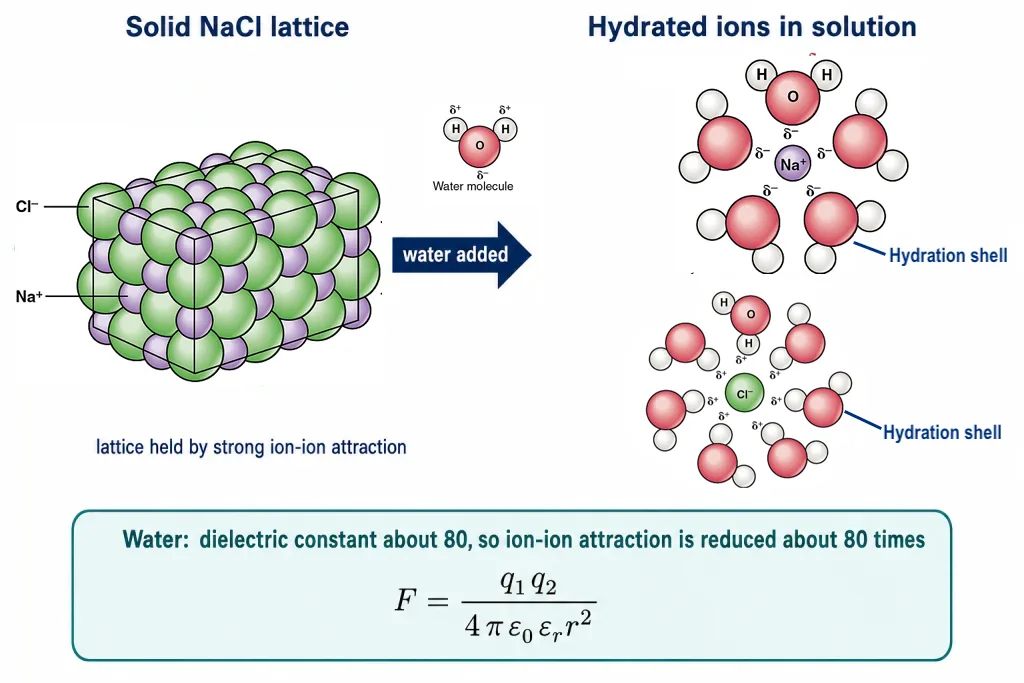
An ionic solid is not a set of molecules. Solid sodium chloride is a lattice of and held by electrostatic attraction, and that attraction is strong: the lattice melts only above . Something must weaken it enormously before the ions can wander apart in solution.
The force between two charges in a medium is
so it falls in proportion to the dielectric constant of the medium. Water has a dielectric constant of about , one of the highest of any common liquid, a consequence of its large dipole moment and hydrogen bonding.
Key Point: Water reduces the electrostatic attraction between dissolved ions by a factor of about compared with the same ions in vacuum. Ion-dipole attraction then wraps each ion in a hydration shell, and the hydration energy released pays most of the lattice energy bill.
Two effects therefore work together. The high dielectric constant weakens the attraction that holds the ions to each other; hydration supplies the energy needed to pull them out of the lattice and keeps them apart afterwards. In a solvent of low dielectric constant such as benzene (), sodium chloride does not dissolve and its solution would not conduct.
Dissociation and ionisation
The two words once had separate meanings. Dissociation described the separation of ions that already existed as ions in the solid, as in sodium chloride. Ionisation described a neutral molecule splitting into ions that did not previously exist, as when meets water. Hydrogen chloride is a polar covalent molecule; the ions are made during the process, not merely released. Modern usage treats the two terms as interchangeable, and this chapter does too.
Whether a covalent molecule ionises at all, and how far, is decided by two things: the strength of the bond that must break, and the extent to which the ions produced are solvated. Polarity is not what separates the two cases: the bond of acetic acid is in fact the more polar, with an electronegativity difference of against for . What decides the outcome is that the bond is much weaker and so breaks far more readily, and that the ions it gives — and the large, low-charge-density — are both well hydrated, so hydrogen chloride ionises completely. The acetate route is far less favourable and stops after a few per cent.
The Arrhenius Definition
Svante Arrhenius gave the first quantitative theory of acids and bases, growing out of his work on the conductivities of electrolyte solutions.
Key Point (Definition): Arrhenius concept. An acid is a substance that dissociates in water to give hydrogen ions . A base is a substance that dissociates in water to give hydroxyl ions .
For an acid ,
and for a metal hydroxide ,
Everything familiar about acids follows: the sour taste, blue litmus turning red, dihydrogen released with active metals, neutralisation with a base to give a salt and water. Bases turn red litmus blue, taste bitter and feel soapy. The theory also explains why the heat of neutralisation of any strong acid by any strong base is the same, about — in every case the reaction actually occurring is .
The proton is never bare
A hydrogen ion is a bare proton of radius near , roughly times smaller than any other cation. Its charge density is therefore colossal and it cannot exist free in water for any measurable time. It attaches to a lone pair on the oxygen of a water molecule, giving the trigonal pyramidal hydronium ion.
The hydronium ion is a real, isolable species; it exists in the solid state in compounds such as . In solution it is hydrated further still, to , and . The hydroxyl ion is likewise hydrated, to , and .
A better way to write the ionisation of an acid in water is therefore
and mean the same thing — a hydrated proton — and are used interchangeably. In any answer that involves proton transfer, write .
Where it breaks down
The Arrhenius picture has two limitations, and both matter.
First, it is tied to water. An acid-base reaction carried out in liquid ammonia, in benzene, or in the gas phase falls outside the definition entirely, even when the chemistry is plainly the same. and meeting in air to make a white cloud of is an acid-base reaction with no solvent and no hydroxyl ion anywhere.
Second, and more damaging for a Class 11 syllabus, it cannot explain the basicity of ammonia. Ammonia turns red litmus blue and neutralises acids, so it is a base by every test. Its molecule contains no hydroxyl group whatever, so on the Arrhenius definition it should not be a base at all.
Sodium carbonate raises the same problem. So does the observation that behaves as an acid in solvents with no protons available.
[Board] State the limitation with the ammonia example attached; the bare sentence "it applies only to aqueous solutions" is half an answer.
The Bronsted-Lowry Definition
Johannes Bronsted and Thomas Lowry, working independently in 1923, moved the focus off the solvent and onto the proton itself.
Key Point (Definition): Bronsted-Lowry concept. An acid is a proton donor. A base is a proton acceptor. An acid-base reaction is the transfer of a proton from the acid to the base.
Nothing in that definition mentions water, hydroxyl ions, or any solvent at all. It works in ammonia, in ethanol, in the gas phase.
Ammonia dissolving in water is now straightforward:
Water hands over a proton, so water is the acid here. Ammonia takes it, so ammonia is the base — without possessing a single group. The solution turns basic because the proton transfer leaves behind. The problem that defeated Arrhenius is solved in one line.
Hydrogen chloride in water is the reverse arrangement:
Here donates and water accepts, so water is the base and is what a proton in water actually looks like.
Conjugate acid-base pairs
Every proton transfer runs both ways, so both directions must be describable. In the ammonia equilibrium, the reverse reaction transfers a proton from to . That makes an acid and a base in the reverse direction.
Key Point (Definition): A pair of species that differ by exactly one proton is a conjugate acid-base pair. The conjugate acid has one proton more; the conjugate base has one proton less.
Reading the ammonia equilibrium as two pairs:
is one pair; is the other. Notice that the members of a pair sit on opposite sides of the equation, never on the same side. That single observation prevents most of the mistakes made with pairs.
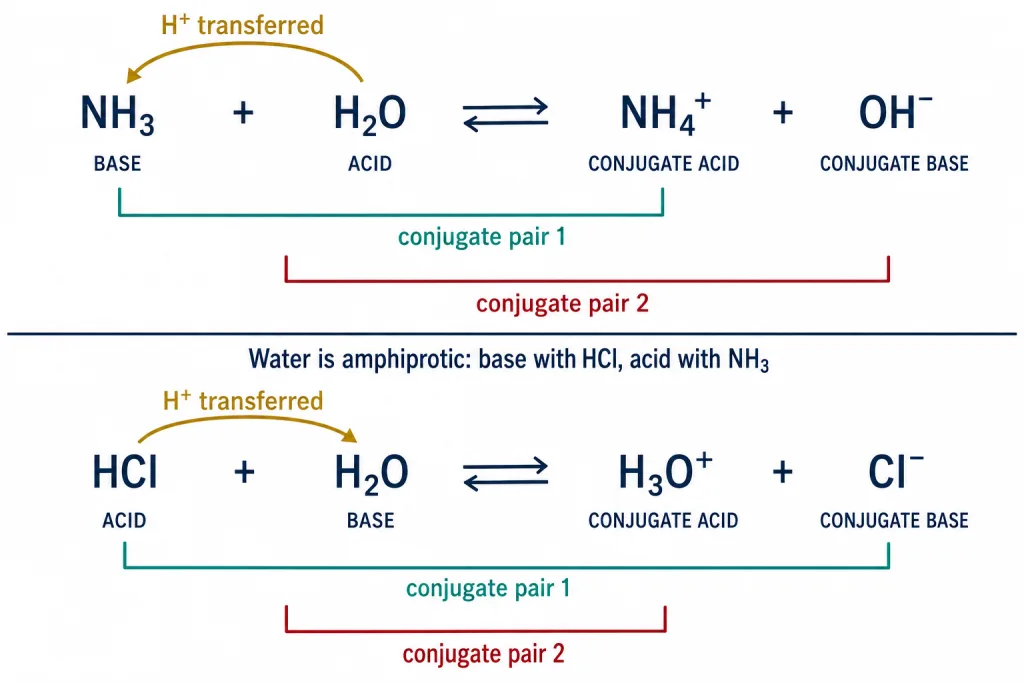
The mechanical rule is worth stating baldly. To get the conjugate base, remove one : subtract one hydrogen from the formula and make the charge one unit more negative. To get the conjugate acid, add one : add one hydrogen and make the charge one unit more positive. Never change anything else. gives , not , because only one proton comes off at a time.
| Acid | Conjugate base | Base | Conjugate acid |
|---|---|---|---|
Strength, Its Conjugate, and the Species That Do Both
A strong acid gives up its proton readily. Once it has done so, the species left behind has almost no tendency to take a proton back — if it did, the acid would not have been strong in the first place. The two strengths are inverse.
Key Point: A strong acid has a weak conjugate base, and a weak acid has a relatively strong conjugate base. The same statement holds with acid and base exchanged.
is a strong acid, so is such a feeble base that a chloride solution is neutral. is a very weak acid, so is a reasonably strong base and a solution of is distinctly alkaline. This is the whole explanation of salt hydrolysis, met in a later section, arriving early.
The same reasoning fixes the direction of a proton-transfer equilibrium.
Key Point: A proton-transfer equilibrium lies on the side of the weaker acid and weaker base. The stronger acid donates its proton to the stronger base.
For , the two acids competing are and . If is the stronger proton donor, the forward direction dominates and the solution ends up containing mostly and . If is the stronger, the mixture stays mostly as , and is a weak acid.
Amphiprotic species
Some species carry a removable proton and a lone pair capable of accepting one. They can act either way, depending on what they meet.
Key Point (Definition): A species that can both donate and accept a proton is amphiprotic (or amphoteric in the Bronsted sense). Water, , , , and are the standard examples.
Water is the clearest case. With it accepts a proton and behaves as a base; with it donates one and behaves as an acid. It even does both to itself, which is where the ionic product comes from in the next section.
The bicarbonate ion is the other case worth knowing, because it runs the pH buffering of blood.
An amphiprotic species therefore has both a conjugate acid and a conjugate base, and questions routinely ask for both at once.
| Species | Conjugate acid | Conjugate base |
|---|---|---|
[JEE/NEET] Species with no removable proton, such as , or , can only be bases. Species with no lone pair to offer, such as itself, can only be acids.
What Bronsted-Lowry still cannot do
Every Bronsted acid carries a proton. Boron trifluoride carries none, yet it reacts vigorously with ammonia and the product is a normal salt-like adduct. Anhydrous catalyses Friedel-Crafts reactions by behaving as an acid, again with no proton to donate. Metal cations such as and bind ammonia molecules the way an acid binds a base. None of this is proton transfer, so a third definition is needed.
The Lewis Definition
G. N. Lewis, in 1923, shifted attention from the proton to the electron pair that the proton was going to attach itself to.
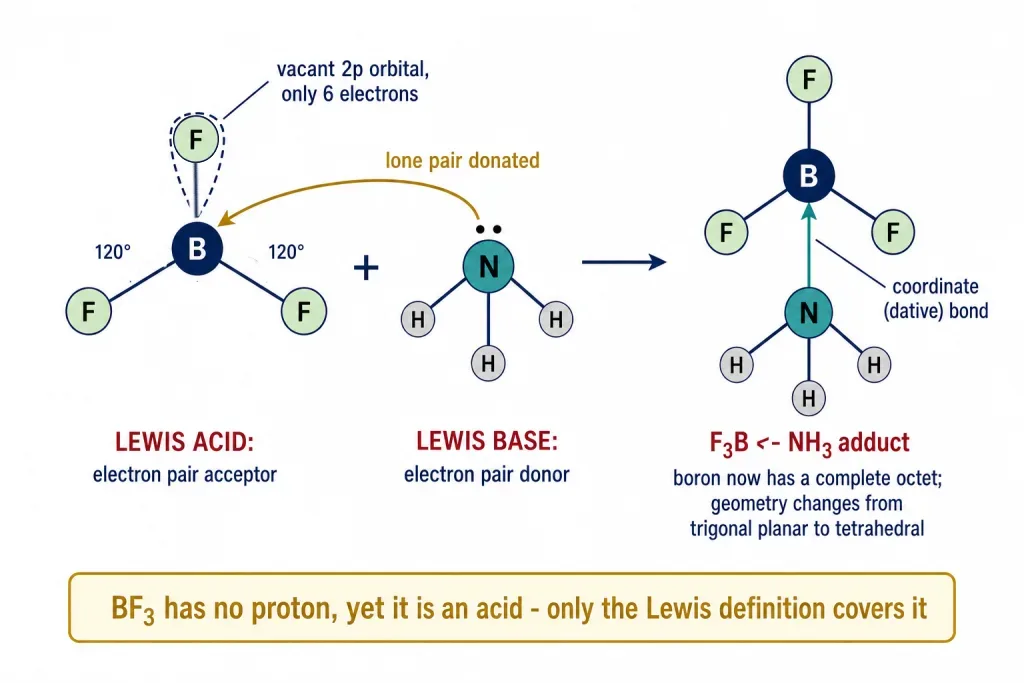
Key Point (Definition): Lewis concept. An acid is a species that accepts a lone pair of electrons. A base is a species that donates a lone pair of electrons. The product of their combination is an adduct, joined by a coordinate (dative) bond.
Nothing is said about protons or about a solvent. The definition is therefore the widest of the three.
The standard illustration is boron trifluoride with ammonia. Boron in has only six electrons in its valence shell and an empty orbital; nitrogen in has a lone pair going spare.
The nitrogen lone pair moves into the empty boron orbital. Both electrons of the new bond came from nitrogen, so the bond is coordinate. Boron reaches an octet and its geometry changes from trigonal planar to tetrahedral in the adduct.
The species that qualify as Lewis acids
Three families cover almost everything asked.
Molecules with an incomplete octet. , , , — the central atom is short of an octet and has a vacant orbital ready.
Simple cations. , , , , , . A positive charge on a small ion attracts electron pairs, which is exactly why every hydrated metal ion and every complex ion exists. In , the copper ion is the Lewis acid and the four ammonia molecules are the Lewis bases.
Molecules whose central atom can expand its octet. , , — vacant orbitals let them add a further pair, as in .
Lewis bases are simply the species with a lone pair to give: , and the other halide ions, , , , amines, alcohols, ethers.
The Lewis reading of the earlier definitions
The Lewis picture reinterprets everything the earlier ones covered. When joins , the proton is accepting a lone pair and is a Lewis acid; the hydroxyl ion is donating one and is a Lewis base. When water accepts a proton to give , the water is donating a lone pair to it.
Key Point: Every Bronsted base is a Lewis base, because accepting a proton means offering it a lone pair. The acids do not fit together so neatly. , and are Lewis acids with no proton to donate, while donates a proton readily and has no vacant orbital with which to accept an electron pair. The two classes of acid overlap; neither one contains the other.
The gain in generality costs something. The Lewis definition is too wide to be useful for ordinary aqueous acid-base work: it takes in every complex-formation and every coordinate-bond reaction, and it gives no simple scale of strength comparable to . For calculations of pH, , buffers and hydrolysis, the Bronsted-Lowry language is the working tool. The Lewis definition is what you reach for when there is no proton in sight.
[JEE Main] Standard trap: is a Bronsted acid but not a Lewis acid. Nitrogen already has a full octet with all four bonds formed, so there is no vacant orbital to accept a pair. Similarly , and accept nothing.
The Three Definitions Side by Side
| Feature | Arrhenius | Bronsted-Lowry | Lewis |
|---|---|---|---|
| Year | 1884 | 1923 | 1923 |
| Acid is | a substance giving in water | a proton donor | an electron-pair acceptor |
| Base is | a substance giving in water | a proton acceptor | an electron-pair donor |
| Solvent needed | yes, water only | no | no |
| Proton needed in the acid | yes | yes | no |
| Neutralisation is | proton transfer | adduct formation by a coordinate bond | |
| Typical acid | , | , , | , , , |
| Typical base | , | , , | , , , |
| Explains as a base | no | yes | yes |
| Explains as an acid | no | no | yes |
| Main limitation | aqueous only; no means no base | acid must have a proton | too general; no simple strength scale |
Every Arrhenius acid is a Bronsted acid, since giving to water is donating a proton, and the reverse is false. The Lewis class does not sit above the Bronsted one in the same tidy way. Most Lewis acids — , , — have no proton to donate and are not Bronsted acids, and donates a proton readily while having no vacant orbital to accept an electron pair, so it is a Bronsted acid and not a Lewis acid. The two classes of acid overlap; neither contains the other, and every question about the limitation of a definition is really a question about which species escape it.
The bases nest more simply than the acids. A Bronsted base and a Lewis base are the same set of species viewed two ways: taking a proton and offering a lone pair are the same act. The difference between the theories lies almost entirely on the acid side.
Key Point: For acids, every Arrhenius acid is a Bronsted acid, but Lewis and Bronsted-Lowry only overlap: the proton donor accepts no electron pair, and the electron-pair acceptor donates no proton. For bases the picture is simpler — Lewis and Bronsted-Lowry coincide, and Arrhenius is narrower than both.
A short set of checks decides any classification question:
- Does the species release in water? Arrhenius acid.
- Does it release in water? Arrhenius base.
- Can it hand a proton to something else, in any solvent? Bronsted acid.
- Can it take a proton? Bronsted base, and therefore also a Lewis base.
- Does it have a vacant orbital or an incomplete octet, and no proton to give? Lewis acid only, as and are.
Question 1: Sorting three solutes
Aqueous solutions of glucose, sodium chloride and acetic acid of equal molarity are tested in a conductivity cell. Arrange them in increasing order of conductance and give the reason.
Answer:
I ask in each case how many ions the solute puts into solution.
Glucose is a molecular solid that dissolves as neutral molecules. No ions form, so it is a non-electrolyte and its conductance is essentially that of pure water.
Acetic acid is a weak electrolyte. Less than 5 per cent of the molecules ionise, so a small ion concentration is present.
Sodium chloride is a strong electrolyte, ionised essentially completely, so it supplies the largest ion concentration of the three.
Ans: glucose acetic acid sodium chloride Watch out: Acetic acid is fully miscible with water, so it is tempting to rank it high. Solubility and degree of ionisation are independent properties.
Question 2: Conjugate bases
Write the conjugate base of each of , and .
Answer:
The conjugate base has one proton less, so I remove one from the formula and lower the charge by one unit.
loses to give .
loses one proton — only one — to give .
already carries a charge of ; removing takes it to , giving .
Ans: , , Watch out: Writing for sulphuric acid removes two protons at once. A conjugate pair differs by exactly one.
Question 3: Conjugate acids
Write the conjugate acid of each of , and .
Answer:
The conjugate acid has one proton more, so I add one and raise the charge by one unit.
becomes , charge going from to .
becomes , charge going from to .
becomes , charge going from to .
Ans: , , Watch out: appears twice, once as a conjugate acid and once as a base. Amphiprotic species do that.
Question 4: Both roles at once
For each of , , and , give the conjugate acid and the conjugate base.
Answer:
Each of these has a proton it can lose and a lone pair with which it can gain one, so each has both.
| Species | Conjugate acid | Conjugate base |
|---|---|---|
Ans: as tabulated above Watch out: The conjugate acid is always the species with more hydrogen and the more positive charge. Swapping the two columns is the commonest error here.
Question 5: Identifying the pairs in an equation
Label the acid, the base, the conjugate acid and the conjugate base in
and name the two conjugate pairs.
Answer:
Going left to right, loses a proton, so it is the acid. gains that proton, so it is the base.
On the right, is what the base became after accepting the proton, so it is the conjugate acid. is what the acid became after losing it, so it is the conjugate base.
I pair each species with the one differing from it by one proton, checking that the two members lie on opposite sides.
Ans: acid , base , conjugate acid , conjugate base ; pairs are and Watch out: Pairing with because they stand side by side is wrong. Both members of a pair never sit on the same side.
Question 6: Lewis acids from a list
Which of , , and are Lewis acids?
Answer:
A Lewis acid must be able to accept a lone pair, which needs a vacant orbital or an incomplete octet.
has two lone pairs on oxygen and donates them, so it is a Lewis base.
has only six electrons around boron and an empty orbital, so it accepts a pair.
has an empty orbital and no electrons at all, so it accepts a pair.
has nitrogen with a complete octet and four bonds already formed. Its positive charge is misleading; there is no orbital free to take another pair.
Ans: and Watch out: A positive charge alone does not make a Lewis acid. is a Bronsted acid, because it can donate a proton, and no kind of Lewis acid.
Question 7: Classifying and justifying
Classify , , and as Lewis acids or Lewis bases, and say how each acts.
Answer:
: oxygen carries three lone pairs and donates one, so it is a Lewis base, as in .
: fluoride has four lone pairs and can donate any one of them, so it is a Lewis base, as in .
: no electrons, empty orbital, accepts a pair from hydroxyl or fluoride, so it is a Lewis acid.
: boron has six valence electrons and accepts a pair from ammonia or an amine, so it is a Lewis acid, giving .
Ans: Lewis bases and ; Lewis acids and
Question 8: Which definition is needed
Decide the smallest definition that classifies each of the following as an acid-base reaction: (a) with in water, (b) with , (c) with .
Answer:
For (a) nitric acid gives in water and potassium hydroxide gives in water, so the Arrhenius definition already covers it.
For (b) there is no solvent, so Arrhenius fails. A proton passes from to to give , which the Bronsted-Lowry definition handles.
For (c) no proton is involved anywhere. Aluminium in has an incomplete octet and accepts a lone pair from chloride to give , which needs the Lewis definition.
Ans: (a) Arrhenius, (b) Bronsted-Lowry, (c) Lewis Watch out: Reaction (a) is also a Bronsted and a Lewis reaction; the question asks for the narrowest definition that already works, not for every definition that applies.
Where Marks Are Lost
Calling a soluble substance a strong electrolyte. Strength is the fraction ionised, not the amount dissolved. Acetic acid: very soluble, weak. Barium sulphate: almost insoluble, strong.
Writing an equilibrium for a strong electrolyte. takes a single arrow. Only weak electrolytes get .
Removing two protons for a conjugate base. , one proton, one charge unit. The rule is exactly one, in either direction.
Putting both members of a pair on one side. Conjugate partners are always on opposite sides of the arrow.
Treating a positive charge as proof of a Lewis acid. is positively charged, has no vacant orbital and is not a Lewis acid. is positively charged, does have vacant orbitals, and is one.
Saying the Arrhenius theory fails only because of the solvent. It also fails to explain the basicity of ammonia and of carbonate, neither of which contains a hydroxyl group. Quote the ammonia case.
Writing where the chemistry needs . A bare proton has a radius near and cannot survive in water. In any proton-transfer equation write , and remember it is hydrated further to , and .
Forgetting which theories agree about bases. Bronsted bases and Lewis bases are the same species. It is on the acid side that Lewis is genuinely wider.