The Ka-Kb Relation, Polyprotic Acids and Factors Affecting Acid Strength
Two Constants for One Pair
A conjugate acid-base pair differs by a single proton. Acetic acid and acetate ion are such a pair; ammonium ion and ammonia are another. Each member of the pair reacts with water, and each reaction has its own equilibrium constant.
Both leave [H2O] out of the expression, since the solvent concentration is fixed at about 55.5molL−1.
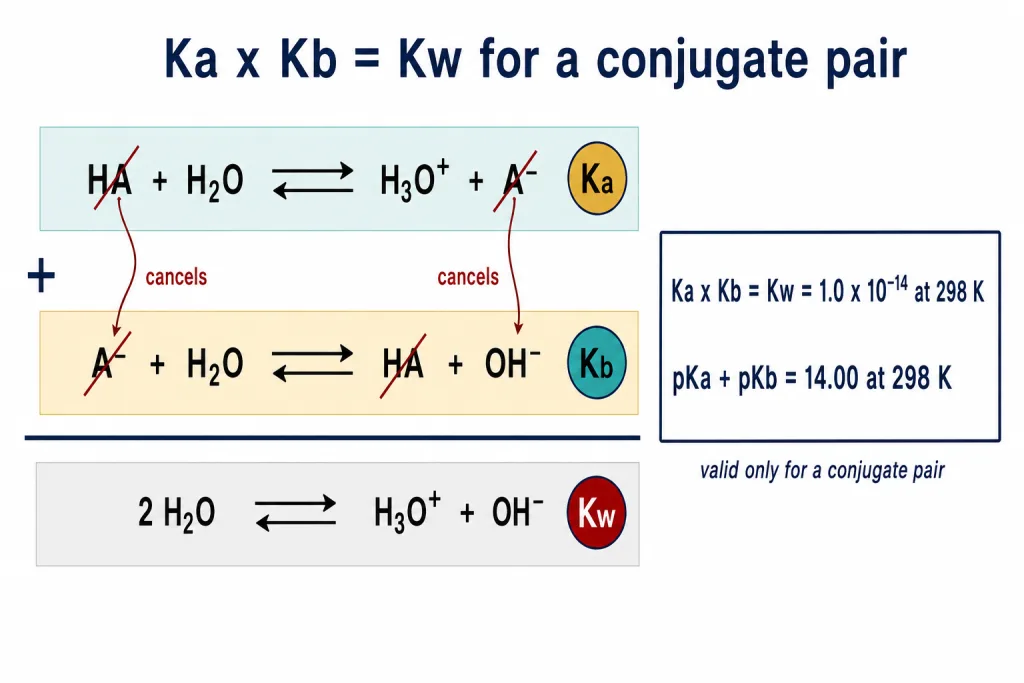
These two constants are not independent. Add the two equations as chemical equations:
HA+H2O+A−+H2O⇌H3O++A−+HA+OH−
HA appears on both sides. So does A−. Strike both out and what is left is the self-ionisation of water:
2H2O(l)⇌H3O+(aq)+OH−(aq)Kw=[H3O+][OH−]
Adding equations multiplies the equilibrium constants. That rule was established earlier for gas-phase equilibria and it holds here without change, because it is a property of the algebra of equilibrium expressions and not of the phase. So the constant for the net reaction is Ka×Kb, and the net reaction is the water equilibrium.
[HA] in the numerator of the second fraction meets [HA] in the denominator of the first. [A−] does the same in reverse. Nothing survives except the ion product of water.
Key Point: For a conjugate acid-base pair in aqueous solution,
Ka×Kb=Kw=1.0×10⁻¹⁴at 298K
Knowing either constant fixes the other. The pair must be conjugate: the base must be exactly the acid minus one proton.
The Same Relation in p-Form
Taking the negative logarithm of both sides of KaKb=Kw turns a product into a sum. Since log(xy)=logx+logy,
−logKa−logKb=−logKw
pKa+pKb=pKw=14.00at 298K
This is the form used in almost every calculation, because it replaces division by subtraction. A base with pKb=4.75 has a conjugate acid with pKa=14.00−4.75=9.25, and no exponent arithmetic is needed.
The temperature condition is real and it is tested. Kw is an equilibrium constant, so it changes with temperature: the self-ionisation of water is endothermic, and heating drives it forward. At 298K, Kw=1.0×10⁻¹⁴ and pKw=14.00. At body temperature, 310K, Kw is 2.7×10⁻¹⁴, so pKw is 13.57. At that temperature pKa+pKb=13.57, not 14.
The general statement is the safe one to memorise: pKa+pKb=pKw, and pKw=14 only at 298K. The same caution applies to pH+pOH=pKw and to the neutral pH of 7.
[JEE Main] A question that supplies Kw at some temperature other than 298K is not being decorative. It is checking whether 14 was memorised as a number or understood as pKw.
The relation also makes the reciprocal nature of conjugate strength quantitative. Rearranging,
Kb=KaKw
Kw is a small fixed number. A large Ka therefore forces a tiny Kb, and a tiny Ka forces a large Kb. A strong acid has a very weak conjugate base; a very weak acid has a comparatively strong conjugate base. This is the statement met qualitatively in the Bronsted treatment, now with a number attached.
Perchloric, hydrochloric, sulphuric and nitric acids ionise completely in water, so ClO4−, Cl−, HSO4− and NO3− have Kb values too small to measure. A solution of sodium chloride is neutral for exactly this reason: Cl− is such a feeble base that it does not take a proton from water at all. At the other end, NH2−, O2− and H− are conjugate bases of extremely weak acids, and they are such powerful proton acceptors that they cannot exist in water — they strip a proton from the solvent itself.
Only for a Conjugate Pair
The single most common error with this relation is applying it to an acid and a base that are not conjugates. Ka of acetic acid multiplied by Kb of ammonia is
1.74×10−5×1.77×10−5=3.08×10⁻¹⁰
which is not Kw and is not anything. The product of the constants of two unrelated species means nothing, because the equations for those two species do not add up to the water equilibrium — the cancellation that produced Kw never happens.
Test the pairing before using the relation. Write down the base. Add one proton. If the result is the acid you were given, the relation applies; otherwise it does not.
Acid
Ka (298 K)
Its conjugate base
Kb=Kw/Ka
HF
3.5×10⁻⁴
F−
2.9×10⁻¹¹
HCOOH
1.8×10⁻⁴
HCOO−
5.6×10⁻¹¹
CH3COOH
1.74×10⁻⁵
CH3COO−
5.7×10⁻¹⁰
NH4+
5.6×10⁻¹⁰
NH3
1.77×10⁻⁵
HCN
4.9×10⁻¹⁰
CN−
2.0×10⁻⁵
Read the last two rows carefully. The pair listed for ammonia is NH4+ and NH3, not ammonia and hydroxide, and not ammonia and acetate. The Kb of ammonia, 1.77×10⁻⁵, is measured directly; the Ka of ammonium ion, 5.6×10⁻¹⁰, is what the relation delivers. That number is what makes an ammonium salt solution acidic, and it is the number needed for the hydrolysis calculations in the next section.
A second slip is a mismatch of forms. Ka×Kb=Kw multiplies constants; pKa+pKb=14 adds logarithms. Writing Ka+Kb=Kw or pKa×pKb=14 produces nonsense.
A third slip is direction. For the pair acetic acid and acetate, Ka belongs to acetic acid and Kb to acetate. Using Kb of acetate where Ka of acetic acid is wanted turns 1.74×10⁻⁵ into 5.7×10⁻¹⁰, a factor of thirty thousand, and turns the pH of a 0.1M solution of the acid from 2.88 into 5.12.
Acids with More Than One Proton
Oxalic acid, sulphuric acid, carbonic acid and phosphoric acid have more than one ionisable proton per molecule. Such acids are polybasic or polyprotic. They do not lose their protons together. Each proton leaves in a separate step, with its own equilibrium and its own constant.
For a dibasic acid H2X:
H2X(aq)⇌H+(aq)+HX−(aq)Ka1=[H2X][H+][HX−]
HX−(aq)⇌H+(aq)+X2−(aq)Ka2=[HX−][H+][X2−]
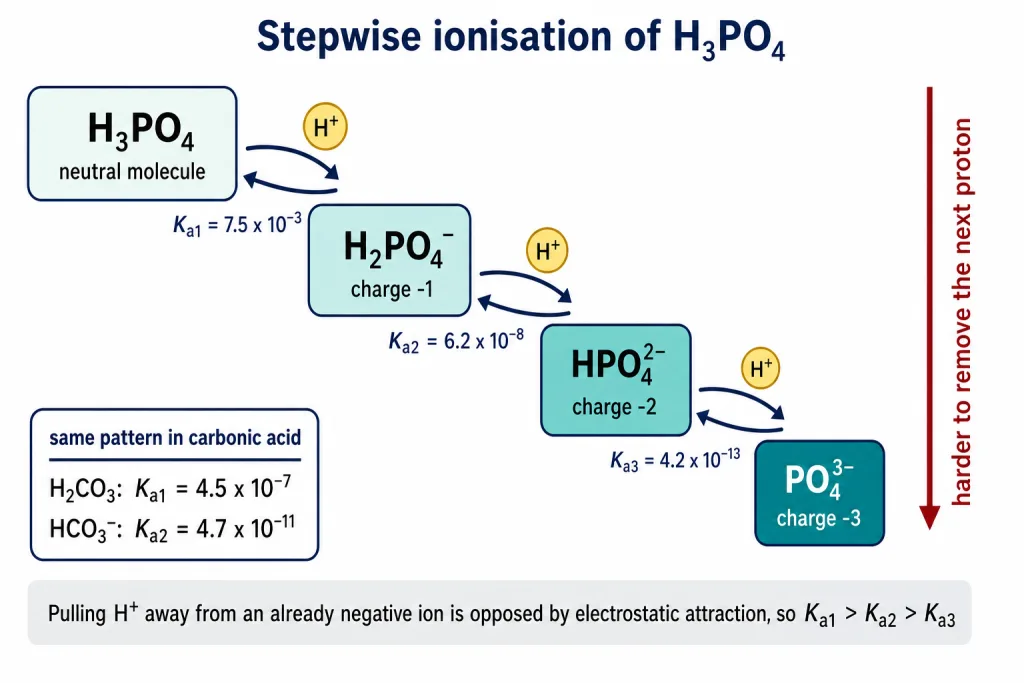
Ka1 and Ka2 are the first and second ionisation constants. A tribasic acid such as H3PO4 has three:
H3PO4⇌H++H2PO4−Ka1
H2PO4−⇌H++HPO42−Ka2
HPO42−⇌H++PO43−Ka3
The intermediate species are worth naming. H2PO4− and HPO42− each appear as a product of one step and a reactant of the next, so each can donate a proton and accept one. Species of that kind are amphiprotic. HCO3−, HS− and HSO4− behave the same way.
Two consequences follow from the stepwise picture.
A solution of a diprotic acid contains three related solute species at once — H2X, HX− and X2− — in proportions set by the two constants and by the pH. It is never a solution of one substance.
The overall ionisation constant, for H2X⇌2H++X2−, is the product Ka1×Ka2, since adding the two steps multiplies their constants. For carbonic acid that overall constant is 4.5×10−7×4.7×10−11=2.1×10⁻¹⁷.
The Values, and Why They Fall
Acid
Ka1
Ka2
Ka3
Carbonic acid, H2CO3
4.5×10⁻⁷
4.7×10⁻¹¹
Sulphurous acid, H2SO3
1.7×10⁻²
6.4×10⁻⁸
Sulphuric acid, H2SO4
very large
1.2×10⁻²
Phosphoric acid, H3PO4
7.5×10⁻³
6.2×10⁻⁸
4.2×10⁻¹³
Oxalic acid, (COOH)2
5.9×10⁻²
6.4×10⁻⁵
Hydrogen sulphide, H2S
9.1×10⁻⁸
1.2×10⁻¹³
Every row shows the same pattern. Ka2 is smaller than Ka1, and where there is a third step Ka3 is smaller again. The gaps are large: four orders of magnitude for carbonic acid, five for sulphurous acid, five for phosphoric acid between the first and second steps and another five between the second and third, six for hydrogen sulphide. Oxalic acid has the narrowest gap at about three orders of magnitude.
The reason is electrostatic. The first proton leaves a neutral molecule. The second must leave an anion that already carries a negative charge, and a positive proton is held far more tightly by a negative ion than by a neutral molecule. Pulling H+ away from HCO3− means separating opposite charges, and that costs energy the first step never had to pay.
Compare the two carbonic acid steps directly. Removing a proton from uncharged H2CO3 has Ka1=4.5×10⁻⁷. Removing one from HCO3− has Ka2=4.7×10⁻¹¹, about ten thousand times harder. Phosphoric acid makes the point three times over: a proton comes off neutral H3PO4 fairly readily, off singly charged H2PO4− with much more difficulty, and off doubly charged HPO42− barely at all, since Ka3=4.2×10⁻¹³ is close to the ionisation constant of water.
Key Point: For any polyprotic acid Ka1>Ka2>Ka3, usually by several orders of magnitude, because removing a positively charged proton from an already negative ion is opposed by electrostatic attraction.
There is a second, smaller contribution. Each proton lost adds negative charge to the same central atom, and the remaining O−H bonds become less polar as the electron density on oxygen rises, so those protons are less willing to leave. The charge argument is the one to write in an answer.
Polyacidic bases behave the same way in reverse, with Kb1>Kb2.
What the Second Constant Does and Does Not Affect
A polyprotic acid solution looks complicated: several equilibria, several species. In practice one step dominates completely.
Take 0.1M carbonic acid. The first step gives [H+]=Ka1c=4.5×10−7×0.1=2.1×10⁻⁴M and the same concentration of HCO3−. The second step now has to work on that HCO3− in a solution which already contains 2.1×10⁻⁴M of H+. That H+ is a common ion, and it pushes the second equilibrium back. Since Ka2 is minute to begin with, the extra H+ produced by the second step is negligible.
Key Point: For most calculations the pH of a polyprotic acid solution is fixed by Ka1 alone. The acid is treated as a monobasic acid of ionisation constant Ka1, and Ka2 is used only to find the concentration of the fully deprotonated ion.
The second constant does one useful job. For a diprotic acid where the first step supplies both the H+ and the HX−, those two concentrations are equal, so
Ka2=[HX−][H+][X2−]≈[X2−]
because [H+] and [HX−] cancel. The concentration of the doubly charged anion is numerically equal to Ka2, whatever the concentration of the acid. In 0.1MH2S, [S2−]=1.2×10⁻¹³M; in 0.05MH2S it is the same 1.2×10⁻¹³M. This result is used constantly in sulphide precipitation problems.
[JEE/NEET] Two standard answers worth keeping: for a diprotic acid, [H+]≈Ka1c and [X2−]≈Ka2.
Sulphuric acid is the exception that has to be handled separately. Its first ionisation is complete in dilute aqueous solution:
H2SO4(aq)→H+(aq)+HSO4−(aq)
The arrow is single, not double. There is no equilibrium and no meaningful Ka1; that is what "very large" in the table stands for. The second step is a real equilibrium of a genuinely weak acid:
HSO4−(aq)⇌H+(aq)+SO42−(aq)Ka2=1.2×10⁻²
Sulphuric acid is a strong acid in its first proton and a weak acid in its second. So a 0.1M solution does not give 0.2MH+, and it does not give exactly 0.1M either. The truth lies between, and Ka2 decides where, as worked out below. Treating H2SO4 as fully ionised in both steps and reporting pH=0.70 for a 0.1M solution is a standard error; so is ignoring the second step entirely and reporting 1.00.
What Makes One Acid Stronger Than Another
Ka measures acid strength but does not explain it. For a binary acid H−A the explanation has two parts, and both concern the same event: a proton leaving.
H−A→H++A−
The strength of the H−A bond. The bond must break. A weaker bond needs less energy to break, so the proton leaves more easily and the acid is stronger.
The stability of the conjugate base A−. The fragment left behind must accommodate the electron pair and the negative charge. A more stable A− has less tendency to take the proton back, so the equilibrium sits further to the right and the acid is stronger. The two statements are linked through KaKb=Kw: a stable, unreactive A− has a small Kb, which forces a large Ka.
Bond polarity feeds into the second factor. When A is more electronegative than hydrogen, the bonding pair sits closer to A, charge is already separated along the bond, and the bond breaks in the required way — with both electrons going to A — more readily. A more polar H−A bond means a stronger acid, provided the bond strength is not what is changing.
Key Point: Acid strength of H−A rises when the H−A bond gets weaker and when the conjugate base A− gets more stable. Increasing the electronegativity of A increases bond polarity and stabilises A−, and so increases acidity.
Both factors always operate, and in the periodic table they often point in opposite directions. Which one wins depends on the direction being compared, and that is the whole content of the next block.
One caution on vocabulary. "Bond strength" here is bond dissociation enthalpy, an energy. "Bond polarity" is charge separation, set by electronegativity difference. A bond can be very polar and very strong at the same time — H−F is exactly that — which is why the two factors have to be tracked separately.
Down a Group Bond Strength Wins, Across a Period Electronegativity Wins
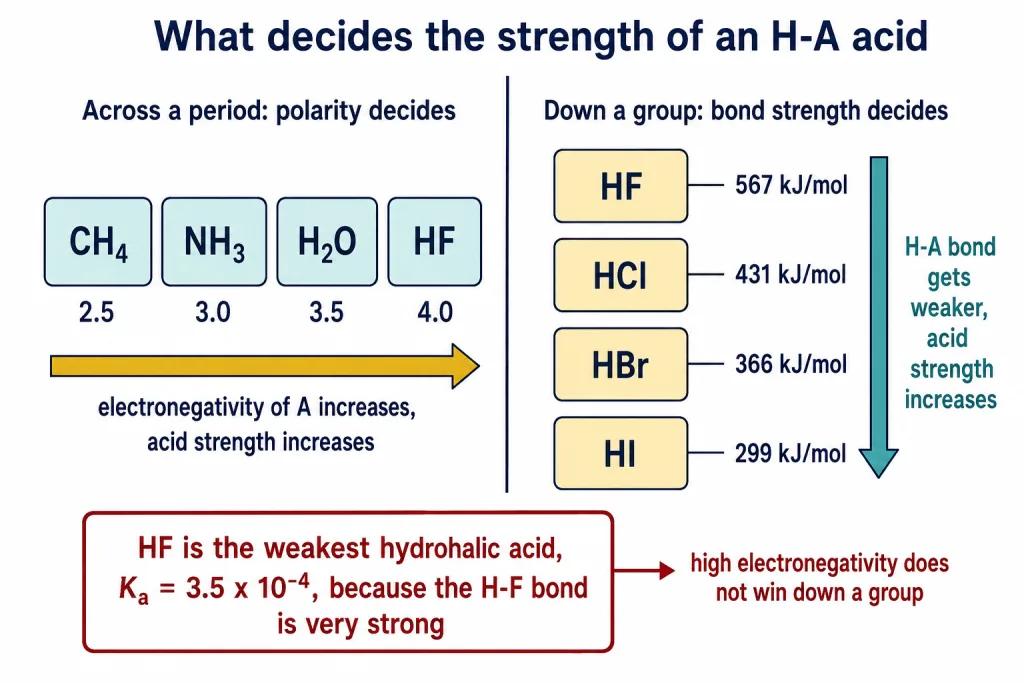
Down a group, the atom A gets larger. Its valence orbital is bigger and more diffuse, its overlap with the small hydrogen 1s orbital gets poorer, and the H−A bond gets longer and weaker. Bond dissociation enthalpy falls steeply: 567kJmol−1 for H−F, 431 for H−Cl, 366 for H−Br, 299 for H−I. Electronegativity also falls down the group, which would predict decreasing acidity, but the collapse in bond strength is much larger and it decides the outcome.
HF⋘HCl<HBr<HI
HCl, HBr and HI are all strong acids in water; HF is weak, with Ka=3.5×10⁻⁴. Group 16 shows the same order, with all four being weak acids:
H2O<H2S<H2Se<H2Te
H2S is a stronger acid than water even though oxygen is far more electronegative than sulphur, because the S−H bond is much weaker than the O−H bond. Size also stabilises the conjugate base: the negative charge on the large I− or HS− ion is spread over a bigger volume, so the charge density is lower and the ion is more stable than a small, charge-concentrated F− or OH−.
Across a period, the atoms are all of similar size, so H−A bond strengths do not differ dramatically. What changes sharply is electronegativity, and it now decides.
CH4<NH3<H2O<HF
Carbon, nitrogen, oxygen and fluorine rise in electronegativity from 2.5 to 4.0. The H−A bond becomes progressively more polar, and the conjugate base — CH3−, NH2−, OH−, F− — becomes progressively better at holding the negative charge. Methane is not an acid in any practical sense; hydrogen fluoride is a recognisable, if weak, acid.
Key Point: Compare down a group using H−Abond strength — acidity increases downward. Compare across a period using the electronegativity of A — acidity increases rightward. Applying the wrong criterion reverses the answer.
The mistake this warning exists to prevent runs as follows: fluorine is the most electronegative element, so HF must be the strongest hydrohalic acid. The conclusion is wrong. In water, HF is the only weak acid of the four, weaker than HCl by many orders of magnitude — hydrochloric acid is ionised so completely that no Ka can meaningfully be quoted for it at all. The H−F bond is exceptionally strong at 567kJmol−1, and in aqueous solution the small F− ion hydrogen-bonds strongly to water and to undissociated HF, both of which hold the proton back.
The two criteria coexist without contradiction because they answer different questions. Fluorine's electronegativity is why HF is a far stronger acid than H2O, NH3 or CH4 — that is the period comparison. Bond strength is why HF is a far weaker acid than HI — that is the group comparison. Both are correct, in their own direction.
[Board] Answers should name the factor, not just the order. "Acidity increases from HF to HI because the H−X bond dissociation enthalpy decreases down the group" earns the mark; the order by itself does not.
Question 1: Kb of fluoride ion
The ionisation constant of HF is 3.5×10⁻⁴ at 298K. Calculate Kb and pKb for the fluoride ion.
Answer:
F− is the conjugate base of HF: remove one proton from HF and F− is what remains. The pair is conjugate, so the relation applies.
Kb=KaKw=3.5×10−41.0×10−14=2.86×10⁻¹¹
For the p-values, pKa=−log(3.5×10⁻⁴)=4−0.544=3.46.
pKb=14.00−3.46=10.54
A check: −log(2.86×10⁻¹¹)=11−0.456=10.54. The two routes agree.
Ans:Kb=2.9×10⁻¹¹; pKb=10.54
Question 2: Ka of the conjugate acid of ammonia
The ionisation constant of ammonia is 1.77×10⁻⁵. Find the ionisation constant and pKa of its conjugate acid.
Answer:
The conjugate acid of NH3 is NH4+, ammonia plus one proton.
NH4+(aq)+H2O(l)⇌NH3(aq)+H3O+(aq)
Ka=KbKw=1.77×10−51.0×10−14=5.6×10⁻¹⁰
pKb=−log(1.77×10⁻⁵)=5−0.248=4.75, so pKa=14.00−4.75=9.25.
Ans:Ka=5.6×10⁻¹⁰; pKa=9.25Watch out:Ka here belongs to NH4+, not to NH3. Ammonia has no measurable Ka in water. A question asking for "Ka of ammonia solution" means the ammonium ion.
Question 3: Reading a pKa backwards
A weak base has pKb=8.30 at 298K. Find Kb, and the Ka and pKa of its conjugate acid. Is that conjugate acid stronger or weaker than acetic acid, pKa=4.76?
Answer:
Kb=10−8.30=100.70×10−9=5.0×10⁻⁹
pKa=14.00−8.30=5.70
Ka=10−5.70=100.30×10−6=2.0×10⁻⁶
A larger pKa means a weaker acid. Since 5.70>4.76, the conjugate acid is weaker than acetic acid, by a factor of 100.94≈8.7 in Ka.
Ans:Kb=5.0×10⁻⁹; Ka=2.0×10⁻⁶; pKa=5.70; weaker than acetic acid
Watch out:pKa and pKb run opposite to strength. Calling the acid with the larger pKa the stronger one is the single most frequent slip in this topic.
Question 4: Ranking conjugate bases
Given Ka(HCN)=4.9×10⁻¹⁰, Ka(CH3COOH)=1.74×10⁻⁵ and Ka2(H2CO3)=4.7×10⁻¹¹, arrange CN−, CH3COO− and CO32− in increasing order of base strength.
Answer:
Each anion is the conjugate base of one of the three acids. CO32− pairs with HCO3−, whose constant is Ka2 of carbonic acid.
Kb(CH3COO−)=1.74×10−510−14=5.7×10⁻¹⁰
Kb(CN−)=4.9×10−1010−14=2.0×10⁻⁵
Kb(CO32−)=4.7×10−1110−14=2.1×10⁻⁴
Increasing Kb is increasing base strength.
Ans:CH3COO−<CN−<CO32−Watch out: The order of the bases is the reverse of the order of their parent acids, so it can be written down without computing anything — but pairing CO32− with Ka1 instead of Ka2 gives Kb=2.2×10⁻⁸ and puts carbonate in the middle.
Question 5: pH of carbonic acid and the carbonate concentration
For 0.05M carbonic acid, Ka1=4.5×10⁻⁷ and Ka2=4.7×10⁻¹¹. Calculate the pH, [HCO3−] and [CO32−].
Answer:
Ka2 is four orders of magnitude below Ka1, so the first step alone sets the pH. I treat the acid as monobasic with Ka=4.5×10⁻⁷.
c/Ka=0.05/(4.5×10−7)=1.1×105, far above 400, so the square-root form is safe.
[H+]=Ka1c=4.5×10−7×0.05=2.25×10−8=1.5×10⁻⁴M
pH=−log(1.5×10⁻⁴)=4−0.176=3.82
The first step produces H+ and HCO3− in equal amounts, so [HCO3−]=1.5×10⁻⁴M.
For the carbonate ion I use the second equilibrium:
Ka2=[HCO3−][H+][CO32−]
Since [H+]=[HCO3−], they cancel and [CO32−]=Ka2=4.7×10⁻¹¹M.
Ans:pH=3.82; [HCO3−]=1.5×10⁻⁴M; [CO32−]=4.7×10⁻¹¹MWatch out: Adding the two steps and using 2[H+], or using Ka1Ka2 for the pH, gives [H+]=2.1×10−17×0.05=1.05×10−18=1.0×10⁻⁹M and a pH of 8.99 — a basic pH for an acid solution, which should immediately look wrong.
Question 6: Sulphide ion concentration
Calculate [H+], [HS−] and [S2−] in a 0.1M solution of H2S, given Ka1=9.1×10⁻⁸ and Ka2=1.2×10⁻¹³.
Answer:
[H+]=Ka1c=9.1×10−8×0.1=9.1×10−9=9.54×10⁻⁵M
[HS−]=[H+]=9.54×10⁻⁵M
[S2−]=Ka2=1.2×10⁻¹³M, since [H+] and [HS−] are equal and cancel in the second-step expression.
pH=−log(9.54×10⁻⁵)=4.02
Ans:[H+]=[HS−]=9.5×10⁻⁵M; [S2−]=1.2×10⁻¹³M; pH=4.02Watch out:[S2−] does not depend on the concentration of the acid at all. It would still be 1.2×10⁻¹³M in a 0.01M solution. What does change [S2−] is the pH, and that is how sulphide precipitations are controlled.
Question 7: pH of dilute sulphuric acid
Calculate the pH of a 0.020M solution of H2SO4, taking the first ionisation as complete and Ka2=1.2×10⁻².
Answer:
The first step goes to completion, giving 0.020MH+ and 0.020MHSO4−.
The second step is an equilibrium, and it starts in a solution that already contains 0.020MH+. Let x be the amount of HSO4− that ionises.
HSO4−⇌H++SO42−, with equilibrium concentrations 0.020−x, 0.020+x and x.
0.020−x(0.020+x)x=1.2×10⁻²
Ka2 is not small compared with the concentration, so no approximation is available. Expanding:
Ans:pH=1.58; [SO42−]=6.3×10⁻³M; [HSO4−]=1.4×10⁻²MWatch out: Treating both protons as fully released gives [H+]=0.040M and pH=1.40. Ignoring the second step gives 0.020M and pH=1.70. The true value sits between them, and only the quadratic finds it.
Question 8: Phosphoric acid, all three steps
For 0.1MH3PO4 with Ka1=7.5×10⁻³, Ka2=6.2×10⁻⁸ and Ka3=4.2×10⁻¹³, calculate the pH and the concentrations of H2PO4−, HPO42− and PO43−.
Answer:
Only the first step matters for the pH, but Ka1 is fairly large, so I check the approximation: c/Ka1=0.1/(7.5×10−3)=13, well below 400. The quadratic is needed.
Ans:pH=1.62; [H2PO4−]=2.4×10⁻²M; [HPO42−]=6.2×10⁻⁸M; [PO43−]=1.1×10⁻¹⁸MWatch out: The square-root shortcut gives [H+]=7.5×10−4=2.74×10⁻²M and pH=1.56, too low by 0.06. Whenever Ka1 is of the order of 10−2 or 10−3, check c/Ka before using the shortcut.
Question 9: Ordering hydrides by acid strength
Arrange each set in increasing order of acid strength in water and name the factor that decides each set: (a) H2O, H2S, H2Se, H2Te; (b) CH4, NH3, H2O, HF; (c) HF, HCl, HBr, HI.
Answer:
Set (a) runs down group 16. The size of the central atom increases, the H−A bond gets longer and weaker, and the acid strength rises.
H2O<H2S<H2Se<H2Te, decided by H−A bond strength.
Set (b) runs across period 2. Sizes are comparable, so bond strengths are comparable; electronegativity rises from carbon to fluorine, the bond becomes more polar and the conjugate base more stable.
CH4<NH3<H2O<HF, decided by the electronegativity of A.
Set (c) runs down group 17, so bond strength decides again.
HF<HCl<HBr<HI, decided by H−X bond strength.
Ans: (a) H2O<H2S<H2Se<H2Te; (b) CH4<NH3<H2O<HF; (c) HF<HCl<HBr<HIWatch out: Water appears in (a) as the weakest and in (b) as the second strongest. Both are right, because the comparison groups are different. Using electronegativity on set (c) reverses the order and puts HF first, which is the classic error.
Question 10: A conjugate pair from a measured pH
A 0.02M solution of a weak monobasic acid HA has pH=3.65. Find Ka of HA and Kb of A−.
Answer:
[H+]=10−3.65=100.35×10−4=2.24×10⁻⁴M
The acid gives H+ and A− together, so [A−]=2.24×10⁻⁴M. That is about one per cent of 0.02, so [HA]≈0.02M.
Ka=0.02(2.24×10⁻⁴)2=0.025.02×10−8=2.51×10⁻⁶
Kb(A−)=2.51×10−61.0×10−14=3.98×10⁻⁹
A check with p-values: pKa=5.60 and pKb=14.00−5.60=8.40, and 10−8.40=4.0×10⁻⁹.
Ans:Ka=2.5×10⁻⁶; Kb(A−)=4.0×10⁻⁹Watch out: Forgetting to square [H+] gives Ka=2.24×10⁻⁴/0.02=1.1×10−2, which would make HA a moderately strong acid inconsistent with a pH of 3.65 at this concentration.
Six errors account for most of the lost marks here.
Multiplying Ka and Kb of species that are not a conjugate pair, and calling the product Kw.
Using 14 where pKw belongs, when the question has quietly changed the temperature.
Assigning Ka to the base or Kb to the acid within a correct pair, which shifts the answer by the full factor Ka/Kb.
Adding the ionisation steps of a polyprotic acid and using Ka1Ka2 to find the pH, which produces a basic pH for an acid.
Treating H2SO4 as either fully strong in both steps or strong in the first step only, when it is strong in the first and weak in the second.
Using electronegativity to order the hydrogen halides, which puts HF at the strong end instead of the weak one.
The next section takes these constants into solutions that contain more than the acid alone: the common ion effect, the hydrolysis of salts, and buffers.
Ready to test your knowledge?
Take a quick interactive quiz on this topic —
free, works without login.