
Where a Reaction Actually Stops
A reaction mixture held at a fixed temperature and pressure has a Gibbs energy that depends on what is in the vessel. Pure reactants have one value. Pure products have another. Every mixture in between has a value of its own, and that value is not the straight-line average of the two ends, because mixing two substances lowers the Gibbs energy of the collection all by itself.
Plot for the whole mixture against the extent of reaction — zero on the left when nothing has reacted, one on the right when the reactants are exhausted — and the curve sags below the line joining its two ends. It falls, flattens and rises again. Somewhere between the two extremes it passes through a minimum.
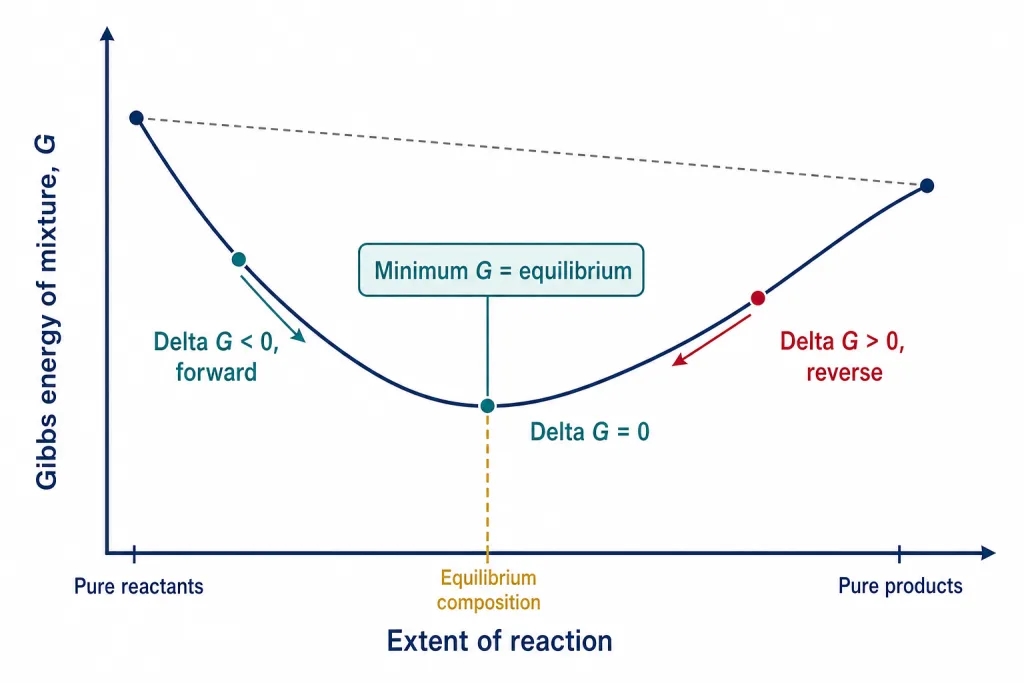
A system at constant temperature and pressure moves in whichever direction lowers its Gibbs energy. Starting from pure reactants the mixture slides to the right, downhill. Starting from pure products it slides to the left, downhill. Both journeys end at the same place — the bottom of the valley. There is nowhere lower to go, so the net movement stops.
Key Point: Equilibrium is the composition at which the Gibbs energy of the mixture is a minimum for the given temperature and pressure. The system settles there not because the molecules run out of anything, but because any movement away from that composition would raise .
The reaction itself has not stopped. Forward and reverse processes continue at equal rates, exactly as the earlier sections described. What has stopped is the net change, and the thermodynamic reason it stopped is that the mixture has reached the floor of the valley.
The slope of that curve is the quantity written — the Gibbs energy change for the reaction as written, evaluated for the mixture as it stands at that moment. A downward slope means is negative and the forward reaction runs. An upward slope means is positive and the reverse reaction runs. At the bottom the slope is zero, and so is .
- — forward reaction is spontaneous from this composition.
- — reverse reaction is spontaneous from this composition.
- — no net drive in either direction; the mixture is at equilibrium.
Every equilibrium constant in this chapter is a report on where the bottom of that valley lies.
Why the Curve Has a Valley
At constant temperature and pressure the Gibbs energy of the mixture is , and two separate things change as reactants turn into products.
The first is the chemistry itself. Bonds break and form, which changes the enthalpy, and the number and kind of particles changes, which changes the entropy. Taken alone, this contribution varies smoothly from the pure-reactant value to the pure-product value — a straight line joining the two ends of the plot.
The second is the simple fact that the vessel holds a mixture. Two kinds of particle sharing one container can be arranged in far more ways than either kind alone, so mixing raises the entropy of the collection. Since , a raised lowers . This mixing contribution is zero at both ends, where only one substance is present, and largest somewhere in between.
The full curve is the straight line pulled downward in the middle by the mixing term. A straight line pulled down in the middle is a valley, and a valley has a bottom.
Key Point: A reaction stops short of completion because a mixture has a lower Gibbs energy than either pure end. Equilibrium is the compromise between the chemical drive and the entropy of mixing.
Two consequences follow. Every reaction has a genuine equilibrium composition containing at least a trace of everything, which is why is never exactly zero and never infinite. And the position of the bottom, not the depth of either end, is what the equilibrium constant reports.
The Equation That Joins Them
The position of the minimum is fixed by one equation, which links the instantaneous drive to the composition through the reaction quotient .
Key Point:
Four symbols, and each one has to be read correctly.
is the Gibbs energy change for the reaction with the mixture at its actual present composition. It changes continuously as the reaction proceeds. This is the term that decides whether the mixture moves forward or backward at this instant.
is the standard Gibbs energy change — the value for the same balanced equation when every reactant and product is in its standard state: a gas at , a solute at , a pure solid or pure liquid as itself. For one balanced equation at one temperature it is a single fixed number, read off a table. Nothing that happens inside the vessel alters it.
carries the temperature. With and in kelvin, comes out in , which fixes the units of the whole equation.
is the correction for the mixture not being in its standard state. is the reaction quotient of the previous section — the equilibrium expression with the concentrations or partial pressures present right now substituted into it. Each term in is understood as a ratio to its standard value, which is why is a pure number and the logarithm is legal.
The shape of the correction term is worth holding on to.
- A reactant-rich mixture has , so is negative and pulls downward. This is why a reaction with an unfavourable still runs forward at the start.
- A product-rich mixture has , so is positive and pushes upward, opposing further forward reaction.
- When the correction vanishes and . The standard Gibbs energy change is the drive of the reaction at the one special composition where every species stands at its standard state.
The equation therefore does exactly what the sagging curve did: it makes the drive depend on where the mixture currently sits.
Setting the Slope to Zero
At the bottom of the valley two things are true at once. The drive has vanished, so . And the composition is the equilibrium composition, so the reaction quotient has become the equilibrium constant, .
Substituting both into the working equation,
which rearranges to the single most useful result in this section.
Key Point:
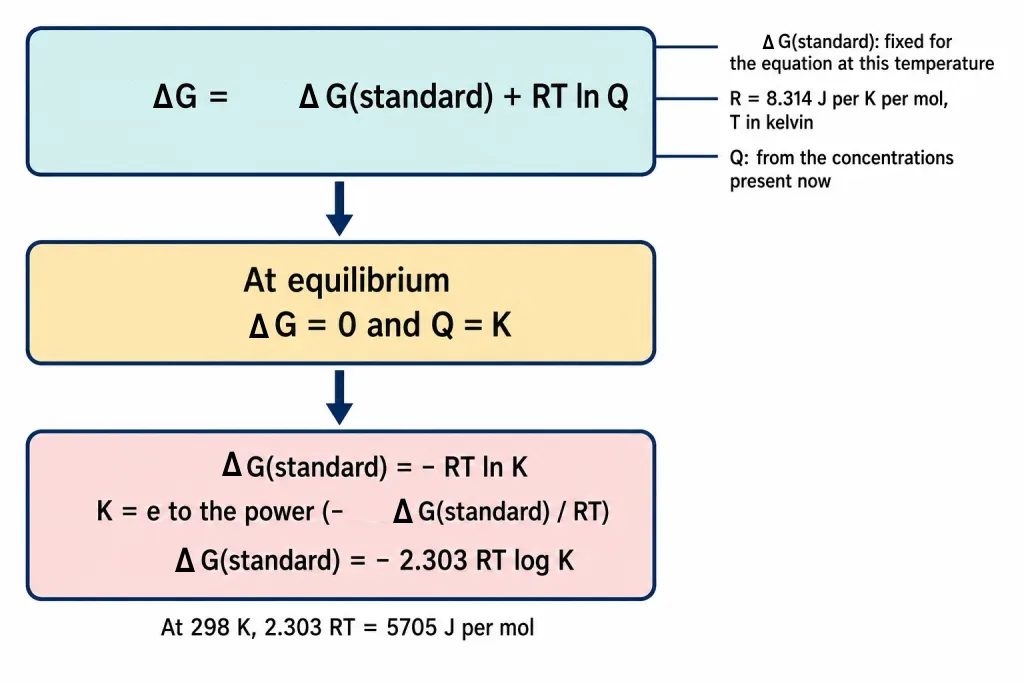
Taking antilogarithms gives the exponential form,
and converting the natural logarithm to base ten with gives the form most calculations actually use,
Three consequences follow immediately.
- is fixed by and , and by nothing else. The right-hand side contains no concentration and no pressure, which is the thermodynamic reason is independent of the initial amounts taken.
- changes with temperature. appears explicitly, and itself depends on temperature. This is the root of everything the next section says about heating an equilibrium.
- The relation is exponential. sits inside an exponent, so a small change in produces an enormous change in . A few kilojoules per mole move the equilibrium constant by orders of magnitude.
A catalyst changes neither nor , so it cannot change . That statement, usually justified by rate arguments, drops straight out of this equation. [JEE/NEET]
Reading the Sign of the Standard Gibbs Energy
Because and is always positive, the sign of alone decides which side of the equilibrium constant falls on.
| Equilibrium mixture | |||
|---|---|---|---|
| Negative | Positive | Products predominate; the forward reaction proceeds to a large extent | |
| Zero | Zero | Neither side is favoured; comparable amounts of both | |
| Positive | Negative | Reactants predominate; only a small quantity of product forms |
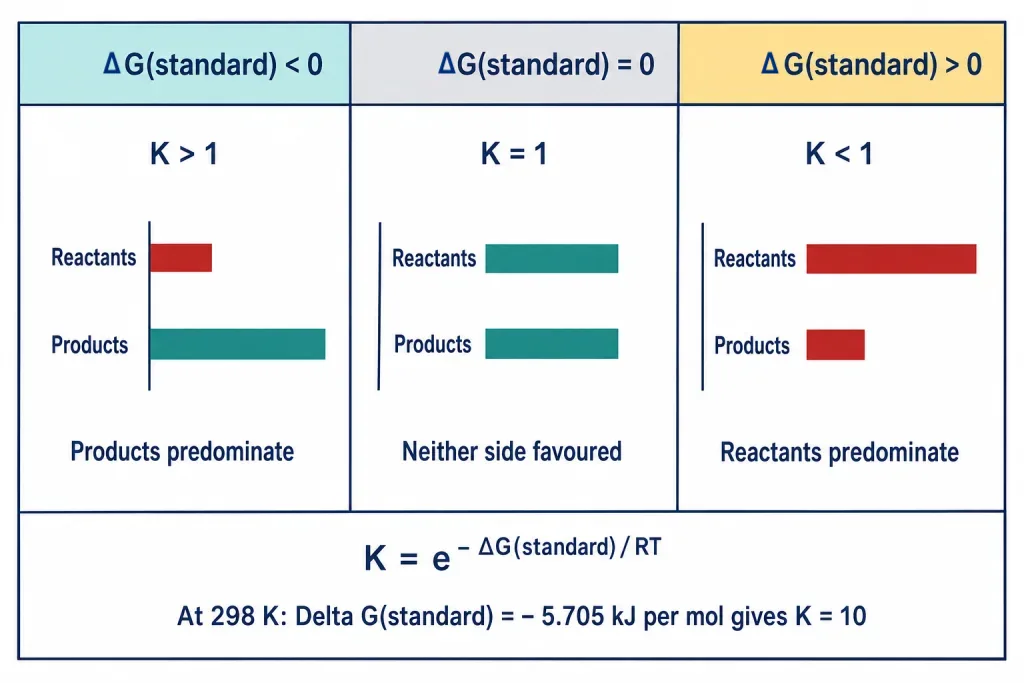
The exponential makes the scale steep. At the numbers work out as follows.
| at | ||
|---|---|---|
Under — less than the energy of a single weak hydrogen bond — swings by a factor of ten. Around swings it by a million.
One warning about language. A positive is often described as making the reaction non-spontaneous, and the description is fair only if it is understood correctly: it means , so the forward reaction proceeds to a small extent and stalls with reactants predominating. It does not mean that nothing at all happens. Starting from pure reactants, , and is hugely negative, so is negative and product does form. The reaction simply runs out of drive early.
Key Point: means a small , not a forbidden reaction. Every reaction with a finite produces some product before it reaches equilibrium.
The Distinction That Costs Marks
and differ by one superscript and by everything else.
| Belongs to | the balanced equation | the mixture at this instant |
| Composition assumed | every species at standard state | whatever is actually present |
| Value during a reaction | fixed, does not move | varies continuously |
| Value at equilibrium | unchanged, generally not zero | exactly zero |
| Decides spontaneity now | no | yes |
| Source | tables, or | calculated from and |
The row that matters most is the one headed Value at equilibrium. is not zero at equilibrium. It keeps whatever value it had before the reaction started, because it refers to a fixed hypothetical composition, not to the vessel. The quantity that goes to zero at equilibrium is .
Eliminating between the two equations makes the connection to the previous section exact. Substituting into ,
Key Point: . The direction of a reaction depends only on how compares with , and the Gibbs energy statement and the -against- statement are the same statement written twice.
| Composition | Net change | |||
|---|---|---|---|---|
| Too much reactant | Negative | Negative | Forward | |
| Equilibrium | None | |||
| Too much product | Positive | Positive | Reverse |
A reaction with a strongly positive can still have a negative at a given moment, provided is small enough. A reaction with a strongly negative can have a positive if the vessel has been loaded with product. Deciding direction from the sign of alone is wrong whenever the mixture is not near standard conditions. [JEE Main]
Handling the Numbers
Most errors in this section are arithmetic, and nearly all of them come from three places.
Units. , so comes out in and so does . Tabulated values of are quoted in . Multiply a tabulated value by before dividing by , and divide a calculated value by before reporting it. A missing factor of a thousand is the single commonest mistake here, and it is easy to spot: it gives a absurdly close to .
The two constants at . These are worth memorising.
With the second one, the whole calculation at collapses to a single division.
Neither shortcut survives a change of temperature. At , ; at it is . Recompute rather than reuse.
Logarithms. Use with and with . Mixing them scales the answer by in one direction or the other, which is why an answer that is times too large or too small almost always means the wrong logarithm was taken. The bridge is .
Two sign checks close the loop, and both take a second.
- A negative must give ; a positive must give .
- A greater than must give a negative ; a less than must give a positive one.
and go into the logarithm as pure numbers. At this level, whatever numerical value of or is quoted in the question is the number that goes in.
Choosing the Form to Use
Four forms of one relation cover every question in this section. The data given decides which one to reach for.
| Given | Asked | Form to use |
|---|---|---|
| and | , then | |
| and | ||
| in at | , quickly | |
| , and a composition | and the direction | |
| and a composition | the direction only | , or compare with |
Order of work in a numerical question. Write the balanced equation first, because both and belong to a particular equation with particular coefficients, and a halved or doubled equation carries a different pair of values. Decide next whether the question concerns the standard state or the vessel, since that choice alone selects between and . Fix the units before touching the calculator. Then compute, and finish with the sign check.
Reporting conventions are worth following. Quote in with its sign written explicitly, and quote as a pure number in scientific notation. A written with a sign, or a written without one, loses marks that the arithmetic had already earned. [Board]
Question 1: Standard Gibbs energy to equilibrium constant
The value of for the phosphorylation of glucose in glycolysis is . Find the value of at .
Answer:
First I convert the standard Gibbs energy change into joules, because is in joules.
Now I use , rearranged for .
Taking the antilogarithm,
The sign check works: is positive, so must come out below , and it does.
Ans: at Watch out: Using instead of gives and , a value suspiciously close to . That is the signature of a forgotten kilo.
Question 2: Equilibrium constant to standard Gibbs energy
Hydrolysis of sucrose gives , with at . Calculate at .
Answer:
I use the same relation, this time in the forward direction.
I need the natural logarithm of .
Substituting,
Ans: Watch out: is far above , so must be negative. Dropping the leading minus sign is the most frequent error in this direction, and the sign check catches it at once.
Question 3: The log-ten route at 298 K
A reaction has at . Find .
Answer:
At the constant , so I use the base-ten form.
Taking the antilogarithm,
Ans: (about ) Watch out: Dividing by instead of gives and a of about . That is the natural logarithm being treated as a common logarithm — a factor of in the exponent, which is a huge error in .
Question 4: Working back from a small K
The equilibrium constant for a reaction is at . Calculate .
Answer:
is exactly here, so the base-ten form is the quick route.
Converting,
is below , so a positive is what I expect.
Ans:
Question 5: A temperature that is not 298 K
For a gas-phase reaction, at . Calculate at this temperature.
Answer:
The shortcut constant belongs to only, so I rebuild it for .
Now,
Ans: at Watch out: Reusing at gives . The shortcut constant is temperature-specific; only and are fixed.
Question 6: The drive at a non-equilibrium instant
For , at . A vessel contains at , at and at . Find and state the direction of net change.
Answer:
First I build the reaction quotient in partial pressures, with the coefficients as powers.
Next the correction term.
Adding it to the standard value,
is negative, so the mixture moves forward and makes more ammonia.
Ans: ; net reaction goes forward Watch out: Cubing the hydrogen pressure is not optional. Using instead of gives , then — right sign, wrong number.
Question 7: Positive standard value, forward-running mixture
For , at . A mixture has . Find , find , and say which way the mixture moves.
Answer:
First the equilibrium constant.
Now the drive at this composition.
is negative, so the forward reaction runs. The same conclusion comes from being smaller than .
Ans: , , net change forward Watch out: A positive does not forbid the forward reaction. It fixes below , and any mixture with below that still moves forward until climbs to .
Question 8: Scaling the equation
Given at for , find for this equation and then and for .
Answer:
For the equation as written,
Halving every coefficient halves the amount of reaction the equation describes, so is halved.
Halving halves , which takes the square root of .
And , which confirms it.
Ans: ; for the halved equation and Watch out: scales linearly with the equation while scales as a power. Halving the equation halves but square-roots — the two never change in the same way.
Question 9: Reversing the equation
For the sucrose hydrolysis of Question 2, and at . Write and for the reverse reaction.
Answer:
Reversing an equation swaps products and reactants, so the equilibrium constant is inverted.
Inverting changes the sign of , and so changes the sign of .
I can check it directly: .
Ans: and for the reverse reaction
Question 10: When the standard value is zero
A reaction has at some temperature . State , and state whether a vessel containing all species at is at equilibrium.
Answer:
Putting into gives , so
at every temperature for which is zero.
For the vessel, every species is at , so whatever the stoichiometry. Since , the mixture is at equilibrium, and confirms it.
Ans: , and the mixture at throughout is at equilibrium Watch out: This is the one case where a standard-state mixture happens to be an equilibrium mixture. For any other the standard mixture has and will react.
What Goes Wrong
- Treating as zero at equilibrium. is zero at equilibrium. keeps its tabulated value throughout.
- Deciding direction from . Only , which contains the term, reports the direction of net change from the composition actually present.
- Forgetting the factor of . is tabulated in and is in . A that lands near for a large is this error.
- Mixing and . and are the same quantity; using with , or with , is out by a factor of .
- Reusing at another temperature. That number is at alone.
- Losing a minus sign. Two minus signs live in ; the sign check comparing with costs nothing.
- Calling a positive a reaction that cannot happen. It means and a small yield, not zero yield.
- Assuming a large means a fast reaction. fixes the destination, never the time taken to arrive.
- Scaling and the same way. Doubling the equation doubles and squares .
- Using a temperature in degrees Celsius. in is always in kelvin.
Key Point: describes the drive from wherever the mixture happens to be. Setting and turns it into , which converts a tabulated energy into an equilibrium constant and back. At , .